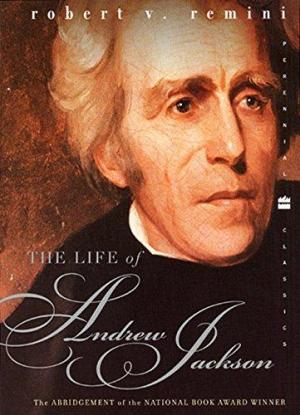
Quick Review: THE LIFE OF ANDREW JACKSON by Robert V. Remini (Harper)

ReminiRV-LifeOfAndrewJacksonUSA very useful, infuriating single-volume biography of the seventh president
Robert V. Remini’s prize-winning, three-volume biography Life of Andrew Jackson won the National Book Award on its completion in 1984 and is recognized as one of the greatest lives of a U.S. President. In this meticulously crafted single-volume abridgment, Remini captures the essence of the life and career of the seventh president of the United States. As president, from 1829-1837, Jackson was a significant force in the nations’s expansion, the growth of presidential power, and the transition from republicanism to democracy.

Jackson is a highly controversial figure who is undergoing historical reconsideration today. He is known as spurring the emergence of the modern American political division of Republican and Democractic parties, for the infamous Indian removal on the Trail of Tears, and for his brave victory against the British as Major General at the Battle of New Orleans.

Never an apologist, Remini portrays Jackson as a foreceful, sometimes tragic, hero — a man whose strength and flaws were larger than life, a president whose conviction provided the nation with one of the most influential, colorful, and controversial administrations in our history.

Robert V. Remini is considered one of the preeminent scholars of Andrew Jackson and his times. His three-volume biography of Jackson won the National Book Award and many think of it as one of the best, substantial biographies of any president. In The Life of Andrew Jackson, he has written a comprehensive, (relatively) briskly paced biography. However, the book suffers from one major flaw that coloured almost everything Remini included within. Continue reading

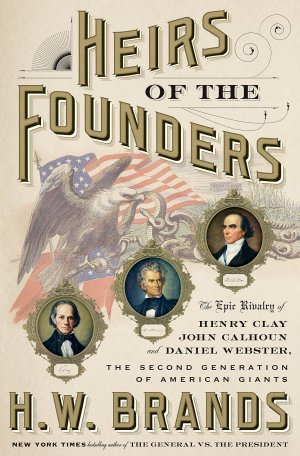
Upcoming: HEIRS OF THE FOUNDERS by H.W. Brands (Doubleday)

BrandsHW-HeirsToTheFoundersUSIn H.W. Brands‘s latest book, the acclaimed historian turns his attention to the three men whose political careers had lasting impact on the United States after the Founding generation had left the stage: Henry Clay, John Calhoun and Daniel Webster. (Sort of — they were all active during some of the founding administrations, but they outlasted them all.) As contemporary politics devolves into horrifying farce, there has rarely been a better time in which to revisit the early years of American politics: messy, contentious, often violent, and yet fascinating. Heirs to the Founders is due to be published by Doubleday in November 2018 (in North America and in the UK). Here’s the official synopsis:
The riveting story of how America’s second generation of political giants — Henry Clay, Daniel Webster, and John Calhoun — battled to complete the unfinished work of the Founding Fathers and decide the shape of our democracy.

In the early days of the nineteenth century, three young men strode onto the national stage, elected to Congress at a moment when the Founding Fathers were beginning to retire to their farms. Daniel Webster of Massachusetts, a champion orator known for his eloquence, spoke for the North and its business class. Henry Clay of Kentucky, as dashing as he was ambitious, embodied the hopes of the rising West. South Carolina’s John Calhoun, with piercing eyes and an even more piercing intellect, defended the South and slavery.

Together this second generation of American founders took the country to war, battled one another for the presidency, and tasked themselves with finishing the work the Founders had left undone. Above all, they sought to remedy the two glaring flaws in the Constitution: its fudge on where authority ultimately rested, with the states or the nation; and its unwillingness to address the essential incompatibility of republicanism and slavery. They wrestled with these issues for four decades, arguing bitterly and hammering out political compromises that held the union together, but only just. Then, in 1850, when California moved to join the union as a free state, “the three great men of America” had one last chance to save the country from the real risk of civil war. But by then they were never further apart.

Follow the Author: Website, Goodreads, Twitter

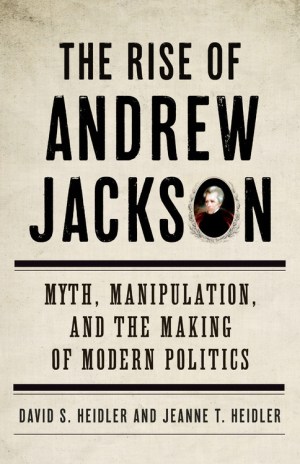
Upcoming: THE RISE OF ANDREW JACKSON by David S. Heidler & Jeanne T. Heidler (Basic Books)

Heidler-RiseOfAndrewJacksonUSIn October, Basic Books are due to publish the new book by David S. and Jeanne T. HeidlerThe Rise of Andrew Jackson. I have mixed feelings about Andrew Jackson — he was a towering, important figure during one of my favourite periods of American history, whose election helped to fundamentally alter the way presidential elections are conducted.

Generally, though, I have found it to be the case that if you’ve read one book about Jackson, you’ve read them all. Many of his papers were lost in a fire at the Hermitage, and he was by no means as prolific as many of his peers and other presidents. I am not Jackson’s biggest fan. However, the Heidlers’ new book caught my attention because of its focus on the propagandists and journalists who helped Jackson polish his image, to scrub his decidedly unattractive personal history and general manner.

The story of Andrew Jackson’s improbable ascent to the White House, centered on the handlers and propagandists who made it possible

Andrew Jackson was volatile and prone to violence, and well into his forties his sole claim on the public’s affections derived from his victory in a thirty-minute battle at New Orleans in early 1815. Yet those in his immediate circle believed he was a great man who should be president of the United States.

Jackson’s election in 1828 is usually viewed as a result of the expansion of democracy. Historians David and Jeanne Heidler argue that he actually owed his victory to his closest supporters, who wrote hagiographies of him, founded newspapers to savage his enemies, and built a political network that was always on message. In transforming a difficult man into a paragon of republican virtue, the Jacksonites exploded the old order and created a mode of electioneering that has been mimicked ever since.

I’m really looking forward to reading The Rise of Andrew Jackson. The book is published by Basic Books in late October 2018, and will be available in the UK. The Heidlers are also the authors of Henry Clay: The Essential American, among others.

Follow the Authors: Website

Upcoming: THESE TRUTHS by Jill Lepore (W.W. Norton)

LeporeJ-TheseTruthsUSHCJill Lepore is one of my favourite historians. Ever since discovering her work in the New Yorker, I have eagerly read anything of hers I could get my hands on (not always easy, when I lived in the UK). The Story of America (Princeton University Press) is one of my favourite non-fiction books, and a must for anyone interested in reading about the evolution of storytelling in, and the story of the United States. Lepore is also the author of the excellent The Secret History of Wonder Woman, Joe Gould’s Teeth and New York Burning (among others).
This year, W. W. Norton is due to publish Lepore’s latest book: a substantial, single-volume history of the United States. Here’s the synopsis for These Truths:

In the most ambitious one-volume American history in decades, award-winning historian Jill Lepore offers a magisterial account of the origins and rise of a divided nation.

The American experiment rests on three ideas — “these truths,” Jefferson called them — political equality, natural rights, and the sovereignty of the people. And it rests, too, “on a dedication to inquiry, fearless and unflinching,” writes Jill Lepore in a groundbreaking investigation into the American past that places truth itself at the center of the nation’s history. In riveting prose, These Truthstells the story of America, beginning in 1492, to ask whether the course of events has proven the nation’s founding truths, or belied them. “A nation born in contradiction, liberty in a land of slavery, sovereignty in a land of conquest, will fight, forever, over the meaning of its history,” Lepore writes, finding meaning in those very contradictions as she weaves American history into a majestic tapestry of faith and hope, of peril and prosperity, of technological progress and moral anguish. A spellbinding chronicle filled with arresting sketches of Americans from John Winthrop and Frederick Douglass to Pauli Murray and Phyllis Schlafly, These Truths offers an authoritative new history of a great, and greatly troubled, nation.

I’m really looking forward to reading this. These Truths is published by W. W. Norton in September 2018 (in North America and the UK).

Follow the Author: Website, Goodreads

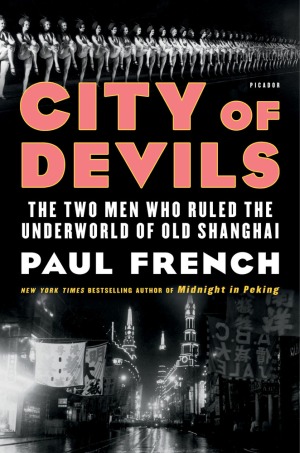
Upcoming: CITY OF DEVILS by Paul French (Picador/riverrun)

FrenchP-CityOfDevilsUSI’ve only recently started to read Paul French‘s books. I’ve been aware of his stuff for a long while, but this past Christmas I went on a Penguin China Special reading-binge, which meant I finally read two of French’s titles: Betrayal in ParisThe Badlands and Bloody Saturday — all three of which were excellent.* I promptly bought Midnight in Peking (for myself and family members), and will read it very soon. In the meantime, I thought I’d some information about his next non-fiction book, City of Devils. here’s the synopsis:

1930s Shanghai could give Chicago a run for its money. In the years before the Japanese invaded, the city was a haven for outlaws from all over the world: a place where pasts could be forgotten, fascism and communism outrun, names invented, fortunes made — and lost.

‘Lucky’ Jack Riley was the most notorious of those outlaws. An ex-Navy boxing champion, he escaped from prison in the States, spotted a craze for gambling and rose to become the Slot King of Shanghai. Ruler of the clubs in that day was ‘Dapper’ Joe Farren — a Jewish boy who fled Vienna’s ghetto with a dream of dance halls. His chorus lines rivalled Ziegfeld’s and his name was in lights above the city’s biggest casino.

In 1940 they bestrode the Shanghai Badlands like kings, while all around the Solitary Island was poverty, starvation and genocide. They thought they ruled Shanghai; but the city had other ideas. This is the story of their rise to power, their downfall, and the trail of destruction they left in their wake. Shanghai was their playground for a flickering few years, a city where for a fleeting moment even the wildest dreams seemed possible.

In the vein of true crime books whose real brilliance is the recreation of a time and place, this is an impeccably researched narrative non-fiction told with superb energy and brio, as if James Ellroy had stumbled into a Shanghai cathouse.

City of Devils is due to be published in July by Picador in North America (Raincoast in Canada), and in June by riverrun in the UK.

Follow the Author: Website, Goodreads, Twitter


* The Penguin Specials series is fantastic in general: around 100 pages or so, compact and focused non-fiction narratives. I’d highly recommend them. They appear to be focusing on a different theme every year (or so). Last year, for example, they released a handful of Hong Kong Specials, which I’ll be buying and reading very soon.

Upcoming: THE MIDNIGHT FRONT by David Mack (Tor)

MackD-DA1-MidnightFrontUSThis is the first novel in David Mack’s Dark Arts series, and I’m really looking forward to giving it a try. I think I’ve only read one other (urban) fantasy set during one of the World Wars — Andy Remic’s very good A Song For No Man’s Land — and I’m certainly interested in trying more. (Feel free to leave recommendations in the comments.) Here’s the synopsis for The Midnight Front:
On the eve of World War Two, Nazi sorcerers come gunning for Cade but kill his family instead. His one path of vengeance is to become an apprentice of The Midnight Front — the Allies’ top-secret magickal warfare program — and become a sorcerer himself.

Unsure who will kill him first — his allies, his enemies, or the demons he has to use to wield magick — Cade fights his way through occupied Europe and enemy lines. But he learns too late the true price of revenge will be more terrible than just the loss of his soul — and there’s no task harder than doing good with a power born of ultimate evil.

The Midnight Front will be published by Tor Books in January 2018, and will be available in the UK.

Follow the Author: Website, Goodreads, Twitter

Guest Post: “A Few Words on Mark Twain’s Mysterious Stranger” by Oliver Langmead

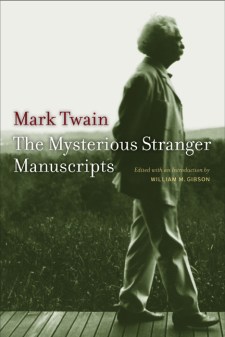
twainm-mysteriousstrangermanuscriptsIn an 1895 notebook, Samuel Clemens (who you might better know by his pen name: Mark Twain) wrote,
“It is the strangest thing, that the world is not full of books that scoff at the pitiful world, and the useless universe and the vile and contemptible human race – books that laugh at the whole paltry scheme and deride it…. Why don’t I write such a book?”

During the last years of his life, Twain tried to write that book. He never finished it. Instead, he left us with three quite different incomplete attempted manuscripts, now carefully put together in one volume by the University of California Press as part of their Mark Twain series. Continue reading

Quick Reviews: MYTHIC CREATURES and FANTASTICAL BEASTS… (Sterling)

Two great guides for history and fantasy fans (and writers)

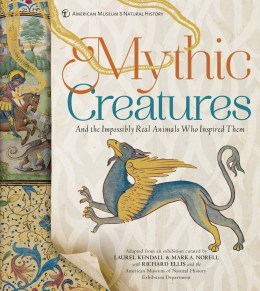
mythiccreaturesMYTHIC CREATURES: AND THE IMPOSSIBLY REAL ANIMALS WHO INSPIRED THEM by Laurel Kendall & Mark A. Norell, w. Richard Ellis
Adapted from the American Museum of Natural History exhibition Mythic Creatures: Dragons, Unicorns & Mermaids, this book explores an array of mythological creatures—and the real animals that inspired them. Lush photos showcase rare objects from around the world as well as models of mythical beasts like krakens and Rocs, along with fossils of actual extinct animals such as the six-foot-tall primate called Gigantopithecus and dinosaurs such as Protoceratops, which may have inspired the griffin. Also included are engravings, paintings, maps, and ephemera from the Middle Ages to modern times, all capturing the origins of legendary animals that continue to thrill, terrify, and enchant us.

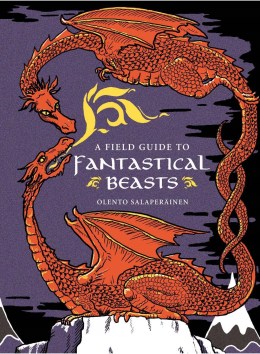
salaperaineno-fieldguidetofantasticalbeastsA FIELD GUIDE TO FANTASTICAL BEASTS by Olento Salaperäinen

A beautiful, illustrated guide to the most magical creatures of legend and myth.

Fairies, demons, four-legged fiends, and, of course, zombies: the world is filled with fantastical beings, beautiful and scary. Come meet them in this magnificently illustrated menagerie, which includes many creatures made famous by popular fantasy and sci-fi film franchises. Take a detailed look at everything from goblins, pixies, and gnomes to vampires and dragons, and discover their origins in literature, folklore, and ancient history.

Both of these books are pretty great. Fascinating looks at the fantastical and mythical creatures that have come to populate so much of our fiction, many of which have remained unchanged (or only slightly altered) for hundreds or thousands of years. Continue reading

Q&A with CATHERINE BAILEY

BaileyCatherine-AuthorPicCatherine Bailey is the author of The Secret Rooms and Black Diamonds — both histories of the British aristocracy. She read history at Oxford University and is an award-winning television producer and director, making a range of critically acclaimed documentary films inspired by her interest in twentieth century history. Bailey’s US publisher, Penguin, organised this Q&A…

In THE SECRET ROOMS, you explain what drew you to the story of the Rutland family, that you were researching a book on World War I and asked to see the Rutland archives and when there were obvious gaps in the records you decided to devote your attention on uncovering what the family was trying to hide. What brought you to write about Wentworth House and the Fitzwilliam family, and how did you discover that they also had secrets they were trying to keep buried?

I first saw Wentworth House in the late 1990s when I was researching a documentary film in Yorkshire. The size of the house – the largest in Europe – was breathtaking. Here, it seemed, was England’s forgotten palace. Unlike comparable houses, such as Chatsworth or Blenheim, it was closed to the public. Outside its locality, few knew of its existence. Seeing it for the first time, it looked empty and abandoned. The shutters were drawn; its 18th century façade was black with grime and in a poor state of repair. The image was haunting: I wanted to know what had happened there over the centuries, and what had led to its abandonment.

Over the next few years, whenever I could find the time from my work as a television producer, I researched the twentieth century story of Wentworth House. From architectural journals and newspaper articles, I was able to piece together a narrative. In 1900, the house had belonged to William, the 6th Earl Fitzwilliam, the richest man in Britain. His fortune came from coal. Within a 30-mile radius of Wentworth, tens of thousands of men worked in mines in which he had an interest. The Fitzwilliams had powerful connections; in the first decades of the 20th century, the newspapers listed the names of guests at their lavish house parties. They included Kings and Queens, Prime Ministers and politicians, famous musicians, writers and artists. Later, there was a connection to the American Kennedy family. In 1948, Peter, the 8th Earl Fitzwilliam, had been killed in a plane crash with Kathleen Kennedy, the sister of the President. But the details were tantalizingly sketchy; very little appeared to have been written about Wentworth or the Fitzwilliam family. Particularly intriguing, was a photograph, taken in the 1940s, which showed the landscape around the house blighted by open cast mining. Soon after, the Fitzwilliams had moved out. Continue reading