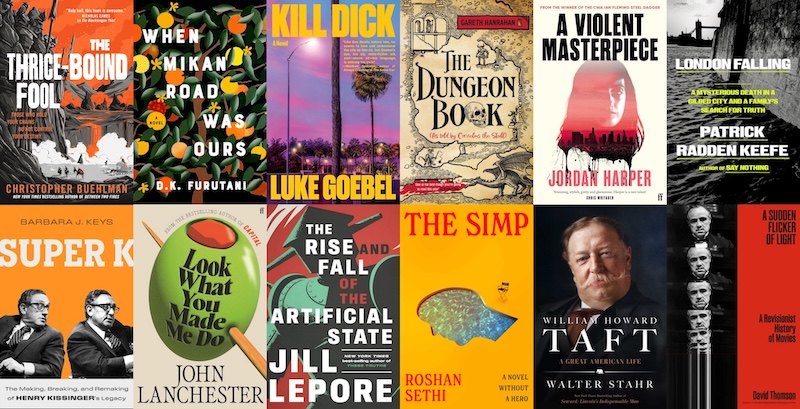
A nice mix of non-fiction and fiction.
Featuring: Christopher Buehlman, D.K. Furutani, Luke Goebel, Gareth Hanrahan, Jordan Harper, Patrick Radden Keefe, Barbara J. Keys, John Lanchester, Jill Lepore, Roshan Sethi, Walter Stahr, David Thomson
A nice mix of non-fiction and fiction.
Featuring: Christopher Buehlman, D.K. Furutani, Luke Goebel, Gareth Hanrahan, Jordan Harper, Patrick Radden Keefe, Barbara J. Keys, John Lanchester, Jill Lepore, Roshan Sethi, Walter Stahr, David Thomson
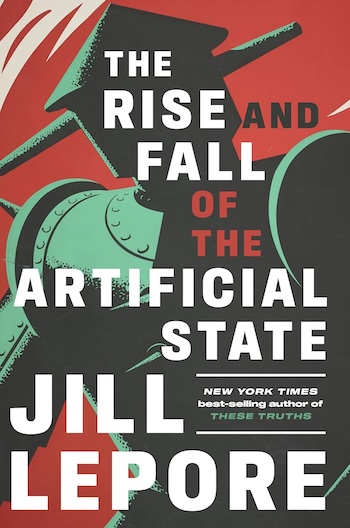 If you’ve been reading CR for any length of time, you’re probably familiar with the fact that I am a huge fan of Jill Lepore’s work. Whether a full-length book, or one of her frequent articles in the New Yorker, Lepore is a must-read for me. So, I frequently check to see if the author has a new book in the works, and was very happy to learn that she does: The Rise and Fall of the Artificial State is due to be published later this year (August), and I can’t wait. Technology and its place in American society and culture has long been an area of interest of the author’s (and mine, but I can’t write about it nearly as well), and I have very high hopes for this new book. Here’s the synopsis:
“The Artificial State is the factory farming of humans, the sorting and segmenting, the isolation and alienation, as if humans were becoming to machines what animals had become to humans.” — Jill Lepore
“Much in history is headlong but few grand transformations have been more precipitate or more heedless than the rise of… the Artificial State,” writes Jill Lepore in this passionate account of how rule by machine has ravaged the world. Inspired by Hannah Arendt’s The Origins of Totalitarianism, which argued in 1951 that the machinery of modern life was reshaping the very fundamentals of human existence, Lepore, profoundly disturbed by the technology revolution and by the soulless inundation of artificial intelligence, unfurls a new history for our own twenty-first century.
Building on an essay in The New Yorker in 2024, Lepore’s clarion call traces our increasing dependence on and strangulation by data. Political campaigns, awash in an avalanche of fake bots, have been reduced to attention-mining algorithms, while multinational media corporations dictate public discourse, and the era of the liberal nation-state seems to be coming to a rapid end, replaced by billionaire technocrats reliant on autocracy and the tools of AI.
 With Orwellian overtones, The Rise and Fall of the Artificial State demonstrates how technology has corroded global democracy, leading to the destruction of both human community and capacity for self-government, creating a new form of AI government, a digital citizen’s assembly, where AI will recommend the course of action to humans in place of human-run legislatures. Especially sobering with this proliferation of “dizzying, ever-changing schemes, prophesies, and predictions” is that the Artificial State has come at the expense of the natural world, leading to catastrophic loss of wildlife habitat and biodiversity.
Deliberately alarming, The Rise and Fall of the Artificial State, despite its abundance of dire facts, is not a funeral dirge; rather, it’s an inspiring wake-up call, written in Lepore’s typically elegiac prose, which demonstrates that nothing about the Artificial State was inevitable, for it is a “government without consent, even government without humans.” It can, Lepore asserts, be dismantled. Other heinous systems, like feudalism, fascism, and slavery, have also been dismantled, but disassembly requires identifying the parts, tracing the sources. It requires telling a new history. This is the purpose of The Rise and Fall of the Artificial State.
As an aside, one of the author’s observations about technology has stuck with me, ever since I read it in one of the pieces included in The Deadline, a fantastic collection of the author’s articles: “Disruption is innovation without progress.”
Jill Lepore’s The Rise and Fall of the Artificial State is due to be published by Liveright in North America and Allen Lane in the UK, on August 25th.
Follow the Author: Goodreads
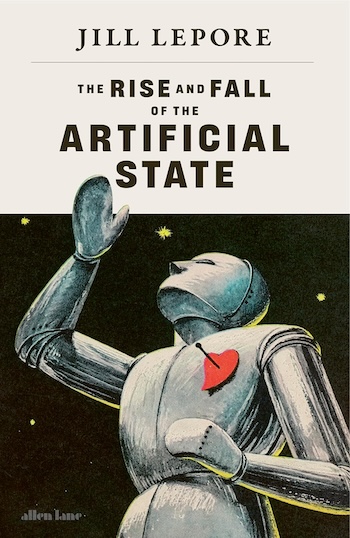
[This post has been updated, April 25th: New North American and UK covers added.]
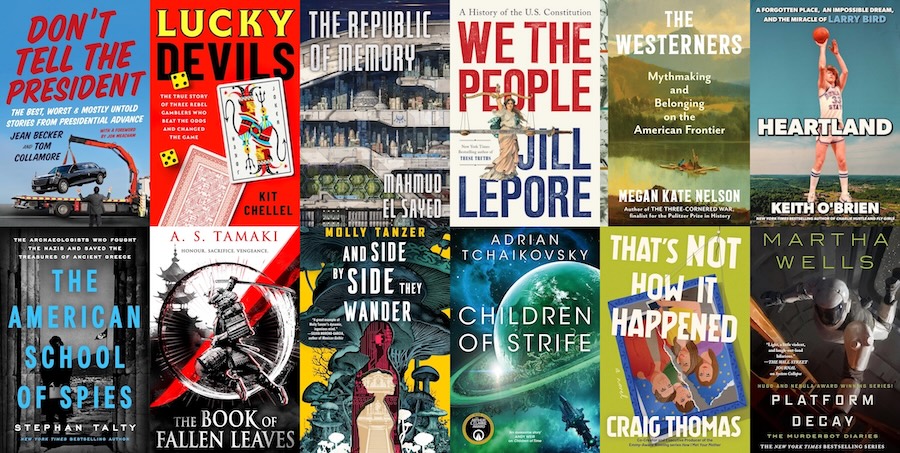
Featuring: Jean Becker & Tom Collamore, Kit Chellel, Mahmud el Sayed, Jill Lepore, Megan Kate Nelson, Keith O’Brien, Stephan Talty, Molly Tanzer, Adrian Tchaikovsky, Craig Thomas, Martha Wells
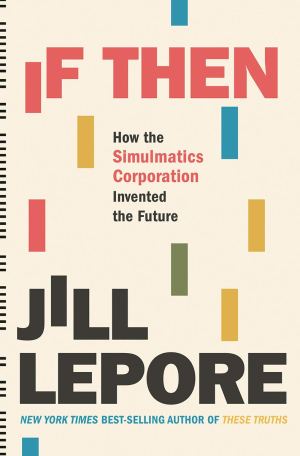 A new Jill Lepore book is always something to celebrate! And this latest looks quite different from the author’s previous histories. In the past, Lepore has covered topics such as the storytelling tradition in America (The Story of America), The Secret History of Wonder Woman, and has also tackled the Herculean task of writing a single-volume history of the United States (These Truths). If Then is a history of a data company established during the Cold War and how its influence can still be felt today. Here’s the synopsis:
A brilliant, revelatory account of the Cold War origins of the data-mad, algorithmic twenty-first century, from the author of the acclaimed international bestseller These Truths.
The Simulmatics Corporation, founded in 1959, mined data, targeted voters, accelerated news, manipulated consumers, destabilized politics, and disordered knowledge — decades before Facebook, Google, Amazon, and Cambridge Analytica. Silicon Valley likes to imagine that it has no past, but the scientists of Simulmatics are the long-dead grandfathers of Mark Zuckerberg and Elon Musk. Borrowing from psychological warfare, they used computers to predict and direct human behavior, deploying their “People Machine” from New York, Cambridge, and Saigon for clients that included John Kennedy’s presidential campaign, the New York Times, Young & Rubicam, and, during the Vietnam War, the Department of Defense.
Jill Lepore, distinguished Harvard historian and New Yorker staff writer, unearthed from archives the almost unbelievable story of this long-vanished corporation, and of the women hidden behind it. In the 1950s and 1960s, Lepore argues, Simulmatics invented the future by building the machine in which the world now finds itself trapped and tormented, algorithm by algorithm.
I’m really looking forward to reading this. I would also highly recommend The Story of America and The Secret History of Wonder Woman. If you are looking for a single-volume history of the United States, then These Truths is certainly one to consider (I’ve typically found that genre rather unwieldy, but Lepore’s book is excellent).
If Then is due to be published by Liveright in North America and in the UK, on September 15th, 2020.
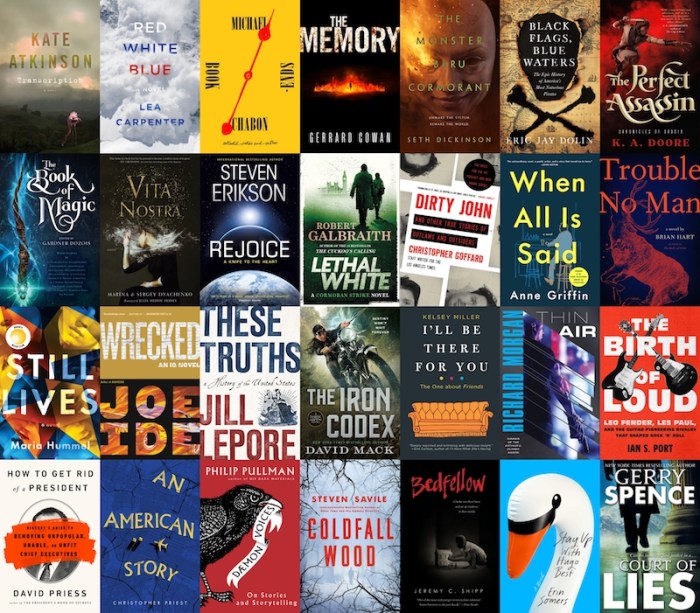
Featuring: Kate Atkinson, Lea Carpenter, Michael Chabon, Gerrard Cowan, Seth Dickinson, Eric Jay Dolin, K. A. Doore, Gardner Dozois, Sergiy Dyachenko, Maryna Shyrshova-Dyachenko, Robert Galbraith, Christopher Goffard, Anne Griffin, Brian Hart, Maria Hummel, Joe Ide, Jill Lepore, David Mack, Peter McLean, Kelsey Miller, Richard Morgan, Ian S. Port, David Priess, Christopher Priest, Philip Pullman, Steven Savile, Jeremy C. Shipp, Erin Somers, Gerry Spence
 Jill Lepore is one of my favourite historians. Ever since discovering her work in the New Yorker, I have eagerly read anything of hers I could get my hands on (not always easy, when I lived in the UK). The Story of America (Princeton University Press) is one of my favourite non-fiction books, and a must for anyone interested in reading about the evolution of storytelling in, and the story of the United States. Lepore is also the author of the excellent The Secret History of Wonder Woman, Joe Gould’s Teeth and New York Burning (among others).
This year, W. W. Norton is due to publish Lepore’s latest book: a substantial, single-volume history of the United States. Here’s the synopsis for These Truths:
In the most ambitious one-volume American history in decades, award-winning historian Jill Lepore offers a magisterial account of the origins and rise of a divided nation.
The American experiment rests on three ideas — “these truths,” Jefferson called them — political equality, natural rights, and the sovereignty of the people. And it rests, too, “on a dedication to inquiry, fearless and unflinching,” writes Jill Lepore in a groundbreaking investigation into the American past that places truth itself at the center of the nation’s history. In riveting prose, These Truthstells the story of America, beginning in 1492, to ask whether the course of events has proven the nation’s founding truths, or belied them. “A nation born in contradiction, liberty in a land of slavery, sovereignty in a land of conquest, will fight, forever, over the meaning of its history,” Lepore writes, finding meaning in those very contradictions as she weaves American history into a majestic tapestry of faith and hope, of peril and prosperity, of technological progress and moral anguish. A spellbinding chronicle filled with arresting sketches of Americans from John Winthrop and Frederick Douglass to Pauli Murray and Phyllis Schlafly, These Truths offers an authoritative new history of a great, and greatly troubled, nation.
I’m really looking forward to reading this. These Truths is published by W. W. Norton in September 2018 (in North America and the UK).
A post-Christmas and New Year smorgasbord of awesome has come flooding in, these past couple of weeks. On top of that, there have been some I’ve bought myself (I got a lot of wonderful book vouchers and Amazon credit, this year…).
Featuring: Tim Akers, Robert Jackson Bennett, Rob Boffard, Terry Brooks, Lindsey Davis, Liz de Jager, Christopher Farnsworth, Matt Gallagher, Carol Goodman, Thomas Christopher Greene, Louisa Hall, Glen Erik Hamilton, Joanne Harris, Kristopher Jansma, Richard Kadrey, Mike Lawson, Tim Lebbon, Patrick Lee, Jill Lepore, Sean McFate & Bret Witter, China Miéville, Megan Miranda, Simon Morden, Anthony O’Neill, Adam O’Fallon Price, Camille Perri, Heidi Pitlor, Matthew Quirk, Richard Russo, Lawrence M. Schoen, A.F.E. Smith, Christopher Sorrentino, Gav Thorpe, Lavie Tidhar, Glen Weldon, Jonathan Wood Continue reading
'just a nobody with a blog'
library lovin', backlist browsin', SFF reader...
Another Book Off The To Be Read Pile
Mostly book reviews, and sometimes other stuff
Book Reviews, News, and Other Stuff
My Irrational Life
The writings, reviews and ramblings of Paul Starkey...
by Marianne de Pierres
News, data and insight about the powerful forces that shape the world.
Books! Where are the great books?
that doesn't fall apart two days later
A topnotch WordPress.com site
Random musings from an extreme bibliophile.
And for summer days
On the Writing of Epic Fantasy - The Archives
Welcome to Gav Thorpe's Weblog
Speculative fiction
Don't worry. None of this blood is mine.

