Thanks to the runaway success of Colson Whitehead‘s Pulitzer Prize, National Book Award and Arthur C. Clarke Award-winning novel The Underground Railroad, his previous books The Intuitionist, Colossus of New York and Apex Hides the Hurt are getting new UK editions, published by Fleet.
 Let’s take them in publication order. First up is The Intuitionist, which is out now:
Verticality, architectural and social, is at the heart of Colson Whitehead’s first novel that takes place in an unnamed high-rise city that combines twenty-first-century engineering feats with nineteenth-century pork-barrel politics. Elevators are the technological expression of the vertical ideal, and Lila Mae Watson, the city’s first black female elevator inspector, is its embattled token of upward mobility.When Number Eleven of the newly completed Fanny Briggs Memorial Building goes into deadly free-fall just hours after Lila Mae has signed off on it, using the controversial “Intuitionist” method of ascertaining elevator safety, both Intuitionists and Empiricists recognize the set-up, but may be willing to let Lila Mae take the fall in an election year.
As Lila Mae strives to exonerate herself in this urgent adventure full of government spies, underworld hit men, and seductive double agents, behind the action, always, is the Idea. Lila Mae’s quest is mysteriously entwined with existence of heretofore lost writings by James Fulton, father of Intuitionism, a giant of vertical thought. If she is able to find and reveal his plan for the perfect, next-generation elevator, the city as it now exists may instantly become obsolescent.
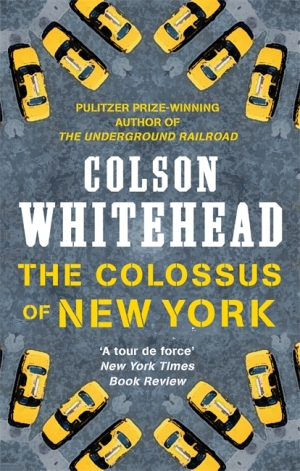 Next up we have The Colossus of New York, which was published yesterday. Here’s the synopsis:
Here is a literary love song that will entrance anyone who has lived in — or spent time — in the greatest of American cities.
A masterful evocation of the city that never sleeps, The Colossus of New York captures the city’s inner and outer landscapes in a series of vignettes, meditations, and personal memories. Colson Whitehead conveys with almost uncanny immediacy the feelings and thoughts of longtime residents and of newcomers who dream of making it their home; of those who have conquered its challenges; and of those who struggle against its cruelties.
Whitehead’s style is as multilayered and multifarious as New York itself: Switching from third person, to first person, to second person, he weaves individual voices into a jazzy musical composition that perfectly reflects the way we experience the city. There is a funny, knowing riff on what it feels like to arrive in New York for the first time; a lyrical meditation on how the city is transformed by an unexpected rain shower; and a wry look at the ferocious battle that is commuting. The plaintive notes of the lonely and dispossessed resound in one passage, while another captures those magical moments when the city seems to be talking directly to you, inviting you to become one with its rhythms.
The Colossus of New York is a remarkable portrait of life in the big city. Ambitious in scope, gemlike in its details, it is at once an unparalleled tribute to New York and the ideal introduction to one of the most exciting writers working today.
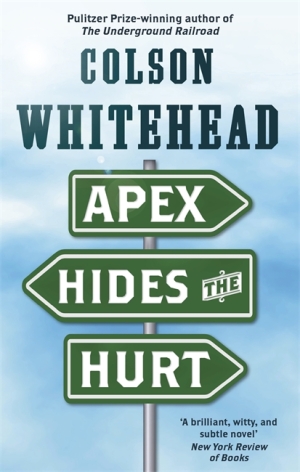 And finally, due out at the beginning of next month, the novel Apex Hides the Hurt:
A brisk, comic tour de force about identity, history, and the adhesive bandage industry.
The town of Winthrop has decided it needs a new name. The resident software millionaire wants to call it New Prospera; the mayor wants to return to the original choice of the founding black settlers; and the town’s aristocracy sees no reason to change the name at all. What they need, they realize, is a nomenclature consultant.
And, it turns out, the consultant needs them. But in a culture overwhelmed by marketing, the name is everything and our hero’s efforts may result in not just a new name for the town but a new and subtler truth about it as well.
Follow the Author: Website, Goodreads, Twitter
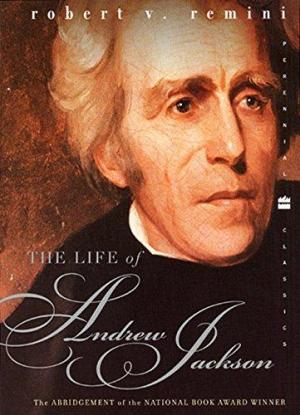 A very useful, infuriating single-volume biography of the seventh president
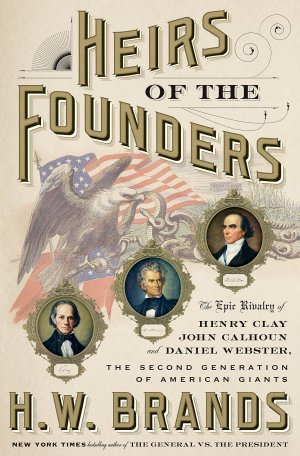 In H.W. Brands‘s latest book, the acclaimed historian turns his attention to the three men whose political careers had lasting impact on the United States after the Founding generation had left the stage: Henry Clay, John Calhoun and Daniel Webster. (Sort of — they were all active during some of the founding administrations, but they outlasted them all.) As contemporary politics devolves into horrifying farce, there has rarely been a better time in which to revisit the early years of American politics: messy, contentious, often violent, and yet fascinating. Heirs to the Founders is due to be published by
  I hadn’t heard of Peter Laws‘s new book before the publicist reached out to me. It is the story of a minister’s investigation into our fascination with the macabre, scary and horrific. I thought it sounded quite interesting, and so today
  In October,
  Jill Lepore is one of my favourite historians. Ever since discovering her work in the
  I’ve only recently started to read Paul French‘s books. I’ve been aware of his stuff for a long while, but this past Christmas I went on a Penguin China Special reading-binge, which meant I finally read two of French’s titles:
  Piu Eatwell’s latest book is a narrative history of the notorious Black Dahlia murder in Los Angeles. The inspiration for a number of novels and movies, it’s an interesting new account of the murder that gripped the headlines. Here’s the synopsis:
 An entertaining romp through a comedian’s history of heavy metal
 An interesting, if not-particularly-revelatory memoir from the Boss
 Civilian Reader