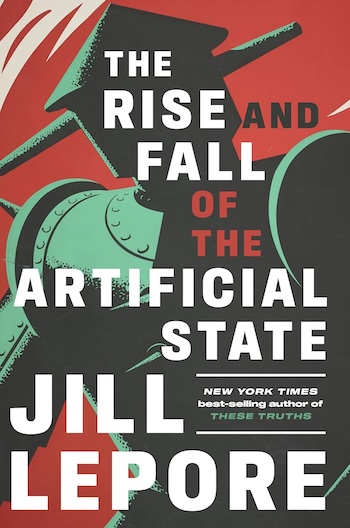
 If you’ve been reading CR for any length of time, you’re probably familiar with the fact that I am a huge fan of Jill Lepore’s work. Whether a full-length book, or one of her frequent articles in the New Yorker, Lepore is a must-read for me. So, I frequently check to see if the author has a new book in the works, and was very happy to learn that she does: The Rise and Fall of the Artificial State is due to be published later this year (August), and I can’t wait. Technology and its place in American society and culture has long been an area of interest of the author’s (and mine, but I can’t write about it nearly as well), and I have very high hopes for this new book. Here’s the synopsis:
“The Artificial State is the factory farming of humans, the sorting and segmenting, the isolation and alienation, as if humans were becoming to machines what animals had become to humans.” — Jill Lepore
“Much in history is headlong but few grand transformations have been more precipitate or more heedless than the rise of… the Artificial State,” writes Jill Lepore in this passionate account of how rule by machine has ravaged the world. Inspired by Hannah Arendt’s The Origins of Totalitarianism, which argued in 1951 that the machinery of modern life was reshaping the very fundamentals of human existence, Lepore, profoundly disturbed by the technology revolution and by the soulless inundation of artificial intelligence, unfurls a new history for our own twenty-first century.
Building on an essay in The New Yorker in 2024, Lepore’s clarion call traces our increasing dependence on and strangulation by data. Political campaigns, awash in an avalanche of fake bots, have been reduced to attention-mining algorithms, while multinational media corporations dictate public discourse, and the era of the liberal nation-state seems to be coming to a rapid end, replaced by billionaire technocrats reliant on autocracy and the tools of AI.
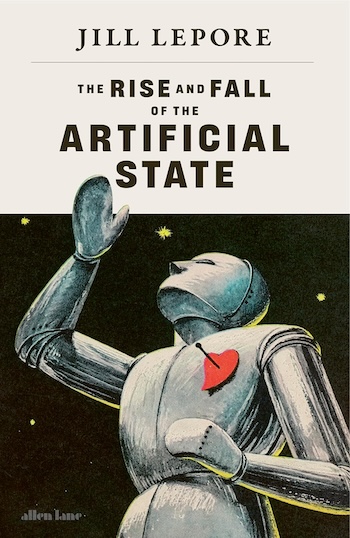 With Orwellian overtones, The Rise and Fall of the Artificial State demonstrates how technology has corroded global democracy, leading to the destruction of both human community and capacity for self-government, creating a new form of AI government, a digital citizen’s assembly, where AI will recommend the course of action to humans in place of human-run legislatures. Especially sobering with this proliferation of “dizzying, ever-changing schemes, prophesies, and predictions” is that the Artificial State has come at the expense of the natural world, leading to catastrophic loss of wildlife habitat and biodiversity.
Deliberately alarming, The Rise and Fall of the Artificial State, despite its abundance of dire facts, is not a funeral dirge; rather, it’s an inspiring wake-up call, written in Lepore’s typically elegiac prose, which demonstrates that nothing about the Artificial State was inevitable, for it is a “government without consent, even government without humans.” It can, Lepore asserts, be dismantled. Other heinous systems, like feudalism, fascism, and slavery, have also been dismantled, but disassembly requires identifying the parts, tracing the sources. It requires telling a new history. This is the purpose of The Rise and Fall of the Artificial State.
As an aside, one of the author’s observations about technology has stuck with me, ever since I read it in one of the pieces included in The Deadline, a fantastic collection of the author’s articles: “Disruption is innovation without progress.”
Jill Lepore’s The Rise and Fall of the Artificial State is due to be published by Liveright in North America and Allen Lane in the UK, on August 25th.
Follow the Author: Goodreads
[This post has been updated, April 25th: New North American and UK covers added.]

 An interesting account of a Republican’s departure from his life-long political home
