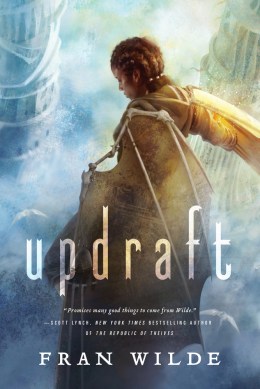
 Welcome to a world of wind and bone, songs and silence, betrayal and courage.
Kirit Densira cannot wait to pass her wingtest and begin flying as a trader by her mother’s side, being in service to her beloved home tower and exploring the skies beyond. When Kirit inadvertently breaks Tower Law, the city’s secretive governing body, the Singers, demand that she become one of them instead. In an attempt to save her family from greater censure, Kirit must give up her dreams to throw herself into the dangerous training at the Spire, the tallest, most forbidding tower, deep at the heart of the City.
As she grows in knowledge and power, she starts to uncover the depths of Spire secrets. Kirit begins to doubt her world and its unassailable Laws, setting in motion a chain of events that will lead to a haunting choice, and may well change the city forever-if it isn’t destroyed outright.
Reviewed by Ryan Frye
Upon its release, Updraft enjoyed a fair amount of positive buzz from SF/F critics and reviewers that I respect, and when it popped up on numerous “Best Books of 2015” lists, I knew I had to give it a read. When a book receives such widespread hype, my anticipation tends to ratchet up. First and foremost, I was very intrigued by the idea of a city made out of living bones, where humans live far above the ground and get around by flying. This set my imagination running, and I was excited to find out what exactly brought the situation into being. Furthermore, I tend to prefer books written in first person perspective, so this seemed like it would be a perfect read. Continue reading →

 My debut novel, Artefact, was released in February 2016. It is book one of The Lazarus War, and the story continues with Legion, released in the UK and US on 26
 It’s an odd occupation, this writing business. You sit alone in a room and make up stuff, and if you’re lucky, you find that someone else likes it, has faith in it, and is willing to put it out in the world for you. If you are even luckier, you make a little money out of the process and find that it becomes a job – a career, even.
 Crack open an author’s skull (preferably after drugging them first) and you’ll find a simmering stew of influences floating around in there like a horrible soup. It’s not pretty, but these are the things that shaped me as I grew up and wound up rendering me virtually unemployable, incapable of doing anything except sitting at a desk and typing about imaginary people doing made up things.
 It was the title that first came to me:
  We humans encounter the world through a very limited set of senses, compared to much of the animal kingdom. Our visual acuity is good but our ability to see colours is crippled by nocturnal ancestors. Birds, reptiles and many grounds of invertebrates see far more bands in the rainbow (if there was a mantis shrimp pride march their flags would be incredible). Our hearing and smell are the shame of Mammalia. What to us is a satisfactory baseline would make dogs cringe with embarassment.
 Regeneration, the third and final book of the ®Evolution sequence, is about to drop in North America. Given that it’s been out in the UK for the past eight months, I’ve already done a lot of public meditating on what it’s ‘like’ to have completed the trilogy (short answer: I don’t really know what it’s like. To what can you compare it?). Now I’m thinking about the internationalist dimension. One of the things that I’ve found fascinating, and often surprising, over the past few years is the different ways in which the books have been received and understood in different countries and communities.
  If I had to name one specific story mode I love the most, it would be the closed-arc series.
 Civilian Reader