This video is great — 64 SFF books in three minutes (with some funny jokes, too)…
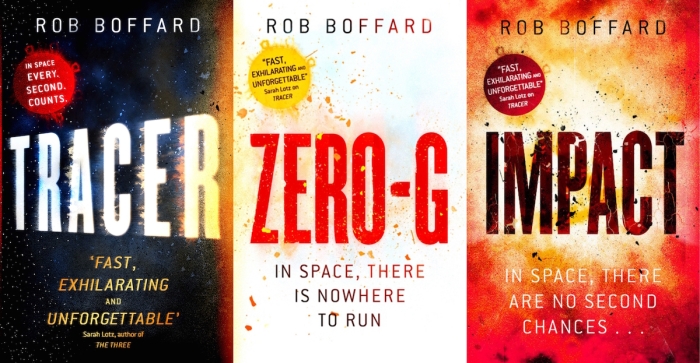
Rob Boffard is the author of Tracer, Zero-G and the upcoming Impact — published by Orbit Books in the UK and North America.
This video is great — 64 SFF books in three minutes (with some funny jokes, too)…
Rob Boffard is the author of Tracer, Zero-G and the upcoming Impact — published by Orbit Books in the UK and North America.
 Let’s start with an introduction, for new readers: Who is Helen Lowe?
Thank you, for hosting me on Civilian Reader, Stefan. In terms of “who I am”: I’m a novelist, poet, and occasional interviewer. So far, the only idea I’ve ever had for a novel has come to me in speculative fiction mode, i.e. as fantasy, science fiction, or legendary history, but I write short fiction in a wider range of genres. Outside of writing, I live in “Middle Earth”, aka New Zealand, and I am interested in a range of “stuff”, from astronomy and history, through martial arts, to wine – especially NZ wines – and making and consuming food, the latter in the company of friends whenever possible.
Your latest novel, Daughter of Blood, was published earlier this year by Orbit (UK) and Voyager (US). It’s the third in your fantasy series, but how would you introduce the series to a potential reader?
Well, the Twitter-length synopsis for the series is that it’s a story about a people who believe themselves to be champions of good but are divided by prejudice, suspicion, and fear. (Not to mention xenophobic, socially rigid, and prone to fratricidal blood feuds.) They are also alien to the world they inhabit (Haarth), so there’s an SF-nal element there. The Wall of Night series is a single story told in four distinct parts, but it centres on a young woman, Malian of Night (think ‘princess’, not ‘farm girl’), who must attempt to reunite her fractured people (the Derai) and restore their abandoned magic, as well as building alliances with the other cultures of Haarth, in order to prevent the world being destroyed by (another) alien invader. Continue reading
 Silent Hall is N.S. Dolkart‘s debut novel, and it sounds like a fun, epic fantasy adventure:
Five bedraggled refugees and a sinister wizard awaken a dragon and defy the gods.
After their homeland is struck with a deadly plague, five refugees cross the continent searching for answers. Instead they find Psander, a wizard whose fortress is invisible to the gods, and who is willing to sacrifice anything – and anyone – to keep the knowledge of the wizards safe.
With Psander as their patron, the refugees cross the mountains, brave the territory of their sworn enemies, confront a hostile ocean and even traverse the world of the fairies in search of magic powerful enough to save themselves – and Psander’s library – from the wrath of the gods.
All they need to do is to rescue an imprisoned dragon and unleash a primordial monster upon the world.
How hard could it be?
Silent Hall is due to be published by Angry Robot Books at the beginning of June 2016. To celebrate the upcoming release, they have allowed me to share the first two chapters. You can also find out more about the author and his work by checking out his website, and following him on Twitter and Goodreads.
 Let’s start with an introduction: Who is Matthew Blakstad?
Former child actor, then a director of fringe theatre, more recently a specialist on digital communications – and now, novelist. I’ve lived in South London most of my life. I’m married, no kids. No cats (allergic spouse). As you’ll guess if you’ve read my book I’m very much into tech culture but perversely I also love the natural world and wild places.
Your new novel, Sockpuppet, will be published by Hodder. It looks rather interesting: How would you introduce it to a potential reader?
It’s a thriller, set in the very near future. An online celebrity starts dishing dirt on a politician, but this online voice is nothing but a chatbot – an artificial persona created by software. So how is a fake personality causing mayhem in the real world? Two very different women – a middle-aged politician called Bethany Lehrer, and a young software developer called Dani Farr – need to find out fast who’s behind this malicious campaign before it takes their lives to pieces.
Along the way, the book asks questions about how our online life is changing us – at the erosion of our privacy, the trolling of women, and the shift of power away from governments and towards the big technology companies. Continue reading
 Your next novel, Cloudbound, is the follow-up to Updraft and due out in September 2016. What can fans of the first novel expect from the new book?
Where Updraft was in some ways about voice — and who speaks, who is heard, and who is not, Cloudbound shifts to a new focus, and a new narrator: Nat.
After the events in Updraft, Nat’s learning how to be a leader, and the benefits and costs of doing so. Politics in the city of living bone are more complex than ever, as are relationships — Nat’s and Kirit’s friendship is tested beyond the breaking point, as is Nat’s understanding of how the city works.
Where Updraft was a story above the clouds, Cloudbound — well, the title tells you a lot about where we’re headed. And yup, more monsters. Big ones. Continue reading
 Regeneration, the third and final book of the ®Evolution sequence, is about to drop in North America. Given that it’s been out in the UK for the past eight months, I’ve already done a lot of public meditating on what it’s ‘like’ to have completed the trilogy (short answer: I don’t really know what it’s like. To what can you compare it?). Now I’m thinking about the internationalist dimension. One of the things that I’ve found fascinating, and often surprising, over the past few years is the different ways in which the books have been received and understood in different countries and communities. Continue reading

Featuring: Andrew Bannister, Stephanie Burgis, Lee Child, Myke Cole, Sebastien de Castell, A.A. Dhand, N.S. Dolkart, Steven Erikson, Christie Golden, Stephen Graham Jones, Jessica Grose, Guy Haley, Peter Hanington, Samantha Hayes, Kaui Hart Hemmings, D.L. Hughley, Kij Johnson, Emma Kavanagh, Laura Lam, Owen Laukkanen, Ken MacLeod, Laurence MacNaughton, Jay McInerney, Barney Norris, Daniel O’Malley, Ann Patchett, Ben Peek, Leif G.W. Perrson, Gae Polisner, Adam Rakunas, Chris Roberson, J. Todd Scott, Helen Sedgwick, J.P. Smythe, Brian Staveley, James Swallow, Michael Swanwick, David Swinson, Adrian Tchaikovsky, Matt Wallace, Robin Yocum
Above Picture: Crop of Injection #7, by Declan Shalvey & Jordie Bellaire (Image)
 Let’s start with an introduction: Who is Thomas Olde Heuvelt?
I’m a Dutch guy who writes pretty scary novels. I started out pretty young, and even now, after five novels, I look younger than I am. So much that at signings, people always thought I was the minion helping with the book sale instead of the author. Two years ago — I was 30 then — I was having dinner with Peter Straub and Jeff VanderMeer and a bunch of other writers in Washington, and I was asked for ID when the waiters poured the wine. They thought I was their adopted child or something.
Oh, right, serious biography stuff. I also won a Hugo. And I have a novel out internationally in 2016 called HEX.
Your latest novel, Hex, will be published by Hodder in the UK. It looks rather fabulous: How would you introduce it to a potential reader?
Thanks — I’m totally in love with the cover. It’s so creepy! HEX is a creepy book about a modern day town, haunted day and night by a 17th century witch whose eyes are sewn shut. The town is virtually quarantined by its elders to prevent her curse from exploding. Frustrated with being kept in lock down, the town’s teenagers decide to break their strict regulations and go viral with the haunting, but in doing so, send the town spiraling into… well, into very dark times, to frame it nicely. Also, I’d say that with HEX, I set off to write the scariest book I could imagine. I took elements from classical horror and tried to turn them around in a modern, twisted way. The witch’s haunting is very rock ‘n’ roll. She’s always there. She walks the streets day and night. She enters your home. She stands next to your bed for nights in a row. The town is bugged with cameras and there’s this control centre that tries to hide her from sight all the time. But besides the supernatural power, it’s a book mostly about human evil. Continue reading

Spotted this a few minutes ago, and shared it on Twitter, but I wanted to pop this cover on the site, too: the third novel in Robert Jackson Bennett‘s Divine Cities series, CITY OF MIRACLES! Easily one of my most-anticipated novels of 2017 (it’s out in January), it’ll be published in the UK by Jo Fletcher Books (and Crown in the US). Here’s the synopsis (possible spoilers):
Sigrud je Harkvaldsson is back, and this time he’s out for vengeance.
Shara Komayd, once Prime Minister of Saypur, has been assassinated. News travels fast and far, even to a remote logging town somewhere northwest of Bulikov, where the silent, shaven-headed Dreyling worker ‘Bjorn’ picks up the newspaper and walks out. He is shocked and grieved and furious; he’s been waiting thirteen years for Shara, his closest friend, to reach out to him — to tell him to come home. He’s always believed she was running a long operation, that there would be a role for him at the right time. Now he has no one else in his life, and nothing to live for — except to find the people who did this.
Sigrud wasn’t there for the death of his daughter Signe, and he wasn’t there when his old comrade Shara was murdered. Now Bjorn is dead and Sigrud is back. And he will find answers, for Shara, and for himself. He’s made a promise…
Jo Fletcher Books have also published the first two books in the series: City of Stairs and City of Blades.
Also on CR: Interview with Robert Jackson Bennett; Guest Post on “City of Stairs & the Super Tropey Fantasy Checklist”; Excerpt from City of Stairs; Reviews of The Company Man and City of Stairs

 If I had to name one specific story mode I love the most, it would be the closed-arc series.
Other kinds of stories are great, too! A self-contained, single-volume story can pack a hell of a punch, and I’m as susceptible as the next reader to wanting the continuing adventures of my favorite characters, tackling a new puzzle or threat every week. But my absolute favorite is the kind of story that takes place in multiple installments, maybe with a semi-episodic structure, but with an over-arching plot that will wrap up in due course.
The advantages of this form are (in my opinion) legion. Comparing them against the standalone novel: a series has more room to work with, and as a result, can pull off effects that are very difficult to do in a confined space. You can show long-term character development, without short-changing the amount of time and effort required to make that kind of thing plausible. You can lay groundwork and then leave it alone for long enough that the reader forgets about it, until it comes back to punch them in the face. You can make use of recurring motifs, revisiting a particular bit of plot from different angles, so the reader gets a variety of perspectives on it rather than just the one. Continue reading
'just a nobody with a blog'
library lovin', backlist browsin', SFF reader...
Another Book Off The To Be Read Pile
Mostly book reviews, and sometimes other stuff
Book Reviews, News, and Other Stuff
My Irrational Life
The writings, reviews and ramblings of Paul Starkey...
by Marianne de Pierres
News, data and insight about the powerful forces that shape the world.
Books! Where are the great books?
that doesn't fall apart two days later
A topnotch WordPress.com site
Random musings from an extreme bibliophile.
And for summer days
On the Writing of Epic Fantasy - The Archives
Welcome to Gav Thorpe's Weblog
Speculative fiction
Don't worry. None of this blood is mine.

