 “Is this book a standalone or the third in your trilogy?” A question that I’ve had to address since the publication of my latest book, Spellbreaker. The answer, perhaps confusingly, is yes. When justifying this answer, I’ve done a lot of thinking about the way stories are told in series, particularly in epic fantasy.
I don’t think too many will disagree that in the traditional conception of epic fantasy, the use of a series of books is a logistical necessity, not an aesthetic choice. The Lord of the Rings, of course, was written as one book (to rule them all?) and broken into three only because the printing, binding, and shipping costs would have been prohibitive. This precedent created the current expectation that every book in an epic fantasy series will be the immediate continuation of the last. Since the 1980s, the majority of successful fantasy series have done exactly that. There are many, well-known advantages to this approach; it allows for intricate exploration of subplots; it proves continuous and detailed character development; it creates an experience in which the reader traverses an epic number of pages that mirrors the characters’ journey across and among an epic number of landscapes and cultures. The grandmasters do so effortlessly and with style. Continue reading

 For some reason, back in college, I had the audacity to think I could become an author. As if that was just one of the options available in the career center. It turned out finding any job at all was a lot trickier than I expected. But I knew how to program computers, so I ended up joining a startup video game company that we would later name Insomniac Games (because of how little we slept back in those days.) And Twenty-Two years later I’m still making video games.
 Now look, I love Shakespeare. Like, a lot. In fact, I was actually a classically trained actor who did a fair bit of Shakespeare back in the day (mostly the comedies, although I still think I could have killed it as Richard III). And not only did I act in Shakespeare, but my first Young Adult novel was called Struts and Frets. As in:
 I’m always in two minds about music when I’m writing. Some days, when my focus isn’t where it needs to be, I have to have as near to absolute silence as I can get in order to zero in on what I want to get down on the page. Other times, a little musical accompaniment is exactly what I need to prime the pump and get me writing.
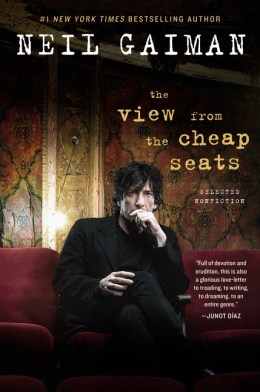 A must-read collection of essays
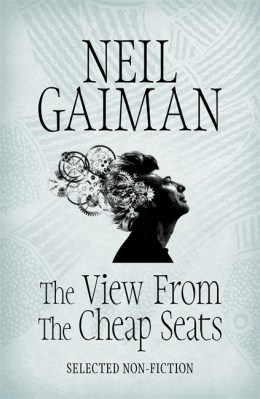 If you have any interest in Gaiman’s thought-processes when it comes to art, creativity, books, popular culture, specific works… Then you will undoubtedly find something fascinating in The View From The Cheap Seats. It’s a substantial collection of essays and speech transcripts. There is some overlap between certain pieces, which I thought was interesting — giving us some insight into those authors and books that most influenced Gaiman, and also the issues that have been most important to him at certain points during his career.
 If I had to name one specific story mode I love the most, it would be the closed-arc series.
 In Prophecy’s Ruin, book one of the Broken Well trilogy, a child is prophesied to be born on a dark and stormy night (of course) who will end the age-old battle between the forces of shadow and light. Pardon me, but YAAAAAAAAAAAWN. We’ve all heard this shit a hundred times before.
 I’ve started writing the third book in my fantasy trilogy, and it is a very strange experience.
 Civilian Reader