Short Review: A FOREIGN COUNTRY by Charles Cumming (Harper)

CummingC-TK1-AForeignCountryUKAn excellent spy thriller

On the vacation of a lifetime in Egypt, an elderly French couple are brutally murdered. Days later, a meticulously-planned kidnapping takes place on the streets of Paris.

Amelia Levene, the first female Chief of MI6, has disappeared without a trace, six weeks before she is due to take over as the most influential spy in Europe. It is the gravest crisis MI6 has faced in more than a decade. Desperate not only to find her, but to keep her disappearance a secret, Britain’s top intelligence agents turn to one of their own: disgraced MI6 officer Thomas Kell.

Tossed out of the Service only months before, Kell is given one final chance to redeem himself – find Amelia Levene, at any cost. The trail leads Kell to France and Tunisia, where he uncovers a shocking secret and a conspiracy that could have unimaginable repercussions for Britain and its allies. Only Kell stands in the way of personal and political catastrophe.

Charles Cumming is one of my favourite authors – in the thriller genre or otherwise. He writes tightly-plotted, gripping espionage thrillers in the tradition of John le Carré and others of that era. [It is, perhaps somewhat cliché to now compare Cumming to le Carré, but it really is apt.] Cumming’s novels are decidedly British, in that they are devoid of melodrama or the dick-swinging swagger that can characterise American-authored espionage thrillers (see, for example, Vince Flynn and Brad Thor). They are, however, just as gripping. Continue reading

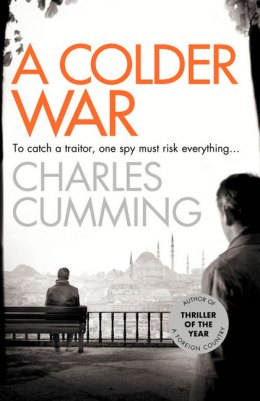
Charles Cumming’s A COLDER WAR Mole Hunt

CummingC-ColderWarMoleHuntBannerSo, Harper Collins are running a special competition to celebrate the release of Charles Cumming’s latest international spy thriller, A COLDER WAR. For those of you who don’t know who he is or haven’t read his work (shame on you!), he is an absolutely fantastic author, and one of my favourites (of any genre).

The competition involves a mole hunt. The name of the mole has been hidden amongst blog posts around the internet (see the banner, right).

In each post, there are a couple of questions (mine are below). The first letter in each answer is in the name of the mole. Collect all the answers, and email your answer to killerreads[at]harpercollins.com. The winner gets a Kindle!

*

So, let us get on. Here are the two videos, and their corresponding questions…

1. Who does America have a so-called “Special Relationship” with?

“The Truth About the Harry Quebert Affair” by Joel Dicker (MacLehose Press)

DickerJ-TruthAboutTheHarryQuebertAffairUKA gripping and absorbing, slightly flawed thriller

August 30, 1975. The day of the disappearance. The day a small New Hampshire town lost its innocence.

That summer Harry Quebert fell in love with fifteen-year-old Nola Kellergan. Thirty-three years later, her body is dug up from his yard along with a manuscript copy of his career-defining novel. Quebert is the only suspect.

Marcus Goldman – Quebert’s most gifted protégé – throws off his writer’s block to clear his mentor’s name. Solving the case and penning a new bestseller soon blur together. As his book begins to take on a life of its own, the nation is gripped by the mystery of ‘The Girl Who Touched the Heart of America’. But with Nola, in death as in life, nothing is ever as it seems.

This is not an easy book to review. It has been on my radar for a while, and I’ve been eager to read it ever since I saw it mention on (I think) The Bookseller. I would say it mostly lived up to my expectations. It is expansive, brilliant, absorbing, briskly-paced, but also flawed and at times frustrating, even aggravating. A confounding novel to review. Despite the issues I had with certain elements of the novel and story, it was utterly gripping, and I thoroughly enjoyed reading it.

First of all, I very much enjoyed reading it – I was always eager to get back to it, when life forced me to stop reading (sleep, meetings, etc.). Dicker has written an engaging thriller, one that brings a decades-old disappearance back into the spotlight, as a beloved member of a small town community – the titular Harry Quebert – is accused of two shocking, heinous acts: continuing an affair with a fifteen year-old girl, and also her murder. What follows is an investigation by the accused’s protégé (of sorts), in an attempt to clear his name and salvage his reputation. Along the way, things get very messy indeed. Threats and revelations abound, which keeps readers guessing all the way through – the truth is only revealed in the final 10% of the novel (I read it as an eARC). I really liked the way Dicker keeps throwing out red herrings, and also that Marcus’s investigation does one hell of a lot of damage along the way: relationships are shattered, secrets (related and not) are brought into the light, and the competing agendas at work tear the community apart.

Speaking of these competing agendas: there are times when Dicker’s character come across as cartoonish, and not in a good way. For example, Marcus’s editor/publisher is rather unrealistic – as if every commercial consideration that any publisher would need to take into account is exaggerated and overblown. He is an awful person, and there’s no reason to disbelieve the existence of such characters, but he does certain things that seem so stupid. Considering he’s able to offer $2,000,000 dollar advances, he comes across as singularly devoid of the emotional intelligence to be a high-powered, successful publisher in New York. The publishing aspects of the novel were, actually, the most lacking in verisimilitude, which was a real pity.

Dicker’s writing is, for the main, excellent and the translation is superb, too. The pacing is superb, and I was absolutely captivated by the narrative and investigation. At the same time, there were instances when the dialogue – especially that featuring Marcus’s editor, Nola and select other characters – appears melodramatic and just not very good. At the risk of sounding condescending or unfair, I can’t help but wonder if this is an instance of lost-in-translation?

There were times when the investigation – official and Marcus’s amateurish actions – veered off in strange ways. Partly, this was to allow for the frequent upending of their attempts to get to the bottom of things. For the main, it worked very well, but there were certainly times when I became frustrated. Without shedding too much light on particulars, some of the switcheroos felt forced. In addition, some of the characters are morons – especially when it comes to the writing of the book-within-the-book. Marcus and his editors commit some astonishing failures and cock-ups, one that didn’t ring true at all. One in particular, very near the end, is an unforgivable oversight that I just can’t see happening in real life – something that could so easily have been rectified over the course of the investigation. Frustrating moments like this robbed the novel of some of its impact.

This review is, I recognise, rather vague on the details. This is because, despite this flaws – and some might consider them huge – I could not stop reading. In terms of sheer enjoyment, The Truth About the Harry Quebert Affair is one of the most enjoyable books I’ve read in a while. Given how picky I can be, and how easy gaffs and inconsistencies can ruin a novel for me, I think that’s saying something. It is not surprising to me that this has been such a success.

If the goal of any novel should be to entertain, be thought-provoking, and get the reader thinking, this this novel succeeds on every level. That is has some shortcomings is made almost irrelevant by just how good the rest of it is.

Gripping and absorbing, this is well worth reading. Definitely recommended, but be warned that there are some niggles.

“Midnight Crossroad” by Charlaine Harris (Gollancz)

HarrisC-MT1-MidnightCrossroadUKA great start to a new series

Welcome to Midnight, Texas, a town with many boarded-up windows and few full-time inhabitants, located at the crossing of Witch Light Road and Davy Road. It’s a pretty standard dried-up western town.

There’s a pawnshop (someone lives in the basement and is seen only at night). There’s a diner (people who are just passing through tend not to linger). And there’s new resident Manfred Bernardo, who thinks he’s found the perfect place to work in private (and who has secrets of his own).

Stop at the one traffic light in town, and everything looks normal. Stay awhile, and learn the truth…

This is the first novel of Harris’s that I’ve read, and I must say I rather enjoyed it. A gently-paced mystery, with a supernatural slant, and populated by endearing, varied and well-constructed characters.

The novel started pretty slowly, for me. For the first 50 pages or so, it felt like Harris was intent on painting as complete and full a picture of Midnight, Texas. Everything was described, at length, and I worried that this was a sign of padding. Thankfully, the story then kicked in, and what followed was an engaging small-town mystery.

A disappearance and death from years ago is dragged into the present, stirring up earlier suspicions and far-reaching animosities. It also brings Midnight to the attention of a number of unsavoury elements, all of which are pursuing their own agendas. A new discovery leads Manfred and a select few of his fellow Mightnighters to investigate. In some ways, Midnight Crossroad feels like an established series, as some of the characters’ actions need to be taken with a pinch of salt – they are far more accepting of certain things than one might expect (the vigilantism, for example, not to mention some of the odder characteristics of certain Midnighters).

HarrisC-MT1-MidnightCrossroadUSEach of the town’s inhabitants has their own secrets, and it is considered very bad form to pry. That each and every one of them has secrets, though, is an accepted fact. This has led to the creation a surprisingly close-knit community, despite none of the characters truly knowing the others. One of the things I really liked about the novel is the fact that Harris doesn’t reveal everything. In fact, many of the characters remain somewhat mysterious – while readers will no doubt draw their own conclusions, Harris is rarely explicit about their natures. I’m looking forward to each of the characters developing over the course of the series. There’s a lot of potential for expansion, I think.

This wasn’t what I was expecting. Although, to be fair, I wasn’t really sure what to expect to begin with. The supernatural elements are pretty down-played, but they are definitely there – be it through Fiji’s witchcraft, Manfred’s clairvoyance, and… well, a couple of other things that to discuss would be spoilers.

Harris is in no rush to tell the story, but it won’t take you long to read this – not only is the book very focused (after the first 50 pages), but you’ll likely not want to put it down. It offers a welcome change in pace to the usual thrillers I read, and the added, understated supernatural elements were expertly woven into the story while also not drowning out the plot.

An excellent first experience with Harris’s work, I’ve become a new convert, and have ordered the first couple of Sookie novels to try. If you are already a fan of Harris’s fiction, then you won’t be disappointed by Midnight Crossroad. If, like me, you are new to her work, then this is as good a place to start as any other.

Definitely recommended. I really enjoyed this.

***

Midnight Crossroad is published by Gollancz in the UK and Ace Books in the US – both in May 2014.

Guest Post: “Influences & Inspirations” by Duncan Jepson

JepsonDuncan-AuthorPic1During the last 150 years, China and the West have collided many times, virtually always on Chinese soil, and their relationship is heavily coloured by this history. Many in Asia are choosing and building their futures motivated by their own and their family’s experiences, ambitions and histories, much of it unclear and unknown to most in the West. The relationship between China and West is set to become more intense and complicated and we have to hope these two sides will work together rather than tear the world apart.

The story of Emperors Once More is about the collision of these different motivations and forces in China and among Chinese people, set against their position on the world stage. On a national level, the government is tasked with maintaining a union of a billion plus people so it does not crumble into chaos again, fighting the very human feeling of humiliation from centuries of defeat, both personal and national, the need to re-establish respect on the world stage, the clashes that will arise from the very practical need to obtain vital resources for the future and China’s new role in the global order. The story is also about those very personal experiences such as migration, subservience, colonialism, aspiration, ideology, revolution and tradition.

JepsonD-EmperorsOnceMore

This is also personal to me. As a Eurasian, I have often found myself stuck awkwardly in geography, sometimes feeling at home in no place in particular but persistently trying to be comfortable in both East and West. I have watched the older generation in Hong Kong, those having lived and grown up under colonial rule, feel the weight of a heavy glass ceiling whether due to limited education, lack of understanding of the governing culture or, at times, simply by race. To some there is a deep frustration and resentment to having been treated as what they feel is a foreigner in their own home. Thankfully the world has moved on and a young generation of Chinese don’t see themselves this way – many are now of a new global generation.

The premise of Emperors Once More is that, in 2017, China has bailed out the West, but the West has defaulted on its debt. For many Chinese, this has the same strong sense of bitterness as the humiliations of the Opium War, Rape of Nanjing and Boxer Rebellion. One man in Hong Kong, deeply affected by colonialism, wants to use this new collective anger and indignation to push Chinese to demand China use its global power to reclaim its rightful place in the world order. To achieve these ends, he will draw on both ancient rites and modern technology to commit a series of killings and provoke national rage.

I wanted a criminal with a purpose and an anger that is rooted deep in history and personal experiences, believing there are wrongs to be righted, and a hero who is of a new different world who sees a better future that does not have to pay for the past. I hope that this story pulls the reader into a full-bloodied crime tale while drawing on Chinese history, culture and mysticism.

***

Duncan Jepson is the award-winning director, producer and writer of five feature films. He also produced documentaries for Discovery Channel Asia and National Geographic Channel. He was the editor of the Asia-based fashion magazine West East and a founder and managing editor of Asia Literary Review. He is a social commentator on Asia and regularly writes for The New York Times, Publishing Perspectives and South China Morning Post. A lawyer by profession, he lives in Hong Kong.

Jepson’s Emperors Once More is out now, published in the UK by Quercus Books. Jepson is also the author of All the Flowers in Shanghai. Be sure to follow Duncan on Twitter and Goodreads.

“Galveston” by Nic Pizzolatto (Sphere)

PizzolattoN-GalvestonUKAn interesting, if flawed debut thriller

Roy Cady is by his own admission “a bad man”. With a snow flurry of cancer in his lungs and no one to live for, he’s a walking time-bomb of violence. Following a fling with his boss’s lover, he’s sent on a routine assignment he knows is a death trap. Yet after a smoking spasm of violence, Roy’s would-be killers are mostly dead and he is mostly alive.

Before Roy makes his getaway, he finds a beaten-up woman in the apartment, and sees something in her frightened, defiant eyes that causes a crucial decision. He takes her with him on the run from New Orleans to Galveston, Texas, permanently entwining their fate along a highway of seedy bars and fleabag hotels, a world of treacherous drifters, pick-up trucks, and ashed-out hopes, with death just a car-length behind.

Only after finishing this novel, did I learn that Pizzolatto is the creator of HBO’s critically-acclaimed True Detective series (starring Woody Harrelson and Matthew McConnaughey). I can certainly see it, now, though. This is a good thriller: very well-written and fast-paced. However, it also left me slightly dissatisfied at the end.

The story is told from the perspective of Roy, a bagman for a crook in New Orleans. After the set-up (mentioned in the synopsis, above), he escapes bruised and brutalised, taking with him Rocky (Raquel), the partner of a prostitute who was turning a trick at the home of the trap. Roy soon finds that, despite a desire to ditch Rocky (and her toddler ‘sister’, Tiffany, who they pick up on the way to Texas), he can’t seem to follow through. Ruminating on his life and his pending death-by-cancer, he develops a wary connection with Rocky and Tiffany. Definitely attracted to Rocky, he is unwilling to allow himself to accept any of her advances – at first, somewhat business-like, but later perhaps genuine. Instead, he plays a role of protector and, in some ways, rehabilitator – a somewhat ironic role, given his own past actions (not to mention present/future actions that he commits over the course of the story).

Pizzolatto writes incredibly well: his prose is stripped back, fluid and sparse. There isn’t a redundant phrase or extraneous word in sight. This has the positive effect of making this a very quick read (I read the first 10% on a Saturday night, after finishing another novel, and blitzed through the rest on Sunday). However, it does also mean certain things aren’t developed too much. There is a fever-like quality to Roy’s recollection and narrative – he is, after all, a practicing alcoholic who necks one hell of a lot of bourbon in these pages…

By the end of the novel, I felt pretty invested in these characters’ fates. But, given the very brisk pacing, by the brutal end, the dénouement was robbed of some impact, while remaining tragic. It was a peculiar feeling, really. Slightly disconnected.

Nevertheless, Galveston is still well-worth checking out. Pizzolatto has a great style, and can only get better. I am definitely looking forward to reading his next novel, and also watching True Detective.

Interview with SARAH LOTZ

SarahLotz-AuthorPicLet’s start with an introduction: Who is Sarah Lotz?

I’m a genre-crossing pulp-fiction writer based in South Africa. I’m addicted to coffee and collaborating, and write horror novels with author Louis Greenberg under the name S.L Grey; a ‘choose-your-own’ erotica series with authors Helen Moffett and Paige Nick (as Helena S. Paige), and a YA series co-written with my daughter under the name Lily Herne.

Your next novel, The Three, is due to be published by Hodder in May. How would you introduce the novel to a new reader?

I’m tempted to say it’s about plane crashes and (possibly) evil children – but I hope there is more to it than that! Here’s a brief description:

Four devastating plane crashes. Three child survivors. A fanatic who insists the survivors are possessed by the harbingers of the apocalypse. What if he’s right?

I’m fascinated by how quickly fear and paranoia can spread throughout society – especially during the aftermath of a devastating event – and the novel attempts to explore how this could potentially influence the political landscape. Continue reading

Review: THE ACCIDENT by Chris Pavone (Crown Publishing/Faber)

PavoneC-TheAccidentUSAn engaging suspense, featuring a secret manuscript, a conspiracy, and unwitting pawns caught in the middle.

As dawn approaches in New York, literary agent Isabel Reed is turning the final pages of a mysterious, anonymous manuscript, racing through the explosive revelations about powerful people, as well as long-hidden secrets about her own past. In Copenhagen, veteran CIA operative Hayden Gray, determined that this sweeping story be buried, is suddenly staring down the barrel of an unexpected gun. And in Zurich, the author himself is hiding in a shadowy expat life, trying to atone for a lifetime’s worth of lies and betrayals with publication of The Accident, while always looking over his shoulder.

Over the course of one long, desperate, increasingly perilous day, these lives collide as the book begins its dangerous march toward publication, toward saving or ruining careers and companies, placing everything at risk—and everyone in mortal peril.  The rich cast of characters—in publishing and film, politics and espionage—are all forced to confront the consequences of their ambitions, the schisms between their ideal selves and the people they actually became.

The action rockets around Europe and across America, with an intricate web of duplicities stretching back a quarter-century to a dark winding road in upstate New York, where the shocking truth about the accident itself is buried.

Pavone’s The Expats was an international bestseller – one I seem to have missed almost entirely. When The Accident popped up on NetGalley, though, its synopsis sent it right to the top of my Must Read titles. The story is located at the confluence of a number of my key interests: politics, media, international relations/espionage, and publishing. While the novel is not perfect, it is nevertheless a gripping, fast-paced thriller that entertained and gripped me from the start. Continue reading

Guest Post: “Up, Up, Down, Down, Left, Right, Left, Right, Tell Story” by Jonathan Wood

JonathanWood2When videogames first appeared, they really were games. There were victory conditions to meet, puzzles to solve, opponents to outwit. You could win. But then somewhere along the way, story snuck in, and videogames changed. You were no longer simply trying to win, instead you were struggling to get to the end, to complete the narrative.

Back when I was in college, I watched my friend play Final Fantasy VII. There was a group of us. We’d make an evening of it, gather round as my friend loaded the disc, pour some drinks, and watch what happened next to Cloud, Yuna, Barrett, and the rest of the gang.

Final Fantasy was the first videogame story that really grabbed me. It was epic, operatic, sprawling through twists and turns, through a mythology that was utterly alien to me. The next two games in the franchise were stutter steps for me, but Final Fantasy X held me in its grip once more, as I hastily fumbled through sections of gameplay to get to the next installment of the story.

FinalFantasyVII

I started trying to write my first novel shortly after finishing Final Fantasy X. I knew I didn’t want to write a traditional, Western fantasy. Elves and dwarfs did little for me. Instead, I remembered the fresh mythology I’d seen in the Final Fantasy games — summoning towering spirits, battling titanic monsters… I remembered that sense of the new. Turning a corner in the game and having my jaw hang at a glowing vista, at an aerial battle, an intimate scene in the glow of a phosphorescent tree… That inspiration drove the novel. It filled page after page with words.

The rather unfortunate end to this story is that the novel stunk. It was a first novel. These things happen. But it wasn’t the last time a videogame has inspired me.

Videogames are not often known for their literary ambition. It’s a situation that’s starting to change, but only slowly. There is often an uneven truce between story and gameplay, one trying to drive the desire for the other. But this doesn’t mean there aren’t lessons a writer can learn.

MassEffect1-Poster

My personal videogame obsession is the Mass Effect series. There are moments of magnificent storytelling in the game. The pinnacle for me comes in the first game. You must choose which of two shipmates you will save. On the surface it’s a standard life-and-death question, but due to hours of careful characterization, it goes deeper than that. It’s about loyalty, friendship, morality, and love. It’s about the person you want to be playing this game. It is a very personal set of character stakes brought to a towering crescendo.

I write a series. I can’t kill my main character. That’s off the table. But Mass Effect taught me that that doesn’t have to lower the stakes. Rather, I force my protagonist to make these kinds of choices. Who is he going to decide to be? Far worse than dying can be the things we are forced to live with.

The Witcher is another popular RPG series that puts a strong emphasis on storytelling. The focus is on the character Geralt, a monster-killing badass fueled by magic and drugs. On the surface Geralt is everything you could want a hero to be, competent, slick, and cold as a sharp steel blade. The games are everything I want them to be. And yet, I’ve never completed one.

TheWitcher-GameThe problem is, I don’t like Geralt. As competent as he is, nothing is ever done to make me actually feel for him. I am simply thrown into his skin and told to go forth and kick righteous ass. It feels hollow.

Readers like characters to be competent. But that’s not enough on its own. That’s what The Witcher taught me. To make sure there’s something human in my characters to hold on to. A sense of humor, a love of cats, an inability to bite ones tongue. We like characters for their qualities, but we fall in love with them for their flaws.

Writers are encouraged to read, and I certainly wouldn’t disagree with that advice. In fact, I think it’s critically important. But I also wouldn’t say that books are the only storytelling medium that writers should pay attention to. I wouldn’t even limit it to books and videogames. Movies, newspapers, conversations around the dinner table. The world is full of stories, and each one contains a lesson. And if we choose to learn them from videogames, we even can do it while stabbing monsters in the face.

***

Jonathan Wood is the author of NO HERO and YESTERDAY’S HERO, first published by Night Shade Books, but coming later this year from Titan Books (March and September). A third novel in the series, ANTI HERO, is due to be published in March 2015. Be sure to follow him on Twitter and Goodreads for news, etc.

WoodJ-Hero1&2

Animated Cover for Stephen King’s MR. MERCEDES (Hodder)

I know it hasn’t been very long since I shared the news that Hodder would be publishing two books by Stephen King this year. But, today they unveiled the UK cover for one of the novels – Mr. Mercedes – and to top it off, there is an (slightly) animated version! Which I thought was rather cool. So here it is, in all it’s moody glory…

KingS-MrMercedes

Mr. Mercedes is due to be published by Hodder on June 3rd 2014 in Hardcover and eBook. Here’s the synopsis:

It is a riveting cat-and-mouse suspense thriller about a retired cop and a couple of unlikely allies who race against time to stop a lone killer intent on blowing up thousands.

Retired homicide detective Bill Hodges is haunted by the few cases he left open, and by one in particular: in the pre-dawn hours, hundreds of desperate unemployed people were lined up for a spot at a job fair in a distressed Midwestern city. Without warning, a lone driver ploughed through the crowd in a stolen Mercedes. Eight people were killed, fifteen wounded. The killer escaped.

Months later, on the other side of the city, Bill Hodges gets a letter in the mail, from a man claiming to be the perpetrator. He taunts Hodges with the notion that he will strike again. Hodges wakes up from his depressed and vacant retirement, hell-bent on preventing that from happening. Brady Hartfield lives with his alcoholic mother in the house where he was born. And he is indeed preparing to kill again.

Hodges, with a couple of misfit friends, must apprehend the killer in this high-stakes race against time. Because Brady’s next mission, if it succeeds, will kill or maim hundreds, even thousands. Mr Mercedes is a war between good and evil, from the master of suspense whose insight into the mind of this obsessed, insane killer is chilling and unforgettable.