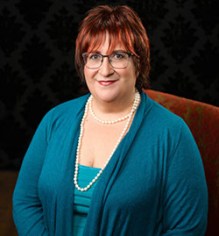
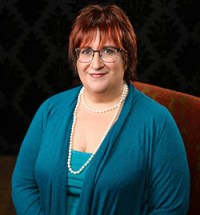
 Let’s start with an introduction: Who is Barbara Barnett?
That is always the hardest question for me to answer. One part science geek (with the academic credentials to prove it!), one part SFF fan (since I was but a wee lass and saw my first Twilight Zone episode), one part political science wonk (with the academic credential to prove that too!) and several parts writer with an often too-wild imagination. Is that too many parts? Hmmm.
Alchemy of Glass, the sequel to The Apothecary’s Curse, is due to be published by Pyr in April. How would you introduce the series to a potential reader? And what can fans of the first novel expect from this second book?
The Apothecary series follows the adventures of apothecary/antiquarian bookseller Gaelan Erceldoune, the descendent of Lord Thomas Learmont de Ercildoune (aka Thomas the Rhymer from British Legend). Made immortal by an error in judgement employing his ancient elaborately illuminated book of healing, Gaelan fears discovery most of all. Continue reading
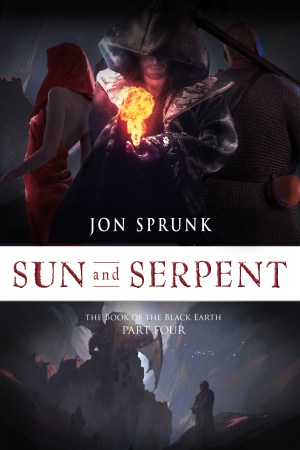 Today, we have a short excerpt from Sun and Serpent by Jon Sprunk. The fourth and final book in the author’s Book of the Black Earth series, it was published by
 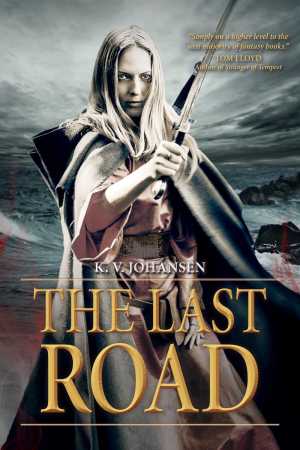 The Last Road is the fifth and final novel of
  The books of Gods of the Caravan Road have several central protagonists: Holla-Sayan in Blackdog, Holla, Ivah, Ahjvar, and Ghu, in The Leopard and The Lady, then Ivah and Ahjvar and Ghu in Gods of Nabban. However, the character to whom the series as a whole belongs is Moth, the devil Ulfhild Vartu. With the half-demon wer-bear Mikki at her side, she begins it, in “The Storyteller,” acquiring the black sword Lakkariss from the Old Great Gods in order to avenge her brother and Mikki’s mother on her cousin and former ally, Heuslar Ogada. She ends it, standing at the centre of events in The Last Road. In between, she and Mikki wander in and out of the others’ tales, with Moth, at least, avoiding ever becoming too close to any of them, even Ivah, in whom she sees perhaps an echo of her own lost daughter, but strongly, of herself.
  Practically every human being, at some point or another, has closed the covers on a satisfying book and thought: I should write a book like that.
 “They never write stories about people like me,” my thirteen-year-old daughter said. She had just finished yet another YA novel filled with active, adventurous, extroverted sort of people. But Naomi isn’t like that. She’s a beautifully quiet, caring, quirky introvert. Being with other people causes her anxiety, and her favorite activity is reading a book alone. She’s more likely to help quietly from the background, unseen, while others take the lead, and never argues with or confronts others. She wanted to know: Why were none of the people in those novels like her?
 Let’s start with an introduction: Who is Barbara Barnett?

 Civilian Reader