Review: SLASH by Slash, w. Anthony Bozza (Dey Street Books)

SlashMy second Guns ‘n’ Roses autobiography

Guns ‘n’ Roses’ Use Your Illusion I was the first album I ever bought for myself. It remains one of my favourite albums. I have always been interested in Guns ‘n’ Roses. After the initial break-up of the original line-up, I followed and waited for news about what the band would get up to. As with many fans, though, I eventually lost interest in waiting for new GnR music and found more enjoyment in following the members’ other bands — for example, Velvet Revolver and Slash’s Snakepit and, now, Slash’s eponymous solo-project (R&F’nR is one of my favourite albums of his music).

I recently read and loved Duff McKagan’s autobiography, It’s So Easy, which gave a fantastic, readable account of Guns ‘n’ Roses (relatively) short rocket to fame and stardom from the perspective of a single member. McKagan was respectful of others’ perspectives, and never guessed his bandmates’ opinions or positions, nor spoke for them. As soon as I finished It’s So Easy, I went out and picked up Slash. I think it’s safe to say that Slash is one of the greatest living guitar players, and I was eager to learn his side of the G’n’R story, and also read about his other music endeavours (Velvet RevolverSlash’s Snakepit, for example). This eponymous memoir is very good, quite exhaustive (without being exhausting), brutally honest, and accessibly written. It has a few minor flaws, but it was certainly a good read. Continue reading

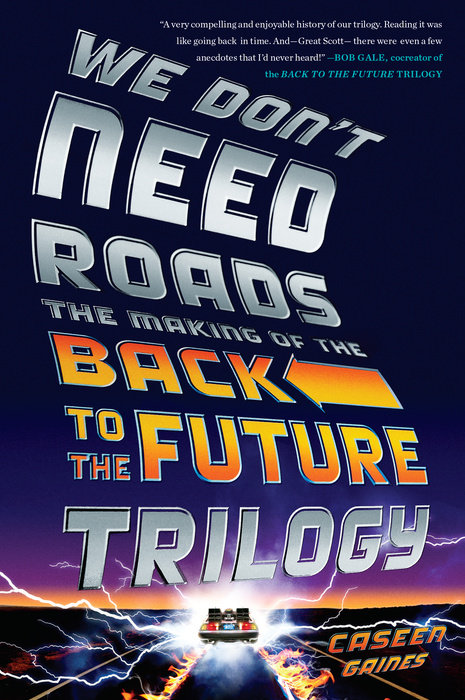
Quick Review: WE DON’T NEED ROADS by Caseen Gaines (Plume)

GainesC-WeDontNeedRoadsUSA behind-the-scenes look at the making of the wildly successful and beloved Back to the Future trilogy, just in time for the 30th anniversary 

Long before Marty McFly and Doc Brown traveled through time in a flying DeLorean, director Robert Zemeckis, and his friend and writing partner Bob Gale, worked tirelessly to break into the industry with a hit. During their journey to realize their dream, they encountered unprecedented challenges and regularly took the difficult way out.

For the first time ever, the story of how these two young filmmakers struck lightning is being told by those who witnessed it. We Don’t Need Roads includes original interviews with Zemeckis, Gale, Christopher Lloyd, Lea Thompson, Huey Lewis, and over fifty others who contributed to one of the most popular and profitable film trilogies of all time.

With a focus not only on the movies, but also the lasting impact of the franchise and its fandom, We Don’t Need Roads is the ultimate read for anyone who has ever wanted to ride a Hoverboard, hang from the top of a clock tower, travel through the space-time continuum, or find out what really happened to Eric Stoltz after the first six weeks of filming. So, why don’t you make like a tree and get outta here – and start reading! We Don’t Need Roads is your density.

It’s always difficult writing reviews of histories like this (or many others), as one’s interest in the subject can often result in over-long recitations of what the author covers — thereby potentially negating the need for others to read it for themselves. That could very easily be the case with this book: there are so many great moments herein. Therefore, I’m going to keep this very short. First of all, We Don’t Need Roads is a very good book — it’s witty, exhaustive (despite its slim length), engaging, and clearly written from a place of affection. This is a must read for any fan of the franchise. Continue reading

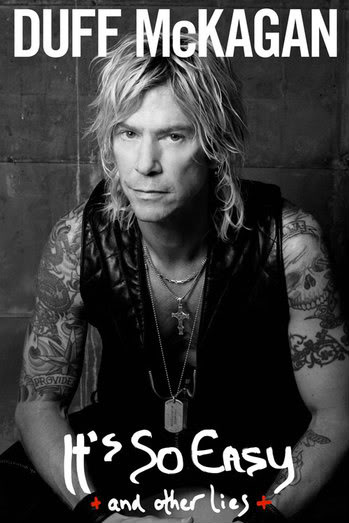
Review: IT’S SO EASY (AND OTHER LIES) by Duff McKagan (Touchstone)

McKaganD-ItsSoEasyUSA superb memoir of Guns ‘n’ Roses and more

A founding member of Guns N’ Roses and Velvet Revolver — and Rock & Roll Hall of Fame inductee — shares the story of his rise to the pinnacle of fame and fortune, his struggles with alcoholism and drug addiction, his personal crash and burn, and his phoenix-like transformation.

IN 1984, AT THE AGE OF TWENTY, Duff McKagan left his native Seattle — partly to pursue music but mainly to get away from a host of heroin overdoses then decimating his closest group of friends in the local punk scene. In L.A. only a few weeks and still living in his car, he answered a want ad for a bass player placed by someone who identified himself only as “Slash.” Soon after, the most dangerous band in the world was born. Guns N’ Roses went on to sell more than 100 million albums worldwide.

In It’s So Easy, Duff recounts Guns’ unlikely trajectory to a string of multiplatinum albums, sold-out stadium concerts, and global acclaim. But that kind of glory can take its toll, and it did — ultimately — on Duff, as well as on the band itself. As Guns began to splinter, Duff felt that he himself was done, too. But his near death as a direct result of alcoholism proved to be his watershed, the turning point that sent him on a unique path to sobriety and the unexpected choices he has made for himself since.

I really enjoyed this book. Despite being a huge Guns ‘n’ Roses fan (my first CD was Use Your Illusion I), McKagan’s story was mostly unknown to me. The first music magazine I ever bought was an issue of Hit Parader which included a long interview with and feature on McKagan and his music, but beyond that I don’t believe I’ve read anything else about him. After finishing Billy Idol’s Dancing With Myself, I wanted to read another music biography, and this one came highly recommended. I can certainly see why: it’s gripping, extremely well-written, sometimes amusing, and brutally honest. Continue reading

Quick Review: DANCING WITH MYSELF by Billy Idol (Touchstone)

IdolB-DancingWithMyselfVital Idol reading…

“I am hopelessly divided between the dark and the good, the rebel and the saint, the sex maniac and the monk, the poet and the priest, the demagogue and the populist. Pen to paper, I’ve put it all down, every bit from the heart. I’m going out on a limb here, so watch my back.” — Billy Idol

An early architect of punk rock’s sound, style, and fury, whose lip-curling sneer and fist-pumping persona vaulted him into pop’s mainstream as one of MTV’s first megastars, Billy Idol remains, to this day, a true rock ‘n’ roll icon.

Now, in his long-awaited autobiography, Dancing with Myself, Idol delivers an electric, searingly honest account of his journey to fame — from his early days as front man of the pioneering UK punk band Generation X to the decadent life atop the dance-rock kingdom he ruled — delivered with the same in-your-face attitude and fire his fans have embraced for decades. Beyond adding his uniquely qualified perspective to the story of the evolution of rock, Idol is a brash, lively chronicler of his own career.

A survivor’s tale at its heart, this sometimes chilling and always riveting account of one man’s creative drive joining forces with unbridled human desire is unmistakably literary in its character and brave in its sheer willingness to tell. With it, Billy Idol is destined to emerge as one of the great writers among his musical peers.

Billy Idol’s music has been pretty much a constant in my life. His albums were among my father’s eclectic collection; “Dancing With Myself”, “Rebel Yell” and “Mony, Mony” were frequently on tapes he would put together for road trips. So, it was perhaps inevitable that Dancing With Myself caught my eye. It’s a great rock biography, one that charts the rise of not only the author, but punk in general. He was a pioneer of so many styles and quirks that we take for granted today. An essential read for all fans of his music, but also for anyone interested in the evolution of rock and punk music. Continue reading

Audio Review: HOW STAR WARS CONQUERED THE UNIVERSE by Chris Taylor (Basic Books/Head of Zeus)

TaylorC-HowStarWarsConqueredUniverseUSThe book every Star Wars fan is looking for…? Yes.

Why do most people know what an Ewok is, even if they haven’t seen Return of the Jedi? How have Star Wars action figures come to outnumber human beings? How did ‘Jedi’ become an officially recognised religion? When did the films’ merchandising revenue manage to rival the GDP of a small country?

Tracing the birth, death and rebirth of the epic universe built by George Lucas and hundreds of writers, artists, producers, and marketers, Chris Taylor jousts with modern-day Jedi, tinkers with droid builders, and gets inside Boba Fett’s helmet, all to find out how STAR WARS has attracted and inspired so many fans for so long.

This book is the first comprehensive history of the Star Wars phenomenon, tracing its origins and examining the incredible impact the films (especially the first three) had on science fiction, film-making and storytelling. Written by Mashable journalist Chris Taylor, this book is a fascinating trove of trivia, insight and observation. Taylor traces almost every kernel of influence — from George Lucas’s fascination and fondness for Flash Gordon to his early days of wanting to be a race-car driver — to paint the most detailed picture of the franchise’s evolution. I alternated between the audiobook edition (provided by Audible UK) and an eARC (provided by Basic Books).

The short version of this review is pretty simple: How Star Wars Conquered the Universe is a must-read for all fans of science fiction. Continue reading

Q&A with CATHERINE BAILEY

BaileyCatherine-AuthorPicCatherine Bailey is the author of The Secret Rooms and Black Diamonds — both histories of the British aristocracy. She read history at Oxford University and is an award-winning television producer and director, making a range of critically acclaimed documentary films inspired by her interest in twentieth century history. Bailey’s US publisher, Penguin, organised this Q&A…

In THE SECRET ROOMS, you explain what drew you to the story of the Rutland family, that you were researching a book on World War I and asked to see the Rutland archives and when there were obvious gaps in the records you decided to devote your attention on uncovering what the family was trying to hide. What brought you to write about Wentworth House and the Fitzwilliam family, and how did you discover that they also had secrets they were trying to keep buried?

I first saw Wentworth House in the late 1990s when I was researching a documentary film in Yorkshire. The size of the house – the largest in Europe – was breathtaking. Here, it seemed, was England’s forgotten palace. Unlike comparable houses, such as Chatsworth or Blenheim, it was closed to the public. Outside its locality, few knew of its existence. Seeing it for the first time, it looked empty and abandoned. The shutters were drawn; its 18th century façade was black with grime and in a poor state of repair. The image was haunting: I wanted to know what had happened there over the centuries, and what had led to its abandonment.

Over the next few years, whenever I could find the time from my work as a television producer, I researched the twentieth century story of Wentworth House. From architectural journals and newspaper articles, I was able to piece together a narrative. In 1900, the house had belonged to William, the 6th Earl Fitzwilliam, the richest man in Britain. His fortune came from coal. Within a 30-mile radius of Wentworth, tens of thousands of men worked in mines in which he had an interest. The Fitzwilliams had powerful connections; in the first decades of the 20th century, the newspapers listed the names of guests at their lavish house parties. They included Kings and Queens, Prime Ministers and politicians, famous musicians, writers and artists. Later, there was a connection to the American Kennedy family. In 1948, Peter, the 8th Earl Fitzwilliam, had been killed in a plane crash with Kathleen Kennedy, the sister of the President. But the details were tantalizingly sketchy; very little appeared to have been written about Wentworth or the Fitzwilliam family. Particularly intriguing, was a photograph, taken in the 1940s, which showed the landscape around the house blighted by open cast mining. Soon after, the Fitzwilliams had moved out. Continue reading

Review: SO, ANYWAY… by John Cleese (Doubleday)

CleeseJ-SoAnywayAn interesting, if surprising biography

Candid and brilliantly funny, this is the story of how a tall, shy youth from Weston-super-Mare went on to become a self-confessed legend. En route, John Cleese describes his nerve-racking first public appearance, at St Peter’s Preparatory School at the age of eight and five-sixths; his endlessly peripatetic home life with parents who seemed incapable of staying in any house for longer than six months; his first experiences in the world of work as a teacher who knew nothing about the subjects he was expected to teach; his hamster-owning days at Cambridge; and his first encounter with the man who would be his writing partner for over two decades, Graham Chapman. And so on to his dizzying ascent via scriptwriting for Peter Sellers, David Frost, Marty Feldman and others to the heights of Monty Python.

Punctuated from time to time with John Cleese’s thoughts on topics as diverse as the nature of comedy, the relative merits of cricket and waterskiing, and the importance of knowing the dates of all the kings and queens of England, this is a masterly performance by a former schoolmaster.

This biography was not at all what I was expecting. For one thing, Monty Python plays a relatively tiny part in the story. Instead of So, Anyway…, this book could easily have been called “The Road to Monty Python”. Despite this, I found it interesting and, after Cleese moved on to his university days, absolutely engaging. Continue reading

Quick Review: THINKING ABOUT IT ONLY MAKES IT WORSE by David Mitchell (Faber)

MitchellD-ThinkingAboutItOnlyMakesItWorseA superb collection of Mitchell’s Observer columns

Why is my jumper depreciating? What’s wrong with calling a burglar brave? Why are people so f***ing hung up about swearing? Why do the asterisks in that sentence make it okay? Why do so many people want to stop other people doing things, and how can they be stopped from stopping them? Why is every film and TV programme a sequel or a remake? Why are we so reliant on perpetual diversion that someone has created chocolate toothpaste? Is there anything to be done about the Internet?

These and many other questions trouble David Mitchell as he delights us with a tour of the absurdities of modern life – from Ryanair to Downton Abbey, sports day to smoking, nuclear weapons to phone etiquette, UKIP to hotdogs made of cats. Funny, provocative and shot through with refreshing amounts of common sense, Thinking About It Only Makes It Worse celebrates and commiserates on the state of things in our not entirely glorious nation.

David Mitchell is a comedian, actor, writer and the polysyllabic member of Mitchell and Webb. He won BAFTAs for Peep Show and That Mitchell and Webb Look, and has also starred in Jam and Jerusalem, The Bleak Old Shop of Stuff and Ambassadors. He writes for the Observer, chairs TheUnbelievable Truth, is a team captain on Would I Lie To You? and has been in two films, neither of which made a profit.

I have long been a fan of David Mitchell’s television work – That Mitchell & Webb Look, Peep Show (which I was actually didn’t love at first), the all-too-short Ambassadors mini-series, and his frequent guest spots on QI and Have I Got News For You being my favourites. After I listened to the audio edition of his superb memoir, Back Story, my respect for him grew even more (it’s among my top ten ‘reads’ of the year, easily). I didn’t know how frequently he had been writing for the Observer, however, so I was pleasantly surprised when I received a review copy of Thinking About It Only Makes It Worse. This is a great read. Continue reading

Upcoming: “The Secret History of Wonder Woman” by Jill Lepore (Knopf)

LeporeJ-SecretHistoryOfWonderWomanI am a huge fan of Jill Lepore’s writing – both long-form and also her journalism and shorter pieces. A professor of American History at Harvard University (and a staff writer at The New Yorker), Lepore has written extensively about history and how we interpret, teach, and read the history of the United States. Last year, I read the paperback edition of The Story of America, which was easily one of the best books I read in 2013. Perhaps of more interest to the readers of Civilian Reader, though, her upcoming work is about the fan-favourite Amazon warrior from the Justice League: Wonder Woman. Due to be published on October 28th, 2014 by Knopf. Here’s the rather long synopsis:

Wonder Woman, created in 1941, is the most popular female superhero of all time. Aside from Superman and Batman, no superhero has lasted as long or commanded so vast and wildly passionate a following. In the more than seven decades since she first appeared, her comic books have never been out of print. In years of interviews and archival research, Harvard historian and New Yorker staff writer Jill Lepore has uncovered an astonishing trove of documents, including the never-before-seen private papers of William Moulton Marston, Wonder Woman’s creator. Lepore has discovered that, from Marston’s days as a Harvard undergraduate, he was influenced by early suffragists and feminists, starting with the British suffragist Emmeline Pankhurst, who was banned from speaking on campus in 1911, when Marston was a freshman. In the 1920s, Marston and his wife brought into their home, as Marston’s mistress, the niece of Margaret Sanger, one of the most influential figures of the twentieth century. The Marston family story – a house of one man, three women, and four children-is a story of drama, intrigue, and irony. In the 1930s, Marston and Sanger’s niece together wrote a regular column for Family Circle celebrating conventional family life, even as they pursued a life of extraordinary nonconformity. No less fascinating is Marston’s role as the inventor of the lie detector. Internationally known as an expert on truth, he lived a life of secrets-only to spill them on the pages of the Wonder Woman comics he began writing in 1941.

The Secret History of Wonder Woman is a tour-de-force of intellectual and cultural history, explaining not only the mysterious origins of the world’s most famous female superhero, but solving some of the most vexing puzzles in the American past. Wonder Woman, Lepore argues, is the missing link in the history of the struggle for women’s rights – a chain of events that begins with the women’s suffrage campaigns of the early 1900s and ends with the troubled place of feminism a century later.

Given how prominent the character has been in not only the comics and SFF communities (specifically the absence of plans for a Wonder Woman big-budget movie), but in pop-culture and gender studies communities, this is a very timely book. I’m really looking forward to this.

Mini-Review: “The Owl Who Liked Sitting on Caesar” by Martin Windrow (Bantam Press)

WindrowM-OwlWhoLikedSittingOnCaesarAn endearing memoir of one man and his owl

When author Martin Windrow met the tawny owlet that he christened Mumble, it was love at first sight. Raising her from a fledgling, through adolescence and into her prime years, Windrow recorded every detail of their time living together (secretly) in a south London tower block, and later in a Sussex village. This is the touching, intriguing and eccentric story of their 15-year relationship, complete with photographs and illustrations of the beautiful Mumble. Along the way, we are given fascinating insight into the ornithology of owls – from their evolution and biology to their breeding habits and hunting tactics. The Owl Who Liked Sitting on Caesar is a witty, quirky and utterly charming account of the companionship between one man and his owl.

This is a book that doesn’t require much of a review. It is an endearing, amusing, and also moving account of an editor’s life and experiences as the owner of an owl. An interesting, short book.

“Perched on the back of a sunlit chair was something about 9 inches tall and shaped rather like a plump toy penguin with a nose-job. It appeared to be wearing a one-piece knitted jumpsuit of pale grey fluff with brown stitching, complete with an attached balaclava helmet. From the face-hole of the fuzzy balaclava, two big, shiny black eyes gazed up at me trustfully. Kweep, it said quietly.”

Windrow recounts his various experiences with Mumble (and the short tenure of his first owl), and there are so many moments that bring a smile or even laugh, as he recounts the rather cat-like affections and mannerisms of his pet owl. (Indeed, Windrow says owls are basically cats with wings). To avoid cute-overload, the author alternates some chapters of his experiences with more informational chapters – for example, one on the biology of owls, one (really interesting) chapter on their place in folklore and mythology, and so forth.

A quick read, that will make you smile and also tug on your heartstrings, The Owl Who Liked Sitting on Caesar is an enjoyable book. It perhaps could have done with being a bit shorter: the anecdotes have a slightly repetitive quality about them, without ever losing the obvious sense of affection Windrow felt for his pet and companion. A different book to what I normally read, it was nevertheless a quick and endearing diversion.