Guest Post: “On Worldbuilding” by Lenora Rose

RoseL-IllusionOfSteel-Crop

Lenora Rose is the author of The Illusion of Steel (Eggplant). A while back, I got in touch with her and asked if she might be interested in writing a little something for the blog, and she agreed. So, in advance of my review of the novel, here is Lenora on worldbuilding…

ON WORLDBUILDING

It seems that lately, worldbuilding has been coming up on the blogs of writers more than usual; possibly this is the case, or possibly it’s confirmation bias, since I’ve been trying to think how to put my own thoughts about worldbuilding into perspective.

Then Ursula Vernon posted this offering, memorably titled Worldbuilding and the Okapi’s Butt, in which she remarks:

The important thing is that the reader get a sense of vast, uncanny history and weird things happening just out of sight. You don’t want to drag the world in and put it on the dissecting table—that way lies Silmarillion-esque prologues—you just want them to catch a glimpse of it, like an okapi’s butt in the rainforest, and go “Whoa. There’s a really big animal over there, isn’t there?” while it glides away into the shadows. … And the truth, of course, is that for me (and I’d guess for many of us) there’s no okapi there at all, it’s basically a big striped butt on a stick that the writer is waving through the undergrowth. Possibly while making “Woooooooo!” noises because none of us actually know what an okapi sounds like.

And this… is true. Any speculative fiction writer, in attempting to present a fleshed out world, will probably several times need to reference something outside the actual story, some past kingdom or mythical animal, some hobby of the lower classes, some religious detail, or a line about, “That time when grandmother got into a drinking contest with a Giant Stoat…” Mostly, they sit in the corners, making the world a bit more solid.

The story where these things are lacking often feels unsatisfying, at least to me as a reader. If there’s nothing past the edges of the map in the frontispiece, if all the people come from the same racial type and same cultural background without a good reason, if the hero isn’t an orphan and yet seems to lack a family, if, to paraphrase Patricia C. Wrede, I can’t figure out who does the laundry (and yet the character’s clothes are always scrupulously clean), my chances of finishing the book decrease. It’s often essential to cultivate the sense that the world is large and has been around a while before the story starts, shifting and changing like the real world does.

RoseL-IllusionOfSteelBut how much worldbuilding, how much extraneous detail is enough? While some people write so as to have an excuse to world-build (Tolkien being the extreme and obvious example), others write so as to get through a story they love. We’re not all up to spending 40 years inventing our worlds; even more so for those working to deadline. It can be a rewarding game, but it can also exhaust the writer.

Even inventing, and remembering, all one’s Okapi butts can be wearing. They seem small, and they’re quicker and lighter than fully writing out the details of the Okapi in the forest (often for the reader as well as the writer), but they all need to be remembered, because when the writer least expects it, one turns into a key detail in the story. Your hero is surrounded by a tribe of giant stoats, and tentatively mentions his grandmother’s name… next thing you know, the stoat nation’s drunken-fu warriors are an essential part of his plan to defeat the enemy.

My usual workaround is to write mostly in the same world. Not the same country or culture, necessarily, not even the same time period, but a consistent world. This gives me some framework to add details that flesh the world out without exhausting myself inventing every single thing from scratch every time. I know what this character’s grandparents were doing, in that country across the sea. I know what animals are in the woods, at least well enough that when some strange thing moves through the trees, even if all I add in this moment is the flash in the trees, in another story, that animal was out in plain sight, being a big part of the plot. So I can produce the whole animal on demand without needing to invent it yet again.

Sherwood Smith uses much the same technique (with some of the overall worldbuilding that doesn’t fit into the stories appearing on her web site, for those interested enough after a few books).

It has its dangers. Not least, of course, is Tolkien syndrome, where most of his stories never got finished because their creator was refining his world yet again, and rewriting all but random pages rather than sitting down to write a piece start to end. The other is the possibility of too many subplots, too many things the reader needs to know to step into a story – as has happened with some of the multi-volume epics.

So for this, too, I developed a personal workaround.

I leave lacunae on purpose.

As I’ve already mentioned in a comment on this web site, when I read Robin Hobb’s Tawny Man trilogy, it often referred back to an earlier trilogy, the Farseer books, sketching out the youthful years of the main character, Fitz. Some of those early years had direct effects on the current story, so of course, the Tawny Man trilogy is filled with references to it, enough to keep new readers in the know but not so much a reader of the first story would feel bogged down by old information.

The main thing I took away from the Tawny Man trilogy, for all I enjoyed it very well, was that I never actually wanted to read the first trilogy. This was not, as it happens, any doubt that the story itself would be well written. I have read and admired numerous other works of Ms. Hobb’s (particularly those published as Megan Lindholm). However, in this one case, the details as they shone through the second trilogy seemed stronger to me as fleshed-out backstory than they would as a story in their own right. They made the world richer, deeper, and they satisfied any craving I had to learn more.

I don’t say this choice was right for others, but it was right for me.

There are places where I have an idea what happens to the characters. In some cases, these turned into essential backstory. In some cases, they’re foreshadowed in stories that already exist. But I do not intend to write these particular stories.

I can’t say that won’t change at some point. But while there are writers of whom I wish, deeply, that they had told more stories, finished works in their lifetime rather than leaving their heir to scramble through boxes and decades of revisions – or simply leaving things unwritten forever – there are other writers where I have noticed that they’re writing every last story they can, every last side quest or passing mention in their other books. And some of them just don’t interest me. I like the implied story, the story as it is in my mind, more than anything I suspect I would read that they wrote to fill that gap.

Story is, after all, something that happens between writer and reader. Fill in all the gaps, and you leave nothing for the reader to do.

***

You can read an excerpt of The Illusion of Steel here. And here’s the synopsis:

Not even a shape-shifter can hide from her past forever…

Abandoned by her mother as a child, never knowing her father, Kanna Mendrays understands how to hide. She has used her shapeshifting ability to mask who she is, what she is, even her gender. Now that she has come to Melidan Tower to heal, she finds her defenses crumbling.

Peace is scarce here. Biadei—the friend who saved her life and brought her to the Tower—goes mad at each full moon. The aged Lord Daemon—infamous for having killed the man who abused him—seems to know too much about her. Every room of the Tower presents Kanna with a mystery when all she wants is peace.

And now she has begun to hear a voice: the spirit of Lord Daemon’s victim, whispering to her through a sword named Desecrator. When Biadei is captured by werewolves, it promises, “Give me Daemon, and I will save your friend. Give me Daemon, and you will know the truth about your family…”
Review: LAST ARGUMENT OF KINGS by Joe Abercrombie (Gollancz)

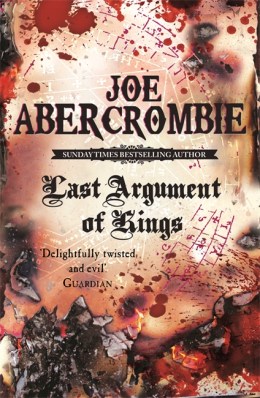
AbercrombieJ-FL3-LastArgumentOfKingsUK1A strong finish to The First Law trilogy
The end is coming.

Logen Ninefingers might only have one more fight in him – but it’s going to be a big one. Battle rages across the North, the king of the Northmen still stands firm, and there’s only one man who can stop him. His oldest friend, and his oldest enemy: it’s time for the Bloody-Nine to come home.

With too many masters and too little time, Superior Glokta is fighting a different kind of war. A secret struggle in which no one is safe, and no one can be trusted. As his days with a sword are far behind him, it’s fortunate that he’s deadly with his remaining weapons: blackmail, threats, and torture.

Jezal dan Luthar has decided that winning glory is too painful an undertaking and turned his back on soldiering for a simple life with the woman he loves. But love can be painful too – and glory has a nasty habit of creeping up on a man when he least expects it.

The king of the Union lies on his deathbed, the peasants revolt, and the nobles scramble to steal his crown. No one believes that the shadow of war is about to fall across the heart of the Union. Only the First of the Magi can save the world, but there are risks. There is no risk more terrible, than to break the First Law…

It is always tricky to review the final book in a trilogy or series. So how to go about it, with a series and novel that I could talk about for hours? To avoid spoilers or over-analysis requires a very short review. But, “This is the culmination of a superb series” seems just too short… The Blade Itself started the series in fine form. Before They Are Hanged kicked things into a much higher gear. And Last Argument of Kings brings things to a brash, loud conclusion. Continue reading

Review: PROMISE OF BLOOD by Brian McClellan (Orbit)

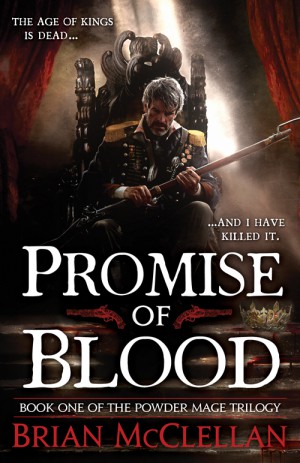
McClellanB-PM1-PromiseOfBloodOne of 2013’s most Hotly-Tipped Fantasy Debuts

“The Age of Kings is dead. And I have killed it.”

Field Marshal Tamas’s coup against his king sends corrupt aristocrats to the guillotine and brings bread to the starving. But it also provokes war in the Nine Nations, internal attacks by royalist fanatics and greedy scrambling for money and power by Tamas’s supposed allies: the Church, workers’ unions and mercenary forces.

Stretched to his limit, Tamas relies heavily on his few remaining powder mages, including the embittered Taniel, a brilliant marksman who also happens to be Tamas’s estranged son, and Adamat, a retired police inspector whose loyalty will be tested to its limit.

Now, amid the chaos, a whispered rumour is spreading. A rumour about omens of death and destruction. Just old peasant legends about the gods returning to walk the earth. No modern educated man believes that sort of thing…

But perhaps they should.

I’ve been looking forward to this novel for a good long while. When I was finally able to get my mitts on a copy, I tore into it, and blitzed through it far quicker than I normally do for a 500+ page novel. Bottom line, while there are a few niggles, Promise of Blood is a lot of fun, and the start of something potentially fantastic. Continue reading

Upcoming: “The Raven’s Shadow” by Elspeth Cooper (Gollancz)

Cooper-RavensShadowI’ve not been very good at keeping up with Elspeth Cooper’s Wild Hunt series. I enjoyed Songs of the Earth, but still need to catch up with Trinity Rising, the second novel in the series. The Raven’s Shadow is the third of four novel in the series, and will be published in August 2013. Here’s the synopsis:

Three moons are rising.

They are rising over the snowy Archen Mountains, where Teia struggles through the high passes to carry her warning to the Empire: the Nimrothi war band is poised to invade and at their head stands Ytha. She means to release the Wild Hunt – and with it Maegern the Raven, the Keeper of the Dead.

In the desert of Gimrael, the moons are rising over the fires of revolution – flames that have already robbed Gair of a friend and left him alone in a hostile city, unsure even if the Song is still his to command. He has one last duty to discharge, and then nothing will stand between him and his ultimate goal: vengeance.

And in the Nordmen’s chilly halls, Savin plays out a game in which kings and chieftains and men are but pawns on a chessboard that spans the Veil itself.

Three moons are rising. When the trinity is complete, the endgame will begin.

The fourth-and-final book in the series, The Dragon House is due to be published (according to Amazon UK) one month after this, in September 2013… Not sure if that can be right. Regardless, this is an interesting series, and well worth your attention.

Also on CR: Interview with Elspeth Cooper

***

UPDATE: Just heard back from Elspeth – this is not the final artwork, but just one that Amazon UK has used and that seems to be doing the rounds on the internet. And, also, book four will be published in 2014. Updates to follow, as-and-when information becomes available. I also inserted a new synopsis, provided by the author, substituting it for the Amazon UK synopsis (below).

Sometimes those with the greatest potential must withstand the hardest blows. Fate, it seems, has nothing kind in store for Gair. First his lover and now his mentor have been killed – the first by the dangerous, ambitious Savin, the second in a revolutionary uprising. Alone, and with even his magical abilities betraying him, he has only one goal left: revenge. Far to the north, if Teia has one goal it is survival. Attempting to cross a high mountain pass in the teeth of winter is an act of desperation, but the message she carries cannot wait for spring. An invasion force is gathering behind her, and only an ancient order of knights can hold them back. The danger is real, there are enemies in the shadows, and time is running out…

Upcoming: “The Black Guard” by A.J. Smith (Head of Zeus)

SmithAJ-BlackGuardThere’s been a little bit of buzz surrounding this novel, but not as much as I’ve expected. The Black Guard is the first in A.J. Smith’s The Long War fantasy series.

I actually read a little bit of a very early version of The Black Guard on submission when I was interning at a publisher last year, only to discover that Head of Zeus had already picked it up. Nevertheless, I was happy to learn it was going to make it to the shelves, and I look forward to reading the final version.

Here’s the synopsis:

The Duke of Canarn is dead, executed by the King’s decree. The city lies in chaos, its people starving, sickening, and tyrannized by the ongoing presence of the King’s mercenary army. But still hope remains: the Duke’s children, the Lord Bromvy and Lady Bronwyn, have escaped their father’s fate.

Separated by enemy territory, hunted by the warrior clerics of the One God, Bromvy undertakes to win back the city with the help of the secretive outcasts of the Darkwald forest, the Dokkalfar. The Lady Bronwyn makes for the sanctuary of the Grass Sea and the warriors of Ranen with the mass of the King’s forces at her heels. And in the mountainous region of Fjorlan, the High Thain Algenon Teardrop launches his Dragon Fleet against the Red Army. Brother wars against brother in this, the epic first volume of the long war.

It’ll be interesting to see how this shapes up. It’ll be released as a Special Edition and also a “standard” Hardcover in August 2013.

Interview with AL EWING

EwingA-TheFictionalMan

Al Ewing has been writing some interesting British SF and Comics for many years now. With the upcoming release of his latest novel, I thought it would be a good time to ask him about his work, practices and so forth.

Let’s start with an introduction: Who is Al Ewing?

Ewing-Zombo-CanIEatYouPleaseAl Ewing is a writer of comics and novels, predominately SF, and he feels odd talking about himself in the third person so he’ll stop… I’m likely best known for my 2000AD work – I’ve written a few well-received Judge Dredd strips, and I’m the co-creator of Zombo, a dark slapstick satire of whatever’s within reach that’s been running for a few years to critical acclaim. In terms of novels, I’ve up until now mostly done work for hire in other people’s fictional universes – not that I’m complaining; it was a lot of fun. Probably my best-known work in that direction is the El Sombra trilogy for the Pax Britannia line from Abaddon Books.

I thought we’d start with your fiction: Your latest novel, The Fictional Man, was recently published by Solaris. How would you introduce the novel to a potential reader? Is it part of a series?

It’s a stand-alone novel – you don’t have to worry about picking up any others, and I don’t think I’m going to be writing any sequels. I suppose I’d try and sell it to a new reader by saying it’s a conversation on the nature of reality and fiction that’s wrapped up in a bunch of funny business, heartfelt tragedy and, occasionally, hot kinky sex. Ordinarily I wouldn’t mention that last bit but judging by recent blockbuster runaway successes in the prose field there’s a huge audience for it.

EwingA-TheFictionalMan

What inspired you to write the novel? And where do you draw your inspiration from in general?

It spun out of a small-press comic strip I did years ago – literally over a decade ago – and I thought the concept of fictional characters being brought into the real world as Hollywood celebrities was interesting enough for a longer-form piece. It was just a matter of when I’d get the chance to do that. So when Solaris approached me and asked if I had any ideas, that was the first one I went to.

In general… I spend a lot of time on magical thinking, which isn’t much good when it comes to practical issues – in fact it’s actively harmful when you apply it to, say, the economy or whether the rights of your fellow humans should be dictated by imaginary beings – but it is good for writing. I suppose if I had to give advice to a new writer it would be to let your mind wander as much as possible. (Try and spend some time actually writing as well, mind. In fact, if you can do both at once you’ll know you’ve made it.)

How were you introduced to genre fiction?

Ewing-JudgeDreddWhen I was a small boy, my brother introduced me to a comic called 2000AD, which I might have mentioned earlier. It was obviously brilliant – this was during the hot streak of the mid-eighties – and I quickly graduated to the American comics, and I’ve been in love with the comics medium ever since. Much as I enjoy playing with the prose format, you can do a lot more with comics, I find.

How do you enjoy being a writer and working within the publishing industry? Do you have any specific working, writing, researching practices?

I like it! It’s nice work if you can get it. As for specific working practices… I always make sure to write lots of things at the plotting stage that won’t let me get bored at the actual writing stage. With The Fictional Man, I put in a lot of differing formats – nested texts within the central text – so I could change my style up a little. For example, there’s one chapter which breaks into screenplay format for a while, and then another that takes the form of a review similar to what you might find on the Onion AV Club. It’s little things like that that help keep everything fresh.

Ewing-AbbadonBooks

More of Al’s novels from Abaddon Books

When did you realize you wanted to be an author, and what was your first foray into writing? Do you still look back on it fondly?

I used to write a lot as a kid – little columns for school newsletters, short stories, short plays. I used to spend hours writing things just for my own pleasure, without any thought of getting paid or making a living. These days, everything has a deadline attached, and while everything I write is still first and foremost for myself – you can’t write otherwise – I don’t really dive into something purely for its own sake anymore. I’m always writing to a brief, even if that brief is “pitch us something, anything”. Maybe that’s why I end up putting all these formal diversions and side-roads into the professional work I do, to scratch that old itch.

Ewing-Dynamite

For Dynamite Comics, Al also wrote Ninjettes (#1-6) and Jennifer Blood (#7-24)

What’s your opinion of the genre today, and where do you see your work fitting into it?

I have no real opinion of the modern SF genre, to be honest. I don’t really read any – most of my book-reading time is spent either on non-fiction or crime fiction – the solid, tough noirs and procedurals of Richard Stark, Ed McBain and, most recently, Chester Himes. I read a lot of comics too – if you asked me where I fit into the comics world I’d probably say that I was trying to push the boundaries of what could be done, in terms of the form, where I could, and the rest of the time just trying to give the readers some value for money so they didn’t feel disappointed when they put the issue down. I have the same approach to my novel work, except I don’t really keep up on the SF ‘scene’, so I have no idea if I’m pushing against open doors. Buy the book and find out!

What are you reading at the moment (fiction, non-fiction)?

I’m in the middle of All Shot Up by Chester Himes, and then I’ve got The Deportees by Roddy Doyle waiting for me after that. Bossypants by Tina Fey is the current non-fiction book, though I just recently finished Marvel: The Untold Story by Sean Howe and I’d recommend that, with the caveat that it becomes a very different book in its final quarter.

Ewing-Reading

What’s something readers might be surprised to learn about you?

I’ve never taken LSD. Or anything psychoactive. Me and Magic Roundabout.

What are you most looking forward to in the next twelve months?

I just had a very tasty opportunity from a comics company who should probably remain nameless for now. And I’ll likely pitch something else for Solaris, though I tend to leave plenty of time between prose novels to let myself forget how hard they are to write.

Look at all the Pretties Coming from Orbit…!

That’s my rather fanboy-esque way of titling a post featuring a LOT of new artwork. I missed the original post, when it went up in March, but I thought I’d share some of the images on here. Because they’re pretty marvellous:

OrbitReleases-2013

Ones that really stand out for me are Peter HigginsTruth And Fear (I assume this will be published by Gollancz in the UK, as Wolfhound Century was):

Higgins-Truth&Fear

Simon Morden’s Arcanum, which I’ve never heard of (but his Sci-Fi has been very well received)…

Morden-Arcanum

And the third book in Francis Knight’s debut trilogy, Last to Rise:

KnightF-LastToRise

Interview with DJANGO WEXLER

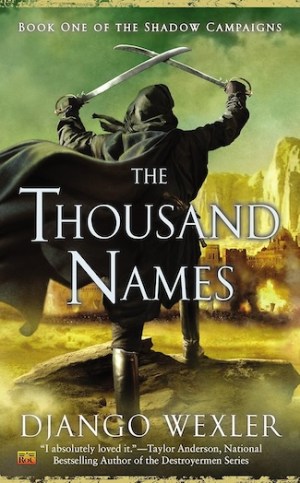
WexlerD-SC1-ThousandNamesUSI’ve been trying to remember how I first came across the name Django Wexler. It was probably via Twitter or a publisher’s catalogue. Since finding out about his next novel, The Thousand Names, I’ve had the chance to chat with Mr Wexler a good deal about fiction and more on the Twitters. With just a couple of months to go before the novel hits shelves (one of my most-anticipated novels of 2013), I thought it would be a perfect time to shoot him some questions. He agreed, so here are his responses…

Let’s start with an introduction: Who is Django Wexler?

That sounds kind of existential. Is the correct answer “I am!”?

Excellent, well done. You’ve passed the first test…

So: I’m Django Wexler, fantasy author. Until fairly recently I was Django Wexler, programmer/writer for Microsoft. I grew up in Westchester, NY and went to school at Carnegie Mellon, in Pittsburgh, where I managed to get degrees in Computer Science and Creative Writing. I moved out to Seattle about five years ago to be where the tech jobs are, which is starting to seem a little ironic now that I no longer work in tech. Continue reading

Upcoming: “Steelheart” by Brandon Sanderson (Gollancz)

Spotted this on Amazon UK, while looking up info for any new Brandon Sanderson releases, and thought I’d share it on here:

Sanderson-Steelheart

Ten years ago, Calamity came. It was a burst in the sky that gave ordinary men and women extraordinary powers. The awed public started calling them Epics.

But Epics are no friend of man. With incredible gifts came the desire to rule. And to rule man you must crush his wills.

Nobody fights the Epics… nobody but the Reckoners. A shadowy group of ordinary humans, they spend their lives studying Epics, finding their weaknesses, and then assassinating them.

And David wants in. He wants Steelheart — the Epic who is said to be invincible. The Epic who killed David’s father. For years, like the Reckoners, David’s been studying, and planning — and he has something they need. Not an object, but an experience.

He’s seen Steelheart bleed. And he wants revenge.

Disclaimer: I work for Brandon’s UK Agent

Steelheart will be published in the UK by Gollancz in September 2013. I was lucky to get my mitts on a copy, though, and I blitzed through the first quarter of the novel last night – it’s a lot of fun. I’ll do a quick sort-of-review on here when I’ve finished it. If you’re a fan of super-heroes, but always wondered what humans would do if the super-powered persons all used their abilities for evil… Well, this could be the novel for you.

I also hope it’ll open up the sub-genre of super-hero fiction, as I’d like to read more of it. (And I’m writing one myself, actually…)

Here’s the US artwork for the novel (to be published by Delacorte in September as well):

Sanderson-SteelheartUS

Guest Post: Can there be such a thing as “Too Much Fantasy?” by David Emrys

David E. Emrys is the author of a couple of self-published fantasies. I got to chatting with him on Twitter, and he seemed like a good fellow. So I asked if he’d like to write something. And he did. So here it is.

image

Is the fantasy world over-populated? It’s a valid question and one that keeps raising its ugly head in the current era of ‘Lord of the Authors: The Fellowship of the Fantasy’.

Without battling out the topic of Indie vs Traditional, I want to take a moment and talk about fantasy worlds. A simple blog post can’t cover every single fantasy tome to have ever graced a book shelf (or a digital market place like Amazon, for all you e-publishing gurus), but we can highlight a few.

J.R.R. Tolkien with his elves, and his dwarves, his hobbits with their hairy feet, and his trolls. Ringwraiths, a dark lord, and a powerful artefact that is a curse to all those who bear it.

George R.R. Martin with his thrones, and his games, the squabbles of men, and the treachery, futility and thick-fast plots (oh, and if you’ve watched the TV adaptation, there’s a fair number of boobs, too).

Ursula K. Le Guin – if there was a Godmother of fantasy, it would be le Guin. Her stories are folklore brought to life, magic and mysticism intoned with a rich world building.

Robin Hobb, who’s back catalogue boasts more tomes than the knives of Joe Abercrombie’s cast (below) – claimed by Orson Scott Card to have “set the standard for the most serious fantasy novel”.

Peter V. Brett – demons galore! How ‘man’ (and woman!) can overcome their fears for what they believe is right.

Karen Miller strives to break down the old fantasy clichés, using them where she will, but bending and twisting them into something new, pushing ‘fantasy’ into a more ‘fantastical’ realm.

Mark Lawrence explores the moral depravity of a Prince who won’t let anything – or anyone – stand in his way, even if that involves burning the world just to keep warm.

Michael J. Sullivan brings bromance to the fold (Webster’s unofficial definition of bromance: “bro-mance, a combination of brother and romance, meaning ‘a brotherly romance’ between two males.” Often seen sharing large quantities of bruises, beauties, and beatings) with a healthy dose of death-defying escapades and swashbuckling adventures.

John Gwynne breaths fresh life into the folklore and legend side of fantasy, giving Giants, Wyrms and even Angels a gritty new lease with a Nordic/Celtic feel.

Brent Weeks forefronts assassins in one, and mages in another, but above all else they struggle with their own powers for further means.

Brandon Sanderson… Magic, need I say more? But then again, his world-building is second to none.

Joe Abercrombie touts more knives than any sane man should ever need, but lucky for us not all of his characters can be deemed sane enough to count or care for that matter. But when all is said and done, it’s down to being what you’re meant to be, and (as he often states by way of infamous barbarian Logen NineFingers) once you’ve got a task to do, it’s better to do it than live with the fear of it.

Helen Lowe, a relative newcomer to the fold, but with her fresh blood added to the mix, the 2012 Gemmell Award winner (Morningstar category) weighs in with a hefty dose of darker, grittier fantasy and a deeper meaning of how we treat each other.

I’ve barely even touched the surface here. I could go on for hours. James Barclay, David Gemmell (big daddy of British heroic-fantasy), Robert E. Howard, Patrick Rothfuss, Robert Jordan, Tamora Pierce, David Dalglish, Mazarkis Williams, Moses Sirergar III, Ben Galley, Steven Erikson, Christopher Paolini… ok, ok – I’ll stop, now.

So, the fantasy genre is a busy set of worlds. But each and every one of them is different. Yes, a lot of them share themes or creatures (elves, dragons, hobbits, dwarves, damsels in distress… hobbits, or other creatures with hairy feet?), but would you really say: “No more!” Heck, I’m sure if you asked a lot of these authors they’d admit to being inspired by one another. Of course they would.

Ok, let’s imagine if someone said “No more” to Robert Jordan. Would we have the Peter V. Bretts, and Christopher Paolinis of today? “Put that pen down, David Gemmell…”, and voila, no John Gwynnes or James Barclays. How many would we lose if Robert E. Howard had run out of ink on the first page, and Conan had been lost to an unfinished sentence?

IMAGINE THE CHAOS if someone told J.R.R. Tolkien to shave his hobbit and write a rom-com? Think of the children, pray for their futures!

Publishing is an ever changing industry, and fantasy is an ever changing realm of possibilities. If you’re Indie or Traditional, reader or writer… could you really say NO to one last fantasy? And before you start culling dwarves, shaving hobbit feet, or cashing in dragons’ fangs and hoards for the last copy of 50 Shades of Grey, just remember:

A Fantasy author isn’t just for Christmas. They’re for life.

(And even then, they’ll think of a way to come back and haunt you from the afterlife – they are, after all, in the business of fantasy.)

***

D.E.M. Emrys is the author of two eBooks in his Wroge Elements fantasy series: From Man to Man (UK/US – currently free on both) and It Began With Ashes (UK/US).

EmrysDEM-WrogeElements