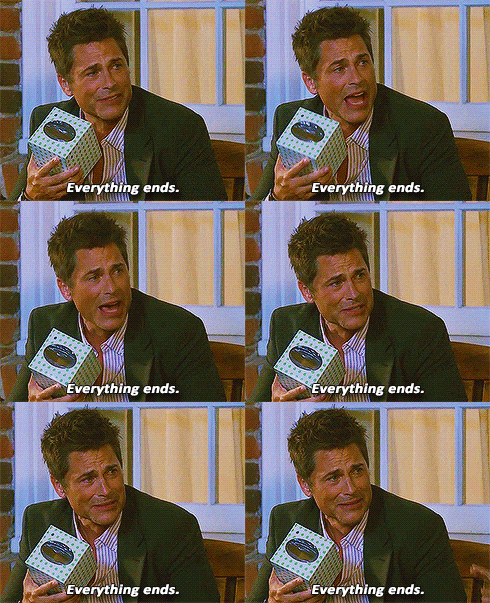
This Year, Everything Ends… Apparently. (With GIFs…)

RobLoweEverythingEndsFirst DC Comics brought us Future’s End, and also Convergence. Marvel comics brought everything sort-of-not-really to an end (so they can have another new beginning-that-isn’t-a-reboot-we-promise). More relevant to this post, Black Library/Games Workshop also brought us the End Times. It would appear that 2014/15 is the year to bring everything to an end so we can start anew. DC and Marvel’s reboots aren’t particularly game-changing — yes, there are some major changes, but functionally everything’s staying pretty much the same, save for Marvel’s series naming strategy, which is moving in a direction that looks like parody: “All-New” is becoming “All-Different All-New”… Which is something I joked about last year. So, +1 divination/prediction for me.

This brings us to Games Workshop’s End Times and what, revealed today, it has been replaced wit. Continue reading
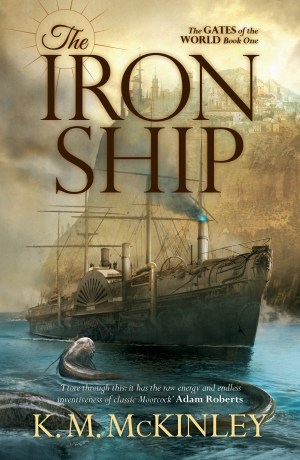
Guest Post: “Whole Cloth Worlds, A Cheeky Cost-Benefit” by K.M. McKinley

McKinleyKM-GoW1-IronShipWorld-building is a cool part of fantasy, but one of the hardest things to get right.
I like realistic worlds in my fiction. By its very nature, a goodly part of fantasy eschews them. A big chunk of the genre tends to fairly simple settings the better to tell its stories. There’s a real art to writing books like that, and as a narrative style it has its advantages, but it sacrifices verisimilitude. Fair enough, not everyone wants reality in their fantasy. The clue, you may say, is in the name. Who wants realistic fantasy?

Well, I do. I do want reality in my fantasy, as counter-intuitive as that sounds. I’m firmly of the school that the stranger the world is, the more real it has to feel. Construct a real enough imaginary environment and anything seems possible. I love Sword and Sorcery, with its vertiginous sense of deep time and holy-cow weirdness. I like the less grand guignol end of grimdark, as it suggests grubby existences of high infant mortality rates and oppressive lives lived in suffocating cultures. I love worlds with real ecologies, societies, economies and geographies. All of the “ies” Bring me more, so that I might feast upon them! Michael Swanwick, Michael Moorcock, Gene Wolfe, Ursula Le Guin, Robert E. Howard, Clark Ashton Smith, Fritz Leiber, Richard Morgan, George R.R. Martin, Robert Silverberg and of course JRR Tolkien – these are writers whose works I love. Continue reading

Review: FALLING IN LOVE WITH HOMINIDS by Nalo Hopkinson (Tachyon)

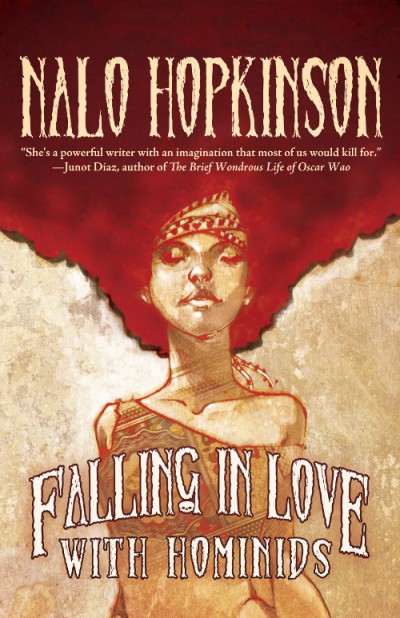
HopkinsonN-FallingInLoveWithHominidsA new anthology of short stories

Nalo Hopkinson (Brown Girl in the Ring, Skin Folk) has been widely hailed as a highly significant voice in Caribbean and American fiction. She has been dubbed “one of our most important writers,” (Junot Diaz), with “an imagination that most of us would kill for” (Los Angeles Times), and her work has been called “stunning,” (New York Times) “rich in voice, humor, and dazzling imagery” (Kirkus), and “simply triumphant” (Dorothy Allison).

Falling in Love with Hominids presents more than a dozen years of Hopkinson’s new, uncollected fiction, much of which has been unavailable in print, including one original story. Her singular, vivid tales, which mix the modern with Afro-Carribean folklore, are occupied by creatures unpredictable and strange: chickens that breathe fire, adults who eat children, and spirits that haunt shopping malls.

Reviewed by Ryan Frye

I typically read short fiction for one of two reasons, either it’s an author whom I love, and I’ve devoured everything else of theirs so I dig into their short-form stuff, or it’s an author whom I’ve never read before and I want to sample their work without trying to pick out a full-length book to start with. The latter was the case with Nalo Hopkinson’s Falling in Love with Hominids. Hopkinson is an author who’s been on my radar for a while now, so when the opportunity came along to check out her yet-to-be-released short fiction collection I jumped at the chance. Continue reading

Guest Post: “On Writing – I do it My Way” by Sue Tingey

TingeyS-AuthorPicI would imagine if you ask half a dozen writers about how they get their ideas and how they go about putting them down on paper you would get a half a dozen different answers. For me, it changes from project to project. On the whole though, there are certain definites to my writing regime and process.

I try to be disciplined about my writing as that’s the only way it works for me. I write every weekday morning without fail from 7 a.m. until 8.30 a.m., and sometimes later when I’ve got caught up in a scene and forgotten the time. Fortunately I have a very supportive boss – at least he hasn’t sacked me yet! In these one and a half hours I re-read and edit the work I wrote the previous day to get me back into the flow and then I aim for a count of between 700 and 1000 words. If I manage more, I’m happy. If I write less than 700 – well, let’s not go there. Meeting the daily word count keeps me focused and if I wasn’t so strict on myself I would probably flounder and not get anything finished. Continue reading

Guest Post: “Juggling YA and Adult Fantasy Writing” by David Hair

HairD-AuthorPicI read a bit of everything (except romance), but fantasy has always been my big love. I blame that on my introduction to Tolkien at an impressionable (teen-)age. Since then, I’ve been through all of the usual suspects as I explored this amazing genre. I knew I wanted to write a genre novel, but it took a while to overcome a lack of confidence, and a lack of time.

What excited me most were epic fantasies: big juicy stories with apocalyptic plot-lines, huge casts and many complex threads, and a whole imagined world to explore. When I did find time to write however, my best idea happened to be better suited to a teenage/YA audience. Growing up in New Zealand, the son of a truck driver who thought nothing of driving his family for hours to visit friends and relatives, I saw a lot of the countryside. Being enamoured of mythology and history, as I stared out of the windows, I began to populate the landscape with historical places and mythic creatures. The result was The Bone Tiki, which won Best First Book at the New Zealand Children’s Book awards in 2009, and had some commercial success. That opened up the opportunity for me to write sequels, the sum of which (six books) collectively became known as The Aotearoa Series. I wrote most of those books while living in New Delhi, India. My wife works for Immigration New Zealand, and was posted to India for four years. Whilst there, I also wrote The Return of Ravana, a four book YA series set in India. Continue reading

Guest Review: TRAITOR’S BLADE by Sebastien de Castell (Jo Fletcher Books)

deCastellS-GC1-TraitorsBladeAnother perspective on the first Greatcoats novel

The King is dead, the Greatcoats have been disbanded, and Falcio Val Mond and his fellow magistrates Kest and Brasti have been reduced to working as bodyguards for a nobleman who refuses to pay them. Things could be worse, of course. Their employer could be lying dead on the floor while they are forced to watch the killer plant evidence framing them for the murder. Oh wait, that’s exactly what’s happening.

Now a royal conspiracy is about to unfold in the most corrupt city in the world. A carefully orchestrated series of murders that began with the overthrow of an idealistic young king will end with the death of an orphaned girl and the ruin of everything that Falcio, Kest, and Brasti have fought for. But if the trio want to foil the conspiracy, save the girl, and reunite the Greatcoats, they’ll have to do it with nothing but the tattered coats on their backs and the swords in their hands, because these days every noble is a tyrant, every knight is a thug, and the only thing you can really trust is a traitor’s blade.

Reviewed by Ryan Frye

I began reading Sebastien De Castell’s Traitor’s Blade late one night and the next thing I knew, it was even later, and I was already a fair chunk into the book. This is one of those books that grabbed my attention immediately and made it easy for me to submerse myself into this new fantasy world and all its trappings. De Castell does this with quick, action packed pacing and a first person narrative voice that makes the story easy to fall into. From page one, there’s great, witty dialog and a dragon’s horde of action. These two elements were the driving forces that kept me reading of Traitor’s Blade as I found some areas where I struggled with the novel. Continue reading

Interview with PETER ORULLIAN

OrullianP-VoH1-UnrememberedUSCrop2

Let’s start with an introduction: Who is Peter Orullian? 

OrullianP-AuthorPicMy rote answer is that I have two abiding passions in life: writing, and music. In addition to my fiction, I’m also a musician. I spent many years in classical voice training. And I love almost all kinds of music: jazz, Broadway, classical, etc., in addition to rock and metal.

By day, I work for Xbox, which is good, since I’m a gamer. But I’m also a dad. Kids are awesome.

Your next novel, Trial of Intentions, was recently published by Tor. It’s the second in your Vault of Heaven series. How would you introduce the series to a potential reader? And what can fans expect from the new novel?

When I started my series, The Vault of Heaven, I had this idea: Write a series that uses some of the familiar elements of the genre to gently lead readers to someplace new. Someplace my own. That idea begins to kick in with the first book. Then, with Trial of Intentions, it kicks into high gear. Things aren’t what readers are expecting. And a few of my early readers have said they’ve loved having me violate their expectations. Continue reading

An Interview with SUE TINGEY

TingeyS-AuthorPicLet’s start with an introduction: Who is Sue Tingey?

Hi Stefan, thank you for inviting me to be interviewed.

Who is Sue Tingey? That is actually rather a deep question and I’m probably the last person you should ask, but I’ll have a go at giving a sensible and possibly truthful reply:

I’m a book and animal lover. Married with no pets at the moment except for some Koi carp. I’m slightly obsessive about things that matter and couldn’t really give a damn about things that don’t (though this has taken years to perfect – I used to be a natural born worrier). I love horror films but only if viewed from behind a cushion or, if no cushion available, from between my fingers. I hate animal films because I spend the whole hour and a half sobbing. I put it down to being traumatised by Disney’s Old Yella when I was a child. As for Marley and Me – don’t even go there.

Your debut novel, Marked, will be published by Jo Fletcher Books. It looks rather fabulous: How would you introduce it to a potential reader? Is it part of a series?

Thank you kind sir. Marked is the first book of the Soulseer Chronicles and is about Lucky de Salle, a young woman who, for as long as she can remember, has been able to converse with the dead. Even her best – and only – friend Kayla is a ghost. The book starts when Lucky reluctantly returns to her old school, from which she was expelled fifteen years earlier, to help with a haunting brought about by three boarders playing with a Ouija board. As it happens her instincts are correct: ghosts are the least of her worries – the schoolgirls have called up a daemon and he has a message for Kayla. From this point on Lucky finds that no one she meets is who they say they are and even her best friend has been keeping secrets. Soon she’s caught up in the political intrigues of a world she never knew existed, and her already weird life gets weirder by the moment. Continue reading

Guest Post: “Don’t Hold the Horses” by Arianne “Tex” Thompson

ThompsonAT-AuthorPicYou know how there’s this one genre that we call “swords and horses” fantasy? It’s a heck of a thing. They’re kind of the PB&J of old-school fantasy: tasty, familiar, and they go so well together. But it’s not exactly an even relationship, is it?

I mean, the swords – let’s be real, The Sword – gets all kinds of literary limelight. It’s got a name, a big ol’ backstory, some awesomesweet epic powers, and probably a good chunk of the hero’s destiny riding around in its carbon-steel interior. More often than not, that sucker actually drives the plot.

So why no love for the horses? Size, sex, color, and that’s it. Maybe a name, if it’s going to be a long-term fixture, and not stolen by goblins or eaten by were-possums at the end of the first act. But unless the horse is some kind of magical creature (with a big tip o’ the hat to Misty Lackey’s Heralds of Valdemar series!), you can almost guarantee that it’s just a half-ton inventory item – as if only the fantasy elements of a fantasy story are allowed to be interesting or important.

I vote we change that. And I think a lot of writers would be up for trying – it’s just that we’re not really sure how. After all, most of us don’t live within thirty miles of a horse, nevermind own or ride one. The only time pop culture shows them to us as characters in their own right is either when they’re the focal point of the story (Black Beauty, Seabiscuit, etc.) or else when someone’s following the “basically furry humans with speech impediments” Disney sidekick model. Continue reading