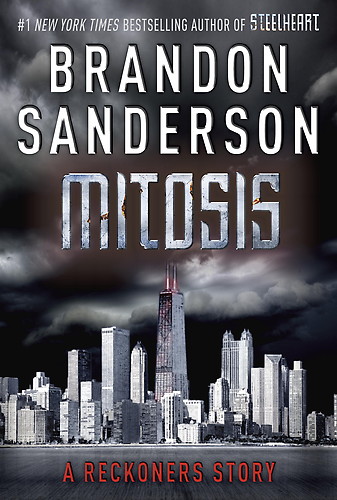
Review: MITOSIS by Brandon Sanderson (Gollancz)

Sanderson-R-MitosisUSA good short story stop-gap between Steelheart and Firefight

Epics still plague Newcago, but David and the Reckoners have vowed to fight back.

Sanderson self-published this short story, set in the same world as his first super-hero novel, Steelheart. I rather enjoyed the novel (which was the first of the author’s that I’ve read), and when I stumbled across this I was very happy to be able to dive back into the world he’s created. I’m not going to include an official synopsis, as that will give away the ending of Steelheart.

Nevertheless, what you need to know (for both the novel and Mitosis) is that in this reality, super-heroes exist – something happened that bestowed upon a small percentage of the global population special powers. Unlike in the super-hero comic books of Marvel, DC, et al, the power has very much gone to most of these powered individuals’ heads, and they started using them for their own ends. In Chicago, Steelheart reigned supreme with a coterie of other powereds. Steelheart the novel was the story of a fight against this tyranny, spear-headed by an insurgent group known as the Reckoners and their new ‘recruit’, who is a bit of a geek, and has been cataloguing the powered dictators and criminals as a means to learn of their weaknesses.

Mitosis deals with a single powered individual: Mitosis. The story moves quickly, and there is a rather nifty homage (perhaps) to Agent Smith from second and third The Matrix movies. That is all I shall say on the specific plot of this story.

If you are familiar with Sanderson’s writing – be it The Way of Kings or his Mistborn series – then you are sure to know what to expect: brisk, engaging and professional storytelling. The man can certainly write, and I intend to get more of his novels read by the end of this year. [Famous last words, perhaps, but I managed to read three of the four authors I promised to last year…]

Short, but well-worth reading to hold you over until the release of Firefight.

***

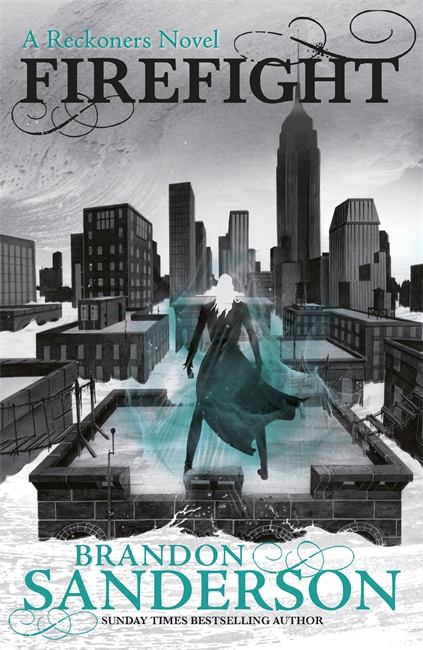
UPDATE: When I first wrote this, Gollancz had yet to announce the UK cover art, which I have now included below. The UK hardcover edition also includes an excerpt from Firefight and also some character sketches. It’s a really great little book. Perfect for any fan of Sanderson’s writing.

Sanderson-R2-FirefightUK

Upcoming: “Vengeful Spirit” by Graham McNeill (Black Library)

McNeill-HH-VengefulSpiritI’ve already posted the full artwork for Graham McNeill’s next Horus Heresy novel, Vengeful Spirit. Now, however, I’ve managed to dig up a synopsis, which gives me another opportunity to feature it – I’m sure everyone who reads CR is fully aware of how much I enjoy the HH series of novels and short stories. So, without further ado…

On the planet of Molech, the Titan Legions go to war against the armies of Horus.

Once the favoured son of the Emperor of Mankind, the name of Horus has become a curse to the loyal defenders of the Imperium, and a rallying call to the traitor forces tearing across the galaxy. While their allies wage war on a thousand different fronts, the XVIth Legion descend upon the Knight World of Molech – home to House Devine and their feudal levies, and a principal seat of Imperial military power. Just what could have drawn Horus to attack such a strongly defended planet, and what might he be willing to sacrifice to fulfill his own dark destiny?

I’m still not 100% sure when this is going to be released – Amazon UK has September 2014 listed as publication, but Black Library often releases things a little earlier through their own store/website. So maybe a couple months earlier? Needless to say, whenever it’s available, I can’t wait to read it.

The Horus Heresy: Horus Rising, False Gods, Galaxy in Flames, Flight of the Eisenstein, Fulgrim, Descent of Angels, Legion, Battle for the Abyss, Mechanicum, Tales of Heresy, Fallen Angels, A Thousand Sons, Nemesis, The First Heretic, Prospero Burns, Age of Darkness, The Outcast Dead, Deliverance Lost, Know No Fear, The Primarchs, Fear to Tread, Shadows of Treachery, Angel Exterminatus, Betrayer, Mark of Calth, Promethean Sun, Scorched Earth, Vulkan Lives, Scars (episodes I-III, IV-IX, X-X11), The Unremembered Empire

Upcoming: “The Truth About the Harry Quebert Affair” by Joël Dicker (Maclehose Press)

DickerJ-TruthAboutTheHarryQuebertAffairUKI’ve been seeing a lot of buzz surrounding Joël Dicker’s latest novel, The Truth About the Harry Quebert Affair. Last year, I started reading more (literary) fiction, and I’ve become as keen on finding new novels in all genres, and not just SFF, to feature on here. I’ve become particularly interested in American literary fiction – author such as Michael Chabon, Donna Tartt, Richard Russo, and Claire Messud to name but four (all but one of whom have featured on the blog already). It was therefore interesting to me that Dicker’s novel has created such a storm (it has sold over two million copies on the continent) and that it has even been hailed as having “all the elements of the Great American novel” (La Croix), despite Dicker actually being Swiss. Now that Maclehose Press has unveiled the UK artwork for the novel, I thought it a good time to post a quick something about it.

The novel is translated by Sam Taylor, who also translated HHhH. Here’s the synopsis…

Who killed Nola Kellergan?

Marcus Goldman, the toast of the New York literary scene, is at his wit’s end after being struck by writer’s block. Desperate not to lose his new found fame and in search of inspiration he decides to spend a few weeks in New Hampshire at the home of Harry Quebert, world famous author and his mentor from university.

During his stay, Marcus discovers that in 1975, aged 34, Harry had an affair with 15 year old Nola Kellergan. The summer of their affair, Nola disappeared after she was seen running through the woods, covered in blood. No one has seen Nola since and no one knows what happened.

Then the unthinkable happens, 33 years after her disappearance, the body of Nola Kellergan is found in Harry’s garden. Determined to prove Harry’s innocence, Marcus gets embroiled in the murder case of the century, while everywhere in America people are asking: Who Killed Nola Kellergan?

Not just a book about an unsolved murder case, The Truth about the Harry Quebert Affair explores the price of fame and the seduction of success, the ferocity of the publishing industry and the power of the media, love in all its forms and what it means to be a truly great writer.

The Truth About the Harry Quebert Affair is published in the UK by Maclehose Press, in May 2014.

Upcoming in the UK: “Black Jewels Trilogy” by Anne Bishop (Jo Fletcher Books)

Anne Bishop’s award-winning BLACK JEWELS trilogy is coming to the UK! The first trilogy in the series will be published in the UK by Jo Fletcher Books: Daughter of the Blood (March 6th 2014), Heir to the Shadows (May 1st), and Queen of the Darkness (July 3rd). JFB are publishing the first trilogy in Bishop’s Urban Fantasy series, but in the US the series has already grown to nine books, published by Roc Books. (If they’re as successful in the UK as across the pond, I’m sure the others will soon follow!) Below are the synopses for the three novels, and also the covers for the first two (third hasn’t been unveiled just yet).

Bishop-BJ1-DaughterOfTheBloodUKDAUGHTER OF THE BLOOD:

The Darkness has had a Prince for a long, long time. Now the Queen is coming.

For years the realm of Terreille has been falling into corruption, as the powerful Queens who rule it have turned to cruelty.

But there is hope – a prophetic vision has revealed the coming of a Queen more powerful than any other. And once the foundations of her power – father, brother, lover – are in place, she will emerge from the darkness, bringing freedom.

For she is the living myth, dreams made flesh; not just any witch, but Witch.

Bishop-BJ2-HeirToTheShadowsUKHEIR OF THE SHADOWS:

Witch – the Queen who would bring freedom to the realms – has come, but now she is lost in darkness, and has a long road to recovery ahead of her.

While her adopted father, Saeten, waits for her to return to the living world, the third side of the triangle needed to complete the prophecy – the lover, Daemon – walks in the Twisted Kingdom on the edge of madness.

As insidious whispers and dark schemes ferment treachery and betrayal, Jaenelle must make a choice: to protect those she loves, she must be more than an heir, she must become a Queen.

QUEEN OF THE DARKNESS:

Jaenelle Angelline now reigns as Queen-protector of the Shadow Realm. No longer will the corrupt Blood slaughter her people and defile her lands. But where one chapter ends, a final, unseen battle remains to be written, and Jaenelle must unleash the terrible power that is Witch to destroy her enemies once and for all.

Even so, she cannot stand alone. Somewhere, long lost in madness, is Daemon, her promised Consort. Only his unyielding love can complete her Court and secure her reign. Yet, even together, their strength may not be enough to hold back the most malevolent of forces.

This third synopsis was taken from the US edition, as JFB haven’t yet released information, outside of the publication date, for their edition. I don’t imagine it’ll be that different – it is, after all, the same book (there may just be a few tweaks).

Upcoming: “No Hero”, “Yesterday’s Hero” and “Anti Hero” by Jonathan Wood (Titan)

Wait, the first two of those books have already been published, right…? Well, yes. Now, though, they are going to be published by a better publisher with better distribution and better artwork. This series made a bit of a splash when No Hero first appeared in 2011. Since then, Wood’s original publisher (Night Shade Books) has experienced a number of… troubles. But fans of the series – existing and prospective – have nothing to fear, for Titan Books has recently acquired publishing rights for the Arthur Wallace series! Here are the details of the three books (thus far):

WoodJ-1-NoHero2NO HERO

“What would Kurt Russell do?”

Oxford police detective Arthur Wallace asks himself that question a lot. Because Arthur is no hero. He’s a good cop, but prefers that action and heroics remain on the screen, safely performed by professionals. But then, secretive government agency MI37 comes calling, hoping to recruit Arthur in their struggle against the tentacled horrors from another dimension known as the Progeny. But Arthur is NO HERO!

Can an everyman stand against sanity-ripping cosmic horrors?

No Hero is due to be published in March 2014.

WoodJ-2-YesterdaysHero2YESTERDAY’S HERO

Another day. Another zombie T-Rex to put down. All part of the routine for Arthur Wallace and MI37 — the British government department devoted to defending Britain from threats magical, supernatural, extraterrestrial, and generally odd.

Except a zombie T-Rex is only the first of the problems about to trample, slavering and roaring, through Arthur’s life. Before he can say, “but didn’t I save the world yesterday?” a new co-director at MI37 is threatening his job, middle-aged Russian cyborg wizards are threatening his life, and his co-workers’ are threatening his sanity.

As Arthur struggles to unravel a plot to re-enact the Chernobyl disaster in England’s capital, he must not only battle foreign wizards but also struggle to keep the trust of his team. Events spiral out of control, friendships fray, and loyalties are tested to their breaking point.

Yesterday’s Hero is due to be published in September 2014.

ANTI HERO

What do you do when your best friend becomes a supervillain?

Agent Arthur Wallace is used to dealing with danger that is extraterrestrial, supernatural, or generally odd. But when a drone-strike interrupts his best friend’s funeral, it becomes clear that his next assignment is going to be stranger than usual. When it turns out that the drone was hijacked by a rogue, digital version of that friend… well then nothing is clear to Arthur any more.

Now the man Arthur counted on most is set on destroying humanity in a grand scheme to save the natural world. And the CIA is set on destroying that man. And Arthur can’t work out who the hero is any more. But he has to work out the all the answers fast, because now he’s staring into the bloody maw of the zombpocalypse itself.

Anti Hero, which has not been available before (to my knowledge), is due to hit shelves in March 2015. I’ll be sure to share the artwork as soon as I spot it.

Also on CR: Interview with Jonathan Wood, Guest Post on Living With Consequences

An Interview with DAVE HUTCHINSON

Let’s start with an introduction: Who is Dave Hutchinson?

Dave Hutchinson is a 53-year-old journalist and writer, born in Sheffield and living in London. He likes cats and hates mushrooms. He is obsessed with Twitter to a disturbing degree.

HutchinsonD-EuropeInAutumnYour latest novel, Europe In Autumn, is published by Solaris. How would you introduce the novel to a new reader?

Europe In Autumn is, for want of a better term, a near-future espionage thriller. It’s set in a Europe where the EU has begun to fracture for various reasons, and new nations are springing up all over the place. Rudi, the central character, is a chef who becomes involved with a group of couriers and people smugglers, and finds himself mixed up in what may be a very large conspiracy. It wasn’t originally planned as part of a series, but while I was writing it I had an idea for a companion novel, and since I finished it I’ve started to see a possible sequel. We’ll see how things go.

What inspired you to write the novel? And where do you draw your inspiration from in general?

Inspirations… that’s a tough one. Alan Furst’s novels were a big influence on the feel and structure of the book, and Anthony Bourdain’s Kitchen Confidential inspired me to make Rudi a chef. Further back, Len Deighton’s definitely an influence, as is Keith Roberts. More widely, ideas come from anywhere. You can be reading the paper and a phrase will jump out at you and set off a chain of association that will wind up with you writing a story. Other times a bit of dialogue will pop into your head, or you’ll see something, and a few months later you’ll see something else and sort of subconsciously bolt them together, and that keeps happening until all the bits reach critical mass and you find yourself sitting down and starting to write. It’s just a matter of keeping your eyes open. That’s the easy bit; it’s the writing that’s hard.

How were you introduced to reading and genre fiction?

WellsHG-FirstMenInTheMoonI’ve been a fan of science fiction ever since junior school, when I read First Men In The Moon. It was really the only thing that seemed interesting to me, and I spent years working my way through Asimov, Heinlein, Niven, E.E.  ‘Doc’ Smith and so on. Then I read Funeral In Berlin and really got into spy fiction. Then I read Farewell, My Lovely and really got into crime fiction.

How do you enjoy being a writer and working within the publishing industry? Do you have any specific working, writing, researching practices?

I find writing very, very difficult. I’m an enormously lazy writer – I was picking around at Europe In Autumn for at least ten years, probably longer – but I love doing it. I love the act of imagining something and describing it, and seeing that turn into a book, an object you can actually hold, is a continual delight to me. It’s a very different discipline to journalism, which – at least in the journalism I did – doesn’t allow great scope for creativity. It does, however, knock any prima donna tendencies out of you; I once wrote a double-page feature on the Reagan-Dukakis Presidential election and saw it subbed down to four column inches.

When did you realize you wanted to be an author, and what was your first foray into writing? Do you still look back on it fondly?

I wanted to be a writer very early on – I was scribbling little stories in notebooks when I was about thirteen or fourteen. My first novel was a rip-off of the Lensman books. It was awful beyond belief, and the world is far better off without it. When I was sixteen my mother bought me a typewriter, and that’s really where I date my writing “career” from. And since then it’s just been a long slog of stories, some better than others.

What’s your opinion of the genre today, and where do you see your work fitting into it?

One of the things I like about science fiction is the way it’s constantly examining itself, asking itself questions. I’m not sure other genres do that. Sometimes, I think science fiction puts itself to the question a little too harshly, but it keeps everyone on their toes, keeps things moving forward, and that’s healthy. I think I’ve been seeing articles about how science fiction is dead, or at least stagnant, for the best part of forty years, but it always keeps going, there’s always new blood coming through, new points of view, new questions to face. If my stuff does fit into it at all, it’s in a small, quiet, English kind of way.

What other projects are you working on, and what do you have currently in the pipeline?

At the moment I’m working on the companion to Europe In Autumn, which is a kind of parallel view of some of the events in the first book. I’m also working on a novel called Gunpowder Square, which is a detective story involving gnomes and the nature of Reality. There will also be a book of previously-uncollected short stories at some point either this year or next from NewCon Press.

What are you reading at the moment (fiction, non-fiction)?

Right now I’m re-reading Alexandra Richie’s fabulous biography of Berlin, Faust’s Metropolis, which is an utterly terrific book, I really can’t recommend it highly enough. I’m also reading Dracula for the first time, and I’m finding it a bit of a surprise. Which is always good.

HutchinsonDave-Reading

What’s something readers might be surprised to learn about you?

What would readers be most surprised to learn about me? I’m not sure anything would surprise people who know me. I was once quite athletic – I was Sheffield City discus champion, back in the day. But then I discovered the joys of sloth and I haven’t looked back since.

What are you most looking forward to in the next twelve months?

I have a feeling the next twelve months are going to be a period of great change for me. Some of it for good, some of it maybe not so much. I’m really looking forward to Europe In Autumn coming out, though. It’s amazing to me to think that this thing, which began over a decade ago as a bunch of notes and bits of dialogue, is now a physical object which other people are reading, and whatever happens I’ll always be grateful to Solaris for taking a chance with it. A lot of writers aren’t so lucky.

Guest Post: “And the World Turned Gray: Gritty vs. Classic Heroes” by Kameron Hurley

KameronHurley-AuthorPicKameron Hurley is an award-winning writer and freelance copywriter who grew up in Washington State. She is the author of the book God’s War, Infidel, and Rapture, and her short fiction has appeared in magazines such Lightspeed, EscapePod, and Strange Horizons, and anthologies such as The Lowest Heaven and Year’s Best SF.

Also on CR: Review of God’s War

***

Peake-GormenghastI’ll sometimes hear folks musing about where the “gritty” hero came from. And though you’ll get a lot of knee-jerk responses of the “Well, it’s a reaction to traditional goody-goody heroes,” I’d argue, in fact, that gritty, unlikeable heroes have been around a lot longer than you’d think. Gormenghast wasn’t exactly full of heroes. It was full of idiots and backstabbers. We just didn’t celebrate them. They were funny.

Oh, sure, what littered the shelves as I was growing up in the ’80s and ’90s were indeed mostly traditional sorts, I suppose. But there were notable exceptions – Jennifer Roberson’s Tiger, Mary Gentle’s Ash, and let’s face it, you know, Conan wasn’t a sweetheart fun dude.

Hobb-1-AssasinsApprenticeUKBut the hero who broke all the rules – who didn’t really save the world, who didn’t get the girl that tore me up the most – was Fitz in Robin Hobb’s Assassin’s Apprentice. I’d argue Hobb’s semi-tragic hero, who did not slay the dragon or win a kingdom (even Joe Abercrombie’s characters sometimes win a kingdom) or run off with the love of their life, was among the first to start the shift toward a hero who was a bit more gray, a bit more complex, and whose end was a lot less predictable than most. Fitz was the Catalyst. He was the person great events moved around. He was not the active agent. Only the spark.

In truth, on looking at a lot of fantasy heroes and heroines of the past, what I found had changed most between, say 1970 and 2004 wasn’t the level of grit or gritty. After all, there was a lot of dark, messed up stuff going on in the New Wave (The Stars My Destination, for a brief departure into SF-land, was hardly full of nice people). Instead, what changed was this idea that the good guys were always going to win. That the Big Bad would be defeated. So you got heroes like Fitz, and KJ Bishop’s war-wrecked veterans, who, it could be argued, often did more harm than good. Maureen McHugh writes complex characters whose endings always tend to be ambiguous, sort of non-endings, more abrupt halts than tying up all the loose ends.

What we’re falling in love with, over time, isn’t necessarily the grittiest jerk with a sword – we had Conan for that. What began to happen is that we craved more complexity in our stories. And with complexity comes a good deal of ugliness. The bad guys sometimes win. Sometimes it’s not even clear who the bad guys are. Oh, sure, folks wrote dark, complex fiction prior to when the term “grimdark” popped up, but grimdark – tragedy, complexity, brutality – of this type has been especially sought after from the early 2000’s. Just as New Weird started becoming a Named Thing, the dark fantasy writers were beginning to get more attention, too.

ME3_Cover_ArtIt’s been interesting to watch video games go through this same tilt toward the more complex, the tragic. I sobbed my way through Mass Effect 3, while the galaxy was being destroyed around me. And… I found it deeply cathartic. But… why? What are these complex stories giving me that fluffier, more comfortable stuff isn’t?

I’d argue this love of the grim and complex isn’t just about the maturity of an art form, but a reflection of the times we live in. The United States has been at constant war since 2001. That’s thirteen years of war. That kind of war – even one conducted on far shores, and brutally ignored in our media – seeps into everything. The world looks a lot more complex when you’re fighting in residential areas and sending drones to blow up wedding parties, doesn’t it?

Our fiction, the stories we were interested in, changed too. Because war gets into your bones. Veterans come home. The war they fought not only affects them, but everyone around them. It bleeds into everything.

And that seepage is nothing compared to the grim reality faced by those whose countries we waged war in.

So when people tell me that the rise of gritty, complex fiction is a reaction against traditional heroes, or something only aliened teen boys read, I can’t help but sigh. Because I’m seeing the desire for grim stories from another angle. From the position of a people who perpetuate violence on others but have very little experience of violence. People struggling to figure out who the good guy is, because, increasingly, as they look in the mirror they realize that it isn’t as clear as it once we.

We look for ourselves in our stories. It’s how we make sense of the world.

The gritty and traditional heroes are products of their times. We used to believe we were right. We’d always win. The world was black and white. As the world is split wide open with greater access to information and instant communication, many are waking up to that fact.

It’s the gray heroes we see – the ones who don’t always win. The ones who bring more war than peace. Who solve disagreements with brutality. With force. And fear. And fault.

We see ourselves.

And we’re not traditional heroes.

***

Kameron’s God’s War, Infidel and Rapture are published by Night Shade Books in the US and Del Rey in the UK (only God’s War has been released so far in the UK).

Hurley-BelDameApocrypha

US Covers

Hurley-GodsWarUKPB

UK Cover (Paperback) for God’s War

Recent Acquisitions (January)

BooksReceived-201412-01

I’ve been very slow about reading and reviewing. Partly, this is because I was busy over the Christmas and New Year period, but also because I kept coming across novels that I ended up not being able to finish. Nevertheless, books have been dribbling in over the weeks, and I wanted to shine a light on the ones that have arrived, in advance of any reviews. I shall resist my usual urge to write “I’ll be reading this soon”, as I always seem to break this promise to myself…

So, keeping it simple, here are the novels’ covers and synopses. Where I have some initial pre-reading thoughts, I’ve shared them, but because there are so many, I’ve decided to keep my mutterings to a minimum.

ClinesP-4-ExPurgatoryUKPeter Clines, Ex-Purgatory (Del Rey UK)

George Bailey is an ordinary guy, working the nine to five as a handyman and trying to make the best of the little he’s got. But when he sleeps, he dreams of fire and flying, of zombies and superheroes.

When the two realities start to merge, George begins to question if he’s gone mad. That, or something has gone terribly wrong…

Hmm… I really didn’t get much from the first in the series, so I can’t imagine I’ll be getting around to the fourth book any time soon. Crazier things have happened, of course, but nobody should hold their breath.

*

Cole-BreachZone-ProofMyke Cole, Breach Zone (Headline)

The Great Reawakening did not come quietly. Across the country and in every nation, people began “coming up Latent,” developing terrifying powers — summoning storms, raising the dead, and setting everything they touch ablaze. Those who Manifest must choose: become a sheepdog who protects the flock or a wolf who devours it…

In the wake of a bloody battle at Forward Operating Base Frontier and a scandalous presidential impeachment, Lieutenant Colonel Jan Thorsson, call sign “Harlequin,” becomes a national hero and a pariah to the military that is the only family he’s ever known.

In the fight for Latent equality, Oscar Britton is positioned to lead a rebellion in exile, but a powerful rival beats him to the punch: Scylla, a walking weapon who will stop at nothing to end the human-sanctioned apartheid against her kind.

When Scylla’s inhuman forces invade New York City, the Supernatural Operations Corps are the only soldiers equipped to prevent a massacre. In order to redeem himself with the military, Harlequin will be forced to face off with this havoc-wreaking woman from his past, warped by her power into something evil…

I’ve actually finished this already. I will have a review up relatively soon. It was good, certainly, but I also had a couple of slightly strange take-aways.

Also on CR: Interview with Myke Cole, Guest Post (Influences & Inspirations), Reviews of Control Point and Fortress Frontier

*

deCastellS-GC1-TraitorsBladeSebastien de Castell, Traitor’s Blade (Jo Fletcher Books)

Falcio is the first Cantor of the Greatcoats. Trained in the fighting arts and the laws of Tristia, the Greatcoats are travelling Magisters upholding King’s Law. They are heroes. Or at least they were, until they stood aside while the Dukes took the kingdom, and impaled their King’s head on a spike.

Now Tristia is on the verge of collapse and the barbarians are sniffing at the borders. The Dukes bring chaos to the land, while the Greatcoats are scattered far and wide, reviled as traitors, their legendary coats in tatters.

All they have left are the promises they made to King Paelis, to carry out one final mission. But if they have any hope of fulfilling the King’s dream, the divided Greatcoats must reunite, or they will also have to stand aside as they watch their world burn…

Reading this at the moment (about 60% in, now) and really enjoying it. More to come.

*

FordR-SH2-ShatteredCrownRichard Ford, The Shattered Crown (Headline)

Heroes must rise…

The King is dead. His daughter, untested and alone, now wears the Steel Crown. And a vast horde is steadily carving a bloody road south, hell-bent on razing Steelhaven to the ground… or the city will fall.

Before the city faces the terror that approaches, it must crush the danger already lurking within its walls. But will the cost of victory be as devastating as that of defeat?

Another fantasy series that kicked off last year that I’ve not been able to get around to reading. It sounds pretty good, though, and a number of people seem to have taken to it rather well.

Also on CR: Interview with Richard Ford

*

Harris&Golden-CemeteryGirl1-PretendersCharlaine Harris & Christopher Golden, Cemetery Girl: The Pretenders (Jo Fletcher Books)

She calls herself Calexa Rose Dunhill — names taken from the grim surroundings where she awoke, bruised and bloody, with no memory of who she is, how she got there, or who left her for dead.

She has made the cemetery her home, living in a crypt and avoiding human contact. But Calexa can’t hide from the dead — and because she can see spirits, they can’t hide from her.

Then one night, Calexa spies a group of teenagers vandalizing a grave — and watches in horror as they commit murder. As the victim’s spirit rises from her body, it flows into Calexa, overwhelming her mind with visions and memories not her own.

Now Calexa must make a decision: continue to hide to protect herself — or come forward to bring justice to the sad spirit who has reached out to her for help…

Another book I’ve already finished reading. It’s the first in a trilogy, and it does have a definite First Part feel to it, but it is still a strong story, well-visualised.

Also on CR: Interview with Christopher Golden

*

HarrisonASA-TheSilentWifeUKPBA.S.A. Harrison, The Silent Wife (Headline)

Todd Gilbert and Jodie Brett are in a bad place in their relationship. They’ve been together for twenty-eight years, and with no children to worry about there has been little to disrupt their affluent Chicago lifestyle. But there has also been little to hold it together, and beneath the surface lie ever-widening cracks. HE is a committed cheater. SHE lives and breathes denial. HE exists in dual worlds. SHE likes to settle scores. HE decides to play for keeps. SHE has nothing left to lose. When it becomes clear that their precarious world could disintegrate at any moment, Jodie knows she stands to lose everything. It’s only now she will discover just how much she’s truly capable of…

Read and reviewed this already. Disappointed.

*

HughesA-ConvictionsOfJohnDelahuntAndrew Hughes, The Convictions of John Delahunt (Transworld)

On a cold December morning, a small boy is enticed away from his mother and his throat savagely cut. This could be just one more small, sad death in a city riven by poverty, inequality and political unrest, but this killing causes a public outcry. For it appears the culprit – a feckless student named John Delahunt – is also an informant and in the pay of the authorities at Dublin Castle. And strangely, this young man seems neither to regret what he did nor fear his punishment. Indeed, as he awaits the hangman in his cell in Kilmainham Gaol, John Delahunt decides to tell his story in this, his final, deeply unsettling statement…

Set amidst Dublin’s taverns, tenements, courtrooms and alleyways and with a rich, Dickensian cast of characters – carousing students, unscrupulous lowlifes, dissectionists, phrenologists, blackmailers and the sinister agents of Dublin Castle – The Convictions of John Delahunt is based on true events that convulsed Victorian Ireland.

Beautifully observed, seductive and laced with dark humour, this gripping historical thriller about a man who betrays his family, his friends and, ultimately, himself marks the debut of an exciting and assured new literary voice.

*

KatsuA-I3-DescentUKAlma Katsu, The Descent (Arrow)

Lanore McIlvrae has been on the run from Adair for hundreds of years, dismayed by his mysterious powers and afraid of his temper. She betrayed Adair’s trust and imprisoned him behind a stone wall to save Jonathan, the love of her life. When Adair was freed 200 years later, she was sure that he would find her and make her existence a living hell. But things turned out far different than she’d imagined.

Four years later, Lanore has tracked Adair to his mystical island home, where he has been living in self-imposed exile, to ask for a favor. She wants Adair to send her to the hereafter so she may beg the Queen of the Underworld to release Jonathan, whom she has been keeping as her consort. Will Lanore honor her promise to Adair to return? Or is her intention to reunite with Jonathan at any cost?

Of all the forces of the universe, the most mysterious, confounding, and humbling is the power of love. The epic story of love and loss, magic and destiny that began with The Taker and sparked a chase around the world in The Reckoning comes to a surprising conclusion with The Descent.

Also on CR: Interview with Alma Katsu

*

Kent-DQ4-ThePeoplesWillJasper Kent, The People’s Will (Bantam)

Turkmenistan 1881: Beneath the citadel of Geok Tepe sits a prisoner. He hasn’t moved from his chair for two years, hasn’t felt the sun on his face in more than fifty, but he is thankful for that. The city is besieged by Russian troops and soon falls. But one Russian officer has his own reason to be here. Colonel Otrepyev marches into the underground gaol. But for the prisoner it does not mean freedom, simply a new gaoler; an old friend, now an enemy. They return to Russia to meet an older enemy still.

In Saint Petersburg, the great vampire Zmyeevich waits as he has always waited. He knows he will never wield power over Tsar Aleksandr II, but the tsarevich will be a different matter. When Otrepyev delivers the prisoner into his hands, Zmyeevich will have everything he needs. Then all that need happen is for the tsar to die.

But it is not only the Otrepyev and his captive who have returned from Geok Tepe. Another soldier has followed them, one who cares nothing for the fate of the tsar, nor for Zmyeevich, nor for Otrepyev. He has only one thing on his mind revenge. And it’s not just Zmyeevich who seeks the death of the tsar.

Aleksandr’s faltering steps towards liberty have only made the people hungry for more, and for some the final liberty will come only with the death of the dictator. They have tried and failed before, but the tsar’s luck must desert him one day. Soon he will fall victim to a group that has vowed to bring the Romanov dynasty to a violent end – a group that calls itself The People’s Will.

This is the fourth in a series I’ve wanted to read in so very long (the Danilov Quintet). I couldn’t tell you why I haven’t got around to it, yet. I have the first novel on my Kindle, too, so I really have no excuse.

Also on CR: Jasper Kent Guest Post on Influences & Inspirations

*

LeGuinUK-LeftHandOfDarkness1992Ursula le Guin, The Left Hand of Darkness (Orbit)

A groundbreaking work of science fiction, The Left Hand of Darkness tells the story of a lone human emissary to Winter, an alien world whose inhabitants can change their gender. His goal is to facilitate Winter’s inclusion in a growing intergalactic civilization. But to do so he must bridge the gulf between his own views and those of the completely dissimilar culture that he encounters. Embracing the aspects of psychology, society, and human emotion on an alien world, The Left Hand of Darkness stands as a landmark achievement in the annals of intellectual science fiction.

This was sent to me as part of the Hodderscape review project. I have been remiss to not read it already. I will force myself to bump it up the TBR mountain, though, and hopefully catch up. (I’ve wanted to read this for years, so I don’t know why I didn’t get my arse in gear and seize the opportunity ASAP.)

*

LeonardA-MothAndSparkAnne Leonard, Moth and Spark (Headline)

He’s cursed with an impossible task. She’s blessed with magical visions.

Together they can save a divided Empire.

Prince Corin has been given the task of freeing the dragons from their bondage to the Empire. However, it seems that that not even the dragonriders themselves know how these terrifying beasts are kept under control.

When Tam, a doctor’s daughter, arrives in the capital she makes an amazing discovery: she is a Seer, gifted with visions.

Sparks fly when Corin and Tam meet … but it’s not all happily ever after. Not only is the prince forbidden to marry a commoner, but war is coming to Caithen. Torn between love and duty, they must work together to uncover the secret that threatens to destroy their country.

I really want to read this. It’s been described as “Princess Bride meets Game of Thrones … with a dash of Pride and Prejudice”. Which is certainly an intriguing mixture. The text in the ARC is rather tiny, though, it could take a while and a magnifying glass to read…

*

PatrickS-ReviverUKPBSeth Patrick, Reviver (Macmillan)

Revivers. Able to wake the recently dead, and let them bear witness to their own demise. Twelve years after the first reviver came to light, they have become accepted by an uneasy public. The testimony of the dead is permitted in courtrooms across the world. Forensic revival is a routine part of police investigation. In the United States, that responsibility falls to the Forensic Revival Service. Despite his troubled past, Jonah Miller is one of their best. But while reviving the victim of a brutal murder, he encounters a terrifying presence. Something is watching. Waiting. His superiors tell him it was only in his mind, a product of stress. Jonah is not so certain. Then Daniel Harker, the first journalist to bring revival to public attention, is murdered, and Jonah finds himself getting dragged into the hunt for answers. Working with Harker’s daughter Annabel, he becomes determined to find those responsible and bring them to justice. Soon they uncover long-hidden truths that call into doubt everything Jonah stands for, and reveal a threat that if not stopped in time, will put all of humanity in danger…

Should have got around to this sooner. No idea why I haven’t. I will! I must! It sounds so cool…

Also on CR: Interview with Seth Patrick

*

StevensT-InformationistUKTaylor Stevens, The Informationist (Arrow)

Vanessa Munroe deals in information – covert information. With an extraordinary intellect, a physique that allows her to pass as either male or female, and ruthless martial arts skills, she offers a unique service to anyone – government or individual – who’ll pay her.

Now a Texas oil billionaire has hired her to find his daughter, who vanished in Africa four years earlier. Where international investigators have tried and failed, Munroe follows a cold trail far into the lawless lands of central Africa.

And then things spin out of control.

Pulled deep into the mystery of the missing girl, Munroe finds herself cut off from civilisation and left for dead. Her only hope of discovering the truth – and of getting out of Africa alive – is to face up to the violent past that she’s fought so hard to forget.

I have an interview coming up with Taylor Stevens. Hopefully up next week. Watch this space…

*

Jo Walton, Farthing, Ha’Penny and Half A Crown (Corsair)

WaltonJ-SmallChangeTrilogy2014

First published in 2006, Jo Walton’s Farthing was hailed as a masterpiece, a darkly romantic thriller set in an alternate postwar England sliding into fascism.

Eight years after they overthrew Churchill and led Britain into a separate peace with Hitler, the upper-crust families of the “Farthing set” are gathered for a weekend retreat. Among them is estranged Farthing scion Lucy Kahn, who can’t understand why her and her husband David’s presence was so forcefully requested. Then the country-house idyll is interrupted when the eminent Sir James Thirkie is found murdered—with a yellow Star of David pinned to his chest.

Lucy begins to realize that her Jewish husband is about to be framed for the crime—an outcome that would be convenient for altogether too many of the various political machinations underway in Parliament in the coming week. But whoever’s behind the murder, and the frame-up, didn’t reckon on the principal investigator from Scotland Yard being a man with very private reasons for sympathizing with outcasts and underdogs—and prone to look beyond the obvious as a result.

As the trap slowly shuts on Lucy and David, they begin to see a way out—a way fraught with peril in a darkening world.

Alyssa blitzed through these in just under four days. That’s a pretty good endorsement to me… Expect me to read at least Farthing soon (it’s at the top of my TBR mountain, so…).

*

WaltonJ-WhatMakesThisBookSoGreatJo Walton, What Makes This Book So Great? (Corsair)

As any reader of Jo Walton’s Among Others might guess, Walton is both an inveterate reader of SF and fantasy, and a chronic re-reader of books. In 2008, then-new science-fiction mega-site Tor.com asked Walton to blog regularly about her re-reading — about all kinds of older fantasy and SF, ranging from acknowledged classics, to guilty pleasures, to forgotten oddities and gems. These posts have consistently been among the most popular features of Tor.com. Now this volumes presents a selection of the best of them, ranging from short essays to long reassessments of some of the field’s most ambitious series.

Among Walton’s many subjects here are the Zones of Thought novels of Vernor Vinge; the question of what genre readers mean by “mainstream”; the underappreciated SF adventures of C. J. Cherryh; the field’s many approaches to time travel; the masterful science fiction of Samuel R. Delany; Salman Rushdie’s Midnight’s Children; the early Hainish novels of Ursula K. Le Guin; and a Robert A. Heinlein novel you have most certainly never read.

Over 130 essays in all, What Makes This Book So Great is an immensely readable, engaging collection of provocative, opinionated thoughts about past and present-day fantasy and science fiction, from one of our best writers.

I don’t like reading reviews of books I want to read. So how does one review a book of reviews and essays on books you want to read? This is a pickle I am going to be presented with, when I start this…

*

Wells-SW-RazorsEdgeMartha Wells, Razor’s Edge (Century)

Times are desperate for the Rebel Alliance. Harassment by the Empire and a shortage of vital supplies are hindering completion of a new secret base on the ice planet Hoth. So when Mid Rim merchants offer much-needed materials for sale, Princess Leia Organa and Han Solo lead an Alliance delegation to negotiate a deal.

But when treachery forces the rebel ship to flee into territory controlled by pirates, Leia makes a shocking discovery: the fierce marauders come from Leia’s homeworld of Alderaan, recently destroyed by the Death Star. These refugees have turned to pillaging and plundering to survive — and they are in debt to a pirate armada, which will gladly ransom the princess to the vengeful Empire… if they find out her true identity.

Struggling with intense feelings of guilt, loyalty, and betrayal, Leia is determined to help her wayward kinspeople, even as Imperial forces are closing in on her own crippled ship. Trapped between lethal cutthroats and brutal oppressors, Leia and Han, along with Luke, Chewbacca, and a battle-ready crew, must defy death — or embrace it — to keep the rebellion alive.

It’s been too long since I last read a Star Wars novel. I started to feel Nine Book Story-Arc Fatigue, but given that this is set in the classic movie-era… It could fix my franchise funk. We’ll see.

*

WolfD-InterceptUKDick Wolf, The Intercept (Sphere)

The first novel from the creator of Law & Order and the first in a series featuring NYPD Special Agent Jeremy Fisk.

Four days before the dedication of the new Freedom Tower at ground zero in New York City, five passengers and a flight attendant bravely foil the hijacking of a commercial jet en route to the city. Thrust into the national spotlight, “The Six” become instant celebrities, hailed for their bravery. But iconoclastic New York Police investigator Jeremy Fisk believes there’s more to this than a simple open-and-shut terrorism case. Fisk – from the department’s Intelligence Division – suspects that in reality this is an early warning signal that another potentially more devastating attack is imminent.

Fisk and his team spring into action, but as each promising new lead fizzles to nothing they realise that their opponents are smarter and more dangerous than anyone they’ve faced before. The seemingly invisible enemy is able to exploit every security weakness, anticipating Fisk’s every move. And time is running out until ground zero day…

*

Zahn-Scoundrels(SW)Timothy Zahn, Scoundrels (Arrow)

To make his biggest score, Han’s ready to take even bigger risks.

But even he can’t do this job solo.

Han Solo should be basking in his moment of glory. After all, the cocky smuggler and captain of the Millennium Falcon just played a key role in the daring raid that destroyed the Death Star and landed the first serious blow to the Empire in its war against the Rebel Alliance. But after losing the reward his heroics earned him, Han’s got nothing to celebrate. Especially since he’s deep in debt to the ruthless crime lord Jabba the Hutt. There’s a bounty on Han’s head – and if he can’t cough up the credits, he’ll surely pay with his hide. The only thing that can save him is a king’s ransom. Or maybe a gangster’s fortune? That’s what a mysterious stranger is offering in exchange for Han’s less-than-legal help with a riskier-than-usual caper. The payoff will be more than enough for Han to settle up with Jabba – and ensure he never has to haggle with the Hutts again.

All he has to do is infiltrate the ultra-fortified stronghold of a Black Sun crime syndicate underboss and crack the galaxy’s most notoriously impregnable safe. It sounds like a job for miracle workers… or madmen. So Han assembles a gallery of rogues who are a little of both – including his indispensable sidekick Chewbacca and the cunning Lando Calrissian. If anyone can dodge, deceive, and defeat heavily armed thugs, killer droids, and Imperial agents alike – and pull off the heist of the century – it’s Solo’s scoundrels. But will their crime really pay, or will it cost them the ultimate price?

Really want to read this, and soon. Zahn wrote some of my favourite early Star Wars novels, and I enjoyed the prequel short story for this tale. Hopefully soon.

***

Which of these catches your eye?
Loki is Everywhere…

Loki seems to be popping up in ever-more places. This is no doubt thanks, in part, to the huge success of Marvel’s Avengers and two Thor movies, and the popularity of Tom Hiddleston’s excellent portrayal of the Norse trickster god. (And Hiddleston did a fantastic job.)

Loki-AgentOfAsgard-01A

Cover by Jenny Frison

Marvel is capitalising on the character’s popularity by releasing a new comic series with the character at centre-stage: LOKI: AGENT OF ASGARD. The series will be written by Al Ewing, with art duties handled by Lee Garbett. Here’s what Marvel has said (thus far) about the series:

“LOKI is back and craftier than ever as the All-Mother’s secret weapon against Asgardia’s strangest threats. With his serpent’s tongue, debonair charm, and taste for the uncanny, there’s no assignment Loki won’t take — including the untimely stabbing of THOR! The surprises only start here for the Prince of Lies, as the most conniving corners of the Marvel Universe are blown open…”

Loki-AgentOfAsgard-01B&C

Variant Cover by Frank Cho; Animal Variant by Mike Del Mundo

Meanwhile, Boom Studios has recently announced LOKI: RAGNAROK AND ROLL, their own comic book starring the trickster deity. According to the press release, the series is “a heavy metal twist on Norse mythology” and shows “what happens when you take the classic Norse god Loki and throw him into a rock and roll band in the underground goth clubs of Los Angeles”. This, to me, sounds pretty fun… The series is written by Eric Esquivel and art will be provided by Jerry Gaylord (who has also worked on the rather fun Fanboys vs. Zombies). Here are the two covers for Loki: Ragnarok and Roll #1:

Loki-Ragnarok&Roll-01

Loki: Ragnarok and Roll #1 Alexis Ziritt and Jerry Gaylord Variants

Here’s a little more information about the series:

Loki steps out of the shadow cast by his thunderous brother as Norse mythology crosses over with the only thing on Earth as wild and crazy — rock and roll!

What happens when Odin banishes Loki to Earth? He finds a world of outcasts that appreciate his style! While his kin sharpen their weapons, he picks up an electric guitar.

Keeping with the Norse mythology theme, Esquivel also penned Thor: The Unkillable Thunder Christ, which I may now have to hunt down…

And, last but by no means least, we have the highly-anticipated THE GOSPEL OF LOKI novel written by Joanne M. Harris. True, this novel is removed from the Marvel Comics universe, but Gollancz/Orion still couldn’t resist adding the following text to the book’s page on their website:

“For fans of THE AVENGERS, this is the first adult epic fantasy novel from the multi-million-copy bestselling author of CHOCOLAT, Joanne Harris.”

Hmm… A little shameless, methinks. Here is the novel’s synopsis:

With his notorious reputation for trickery and deception, and an ability to cause as many problems as he solves, Loki is a Norse god like no other. Demon-born, he is viewed with deepest suspicion by his fellow gods who will never accept him as one of their own and for this he vows to take his revenge.

But while Loki is planning the downfall of Asgard and the humiliation of his tormentors, greater powers are conspiring against the gods and a battle is brewing that will change the fate of the Worlds.

From his recruitment by Odin from the realm of Chaos, through his years as the go-to man of Asgard, to his fall from grace in the build-up to Ragnarok, this is the unofficial history of the world’s ultimate trickster.

And here’s that beautiful cover again…

HarrisJM-GospelOfLoki

Guest Post: “How Did I Come To Write ‘What Makes This Book So Great?’” by Jo Walton

WaltonJ-WhatMakesThisBookSoGreatJo Walton is a prolific writer and reviewer of speculative fiction and more. One of her newest titles is a collection of essays, adapted from her work for Tor.com, What Makes This Book So Great? Here, Walton addresses how the book came about.

*

The answer to the question “How did I come to write this book?” is that I didn’t. I never wrote it. I wrote a series of blog posts for Tor.com – hundreds and hundreds of them. In all of them I was burbling about books and the way people read. My brief on the blog is to say interesting things about books nobody else has thought about for ages. I read very fast, and I do re-read a lot. I read new things too, but I also enjoy re-reading – and the first thing I ever wrote for Tor.com was the first essay in the book about why I like to re-read. So I re-read old favourites and shared my enthusiasm about them, and along the way I examined some questions about what happens when you re-read a book and don’t enjoy it any more, and the question of why people love reading series. It was exciting to be able to draw people’s attention to books I love that seem neglected or under-rated, like Karl Schroeder’s Lady of Mazes and Terri Windling’s The Wood Wife. I had a lot of fun writing the posts and starting conversations.

WaltonJ-Schroeder&Windling

But all this was blogging, not writing a book. I didn’t think of the posts as the kind of thing that could be published in book form until Patrick Nielsen Hayden suggested that they could be. He and Teresa Nielsen Hayden came up to Montreal for a weekend and the three of us sat down together with a huge pile of printout of all my posts to select a representative and interesting sample to make into a book. We made a lot of selection decisions and also decided to keep the posts chronological, instead of organizing them by some other principle. Doing that selection was hard work but also a lot of fun. So I feel as if I wrote the posts and then assembled the book, but not that I really wrote the book, certainly not in the way I write fiction.

This isn’t a book of reviews – reviews are immediate reactions to new books, and by the nature of things a reviewer is going to feel negative about some of what they’re given to review. These are not first thoughts on books but second thoughts, thoughts after reflection. But I’ve also been a little disconcerted at people referring to it as a book of criticism. I don’t feel as if it’s that at all. Criticism is the kind of thing Gary Wolfe and Farah Mendlesohn and John Clute do – you have to be trained to do criticism. There are people writing wonderful SF criticism these days. It’s part of an academic conversation. This book is much more part of a fannish conversation. My qualification for writing these posts isn’t that I write fiction, it’s that I love reading. I’m not considering things objectively. I haven’t read secondary literature. This is a book of my thoughts about books. It’s  saying “This thing, this thing is interesting and important and this is why I love it – and you might love it too!”

Most of the books discussed are SF and fantasy, because I love SF and fantasy, and because that’s the main focus of Tor.com. But I read widely, and so though there are occasional pieces about other things, George Eliot and Dorothy Sayers and so on, but always with a genre sensibility. And despite what it says on the cover, they’re not all classics by any means. This isn’t an attempt at a history of genre fiction or a survey of the highlights or anything of that kind. It is what it says in the title – me explaining what, in my opinion, makes them so great.

***

What Makes This Books So Great is published today by Corsair Books in the UK. Here’s what Patrick Neilsen Hayden, a senior editor at Tor Books, had to say about the volume’s content, in the announcement on Tor.com:

Included are discussions of books by authors ranging from Vernor Vinge, Robert A. Heinlein, and Jerry Pournelle, to Ursula K. Le Guin, Connie Willis, and Susanna Clarke. Several long series get examined in strings of essays; in particular, Jo re-reads and discusses all of Lois McMaster Bujold’s “Miles Vorkosigan” novels, and all of Steven Brust’s “Vlad Taltos” books, in long multi-part considerations. There are examinations of books you’ve never heard of; there’s at least one essay about a book I’d never heard of. There are insightful and (sometimes) irreverent looks at established classics… and several sharp looks at why and how certain works of the sort that George Orwell called “first-rate second-rate books”… are sometimes exactly what we want to re-read. Taken together, the 130 essays in What Makes This Book So Great are a wonderful immersion in the mind of Jo Walton and a fantastic set of insights into what makes SF and fantasy tick.

*

In related news, Jo Walton’s Small Change trilogy – FARTHING, HA’PENNY, and HALF A CROWN – are to be re-issued in paperback by Corsair in February 2014. Expect reviews of them in the not-too-distant future here on Civilian Reader. In the meantime, here are the synopsis for book one and three new covers…

Eight years after they overthrew Churchill and led Britain into a separate peace with Hitler, the upper-crust families of the “Farthing set” are gathered for a weekend retreat. Among them is estranged Farthing scion Lucy Kahn, who can’t understand why her and her husband David’s presence was so forcefully requested. Then the country-house idyll is interrupted when the eminent Sir James Thirkie is found murdered – with a yellow Star of David pinned to his chest.

Lucy begins to realize that her Jewish husband is about to be framed for the crime – an outcome that would be convenient for altogether too many of the various political machinations underway in Parliament in the coming week. But whoever’s behind the murder, and the frame-up, didn’t reckon on the principal investigator from Scotland Yard being a man with very private reasons for sympathizing with outcasts and underdogs – and prone to look beyond the obvious as a result.

As the trap slowly shuts on Lucy and David, they begin to see a way out – a way fraught with peril in a darkening world.

All three novels are already available as eBooks (and Farthing is at a real bargain-price on Amazon, at the time of writing).

WaltonJ-SmallChangeTrilogy2014