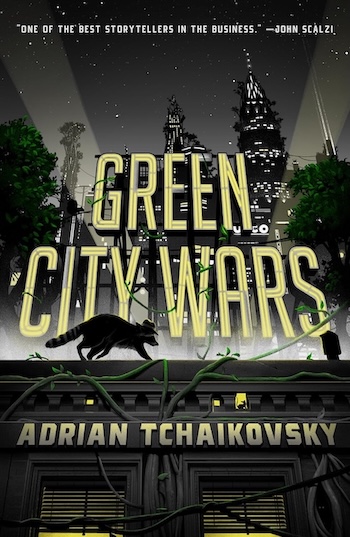
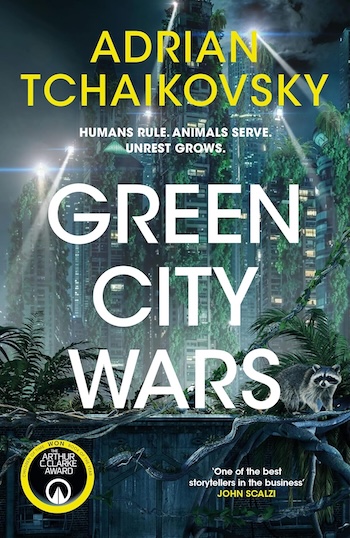
 This summer, Tor Books will publish Green City Wars by Adrian Tchaikovsky. A fantastical spin on the noir detective genre — “Philip Marlowe meets Redwall” — this has been on my must-read list ever since I read the synopsis. Luckily, I do have a review copy, which I’ll be reading very soon. In the meantime, the publisher has allowed CR to share a substantial excerpt!
Here’s the synopsis:
In the solar cities of the future, the humans relax in the sun and the animals work in the shadows. Genetically engineered Little Helpers, serving humanity—unseen, unheard.
Meet Skotch. Raccoon, PI—yours for a few buttons as long as the job isn’t too illegal, whatever that means.
A mouse has gone missing. Normally this wouldn’t raise any hackles, nor any alarms, but this mouse has something that everyone seems to want, though nobody appears particularly eager to say what that something is.
The fee is good—perhaps too good. Certainly not something Skotch can easily turn down.
If only Skotch can work out where the mouse is hiding, what he’s hiding, and why his secrets are upsetting a lot of animals caught up in the Green City wars.
And now, on with the excerpt!
*
1.
SKOTCH ON HIS UPPERS
Skotch wakes up feeling dumb. That oddly numb sensation about his jaw and tongue. You’d think you’d feel it in the head, like a shrinking of the brain within the skull. Like a fog. But it’s the teeth, the mouthfeel of it, that tells him he’s jonesing in that worst way, the animal way. And he knows that if someone sat him down right now, put him through his paces in a citizenship test of the wider Gehirner community, then his metrics would be down. He’d pass, but they’d be down. He’d have lost the long words, the more complex associations.
He feels around in his super until his hands—the clever little things they hadn’t had to change much, honestly, not like some Gehirner Strains—find a strip of ampoules. Just tiny plastic tabs with a mil of fluid in them and a breakable top. Most of which are broken, but, bringing them out, he sees three intact. That isn’t much more life.
Oh, he’s being dramatic. His Strain is prone to it, a little instability in the engineering that the updates haven’t ironed out yet. Not life. Just the sort of life that can know itself.
He should save it. He should live with feeling that dumbness at the back of his throat, laying a weight on his tongue, stifling the big words, slurring his speech like he’s been at the fermenter. Backseating the finer judgements and letting instinct go wild. But right now Skotch is a freelancer without a job and, in the fine city of Neuwien-Grunstadt, that can be a death sentence.
A specific death. The death of the mind and the voice. Maulkrankeit. The mouth-sickness, the locals call it. And back in the US where Skotch had been made, they’re sensible about things and talked about brain-dampening and other terms that locate the problem properly in the augmented grey matter packing out his low and narrow skull. Here over the pond, in the local argot, everything is located in the mouth. Skotch can appreciate that, honestly. That’s how it communicates itself to you, the fact that you’re falling back into the hole your ancestors were dragged out of.
The more that dumbness grows, the harder it will be to find work. Try to sell yourself as a finder of things and of secrets when you can’t string words together: It’s never a good look. He cracks an ampoule and rolls onto his back because it’s easier to tilt an eye skywards like that. It’s not true that raccoons can’t look up. That’s just the joke. But still.
The drops, into his eye. One, two, three. Fighting the reflex to just blink and shake all the precious stuff away. And most Strains just neck the stuff. Even put it in a drink to wash it down. But for arcane reasons of their own, the Strain engineers over in the US used tear ducts as the ingress point to get Plangent to his augmented neutral centres, so he has to go through this rigamarole. The locals, discreetly sipping their own, find the sight awkward, painful, or hilarious. He’s learned to go somewhere private to dose himself up.
Not that topping up on Plangent is exactly a prized social activity. Unless you’re a pigeon or a squirrel or something—he’d heard they do major bonding sessions over it, swearing allegiance and siblinghood and all that as they shoot their brains full of the good stuff. But for most sensible and civilized animals it’s a little shameful. An admission that you’re on the downward curve of dumbness. Returning to the beast.
He feels better, after all that. The rather dangerous complacency you get after a hit, when your brain is doing cartwheels; when it can do the hard sums and learn a dozen languages and even maybe read some human words, but doesn’t actually want to do any of that hard work. Just wants to revel in the potential. And, left to its own devices, will squander all that sharpness before it can be put to work. So it’s up to Skotch to wriggle out of his nook and go scrounge for business.
. . .
Nook is just about all he has. For those still on the company payroll—or the guilds, as the locals have—accommodation is usually laid on. Either it’s built into the city structure, part of the way that the Grunstadts are designed so their invisible workforce can tuck itself neatly away and not get in eyeline of the actual human residents—or else the incomer guilds and companies provide for their employees. Back when he was on the payroll, Skotch had a little cubby he could call his own, rent-free, up in the eaves of Uzco Towers.
Right now he lives in Unterroot 93. Which means a nook within the tangle of roots, ducts, and cabling that leads from the city’s green ceiling down to below the bridges and boulevards. Down into the dark warren of irregular spaces created inadvertently by the organic nature of Grunstadt infrastructure. A host of little gaps an animal can call its own, where you can curl up and grab some shut-eye. Warmed by the minimal lost heat and energy that gets out where living plants meet the inorganic conduits that feed photoelectricity to the city. Neuwien winters can be harsh, even in these latter, warmer days. The lake itself hasn’t frozen for the best part of a century, but the streets get cold. Many of the luckless, the foolish, and especially the dumbed-down die every year because they can’t find shelter. A fraction of the amount who die due to territorial squabbles, of course, but Skotch doesn’t plan on joining either contingent of the deceased just yet. And even a nook in the roots needs rent—or at least the heavy mob who claim this turf come round every so often and demand landlord rights from all the wretched refugees and rogues and freelancers who call the place home. And he has to eat, and he’s going to need to haggle for some more ampoules soon.
Work. He needs work. When he parted company from the company, the city had seemed full of jobs needing doing, and Skotch felt as though he could just reach his clever little hands up and pluck gainful employment from the air like fruit from trees. And like the fruit on the trees, it turns out everything in Neuwien is parcelled out and claimed by a competing network of guilds, syndicates, foreign companies, and just ornery individuals. A poor raccoon could starve, or worse.
It beats working for the company. He tells himself that on the regular. It keeps him from going back to Uzco Towers, notional cap in hand, asking for a job that doubtless has long since been filled.
And it does beat working for the company, because the problem with being a bunch of foreign nationals trying to drive a wedge into a city already tightly parcelled up between competing packs of locals is that you end up cutting a lot of very dodgy deals to make space for your people in the ecosystem. Invasive species, basically. One of the things that comes with not being just a dumb beast is a sense of doing the wrong thing, or doing a thing wrong. It’s a mandated piece of Gehirner mental architecture, because humans need to rely on their little partners to make sure the city runs right. And in the end Skotch decided that working on the company tab conflicted too much with the nagging little voice in his head that tells him he’s being bad. It’s a voice most animals learn to tune out. He wishes he had, most days.
It’s also a voice that will go silent with the rest of him if he runs out of ampoules, so time to get hustling.
. . .
 The Grunstadts—or whatever label they go by, wherever they’re built—are spacious, open. Parks and leisure spaces, broad boulevards, pedestrians, cycles. The effortless coordination of electric trams and metro trains, clean and soundless, linking every district. A citywide communications web invisibly connecting everyone to everyone, via device or implant. Augmented reality overlays so you’re never lost or alone or short of something to spend your money on. Outer rings of electric vehicles, segueing smoothly from driver-controlled to city-slaved as they cross from district to district. Shaded avenues, sunlight filtering down through an interlaced ceiling of greenery that cools and refreshes and generates carbon-neutral power. Not a fossil set on fire, nothing more ecologically damaging than a scented candle burned. A city sufficient unto itself, spotless streets and gleaming buildings. A forest that is also a town, as though humans have, in these latter days, become the elves of past fictions. A balance with creation. An equilibrium. The turning point of the end of the world into something new, strange and sustainable.
All of that was in the stuff Skotch sat through, after he left the creche and was inducted into the company. Pictures of cities in China, France, Kentucky, Canada. Sometimes old-style architecture greened over, more often brand-new places set up right next door to the old because it’s literally more efficient to build new eco houses, offices, and infrastructure designed for the green to grow around.
Of course, that’s for the humans. Skotch has, on occasion, seen it. Mostly at night. One of Uzco’s prime selling points, when it’s scrounging for contracts outside the US, is that its workforce is capable of day and night work. Because any kind of major works tend to go on after dark to avoid breaking Rule One.
Skotch has broken Rule One, in his day. Sometimes you have to. You just do it really politely, and actually it doesn’t explode in your face as much as you’d think, from something they literally call “Rule One” and practically hardwire into your genome. But Gehirner who make a habit of it get kicked out, find themselves sans work or friends and, soon after, get dumb, and get dead, in that order.
Which is a problem for the aspiring freelancer, because a lot of the work that filters through the greenery down to Skotch’s shady little stratum tends to involve messing around the edges of Rule One, which is why the regular guilds don’t want it.
A weird side-effect of the Gehirner life. Put a few thoughts in an animal’s head and apparently one of the first things they invent for themselves is criminality.
Opportunity, Skotch tells himself. Was it criminal, to push the boundaries of what they’d given you? Of what they’d literally built into you? To explore the edges of the systems they’d set up, that are so perfect, and find where all the gaps were, where things didn’t quite fit together? He isn’t the first animal to explore the grey area between expressly permitted and definitely forbidden.
. . .
He lowtails it out of the knotted tangle of roots that is his flophouse. His neighbours, such of them as he can’t avoid seeing, make a big show of not seeing him. A ragged motley of species they are, too. Redcoats, rats, pigeons, a crow, a newt. Native
Gehirner Strains who’ve been cut loose from their guilds but haven’t fallen into utter penury yet, or who’ve made the bold decision to go freelance like Skotch and, like Skotch, are probably regretting it around now. A scatter of other invasive Strains, brought in by one foreign company or another, or just slipped into town on their own paws. A mongoose, a possum, a pair of belligerent parrots. At the very back, holed up in the darkest corner of what passes for a common space in the Unterroot, Old Tekki the ratsnake rustles his coils together and looks death at everyone. Hard to make friends when your Strain had been specifically designed to predate on other small animals, after all. As far as Skotch knows, Tekki’s the only ratsnake who’s braved the European winters, and Skotch hopes against Jeff that it stays that way. When the snake Strains go dumb, he’s heard, they let go of whatever’s in them that stops them just killing and eating every damn thing that comes within strike range.
Another reason not to be a lone freelancer in this green city. Down these mean streets a beast must walk . . . Or at least beneath them.
Outside of the Unterroots is still behind the scenes of the city, where Gehirner are supposed to be. The shadowy walks between the organic roots and behind eco-crete walls. The roads that go around the back of all the human spaces, the Gehirner thoroughfares leading to where the pipes and ducts are, the access hatches, the crawlspaces and ladders. Crowded, even early morning like now. Everyone scurrying like they’ve got a job on, whether they have or not, because you don’t want to look down on your luck in this part of town. There are Redcoats about in force, he sees. Squads of them strutting about, tufty ears and tails high, maintaining a presence. Scuttlebutt says this district might be changing hands soon, the fighting swinging close to home. And theoretically it isn’t anyone else’s business, certainly not a loose nut like Skotch’s. The truth is, though, when one of the big factions decides they are going to take over a services contract somewhere, everyone gets caught in the crossfire. Unless you’ve a guild watching your back, it’s very easy to become just one more casualty of circumstance.
Maybe time to change address, Skotch thinks. But that’s hard. Like a lot of Strains, the idea of a little span of territory that’s his is hard to shake. Even if it’s a single nook in the Unterroots. And besides, trouble for everyone means opportunity for some. Maybe this time he can be in that some.
You catch glimpses, sometimes, of how the other half live. There’s a path that leads through a tunnel in the wall-cladding ivy, and you look out into the early morning sunlight and see the vast spaces that the city gives to its masters. Tables outside a restaurant, all of that enormous scale that humans need. People—people people—sitting and enjoying what Skotch’s nose tells him is good coffee. And Gehirner aren’t supposed to have a taste for coffee, but when Skotch was on trash-panda detail for the company, he’d go around all those tables at night and slurp out the dregs from every cup. Uzco’s marketing fluff proudly announces that its Assistant Strains are engineered not to process human-meant stuff. No metabolising nicotine, caffeine, alcohol, cannabis. They’re big on that kind of message back home, all very puritanical. Of course, there are hacks. The caffeine hack is particularly popular. Most of Uzco’s foreign deployment units laid out for it. Skotch finds the buzz is even a short-term Plangent supplement if he’s desperate. He’s snuck out and scavenged the last inch of prime Spanish bean blend more than once, when his tongue started feeling heavy. Doesn’t actually fight off the dumb, just makes you think it has.
Right now, on his way to Rootspace Central 38, he’s passing by those tables. Up close, the ivy clinging to the very café wall. He can stop and sit up, and put a hand out to where the fibrous anchoring roots link into the building’s grid, the dark leaves harvesting the second-degree sunlight that filters through the upper canopy of the city. He can take a noseful of that rich roasted aroma. Wasted on humans, who can barely smell it. Skotch, paused in his hustle, is in good company. Half a dozen other Gehirner of various species, stopping to inhale as a human on the nearest table sips at his broad, shallow, biodegradable porcelain. The stuff that’s like fine china for half a day and then sludges into crinkly cardboard for the trash-panda patrols to gather up and recycle.
Skotch shares a moment with his fellow caffeine addicts. They let their keen noses drink it in, because that’s all they’re getting of the blend of the bean. Nobody’s going to stroll out into the light of this fine autumnal morning and polish off the grounds, not in front of the humans. Not break Rule One so brazenly.
And Skotch has done that. Just the once. Desperate. Just hopped out right in front of a woman working on her tablet. A bold little nod through the haze of the virtual screen. And the woman, bespectacled, huge, blond, actually nodded back to him. Watched as he cleared away a half-full cup her colleague had abandoned when he got called away. Assumed, doubtless, that Skotch being there was just the city’s service sector working as usual, and not an opportunistic raccoon caffeine-fiend.
Once was enough, though. When the jolt had brought him back to himself enough to understand just how he’d danced on the edge, he’d taken his last—then—ampoule in the eye and sworn never again. It would only take one complaint to City Services. He didn’t want anyone passing his name and a contract to Tekki the ratsnake or his peers.
. . .
Rootspace Central 38 is an example of a particular kind of space. The people—the human people—who planned the city didn’t really intend for these little hubs to exist, but the radial way the infrastructure spreads out from the hubs of the big trees gives rise to little bubbles of hidden vacancy. And when you leave that kind of opportunity, the animals move in. It’s like the Jeffist mantra everyone parrots. Up to and including the parrots themselves, in their raucous, aggressive, semi-sapient flocks, where the vast hubbub of talk is half meant and half just echo. But what those Jeffist words mean is that where there’s an opportunity, someone’ll work out how to take it. Where there’s a space, someone moves in.
Small spaces, single occupancy. Big spaces go one of two ways. Mostly some faction takes over. One of the service guilds claims the space, or else one of the armies that run protection over them. Sometimes it’s a personality, though. One of the Rattenkönig class, and these days that’s more than just rats. More animals finding the cracks and prying until there’s a space for them. Building their own niches on the backs of everyone else, just like the Jeffists are so keen on.
But Central 38 isn’t Rat King territory. Instead, it’s Commons. Enough small local operators working in lockstep that it’s known as a safe place to go, buy, sell, deal, meet. You wear big boots if you want to make trouble in Central 38, and since none of the Gehirner wear boots—or anything more than a toolbelt mostly—that means trouble stays away.
Skotch slouches down there and looks for a ready mark. Finds his way to a rat who’s boiling up coffee and puts down a couple of buttons for a cup the size of an acorn cap. Strong, vicious, artificial-tasting stuff that he’s not supposed to get the jolt out of. There was that time he’d been flush, though. Uzco-mint buttons stuffing out the pocket of his super. Getting the caffeine hack had seemed a good use of his time. Now it’s one more dependency he’s having trouble supporting.
There will be someone around with tabs of Plangent under the table, strictly banned and who knows what you’re getting in the greasy hand-to-hand ampoules. It doesn’t matter because Skotch doesn’t have credit nor cash to pay. Instead he’s hustling work because, like every freelance animal in the green cities, he has bills and debts and habits and they all cost.
The rat who makes the coffee is also a freelancer. It’s tough being a rat. He has to give away a lot of free samples to avoid bigger beasties giving him a stomping, and every little rodent polity calls him a quitter. All about family, with the rats. Skotch doesn’t have family. The only other raccoons in Neuwien-Grunstadt are on the Uzco payroll, strictly professional. He sits with the rat—Iggy, this rat—and passes the time. Drinking rumours with the coffee, because Iggy’s position is precarious, so he keeps his big rat ears to the ground.
Iggy is going through a depressive phase, so either too much or too little of his own stock is going down his throat. He serves a handful of other loose, unaffiliated Gehirners while keeping up a constant despondent complaining to Skotch. The war’s coming here, he says. The Grays are making a play for the whole district. Every guild and every independent ending up in their shadow. Making it sound like Skotch’s fault.
“I don’t give marching orders to the Grays,” Skotch says, reasonably.
“Your people, then,” Iggy accuses.
“I’m not with the company, Iggy,” Skotch says. “And the company’s not with the Grays, not anymore. Come on, Iggy, you know this.” And Iggy does, or should, but he doesn’t let up with the pointing of those little rodent fingers. And maybe Iggy’s light on recent doses of Plangent, too. That’s how it shows, in some animals. Difficulty in processing new info, a loss of recent developments, retreating into calcified old memories. The rat still remembering how to operate the Rube Goldberg mess of his jury-rigged coffeemaker, but living in the distant past of the year before last, when he was a pup.
Eventually Iggy mentions that Uwe has a lead on something, and Skotch can only hope that’s current news and not the greatest hits of yesteryear. Uwe has a nook across the root-ceilinged dome of Central 38, festooned with wiring both modern-organic and old-artificial. The greatest concentration of undegraded retroplastics in the district. Uwe himself is a pigeon, but a freelancer, again. Not a part of the airborne army that’s currently shunting round the edges of the Red-Gray conflict, just some pigeon. Cyborg pigeon. Honestly, Uwe looks like humans thought augmented animals would look around thirty years ago. All that art they made, of creatures ravaged by tech. Visible implants and wires and VR goggles covering everything above the beak. One wing fewer than the regulation complement, and the other one atrophied from lack of use and reallocation of calcium resources. A body too plump and round to fly anyway, even if Uwe wasn’t cabled into his booth by a hundred hair-thin connections.
That blind head turns not-quite-towards Skotch as the raccoon ambles over. Uwe’s voice is gone with a lot of the rest of him. The smooth Tiersprech—the local version of the artificial language gifted by Santa to his Little Helpers—coming from fuzzy speakers buried in his mass of obsolete electronics. “Skotch, long time no see.” The pigeon limps three steps towards him, cables whispering and rustling around him like Medusa. One foot is just an aluminium plate but, the way Skotch heard, the original was short two toes anyway so what’s lost, exactly?
Uwe takes buttons for info. He is the bird of a hundred hacks, connected to all the Gehirner data-chatter—some of the human, too. You want to know exactly where the Reds or the Grays are moving next, you ask Uwe. Plenty of his customers are on the army payrolls, though nobody in an actual uniform would be seen dead talking to 60 percent of a pigeon down in Central 38.
“Praise Jeff but you’re looking peaky, Skotch,” says Uwe’s fake voice. The pigeon comes too close, the back-and-forth motion of his head sending little snakes of movement down the cables. It’s to do with visual focusing, Skotch heard, that bob-of-the-head so many birds do. Meaning Uwe could probably do without it and not end up constantly about to put Skotch’s eye out.
“Just between jobs at the moment,” Skotch says, casually.
“So you come to call on your good friend Uwe.” Skotch is having to concentrate, because when you’re light on Plangent, one of the first things that goes is second languages. The compacted Germanic mash of ’Sprech is supposed to be intuitive compared to what he’s wired for, but it doesn’t help. And he had his ampoule this morning, should be good for a few days, but you start double-checking every word you hear for errors, once you know you’re on the downward slide.
“Uwe, pal,” Skotch says. Pal, from the US-standard, one of those words that’s seeped its way into the local argot. Defiantly seedy, connotations of debts, pressure, underhand schmoozing.
The pigeon goes still for a heartbeat—a fraction of a second given pigeon hearts. There was a time when Skotch bailed Uwe out. Last year, which is a lifetime for some, an age ago for Skotch, a decent chunk even for a long-lived pigeon. Uwe hasn’t forgotten, hasn’t really forgiven either. Nobody likes being beholden.
“Grays are hiring,” says the robot voice from Uwe’s speakers.
“I don’t take army work,” Skotch says. “You know that.”
The pigeon limps away, taps at a few keys, moults a feather. He has bald patches, but then his alcove is uncomfortably hot from all the outdated electronics. Probably he’s glad of the ventilation. “Sometimes,” say the speakers, “work finds you.”
Skotch’s turn to go still. His hands—their nimble dexterity a major selling point of his model—are the only moving part, fidgeting over one another. “Tell me,” he prompts, knowing he’s eating into his credit.
“Company suddenly remembered you exist, just yesterday,” Uwe says. “Maybe that’s the work you’re looking for.”
It isn’t. It isn’t welcome news either, but it’s news Skotch is glad to have so he can get out from under before the wave breaks. His former employers, from whom he’s been enjoying an amicable separation these six long months, have suddenly developed an interest in him. Can’t be good.
That changes the parameters. Rather than just some work, he needs to find a job with someone big enough to keep Uzco on the back foot. Which means rifling through his super for the really big favours.
Skotch ducks out of Central 38 before anyone with an Uzco collar turns up with his name in their mouth. Heads across town by the rootways. Through the shaded and the dark. Past tunnels leading to clustered digs just like the nook he stays in. Guild-controlled, some of them, but some just rookeries. Spaces claimed by anyone strong enough to hold them, changing hands daily. Desperate dives, and he knows them. In most, there’s at least one name he can call on. To push, to wheedle, to bribe, to exact payment for past services rendered. That’s his stock in trade. You want something dug up, ask Skotch. Want the dirt on someone, the truth on someone, or even just a particularly useful lie. Skotch is your animal.
. . .
None of it was meant, of course. All the whole system was for was to make sure everything worked behind the scenes. Keep the lights on and the water clean and the streets free from trash in these, the new green cities humans were building for themselves. The utopian cities that lived off the sun and had the carbon footprint of an ant wearing tight shoes. And for all that to work, for the green city residents to get the full futurist experience, nobody wanted to have to go unclog the sewers or go up a pole to fix the telecoms transmission box. It all had to go on seamlessly, unseen, like magic. And, like magic, the solution was having a dove up your sleeve and a rabbit in your hat. Or a pigeon and a rat, respectively.
Nowhere in this plan did it say Freelance Raccoon Investigator, but the problem is, when you put a bunch of animals in a system, and engineer them with a load of complexities and a bunch of extra needs, they start to push the boundaries. And if Freelance Raccoon Investigator was on your bingo card for where those boundaries might extend, then you should mark it now.
. . .
Embassy Plaza is not in the rootways. It is in the centre of human Neuwien-Grunstadt, overlooking the marina and the blue, blue waters of the lake. Blue blue, because of all the decontamination work they did last decade, when the corner got turned on the whole deindustrialisation wars. This is where the city’s human governance goes on, and where a handful of foreign interests are, and—because all of those humans are wealthy even above the universal provisions of the green cities—a lot of restaurants and theatres and other fancy places. Most of the foreign interests—not actual political embassies but the holdings of various major tech corporations—have their own in-house Gehirner staff, and the Bärenhaus is a unique place where they can go, that’s upstairs, in sight, revealed to the sun and to human gaze. Here, a handful of extremely well-behaved animals can have teddy bears’ picnics, sitting on the floor at low human-style tables, drinking tea from little cups. Human tourists from less green places love it.
The Bärenhaus belongs to HengZeico, a Japanese group specialising in Gehirner design—Henge as they call them, over there. HengZeico were a major partner in green city projects across the world, and part of the price was a permanent embassy building in the best part of town. In Neuwien this includes the Bärenhaus and, in the Bärenhaus, Skotch spots his good old friend Shojen. Shojen probably doesn’t have any work for an itinerant racoon, but Shojen owes Skotch for extrication from a spot of bother. A foreign model getting lost in the wrong part of town, a pack of leery locals. Skotch turning up and the regular Gehirner assuming that the raccoon and the tanuki were pals because they had the same face markings. An association that was rather less complimentary to Shojen than to Skotch, honestly, but they’d come out of it on good terms. And Shojen owes him—and also, somehow, is something like a friend—and if Skotch gets a temping contract with HengZeico that would keep the company off his back.
He doesn’t know how late he is. Not by much, certainly. If he’d got the lowdown from Uwe an hour beforehand, maybe it would have made all the difference. The truth is in Shojen’s body language, though. The stiffness to the tanuki. That stare—the black-banded eyes that every other Gehirner species sees as identical, but to Skotch and Shojen both are worlds apart. Get out, those eyes say. Not hostile, warning. But Skotch is at least three-quarters away in his own head and he only registers the unspoken caution as he’s on the point of joining Shojen at the little low table. The human thing, fit for humans to see their Little Helpers at, like the animals are playing dress-up here in the front window of the Bärenhaus.
Skotch turns on his heels, front and rear, then rises to his haunches, feeling resigned. They’re right there, a raccoon and a possum with collars on, their tags showing the Uzco logo just as Shojen’s shows the spiral of HengZeico.
“If it isn’t our old pal Skotch,” says the other raccoon, the company raccoon, whose name is Fitch. The possum, designated Maria, nods and bares a lot of sharp teeth, though that’s par for the course with possums. The speech is the US argot, which some human joker somehow got away with calling Furze.
Shojen stands up—tanuki are bigger, so that’s a lot of up. The two American animals aren’t intimidated.
“Siddown, Tom,” says Fitch, the talker. The old slur name for tanuki models, coined by some recidivist human way back when and passed into animal parlance because no human really watches what they say in front of the Gehirner.
Shojen is maybe about to make a scene, because he’s a good sort and takes debts seriously. And the last thing Skotch needs is to be cause célèbre for some sort of international incident here in green city turf, because Uzco and HengZeico are commercial rivals, and the boardroom and stock price friction tends to filter down to hackles and scraps here at the animal level.
“It’s cool,” Skotch tells Shojen. “I reckon these two gents just want to talk about outstanding paperwork.”
“Sure,” says Fitch.
“Something like that,” snickers Maria, because apparently she can talk too. Lispy, because possum dentition screws with the diction.
“I’ll be back for that meeting we talked about,” Skotch says, in the hope that a sudden absence of Skotch in the world now has a stink attached to it, and maybe that’ll stay someone’s paw if the question of whether or not to off him reaches edge-case status.
“I will look forward to it,” Shojen says in precise Furze, giving Fitch and Maria the hard look, which they return in spades.
The pair don’t quite frog-march Skotch out of the Bärenhaus. But then, given that a whole class of Gehirner models are amphibians, the phrase is reckoned bad taste. There’s a definite impression that, even though Skotch’s four feet are taking him the right way, his consent is not being asked for.
This is how Skotch returns to the bosom of the company that made him.
*
Adrian Tchaikovsky’s Green City Wars is due to be published by Tor Books in North America (June 23rd) and in the UK (June 25th).
Also on CR: Interview with Adrian Tchaikovsky (2012); Guest Posts on “Nine Books, Six Years, One Stenwold Maker”, “The Art of Gunsmithing — Writing Guns of the Dawn”, “Looking for God in Melnibone Places: Fantasy and Religion”, and “Eye of the Spider”; Excerpt from Guns of the Dawn; Reviews of Empire of Black & Gold, Guns of the Dawn, Children of Ruin, Spiderlight, Ironclads, Made Things, and One Day All This Will Be Yours, Shards of Earth, and Ogres

