Upcoming in 2014 from Gollancz

I kind of dropped the ball with my Gift Guides at the end of 2013. I would apologise, but that’s the beauty of running your own blog: you don’t answer to anyone. Nevertheless, there are still plenty of novels coming up in the first few months of 2014 that deserve some advance warning/notice, and I intend to share with you cover art and synopses (and anything else that might be of interest) as and when I can. Today, I highlight just a few of the novels coming up from Gollancz, that bastion of SFF quality and excellence.

HarrisJM-GospelOfLokiJoanne M. Harris, The Gospel of Loki

With his notorious reputation for trickery and deception, and an ability to cause as many problems as he solves, Loki is a Norse god like no other. Demon-born, he is viewed with deepest suspicion by his fellow gods who will never accept him as one of their own and for this he vows to take his revenge.

But while Loki is planning the downfall of Asgard and the humiliation of his tormentors, greater powers are conspiring against the gods and a battle is brewing that will change the fate of the Worlds.

From his recruitment by Odin from the realm of Chaos, through his years as the go-to man of Asgard, to his fall from grace in the build-up to Ragnarok, this is the unofficial history of the world’s ultimate trickster.

I shared this on Tumblr earlier today, but damn I love that cover, and I love the premise. In fact, I love it so much, that I also have another post coming up later this month that includes the cover again. I love Norse Mythology, and I have a feeling that Harris is going to do the source material proud and do something wonderful with it. Easily one of my most highly-anticipated novels of 2014.

Can. Not. Wait. Due to be published in February 2014.

*

JacobsJH-TheIncorruptiblesJohn Hornor Jacobs, The Incorruptibles

In the contested and unexplored territories at the edge of the Empire, a boat is making its laborious way upstream. Riding along the banks are the mercenaries hired to protect it – from raiders, bandits and, most of all, the stretchers, elf-like natives who kill any intruders into their territory. The mercenaries know this is dangerous, deadly work. But it is what they do.

In the boat the drunk governor of the territories and his sons and daughters make merry. They believe that their status makes them untouchable. They are wrong. And with them is a mysterious, beautiful young woman, who is the key to peace between warring nations and survival for the Empire. When a callow mercenary saves the life of the Governor on an ill-fated hunting party, the two groups are thrown together.

For Fisk and Shoe – two tough, honourable mercenaries surrounded by corruption, who know they can always and only rely on each other – their young companion appears to be playing with fire. The nobles have the power, and crossing them is always risky. And although love is a wonderful thing, sometimes the best decision is to walk away. Because no matter how untouchable or deadly you may be, the stretchers have other plans.

Heard about this a little while ago, and I believe Mark Lawrence (Prince of Thorns) mentioned that he really enjoyed it. This is due to be published in June 2014.

*

PatrickD-BoyWithThePorcelainBladeDen Patrick, The Boy With the Porcelain Blade

A world of betrayals and deceit. A hero alone. A delicate sword. A thrilling new fantasy from an exciting new voice.

An ornate yet dark fantasy, with echoes of Mervyn Peake, Robin Hobb and Jon Courtenay Grimwood. An original and beautifully imagined world, populated by unforgettable characters.

Lucien de Fontein has grown up different. One of the mysterious and misshapen Orfano who appear around the Kingdom of Landfall, he is a talented fighter yet constantly lonely, tormented by his deformity, and well aware that he is a mere pawn in a political game. Ruled by an insane King and the venomous Majordomo, it is a world where corruption and decay are deeply rooted – but to a degree Lucien never dreams possible when he first discovers the plight of the ‘insane’ women kept in the haunting Sanatoria.

Told in a continuous narrative interspersed with flashbacks we see Lucien grow up under the care of his tutors. We watch him forced through rigorous Testings, and fall in love, set against his yearning to discover where he comes from, and how his fate is tied to that of every one of the deformed Orfano in the Kingdom, and of the eerie Sanatoria itself.

That’s a really nice cover. Aside from that, it also sounds like a really interesting novel. I’ve met Den, and he was a very nice fellow. His Elf/Orc/Dwarf war manuals were quite fun, and it’ll be interesting to see what his fiction is like. I have high hopes for this. Due to be published in March 2014.

*

These are three of the novels I most want to have read and on my shelves by the end of the year. There are, of course, more titles coming from Gollancz that I have my eye on, but these are just the ones I chose to highlight today. More to come over the year.

An Interview with JOHN MEANEY

MeaneyJ-R3-Resonance

John Meaney is the author of the now-complete Ragnarok science fiction trilogy and more. His latest novel, Resonance, was published in December 2013, and I thought this would be a perfect time to get in touch and ask him about his work, the trilogy, and more…

Let’s start with an introduction: Who is John Meaney?

Just some weird bloke, you know?

A little grey-haired geezer who might surprise you by dropping into box splits at fifty-six years of age. Runs up mountains and lifts big, rusty weights. Pounds the crap out of heavy punch bags. Survived over forty years of martial arts training, despite or because of starting out as a podgy, asthmatic couch potato. Didn’t feel he’d accomplished anything until twenty-five years after starting, when he left the elite shotokan dojo of the late Enoeda sensei (as the least of the students) and realised what he’d been through.

As a young guy he dropped out of his original physics degree in his final year, due entirely to a philosophical crisis, and wrote unpublished fiction before getting his head together. He passed up the chance of finishing the degree and took a programming course instead, leading to his first computing job. At the same time, he studied all the higher-level physics and computer science modules that the Open University offered and gained his degree with the OU. Recognised as a physics graduate by the Institute of Physics, he later gained an MSc (with distinction) in Software Engineering at Oxford University. Despite being a working-class boy raised in Slough, he thinks that Oxford rocks.

He worked for three IT departments in the South East during the 1980s, was a senior consultant for a Very Large Software House during the 90s, and worked for an IT training company before becoming a freelance trainer and consultant, so that he could manage his time for writing books. Bizarrely, his most interesting computing assignments came after selling his first novel, and involved frequent travel to the US and Europe, and a couple of trips to Asia.

He lives in Wales, laughs a lot, and hardly ever takes himself seriously.

MeaneyJ-R3-Resonance

I thought we’d start with your fiction: Your latest novel, Resonance, was recently published by Gollancz. It’s the third in your Ragnarok series – what can fans of the series expect from this final book? How would you convince a new reader to check out the series?

In the first book’s prologue, you meet resurrected humans in crystal bodies, waking up on the Moon and staring up at space. One of the stars in Orion’s belt has changed colour, which means that a million years have passed since the humans lived their original lives. And the mysterious Kenna, their leader, makes it clear that the final battle, Ragnarok, is imminent.

After the first two books, readers know that a darkness has subtly influenced selected individuals across millennia of human history, starting in what we now call the Viking Age, and significantly during the twentieth and twenty-seventh centuries. And they’ll know that the darkness commenced its voyage from the far side of a cosmic void that’s one hundred and fifty million lightyears across, and has been heading for our galactic centre for at least that number of years.

MeaneyJ-Ragnarok1&2

They’ll also have been following the intricate links between the various timelines, both overt and covert, obvious and subtle. If the readers are astute, they’ll have paid particular attention to surnames, since a passing character in one timeline may be the ancestor or descendant of someone they know from another century.

What I’ve promised is Ragnarok, or Ragnaroekkr, as a galaxy-spanning battle that follows on from the previous machinations. And with luck I’ve delivered, with billions of resurrected humans following the nine leaders whom you may (or may not) expect. (One of the subtleties is that everything comes in threes and nines, primarily nines, matching Old Norse memes, including their cosmology.)

To the new reader, the good news is that you don’t have to wait for the ending! Try the books if you like multiple-timeline stories: there’s a 27th century timeline that forms the spine, comprising every second chapter, set in the Pilots future that features in four of my other novels. Cities where quickglass buildings alter their shape, including room furnishings, at will. A city-world in the golden fractal continuum that underlies this universe. Political intrigue within and across the universes.

The 20th century timeline features a Jewish physicist whom you first meet as a student in 1920s Zurich, before she escapes Europe to work in Bletchley Park and later for its intelligence-community descendant, one of the few who can perceive the darkness. Her conflicted Russian counterpart is an agent of that same darkness.

Among the Norse, a young warrior originally called Ulfr will also face the darkness, and in many ways become the enemy, while his actual enemy Stigr, the one-eyed poet, is his darkness-controlled nemesis. In total there are five important timelines running through the trilogy, with some others added painlessly as we go along .

And everything links together. I made it happen.

To the long-term reader, here’s something which appears to make folk smile: the Ragnarok trilogy spans a far greater period than my Nulapeiron trilogy, whose mere 1400-year duration is buried deep within the Ragnarok timeframe. In Resonance, the final Ragnarok book, some of the key chapters take place on Nulapeiron…

I haven’t just linked a tangle of timelines together in one trilogy. I’ve linked every single short story and novel that I’ve ever written in the Pilots universe, that’s twenty years of my life, all coming together in Resonance. And in a way that also works, so I’m told, for someone who’s not read any of that other stuff.

Spacetime is big. We are thin ghosts in a universe whose greatest density of stuff consists of something whose properties we don’t know and which we cannot see, hence dark matter and dark energy. For dark read invisible. And this is the universe we really, really live in.

My goal has been to write an exciting story that hints at the cosmic context which is all around us, all the time.

MeaneyJ-NulapeironTrilogy

What inspired you to write this series? And where do you draw your inspiration from in general?

The general mental process involves a foreground/background duality. Fragmented visual images of particular scenes come to me, and set up a tension against a more abstract visualisation of – typically – weird but real physics.

For the latter, I mean concepts like the absence of timeflow, of past-present-future, from any of the equations that are considered fundamental. Time appears as a geometric dimension, not something with flow. And photons can travel a billion lightyears in a vacuum, can be created and destroyed with a lifetime that is literally zero in duration. Or they can be slowed down passing through a medium, and begin (after perhaps a billion lightyear journey that was instantaneous) to experience time.

This is John’s brain on physics…

More normally, one of the particular human images that came to me was Ulfr, a young Viking, walking into a village to see one of his friends tied to a post while the other villagers throw axes at him. I know where that came from.

ColumP-NordicGods&HeroesWhen young, I read poet Padraic Colum’s Norse tales for children. A decade later, I read more deeply, and was struck by a particular paradox: gay Vikings (not a term you meet every day: stereotypes are insidious) were often punished in exactly that manner – tied to a post and used as a target for axes – while Loki and Odin were themselves practitioners of dark magic, called seithr, being shape-shifters and gender-changers. The Trickster and the All-Father both belonged to the dark side, at least partly, unlike Thor and his mates.

I use different spellings for the mythological names in the books, incidentally, partly because I got all geeky about Old Norse, partly to distinguish what I was writing from, let’s face it, the Marvel universe. (I’m not knocking Marvel. When I turned my beard into a goatee a few years back, I went round saying: “The truth is… I am Iron Man.” My extended family know I’m strange.)

Likewise, scenes from Gavriela Wolf’s student life in 1920s Zurich just popped into my head, but I can work out where they came from. Once, on one of several week-long business trips to Zurich, I wandered around inside the ETH, the university where Einstein studied and taught, at night when everything was deserted. (Because I could.) And in that mental landscape appeared distorted images of things that happened during my own student days in Birmingham.

Then of course there are the images with no obvious roots: humans of living crystal awakening on biers; Pilots flying through a golden universe with physically fractal dimensions; the glorious image of Labyrinth, the infinitely complex city-world I can scarcely imagine: depicting my mental image in detail would have been impossible, but it was mind-blowing.

Welcome to John’s brain on physics and fiction…

The trick is to be able to place all of reality subtly out of focus, any place, any time.

If you want to be weird, that is.

How were you introduced to genre fiction?

When I was five and eligible to join the local library (in north-west London), my mum took me to sign up and take home my first books, including the story of a young boy who hid behind some wooden crates before sneaking on board a rocket to the moon.

And hats off to television… It’s a huge time waster for adults with unfulfilled dreams, but Supercar and Fireball XL5 and Torchy the Battery Boy laid down some of the basic circuits in my brain. I was six when Dr. Who first aired, and boy do I remember it. I read my first Marvel comics at the same time: for me, the Golden Age of Comics is, well, six.

Two years later I was reading Robert Heinlein and Andre Norton, and my fate was sealed.

MeaneyJ-IntroToGenre

How do you enjoy being a writer and working within the publishing industry? Do you have any specific working, writing, researching practices?

Let me put it this way. I would never encourage anyone to become a writer. But if someone absolutely has to become a writer, then – provided they’re polite and honourable – I’ll do whatever I can to help. (Although, let’s face it, the best help is simply an instruction to knuckle down, write every day, read as much as you can, and live your life.)

As a profession, writing sucks. In fact it barely passes the definition of a profession, not when the average annual earnings for writing come to four thousand quid. Why do writers even bother to produce books for publishers? Oh, only because we have to. There’s a devil riding our backs, didn’t you know?

I could have earned an awful lot more by making different career choices at many stages, starting long before I got published, and staying full-time within the computer industry. One of many examples: when I received news of my first ever book deal, in 1996, it was via fax to my hotel room at Worldcon in Los Angeles. During that same trip, a computer industry contact offered me a job in San Francisco. But I had a book to finish…

On the other hand, consider the pop-psychological advice on how to spend money on yourself. Given a choice of a material item (which you’ll soon take for granted) or an experience, always choose the experience. It stays with you forever, and the joy can be fresh every time you remember.

No computing job could compare with the triumph of selling my first book.

As for working practices, I realised a long time ago that I needed to be able to trigger the right mental state at will. I wrote my first two novels on a busy commuter train, working long days for Europe’s largest software house, and training at one of the toughest dojos in the world. Cue music…

I write to movie soundtracks, particularly Hans Zimmer’s work, just as Anne McCaffrey used to. It was a strategy that worked for her, and when I tried it, it turned out to be perfect for me as well.

I also use a colour scheme (normally on a dedicated machine) that looks radically different from anything you’d see if I were performing any other task on a computer. My dedicated writing machine is permanently disconnected from all networks.

By preference, I write first thing in the morning, before any other major tasks.

Research-wise, I don’t do anything radical. For deep background on the next book, I read a dozen or fifteen books in one field I didn’t know, a couple of years ago while still in the middle of the Ragnarok trilogy. But that interest spins partly from a foreign trip made decades ago: hands-on stuff. When it comes to cities on Earth in anything like the present day, I use locations I know, at least in passing. Travel is a wonderful thing.

For Ragnarok, I did no directed research in advance. Rather, it came from my existing long term interests, from the Norse mythology to the Bletchley Park codebreaking and the dark-matter physics. While the trilogy was in progress though, I did have to dive in deeply, reading dozens of books, many obscure, as the bibliographies at the end of the books indicate.

It’s hard work. It’s supposed to be.

When did you realize you wanted to be an author, and what was your first foray into writing? Do you still look back on it fondly?

OLYMPUS DIGITAL CAMERA         Aged eleven, and for three years afterwards, I found that my English teachers would accept short stories in lieu of essays for homework assignments, and I can remember some of them still. One featured a meditation on infinite reflections in a barber-shop mirror, foreshadowing my interest in recursion, meta statements and paradoxes. Another, supposed to be an essay entitled “The Salad Bowl”, turned into an assassination thriller set in a botanical garden. They were the beginning.

The year after that, a different English teacher poured scorn on the idea of submitting science fiction instead of essays. Her discouragement might have been as important as the earlier encouragement. Sod her, in other words.

The realisation that I wanted to write professionally occurred while I was a physics undergraduate. That was painful, because when you write for publication it begins with rejection. Fifteen years later, of course, that becomes sheer joy, when publication happens.

In my case that was a short story called “Spring Rain”, published in 1992 in Interzone, then edited by David Pringle. That man started the career of a huge percentage of British writers. And we are very, very grateful.

What’s your opinion of the genre today, and where do you see your work fitting into it?

The genre… Ask most people whether they like science fiction, and their answer will be based on Dr. Who or Star Trek, or a movie based on a game. Elements of written SF bleed out into the greater cultural awareness, but the process is subliminal. From the outside, the genre is misunderstood, as it always has been.

I don’t think this matters. When John le Carré was asked about the changes made to his story for the Tinker, Tailor movie, he pointed out that most people don’t read. Insisting on some kind of purity is irrelevant.

As for judging the state of the genre as We True Readers perceive it… I’m too aware of the books I haven’t read, the authors whose works I’m unfamiliar with, to form a judgement or want to. I will say that it’s a mature genre, which offers different challenges to writers compared to something new.

By that I mean, once there were the Three Big Names in our field. Now, no one could occupy a similar position. No space opera will ever have the impact of Foundation. Not unless someone breaks new ground to the extent that the genre itself is reborn.

As for my own work, that is seriously for other people to judge. I know that I’ve written each book to the best of my ability at that time. That’s all I can do. And of course, reading a book is a deeply personal experience, just like the writing.

Meaning and significance are decided subjectively and individually.

What other projects are you working on, and what do you have currently in the pipeline?

All I can say about the next book is that there will be one.

For most writers, and probably most people engaged on projects of great personal significance, public discussion of goals is the wrong way to go, while the optimum approach is to keep everything locked up in a mental pressure cooker. Keep pressurised until done.

That’s only a generalisation: Charlie Stross can discuss details of a new project in detail with his friends (it’s an honour to hear them), and people who know Larry Niven say that he’s the same. It works for them, clearly.

If I were writing more science fiction, which is going pretty well for me, I’d feel no need to be mysterious or guarded… but in fact I’m jumping to a totally new genre.

I’ve nailed the first draft of something very new, having previously thrown away a 65,000-word prototype. I’m taking it seriously.

Really seriously.

For a sedentary occupation, writing can feel a lot like a white-knuckle ride.

What are you reading at the moment (fiction, non-fiction)?

I’ve just finished reading the latest George Pelecanos thriller, immediately preceded by the latest C.J. Box. In the past month I’ve ripped through a lot of fiction, including Somerset Maugham’s Ashenden, two Harlan Cobens, an early Robert B. Parker for the umpteenth time, and Stephen King’s Doctor Sleep. At other times my fiction reading drops right off, but not for long.

MeaneyJ-ReadingFiction

Non-fiction-wise, I’m currently reading Brian Clegg’s Dice World, Alfred Ayers’s Language, Truth and Logic, and Nick Lane’s excellent Life Ascending. Plus some heavy-duty computer science stuff, because I can.

MeaneyJ-ReadingNonFic

What’s something readers might be surprised to learn about you?

I was Stephen King.

More precisely, I once spent several hours being Stephen King.

To add some extra precision: when I was learning advanced hypnosis from Paul McKenna, I used a technique called Deep Trance Identification… with trusted hypnotists around me. It’s method acting taken to its extreme, because it involves deep, deep trance, to the extent that your facial features and voice alter totally, as you become convinced you’re someone else.

The purpose is to gain insight into an individual’s talent. It’s also a controlled form of deliberate, temporary psychosis. I went so deep, I think I freaked out one of Paul’s assistants. But it was very interesting…

Afterwards, I had to leave the course venue and sit in a lonely graveyard for two hours to recover my own identity. If I ever did.

I should add that I’m a clean-living, teetotal vegetarian – the most mind-altering substance I would ever imbibe is coffee. I’m one hundred percent a rationalist (and hypnosis is a straightforward neurological phenomenon – a trance state is obvious when measured with even the crudest EEG – and mainstream medicine, used every month by the NHS for surgical patients who are allergic to anaesthesia).

But shhh… Don’t tell Mr. King. He’s got a phobia of therapists and hypnotists, though I can’t imagine why. What’s the worst that could happen? It’s not as if someone could, like, enter a strange trance and steal his soul. Surely he couldn’t believe that?

Ha, ha, ha…

What are you most looking forward to in the next twelve months?

Wouldn’t it be nice if “world peace” were a realistic answer?

Within SF fandom, I’m enormously honoured to be Guest of Honour at two conventions: Confetti in Gothenburg, Sweden – having been a guest at Fantastika in wonderful Stockholm last year – and the British national convention (Eastercon) in Glasgow, both happening in April.

In my fifth decade of martial arts training, I have fitness goals that are important to achieve this year, but the real joy is simply the continuing hard work of running, lifting weights, bodyweight exercises, bag work, solo drills and sparring with my equally mad mates. I look forward to every single training session, six a week at least.

In computer science, I’m looking forward to teaching another in an annual series of graduate training programmes that I enjoy immensely. A total blast.

And, oh man, the writing… Finishing the new book and finding out what happens next.

I can’t wait.

*

Resonance is out now, published in the UK by Gollancz.

Guest Post: “Influences & Inspirations” by Robert Bailey

Robert Bailey is the author of THE PROFESSOR, a legal thriller to be published by Exhibit A Books late January 2014.

BaileyR-TheProfessor-2014I was born from a family of storytellers and teachers. My mother taught English and reading, and my grandmother, a math teacher, was never without a book to read. My father, though a builder by trade, can still hold a room captive with his stories and jokes, and, as a little boy, I was always on the edge of my chair when he would rasp on about Coach Paul “Bear” Bryant and the legends that played football for the Crimson Tide.

As far as writers, John Steinbeck was a major early influence. As a kid, I loved his shorter novels, The Red Pony and The Pearl. As a high school sophomore, we studied The Grapes of Wrath, and Tom Joad remains one of my favorite characters in all of literature. As a southerner and an Alabamian that grew up to be a lawyer, To Kill a Mockingbird holds a special place. I think every lawyer wants to grow up to be Atticus Finch, and the story just had everything. It was thrilling, historical, funny and tragic. Just a remarkable achievement.

Later in high school and early college, I became enraptured with John Grisham, and loved Jack Brigance in A Time to Kill and Mitch McDeere in The Firm. I think it was these Grisham stories that really made me want to give writing a shot. Other writers that have been great influences are Greg Iles (I love the Penn Cage series starting with The Quiet Game), Michael Connelly (It doesn’t get much better than the Harry Bosch series), John Sandford, Lee Child, Winston Groom, Stephen King, Dean Koontz and Mark Childress.

When I decided I wanted to write The Professor, I picked up Stephen King’s memoir, On Writing, and have probably read it at least three times. Not only is it entertaining, but King’s insights on the writing process are insightful and inspiring. I would recommend it for any aspiring writer.

Finally, my time at the University of Alabama School of Law in Tuscaloosa certainly influenced The Professor. In fact, the idea for the story was hatched while day dreaming in class and wondering whether my professors could still try a case after years in the classroom.

“Shovel Ready” by Adam Sternbergh (Headline)

SternberghA-ShovelReadyThe start to an interesting new dystopian series…

“I don’t want to know your reasons. I don’t care. Think of me as a bullet. Just point.”

Spademan used to be a garbage man. That was before the dirty bomb hit Times Square, before his wife was killed, before New York became a burnt-out shell. Now the wealthy spend their days tapped into virtual reality; the rest have to fend for themselves in the streets. Now there’s nothing but garbage.

So he became a hit man. He doesn’t ask questions, he works quickly, and he’s handy with a box-cutter.

When he’s hired to kill the daughter of a high-profile evangelist, Spademan’s life is upended. He will have to navigate two worlds – both the slick fantasy and the wasteland reality – to finish the job, clear his conscience, and make sure he’s not the one who winds up in the ground.

In the final few months of 2013, there was quite a bit of buzz around the genre sites related to this book. It has received a slew of great blurbs from respected and excellent authors. It was with great anticipation, therefore, that I dove into it when I received an ARC (quite a while ago, so I’ve been sitting on this review for some time). I enjoyed the novel, and Sternbergh offers up a rather convincing dystopian future, but one that at the same time felt slightly half-baked. The author has written a tightly-plotted novel that is certainly immediate and gripping. It left me wanting more, but not always in a good way.

Right off the bat, I should mention that this is another novel that dispenses with “proper” punctuation – specifically, there are no speech marks to indicate dialogue. This seems to be a style that is becoming popular again – before this, my latest read to take this path was Lavie Tidhar’s excellent The Violent Century. Unlike Tidhar’s latest offering, however, the lack of “normal” dialogue punctuation was confusing more often than I would like: the lack of differentiation between characters speaking would sometimes clash or merge less-than-seamlessly with Spademan’s internal monologue.

The main character, Spademan, is a “different kind of psycho”. He is quietly sociopathic, a product of an uncaring and dehumanizing New York city. Devastated by a dirty bomb, New Yorkers have either fled the city wholesale, barricaded themselves into their homes, or retreated to the outer boroughs. Wealthy and not alike have also retreated to a new, online reality – something akin to a steroidal, higher-tech Second Life – where ‘normal’ life can continue. This is where the bulk of international trade takes place, and the world of financial transactions in particular has retreated from the real world entirely, it seems. Interestingly, and related to the story contained herein, mega-churches have gleefully adopted the new technology as well. [That is all I shall say on that matter…]

The story moves at a breakneck pace, and we’re introduced to a number of interesting and varied, as well as believable, characters from a number of New York neighbourhoods and walks of life. His target and new job turns out to be not at all what he expected.

“Truth is, I have no idea what the next step should be. I’ve had jobs get out of hand, but not like this. I was hired to kill her, not adopt her.”

As someone who was having an extended moment of frustration with what felt like ever-increasingly-long Big Book Fantasies, its slim length was certainly welcome. I enjoyed the pace, but there was a sacrifice: world-building. Not only is the world beyond New York fleshed out at all, really (save the quotation, below), it also meant the world’s logic failed – I ended up not buying that so many people would remain in New York City. Suspending that frustration, though (and there were times when that was difficult), I did rather enjoy the novel.

“As for the rest of it, in in-between part, I hear it’s relatively clean and still open for business, like a plucky dollar store. No longer the land of milk and honey, maybe, but at least you can still get high-grade pharmaceuticals on every street corner on the cheap… Really, it’s just New York that got nuked, cordoned off, shut down, shunned. Capital of the world, cut loose to drift into the sea. The country’s soul, on a funeral pyre.”

The fact that New Yorkers stay in the city, despite the dirty bomb’s destruction and lingering radiation, and also the violence that rose in place of order, reminded me of the New York mentality Brian Wood showed in his masterful DMZ comic series. However, I think it worked much better in the graphic novel series – here, it felt that there wasn’t as much thought put into the world-building as there perhaps should have been. Bits and pieces felt forced, and to then not be fleshed out… Well, Sternbergh’s brevity was not always a boon (though, I repeat, it was refreshing amidst a sea of new, massive doorstoppers).

SternberghA-ShovelReadyUSAs the first book in a series, I’m hoping Sternbergh takes some of the time in his next (and future?) novels to flesh out this dystopian reality. As it stands, this is an engaging thriller, which happens to be set in a dilapidated New York City. Spademan is a good protagonist, and I’d like to read more, but this novel didn’t do enough to establish the world, and given the gaps, why people would remain in the city.

Recommended, therefore, but with the aforementioned caveats. An author to watch, certainly.

*   *   *

Shovel Ready is published by Headline in the UK (Jan.14/Jul.3 eBook/PB) and Crown in the US.

Holiday Book Acquisitions… (Non-ARCs, Mostly eBooks)

In a rather unusual move, I’ve been buying rather a lot more books than I normally do. Partly, this is because Amazon (UK) has been having some pretty amazing Daily Deals. There have been great selections from a variety of authors on or near 99p, which I thought too good to pass up. Now, whether or not I’ll have enough time to read them all in a timely manner is, of course, the always-present question when it comes to my insatiable acquiring of reading material. [An insatiability that has been somewhat tempered, of late, but that is a topic for a later post, as it will have an impact on the blog going forward. That and a number of other things.] So, just to flag some interesting books that I think are worth everyone’s attention, here is what I’ve acquired over the Christmas and New Year period…

*

AbramsDorst-SJ.J. Abrams & Doug Dorst, S. (Mulholland)

One book. Two readers. A world of mystery, menace and desire

A young woman picks up a book left behind by a stranger. Inside it are his margin notes, which reveal a reader entranced by the story and by its mysterious author. She responds with notes of her own, leaving the book for the stranger, and so begins an unlikely conversation that plunges them both into the unknown.

THE BOOK: Ship of Theseus, the final novel by a prolific but enigmatic writer named V. M. Straka, in which a man with no past is shanghaied onto a strange ship with a monstrous crew and launched on a disorienting and perilous journey.

THE WRITER: Straka, the incendiary and secretive subject of one of the world’s greatest mysteries, a revolutionary about whom the world knows nothing apart from the words he wrote and the rumours that swirl around him.

THE READERS: Jennifer and Eric, a college senior and a disgraced grad student, both facing crucial decisions about who they are, who they might become, and how much they’re willing to trust another person with their passions, hurts and fears.

S., conceived by filmmaker J.J. Abrams and written by award-winning novelist Doug Dorst, is the chronicle of two readers finding each other in the margins of a book and enmeshing themselves in a deadly struggle between forces they don’t understand. It is also Abrams and Dorst’s love letter to the written word.

I’ve been intrigued by this ever since I first saw it advertised. Then I saw an interview with Abrams on the Colbert Report, and my interest has only grown since. It’s a beautiful physical object, too. Wonderfully produced. One thing, though: I have no idea how to read it…

*

AtwoodM-1-Oryx&CrakeMargaret Atwood, ORYX AND CRAKE (Virago)

Pigs might not fly but they are strangely altered. So, for that matter, are wolves and racoons.A man, once named Jimmy, now calls himself Snowman and lives in a tree, wrapped in old bed sheets. The voice of Oryx, the woman he loved, teasingly haunts him. And the green-eyed Children of Crake are, for some reason, his responsibility.

She’s one of Canada’s most famous and successful authors. So copies of her novels are in plentiful supply in Toronto’s bookstores. And yet, I have never read any of her books. So, hopefully, this will be my first of many.

*

Baldacci-ChristmasTrainDavid Baldacci, THE CHRISTMAS TRAIN (Grand Central Publishing/Macmillan)

Disillusioned journalist Tom Langdon must get from Washington to LA in time for Christmas. Forced to take the train across the country because of a slight ‘misunderstanding’ at airport security, he begins a journey of self-discovery and rude awakenings, mysterious goings-on and thrilling adventures, screwball escapades and holiday magic. He has no idea that the locomotives pulling him across America will actually take him into the rugged terrain of his own heart, where he will rediscover people’s essential goodness and someone very special he believed he had lost. In equal parts hilarious, poignant, suspenseful and thrilling, The Christmas Train is a delightful journey filled with memorable characters who have packed their bags with as much wisdom as mischief… Part detective story, part disaster movie, part romance, this is a brilliant, heart-warming holiday tale.

I’ve read most of Baldacci’s thrillers (though I am a little behind at the moment), but when I saw this on sale, I thought it would be interesting to read something different by him.

*

Eugenides-VirginSuicidesJeffrey Eugenides, VIRGIN SUICIDES (Fourth Estate)

This is the story of the five Lisbon sisters – beautiful, eccentric, and obsessively watched by the entire neighbourhood.

The boys that once loved them from afar are now grown men, determined to understand a tragedy that has always defied explanation. For still, the question remains – why did all five of the Lisbon girls take their own lives?

This hypnotic and unforgettable novel treats adolescent love and death with haunting sensitivity and dark humour, and creates a coming-of-age story unlike any of our time.

It’s a classic that I have failed to read already, and I wanted to address this oversight. I have seen the movie, though I don’t remember much about it…

*

ExtenceG-UniverseVsAlexWoodsGavin Extence, THE UNIVERSE VERSUS ALEX WOODS (Hodder)

Alex Woods knows that he hasn’t had the most conventional start in life.

He knows that growing up with a clairvoyant single mother won’t endear him to the local bullies.

He also knows that even the most improbable events can happen – he’s got the scars to prove it.

What he doesn’t know yet is that when he meets ill-tempered, reclusive widower Mr Peterson, he’ll make an unlikely friend. Someone who tells him that you only get one shot at life. That you have to make the best possible choices.

So when, aged seventeen, Alex is stopped at Dover customs with 113 grams of marijuana, an urn full of ashes on the passenger seat, and an entire nation in uproar, he’s fairly sure he’s done the right thing.

I saw a number of big advertisements for this novel in London Tube stations last year, but never got around to investigating it further. I’ve heard good things, though.

*

Fey-BossypantsTina Fey, BOSSYPANTS (Sphere)

Once in a generation a woman comes along who changes everything. Tina Fey is not that woman, but she met that woman once and acted weird around her.

Before 30 Rock, Mean Girls and ‘Sarah Palin’, Tina Fey was just a young girl with a dream: a recurring stress dream that she was being chased through a local airport by her middle-school gym teacher. She also had a dream that one day she would be a comedian on TV. She has seen both these dreams come true.

At last, Tina Fey’s story can be told. From her youthful days as a vicious nerd to her tour of duty on Saturday Night Live; from her passionately halfhearted pursuit of physical beauty to her life as a mother eating things off the floor; from her one-sided college romance to her nearly fatal honeymoon — from the beginning of this paragraph to this final sentence.

Tina Fey reveals all, and proves what we’ve all suspected: you’re no one until someone calls you bossy.

It’s Tina Fey. This wasn’t on sale. But I’ve wanted to read it for ages. Now I have no excuse not to.

*

Ford-SportswriterRichard Ford, THE SPORTSWRITER (Bloomsbury)

Frank Bascombe has a younger girlfriend and a job as a sportswriter. To many men of his age, thirty-eight, this would be a cause for optimism, yet Frank feels the pull of his inner despair and especially of his recent losses – his preferred career has ended, his wife has divorced him, and a tragic accident took his elder son. In the course of this Easter weekend, Frank will lose all the remnants of his familiar life, though he will emerge heroic with spirits soaring. This is a magnificent novel that propelled Richard Ford into the first rank of American writers.

I picked up Canada late in 2013 (can’t believe that’s “last year”, now…), and have seen a number of copies of The Sportswriter in Toronto bookstores – and also the sequel, which I believe was a Pulitzer Prize-winner?

*

HomesAM-ThingsYouShouldKnowA.M. Homes, THINGS YOU SHOULD KNOW (Granta)

Things You Should Know is a collection of dazzling stories by one of the most talented and daring young American writers. Homes’ distinctive narratives demonstrate how extraordinary the ordinary can be. A woman pursues an unconventional strategy for getting pregnant; a former First Lady shows despair and courage in dealing with her husband’s Alzheimer’s; a teacher’s list of ‘things you already should know but maybe are a little dumb, so you don’t’ becomes an obsession for someone wasn’t at school the day it was given out; and adult tragedy intrudes into a childhood friendship. The stories are full of magic and strangeness and humour, but also demonstrate an uncanny emotional accuracy and compassion.

Thought these would be a good introduction to Holmes’s writing.

*

Kaufman-AllMyFriendsAreSuperheroesAndrew Kaufman, ALL MY FRIENDS ARE SUPERHEROES (Telegram Books)

All Tom’s friends really are superheroes. Tom even married a superhero, the Perfectionist. But at their wedding the Perfectionist is hypnotized by her ex, Hypno, to believe that Tom is invisible. Nothing he does can make her see him. Six months later the Perfectionist is sure that Tom has abandoned her, so she’s moving to Vancouver. She’s going to use her superpower to leave all the heartbreak behind. With no idea that Tom is beside her she boards the plane: Tom has until they touch down to convince her he’s there, or he loses her forever. A wonderful, heartbreakingly funny tribute to love, sweet love.

This slim volume has been on my radar for a while. Then I saw it go on sale, and I considered it fate. Will be reading this very soon.

*

LandayW-DefendingJacobUKWilliam Landay, DEFENDING JACOB (Orion)

When a teenaged boy is discovered stabbed to death in the woods adjoining the local high school, a wave of shock ripples through the suburban community of Newton, outside of Boston. Assistant district attorney Andy Barber is used to dealing with murder and its after-efffects, but with his own son, Jacob, also a student at the school, he too is anxious for a swift arrest and conviction. But as the kids appear to be stonewalling the cops and the investigation stalls, evidence emerges that ties Jacob to the crime – and suddenly Andy faces a very different challenge: preventing his son from being convicted of murder. Together with his wife, Laurie, the family closes ranks in the midst of an increasingly hostile community as Andy prepares for the trial of his life, the one trial he cannot afford to lose. Especially when the emergence of his own dark family secrets threatens to undermine Jacob’s defence. And as the drama reaches its climax, Andy and Laurie have to face every parent’s toughest questions: how well do you really know your own child, and how far would you go to save them?

This has been on my radar for far too long. It was on sale, and I thought it too good to pass up, and also think this will make me finally get around to reading it. Really interesting premise.

*

RothV-D1-DivergentVeronica Roth, DIVERGENT (HarperCollins)

In the world of Divergent, society is divided into five factions – Candor (the honest), Abnegation (the selfless), Dauntless (the brave), Amity (the peaceful) and Erudite (the intelligent). Every year, all sixteen-year-olds must select the faction to which they will devote the rest of their lives. For Beatrice Prior, the decision is between staying with her family and being who she really is. Her choice shocks everyone, including herself.

During the initiation that follows, Tris and her fellow initiates undergo extreme physical tests of endurance and intense psychological simulations, some with devastating consequences. As initiation transforms them, Tris must determine who her friends really are – and where the boy who seems to both threaten and protect her fits into the life she’s chosen.

But Tris also has a secret, kept hidden because she’s been warned it can mean death. As unrest and growing conflict threaten to unravel her seemingly perfect society, Tris learns that this secret might save those she loves… or it might destroy her.

I saw the trailer for the movie adaptation of this. It didn’t suck. Then I saw this was on sale for Kindle. That was enough of an incentive. I’m so easy when it comes to book bargains… I don’t know anyone who has read it, nor do I really know what to expect.

*

RussoR-StraightManRichard Russo, STRAIGHT MAN (Vintage)

Hank Devereaux, a fifty-year-old, one-time novelist now serving as temporary chair of the English department, has more than a mid-life crisis to contend with when he learns that he must cull 20 per cent of his department to meet budget. Half in love with three women, unable to understand his younger daughter or come to terms with his father, he has a dangerous philosophy that life, and academic life, could be simpler, but he fails to see the larger consequences of his own actions or of the small-world politics that ebb and flow around him, as his colleagues jostle for position and marriages fall apart and regroup. The despair of his wife, and the scourge of the campus geese, he is a man at odds with himself and caught somewhere between cause and effect.

I’ve only recently found out about Russo’s novels. I came across this one shortly after reading Michael Chabon’s Wonder Boys, and it seems to have some similarities that attracted me. Hopefully be reading this soon. (Russo’s Empire Falls, which I also bought somewhat recently, was a Pulitzer Prize winner.)

An Interview with ALMA KATSU

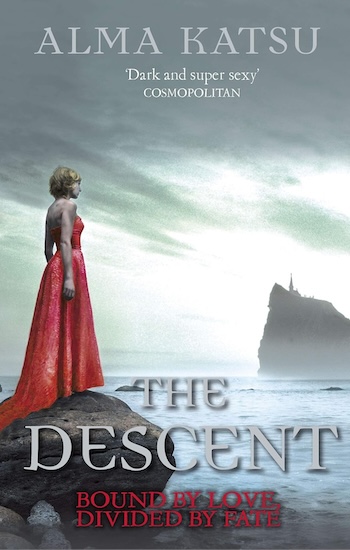
KatsuA-I3-DescentUKA few days ago, a copy of Alma Katsu’s third novel, The Descent dropped through the mailbox. It is the third novel in the author’s The Immortal trilogy, but I didn’t (at the time) know too much about the series or the author, so I took the opportunity to send her some questions.

Who is Alma Katsu?

As a girl, I wanted to have a magical, fantastical life but the outlook was kind of narrow and grim, and I think that’s why I turned to creating my own worlds in fiction. Then, funnily enough, I ended up having a life that was the stuff of fantasy: working in intelligence, traveling, doing all this technical, math-y stuff that I never would’ve thought possible for a little storyteller. Lesson: you never know where life will take you. Continue reading

Christmas Fiction Review Catch-Up: Jonathan Dee, A.S.A. Harrison & John Niven

I am falling terribly behind on my reviews. So, in order to get caught up a bit more on the backlog, I’ll be combining some reviews into thematic posts (of sorts). This one takes a look at three non-SFF novels I’ve read recently.

***

DeeJ-AThousandPardonsJonathan Dee, A Thousand Pardons (Corsair)

Ben and Helen Armstead have reached breaking point and it takes one afternoon – and a single act of recklessness – for Ben to deal the final blow to their marriage, spectacularly demolishing everything they built together.

Helen and her teenage daughter Sara leave for Manhattan where Helen takes a job in PR – her first in many years – and discovers she has a gift for spinning crises into second chances. But can she apply her professional talent to her personal life?

I rather enjoyed this. It was a quick read, but not perfect. The novel starts out with the sudden, spectacular dissolution of Helen’s marriage to Ben, who is quite the narcissist experiencing quite the midlife crisis and breakdown. The first part of the novel follows Helen as she makes her way to New York, and stumbles into a PR job. She has a knack for coaxing out appropriate, believable apologies out of her clients. For a short time, she is able to enjoy this success. Then the novel brings Ben back into the narrative, and we get a more even-handed impression of the two characters – while I had enjoyed reading about Helen, and it did take a little while before reorienting myself for Ben’s side of the story, the novel benefited from them both being central. Dee’s prose is fluid, and I rattled through this novel at quite the pace. At times, though, things moved perhaps a little too fast – Helen’s advancement in the PR business jumps ahead slightly, and Dee doesn’t give much time over to Helen and Sara’s new lives in the big city. I think the author could have spent some more time exploring what each of the characters was going through.

Nevertheless, A Thousand Pardons is an enjoyable novel about a marriage in ruins and a family in crisis; about the limits and joys of self-invention; and about the peculiar seduction of self-destruction. It is also the tale of redemption and forgiveness, of sorts, and the enduring connection families can feel with each other, despite some of the most difficult of circumstances. It’s not a bad introduction to Dee’s fiction, and I enjoyed it enough to convince me to pick up The Privileges at some point in the not-too-distant future.

*

HarrisonASA-TheSilentWifeUKPBA.S.A. Harrison, The Silent Wife (Headline)

Todd Gilbert and Jodie Brett are in a bad place in their relationship. They’ve been together for twenty-eight years, and with no children to worry about there has been little to disrupt their affluent Chicago lifestyle. But there has also been little to hold it together, and beneath the surface lie ever-widening cracks. HE is a committed cheater. SHE lives and breathes denial. HE exists in dual worlds. SHE likes to settle scores. HE decides to play for keeps. SHE has nothing left to lose. When it becomes clear that their precarious world could disintegrate at any moment, Jodie knows she stands to lose everything. It’s only now she will discover just how much she’s truly capable of…

Oh, how I wanted to love this book. For months, it seems, I’ve seen so much praise and a constant trickle of links for great and gushing reviews on Twitter. The book itself is covered in eye-catching blurbs from prominent authors, reviewers, and so forth. So how was it? Well… Politely? It wasn’t for me. Bluntly honest? I was bored. Throughout. I didn’t like either of the main characters. He is a douche, a lecherous cheater, who seems to only appreciate what his wife does for him and the fact that she’s attractive. She is fastidious to a fault, ordered and lacking any impulsiveness and rather bland:

“Meticulous planning has its merits. Life at its best proceeds in a stately manner, with events scheduled and engagements in place weeks if not months ahead. Scrambling for a last-minute date is something she rarely has to do, and she finds it demeaning.”

Now, I understand that both of the characters were probably meant to come across as either a complete ass (him) or quietly in denial about everything (her), but damn it doesn’t make for interesting reading. The synopsis above is not the whole synopsis. I cut the following:

“A chilling psychological thriller portraying the disintegration of a relationship down to the deadliest point when murdering your husband suddenly makes perfect sense.”

I found this as chilling as tepid tap water. That being said, in terms of prose and construction, The Silent Wife is very competent. The author’s prose are very well constructed, which is really the only reason I kept reading. That bit about the novel being a “chilling psychological thriller”? I was waiting for that to happen right up until I turned the final page. Maddeningly bland. This was the biggest let down of the year, I was left wondering if what I bought and read was the same book everyone else had been talking about…

*

NivenJ-StraightWhiteMaleJohn Niven, Straight White Male (William Heinemann)

Kennedy Marr is a novelist from the old school. Irish, acerbic, and a borderline alcoholic and sex-addict, his mantra is drink hard, write hard and try to screw every woman you meet.

He’s writing film scripts in LA, fucking, drinking and insulting his way through Californian society, but also suffering from writers block and unpaid taxes. Then a solution presents itself – Marr is to be the unlikely recipient of the W.F. Bingham Prize for Outstanding Contribution to Modern Literature, an award worth half a million pounds. But it does not come without a price: he must spend a year teaching at the English university where his ex-wife and estranged daughter now reside.

As Kennedy acclimatises to the sleepy campus, inspiring revulsion and worship in equal measure, he’s forced to reconsider his precarious lifestyle. Incredible as it may seem, there might actually be a father and a teacher lurking inside this “preening, narcissistic, priapic, sociopath”. Or is there.

This was a very pleasant surprise. There was a bit of a rocky start – the first couple of chapters painted an awful picture of the protagonist, and I worried that I’d always struggle to engage with him. However, Niven very quickly surprised. Straight White Male ended up being one of my favourite reads of the year.

Kennedy, our protagonist, starts off as one ugliest protagonists I’ve read about. He’s kind of awful: spoiled, wasteful, a drunkard, lewd, a sex addict with an unhealthy disrespect for women (sleeping with someone in the cloak room at his wedding, juggling multiple porn platforms at once)… He’s a complete narcissist. He’s not a pleasant guide for a lot of the opening chapters, which did make me wonder if I wanted to continue reading. Everyone else Kennedy interacts with is as well-written as this asshole, which made me stick with it, and eventually we learn why Kennedy is the way he is, and see his character develop. Niven can definitely write, and write very well, which kept me coming back. So, if you aren’t a fan of anti-hero protagonists, I’d recommend still sticking with the book, as it gets very good.

I really liked the way Kennedy gets to say and do all the things I bet many people living and working in or with Hollywood would love to say to all the self-important, pompous “artistes” with inflated senses of their own genius… He doesn’t shy away from opining on their flaws (or shouting  them at prima donna, uneducated actors). His internal and external commentary is often very funny. He’s also honest about why he does certain things. Kennedy is also not sparing on his frustrations with the publishing industry, either.

“Busy jumping from rewrite to polish to dialogue pass because, of course, all this was easier (and much more remunerative) than spreading his intestines across the page for two fucking years writing a novel. Because the only things he wanted to write about he couldn’t. He wasn’t blocked so much as… finished. The novel? That was a man’s business. He was done with it. Not that anyone knew that yet of course.”

What was most interesting, however, is how Niven slowly unveiled the tragic story of Kennedy’s sister, and how that has effected his behaviour. A lot of what he does, in the end, seems like avoidance and alcohol-fuelled coping and distraction. After the story shifts to the UK, things move quite a bit faster, too, which was a little disappointing. I would have liked some more… well, everything, really. Rather than reading that as an indictment of the novel, consider it my way of saying I wish it had been longer, because it was so good. Which it was.

Straight White Male is a very good novel on some of the many neuroses and coping mechanisms to which men can turn. Funny, irreverent, touching, and well-written, this is definitely recommended.

An Interview with PAT CADIGAN

CadiganP-Chalk

A few days ago, I got an email from an editor at This Is Horror, a UK indie publisher. I haven’t been the biggest of horror readers, but the email was about Pat Cadigan’s latest chapbook, Chalk. I was intrigued, and will hopefully have it read and reviewed in the near future. I’ve been aware of the multi-award-winning Cadigan for years, though, and so I took this opportunity to interview the author. So, here we chat about her work, the chapbook, writing, and more…

Let’s start with an introduction: Who is Pat Cadigan?

CadiganP-SynnersI’m a recovering American and the mother of a grown son. I’ve lived in North London for almost eighteen years. Most people would know me as a science-fiction writer. All my novels are hard science-fiction (meaning they’re based on things that are possible now). I’ve won the Arthur C. Clarke Award twice, once in 1992 for Synners and again in 1995 for Fools. I’ve won the Locus Award three times: once for my short story, “Angel,” once for my collection Patterns, and most recently for my novelette, “The Girl-Thing Who Went Out For Sushi,” which also received the Hugo Award in 2013. In between, I had cancer but it’s gone now. I keep busy.

I thought we’d start with your fiction: Your latest novellette (or chapbook, if you will), Chalk, was recently published by This Is Horror. How would you introduce it to a potential reader? Is it part of a series?

It’s not part of a formal series, but it is one of several pieces of short fiction set in the neighbourhood where I grew up in Massachusetts. They’re generally set in the early 1960s and while they contain autobiographical elements, they are not the story of my life. I just borrowed a few things to riff on. Or riff off.

What inspired you to write this particular story? And where do you draw your inspiration from in general?

Michael Wilson asked me if I’d be interested in doing a chapbook and I said yes. I’d never done a chapbook before and I’m always up for a new experience. I read the previous ones from This Is Horror and found them all satisfyingly variegated (and quite good). So I prayed to the Story Fairy (Dept. of Horror) and this is what I got.

CadiganP-Chalk

I know how that must sound. My creative process is a black-box operation and I’ve been at this long enough (34 years professionally) to know what works best for me: tell brain to think, consider the elements involved – genre, length, my personal taste; allow the associations to marinate overnight in REM sleep; return to task the next day, try writing a paragraph, see what happens. The first paragraph written isn’t always the first paragraph of the story and it usually undergoes editing if not outright retro-fitting, depending on what I discover in the course of writing the story.

Paragraphs that don’t work end up in my fragment box for recycling.

How were you introduced to genre fiction?

We met in the dark. We’d already been making out for some time before I said, “Say honey, what’s your name?”

I had a library card for longer than I can remember. My mother would take me to the library with her and find books to read to me. Eventually, I learned to read myself and discovered that all the cool stuff was in the science fiction section. In those days – when dinosaurs roamed the net, before the discovery of flame – the genre wasn’t as stratified as it is now. Everything was science fiction – Heinlein, Bradbury, Clarke, Tolkien, Mervyn Peake’s Gormenghast books, Richard Matheson, Jack Finney – anything with a fantastic element was science fiction. Judith Merrill used to edit a best-of-the-year anthology that was the same way – pure-quill hard SF by Mack Reynolds and Walter M. Miller, Jr., sat cheek-by-jowl with oddities from Bernard Malamud, John Cheever, and Tuli Kupferberg. My ambition was to be good enough to get into one of those anthologies. I still want to be that good.

PatCadigan-IntroToGenre

How do you enjoy being a writer and working within the publishing industry? Do you have any specific working, writing, researching practices?

I love being a writer and I wouldn’t do anything else. For most of my life, I’ve had additional responsibilities – school, an outside job, motherhood, looking after my aged parent – so I learned to write as and when: late at night, early in the morning, lunch hour, weekends, sometimes reaching around the baby napping in my front-carrier to the keyboard, in hospital waiting rooms, on the train. If you really want to do something, you figure it out.

When did you realise you wanted to be an author, and what was your first foray into writing? Do you still look back on it fondly?

I don’t remember a time when I didn’t want to be a writer. As soon as I knew books and stories were written by people, I knew I was one of those people. My mother gave me her old Underwood typewriter – it was a monster. It must have weighed about five hundred pounds. You had to really bang on the keys and all the capital letters were half a line up from the rest of the word. I started out at 3 or 4, always typing “Chapter One” first. Finally my mother suggested that I should maybe try writing a short story first to get the hang of storytelling. But I preferred trying to write novels. Eventually, I hand-wrote several novels that were my cracked version of a mystery series. It was a kind of a cross between Nancy Drew and Trixie Belden, with occasional supernatural flourishes. I was very disciplined. Every chapter had to run both sides of the page, no less, no more.

UnderwoodTypewriter

This is an Underwood. It looks heavy as all get-out…

Later I had a sort of Doc Savage in space thing going for a while – by then, my Aunt Loretta had given me her portable typewriter, which was a lot easier on the fingers than the Underwood. Then sometimes, when my mother worked weekends, I’d go with her. She worked in the admitting office of a hospital and I wasn’t supposed to be there but as long as I sat in the back office and kept quiet, nobody minded. There I met my first IBM Selectric; I couldn’t imagine a machine more advanced, more futuristic. Selectrics were so expensive back then, only businesses had them.

IBMSelectricII

Somewhere in there, I read the Isaac Asimov issue of F&SF in which he talked about his early attempts at writing, including something he called The Greenville Chums At College. I was delighted; I could relate. I’d just left the Greenville Chums stage of my own development and I knew I would persevere.

What’s your opinion of the genre today, and where do you see your work fitting into it?

PatCadiganI love genre and I read for pleasure as much as I can. But I don’t think of my work as “fitting into it.” I write genre fiction because I love genre fiction. I don’t write critical essays and I don’t do reviews, so you’ll have to forgive me for not answering that question.

People love genre fiction, in every medium – print (including e-print), TV shows, movies, and of course games (when was the last time you heard about a game that was all real, all the time?). If you want to see writers treated like rock stars, go to the American Library Association convention and watch how they react to children’s and YA authors. YA authors who work in genre get the most attention and adulation, because they keep kids reading.

Fine art is fine art and I have drawn inspiration from it in many forms. But to be brutally honest, the things people internalise most come from popular culture, particularly the genre portion. Everything I Ever Needed To Know I Learned In Kindergarten was soon followed by Everything I Ever Needed To Know I Learned From Star Trek. Some people might scoff but people tend to take their cues from things they enjoy, that give them pleasure, more often than from things they’ve been told are good for them.

So if people turn to entertainment, I try to provide good entertainment.

What other projects are you working on, and what do you have currently in the pipeline?

Right now I’ve just crawled out of Deadline Hell into Deadline Purgatory. I said yes to a lot of short fiction requests and they all came due around the same time. I have to plan better in the future so I can go back to work on the novel based on “The Girl-Thing Who Went Out For Sushi.”

KingS-DoctorSleepUKWhat are you reading at the moment (fiction, non-fiction)?

I’m reading a lot of science and books about the solar system. I had to take a few days away from everything so I could read Doctor Sleep, and I’ll probably re-read some other Stephen King books. When it comes to writing about the human condition, nobody does it better. Even if the books themselves aren’t completely successful – which doesn’t often happen – they still contain brilliant passages of superb writing and characters that are as real as anything.

And like everyone else, I’m waiting for the next Game of Thrones book from George R.R. Martin. At last, epic fantasy with a dirty face, dirtier clothes, permanent scars, and body odour. And occasional dragons.

LindaLovelaceForPresidentI read a lot of crime fiction and thrillers, too. I like Nicci French and Minette Walters, among others.

What’s something readers might be surprised to learn about you?

I was an uncredited (and fully-clothed) extra in Linda Lovelace For President.

What are you most looking forward to in the next twelve months?

The London Worldcon. That’s going to be great!

***

Be sure to follow Pat Cadigan on Twitter and Live Journal; and also This Is Horror on Twitter on Facebook. Chalk is available to buy in print and eBook formats.

Artwork: “Gotrek & Felix: The Serpent Queen” by Joshua Reynolds (Black Library)

I must have said it a hundred times on the blog, now, but I really must get around to reading Josh Reynold’s Road of Skulls, his first full-length novel featuring my favourite Dwarf Slayer and human companion… In advance of that, though, I spotted the artwork for Reynolds’s next novel in the series, The Serpent Queen:

ReynoldsJ-G&F-SerpentQueen

Sorry for the low-quality image, but I wanted to share the cover anyway. It’s one of my all-time favourite fantasy series, so I’m always excited for news and more fiction (even if it does take me altogether too long to get around to reading them…). Here’s the synopsis:

Gotrek and Felix: unsung heroes of the Empire, or nothing more than common thieves and murderers? The truth perhaps lies somewhere in between, and depends entirely upon whom you ask… Travelling to the mysterious south in search of a mighty death, the Slayer Gotrek Gurnisson and his human companion, Felix Jaeger, find themselves caught up in a battle between warring kingdoms. Captured by the sinister Queen Khalida and forced to do her bidding, the adventurers must brave the horrors of the sun-soaked Land of the Dead, where the dead do not rest easy.

Serpent Queen is due to be published in March/April 2014. Road of Skulls and David Guymer’s City of the Damned are available now from Black Library. In addition, the first in the series, William King’s Trollslayer, has recently been re-released as part of the Black Library Classics series – it is, in my humble opinion, a must-read.

Gotrek&Felix-AlsoAvailableNew

Uncanny X-Men, Vol.1 – “Revolution” (Marvel NOW)

UncannyXMen-Vol.01A so-so ‘start’ to a new Uncanny X-Men series…

Writer: Brian Michael Bendis | Artist: Chris Bachalo (1-4), Frazier Irving (#5) | Inks: Jaime Mendoza, Tim Townsend, Al Vey, Victor Olazaba & Frazier Irving | Colours: Chris Bachalo & Frazier Irving

The true flagship X-Men series returns… NOW! In the wake of the Phoenix event, the world has changed and is torn on exactly what Cyclops and his team of outlaw X-Men are – visionary revolutionaries or dangerous terrorists? Whatever the truth, Cyclops, Emma Frost, Magneto, and Magik are out in the world gathering new mutants and redefining the name Uncanny X-Men. But the challenges that they must overcome are fierce: once again, robotic Sentinels hunt the team and the mutants they protect… but when you find out who’s doing the hunting, your jaw will drop! And if that’s not enough, there’s a mole on Cyclops’s team – but who is it?

Collects: Uncanny X-Men #1-5

This is not a bad start to one of the Marvel NOW re-launch titles. Nevertheless, I had some issues with it, but they are more related to the overall direction of the Marvel NOW titles than this series per se. So: some good, some middling.

UncannyXMen-Vol.01-Interior3

Sentinels!

Yes, Uncanny X-Men is quite fun, and this book has a cheeky and gentle wit and humour running throughout – Bachalo’s artwork is a wonderful medium to realise this on the page, too. I’ve really grown to like it from Wolverine & the X-Men, despite initially not being too sure if I did. Speaking of W&tXM, the humour in Uncanny X-Men is very reminiscent of that, so I wonder if it is a conscious effort or just something Bachalo brings to the books he’s working on? Either way, I enjoyed it.

That being said… I understand that Cyclops, Emma Frost and Magick are struggling with their powers – they’re misfiring, malfunctioning, or out of control. They all were infused by the Phoenix Force in Avengers vs. X-Men, after all – and, if I remember correctly, there was a mention of at least Scott’s difficulties coming to terms with his reduced control and powers in AvX: Consequences (or possible in volume one of All-New X-Men?). But… Why is Magneto having difficulty with his powers? He wasn’t taken over by the Phoenix Force. I don’t remember that coming up before, nor any reason being given for it.

UncannyXMen-Vol.01-Interior1

The new mutants Cyclops & Co. have added to their numbers – new young recruits, people manifesting new powers since the arrival and dispersal of the Phoenix Force, are fun. It does mean, though, that we’re seeing another series that is probably trying to attract younger readers, something more in common with Wolverine & the X-Men (another similarity, perhaps only brought to mind lazily by Bachalo’s involvement). This despite fertile ground to explore a number of deeper issues. For example, who is culpable for the whole AvX mess (as they point out, it was Iron Man’s mistake that split the Phoenix Force into five hosts in the first place…). There is plenty they could explore with this series, but instead it looks like they’re going to wander off into other areas (the final chapter of the book turns the focus on to Magick and her misfiring powers). Revolution felt sadly unfulfilling and thin.

UncannyXMen-Vol.01-Interior2

Love this bit. “Did he actually call a time-out?”

I don’t know, ultimately, what I think about this book. Some of it I really liked (the art and humour), but some of it irked me because I think the whole franchise may have made some real problems for itself with these endless mass Events, crossovers, etc. I’ll probably still check out book two, but I’m in no hurry to do so. So this is recommended, but perhaps for real Marvel fans only, and not for just-casual readers.

UncannyXMen-01B-SkottieYoung

Skottie Young’s Variant Cover for #1
[Because I can’t pass up an opportunity to share Young’s work…]