Quick Review: DEPTH by Lev A.C. Rosen (Titan/Regan Arts)

RosenLAC-DepthUSMurder and conspiracy in flooded future New York City

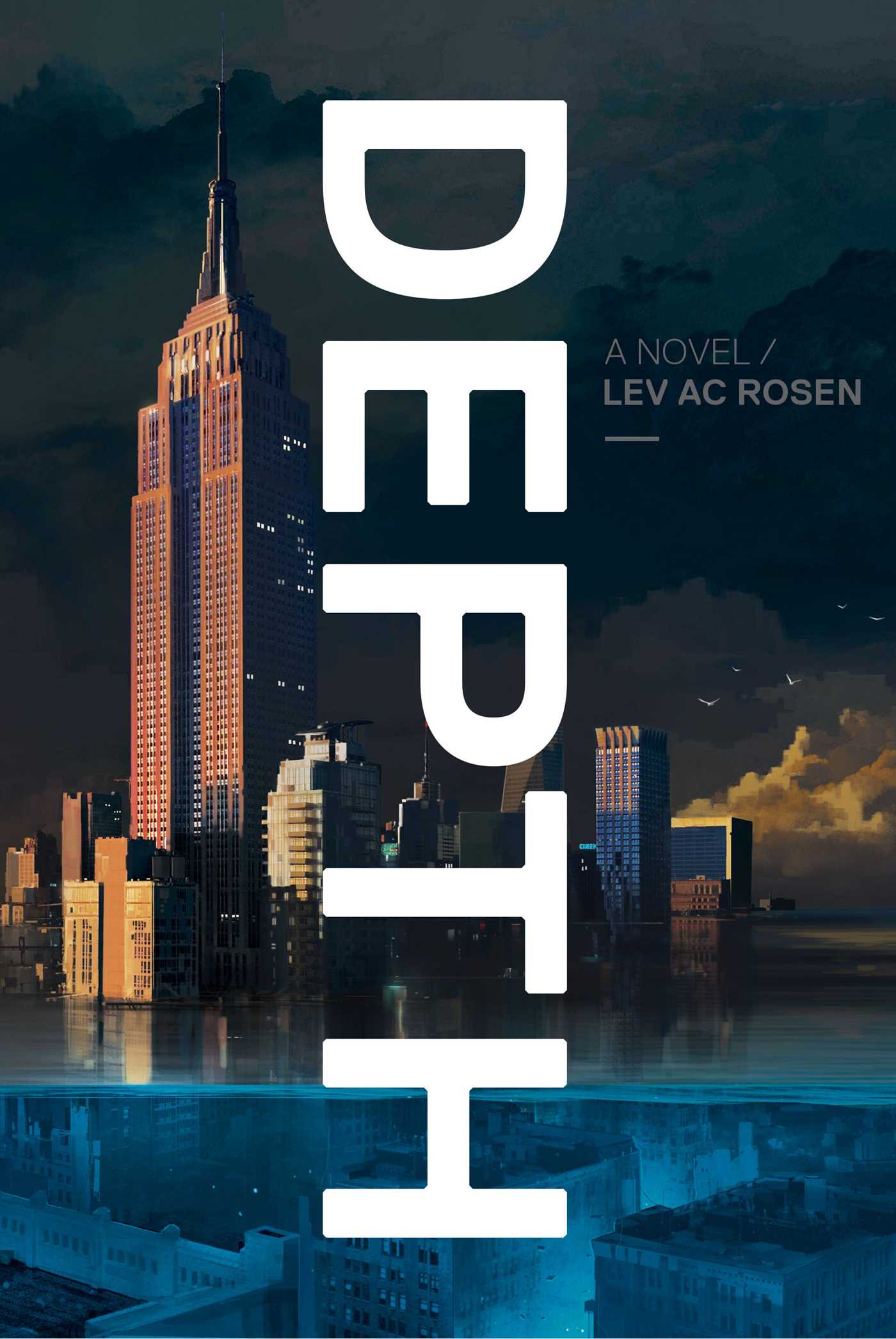
Depth combines hardboiled mystery and dystopian science fiction in a future where the rising ocean levels have left New York twenty-one stories under water and cut off from the rest of the United States. But the city survives, and Simone Pierce is one of its best private investigators. Her latest case, running surveillance on a potentially unfaithful husband, was supposed to be easy. Then her target is murdered, and the search for his killer points Simone towards a secret from the past that can’t possibly be real—but that won’t stop the city’s most powerful men and women from trying to acquire it for themselves, with Simone caught in the middle.

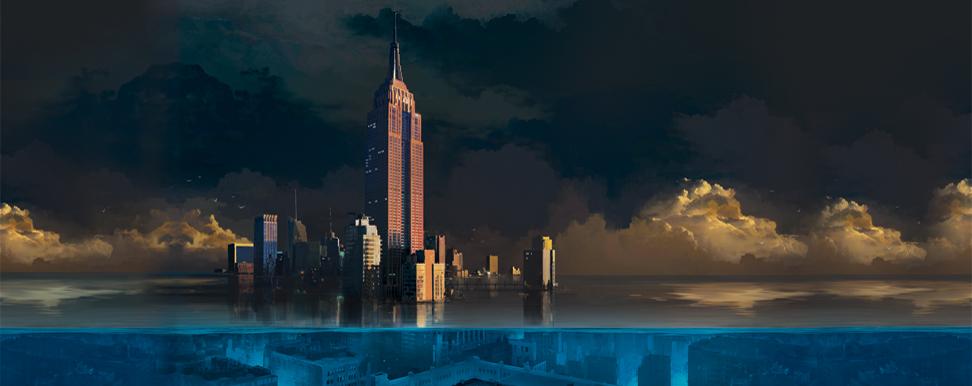
Without a doubt, my favourite thing about the novel is the setting — a partially submerged New York City, cut off from the (now-fundamentalist-Christian) mainland. The first 21 storeys are underwater, only tower blocks and sky-scrapers inhabitable — each stitched together by bridges of varying quality and safety. Rosen doesn’t give us too much about the city, but it is unquestionably a character in itself. Every scene offers a new description and development, letting readers know how the city has changed over the decades since the oceans rose, and the methods used by New Yorkers to adapt. The fundamentalist swing of the mainland was amusing to read, even though it’s mainly just offered in passing as a contrast to New York.

The story itself was pretty straight-forward, and I appreciated the fact that Rosen wove it into this world. It wasn’t the best PI/detective story I’ve ever read, and I’m sad to say I wasn’t fully gripped throughout — I ended up far more interested in visualizing the city, rather than following the case. There were moments of excellence (in particular, a handful of turns of phrase that were fantastic).

This was a pretty interesting novel and a quick read. While a bit slow, and not as gripping as I had hoped, it’s still a good introduction to this post-apocalyptic New York City. I would certainly read more novels in this setting.

*

Depth is published in the UK by Titan Books and in the US by Regan Arts.

RosenLAC-DepthBanner

Image Comics Catch-Up (Sci-Fi)

Short-but-sweet reviews of three of Image Comics’ latest Sci-Fi series.

Descender-Vol1DESCENDER, Vol.1 – “Tin Stars”

Writer: Jeff Lemire | Artist: Dustin Nguyen

Young Robot boy TIM-21 and his companions struggle to stay alive in a universe where all androids have been outlawed and bounty hunters lurk on every planet. Written by award-winning creator, Jeff Lemire, Descender is a rip-roaring and heart-felt cosmic odyssey. Lemire pits humanity against machine, and world against world, to create a sprawling epic.

Collects: Descender #1-6

This series has received so much love from critics and readers alike, and it’s easy to see why. Not only is Nguyen’s artwork gorgeous, but Lemire’s story and characters are fantastic as well. (Is anyone really surprised by either of those things…? No. Didn’t think so.) It’s an interesting setting and idea, pulled off with skill and deft characterisation. It’s a little unclear where this is headed, but the revelations at the end of the final chapter certainly suggest things are going to get very interesting indeed.

Tim-21 is an interesting character, as are the others he meets on his journey. His innocence is a great foil for the harsh universe he finds himself in, after awakening from years in sleep-mode. Different factions are after him, and this will, I’m sure, ultimately be the story of how he changes those he comes into contact with (as well as some interesting possibilities hinted at regarding A.I., spirituality and so forth).

A really excellent beginning to one of the year’s best new series. I really enjoyed this.

Publisher Page

*
InvisibleRepublic-Vol.01INVISIBLE REPUBLIC, Vol.1

Writer: Gabriel Hardman & Corinna Bechko | Artist: Gabriel Hardman & Jordan Boyd

When a reporter unearths the secret history of the recently deposed dictator of a remote colonized moon, he discovers exposing secrets can be deadly.

Collects: Invisible Republic #1-5

The last couple of years have given readers so very many excellent new series (including Descenders, above). Invisible Republic, though, is possibly my favourite new series of the year. The story is told in two different time periods, 42 years apart. In the “current” time-period, a dictatorship has fallen, leaving a moon economically strained, socially unsettled, and politically a mess. Into the mix, a reporter stumbles across what appears to be a diary by the now-deposed dictator’s cousin. It offers an alternative perspective on the official history of the moon — upending the fabricated account the dictator used to solidify his mystique and legendary revolutionary status. It is a present-at-the-creation, type of diary. Naturally, this is explosive material with incredible potential for further disruption and lucrative media possibilities. The second time-line is focused on the months leading up to the coup and installation of the dictatorship.

That’s all pretty vague, but I came into the book knowing nothing about it (at all — didn’t even read the synopsis), and I loved not knowing anything that was to come. The artwork is great, reminiscent of a lot of DMZ and Epting’s Captain America, but by no means a rip-off — it has a distinct character of its own, which brilliantly evokes the characters, their environs and the situations they find themselves in. The dialogue is some of the most natural I’ve read in a comic in a while, and the story is perfectly-paced and gripping.

Really very highly recommended. I can’t wait for book two. Marvellous stuff.

Publisher Page

*
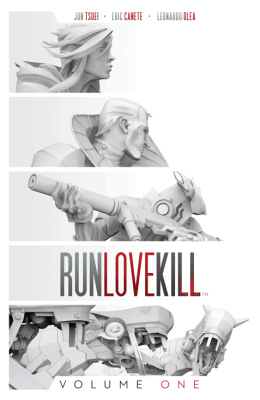
RunLoveKill-Vol.01RUNLOVEKILL, Vol.1

Writer: Jonathan Tsuei & Eric Canete | Artist: Eric Canete

The Origami, a mysterious military organization, is on the hunt for one of their former assassins, Rain Oshiro. Their grasp over the city of Prygat is tightening and Rain has less than twenty-four hours to get out before she’s trapped forever. Rain must face the decisions of her past while using everything at her disposal to avoid capture or even worse, death.

Collects: RunLoveKill #1-4

Of the three issues reviewed today, this one was a bit of a disappointment. It wasn’t necessarily bad, it was just very busy. Rain is on the run from actions in her past; Origami agents are after her, and some of them have dino-suits and aren’t above destroying a nightclub packed with innocent bystanders; she has a friend who seems to control a teleportation device, has a lot of money and is clearly in love with her… Oh, and maybe she is special beyond the fact that she did something in the past…? (You find out at the end of the book. Sort-of.)

The pace is relentless, which can be no bad thing, but here it seemed that action and perpetual motion buried the story and context a bit. That the ending is so abrupt was also an interesting decision. I came away from this book not really sure what to think. I’ll certainly be reading volume two, if only to see if they give us a little bit more to go on. An interesting idea, a nice spin on the fugitive/sci-fi story-type. The artwork’s pretty nice, too — interestingly style, colourful, distinct.

A cautious recommendation, perhaps wait until you can get more issues/volume two as well…?

Publisher Page

*
Interview with RAJAN KHANNA

KhannaR-AuthorPicLet’s start with an introduction: Who is Rajan Khanna?

What a difficult question. I suppose it’s redundant to say I’m a writer, so I’ll also say that I’m also a blogger, a reviewer and a narrator. I live in Brooklyn, New York. I have a passion for writing and books. Also for music and beer and airships and the creatures that live in the depths of the ocean.

Your next novel, Rising Tide, will be published by Pyr in October 2015. It’s the second in your dystopian series. How would you introduce the series to a new reader, and what can fans of Falling Sky expect from book two?

My simple explanation for the series is that it’s post-apocalyptic with airships. It’s a fast-paced series of adventures about an airship captain trying not just to survive in the post-apocalypse, but to find a greater purpose.

Readers who read Falling Sky will know that Ben ended that book in a precarious situation. Things only get worse in Rising Tide for both Ben and Miranda. It’s still a fast-paced book, but the stakes are higher in this one.

Continue reading

Guest Post: “Facebook and the First World War — The inspiration behind IF THEN” by Matthew De Abaitua

DeAbaituaM-AuthorPicIt was a news report on CNBC that provided a glimpse of the world to come:

“A single mysterious computer program that placed orders — and then subsequently canceled them — made up 4 percent of all quote traffic in the U.S. stock market last week, according to the top tracker of high-frequency trading activity. The motive of the algorithm is still unclear.”

This last phrase was taken by the artist James Bridle as the title of a talk. I hope to find it on a t-shirt one day.

The opacity of the algorithm indicates the underlying otherness of the technology that surrounds and penetrates us. On the surface, the algorithms powering Google and Facebook are compliant. Place a search term into Google and watch it scamper to please you. But there are layers of intent behind that compliance, some of which are commercial but a few offer stranger sites for speculation. Continue reading

Guest Post: “On Worldbuilding (Food, in Particular)” by Adam Rakunas

RakunasA-AuthorPicHow does your city eat?

Are there supermarkets? Specialty groceries? Farmers markets? Hell, do people even bother cooking at home? Does everyone crowd into the same diners and cafés? Are there bistros and bars? What does your city look like at breakfast, lunch, and dinner? What time do those meals start?

I can ask and answers those questions about my current city (Santa Monica, California), and I’m going to start asking them next month when my family moves to Seattle, Washington. I can do the same with cities I’ve visited, and I can get a surface understanding of that neighborhood. Food is the thing that unites all humans. We all have to eat. How we eat, however, is open to interpretation. Continue reading

Guest Post: “The Best Villains Dress in Gray” by David Walton

What do Severus Snape, Gollum, and Darth Vader all have in common? Besides being three of the most celebrated villains in science fiction and fantasy, that is?

The way I see it, there are two types of villains. The first type is like a natural disaster. This kind of villain personifies evil, with no redemptive qualities at all. He represents a force outside of the protagonists, powerful and relentless, that can’t be reasoned with or turned aside. We rarely see the story from his point of view. Voldemort is a villain of the first type, as is Sauron. But that’s not the type I like best. Continue reading

An Interview with JASON M. HOUGH

HoughJM-AuthorPicLet’s start with an introduction: Who is Jason M. Hough?

He’s me. I’m him. Oh! I see what you mean. Let’s see… These days I’m a full-time author. Perhaps more accurately I’m a full-time author and a full-time father, since I’m always doing both to some extent. Before that I designed video games, did 3D animation, made mobile software that utilized machine learning and contextual awareness, and other things not quite as interesting.

Your next novel, Zero World, is published by Titan Books (UK) and Del Rey (US). It looks pretty excellent: How would you introduce it to a potential reader? Is it part of a planned series?

Thanks! The quick intro is that it’s a bit like “James Bond meets Total Recall”, though of course such things are always lacking.  So let’s say it’s a futuristic spy thriller featuring a assassin who, upon completing his missions, has his memories reset to the pre-mission state. He’s sort of embraced this “feature” about himself, and lives his life to give himself the best chance of success when he’s out doing… whatever it is he does. Continue reading

Guest Post: “Building a World on One Idea” by Gerrard Cowan

CowanG-AuthorPicI was digging through ancient emails the other day when I came across an old plan for my novel, The Machinery. After admonishing myself for never cleaning my inbox, I decided to take a look and was struck by how different it was from the finished book. In fact, you would be hard pushed to recognise it as the same story.

This is probably true of many novels, but in my case, it stemmed from how the story developed. In the past, when I’ve had an idea for a book, I would come up with the narrative thrust, the main characters, the general setting. I’d have a hazy picture of what was going to happen and where it would take place. With The Machinery, it was different: all I had was the premise of the novel, and I had to build from there.

The conceit of The Machinery is based on the existence of an omnipotent machine, which chooses the leaders of society. They could be anyone at all, adult or child: the Machinery picks them as they are the best suited to their particular roles. There’s only one problem: it seems as if the machine is breaking. Continue reading

Guest Post: “Planet Jacked!” by Weston Ochse

OchseW-AuthorPicI’d never really encountered the idea about terraforming until I read David Gerrold’s A Matter for Men, and boy did that scare me more than any horror novel I’d ever read. It’s one thing to have space duels with enemy ships or visitations from aliens seeking to see what we’re up to, but it’s another thing altogether when you begin showing aliens who’ve decided that they want your planet and have begun changing the entire ecosystem right out from under you. I mean, what do you do? What technology do we have to stop them?

In Hollywood, there’d be some last second solution overlooked by mainstream scientists, but discovered by the conspiracy theorist picking his nose in the corner. But that’s never going to happen.

In Hollywood, the aliens would find a way to communicate with the President of the United States, because that’s what all aliens do, to give us some sort of ultimatum.

I drop the bullshit flag on that one. Continue reading

Mini-Review: SPEAK by Louisa Hall (Ecco/Orbit)

HallL-SpeakUSAn interesting, multi-narrative look at AI and what it means to be human

In a narrative that spans geography and time, from the Atlantic Ocean in the seventeenth century, to a correctional institute in Texas in the near future, and told from the perspectives of five very different characters, Speak considers what it means to be human, and what it means to be less than fully alive.

A young Puritan woman travels to the New World with her unwanted new husband. Alan Turing, the renowned mathematician and code breaker, writes letters to his best friend’s mother. A Jewish refugee and professor of computer science struggles to reconnect with his increasingly detached wife. An isolated and traumatized young girl exchanges messages with an intelligent software program. A former Silicon Valley Wunderkind is imprisoned for creating illegal lifelike dolls.

Each of these characters is attempting to communicate across gaps — to estranged spouses, lost friends, future readers, or a computer program that may or may not understand them. In dazzling and electrifying prose, Louisa Hall explores how the chasm between computer and human — shrinking rapidly with today’s technological advances — echoes the gaps that exist between ordinary people. Though each speaks from a distinct place and moment in time, all five characters share the need to express themselves while simultaneously wondering if they will ever be heard, or understood.

This is an interesting novel. I had pretty high hopes, when I first learned of it, and I’m happy to say I wasn’t disappointed. Through four loosely-connected narrative strands, Hall has created a beautifully-written novel about humanity, artificial intelligence, and relationships. With just one caveat, this is an excellent novel. Continue reading