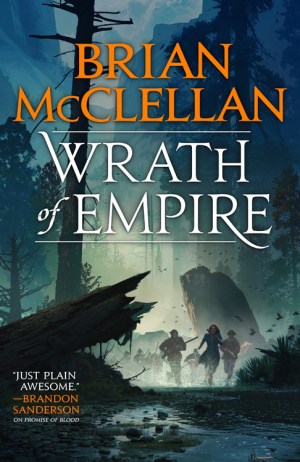
 This week, Brian McClellan unveiled the cover for his next novel: Wrath of Empire. The second novel in his Gods of Blood & Powder fantasy series, and follow-up to Sins of Empire, I’m really looking forward to reading it. (I’ll need to get caught up, first, of course — I’ve still got to read The Autumn Republic and Sins of Empire before diving into this one.) Due to be published by Orbit Books in March 2018 in the US and UK, here’s the synopsis:
The country is in turmoil. With the capital city occupied, half a million refugees are on the march, looking for safety on the frontier, accompanied by Lady Flint’s soldiers. But escaping war is never easy, and soon the battle may find them, whether they are prepared or not.
Back in the capital, Michel Bravis smuggles even more refugees out of the city. But internal forces are working against him. With enemies on all sides, Michael may be forced to find help with the very occupiers he’s trying to undermine.
Meanwhile, Ben Styke is building his own army. He and his mad lancers are gathering every able body they can find and searching for an ancient artifact that may have the power to turn the tides of war in their favor. But what they find may not be what they’re looking for.
Also on CR: Interview with Brian McClellan (2013); Guest Posts on “My Favourite Novel” and “Protagonist Ages in Epic Fantasy”; Excerpt from The Autumn Republic; Reviews of Promise of Blood and The Crimson Campaign
 Let’s start with an introduction: Who is Vivian Shaw?
 Let’s start with an introduction: Who is Dale Lucas?
 Whilst I don’t like to stereotype, I’m going to assume that if you’re reading this then there’s a fair chance you’re familiar with the sitcom The Big Bang Theory. In one of the earlier episodes Penny asks Leonard “What did you do today?”, to which he responds, “Well, I’m a physicist, so I, y’know… thought about stuff.” Although I wouldn’t want to imply that the complexities of writing fiction are of a similar order to particle physics, writers, like physicists, do spend a considerable amount time thinking about stuff. When it comes to inspiration thinking time is crucial. When I count all the stories I actually wrote, compared to those I thought about writing, I come up with a ratio of approximately one in ten, i.e. only about 10% of my ideas actually turn into stories and then only after a lengthy period percolating in the confused teapot of my imagination.
  Let’s start with an introduction: Who is David Mealing?
 Let’s start with an introduction: Who is RJ Barker?
 Let’s start with an introduction: Who is Nicholas Eames?
 Let’s start with an introduction: Who is Mur Lafferty?
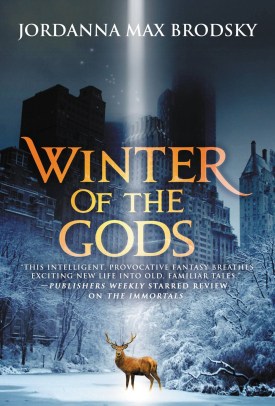 Is someone killing the gods in New York…?
 Civilian Reader