 The books of Gods of the Caravan Road have several central protagonists: Holla-Sayan in Blackdog, Holla, Ivah, Ahjvar, and Ghu, in The Leopard and The Lady, then Ivah and Ahjvar and Ghu in Gods of Nabban. However, the character to whom the series as a whole belongs is Moth, the devil Ulfhild Vartu. With the half-demon wer-bear Mikki at her side, she begins it, in “The Storyteller,” acquiring the black sword Lakkariss from the Old Great Gods in order to avenge her brother and Mikki’s mother on her cousin and former ally, Heuslar Ogada. She ends it, standing at the centre of events in The Last Road. In between, she and Mikki wander in and out of the others’ tales, with Moth, at least, avoiding ever becoming too close to any of them, even Ivah, in whom she sees perhaps an echo of her own lost daughter, but strongly, of herself. Continue reading
Guest Post
Guest Post: “Five Books That Inspired Me to Be a Writer” by Laurence MacNaughton
 Practically every human being, at some point or another, has closed the covers on a satisfying book and thought: I should write a book like that.
That initial burst of inspiration is quickly followed by nagging doubt. Do you have what it takes to write?
After all, knowing how to write is only half the battle. The other half is finding the inspiration, the self-confidence, the grit to actually write something worth reading. And the fortitude to stick with it through months or years of rewrites, revisions, and rejection.
It’s not easy. But it can be done. The best advice on toughing it out comes from those who have cranked out hundreds or thousands of pages of prose, and shared their hard-earned insights on what it’s really like to be a writer. Here are five books about writing that inspired me most. Continue reading
Guest Post: “Our Fascination with Genre Distinctions” by Christopher Ruocchio
 I don’t know what it is about genre distinctions that so fascinates writers and readers alike. We enjoy them perhaps for the same reason we obsess about character classes and skill trees and so on in games like Dungeons and Dragons and why so many of us obsess (wrongly) about “magic systems” (as if anything which supercedes and violates natural law should be systematic, ha)! We like complexity, perhaps too much, we like categories (heavens, so much trouble in fan culture of late is the result of trying to categorize fans and creators alike: for their immutable traits, for the beliefs, for their politics, and so on). Complex categories give the world a texture that we nerds find pleasing, for they bespeak a deep sense not merely of order, but of ordered chaos.
The best of both worlds. Continue reading
Guest Post: “How My Daughter Reacted When I Made Her a Main Character in my Novel” by David Walton
 “They never write stories about people like me,” my thirteen-year-old daughter said. She had just finished yet another YA novel filled with active, adventurous, extroverted sort of people. But Naomi isn’t like that. She’s a beautifully quiet, caring, quirky introvert. Being with other people causes her anxiety, and her favorite activity is reading a book alone. She’s more likely to help quietly from the background, unseen, while others take the lead, and never argues with or confronts others. She wanted to know: Why were none of the people in those novels like her?
I decided that the world needed a protagonist like Naomi. For my novel Three Laws Lethal, I created a fictional Naomi, eight years older than the real one, a senior at the University of Pennsylvania. I invented for her a library nook that no one else knew about where she could spend hours reading or working and feel safe. I gave her an inner thought life based on all of the science fiction and fantasy books she’d read and reread. Continue reading
Guest Post: “The Challenge of the Middle Books” by D.B. Jackson
 My newest book, Time’s Demon, comes out on May 28 from Angry Robot Books. This is the second book in The Islevale Cycle, my time travel/epic fantasy trilogy, which began with Time’s Children (October 2018). This was a challenging – and ultimately rewarding – book to write for a number of reasons. Time travel stories are always difficult to construct because of the constant danger of creating paradoxes, anachronisms, and plotting loopholes. Epic fantasies come with their own challenges – the need to balance and keep track of multiple narrative strands and point of view characters.
Finally, and most importantly for our purposes today, Time’s Demon is the second book in a trilogy – the dreaded middle book – and as such it presented a unique set of issues. Now, not everyone is foolish enough to take on time travel in their novels, and hard SF, space opera, urban fantasy, grimdark, steampunk, and other varieties of speculative fiction are not necessarily any easier to approach than epic fantasy. But most if not all of us writing in our genre will eventually confront the dreaded “middle book” problem. So I would like to discuss my approach to second books. Continue reading
Guest Post: “Worldbuilding PIMP MY AIRSHIP” by Maurice Broaddus
 I’ve often told the story of how the short story “Pimp My Airship” started as a joke gone awry on Twitter. When the story was actually requested, I had to build a world. The main criticism the story received was that there seemed to be a lot of world that the reader barely gets to see in the five-thousand-word story. When I fleshed out the origins of the Star Child, it led to the novelette “Steppin’ Razor”; and a throwaway line about “the Five Civilized Nations of the northwest territories and the Tejas Free Republic” led to the novella Buffalo Soldier. I won’t lie, the criticism still followed me. Perhaps they had a point about how much world I can compact into a story. That’s because my favorite part of the writing process is worldbuilding since that’s when I really get to play. For Pimp My Airship, I allow myself plenty of room to build out my world. Its creation centers around three areas: Continue reading
Guest Post & Excerpt: “Making of the Prologue” by David Hair, author of HEARTS OF ICE (Jo Fletcher Books)
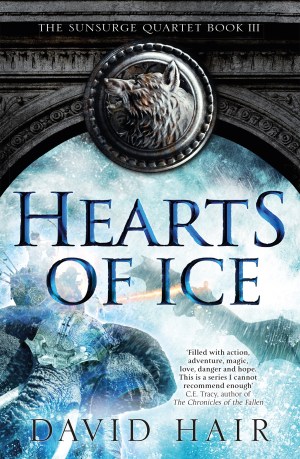 First up, I’m a planner: The Sunsurge Quartet is mapped out from start to finish, before I start writing Book One. That includes the Prologues, which I’m using (along with mid-book ‘Interludes’) to introduce the backstory and current status of the villain who’s going to feature most in the next part of the story. They give the reader a chance to see inside the enemy’s heads, and set the agenda for the coming chapters.
In this series, the main villains are part of a cabal trying to tear down human society, and they use theatre masks to disguise their true selves. I was inspired in this by Venetian carnival masques, of which I have a bit of a collection after going mad in a Venice mask shop. I invented my own mask designs and a backstory for them, using the concept of a tradition of morality tales that theatre troupes adlib on stage, every show unique. These can be high art or low farce, always with the same eight characters and central theme – a romance between Ironhelm (the sturdy knight) and Heartface (the innocent maid). Their love is aided or thwarted by the other six characters: the meddling Beak, the prankster Jest, the duplicitous Twoface, the lucky Felix, the nemesis-like Angelstar and the sorrowful Tear. The tale is narrated by a narrator known as the Puppeteer. Continue reading
Guest Post: “Interview with the Gumshoe” by Graham Edwards
 I knew I shouldn’t have gone to that bar. There I was, sitting on a stool staring down a shot of Southern Comfort, when in he walked – a weary-looking gumshoe wearing a crumpled fedora and tattered leather coat.
I knew him at once, and why wouldn’t I? He was the hero of my new novel, String City, large as life and looking mad as hell. What follows is a transcript of our conversation. I’ve called it an interview, but really it wasn’t.
It was an interrogation.
GUMSHOE: What in the name of Hades do you think you’re playing at?
GRAHAM EDWARDS: I’m sorry?
GUMSHOE: (pulling a copy of String City from his coat pocket) You think this is funny? Continue reading
Guest Post: “On Research” by Fran Dorricott, author of AFTER THE ECLIPSE
 Research is one of the most important parts of writing a crime novel, and while I don’t research as heavily as some authors I did have several areas I wanted to focus on to make After the Eclipse as authentic a story as I could. I started with the setting – for me, a vivid setting is vitalto getting sucked into a book. I knew from the start I wanted to create a similar world to the one in which I grew up. My parents were divorced, and for a while my dad lived in a caravan. He travelled all over Derbyshire, and when I would stay with him at the weekends my inner explorer came to life. I loved the sweet-smelling open fields, the friendly locals in the small towns and villages, and the glimpses into a hundred other lives. Continue reading
Guest Post: “Identity Motifs in The Goldfinch, The Catcher in the Rye and Life As We Know It” by Weston Ochse
 I was introduced to the idea of The Catcher in the Rye in 1979. I’d heard about this 1950s novel through my parents, both educators. I’d also heard about it through a Freshman English teacher at my High School. The reason I’d only heard about it and not seen it was because I was living in Tennessee and at the time it was a banned book. By banned, I don’t mean that there were any Fahrenheit 451 Fireman to come and burn them up — although I am sure there were those who wished that to be true. By banned I mean that the book was considered an unhealthy read and stores and libraries were urged not to provide them to young healthy minds. So it was with great delight that I was able to buy a copy of the book in 1981 at the local Walden Books store, who provided it from a box in the backroom and sold to me wrapped in brown paper so no one would see what I’d purchased. Continue reading
 Civilian Reader