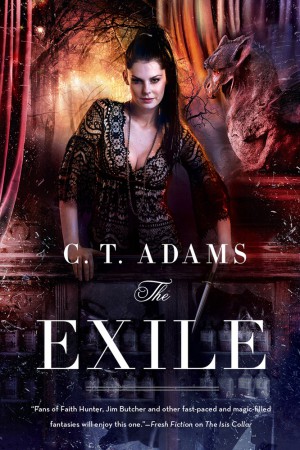
Guest Post: On Inspiration by C.T. Adams

AdamsCT-TheExileCoverWhat inspires me? Everything.

No, seriously, I mean it. I know it sounds corny, but one of the things I’ve noticed about writers is that we pay attention to things—things catch our eye, and get filed away for future reference and use in the next (or next, or maybe the one after that) book. The best way to keep your conversations from being ‘clunky’ on paper is to listen to actual people talking. The best way to have diversity in your writing is to pay attention to the rich diversity existing all around you and try to reflect it on paper.

And influences? I can’t even begin to count them all. Every book you ever read, show you watch, even people you’ve run into on the cross town bus can come into play. Say you have a craptastic day where the car won’t start, and the toast gets burnt, you’re late to work and the boss is grumpy. It’s awful. Continue reading

Video: “He For She in Science Fiction”

The video above was put together by Open Road Media, and I thought it was interesting.

The past year has been a crucial one for female writers of science fiction. Discussions in the world of science fiction authors, editors, and fans about women writing in the genre, winning awards, and being recognized in fandom often carried a certain defiant tone, followed by a frustration that women in science fiction still have to prove themselves at all.

In light of the He for She movement, a UN project aimed at encouraging men to speak up for women in a bid of solidarity and support, Open Road Media asked male science fiction authors to discuss how women have been portrayed in science fiction, and their own favorite female science fiction authors.

The video features a great selection of authors (published in eBook by Open Road). Here’s the description from the YouTube page:

“The purpose of a woman” in ’50s science fiction “was to make the man look good,” laments Todd McCaffrey, son, co-author, and biographer to his mother, revered science fiction and fantasy author Anne McCaffrey. He goes on: “And scream when the bug-eyed monsters came in. My mother hated that trope; and she said, you know, ‘If a bug-eyed monster was invading my home, I’d find the nearest frying pan and beat the crap out of him!’”

Along with McCaffrey, Science Fiction Grand Master Samuel R. Delany, Joe Haldeman, Simon R. Green, Ian R. MacLeod, and Ian McDonald discuss how women have been portrayed in science fiction, in light of the He for She movement. These men also share their thoughts about their female role models in the genre; groundbreaking female science fiction authors like Ursula K. Le Guin, Octavia E. Butler, and Andre Norton.

“The most important political problem in the modern world is the position of women…” says Samuel R. Delany. “Something has got to be done about it.”
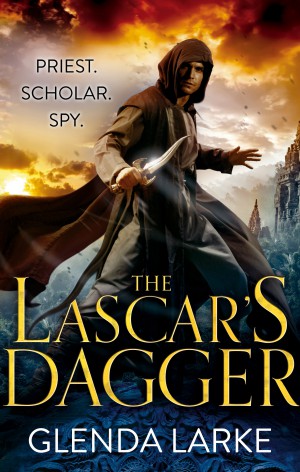
Guest Review: THE LASCAR’S DAGGER by Glenda Larke (Orbit)

LarkeG-1-LascarsDaggerA good start to a new series

Faith will not save him

Saker looks like a simple priest, but in truth he’s a spy for the head of his faith. It’s a dangerous job, and more lives than merely his own depend on his secrecy.

When Saker is wounded by a Lascar sailor’s blade, the weapon seems to follow him home. Unable to discard it, nor the sense of responsibility that comes with it, Saker can only follow its lead.

It will put him on a journey to strange shores, on a path that will reveal terrible secrets about the empire, about the people he saves, and likely lead to his own destruction. The Lascar’s dagger demands a price, and that price will be paid in blood.

Reviewed by Ryan Frye

From the blurb provided above, I honestly had some doubts about reading Glenda Larke’s The Lascar’s Dagger. Buzz words like spies, magical daggers, and empires harboring dark secrets give rise to a few red flags for this reviewer. I’ve never gotten into the whole bad-ass hooded assassin thing. And empires/kingdoms with dark secrets, and sketchy politics have become ubiquitous within the epic fantasy genre. As a result, I try to outright avoid, or at least limit to some degree those genre themes in my fantasy reading. That being said, I’d read some positive reviews of the book from trusted sources, and I had a feeling that I needed to give this book a shot. I’m glad I listened to that feeling. Continue reading

Guest Post: “Watership Down, Or the Film that Made Me” by Jen Williams

WilliamsJen-AuthorPicI was going to write about some of my non-book influences for this guest blog. There are a lot of them – the video game Dragon Age, which pretty much singlehandedly reinvigorated my love of high fantasy; the TV show Farscape, partly responsible I suspect for my obsession with snippy banter and weird creatures; and Labyrinth, of course – what fantasy fan of my age wasn’t influenced by Labyrinth? And then I remembered a conversation I had way back when The Copper Promise was a tiny wee novella. Someone asked me if I’d named Lord Frith after the god of rabbits in Watership Down. I laughed, because if anyone would object to being named after the god of rabbits it’s probably my grumpy Lord Frith, and then I stopped laughing, because I realised I had done exactly that. Not entirely consciously, but then Watership Down has been with me for a very long time, and I have over the years noted it cropping up in tiny ways in lots of things I did. For me, Watership Down was a film before it was the book – I love the book very much, but if you really wanted to mess with my head as a very small child, you needed to come in the form of a cartoon. Continue reading

Guest Post: “The Art of Gunsmithing – Writing GUNS OF THE DAWN” by Adrian Tchaikovsky

TchaikovskyA-AuthorPicWell, it’s out February 12th this year, and I started writing Guns of the Dawn in… it must have been the late 1990’s.

I mean, obviously there were some distractions along the way. I seem to recall something to do with a ten-book series about insect-people. It’s amazing what just slips in when your attention’s on other things.

Seriously, though, way back when, after the insect-kinden were conceived as an RPG setting in university – but not that long after – and long before I actually scored a hit with this writing lark, I had the idea for a book about a woman who goes to war, following in the footsteps of her brother. She wouldn’t go dressed up as a man, but on her own merits. The setting was decidedly regency-y. Some of the current plot was certainly vaguely planned out. Back then, it didn’t get very far.

I was going through a very choppy period in my writing about then. I’d finished about seven complete manuscripts over the years, and each one had been slapped down by publishers and agents, or just vanished into the void, because that’s my thing, as far as “How did you get to become a writer”; to wit, the long way, the traditional, painstaking and slowly soul-destroying way of writing things and not getting anywhere. It’s a varied and gallant siblinghood. There are a lot of us out there. Continue reading

Guest Post: “Thinking Like A Monkey” by Gareth L. Powell

PowellGarethL-AuthorPicOne of the largest challenges I faced while writing my ‘Macaque’ trilogy (Ack-Ack Macaque, Hive Monkey and Macaque Attack – all published by Solaris Books) was in writing chapters and scenes from the point of view of my main character.

Ack-Ack Macaque really is a monkey. He’s not a guy in a rubber suit. So, I felt duty bound to make him act like one. I had to imagine how a monkey (even a monkey whose intelligence has been boosted to human-like levels by artificial implants) would react in given situations and interact with the other characters in the book.

For instance, early in the first book, he warns somebody he’s just met not to smile at him, as, to a monkey, baring one’s teeth can be a challenge, as can sustained eye contact.

“Don’t take it personally,” he says. “It’s a primate thing.” Continue reading

Guest Post: “When Reading Habits Become Writing Habits” by David Towsey

TowseyD-AuthorPicCropA few months ago I stumbled across a Twitter discussion that changed the way I look at my reading habits – both past and present. I have since forgotten who was involved, which is unfortunate because, like a good academic, I prefer to cite my sources. Essentially, ideas of “deep” and “shallow” reading in genre circles were tabled (without attaching any value judgements to either term). In this sense deep meant reading all the works and series of relatively few authors – typically favourites – and shallow referred to someone who reads single texts by a lot of different authors. This was something I hadn’t really thought about. I started asking those difficult questions – the kind we aim at ourselves. What kind of reader am I? What kind of reader have I been in the past? Continue reading

Guest Post: “Influences & Inspirations” by Jamie Schultz

SchultzJ-AuthorPicMy taste in books, of whatever genre, can be summed up as follows: I like to turn literary rocks over and see if something nasty crawls out. I can’t help it. For this, I thank my mother, who got me hooked on that stuff at a young age. I remember being about eleven or twelve when she came home with a box of used books, one of which was a battered copy of Stephen King’s Christine, old even then. The cover was black with a white or silver striped design with a skull on it, best I can recall, and I thought it looked pretty cool. Plus, I had read some of IT over her shoulder at some point, and, with a twelve-year-old’s typical fascination with the morbid, this seemed like a pretty good author to tackle. My parents’ attitude toward my reading material was, “Whatever you think you can handle, kid,” so I dug in. Continue reading

Guest Post: “City of Stairs and the Super Tropey Fantasy Checklist” by Robert Jackson Bennett

City of Stairs is definitely a fantasy novel. It’s got dead gods, magic, monsters, political skullduggery, and a healthy serving of mayhem. (I actually think all my novels are fantasy, but that’s beside the point.)

However, despite the popular aphorism, the clothes don’t make the man: if I put on a policeman’s uniform, for example, that doesn’t make me a cop.

So despite City of Stairs having a huge amount of fantasy elements, I sometimes find myself wondering – does it act like a fantasy? Content does not dictate behavior, in other words. Continue reading

Guest Post: “Writes & Wrongs” by Edward Cox

CoxE-AuthorPicIt’s time for me to admit that I might have taken the longest route possible to getting an agent. I’m something of a blunderer by nature, and learning the hard way is the theme of my life. So much so that I sometimes wonder how I managed to get an agent at all.

The original version of The Relic Guild is very different from the version that was signed by Gollancz. It was written for a Master’s degree that I concluded in in 2009. When I was coming to the end of that degree, I had been wondering if my work could hold its own with the bigger names in the publishing industry. I sent the first three chapters and a synopsis of the novel to the man who is now my agent. It impressed him enough to request the remainder of the book. However, although that early version of The Relic Guild gained me an MA, it didn’t quite make the grade with my agent.

For the sake of avoiding long and boring explanations, let’s just say that the original version was something akin to an academic exercise. The result fell somewhere between a fantasy adventure and a pseudo-intellectual dystopian wannabe. It was right for academic purposes, but wrong for the publishing industry. It had potential, but lacked focus and commercial value. Make it the fantasy adventure it wants to be, my agent said, and then we’ll do business. Continue reading