Music Video: “Rusted Nail” by In Flames

In Flames is one of my favourite bands – their last couple of albums haven’t had as much of an impact on me, though. Reroute to Remain and The Quiet Place are still two of my favourite albums. They recently unveiled a new video for “Rusted Nail”, the first single from their upcoming album Siren Charms. Here it is, via Metal Hammer:

Mini-Review: “Back Story” by David Mitchell (Audible / Harper)

MitchellD-BackStoryA marvellous memoir by one of Britain’s best new(ish) comedians

David Mitchell, who you may know for his inappropriate anger on every TV panel show except Never Mind the Buzzcocks, his look of permanent discomfort on C4 sex comedy Peep Show, his online commenter-baiting in The Observer or just for wearing a stick-on moustache in That Mitchell and Webb Look, has written a book about his life.

As well as giving a specific account of every single time he’s scored some smack, this disgusting memoir also details: the singular, pitbull-infested charm of the FRP (‘Flat Roofed Pub’); the curious French habit of injecting everyone in the arse rather than the arm; why, by the time he got to Cambridge, he really, really needed a drink; the pain of being denied a childhood birthday party at McDonalds; the satisfaction of writing jokes about suicide; how doing quite a lot of walking around London helps with his sciatica; trying to pretend he isn’t a total **** at Robert Webb’s wedding; that he has fallen in love at LOT, but rarely done anything about it; why it would be worse to bump into Michael Palin than Hitler on holiday; that he’s not David Mitchell the novelist. Despite what David Miliband might think…

The synopsis does a very good job of suggesting the tone and content of the memoir. But what it doesn’t fully convey is just how good it is. Delivered in Mitchell’s distinctive voice, with just the right amount of sarcasm and cynicism, this could very well be the best memoir I’ve listened to from Audible, or at least an equal to Stephen Fry’s The Fry Chronicles. This memoir had me laughing out loud plenty of times (something only Tina Fey and Jane Lynch have done so far).

I was surprised to learn just how much great television Mitchell has been involved in over his relatively few years of fame and celebrity. That being said, it was the chapters covering his early years that were hilarious – when talking about his successes, he came across as almost embarrassed (which was rather endearing). Tales from his childhood and years at Cambridge were great, and quite relatable. Recounting his post-university years of near-poverty, and his eventual success also gave me a modicum of confidence that I’ll be able to make something of myself, too (though, not in the way Mitchell has, I’m sure).

While the memoir is undoubtedly funny, as one can expect, it is also quite moving. When talking about his friends and colleagues, he is always gracious and warm. His respect and brotherly love for Robert Webb is obvious, and he is particularly heartfelt when talking about his writing/comedy partner’s wedding. The second-to-last chapter of the book, however, was the greatest surprise: in it, he talks about Victoria Coren, who he recently married. It is a very sweet and endearing story of a long courtship, with its ups-and-downs, but also shows Mitchell has a hitherto unseen romantic streak. Very moving.

Overall, and I know this review is relatively short, I loved listening to this. It’s funny, curmudgeonly, honest, and entertaining from beginning to end. There were no drops in momentum or interest. Excellently and clearly performed, great production, and a great story.

Very highly recommended. If you have any interest in comedian/actor memoirs, or comedy, then you must listen to and/or read Back Story.

I liked it so much, I’ve also bought the eBook, so I can read the best bits again, later – I’d like to share some of the best nuggets of wisdom, but I didn’t write any of them down while listening.

***

Back Story is out now – available as an audiobook from Audible, and in print and eBook from Harper.

Guest Post: “‘You’re doing what?’ – Why I Decided to Self-Publish My Next Series” by Rachel Aaron

RachelBach-authorphotoWhenever a New York published author decides to self-publish, there’s always the implicit assumption that Something Happened. Why else, after all, would an author who was presumably happily settled in a nice, big publishing house suddenly strike out on her own, like a child running away from home? Clearly, something terrible must have occurred. Was there a fight? A hot tempered editorial phone call where bridges were burned like kindling? Or perhaps it was the book itself? Maybe the story failed to meet the publisher’s expectations, and now the slighted author is unloading drek onto her fans for a quick buck?

Whatever imagined tragedy you prefer, they all start with the same opening: Something Happened. Something fundamental went horribly wrong in the publishing relationship. There’s simply no other plausible explanation why an author who’d already “made it,” who’d cleared the slush pile, gotten the agent and the book deal and gone on to write multiple series would give it all up and go it alone in self-publishing, the last refuge of the desperate and rejected. Continue reading

Book Received … (July)

BooksReceived-20140705

Featuring: Annie Hauxwell, David Hosp, C.C. Humphreys, David Ignatius, Tim Lebbon, Rebecca Levene, D.J. Molles, Marie Phillips, William Shaw, & graphic novels

HauxwellA-AMorbidHabitUKAnnie Hauxwell, A Morbid Habit (William Heinemann)

The hands were warm. Soft fingers, but flesh inflected with iron. Squeezing. The tongue lolled and protruded from the mouth. Vertebrae fragmented, one, two, three, until finally the hands relaxed and the limp body slid from their embrace.

Blood turned to ice and sealed the nostrils.

It’s the week before Christmas. Catherine Berlin sits alone gazing at a bank of monitors, each capturing a slice of a vast industrial estate. A van appears: two men delivering crates, moving quickly. Her boss tells her to ignore them, but she can’t.

Berlin’s scars have faded, but she still walks with a limp. She’s broke and working nights as a relief CCTV operator, and looking for something more substantial. Her heroin habit is under control – only just.

The night shifts end, but now Berlin herself is being watched. When an old friend offers her a job in Russia, she quickly agrees. The details are vague: a mysterious businessman with money to spend, a UK company offering a high fee for Berlin to investigate. Easy enough.

But Berlin arrives in Moscow to find that her problems are only just beginning. She is soon forced to confront some uncomfortable truths about her past, and her present. A body is found at the airport: a man clutching a sign with her name on it. Her pursuers reappear, and her guide, a Brit named Charlie, has secrets to hide. When Berlin’s businessman goes missing, she realises that she cannot trust anyone or anything, if she is to survive.

I’ve never heard of Hauxwell’s work, but this sounds pretty interesting. We’ll see.

*

HospD-GameOfDeathUKDavid Hosp, Game of Death (Macmillan)

When a dark and thrilling fantasy becomes a terrifying reality

The first thing I notice is her face. It is so perfect it seems unlikely that it could ever exist in the real world. Her white skin is flawless, her features perfectly symmetrical, her lips red and wet and full, parting with every gasp. It is her eyes that hold me, though. They are a shade of blue I have never seen, with flecks of gold and crystal, and they are so penetrating it feels as though they are reaching out straight through his eyes into mine, begging me for… something I can’t quite make out. It’s like those eyes have captured the dialectic of every human emotion that ever mattered – love and hate; ecstasy and terror; comfort and jealousy – and rolled them into a single glance that could level entire cities. I am slaughtered.

Imagine being able to create and experience your deepest dreams and your darkest fantasies…

Boston entrepreneur and techno whizz-kid, Nick Caldwell with the help of his long-time friend and colleague, Yvette, has worked on a programme where people can do just that – all from the safety and comfort of their home.

NextLife is an exciting young company which promises its subscribers the chance to experience anything they want. Climb Everest. Dive off the Barrier Reef. Go to a 1970s Rolling Stones concert. Walk the Great Wall of China.

But it seems that one of their clients has much more sinister desires.

And it involved the girl with the wonderful blue eyes…

David Hosp is an author I’ve been aware of for years, but for some inexplicable reason haven’t got around to reading before… This novel, however, sounds really good (even more so than his other, really-good-sounding novels), so I may read this next-but-one. Or certainly this month, anyway.

*

HumphreysCC-PlagueC.C. Humphreys, Plague (Century)

London, May 1665.

On a dark road outside London, a simple robbery goes horribly wrong – when the gentlemanly highwayman, William Coke, discovers that his intended victims have been brutally slaughtered.

Suspected of the murders, Coke is forced into an uneasy alliance with the man who pursues him – the relentless thief-taker, Pitman.

Together they seek the killer – and uncover a conspiracy that reaches from the glittering, debauched court of King Charles to the worst slum in the city, St Giles in the Fields.

But there’s another murderer moving through the slums, the taverns and palaces, slipping under the doorways of the rich.

A mass murderer.

Plague…

Another author I’ve been familiar with, but haven’t read… There are an ever-growing number of those, too… I hope to get to this soon. I haven’t read much historical fiction, recently, so it’ll be nice to start mixing up the genres a bit more. I’ve heard nothing but excellent things about Humphreys, too.

*

untitledDavid Ignatius, The Director (Quercus)

A MAN WITH SOMETHING TO CHANGE.

Graham Weber, the new director of the CIA, is tasked with revolutionising an agency in crisis. Never intimidated by a challenge, Weber intends to do just that.

A HACKER WITH SOMETHING TO EXPOSE.

Weber’s task greatens when a young computer genius approaches the CIA with proof their systems have been compromised. There is a breach. There is a mole.

A WOMAN WITH SOMETHING TO PROVE.

The agent who takes this walk-in is K. J. Sandoval – a frustrated yet ambitious base chief desperate to prove her worth to the agency and its new director.

Weber must move quickly. And he must choose his allies carefully, if he is to succeed in identifying an enemy that is inside the gates, and out to destroy him.

Yet another author I’m very familiar with – but, in this case, more his non-fiction and journalism. All of this novels and short stories have looked pretty interesting. I don’t really know why I haven’t given them a try, though… This is his latest, and I’m really interested in the politics/issues he’s looking at here.

*

SW-DotJ-IntoTheVoid(Lebbon)Tim Lebbon, Star Wars: Dawn of the Jedi – Into the Void (Arrow)

Taking place thousands of years before the time of Luke Skywalker and Darth Vader. On the remote world Tython ancient philosophers and scientists share their mystical knowledge and study the ways of the Force. They establish the order of the Je’daii – which, in years to come, will become the Jedi. But first these visitors from so many different planets must colonize a dangerous new homeworld and surmount societal conflicts as the burgeoning Rakatan Empire prepares to conquer the known galaxy.

Lebbon is a pretty good writer. Sadly, though, I’m not particularly interested in Star Wars fiction set before episode IV. I also didn’t particularly care for the Dawn of the Jedi comic books – it felt a bit… I don’t know. The only thing I can come up with is the rather ineloquent “meh”…

*

LeveneR-HG1-SmilersFairUKRebecca Levene, Smiler’s Fair (Hodder)

Yron the moon god died, but now he’s reborn in the false king’s son. His human father wanted to kill him, but his mother sacrificed her life to save him. He’ll return one day to claim his birthright. He’ll change your life.

He’ll change everything.

Smiler’s Fair: the great moving carnival where any pleasure can be had, if you’re willing to pay the price. They say all paths cross at Smiler’s Fair. They say it’ll change your life. For five people, Smiler’s Fair will change everything.

In a land where unimaginable horror lurks in the shadows, where the very sun and moon are at war, five people – Nethmi, the orphaned daughter of a murdered nobleman, who in desperation commits an act that will haunt her forever. Dae Hyo, the skilled warrior, who discovers that a lifetime of bravery cannot make up for a single mistake. Eric, who follows his heart only to find that love exacts a terrible price. Marvan, the master swordsman, who takes more pleasure from killing than he should. And Krish, the humble goatherd, with a destiny he hardly understands and can never accept – will discover just how much Smiler’s Fair changes everything.

This is a really nice-looking hardcover – not only in terms of the story, but also the physical object. Really nicely put together. I should have got around to reading this already (I received an ARC a while ago), but I’ve just been in a really weird reading-mood these past couple of months.

*

Molles-R2-AftermathD.J. Molles, The Remaining: Aftermath (Orbit)

A SOLDIER’S MISSION IN A WORLD GONE TO HELL: SURVIVE, RESCUE, REBUILD

Nothing has gone according to plan.

To Captain Lee Harden, Project Hometown feels like a distant dream and the completion of his mission seems unattainable.

Wounded and weaponless, he has stumbled upon a group of survivors that seems willing to help. But a tragedy in the group causes a deep rift to come to light and forces him into action. In the chaos of the world outside, Lee is pursued by a new threat: someone who will stop at nothing to get what he has.

The second installment in Molles’s originally-self-published zombie apocalypse series with a difference. Now published in eBook and print by Orbit Books, I do really want to read this ASAP. I have a soft-spot for the genre, but I’m also really particular about what I like within it (V.M. Zito and Adam Baker have been my favourites so far). We’ll see. Still need to read the first book, too.

*

PhillipsM-TableOfLessValuedKnightsUKMarie Phillips, The Table of Less Valued Knights (Jonathan Cape)

Sir Humphrey du Val of the Table of Less Valued Knights – Camelot’s least prestigious table, with one leg shorter than the others so that it has to be propped up with a folded napkin – doesn’t do quests … until he meets Elaine, a damsel in distress with a secret to hide.

Meanwhile, Queen Martha of Puddock is on the run from an arranged marriage to the odious Prince Edwin of Tuft. But an encounter with the Locum of the Lake (standing in for the full-time Lady) leaves her with a quest of her own: to find her missing brother, long believed dead.

The two quests collide, introducing a host of Arthurian misfits, including a freakishly short giant, a twelve-year-old crone, an amorous unicorn, and a magic sword with a mind of her own.

“With Gods Behaving Badly Marie Phillips showed that she has a rare gift for comedy, giving the Greek Gods an ingenious contemporary twist. In The Table of Less Valued Knights it’s Camelot’s turn, and you’ll never see a knight in shining armour in the same way again.”

*

ShawW-AHouseOfKnivesWilliam Shaw, A House of Knives (Quercus)

London, November 1968. The decade is drawing its last breath. In Marylebone CID, suspects are beaten in the cells and the only woman is resigning. Detective Sergeant Breen has a death threat in his in-tray and a mutilated body on his hands.

The dead man was the wayward son of a rising MP with the ear of the home office – and everywhere Breen turns to investigate, he finds himself obstructed and increasingly alienated. But PR wary politicians can’t stop him talking to the art dealer Robert ‘Groovy Bob’ Fraser; whose glamorous parties mask a spreading heroin addiction among London’s young and beautiful.

He begins to see that the abuse of power is at every level of society. And when his actions endanger those at the top, he becomes their target. Out in the cold, banished from a corrupt and fracturing system, Breen is finally forced to fight fire with fire.

Don’t know much about this novel, or the author. This sounded pretty cool, though, so I requested it via NetGalley. I’m really behind on my Quercus/Jo Fletcher Books reviews, though. Quite shameful. I’m hoping to catch up over the next couple of months, though.

*

GRAPHIC NOVELS

Alex-Ada-Vol.1Alex + Ada, Vol.1 (Image)

Writer: Jonathan Luna & Sarah Vaughn | Artist: Jonathan Luna

The last thing in the world Alex wanted was an X5, the latest in realistic androids. But after Ada is dropped into his life, he discovers she is more than just a robot.

Picked up the first issue during one of Image Comics’ first issue sales on ComiXology (it was actually free, along with a whole bunch of others), and really liked it. Far more than I’d anticipated, too. So, when it appeared on NetGalley, I snapped it up. Should read it very soon. (Oh, those famous last words…)

*

JusticeLeagueOfAmerica-Vol.02Justice League America, Vol.2 – “Survivors of Evil” (DC New 52)

Writer: Matt Kindt | Artist: Doug Mahnke & others

As the smoke clears from the Trinity War, one thing looks disturbingly clear­, the members of the Justice League of America are dead, betrayed by one of their own.  But as with the Trinity War, all is not what it seems. Martian Manhunter and Star Girl have lived to fight another day and find themselves trapped on an alien world that is under the control of a group of super-villains.  The key to their survival may lie in the hands of the super-villain Despero, but will these heroes be able to find it within themselves to trust someone who is supposed to be their mortal enemy?

Now, I was actually not particularly taken by Justice League of America, Volume 1 (which I bought). I’m always willing to give series a look a little way beyond when I think they drop off in quality (or never meet it) – there have been a couple of series that have improved after a writer finds his or her feet. So, I’m hoping this series picks up. Despite having already been canned, to be replaced (sort of) by Justice League International (or, JL Canada, as I like to call it, for reasons).

*

RocketGirl-Vol.1Rocket Girl, Vol.1 – “Times Squared” (Image)

Writer: Brandon Montclare | Artist: Amy Reeder

A teenage cop from a hightech future is sent back in time to 1986 New York City. Dayoung Johansson is investigating the Quintum Mechanics megacorporation for crimes against time. As she pieces together the clues, she discovers the “future” she calls home – an alternate reality version of 2014 – shouldn’t exist at all!

This series has been garnering a lot of attention, recently. I picked up the first issue via ComiXology, but I got the first collection via NetGalley. Expect a review very soon.

*

RogueTrooper-Vol.01 (Ruckley)Rogue Trooper, Vol.1 (IDW)

Writer: Brian Ruckley | Artist: Alberto Ponticelli

Nu-Earth, just another planet ravaged by a galaxy-wide war, its atmosphere poisoned by chemical weapons. Created to fight in such conditions were the G.I.s – genetically engineered infantrymen. But now only one remains, the man known as… Rogue Trooper.

Years ago – years! – I had a subscription to 2000AD. One of my favourite characters and series therein was Rogue Trooper. Not only that, I’ve really enjoyed Brian Ruckley’s fiction Edinburgh Dead in particular). So when I learned that he was writing a Rogue Trooper story, I was very intrigued indeed. I picked up this ARC from NetGalley.

*

Guest Post: “Whosoever touches the Tarot of Eternity…” by Rachel Pollack

PollackRachel-2014THE USE OF TAROT CARDS IN THE CHILD EATER

Tarot cards appear in my novel, The Child Eater, in a number of ways, in particular a mysterious pack called the Tarot Of Eternity. In the story, the original has been lost for many centuries, so that the pack is known only through “a copy of a copy,” or even “a copy of a copy of a copy.” At the same time, the pack is seen as so significant that even these copies several times removed, but hand-created by magicians, have great power.

The book moves back and forth between two worlds, the first a medieval-style land ruled by wizards, the second a contemporary small city America. In the medieval world, an abused boy named Matyas runs away from his violent father to study magic. In the second, a lonely boy named Simon Wisdom desperately tries to suppress his deep psychic abilities, partly because he knows that no one likes him “reading” their minds, and more, because they bring him terrifying visions—dead children begging him for help, severed heads that live on in pain, and a gray man with an ancient stone knife. Matyas has similar visions, and he too does his best to forget them.

What bridges the two worlds, or rather crosses between them, is the Tarot of Eternity.

PollackR-ChildEaterAnimated

This use of the Tarot is not what many people expect when Tarot cards appear in a story. The pack in the novel has almost nothing to do with fortune-telling. There is a point in Simon’s story where a girl brings a set of Tarot cards to school and announces she will “read” everyone’s future. Simon is contemptuous. He can just see the future—though he tries not to—what does he care about some dumb deck of cards? Later, Simon discovers a set of Tarot that the reader suspects may in fact be the Tarot Of Eternity (or at least a copy of a copy), but he does not even consider using them for divination. It’s not the future Simon seeks, but a refuge—doorways to worlds where he might escape the severed heads of children begging for help.

Matyas too seeks something when he encounters the cards. He has seen a man fly, and even though everyone, including his teacher and all the other wizards, tell him it cannot be done, he believes that he is destined to do it, if only he can find the secret. He tries to find it in the cards only to discover that for him, all roads lead to the man with the stone knife.

Readers who only know of the Tarot as a tool for divination may find these more fantastic uses of the cards as far afield from what they expect. In fact, the idea that the Tarot contains mystical power completely separate from any psychic function is deeply rooted in Tarot tradition. At least, in the occult Tarot tradition, since 1781.

First, a bit of history. The Tarot was not created for fortune-telling. In fact, there is no documented use of the Tarot as a divinatory tool until after 1781 (more about that date in a moment). Extensive research over the past thirty or so years has demonstrated that the Tarot began its life in Northern Italy around 1430, as a card game called at first Il Trionfii (The Triumphs, or Trumps), and later, Tarocchi, which the French shortened to “Les Tarots.” The various titles refer to the pack’s unique feature, an extra suit of elaborately painted images, some secular (an Emperor and Empress), some moralistic (virtues such as Justice and Fortitude), and some religious (a Pope, various angels). In Tarocchi these cards will triumph over the regular suit cards.

The first known use of the Tarot not as a game—only a few years after the earliest packs—was as inspiration for poetry. People in salons would make up poems about the figures in the cards, but everybody knew they would be satires on people at court.

So what happened in 1781? A pair of French occult scholars set forth a daring idea. Antoine Court de Gébelin and Comte de Mellet announced that the Tarot, assumed to be a trivial game, was in fact the coded wisdom of Ancient Egypt, disguised as a game so that it might survive the Dark Ages of ignorance until it might be discovered by the sages of the future—that is, Court de Gébelin and de Mellet.

From a strict historical perspective this was wrong, both about the cards and about Egypt, but it didn’t matter. A new myth had taken hold, what we might call the Tarot’s secret origin. For the next 200+ years people would argue about which great secrets the cards concealed, but never about the basic idea. In The Child Eater the Tarot of Eternity draws on the secret origin idea but in fact goes further, suggesting that the Tarot was involved in creation itself.

One of the major influences on the novel is Jewish myth and folklore, in particular several Talmudic and medieval tales. The terrible ritual in the center of the novel, the reason for the Child Eater’s actions, derives from a bizarre belief that an evil magician can lure away a boy just before his bar mitzvah, kill him, and keep his head alive as a tool to…predict the future. In my story the heads of the murdered children serve a different purpose entirely. Perhaps I unconsciously wanted to divorce Tarot from its assumed purpose in order to re-create it.

Possibly the most daring use of Tarot in the book also comes from Jewish myth. The rabbinic tradition sees the Five Books of Moses, the Torah, as more than just a sacred text. Some say that before God created the universe, S/He (yes, the Jewish God is hermaphroditic; this too is an ancient Talmudic idea) created the Torah. Then God consulted the Torah on how to make a universe!

This idea has fascinated me for many years, only, instead of the Torah I imagine the Tarot, that is, that God created the Tarot before the universe. This is not meant as a serious suggestion, but as a way to open our minds. I once did a reading in which I asked the cards “Show me the reading you gave God to create the universe.” (It appears in a book titled The Forest Of Souls). The same idea occurs in the novel.

There is another power in the cards that is unique to this book. The first time Matyas encounters the Tarot, or rather, a copy of a copy of a copy, the old wizard who lets him see them says a very strange thing, an ancient saying about the original. “Whosoever touches the Tarot Of Eternity, he shall be healed of all his crimes.” Matyas will not understand this until the very end of the book.

***

Rachel Pollack’s The Child Eater was published by Jo Fletcher Books last week.

Also on CR: Interview with Rachel Pollack

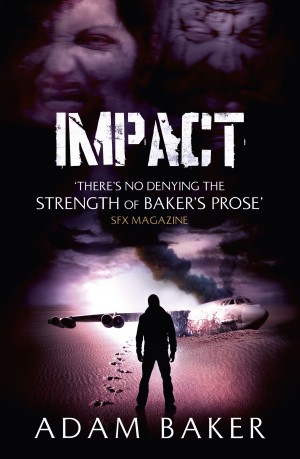
Review: IMPACT by Adam Baker (Hodder)

BakerA-4-ImpactUKSuperb fourth novel in Baker’s horror survival series

The world is overrun by an unimaginable horror. The few surviving humans are scattered in tiny outposts across the world, hoping for reprieve – or death. Waiting on the runway of the abandoned Las Vegas airport sits the B-52 bomber Liberty Bell, revving up for its last, desperate mission. On board – five crew members and one 10-kiloton nuclear payload. The target is a secret compound in the middle of the world’s most inhospitable desert.

All the crew have to do is drop the bomb and head to safety.

But when the Liberty Bell crashes, the surviving crew are stranded in the most remote corner of Death Valley. They’re alone in an alien environment, their only shelter the wreckage of their giant aircraft, with no hope of rescue. And death is creeping towards them from the place they sought to destroy – and may already reside beneath their feet in the burning desert sands.

Impact is the gripping, suspenseful fourth novel set in Baker’s post-apocalyptic reality. Everything I liked about Terminus, the previous novel in the series, is evident here: the tightly-plotted story, the stripped-down prose, realistic characters, sinister atmosphere, and addictive, chilling suspense. From the first page until the last, I was hooked. Continue reading

Mini-Review: “Drama” by John Lithgow (Audible/Harper)

Lithgow-DramaOne of America’s great contemporary thespians on his actor’s education

Through the vivid stories in Drama, John Lithgow shares a backstage history of his struggle, crisis, and discovery, and the scenes of his early life and career that took place before he became a nationally-known star. Above all, Drama is a tribute to the most important influence in John Lithgow’s life: his father, Arthur Lithgow. An actor, director, producer, and great lover of Shakespeare, Arthur brought theatre to John’s boyhood, where performance and storytelling were a constant and cherished part of family life. Lithgow brings the theatre worlds of New York and London to life as he relives his collaborations with renowned performers and directors including Mike Nichols, Bob Fosse, Liv Ullmann, Meryl Streep, and Brian De Palma. Lithgow’s ruminations on the nature of theatre, performance, and storytelling cut to the heart of why actors are driven to perform, and why people are driven to watch them do it. At once hilarious and reflective, Drama pulls back the curtain on the making of one of our most beloved actors.

This memoir took me a little by surprise. For one thing, Lithgow doesn’t linger so much on the projects in which he has performed – rather, he focuses more on the lessons he’s learned, the experiences he’s enjoyed, and some of the people he has met along the way. It’s an interesting memoir, and a really good listen.

He talks about his peripatetic upbringing, and how he would change school too often to form close bonds – a problem that resolved later in his school years, when he returned to Massachusetts. Lithgow also talks honestly about his early-career luck, and acknowledges that some of his earliest roles he got partly because of his father’s position as a director. At the same time, he later recognises how this spoiled him for his career-proper, and how when he was in New York, he was completely unused to having to go through the auditioning grinder. Lithgow tells us about his time in London, and how he tried to get his draft deferred (successfully, it seems). He’s not proud of it, but he is honest about how afraid he felt about having to go to the jungles of Vietnam. He speaks candidly about his first marriage, and the dalliances that led to its demise.

Delivered in Lithgow’s distinct voice, the emotion in his performance is pretty flat – or, measured, perhaps. It’s not bad by any stretch of the imagination, but I think I could spot the moments he found less interesting. It’s not as humorous as I was expecting, but it didn’t suffer for this.

Definitely recommended, this is another very good memoir – well-written, excellent production, and enjoyable and interesting.

***

Drama is out now, available as an audiobook through Audible, and is published in print by Harper.

Q&A with ELIZABETH GILBERT

Recently, Penguin Books organised a Q&A with Elizabeth Gilbert, the mega-selling author of Eat, Pray, Love. With the recent publication of her latest book, the novel The Signature of Things, I’m sharing some excerpts from that long Q&A…

GilbertE-AuthorPic (JenniferBailey)After the incredible dual successes of your memoirs Eat, Pray, Love and Committed, the safer, more obvious choice for you would have been to continue in nonfiction. What was it that prompted you to return to writing novels with THE SIGNATURE OF ALL THINGS?

I needed to come home to my roots as a writer. Fiction is where I began my writing journey, and all I ever wanted to be was a pure novelist. Fate intervened and led me into the world of memoir (and believe me, I am grateful for my success there!) but the next thing I knew, a dozen years had passed since I’d written a word of fiction. I simply couldn’t let another year go by, so I embarked on this novel.

How difficult is it for you to shift gears between genres?

I thought it would be more difficult than it was. I feared I had lost the skill of fiction entirely (almost the way you can lose a foreign language if you don’t practice it often) and so I was intimidated by the prospect of returning to the form of a novel. As a result of my fear, I over-prepared for this book ridiculously. I did ten times the research I actually needed, just to feel covered and safe. Up till the very day I put down the research and began actually writing the novel, I honestly wasn’t sure if I could do it. But as soon as I began, the moment Alma was born, I realized, “Oh! I was so wrong! Fiction isn’t a foreign language; it’s my mother tongue!” I had forgotten nothing, except the joy of it. It felt like a homecoming.

GilbertE-SignatureOfAllThingsUSPB

THE SIGNATURE OF ALL THINGS opens in 1800 and spans much of the 19th century as its heroine Alma Whittaker comes into her own as an accomplished botanist. Why did you choose to set your novel during this particular time? And what aspects of this era are important for us to remember in modern times?

The nineteenth century fascinated me because of its intellectual accessibility. I could never write a story about modern science, because the comprehension of modern science is far out of reach to anyone except modern scientists (and each of them can only understand the specifics of their own narrow fields). The nineteenth century was the last moment in history when a relatively educated layperson could follow what was going on in the world of science and invention to a wide degree. Also, there were no “professionals”, such as we know them today. This was a time when amateur explorers, naturalists and enthusiasts were are still making major contributions to progress. Alma is a woman who would have been up-to-date on all the latest thinking in the world, across many different fields of study. With her own well-tended library, her private offices, and her brilliantly cultivated mind, she could easily have come up with botanical theories to rival those of any man. This idea of such open access to history-changing ideas fascinated me more than anything. That, and an inherent attraction to the gorgeous language of the day. With apologies to the Elizabethans, I think nobody ever wrote or spoke better English than during the nineteenth century. We could use a little more of that.

GilbertE-EatPrayLove&CommittedUS

Eat, Pray, Love and Committed – US Covers

The novel’s story soars across the globe – from London, to Peru, to Philadelphia, to Tahiti, to Amsterdam and beyond. You are famous for being an ardent traveler – from Italy, India and Indonesia in Eat, Pray, Love; to Vietnam, Thailand and Cambodia in Committed – so readers will surely be looking forward to the armchair travel of THE SIGNATURE OF ALL THINGS. Can you discuss why you chose any of these particular settings for the story?

I think of this story in some respects as a mystery novel (in that everyone is seeking to solve or find something of great importance to their fates) so I felt the need to follow the mystery wherever it led me, anywhere on the planet, as long as the search remained historically accurate. For Henry to have made his fortune in the quinine trade, for instance, I needed him to explore Peru and then set up business in the Dutch East Indies, before settling down in Philadelphia, which was in fact the birthplace of the American pharmaceutical industry. Ambrose’s search for rare orchids would naturally have led him to the jungles of South America. As for the section of the novel that takes place in the South Seas, well… no self-respecting nineteenth century adventure story would be complete without a journey to the South Seas! That was just a nod to Kipling, Melville and Robert Louis Stevenson – as well as a nod to Captain Cook himself. Finally, Alma’s search for an independent and dignified life could only have brought her back to Amsterdam, which has always been a progressive and intellectually welcoming city. As somebody who herself has found great answers to life through travel, I wanted my characters (especially Alma) to be afforded the same privilege. (And if researching this novel forced me to travel to places like London, Amsterdam and Tahiti in order to get my facts straight… well, that is simply the sacrifice I am willing to make for my work!)

GilbertE-EatPrayLove&CommittedUK

Eat, Pray, Love and Committed – UK Covers (Bloomsbury)

The title of your novel alludes to a theory set forth by a sort of scientific mystic from the 1500s, Jacob Boehme, who argued that the entire natural world is a divine code, crafted and encrypted by God for the betterment of humankind. Boehme was a pretty weak scientist but a highly inspirational thinker. Why did you choose his phrase “the signature of all things” as the name of your novel?

First of all, the phrase itself is simply beautiful. But I also felt that Boehme’s theory speaks to a common longing which unites scientists, the religious and the artistic – namely an urge to break the code, to look behind the veil, to be shown the secret answers. I feel as though all the main characters in the novel are, in their own ways, searching for the Signature of All Things. They don’t merely want some of the answers: they want the answer.

Your book has much of the feel of a novel written in the nineteenth century. How, as a writer, did you go about establishing the authenticity of your novel’s mood?

I completely immersed myself in nineteenth-century prose and ideas. Fortunately this was fun for me; I have always had a particular love for writers like Dickens, Trollope, Eliot, Austen, and James. I went back and re-read many of those great novels, and, of course, I also sought out as much information as I could on the botanical exploration and history of the day. But mostly I read letters – not only letters of great naturalists, but also the letters of common people. Those unguarded everyday letters are where I could best hear people’s common speech, and that helped me fall down the rabbit hole of time and language.

Henry Whittaker, your heroine’s father, dominates the first fifty pages of the book, and he rules much of his daughter Alma’s life thereafter. He’s a bit like a pre-modern Gatsby: an uncultured roughneck who parlays his I’ll-show-them attitude into an incredible fortune. Do you see his story as a commentary on the temptations and pitfalls of the American Dream?

I didn’t intended for Henry to be a commentary on the American Dream, to be honest… partially because I don’t totally see Henry as American, and partially because I don’t see his trajectory as being tragic in the manner of Gatsby. Henry doesn’t have enough self-doubt or self-awareness to be a tragedy, and he never really fails, either. There is nothing he longs for that he does not achieve – except immortality, of course. I see Henry more as a countryless force of nature, as a creature who is, from birth to death, comprised of pure and unstoppable will.  It was exhilarating for me to write Henry Whittaker, because he is so huge and relentless and shameless. It was so fun to write of his galloping ascent and his stubborn endurance. He’s the power source whose energy fuels the whole first half of the book. I think of him like the booster rocket who eventually thrusts Alma out into the stratosphere. Yes, he is domineering, but he also loves and challenges his daughter, and without the example of his ruthless might, Alma could never have been the force that she turns out to be.

Your heroine, Alma Whittaker, may be one of the most fully developed characters in all of American fiction. Were there real-life nineteenth-century women to whom you referred in creating her?

I looked closely at the lives of such women as Mrs. Mary Treat (a New Jersey-based expert on carnivorous plants who was a correspondent of Darwin’s), and Elizabeth Knight Britton (a respected moss expert who founded the New York Botanical Gardens along with her husband), and Marianne North (a wonderful and fearless botanical illustrator who, like Alma, set out alone to explore the world quite late in life)… And many more besides! In the nineteenth-century, botany was considered the only science that was truly open to women (flowers and gardens being “feminine” topics, you know) so I found no shortage of brilliant and tireless female researchers from whom to draw inspiration for Alma’s work. Emotionally, though, Alma is my own creation. From the very first page, I simply felt that I knew her in my bones, and that I had an obligation to tell her story as honorably and thoroughly as I could.

For each of the friends, marriage turns out to be, to one degree or another, a catastrophe. You have reflected a great deal about marriage in your other writings, especially in the memoir Committed. What do you think your characters’ errors might teach us about the rather tricky business of matrimony?

I think, to be honest, the depiction of their marriages is a bit more realistic and accurate than the model that most romantic novels would have us believe! I didn’t intentionally set out to make these women suffer, but I wanted to show what would really and truly have happened in these mismatched unions. None of their husbands are bad men (in fact, there is not a villain of any kind in the entire novel) but they are simply not the right fit. We all know that this can happen. Poor Retta Snow is the only one who is really undone by matrimony (though I suspect her mind would have unraveled over time anyhow, no matter whom she had married.) Prudence and Alma both survive their marriages with dignity. As their mother teaches them early on, dignity is the only thing that matters, and time will reveal who has it. I feel proud that, by the end of the novel, they both have earned their dignified lives.

The mass popularity you achieved with Eat, Pray, Love has probably changed your definition of success. As you go forward, what does it mean to you now to succeed as a writer?

I’m lucky in that pressure for success is completely off for me – at least as far as I’m concerned. Fortunately, there’s no way to match the phenomenon of Eat, Pray, Love, so I don’t even have to attempt it! What Eat, Pray, Love did for me was to give me the liberty (both artistically and financially) to pursue my own private literary passions in whatever direction I wanted. There could be no The Signature of All Things without the beneficence of Eat, Pray, Love. That book has been my great enabler, my great patron. My notion of success now is simply to keep following my interests, wherever they may take me.

What are you working on now?

Absolutely nothing! I am resting. I am deeply at rest. This book was a long journey and I think I may have to catch my breath a bit before launching into another.

***

The paperback edition of The Signature of All Things was published by Penguin in the US last week, and will be published in the UK by Bloomsbury tomorrow.

Author Photo Credit: Jennifer Bailey

Short Fiction Review: “The Bloody Deluge” by Adrian Tchaikovsky (Abaddon)

Various-JournalOfThePlagueYearA very good post-apocalyptic story from the author of the Shadows of the Apt series

WHEN THE WORLD ENDED…

The Cull swept the world in the early years of the twenty-first century, killing billions and ending civilisation as we know it. Only a fortunate few, blessed with the right blood, were spared. But in times of need, heroes rise. Leaders, soldiers, rebels – even children – take a stand, to hold back the tide of savagery and set a light in the darkness…

Katy Lewkowitz and her friend and old tutor Dr. Emil Weber, fleeing the depredations of the so-called New Teutonic Order, take refuge among the strangely anachronistic survivors at the monastery of Jasna Góra in Western Poland. A battle of faith ensues, that could decide the future of humankind…

This is the first non-fantasy story of Tchaikovsky’s that I’ve read. It is also the first story I’ve read from Abaddon Books’ Afterblight series. With that in mind, I approached it concerned that I would be lost, missing important backstory and context for this post-apocalyptic world. However, I was very pleased to discover that this works perfectly well without past experience with the series. It’s very well-written, and moves at a pretty brisk pace. This is a good story.

Tchaikovsky’s characters are well-drawn and realistic, not to mention plenty of shades of grey. The role of religion in the story was interesting, and I liked the way the author showed how religious organisations could develop in multiple, conflicting ways when presented with the end of the world. Here, we have an Order that seems to feed of the worst historical characteristics of organised religion, fuelled and worsened by intolerance and bigotry. On the flip side, the group occupying Jasna Góra are far more accepting and focused on good works and charity.

There’s an interesting blend of historical/fantasy and post-apocalypse, here, which can be seen most clearly during the siege – bows and arrows from the walls compete against motorbike-mounted “knights” and a tank. Really enjoyed that about this story, the way the future and advancement of the human race came crashing to a halt in the wake of the Cull.

Speaking of bows, I think the only thing that didn’t work for me was Katy’s rather bizarre confusion, when she realised that the people at Jasna Góra used bows for fighting, and not just hunting. For a British-educated postgraduate, the idea that she would have been unaware of archers’ role in warfare was somewhat baffling.

Overall, then, this is not only a good new direction for Tchaikovsky, but also a good introduction (and, no doubt, continuation) of Abaddon Books’ Afterblight series.

It’s not as assured as Tchaikovsky’s Shadows of the Apt epic fantasy series (one that I am woefully behind on, but which comes to an end this year), and I think I preferred his writing and style in that series. Nevertheless, that should not discount The Bloody Deluge – it’s a solid example of post-apocalyptic fiction. If you’re a fan of the genre, then I think you’ll enjoy this, too.

*

You can read an interview with Adrian about this story, here.

The Bloody Deluge has been collected in the Journal of the Plague Year anthology. Here’s the synopsis for the other two stories therein:

Journal of the Plague Year offers three new tales from across the world of The Afterblight Chronicles, from the International Space Station to the wilds of the Australian Outback and beyond.

In Malcolm Cross’s Orbital Decay, the team in the Space Station watch helplessly as the world is all but wiped out. Exiled from Earth, astronaut Alvin Burrows must solve the mystery of the “Pandora” experiment, even as someone on the station takes to murdering the crew one by one.

In C. B. Harvey’s Dead Kelly, fugitive and convict Kelly McGuire returns to the lawless city of Melbourne to be revenged on his old gangmates, and, ultimately, to reveal his own terrible destiny.

Books Received… (Amazon Associates Pay-Back)

BooksReceived-20140630-AmazonAssoc

I’ve been signed up to the Amazon Associates programme for what feels like forever, but this month was the first time I’ve earned enough to receive pay-back. So, as I always intended to do, that money will be going towards books that I will be reviewing here. Given the timing, some of this money will go towards buying eBooks of ARCs I’ve received and won’t be able to take with me to Canada. (Sad.) Much like the “Books Received” posts, therefore, I thought I’d share details on the books I bought (so far) with the Amazon credit…

Featuring: Megan Abbott, Edward Cox, Mark Charan Newton, Joanna Rakoff, Django Wexler

AbbottM-QueenpinUKMegan Abbott, Queenpin (Simon & Schuster)

A young woman hired to keep the books at a down-at-heel nightclub is taken under the wing of the infamous Gloria Denton, a mob luminary who reigned during the Golden Era of Bugsy Siegel and Lucky Luciano. The moll to end all molls, Gloria is notoriously cunning and ruthless. She shows her eager young protégée the ropes, ushering her into a glittering whirl of late-night casinos, racetracks, betting parlours, inside heists and big, big money. Suddenly, the world is at her feet — as long as she doesn’t take any chances, like falling for the wrong guy.

It all falls to pieces with a few turns of the roulette wheel, as both mentor and protégée scramble to stay one step ahead of their bosses and each other.

In the tradition of hardboiled potboilers such as Double Indemnity and The Grifters and mob tales such as Goodfellas, Queenpin offers a feminine twist on a classic story of underworld seduction and greed, or tortured loyalty and inevitable betrayal.

I still haven’t read anything by Abbott, but I now have four of her novels – Dare Me, The End of Everything, and The Fever as well as this one. I’ve heard nothing but excellent things.

*

CoxE-RG1-RelicGuild2014Edward Cox, The Relic Guild (Gollancz)

Magic caused the war. Magic is forbidden. Magic will save us.

It was said the Labyrinth had once been the great meeting place, a sprawling city at the heart of an endless maze where a million humans hosted the Houses of the Aelfir. The Aelfir who had brought trade and riches, and a future full of promise. But when the Thaumaturgists, overlords of human and Aelfir alike, went to war, everything was ruined and the Labyrinth became an abandoned forbidden zone, where humans were trapped behind boundary walls 100 feet high.

Now the Aelfir are a distant memory and the Thaumaturgists have faded into myth. Young Clara struggles to survive in a dangerous and dysfunctional city, where eyes are keen, nights are long, and the use of magic is punishable by death. She hides in the shadows, fearful that someone will discover she is touched by magic. She knows her days are numbered. But when a strange man named Fabian Moor returns to the Labyrinth, Clara learns that magic serves a higher purpose and that some myths are much more deadly in the flesh.

The only people Clara can trust are the Relic Guild, a secret band of magickers sworn to protect the Labyrinth. But the Relic Guild are now too few. To truly defeat their old nemesis Moor, mightier help will be required. To save the Labyrinth – and the lives of one million humans – Clara and the Relic Guild must find a way to contact the worlds beyond their walls.

Because I read an early version, loved it, and can’t wait to read the final version. It’s also available as part of Gollancz’s 2014 Debuts eBook Promotion, so it’s only £1.99.

*

NewtonMC-DrakenfeldPBMark Charan Newton, Drakenfeld (Tor UK)

The monarchies of the Royal Vispasian Union have been bound together for two hundred years by laws maintained and enforced by the powerful Sun Chamber. As a result, nations have flourished but corruption, deprivation and murder will always find a way to thrive…

Receiving news of his father’s death Sun Chamber Officer Lucan Drakenfeld is recalled home to the ancient city of Tryum and rapidly embroiled in a mystifying case. The King’s sister has been found brutally murdered – her beaten and bloody body discovered in a locked temple. With rumours of dark spirits and political assassination, Drakenfeld has his work cut out for him trying to separate superstition from certainty. His determination to find the killer quickly makes him a target as the underworld gangs of Tryum focus on this new threat to their power. Embarking on the biggest and most complex investigation of his career, Drakenfeld soon realises the evidence is leading him towards a motive that could ultimately bring darkness to the whole continent. The fate of the nations is in his hands.

I have no idea why I haven’t read this, yet. I loved Newton’s first series, The Legends of the Red Sun, after all. I think it arrived during one of my fantasy-fatigue moments, so got put back. Now I have no excuse.

Also on CR: Interview with Mark Charan Newton; Catch-Up Interview; Reviews of The Nights of Villjamur, City of Ruin, The Book of Transformations, and The Broken Isles

*

RakoffJ-MySalingerYearUKJoanna Rakoff, My Salinger Year (Bloomsbury)

At twenty-three, after leaving graduate school to pursue her dreams of becoming a poet, Joanna Rakoff moves to New York City and takes a job as assistant to the storied literary agent for J.D. Salinger. She spends her days in the plush, wood-panelled agency, where Dictaphones and typewriters still reign and old-time agents doze at their desks after martini lunches, and at night she goes home to the tiny, threadbare Brooklyn apartment she shares with her socialist boyfriend.

Precariously balanced between glamour and poverty, surrounded by titanic personalities and struggling to trust her own artistic sense, Joanna is given the task of answering Salinger’s voluminous fan mail. But as she reads the candid, heart-wrenching letters from his readers around the world, she finds herself unable to type out the agency’s decades-old form response. Instead, drawn inexorably into the emotional world of Salinger’s devotees, she abandons the template and begins writing back…

I’m actually reading this at the moment, having started it last night. In fact, I should have it finished tonight, and reviewed by the end of the week. It’s a… strange read. I can’t stop reading it, and the prose is very breezy, but at the same time I can’t figure out if I like it or find it really irritating. Hopefully I’ll have figured this out by the time I review it. My Salinger Year is not what I was expecting – in some ways, this is very disappointing, while in others it has been better than expected.

*

WexlerD-2-ShadowThroneUKDjango Wexler, The Shadow Campaign (Del Rey UK)

Anyone can plot a coup or fire an assassin’s bullet. But in a world of muskets and magic, it takes considerably more to seize the throne.

The ailing King of the Vordan lies on his deathbed. When he dies, his daughter, Raesinia Orboan, will become the first Queen Regnant in centuries – and a ripe target for the ambitious men who seek to control her. The most dangerous of these is Duke Orlanko, Minister of Information and master of the secret police. Having meticulously silenced his adversaries through intimidation, imprisonment, and execution, Orlanko is the most feared man in the kingdom.

And he knows an arcane secret that puts Raesinia completely at his mercy.

Exposure would mean ruin, but Raesinia is determined to find a way to break herself – and her country – out of Orlanko’s iron grip. She finds unlikely allies in the returning war hero Janus bet Vhalnich, fresh from a brilliant campaign in the colony of Khandar, and his loyal deputies, Captain Marcus d’Ivoire and Lieutenant Winter Ihernglass.

As Marcus and Winter struggle to find their places in the home they never thought they would see again, they help Janus and Raesinia set in motion events that could free Vordan from Orlanko’s influence – at the price of throwing the nation into chaos. But with the people suffering under the Duke’s tyranny, they intend to protect the kingdom with every power they can command, earthly or otherwise

Really enjoyed the first novel in the series, The Thousand Names, and also the short story The Penitent Damned. I am, therefore, very much looking forward to reading this. It’s out on July 3rd. The Shadow Campaign has already been garnering good reviews, so I’m rather excited about starting this ASAP. Maybe on Thursday, as soon as it’s delivered to my Kindle…

Also on CR: Interview with Django Wexler; Reviews of The Thousand Names and The Penitent Damned; Guest Post on Terry Pratchett

*