Upcoming: “Abaddon: The Talon of Horus” by Aaron Dembski-Bowden (Black Library)

DembskiBowden-A1-TalonOfHorus

I had no idea this cover had been released, yet, but while on Goodreads adding my latest read to my Currently Reading shelf (Aaron Dembski-Bowden’s Helsreach), I saw this listed among his novels. Complete with a cover. So I did some more digging/Googling, and this post is the result.

Abaddon: Talon of Horus is the first in a new series of novels focussing on the Black Legion and their leader – former first captain of the Luna Wolves/Sons of Horus (who will be familiar to readers of the Horus Heresy series). Naturally, I’m extremely excited about reading this. The author is one of my favourites, period. (Although, that being said, I’m struggling a bit with Helsreach…) Also, as a more personal aside, Abaddon was my favourite model from the Warhammer 40,000 range, when I was younger and paid more attention.

Can’t wait for this. I’m ready for it to be April 2014, now!

Here’s an early synopsis, which I found on Simon & Schuster Canada’s catalogue…

The rise of Abaddon, successor to Horus and Warmaster of the Black Legion.

When Horus fell, his Sons fell with him. A broken Legion, beset by rivalries and hunted by their erstwhile allies, the former Luna Wolves have scattered across the tortured realm of the Eye of Terror. And of Abaddon, greatest of the Warmaster’s followers, nothing has been heard for many years. But when Horus’s body is taken from its resting place, a confederation of legionaries seek out the former First Captain, to convince him to embrace his destiny and continue what Horus began.

Aaron is also the author of brilliant The First Heretic (Horus Heresy), and the superb Night Lords trilogy (Soul Hunter, Blood Reaver, and Void Stalker), among others.

An Interview with MICHAEL MARTINEZ

MartinezM-DaedalusIncidentHeader

Michael Martinez is the author of the highly anticipated (in my opinion) The Daedalus Incident. I actually also already have a copy of the book, but have been dreadfully negligent about getting around to actually reading it. I will endeavour to rectify this as soon as possible. In the meantime, I thought it would be nice to interview Michael, as I’ve chatted a fair bit with him via Twitter and he seems like a great fellow. So, read on!

Let’s start with an introduction: Who is Michael J. Martinez?

Well, I’m the new guy on the block, I suppose. I’ve been a professional writer for more than two decades, primarily as a journalist. A few years back, I got it in my head that I could try writing a novel. It seemed healthier and less expensive than your typical mid-life crisis hobbies. To my surprise, it worked out quite nicely

I thought we’d start with your fiction: Your new novel, The Daedalus Incident, was recently published by Night Shade Books. How would you introduce the novel to a potential reader? Is it part of a series?

The Daedalus Incident combines my love of science fiction with my appreciation for that great tradition of British naval fiction – Horatio Hornblower, Jack Aubrey and the like. It’s about two settings: a future mining colony on Mars, and a historical fantasy in the late 18th century in which sailing ships ply the Void between the planets of our Solar System. Thanks to the machinations of an evil alchemist and an alien warlord, the two worlds are colliding – and may be ripped apart in the process.

Honestly, I just tell people I’m crashing a Royal Navy frigate into Mars. That tends to be enough to capture interest.

Ideally, this will be the first of a series. Both C.S. Forester and Patrick O’Brian both produced strong series based on the Napoleonic era, and I hope to do a little of that as well.

MartinezM-DaedalusIncident

What inspired you to write the novel? And where do you draw your inspiration from in general?

The specific inspiration for the book came from a poster advertising Treasure Planet more than a decade ago. The movie, of course, was deeply flawed, but it gave me the idea of sailing ships in space. I just decided to make it more adult and more realistic, but also an homage to those historical novels as well.

Generally, I find myself inspired by non-fiction, anything from news stories to Wikipedia. Something will just strike me as interesting or cool, and I’ll write it down so I can use it later.

How were you introduced to genre fiction?

StarWars-4-ANewHopeStar Wars and Dungeons & Dragons were pretty much my childhood, so it was easy to go from that to reading great genre fiction. It’s been a constant in my life.

How do you enjoy being a writer and working within the publishing industry? Do you have any specific working, writing, researching practices?

Being a writer and working with the publishing industry are two very different things. I’ve been a professional writer my whole adult life, so my writing practices are pretty well established. I outline in a good amount of detail, and I chunk out the writing into sections that I can clear in a reasonable day’s effort. It’s the journalist in me. I need that sense of accomplishment before I walk away from the keyboard. And I’m an inveterate researcher, again likely due to the journalism background.

Working within the publishing industry is a different beast altogether. The artist in me writes books. My dealings with the industry are pretty much business-focused. I see my publisher as a business partner, with each of us having a vested interest in putting out a great product and treating each other fairly. Thankfully, I have a fantastic agent, Sara Megibow, who pretty much takes care of that aspect of it, and I’m fairly well versed in marketing. So it works out well.

When did you realize you wanted to be an author, and what was your first foray into writing? Do you still look back on it fondly?

I never really thought I had the chops to be a novelist. I’d written thousands of newspaper articles, dozens of magazine pieces and a couple of non-fiction business books. But I had the idea that became Daedalus for a long time, and it ended up being my first foray into fiction. When I started writing it up, the switch went on. I mean, that first draft was crap, but it was a completed first draft. Getting over that first-draft hump was big for me.

MartinezM-AuthorPic

What’s your opinion of the genre today, and where do you see your work fitting into it?

This is a great time to be writing SF/F. The genre is growing in popularity and becoming more mainstream. There’s genre fiction that is just so amazing and beautiful and well-crafted that it blows my mind. It’s more akin to literary fiction than anything else. And yet you still have that really fun, adventure-driven fiction as well, and Daedalus definitely fits into that latter category. That doesn’t mean you can’t have nuance and craft in adventure stories, but I definitely like a good ride, and that’s what I write.

What other projects are you working on, and what do you have currently in the pipeline?

I’m currently serializing a novella, The Gravity of the Affair, on my website. While Daedalus was delayed, I wanted to give folks a taste of the setting and the style, so I decided to put that story out there. I have a couple other things in the works that…well, there are things afoot, so I don’t want to jinx it. Suffice it to say, the reception Daedalus has garnered is lovely, and has been noticed. ‘Nuff said for now.

What are you reading at the moment (fiction, non-fiction)?

Scalzi-HumanDivisionI’m one of those terrible authors who actually doesn’t read a book a week. Or even a book a month. I’m woefully behind on my fiction reading, but only because I’ve been spending my free time fiction writing. I have a family and a career outside all this, so there’s only so much time in the day! Plus, I’m big on re-reading; it’s like comfort food. In terms of non-fiction, I’ve been doing research on a few different projects. Telling you the exact books would be a bit of a cheat, really. That said, I cleared John Scalzi’s The Human Division in pretty much one sitting, on the trip back from the Nebulas. It’s a very quick read for the length, and I learned some writerly things along the way.

What’s something readers might be surprised to learn about you?

Most of my day-job writing is about business and finance. I could probably go for an MBA if the thought of taking math classes and writing a master’s thesis didn’t put me off. I also brew my own beer and I’m weak around barbecue.

What are you most looking forward to in the next twelve months?

I’m looking forward to attending my first WorldCon in San Antonio in August. And I’ll be very interested to see if I can sell another book, so that I can claim that this whole fiction thing is a repeatable phenomena and not simply a fluke.

*

The Daedalus Incident is available now as an eBook, and will be published in physical editions in August 2013.

“Lexicon” by Max Barry (Mulholland Books)

BarryM-LexiconA superb new thriller, from the author of Jennifer Government

At an exclusive school somewhere outside of Arlington, Virginia, students aren’t taught history, geography, or mathematics—they are taught to persuade. Students learn to use language to manipulate minds, wielding words as weapons. The very best graduate as “Poets,” and enter a nameless organization of unknown purpose.

Whip-smart runaway Emily Ruff is making a living from three-card Monte on the streets of San Francisco when she attracts the attention of the organization’s recruiters. Drawn in to their strange world, which is populated by people named Brontë and Eliot, she learns their key rule: That every person can be classified by personality type, his mind segmented and ultimately unlocked by the skillful application of words. For this reason, she must never allow another person to truly know her, lest she herself be coerced. Adapting quickly, Emily becomes the school’s most talented prodigy, until she makes a catastrophic mistake: She falls in love.

Meanwhile, a seemingly innocent man named Wil Parke is brutally ambushed by two men in an airport bathroom. They claim he is the key to a secret war he knows nothing about, that he is an “Outlier,” immune to segmentation. Attempting to stay one step ahead of the organization and its mind-bending poets, Wil and his captors seek salvation in the toxically decimated town of Broken Hill, Australia, which, if ancient stories are true, sits above an ancient glyph of frightening power.

I’m going to keep this review very short (for me). Lexicon is filled with twists, revelations, and a superb blending of timelines that makes it rather difficult to review sans spoilers. Needless to say, though, Lexicon is a thoroughly enjoyable, gripping and original thriller.

The novels starts with a kidnapping at an airport that is at once amusing, while also quite excellently, uncomfortably mirroring the drugged-nature and mindset of the victim, Wil. (A brave choice, to be sure, as it was a little weird…) Over the course of the novel, we follow Wil, as he has one brush with death after another – the plan of his kidnapper, Tom, goes to hell in a hand basket fast, so they form a weird kind of partnership (I won’t spoil why).

The narrative switches between Wil’s story and that of Emily. Emily, one of our primary protagonists, is great. She starts off as a huckster on the streets of San Francisco, scraping by on card tricks and scamming tourists and gullible locals alike. She is approached by some strange man in a suit, who seems to have a considerable power of suggestion… After passing a potentially-degrading test, she is taken to the school (mentioned in the synopsis, above), and we see her learn various aspects of what they can teach – advanced persuasion, if you will (or, linguistic manipulation, if we’re being a bit more honest). The school is run by an ancient secret society called the Poets, which uses words as weapons. Emily develops into their most gifted, and also troubled, member. Her story follows her rise within the school, and her education there. In her younger years, I was reminded of Veronica Mars, for some reason. I could totally see Kristen Bell playing her in a movie… I thought Barry handled her story arc, and development very well. There were plenty of endearing moments, and also heartbreaking moments.

As story progresses, these two threads inevitably join (not how I expected, but it happens about a third of the way in). Barry mixes up timelines without much signposting, but it works.

The author writes with a great prose style: it is inviting, engaging, extremely well-paced, and sprinkled with a fair few quips and funny asides, which only made me love the story and characters even more.

Overall, Lexicon is a superb thriller. It touches upon a number of modern questions of privacy, identity, and perhaps most importantly, the rising obsession of data-collection. Barry weaves these topics into a tapestry that also underlines the power of language and coercion. It is utterly engrossing, and brilliantly written.

Very highly recommended. Lexicon is easily one of my favourite reads of the year.

Guest Post: “SEEDS IN THE DESERT” by Peter Liney (Detainee Blog Tour)

Liney-DetaineeI’m not exactly sure when THE DETAINEE started to take shape in my mind. For a long time I had this notion that I wanted to write a book about the human spirit, about the fact that, no matter how dark the situation, given hope, we always find a way to survive. Like those seeds that lie dormant in the desert, year in, year out, waiting for rain, and when it comes, suddenly burst into the most beautiful of life. Or the victims of kidnapping, political prisoners, those held for no reason and often under the most appalling of circumstances, where do they find the will to survive? To wait for the arrival of that shower of life-giving rain? Continue reading

A Q&A with MAX BARRY

BarryM-Lexicon

Max Barry is a superb author. I haven’t read as much of his stuff as I would like, and I’m due a re-read of Jennifer Government at some point in the near future. His latest novel, Lexicon, is one of my favourite reads of 2013 so far, and will be reviewed tomorrow. He was kind enough to take some time out of a busy schedule to answer some questions for me…

Let’s start with an introduction: Who is Max Barry?

Max Barry is a Melbourne-based author who runs an online political simulation game in his spare time. Except by “spare time” I mean “time he should be spending writing novels.”

I thought we’d start with your fiction: Your latest novel, Lexicon, was recently published by Mulholland Books. How would you introduce the novel to a potential reader?

I’d probably be all like, “I wrote this book about… stuff.” Because I’m terrible at describing my own work. But someone else said, “Modern-day sorcerers fight a war of words.” That’s not too bad. It’s a thriller.

BarryM-Lexicon

Lexicon is about the power of language. What inspired you to write the novel? And where do you draw your inspiration from in general?

The novel came from a lot of little ideas intersecting, one of which was privacy: the notion that so much of what we do is tracked now, and analyzed, and used to figure out what kind of person we are. So what used to be a very personal decision – how and when we reveal ourselves to other people – has been taken away.

How were you introduced to reading and genre fiction?

I’m not sure kids need to be introduced to genre fiction. If you’re an eight-year-old boy and you see a picture of a book with a dragon on it, you want that book. I’ve always loved reading; my parents made sure I was never short of a book.

How do you enjoy being a writer and working within the publishing industry? Do you have any specific working, writing, researching practices?

BarryM-AuthorPicI have the best job in the world: I get to make up stories all day, I can work in my underwear, and people periodically email me to say, “Hey! Great job!” It’s like the opposite of a real job. Except for the part about making up stories all day. Because I used to work in sales.

I don’t have a formal routine. I do try to make sure I’m at the keyboard, ready to write creatively, every weekday. I don’t force myself to write if it’s not working. But I always give it a shot.

When did you realize you wanted to be an author, and what was your first foray into writing? Do you still look back on it fondly?

I don’t remember ever not wanting to be an author. I realized it wasn’t a very practical goal, but it was what I wanted. Pretty much all of my formal education was acquired with the aim of staving off homelessness while I wrote novels on the side.

What’s your opinion of the genre today, and where do you see your work fitting into it?

I don’t write to any particular genre. Which is kind of stupid, for both creative and commercial reasons. But I’ve never cared too much about genre. I am usually shelved in the sci-fi section, but I think you can read my books without really noticing their genre.

What other projects are you working on, and what do you have currently in the pipeline?

I no longer talk about books I’m working on. I used to, in great detail, but then it was embarrassing when the book turned out to be unpublishable. So I stopped. Also, I feel authors need a long period of quiet discovery with their books. Talking about them early kills a little of the magic for me.

What are you reading at the moment (fiction, non-fiction)?

I’ve just started Life After Life by Kate Atkinson. The most recent non-fic I’ve read is The Signal And The Noise by Nate Silver, which was really good.

BarryM-Reading

What’s something readers might be surprised to learn about you?

I can tell what’s wrong with your computer just by listening to it.

That’s not true. I have to SSH in and run some diagnostics. But that’s almost the same thing. I know more about Linux systems administration than is healthy.

What are you most looking forward to in the next twelve months?

Working on a good book.

Upcoming: “Jupiter War” by Neal Asher (Tor)

AsherN-O3-JupiterWarUKThe highly-anticipated third book in Neal Asher’s Owner Trilogy

Alan Saul is now part-human and part-machine, and our solar system isn’t big enough to hold him. He craves the stars, but can’t leave yet. His sister Var is trapped on Mars, on the wrong side of a rebellion, and Saul’s human side won’t let her die. He must leave Argus Station to stage a dangerous rescue – but mutiny is brewing onboard, as Saul’s robots make his crew feel increasingly redundant. Serene Galahad will do anything to prevent Saul’s escape. Earth’s ruthless dictator hides her crimes from a cowed populace as she readies new warships for pursuit. She aims to crush her enemy in a terrifying display of interstellar violence. Meanwhile, The Scourge limps back to earth, its crew slaughtered, its mission to annihilate Saul a disaster. There are survivors, but while one seeks Galahad’s death, Clay Ruger will negotiate for his life. Events build to a climax as Ruger holds humanity’s greatest prize – seeds to rebuild a dying Earth. This stolen gene-bank data will come at a price, but what will Galahad pay for humanity’s future?

Jupiter War will be published by Tor UK, on September 26th, 2013.

Guest Post: “How Do You make Non-Humans Seem Human?” by Madeline Ashby

AshbyM-AuthorPicMadeline Ashby is the author of the critically-acclaimed vN and iD science fiction novels, the first two books in the Machine Dynasty series (published by Angry Robot Books). Her protagonist is a “von Neumann machine, a self-replicating humanoid robot”. This made me wonder how one goes about making a non-human character relatable and sympathetic? When I was told Madeline was available for guest posts, I jumped at the chance to ask her about this. So, without further ado…

*

How Do You Make Non-Humans Seem Human?

by Madeline Ashby

How do you make non-humans seem human? Well, with self-replicating humanoids designed to love and serve humans, it’s not that difficult. At least, it’s not for me. In vN and iD, the robots love humans enough to spend significant amounts of time with them. They have long-term relationships, both at home and at work. The longer they live, the better they learn to “pass,” as human, or at least to behave in the most human way possible.

But that’s not the real issue. The real issue is making them read as human – making them leap off the page in the way that three-dimensional human characters do in other books. I try to do that in a few different ways. Continue reading

An Interview with SETH PATRICK

PatrickS-ReviverUS

Anyone who’s been keeping an eye on the SFF online community and blogosphere can’t have totally missed Seth Patrick’s debut, Reviver. I’ve seen posters on rail platforms during my commute into London, and seen mentions in print magazines. It is clearly a hotly-anticipated novel of the year. Despite this, I’ve been slow about getting around to reading it. (Shame on me!) Nevertheless, I’m happy to share with you today a quick interview with Seth, in which he talks about writing, the novel and more…

Let’s start with an introduction: Who is Seth Patrick?

I’m a games programmer by day (on the Total War strategy series for PC), writer by night; father of two; book fan, movie fan, comic fan. Usually lacking sleep.

I thought we’d start with your fiction: Your debut novel, Reviver, was recently published by Macmillan. How would you introduce the novel to a potential reader? Is it part of a series?

Reviver is a supernatural crime thriller, the first of a trilogy, set in a world where some people have found they have the ability to revive the recently dead, but only briefly. Just long enough for their loved ones to say goodbye, but – more importantly for the novel – for forensic specialists to learn as much from murder victims as they can. Jonah Miller is a young forensic reviver, one of the best working for the Forensic Revival Service in the US. While reviving the victim of a brutal murder, he encounters something terrifying that makes him question everything he knows.

PatrickS-Reviver

What inspired you to write the novel? And where do you draw your inspiration from in general?

The novel began in a creative writing class hosted by the crime author Peter James, back in 2004. At the time, Peter’s background had been as a horror writer, but he was just launching his first crime novel, a transition that showed in the homework he set the class for the first week: write the first page of a horror novel, introducing your protagonist and a murder weapon.

I wrote the first page of Reviver, and it’s hardly changed since.

The idea itself came from the discovery that I share my birthday with Edgar Allan Poe. Two Poe tales came to mind: The Facts in the Case of Monsieur Valdemar, in which the terminally ill Valdemar is hypnotised at the point of death, but continues to speak long after he’s died; and Murders in the Rue Morgue, widely considered to be the first modern detective fiction.

SethPatrick-InspirationsPoe

These two stories fused, and I had an image of the detective from Murders in the Rue Morgue interviewing the dead Valdemar.

In general, my inspiration is almost entirely from being a constant daydreamer. My mind likes to wander, and continually slams disparate ideas together with absolute glee. I end up with a palette of images and scenarios, snippets of story that I can then use to forge a narrative.

How were you introduced to genre fiction?

My first big reading frenzy started when I was eight, in a bookshop for a Tom Baker signing, where I bought Doctor Who and the Giant Robot. That led to me ploughing through a million Doctor Who novelisations, and 2000AD, then moving on to Stephen King, Greg Bear, Arthur C Clarke, Clive Barker, Alan Moore.

How do you enjoy being a writer and working within the publishing industry? Do you have any specific working, writing, researching practices?

I’m still a total noob, and awed by every aspect of the process. It’s great to meet so many people with such a love of books, and it’s a huge thrill to hang out with other authors.

I’m only on my second novel, and with Reviver I was winging it, learning the craft as I went, so my working method is evolving pretty fast – it has to, really, since the first book took me six years to write, but each of the sequels have less than a year.

But I’m still winging it. It’s fun.

SethPatrick-AuthorPic

When did you realize you wanted to be an author, and what was your first foray into writing? Do you still look back on it fondly?

As a ten year old kid, my favourite homework was always when we could write anything we chose. I’d have asteroid impacts, or being shrunk to the size of a Lego man, all in four sides of scrawled handwriting.

As I got older, doing it in my own time, I struggled to finish anything and had no confidence in what I turned out. Really, I just didn’t appreciate how much work had to be put in after the point I thought something ‘finished’. I ended up trying out other forms, like screenwriting, and my first taste of success was being shortlisted for a BBC competition, with a ghost story screenplay. I’m proud of it; some of the ideas for Reviver were harvested from there.

What’s your opinion of the genre today, and where do you see your work fitting into it?

Reviver is a blend of the Horror, SF and Crime genres, but I’m far more a fan of Horror and SF than crime. I think that’s just because of the total freedom to explore interesting ideas.

Today, genre fiction is strong and varied, possibly more so than it’s ever been. There’s a certain confidence in the field, too; there’s also a degree of insecurity, which means that the old argument about genre-vs.-literary keeps rearing its head.

It stems from the long-standing cold shoulder that genre novels get from the mainstream press, but rather than engage with the underlying reasons for that, some try to push the idea that novels can be both genre and literary, as if that’s the important thing.

It drives me mad, certainly, when ‘literary’ notions are presented as the only thing of any real value, yet are largely equated with being difficult or inaccessible. I’ve no problem with people who rate style and tone over plot and pacing, even to an extreme – that’s when personal taste comes into it – but trying to have genre recognised as having that rather limited kind of merit seems to miss the point of just how wide-ranging its merits actually are.

Genre fiction is easily strong enough to stand on its own terms, chock-full of intelligent and exciting fiction that covers all tastes.

My own work is firmly at the accessible and entertaining end, of course, but genre really does have it all.

What other projects are you working on, and what do you have currently in the pipeline?

Right now, books two and three of Reviver are taking up my full attention, but like I said, I’m a constant daydreamer. I have a few notions for what follows Reviver, enough to know that picking just one will be tough.

What are you reading at the moment (fiction, non-fiction)?

I’ve just finished the excellent London Falling by Paul Cornell, I’m nearly through the also-excellent You Are Not So Smart by David McRaney, and next up for me is Greg Egan’s The Clockwork Rocket.

SethPatrick-Reading

What’s something readers might be surprised to learn about you?

One of my top five movies is Muppet Christmas Carol. My absolute favourite is John Carpenter’s The Thing, though. Less of a surprise.

Muppet Christmas Carol has one of my favourite scenes in it – when they ask for more coal, are denied, and “HEATWAVE!” Cracks me up every time…

One final question: What are you most looking forward to in the next twelve months?

It’s going to be busy! Hopefully, there’ll be movement on the Reviver movie; I’ll have finished Book Three, seen Book Two out in hardback, and Book One will be in paperback. I’m also going to the World Fantasy Convention in Brighton in October, by which time I may have convinced myself that this is all real.

*

Be sure to check out Seth’s website and Twitter for more information about his books and writing.

Reviver is out now, published in the UK by Macmillan and Thomas Dunne in the US.

Review: PROMETHEAN SUN by Nick Kyme (Black Library)

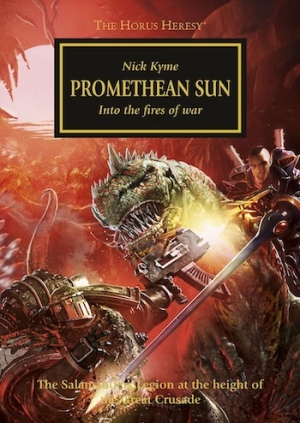
KymeN-HH-PrometheanSunFormer Limited Edition Novella gets a wider release

As the Great Crusade sweeps across the galaxy, the forces of the Imperium encounter a world held in thrall by the alien eldar. While the Iron Hands of Ferrus Manus and Mortarion’s Death Guard battle against the hated xenos, it is the Salamanders who brave the deepest and most deadly jungles, encountering monstrous reptilian beasts and foul witchery along the way. Ultimately, it falls to their primarch Vulkan himself to thwart the sinister designs of the eldar, if the Legions are to liberate this world and bring illumination to its inhabitants.

Promethean Sun was Black Library’s first limited edition Horus Heresy novella. As someone who couldn’t afford it back then, naturally I grumbled quietly to myself about missing out on this part of the series – which has, actually, been a superb example of sustained, multi-volume and multi-author storytelling. There have been wobbles, of course, but for the most part this series has been amazingly strong. So, back to this book. After reading it, I realise I shouldn’t have grumbled. Sad to say (and very surprisingly), this was a disappointment, with greater weaknesses than strengths. The story meanders, the writing’s not as strong as I know Kyme can produce, and Vulkan’s characterisation feels off. For completists only, I would say. Continue reading