Upcoming: FORTUNE’S PAWN, HONOUR’S KNIGHT & HEAVEN’S QUEEN by Rachel Bach (Orbit)

Rachel Bach is the science-fiction pseudonym for Rachel Aaron, the author of the humourous, fun (and therefore recommended) The Legend of Eli Monpress fantasy series – which started with The Spirit Thief. Orbit Books (who publish the Monpress novels) will be releasing Rachel’s Paradox series over the next few months. The first three novels, Fortune’s Pawn, Honour’s Knight, and Heaven’s Queen have already received covers, which are below.

Bach-Paradox-1to3

Here is the synopsis for Fortune’s Pawn:

Devi Morris isn’t your average mercenary. She has plans. Big ones. And a ton of ambition. It’s a combination that’s going to get her killed one day – but not just yet.

That is, until she just gets a job on a tiny trade ship with a nasty reputation for surprises. The Glorious Fool isn’t misnamed: it likes to get into trouble, so much so that one year of security work under its captain is equal to five years everywhere else. With odds like that, Devi knows she’s found the perfect way to get the jump on the next part of her Plan. But the Fool doesn’t give up its secrets without a fight, and one year on this ship might be more than even Devi can handle.

Also on CR: Interview with Rachel Aaron

Star Wars in Rolling Stone

RS-198007-SlavesOfTheEmpireWhile perusing Rolling Stone’s website (something I do frequently), I spotted a link for “Star Wars in Rolling Stone”. It’s a collection of the articles from the magazine, beginning with an interview with George Lucas from 1977. They’re presented in reverse-chronology, so I’d start with the final page (linked above) and work from there.

One article in particular jumped out for me – partly because of the title – and that was from the June 12th, 1980 issue of the magazine (pictured): “Slaves to the Empire: The ‘Star Wars’ Kids Talk Back”, by Timothy White. The article is about (according to the standfirst):

“Five actors caught in the paradox of ‘Star Wars’ (the highest-grossing film of all time has done nothing for their careers) talk about their trap, the making of ‘The Empire Strikes Back’ and why they still want to be a part of the third installment”

It’s an interesting interview, more about their opinions about the movies, working on them, and where they came from, than about being “trapped” by the films’ success. It’s filled with some great trivia for die-hard Star Wars fans. For example: Carrie Fisher is quite mischievous, and suggests that Leia should have fallen for Chewbacca; Mark Hamill considered Luke to be the “classic thankless role”, confesses that he is a “serious collector” of Star Wars memorabilia, and amusingly bemoans the fact that the Luke dolls have been marked down in price for collectors; Anthony Daniels (C-3PO) explains why the first movie was a “miasma of pain”; Harrison Ford sheepishly admits that he’s “never been much of a film fan” but felt like Empire Strikes Back was “the first time I’ve ever seen anything I’ve done that I’m happy with”.

The piece also addresses Mark Hamill’s car accident, and is actually the first time I’ve read anything about it:

“Hamill’s anxiety about landing choice roles was tragically accelerated when his BMW ran off the freeway in 1977. Star Wars had not yet been released, and his face was sufficiently ravaged that he wondered whether he would be able to retain any part of his angular good looks, let alone fulfill the remainder of his three-picture deal with Lucas. That mental anguish was only intensified when the film proved to be an international smash.”

Reading these articles got me to thinking: has anyone written a book about the making of the movies? Not just big, photo-stuffed Coffee Table books (although, those are really nice, too), but a campaign-biography-style volume about the making of the original movies. I’d definitely read one of those.

Upcoming: ARMADA by Ernest Cline (Crown)

ClineE-ArmadaAnyone who’s been following Civilian Reader for a while, should have spotted my glowing, gushing review of Ernest Cline’s debut novel, Ready Player One. Ever since I read that novel (devoured, it really), I have been on the look-out for information on his next fiction project. The other week, I stumbled across the information for Armada over on excellent The Book Smugglers website. So I’m going to shamelessly pinch the info from them, and share it here. Here’s the synopsis…

Lightman is daydreaming through another dull math class when the high-tech dropship lands in his school’s courtyard-and when the men in the dark suits and sunglasses leap out of the ship and start calling his name, he’s sure he’s still dreaming.

But the dream is all too real; the people of Earth need him. As Zack soon discovers, the videogame he’s been playing obsessively for years isn’t just a game; it’s part of a massive, top-secret government training program, designed to teach gamers the skills they’ll need to defend Earth from a possible alien invasion. And now…that invasion is coming.

As he and his companions prepare to enter their ships and do battle, Zack learns that the father he thought was dead is actually a key player in this secret war. And together with his father, he’ll uncover the truth about the alien threat, race to prevent a genocide, and discover a mysterious third player in the interplanetary chess game he’s been thrown into.

Armada is due to be published by Crown Publishing in the US (July 2014) – no news yet on the UK or other international publishers. Be sure to follow Cline on Twitter, too, for more up-to-the-minute news. I was also able to find the following image on Forces of Geek, which was categorised as “Poster”, but it was cool enough that I thought I’d share it here as well…

ClineE-Armada-Poster

Guest Review: PROMETHEAN SUN by Nick Kyme (Black Library)

Kyme-HH-PrometheanSunReviewed by Abhinav

The Horus Heresy series has proven to be rather spectacular, right from the very beginning with Dan Abnett’s game-changing opener, Horus Rising. As an exploration of the entire origin-mythos that defines the Warhammer 40,000 setting, the series has done well in exposing how this galactic civil war happened, and how all the players reacted to it, each in their own way. Being a multi-author series (projected to go on to roughly 50 full novels and anthologies, plus additional novellas, short stories and audio dramas), the quality hasn’t been entirely consistent, and there have been some let-downs, or books that don’t seem to fit into an ongoing arc.

Two years ago, Black Library changed the game once more, by offering direct exclusive limited-edition novellas set as interstitials within the larger narrative at work. Being limited to a select few thousand copies, these hardback stories with extra content (such as special faux-skin and illustrations) gave way to a lot of controversy with regards to pricing for the series. This was compounded last year by the publisher’s inexplicable decision to change formats mid-series and offer books in hardback and hardback-sized trade paperbacks before the regular and familiar mass market copies were made available.

As such, novellas like Promethean Sun and Brotherhood of the Storm among others have had to field quite a bit of negative criticism completely unrelated to the actual fictional content within. And that’s what I wanted to focus on in this review. Promethean Sun was re-released a few weeks ago as a non-limited hardback with an accompanying eBook, which is what I got. The two-year wait in between definitely didn’t hurt my enthusiasm.

So, on to the review itself. Here’s the synopsis…

As the Great Crusade sweeps across the galaxy, the forces of the Imperium encounter a world held in thrall by the alien eldar. While the Iron Hands of Ferrus Manus and Mortarion’s Death Guard battle against the hated xenos, it is the Salamanders who brave the deepest and most deadly jungles, encountering monstrous reptilian beasts and foul witchery along the way. Ultimately, it falls to their primarch Vulkan himself to thwart the sinister designs of the eldar, if the Legions are to liberate this world and bring illumination to its inhabitants.

Promethean Sun does one thing really, really well: it delves deeply into Vulkan’s psyche and explores his character through the present and the past alike. That’s what the entire story is about. The Primarch of the Salamanders Legion has been a fairly unknown quantity so far, outside of extremely brief cameos in other stories, most notably Graham McNeill’s Fulgrim, if I recall correctly, and so it was great to finally see more of him. Continue reading

“Scars” Episodes I-III, by Chris Wraight (Black Library)

Wraight-Scars(HH)A Horus Heresy Serialised Novel

This is a review of the first quarter(-ish) of the 27th Horus Heresy novel, which is being serialised through Black Library’s website. Reading these, one is left with a bit of a conundrum: how do you review the first three-of-twelve parts of a novel? What constitutes a spoiler, for example?

I’ve decided to approach the installments as if they were the first quarter of a novel, which means all the content is fair game for discussion and mention (although, I have addressed each episode individually, which has made this a rather long review).

I wonder if it might have been better to organise some kind of forum, in which fans of the series could discuss the episodes and novel? There’s so much in these three parts, and given the week-long gaps between each new episode, I think it lends itself quite well to forum-style engagement and discussion.

Anyway, back to the review. First up, here is the synopsis for the full novel:

Jaghatai Khan and his White Scars Legion must choose – the Emperor or Horus? Fresh from their conquest of Chondax and the discovery of Horus’s rebellion, Jaghatai Khan’s warriors stand divided. Long considered one of the less trustworthy Legions, many of the White Scars claim to owe their loyalty exclusively to Terra, and others still to the Warmaster and his warrior lodges. But when a distress call from Leman Russ of the Space Wolves brings the wrath of the Alpha Legion to Chondax, the Khan’s hand is forced and the decision must be made – in the great war for the Imperium, will he side with the Emperor or Horus?

The first Episode was not the strongest start to a novel. It didn’t fully grab me, like most other Heresy novels have – this is, perhaps, a real danger when serialising a novel that has not been specifically written for this format. (Although, it should be stated from the outset that the first three episodes have been chopped up rather well.) It’s also tricky, though, to address: taken as an individual read, it wouldn’t have left me 100% convinced that I wanted to read on. Because I had the next two episodes, though, I can say that Scars could shape up into one of the strongest Heresy novels.

The story opens with two Astartes aspirants, Tamu and Haren. The two characters are going through trials for what I had assumed were the White Scars. It took a few pages to realise they weren’t both trying out for the same Legion, though, which at least explained the different types of name (Haren Svensellen didn’t sound particularly Asian-influenced, as most White Scars’ names are). Haren, it turns out, had been marked for selection by the Luna Wolves, but is reassigned to the White Scars at the last minute. It’s a little bit muddled, if you haven’t memorised the Legion numbers (as opposed to names), but it quickly sorted itself out.

Through Haren’s ordeal, we learn that this is happening after Horus has made a name for himself: “I will become one of you,” he thinks after confronting a Luna Wolf. “For Horus. For Horus and the Emperor, I will become one of you.”

The mix of ‘Asian’-style terminology (“an owlish Khitan from Choq-tan named Jeldjin” – a bit of a clunky example) seemed at times to be rather heavy-handed or excessive. Wraight throws out a lot of new jargon without the best integration. Less, or a more gradual introduction, would have been better. Interestingly, we learn through Haren’s experiences, the White Scars prefer recruits from the Asiatic hive cities, and he finds their “archaic customs, their introversion, their exceptionalism” irritating. The first episode, then, offers an interesting, if truncated, alternative induction story. I liked this a lot, as it suggests that inductions are not always as harmonious or clear-cut as we may have been led to believe.

To make things a bit more confusing, at the end of Episode I, Tamu changes his name as he is inducted, to Shiban. Haren becomes Torghun.

There’s some foreshadowing, as Tamu asks if Terrans are as tough as Chogorians:

“I am glad you are a poet. Only poets can be true warriors.”

“Do the Terrans think the same way?”

Yesugei laughed. “I do not know,” he said. “One day you will meet one. When you do, ask him.”

Not difficult, therefore, to spot that Tamu/Shiban and Haren/Torghun are fated to meet.

Wraight-Scars(HH)-pt1In Episode 2, the story’s scope widens, and we are introduced to a number of other key characters. Ilya Ravallion, a General in the Departmento Munitorum, for example, who is charged with handling the White Scars’ logistics. Through Ilya’s eyes, we get some good commentary on the White Scars’ style – both martial and temperamental.

“They were the elusive ones, the Legion who roamed too far, the ones who had almost broken away entirely, rampaging outwards from the thrust of the Crusade and angling off into the deep void. Prodigal, her superior had called them.”

Assigned to the White Scars, Ilya feels she’s been given a surprising final assignment: “organising the unorganisable, imposing some sense of discipline upon a Legion that treated warfare like a kind of carefree, joy-filled art form.” In the third episode, discussed below, this theme is revisited, and we learn that Ilya “had come to find the White Scars’ amiable indifference to Imperial edicts more endearing than exasperating.”

And finally, we get some examination on Jhagatai Khan, in relation to his brother Primarchs:

“They said Horus Lupercal was the finest commander in the galaxy. They said that the Angel Sanguinius was the mightiest in combat, or maybe Russ of Fenris, or maybe poor tortured Angron. They said Guilliman was the greatest tactician, the Lion the most imaginative, Alpharius the subtlest. None of them gave the Khan a second thought. But then, they hadn’t seen him [in combat].”

We learn a bit more about Shiban and Torghun, and also start to get a glimpse of a rift between Terran-born White Scars and Chogorian-born Astartes. Torghun, for example, is a member of a Lodge (which haven’t featured much in recent HH fiction), which is made up exclusively of Terran-born Astartes. I have a feeling that the rift within the Legion is going to be borne of these hostilities. It’ll be an interest addition to the canon, too – despite their obviously aggressive, homicidal approach to non-humans, none of the Heresy (or WH40k) fiction has dealt with human racial tension. If handled well, this could be very interesting indeed.

The second episode also gives us more idea of the time-period for the novel – the Space Wolves have already burned Prospero (the events of McNeill’s excellent A Thousand Sons and Abnett’s Prospero Burns), and also after the Isstvan Dropsite Massacre. The final portion of this part focuses on the Space Wolves, who are chaffing at having been sent away to discipline Magnus’s Legion – thereby ensuring their absence from Isstvan, which in turn likely helped sway the conflict in favour of the traitors. Their task also prevented them from coming to the aid of their now-fallen brother Legions. Then, while preparations are underway for the Legion return to Terra, an Alpha Legion fleet appears out of the warp…

One of the most interesting scenes is at the start of Episode III. It is set in the Observatory of the Imperial Palace on Terra. Malcador the Sigillite, Primarch Rogal Dorn and Commander Valdor of the Legio Custodes are discussing the state of the galaxy and the newly-erupted Civil War. Through their discussion, we learn just how thin information is.

“I never asked you how it felt, Constantin, to see Prospero burn. Did even your callous soul blanch at that?”

Valdor didn’t miss a beat. “No. It was necessary.”

“Was it?” sighed Malcador. “I did not give the order. I wanted Magnus censured, not destroyed. What was it that made Russ do it? You never could give me an answer.”

Dorn exhaled impatiently. “You know all of this, Malcador. You know all that happened there, just as we do.” He was coldly furious. “Does this need repeating? The Warmaster is at the heart of it, poisoning everything we do, and now he has the blood of three more Legions on his hands.”

This chapter expands once again our understanding of the rivalries and loyalties between the Primarchs. It also re-iterates the strange, almost lonely position of the Khan. The Khan was only really close to two of his brothers: Horus and Magnus. Naturally, this produces some concern among the leaders of the Imperium. As Valdor states, “So there it is. The Khan’s known allies, Horus and Magnus, traitors both.”

As with the aforementioned novels by McNeill and Abnett, Wraight ties in the treason to the events at Nikaea, when the Emperor decreed that all Legions must disband their psychic corps (the Librarians, etc.). As Malcador laments,

“As I said at the time, Nikaea was the root of this. We should have explained things better, though there were reasons, some of which we could never disclose, not there… We were too caught up in what needed to be done. That may be the tragedy of it all – we did not explain.”

Thankfully, we finally meet the Primarch Jaghatai Khan. He had felt rather absent up to this point… As it turns out, Khan has no idea what occurred on Nikaea, hoping instead that Yesugei (who appears to be his second-in-command?) was successful in helping keep the Librarius alive in the Legions.

The Space Wolves and Alpha Legion also face off in the void.

“I wondered if it would become easier,” Bjorn mused.

“If what would?” asked Godsmote.

“Killing another Legion. Killing kinsmen.”

“We’re not there yet.”

“Yes, we are.”

To return to the pending rift within the Legion, we see a little bit more of the Terran-born Astartes’ frustrations.

“As was typical, the White Scars straggling Legion structure made coordination difficult… The Chogorians seemed happy enough with that. They were used to their inscrutable primarch and his impulsive decision-making. The Terrans took it harder, at least those who hadn’t long resigned themselves to the Legion’s haphazard methods of command and control.”

Given that we’re told the process can take well over a decade, I find this a little strange. It’s an interesting development, certainly, and one I haven’t seen in other Heresy fiction. Therefore it is welcome, not to mention also providing the motivation behind the Legion split easier to swallow, but at the same time… They were made into Astartes, elevated to become super-humans. So they didn’t become Luna Wolves – we’ve been led to believe that all humans see all Space Marines as the pinnacle of supra-human evolution, and are in complete awe of them. It seems almost petty that the friction effectively arises because some of them weren’t pick for the right ‘team’.

All in all, despite the weaker first Episode, Scars is shaping up to be a pretty interesting addition to the Horus Heresy series. Wraight’s writing is well-crafted, and the story moves at a brisk, smooth pace. I hope we get some more White Scars background, though, and perhaps some of their Primarch’s history. I haven’t read much about the Legion before (and have read neither Wraight’s previous novel Savage Scars, nor the limited edition novella, Brotherhood of the Storm).

I do, however, think I would have preferred to read this as part of the complete novel, so I’m not sure if I’m going to continue reviewing the episodes in collected chunks, or just wait for the novel to be complete. Part of this is just down to my own personal impatience with reading in small chunks – I much prefer to devour a novel in a relatively quick period, rather than in slow, weekly drips. It’s an interesting experiment, at least.

Upcoming: “Stormcaller” by Chris Wraight (Black Library)

Wraight-SW2-StormCallerThe final Upcoming post related to Black Library for a little while, this is for the second in Chris Wraight’s Space Wolves series: Stormcaller. The sequel to Blood of Asaheim (which I really wish I’d had the chance to read by now), I’m really looking forward to it:

As events on the plague-wracked world of Ras Shakeh spin out of control, the Imperium descends upon the world in force. Njal Stormcaller, Space Wolves Rune Priest, arrives to reinforce the embattled Jarnhamar pack, and finds his battle-brothers at one another’s throats, each pursuing their own agendas. Meanwhile, the forces of the Ecclesiarchy arrive to retake their world and uncover the sinister secret behind the world’s corruption, a secret that threatens the survival of the Imperium itself…

One of the first Games Workshop books I ever bought was Codex: Space Wolves. Njal Stormcaller was a pretty prominent special character for Warhammer 40,000 game at that point. Interestingly (at least for me), the first ever issue of White Dwarf, the monthly gaming magazine that Games Workshop publishes, also featured the Space Wolves, as I think they’d just been re-released or something. It was so long ago, I can barely remember the details, expect for the battle report and the fact that Ragnar Blackmane was released that month. Perhaps. This would have been back in 1994/5, I think? [Damn, I’m getting old…] I kind of miss getting the magazine – I always liked looking at the new miniatures and reading the short bits of fiction and background when they were included. (This was before Black Library started, so there wasn’t much Warhammer fiction available at all.)

Stormcaller is due to be published by Black Library in March 2014.

Wraight-BloodOfAsaheimAnd, in case you weren’t aware of it, here’s the synopsis for Blood of Asaheim

The feral warrior-kings of Fenris, the Space Wolves are the sons of Leman Russ. Savage heroes, few can match their ferocity in battle. After half a century apart, Space Wolves Ingvar and Gunnlaugr are reunited. Sent to defend an important shrine world against the plague-ridden Death Guard, the Grey Hunters clash with the pious Sisters of Battle, who see the Space Wolves as little better than the enemy they fight. As enemies close in around them and treachery is revealed, Gunnlaugr and his warriors must hold the defenders together – even as hidden tensions threaten to tear their pack apart.

Blood of Asaheim is out now in Hardcover and eBook.

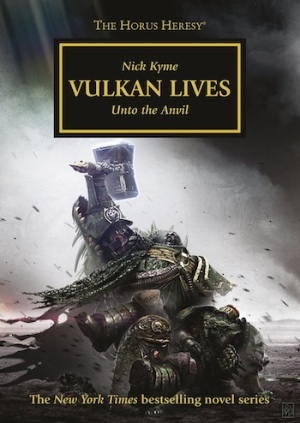
Review: VULKAN LIVES by Nick Kyme (Black Library)

KymeN-HH26-VulkanLivesA superb, different Horus Heresy novel

In the wake of the Dropsite Massacre at Isstvan V, the survivors of the Salamanders Legion searched long and hard for their fallen primarch, but to no avail. Little did they know that while Vulkan might have wished himself dead, he lives still… languishing in a hidden cell for the entertainment of a cruel gaoler, his brother Konrad Curze. Enduring a series of hellish tortures designed to break his body and spirit, Vulkan witnesses the depths of the Night Haunter’s depravity, but also discovers something else – a revelation that could change the course of the entire war.

How does one review a novel that packs in so very many revelations? With great difficulty, as it happens… Vulkan Lives is a great novel. It is a superb addition to Black Library’s New York Times-bestselling sci-fi series. It is a superb example of intelligent, thoughtful science fiction. It’s not flawless, true, but I loved it. I have a feeling it won’t be met with universal acclaim from the more action-oriented sections of the WH40k fan-base, but I think it does a great job of fleshing out some hitherto overlooked events and questions of the era. Continue reading

Short Story Review: “Know Thyself” by Andy Smillie (Black Library)

Smillie-KnowThyselfMore superb Flesh Tearers from Smillie

Sent to meet with Flesh Tearers Chapter Master Gabriel Seth to discuss a recent incident in which the Flesh Tearers and Space Wolves came to blows, Inquisitor Corvin Herrold boards the flagship of the Chapter, the mighty Victus. But when he discovers a shocking secret, Herrold finds himself a prisoner of Sanguinius’s most dangerous sons, and his audience with the Master of the Flesh Tearers proves more perilous than he could have ever imagined.

Andy Smillie has done it again: he has managed to portray characters that should be mindless, ferocious psychopaths in a nuanced, relatable, and not-unsympathetic manner. What Aaron Dembski-Bowden does in long-form, Smillie has mastered in this shorter-format.

It was really interesting to see how the Flesh Tearers’ command deal with the Inquisition, and their extreme means of conveying unto those who deem them heretics and corrupt what lies at the heart of their character. It’s not pretty, nor is it supposed to be. The Tearers are the way they are, a distillation of the more brutal aspect of their originator Primarch, Sanguinius.

This is a superb short story, and I can’t wait to read more by Smillie. I really must get caught up with Flesh of Cretacia

More Flesh Tearers by Andy Smillie: Beneath The Flesh, Torturer’s Thirst

[This story was originally published in the Black Library Weekender Anthology 2012: Saturday.]

Four HORUS HERESY Short Stories by Graham McNeill, Rob Sanders, James Swallow & Gav Thorpe (Black Library)

HorusHeresy-Logo

Near the end of July, Black Library released four Horus Heresy short story eBooks through their website. Naturally, as a real Heresy junky, I gobbled these up ASAP. All four are pretty different, offering alternative perspectives on different events and times during the galaxy-spanning civil war that dictates much of how mankind operates in the 41st Millennium (the ‘present’ for the game and system). So, here are four mini-reviews of these excellent stories… Continue reading

An Interview with PETER LINEY

Liney-Detainee

Peter Liney’s The Detainee has been on my radar for a little while, now, yet I keep getting distracted from reading it. With this interview, an excerpt and a guest post up on the blog already, I really should get my butt in gear and read the novel. Very soon, hopefully. In the meantime, here is what Peter had to say about his novel, writing, and more…

Let’s start with an introduction: Who is Peter Liney?

Well, first and foremost, he’s a writer. I’ve done all kinds of jobs – selling sewing machines in the Oz Outback, modeling, acting, fashion buying, decorating, teaching, etc., etc. – but the one constant has always been writing, the one dream has always been success. And no, I don’t agree with writing for yourself; no matter what we do, we want to be appreciated for it. Continue reading