 I’m not exactly sure when THE DETAINEE started to take shape in my mind. For a long time I had this notion that I wanted to write a book about the human spirit, about the fact that, no matter how dark the situation, given hope, we always find a way to survive. Like those seeds that lie dormant in the desert, year in, year out, waiting for rain, and when it comes, suddenly burst into the most beautiful of life. Or the victims of kidnapping, political prisoners, those held for no reason and often under the most appalling of circumstances, where do they find the will to survive? To wait for the arrival of that shower of life-giving rain? Continue reading
Sci-Fi
A Q&A with MAX BARRY

Max Barry is a superb author. I haven’t read as much of his stuff as I would like, and I’m due a re-read of Jennifer Government at some point in the near future. His latest novel, Lexicon, is one of my favourite reads of 2013 so far, and will be reviewed tomorrow. He was kind enough to take some time out of a busy schedule to answer some questions for me…
Let’s start with an introduction: Who is Max Barry?
Max Barry is a Melbourne-based author who runs an online political simulation game in his spare time. Except by “spare time” I mean “time he should be spending writing novels.”
I thought we’d start with your fiction: Your latest novel, Lexicon, was recently published by Mulholland Books. How would you introduce the novel to a potential reader?
I’d probably be all like, “I wrote this book about… stuff.” Because I’m terrible at describing my own work. But someone else said, “Modern-day sorcerers fight a war of words.” That’s not too bad. It’s a thriller.

Lexicon is about the power of language. What inspired you to write the novel? And where do you draw your inspiration from in general?
The novel came from a lot of little ideas intersecting, one of which was privacy: the notion that so much of what we do is tracked now, and analyzed, and used to figure out what kind of person we are. So what used to be a very personal decision – how and when we reveal ourselves to other people – has been taken away.
How were you introduced to reading and genre fiction?
I’m not sure kids need to be introduced to genre fiction. If you’re an eight-year-old boy and you see a picture of a book with a dragon on it, you want that book. I’ve always loved reading; my parents made sure I was never short of a book.
How do you enjoy being a writer and working within the publishing industry? Do you have any specific working, writing, researching practices?
 I have the best job in the world: I get to make up stories all day, I can work in my underwear, and people periodically email me to say, “Hey! Great job!” It’s like the opposite of a real job. Except for the part about making up stories all day. Because I used to work in sales.
I don’t have a formal routine. I do try to make sure I’m at the keyboard, ready to write creatively, every weekday. I don’t force myself to write if it’s not working. But I always give it a shot.
When did you realize you wanted to be an author, and what was your first foray into writing? Do you still look back on it fondly?
I don’t remember ever not wanting to be an author. I realized it wasn’t a very practical goal, but it was what I wanted. Pretty much all of my formal education was acquired with the aim of staving off homelessness while I wrote novels on the side.
What’s your opinion of the genre today, and where do you see your work fitting into it?
I don’t write to any particular genre. Which is kind of stupid, for both creative and commercial reasons. But I’ve never cared too much about genre. I am usually shelved in the sci-fi section, but I think you can read my books without really noticing their genre.
What other projects are you working on, and what do you have currently in the pipeline?
I no longer talk about books I’m working on. I used to, in great detail, but then it was embarrassing when the book turned out to be unpublishable. So I stopped. Also, I feel authors need a long period of quiet discovery with their books. Talking about them early kills a little of the magic for me.
What are you reading at the moment (fiction, non-fiction)?
I’ve just started Life After Life by Kate Atkinson. The most recent non-fic I’ve read is The Signal And The Noise by Nate Silver, which was really good.

What’s something readers might be surprised to learn about you?
I can tell what’s wrong with your computer just by listening to it.
That’s not true. I have to SSH in and run some diagnostics. But that’s almost the same thing. I know more about Linux systems administration than is healthy.
What are you most looking forward to in the next twelve months?
Working on a good book.
Upcoming: “Jupiter War” by Neal Asher (Tor)
 The highly-anticipated third book in Neal Asher’s Owner Trilogy…
Alan Saul is now part-human and part-machine, and our solar system isn’t big enough to hold him. He craves the stars, but can’t leave yet. His sister Var is trapped on Mars, on the wrong side of a rebellion, and Saul’s human side won’t let her die. He must leave Argus Station to stage a dangerous rescue – but mutiny is brewing onboard, as Saul’s robots make his crew feel increasingly redundant. Serene Galahad will do anything to prevent Saul’s escape. Earth’s ruthless dictator hides her crimes from a cowed populace as she readies new warships for pursuit. She aims to crush her enemy in a terrifying display of interstellar violence. Meanwhile, The Scourge limps back to earth, its crew slaughtered, its mission to annihilate Saul a disaster. There are survivors, but while one seeks Galahad’s death, Clay Ruger will negotiate for his life. Events build to a climax as Ruger holds humanity’s greatest prize – seeds to rebuild a dying Earth. This stolen gene-bank data will come at a price, but what will Galahad pay for humanity’s future?
Jupiter War will be published by Tor UK, on September 26th, 2013.
Guest Post: “How Do You make Non-Humans Seem Human?” by Madeline Ashby
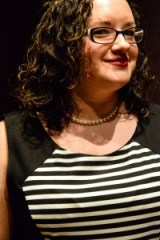 Madeline Ashby is the author of the critically-acclaimed vN and iD science fiction novels, the first two books in the Machine Dynasty series (published by Angry Robot Books). Her protagonist is a “von Neumann machine, a self-replicating humanoid robot”. This made me wonder how one goes about making a non-human character relatable and sympathetic? When I was told Madeline was available for guest posts, I jumped at the chance to ask her about this. So, without further ado…
*
How Do You Make Non-Humans Seem Human?
by Madeline Ashby
How do you make non-humans seem human? Well, with self-replicating humanoids designed to love and serve humans, it’s not that difficult. At least, it’s not for me. In vN and iD, the robots love humans enough to spend significant amounts of time with them. They have long-term relationships, both at home and at work. The longer they live, the better they learn to “pass,” as human, or at least to behave in the most human way possible.
But that’s not the real issue. The real issue is making them read as human – making them leap off the page in the way that three-dimensional human characters do in other books. I try to do that in a few different ways. Continue reading
An Interview with SETH PATRICK

Anyone who’s been keeping an eye on the SFF online community and blogosphere can’t have totally missed Seth Patrick’s debut, Reviver. I’ve seen posters on rail platforms during my commute into London, and seen mentions in print magazines. It is clearly a hotly-anticipated novel of the year. Despite this, I’ve been slow about getting around to reading it. (Shame on me!) Nevertheless, I’m happy to share with you today a quick interview with Seth, in which he talks about writing, the novel and more…
Let’s start with an introduction: Who is Seth Patrick?
I’m a games programmer by day (on the Total War strategy series for PC), writer by night; father of two; book fan, movie fan, comic fan. Usually lacking sleep.
I thought we’d start with your fiction: Your debut novel, Reviver, was recently published by Macmillan. How would you introduce the novel to a potential reader? Is it part of a series?
Reviver is a supernatural crime thriller, the first of a trilogy, set in a world where some people have found they have the ability to revive the recently dead, but only briefly. Just long enough for their loved ones to say goodbye, but – more importantly for the novel – for forensic specialists to learn as much from murder victims as they can. Jonah Miller is a young forensic reviver, one of the best working for the Forensic Revival Service in the US. While reviving the victim of a brutal murder, he encounters something terrifying that makes him question everything he knows.

What inspired you to write the novel? And where do you draw your inspiration from in general?
The novel began in a creative writing class hosted by the crime author Peter James, back in 2004. At the time, Peter’s background had been as a horror writer, but he was just launching his first crime novel, a transition that showed in the homework he set the class for the first week: write the first page of a horror novel, introducing your protagonist and a murder weapon.
I wrote the first page of Reviver, and it’s hardly changed since.
The idea itself came from the discovery that I share my birthday with Edgar Allan Poe. Two Poe tales came to mind: The Facts in the Case of Monsieur Valdemar, in which the terminally ill Valdemar is hypnotised at the point of death, but continues to speak long after he’s died; and Murders in the Rue Morgue, widely considered to be the first modern detective fiction.

These two stories fused, and I had an image of the detective from Murders in the Rue Morgue interviewing the dead Valdemar.
In general, my inspiration is almost entirely from being a constant daydreamer. My mind likes to wander, and continually slams disparate ideas together with absolute glee. I end up with a palette of images and scenarios, snippets of story that I can then use to forge a narrative.
How were you introduced to genre fiction?
My first big reading frenzy started when I was eight, in a bookshop for a Tom Baker signing, where I bought Doctor Who and the Giant Robot. That led to me ploughing through a million Doctor Who novelisations, and 2000AD, then moving on to Stephen King, Greg Bear, Arthur C Clarke, Clive Barker, Alan Moore.
How do you enjoy being a writer and working within the publishing industry? Do you have any specific working, writing, researching practices?
I’m still a total noob, and awed by every aspect of the process. It’s great to meet so many people with such a love of books, and it’s a huge thrill to hang out with other authors.
I’m only on my second novel, and with Reviver I was winging it, learning the craft as I went, so my working method is evolving pretty fast – it has to, really, since the first book took me six years to write, but each of the sequels have less than a year.
But I’m still winging it. It’s fun.

When did you realize you wanted to be an author, and what was your first foray into writing? Do you still look back on it fondly?
As a ten year old kid, my favourite homework was always when we could write anything we chose. I’d have asteroid impacts, or being shrunk to the size of a Lego man, all in four sides of scrawled handwriting.
As I got older, doing it in my own time, I struggled to finish anything and had no confidence in what I turned out. Really, I just didn’t appreciate how much work had to be put in after the point I thought something ‘finished’. I ended up trying out other forms, like screenwriting, and my first taste of success was being shortlisted for a BBC competition, with a ghost story screenplay. I’m proud of it; some of the ideas for Reviver were harvested from there.
What’s your opinion of the genre today, and where do you see your work fitting into it?
Reviver is a blend of the Horror, SF and Crime genres, but I’m far more a fan of Horror and SF than crime. I think that’s just because of the total freedom to explore interesting ideas.
Today, genre fiction is strong and varied, possibly more so than it’s ever been. There’s a certain confidence in the field, too; there’s also a degree of insecurity, which means that the old argument about genre-vs.-literary keeps rearing its head.
It stems from the long-standing cold shoulder that genre novels get from the mainstream press, but rather than engage with the underlying reasons for that, some try to push the idea that novels can be both genre and literary, as if that’s the important thing.
It drives me mad, certainly, when ‘literary’ notions are presented as the only thing of any real value, yet are largely equated with being difficult or inaccessible. I’ve no problem with people who rate style and tone over plot and pacing, even to an extreme – that’s when personal taste comes into it – but trying to have genre recognised as having that rather limited kind of merit seems to miss the point of just how wide-ranging its merits actually are.
Genre fiction is easily strong enough to stand on its own terms, chock-full of intelligent and exciting fiction that covers all tastes.
My own work is firmly at the accessible and entertaining end, of course, but genre really does have it all.
What other projects are you working on, and what do you have currently in the pipeline?
Right now, books two and three of Reviver are taking up my full attention, but like I said, I’m a constant daydreamer. I have a few notions for what follows Reviver, enough to know that picking just one will be tough.
What are you reading at the moment (fiction, non-fiction)?
I’ve just finished the excellent London Falling by Paul Cornell, I’m nearly through the also-excellent You Are Not So Smart by David McRaney, and next up for me is Greg Egan’s The Clockwork Rocket.

What’s something readers might be surprised to learn about you?
One of my top five movies is Muppet Christmas Carol. My absolute favourite is John Carpenter’s The Thing, though. Less of a surprise.
Muppet Christmas Carol has one of my favourite scenes in it – when they ask for more coal, are denied, and “HEATWAVE!” Cracks me up every time…
One final question: What are you most looking forward to in the next twelve months?
It’s going to be busy! Hopefully, there’ll be movement on the Reviver movie; I’ll have finished Book Three, seen Book Two out in hardback, and Book One will be in paperback. I’m also going to the World Fantasy Convention in Brighton in October, by which time I may have convinced myself that this is all real.
*
Be sure to check out Seth’s website and Twitter for more information about his books and writing.
Reviver is out now, published in the UK by Macmillan and Thomas Dunne in the US.
Review: PROMETHEAN SUN by Nick Kyme (Black Library)
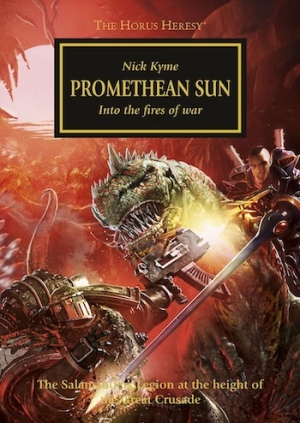 Former Limited Edition Novella gets a wider release
As the Great Crusade sweeps across the galaxy, the forces of the Imperium encounter a world held in thrall by the alien eldar. While the Iron Hands of Ferrus Manus and Mortarion’s Death Guard battle against the hated xenos, it is the Salamanders who brave the deepest and most deadly jungles, encountering monstrous reptilian beasts and foul witchery along the way. Ultimately, it falls to their primarch Vulkan himself to thwart the sinister designs of the eldar, if the Legions are to liberate this world and bring illumination to its inhabitants.
Promethean Sun was Black Library’s first limited edition Horus Heresy novella. As someone who couldn’t afford it back then, naturally I grumbled quietly to myself about missing out on this part of the series – which has, actually, been a superb example of sustained, multi-volume and multi-author storytelling. There have been wobbles, of course, but for the most part this series has been amazingly strong. So, back to this book. After reading it, I realise I shouldn’t have grumbled. Sad to say (and very surprisingly), this was a disappointment, with greater weaknesses than strengths. The story meanders, the writing’s not as strong as I know Kyme can produce, and Vulkan’s characterisation feels off. For completists only, I would say. Continue reading
Guest Post: “Why I Didn’t Write My Book in an Elevator” by Jack Skillingstead
 Here’s the so-called elevator pitch for my new novel, Life On The Preservation.
A man discovers his city is caught in a time loop. He fears he may be losing his mind. Then a girl from outside the loop arrives. They find each other and solve the mystery. It’s Dark City meets Groundhog Day.
I never actually delivered this pitch. In fact, I only wrote it just now. One time I did find myself in an elevator with David Hartwell, who is the senior editor at Tor Books. I wasn’t even tempted to blurt a pitch at him. All I said was, “Nice tie.” David is famous for his ties. After that, we did what most people do on elevators. We stared at the doors and waited.
On publication day, which was May 28th, I did a public reading from, Life On The Preservation. The reading took place at the University Bookstore in Seattle, Washington. Duane Wilkins, who runs the excellent science fiction section of the store and who is probably as well-read as anyone ever has been in our genre, had this to say in his introduction:
“I don’t know how to explain this book.”
Then he stared into space for a while, repeated himself, and suggested I might do better at describing Life On The Preservation. Presumably, he believed I could describe my own novel because, after all, I’d written it. But I couldn’t, even though I’m a fairly articulate person. If I’d had my elevator pitch handy I might have recited the thing, but I doubt it. Besides, I only wrote the elevator pitch five minutes ago.
People who like to give writing advice will often tell you that if you can’t describe your book in one paragraph you probably don’t have a saleable idea. If that’s true, I’m living in the wrong universe. Though I have described both of my novels in one or two paragraphs, I did it only after the books were finished and sold and the publishers asked me to do it, so they would have some copy to put on the back of the book and to advertise it in catalogues and around the internet.
 The truth is, you don’t know what your book is about until you’ve written it, and if the book is any good it lives in the details – details that you discover along the way. At my University Bookstore reading I could have described LOTP as a story of alien destruction, time loops, transhuman survival in an environment of outlaw art, paranoid estrangement and redemption. I could even have said its secret theme concerned living in the world you create – whether you acknowledge you’ve created it or not.
But, while true enough, that description isn’t anything but a laundry list of related generalities. And I must say that, generally, I distrust generalities. Before I wrote LOTP I took several stabs at the one-paragraph description. I even tried to outline chapters. It felt a little like looking at a slide show from a vacation I hadn’t yet enjoyed. Here’s a pretty picture of a beach with random people lying around! Yes, the people are strangers, ciphers, and the beach looks like any other beach. But there it is! And I’m going!
My early efforts of transforming Life On The Preservation from a short story to a novel looked something like a generic beach with sun-bathing ciphers. This is because I was desperate to get organized and write a novel that pushed all the right buttons – you know, the buttons that would make people love the book and shower me with contracts and money. Of course, those first attempts to expand Preservation turned out to be abysmal failures. I learned that – for me, at least – there is only one way to discover whatever it is that might be original within myself. I had to go there and document the journey every inch of the way. Only then could I begin to organize my fancy slide show.
*
Life on the Preservation was published by Solaris Books on June 6th. Here’s the synopsis…
Inside the Seattle Preservation Dome it’s always the Fifth of October, the city caught in an endless time loop. “Reformed” graffiti artist Ian Palmer is the only one who knows the truth, and he is desperate to wake up the rest of the city before the alien Curator of this human museum erases Ian’s identity forever. Outside the Dome, the world lies in apocalyptic ruin. Small town teenager Kylie is one of the few survivors to escape both the initial shock wave and the effects of the poison rains that follow. Now she must make her way across the blasted lands pursued by a mad priest and menaced by skin-and-bone things that might once have been human. Her destination is the Preservation, and her mission is to destroy it. But once inside, she meets Ian, and together they discover that Preservation reality is even stranger than it already appears.
Review: MARK OF CALTH ed. Laurie Goulding (Black Library)
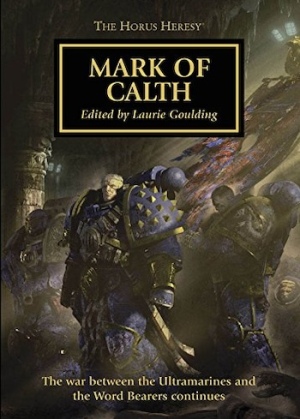 The latest Horus Heresy Anthology
In this all-new collection of Horus Heresy stories, witness the untold tales of the Underworld War.The Heresy reached Calth without warning. In just a few hours of betrayal and bloodshed, the proud warriors of the XIIIth Legion – Guilliman’s own Ultramarines – were laid low by the treachery of their erstwhile brothers of the XVIIth. Now, as the planet is scoured by solar flares from the wounded Veridian star, the survivors must take the fight to the remaining Word Bearers and their foul allies, or face damnation in the gloomy shelters beneath the planet’s surface.The battle for Calth is far from over
I’ve enjoyed all of the Horus Heresy anthologies that Black Library has produced. So I was very happy when I received this as a gift from a friend. I’ve liked some anthologies more than others, it’s true. But in each one, I think the authors have done a great job of advancing the overall story of the larger Galactic Civil War, as well as fleshing out the mythology of the event that has dictated much of the development of the Warhammer 40,000 universe. Mark of Calth takes a slightly different approach, focussing on the after-effects of the Word Bearers’ assault on Calth (as portrayed in Dan Abnett’s Know No Fear). It’s a good selection of stories, certainly, but I definitely think it’s time to move the HH story beyond Calth… (I have high hopes for Vulkan Lives, the next novel in the series, by Nick Kyme; and the soon-to-be-more-widely-released Promethean Sun novella, also by Kyme). So, one after the other, here are some short thoughts on the stories herein… Continue reading
Excerpt: THE BEST OF ALL POSSIBLE WORLDS by Karen Lord (Jo Fletcher Books)

Karen Lord is also the author of Redemption in Indigo, which I first heard of at the Kitschies Award ceremony back in February 2013. It immediately went on to my to-be-purchased list (I’m still getting around to it!). Luckily, I do have a copy of The Best of All Possible Worlds, the author’s second and already-critically-acclaimed novel, which I hope to read as soon as possible. In the meantime, I offer you this taste of the novel, courtesy of Lord’s UK publisher, Jo Fletcher Books…
*
THE BEST OF
ALL POSSIBLE WORLDS
by Karen Lord
BEFORE…
He always set aside twelve days of his annual retreat to finish up reports and studies, and that left twelve more for everything else. In earlier times, he had foolishly tried retreats within commreach of his workplace, and that was not at all helpful. There would always be some crisis, something for which his help would be required. As his salary and sense increased, he took his retreats further and further away, until at last he found himself going off-planet to distant temples where the rule of silence and solitude could not be broken by convenient technologies.
This season, he had chosen Gharvi, a place with small wooden buildings scattered about a huge temple of stone, all set within the rain shadow of a mountain range. An endless ocean, both vista and inspiration, ran parallel to the mountains, and a beach between the two offered long walks to nowhere on either side. A place of two deserts, some said, for sea and land were bleak together – one boundless, one narrow, and both thirsty.
There was a place at home very like it, which had probably influenced his choice, but the sky was unique. The atmosphere was the cloudy blueish-lavender of a recently bioformed planet and the sun was scorching bright. It was so unlike the cool, strong blues and gentle sunlight of his home world that for the first few days he kept his head down and his door closed till nightfall.
On the twelfth day, he took his handheld, replete with work well completed, and put it in the box outside his hermitage door. He cooked and ate his evening lentils, slept soundly through the night and rose to prepare his morning porridge. There was a little water left over from the day before (he was ever frugal), but to have enough for washing he had to fetch the new day’s supply from the box. The young acolytes of the temple always put sufficient water and food into each hermit’s box before dawn. It was enough to stay clean, to fill the solar pot with porridge or pottage and to sip and slake the constant thirst that was the natural consequence of dry air and silence. The acolytes would also take away his handheld and safely transmit its contents to his workplace.
But his handheld was still there.
He paused, confused by this disconnect in the seamless order of the temple’s routine. He stared at the untouched box. He looked up and frowned in puzzlement at the squat shape of the temple, vaguely visible through a haze of heat, blown sand and sea spray.
Then he shrugged and went on with his day, a little dustier, a little thirstier but convinced that an explanation would eventually be made manifest.
The following morning, well before dawn, the sound of the box lid closing woke him from a sleep made restless by dreams of dryness. He waited a bit, then went to bring in the supplies and drink deeply of the water. His handheld was gone and a double ration of food sat in its place. He did not even peer into the darkness to catch sight of the tardy acolyte. Order had been restored.
‘Dllenahkh, with your level of sensitivity and strength, you must go on retreat regularly.’ So he had been told, long ago, by the guestmaster of his monastery. ‘You are constantly looking to set things to rights, even within yourself. A retreat will teach you again and again that you are neither indispensable nor self-sufficient.’
Put bluntly, learn to stop meddling. Commitment is important, detachment equally so. He congratulated himself on his developing ability to keep curiosity in check and spent the next few days in undisturbed meditation and reflection.
One day, after a long morning meditation, he felt thirsty and decided to fetch more water from his supply box. He stepped out with his glass drinking bowl in hand and set it on the edge of the box while he tilted the half-lid and reached inside. His hands were steady as he poured water smoothly from the heavy narrownecked jug. Moving slowly, he straightened and took a moment of blissful idleness, the jug left uncovered near his feet, to squint at the sun glare on the desert beach and the desert ocean, and to feel the coolness of the water creeping into his palms as he held the bowl and waited to drink. It was a child’s game, to hold a bowl of water and mark the increase of thirst with masochistic pleasure, but he did it sometimes.
He brought the bowl to his mouth and had a perfect instant of pale-blue ocean, bright blue glass and clear water in his vision before he blinked, sipped and swallowed.
Many times after, when he tried to recall, his mind would stop at that vivid memory – the neatly nested colours, the soothing coolness of the glass – and not wish to go any further. It was not long after that, not very long at all, that the day became horribly disordered.
A man walked out of the ocean, his head darkly bright with seawater and sunlight. He wore a pilot’s suit – iridescent, sleek and permeable – which would dry as swiftly as bare skin in the hot breeze, but his hair he gathered up in his hands as he approached, wringing water from the great length of it and wrapping it high on the crown of his head with a band from his wrist.
Recognition came to Dllenahkh gradually. At first, when the figure appeared, it was a pilot; then, as it began to walk, it was a familiar pilot; and finally, with that added movement of hands in hair, it was Naraldi – a man well known to him, but not so well known as to excuse the early breaking of a retreat. He opened his mouth to chide him. Six more days, Naraldi! Could anything be so important that you could not wait six more days? That was what he intended to say, but another thought came to him. Even for a small planet with no docking station in orbit, it was highly uncommon for a mindship to splash down so close to land that a pilot could swim to shore. Although he knew Naraldi, they were not so close as to warrant a visit at this time and in this place.
The pilot slowed his step and looked uncertainly at him with eyes that streamed from the irritation of salt water.
‘Something terrible has happened,’ Dllenahkh said simply.
Naraldi wiped at his wet face and gave no reply.
‘My mother?’ Dllenahkh prompted to break the silence, dread growing cold and heavy in his stomach.
‘Yes, your mother,’ Naraldi confirmed abruptly. ‘Your mother, and my mother, and . . . everyone. Our home is no more. Our world is—’
‘No.’ Dllenahkh shook his head, incredulous rather than upset at the bitterness and haste of Naraldi’s words. ‘What are you saying?’
He remembered that he was still thirsty and tried to raise the bowl again, but in the meantime his hands had grown chilled and numb. The bowl slipped. He snatched at it, but only deflected it so that it struck hard on the side of the water jug and broke just in time to entangle his chasing fingers.
‘Oh,’ was all he said. The cut was so clean, he felt nothing. ‘I’m sorry. Let me . . .’ He crouched and tried to collect the larger fragments but found himself toppling sideways to rest on one knee.
Naraldi rushed forward. He grasped Dllenahkh’s bleeding right hand, yanked the band from his hair and folded Dllenahkh’s fist around the wad of fabric. ‘Hold tight,’ he ordered, guiding Dllenahkh’s left hand to clamp on to his wrist. ‘Don’t let go. I’ll get help.’
He ran off down the beach towards the temple. Dllenahkh sat down carefully, away from the broken bits of glass, and obediently held tight. His head was spinning, but there was one small consolation. For at least the length of time it took Naraldi to return, he would remember the words of the guestmaster: he would not be curious, he would not seek to know, and he would not worry about how to right the tumbled world.
***
Karen Lord’s The Best of All Possible Worlds is published by Jo Fletcher Books in the UK, and Del Rey in the US (both covers, below the synopsis).
The Sadiri were once the galaxy’s ruling élite, but now their home planet has been rendered unlivable and most of the population destroyed. The few groups living on other worlds are desperately short of Sadiri women, and their extinction is all but certain.
Civil servant Grace Delarua is assigned to work with Councillor Dllenahkh, a Sadiri, on his mission to visit distant communities, looking for possible mates. Delarua is impulsive, garrulous and fully immersed in the single life; Dllenahkh is controlled, taciturn and responsible for keeping his community together. They both have a lot to learn.

Review: GEMSIGNS by Stephanie Saulter (Jo Fletcher Books)
 An intriguing techno-socio-political science fiction debut
For years the human race was under attack from a deadly Syndrome, but when a cure was found – in the form of genetically engineered human beings, Gems – the line between survival and ethics was radically altered.
Now the Gems are fighting for their freedom, from the oppression of the companies that created them, and against the Norms who see them as slaves. And a conference at which Dr Eli Walker has been commissioned to present his findings on the Gems is the key to that freedom.
But with the Gemtech companies fighting to keep the Gems enslaved, and the horrifying godgangs determined to rid the earth of these ‘unholy’ creations, the Gems are up against forces that may just be too powerful to oppose.
I didn’t actually know anything about this novel, before I started it. Nevertheless, during a moment of book-funk, I browsed my TBR shelf, selected three books and Gemsigns had by far the best opening page. And the best second, third, and onwards. I soon found I was a few chapters in, and I couldn’t stop reading. I really enjoyed this novel. Continue reading
 Civilian Reader