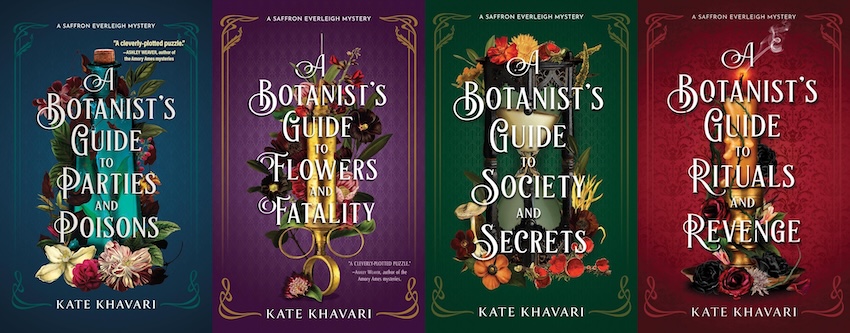
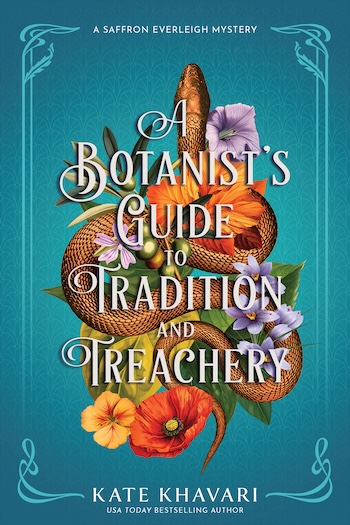
 A Botanist’s Guide to Tradition and Treachery is the fifth novel in Kate Khavari‘s popular Saffron Everleigh Mystery series, and it is due to be published tomorrow (June 9th) by Crooked Lane Books. To celebrate the release, and give readers a taste of the novel (and series as a whole, for newcomers), CR has an excerpt to share! First, though, here’s the synopsis:
Brilliant botanist Saffron Everleigh has set sail on her first research expedition, but it’s disrupted by accusations of murder when one of her fellow scientists is murdered…
Saffron Everleigh is newly engaged and full of optimism as she sets off on the adventure of a lifetime for any scientist: a research expedition. She sails to newly formed Turkey with her fiancé, Alexander Ashton, and a bevy of fellow researchers under the watchful and reformed eye of Dr. Henry. With only two other women on board, Saffron soon finds she is right back in the same infuriatingly misogynistic environment that marked the earliest days of her career. Only this time, Saffron is determined to show everyone, including Alexander, that she can handle the trials of an expedition.
And trials she has in spades. Before the expedition team has even arrived, Saffron has managed to find an enemy in historian Joseph Clark, who frequently torments the assistant that Saffron has taken under her wing, Martin Neill. But when Martin unexpectedly dies, Saffron is targeted as the main suspect.
Falling ruins, venomous snakes, and mysteriously blocked passages are the least of Saffron’s worries. With unexpected help from a familiar face, Alexander and Saffron have to work fast to prove not only that Saffron is innocent but that they both have nothing to do with a larger conspiracy at play among the expedition crew.
And now, on with the excerpt…
*
Chapter 9
Saffron went to join Alexander where he stood a few yards away in the field and they were soon joined by Geoffrey Kent, Martin Neill, and Harvey Dunmore. Kent, tall and somber, was a colleague of Alexander’s, there to discover what he could about the quality of the water that used to flow through the agora. Dunmore, short, round, and fussy, was a herpetologist, specializing in lizards. He would be doing preliminary research into the coloring of the reptiles dwelling in the city versus the countryside. Not that he himself had told Saffron anything about it. Martin Neill was the assistant for their department, and he’d shown Saffron some of the materials Dunmore had demanded he memorize on the voyage, including some hundred-fifty species of lizards, snakes, and toads.
“We’ll be touring the land here in a moment,” Alexander told them, “to get a feel for the scope of the property. The local fellow assigned to assist us will show us around.” He looked over his shoulder at the cluster of locals speaking with the officials and the Henrys. None of them looked likely to be moving in their direction any time soon.
“Oh!” Dunmore craned his neck in the direction of the nearest hunk of stone. Saffron thought for a moment he was intrigued by the designs carved into the stone—it was clearly a relic of the agora—but he darted forward and went to his knees just before the stone. “Neill! Bring me my measuring tools, quickly!” he hissed. “This is a prime specimen of agamid!”
Martin darted a look at Alexander, whose lips had thinned. He nodded, grudgingly, and Martin trotted off, extracting a flexible ruler from his satchel.
“I’ll just go collect our guide,” Alexander muttered, and strode off in that direction.
Saffron glanced about the field for Clark, who should have been with them. He was no doubt off pretending she—and their work—didn’t exist.
Alexander soon returned to their group with a short man in a fez. Mr. Apak, as he introduced himself, admitted to not knowing much about the history of the agora other than the information he’d been provided, as he was no scholar but a tariffs clerk that had been asked by the officials to act as a guide due to his mastery of English.
“But that’s all right,” Saffron said, charmed by the man’s pleasant manner. It felt more like a private conversation rather than a group introduction, since Dunmore and Neill were still examining the lizard and Kent contributed about as much as the rock on which the lizard sat. “Most of us are here for the things living in the agora now, rather than what used to live here. And we do have someone meant to help us with the history, anyway.”
Mr. Apak inclined his head to her. He was middle-aged, with a little paunch and a big smile of excellent teeth. “You are too kind.” To Alexander, he said, “I have only a few things to discuss with you before we begin the tour, Mr. Ashton, if I may have a moment?”
Alexander agreed, adding apologetically to Saffron, “Do you mind going to find Clark?” It looked like the last thing he wanted to request, but Kent had wandered off toward Neill and Dunmore, who now looked to be attempting to lift the stone on its side, ostensibly so Dunmore could see what was underneath it.
She found Clark standing at the mouth of the pit with a handful of the archaeology staff. “Mr. Clark, Mr. Ashton says—”
She was rather hoping to catch him off guard, still surprised she’d managed to beat his little scheme with the sleeping draught, but without missing a beat, Clark took one look at her and stifled a laugh. Saffron would have loved to head off whatever comment was no doubt forthcoming, but she didn’t know which aspect of her presence he was preparing to insult.
Clark cleared his throat in a futile attempt to rid the laughter from his voice. “Beg pardon, Miss Everleigh, I’m afraid I’ve never seen a woman attempting so vainly to take on the appearance of her male superiors.”
Saffron cocked an eyebrow. She was sure that was meant to be an insult, but she rather liked the idea that her masculine clothing didn’t entirely suppress her femininity. She and Elizabeth hadn’t spent hours figuring out what she would wear for nothing. Still, she didn’t enjoy being laughed at in front of their colleagues. “If you’re ready to get to work?”
“Of course,” he said easily, planting his red-banded straw fedora on his head. “Best I come with you. Left to your own devices, you’ll be careless and damage something priceless.”
“We are walking with a local guide. I can’t imagine anyone would do anything to harm the site.”
Clark looked down his large nose at her. “And who will be responsible for you when you inevitably walk onto something valuable?”
Saffron felt heat rising in her face. “I will be responsible for myself.”
He laughed. “I’ll let the responsibility slide to poor Ashton. Lord knows he’d better get used to picking up after you.” He walked off, leaving Saffron stewing.
Clark had joined the others by the time Saffron returned to their bit of field. Mr. Apak set off at a spritely pace toward the southern end of the field where they had entered. “Here,” he called, “is where the agora begins. Agora means ‘market,’ but in ancient times, it also means meeting place. Farmers selling crops, artisans selling goods, and any who wished to hear the news of the day, they came here. And the basilica is believed to be there”—he pointed to the far end of the field—“where the government did its work. This was the heart of Smyrna.”
“New Smyrna,” Clark said from the back of the group. Everyone turned to him, and he shrugged, a little smile on his lips. “It was New Smyrna, here. Hellenistic period.”
Mr. Apak nodded. “Yes. This one belongs to the Roma, the Romans. And records of this place tells us—”
“Not just the Romans, but the Greeks, too,” Clark drawled. He shot a nasty look at Alexander. “Alexander the Great, in fact, had a hand in rebuilding this place some three hundred years after the pillaging of Alyattes, did he not?”
Mr. Apak nodded again, but his bright enthusiasm had faded somewhat. “He did, sir, and when they reconstructed the city center here, rather than—”
“Atop the peak there,” Clark interrupted again, turning around and pointing to the south, where a modest hump of a mountain stood. “The acropolis still stands there, along with a few other bits of old rock. There was a theater, I believe, and cisterns. Are there cisterns here, too?” He addressed the question to Mr. Apak, who looked startled Clark was asking him.
“Ah, the cisterns.”
“The cisterns,” Clark repeated with obnoxious emphasis. “You know, for holding water?”
Mr. Apak’s expression flickered before brightening. “Ah, yes, the cisterns. Please, excuse me, but my knowledge of the language is mostly from reading, rather than speaking, and all too often the words sound differently than they are spelled.” He chuckled, and Saffron liked him all the more for being able to laugh off Clark’s rudeness. “If you will come with me, over here . . .”
Saffron and the others hurried after him as he strode toward the pit. Clark, of course, did not hurry, though Mr. Apak was sure to wait for him until he spoke. A handful of the local workers were already down in the pit, extracting rock and dirt in buckets, while others carefully tapped at more rock with digging instruments.
“Historical records tell us the cisterns are here, beneath several layers,” Mr. Apak said proudly, gesturing down at the workers. “The lowest floor was made into cisterns in the time of the Roma. We will find them before long, I am sure.”
Anticipating another snarky show of knowledge, Saffron looked at Clark, but his eyes were on the workers. It was as if he was interested in what they were doing, rather than preoccupied with being as annoying as possible.
He remained surprisingly quiet as they continued their tour, forgoing any commentary on the pit where the workers were digging, the overgrown field pockmarked with exploratory holes and large chunks of rock clearly belonging to the ruins, and even when Mr. Apak shared theories of what the surrounding buildings had been built on top of. If Mr. Apak was correct, this entire area could become one massive dig site. If the Turkish government intended to unearth the rest of New Smyrna, the houses and businesses immediately surrounding the field would be demolished and the ground beneath them dug up. Ancient Smyrna held a great deal of importance, he said proudly, and the leaders of not only Turkey but academic institutions around the world would watch the progress of their work with interest.
Throughout Mr. Apak’s speech, Dunmore had rushed off no fewer than six times to catch and measure snakes and lizards, even going so far as to demand Neill race back and forth to the tent for small specimen cages. He seemed to be oblivious that his interruptions were distracting. Saffron half expected Alexander to say something, for he looked just as annoyed as she felt, but he kept silent. Perhaps he planned to speak to Dunmore privately.
At the conclusion of his talk, Mr. Apak bowed graciously in response to their thanks and said, “Mr. Clark is your historian and will guide your work, I understand.” He looked between Alexander and Clark for confirmation before continuing. “I will introduce him to the men excavating. Come, come.”
When Mr. Apak left with Clark to meet the locals, Alexander suggested they pause in the mess tent for a water break. By now, the sun had risen high above, bright and hot in the clear sky. The men had damp patches on their white shirts, and Saffron was no better under her duster.
She slipped off the jacket and placed it on one of the carpets covering the uneven ground of the mess tent, then blotted her brow with a handkerchief while the others accepted glasses of water from the young man manning the table laden with urns of water and tea.
Alexander mopped his own brow, and not looking at her, said, “Take Neill with you when you join Clark later.”
“I doubt Dunmore will let him out of his sight. How many lizards do you think he managed to measure in the hour we spent touring the site?”
His smile was brief. “Too many, and not enough. I’ve already told Neill he’ll be working with you and Clark.”
“We don’t need an assistant yet. If they haven’t even begun to excavate the other market stall, I don’t know if they’ve dug up anything more for me to see, apart from the wares from the first stall.” Those wares were what allowed her to come on the expedition. The excavation team had opened one jar, saw there were botanicals preserved inside, and had immediately set the rest aside for more careful study. She and Clark would be opening and examining the clay vessels later today, when the expert from Istanbul University joined the team.
Alexander looked away, squinting out over the field. His silence said plenty.
Saffron frowned at him. “Why do you want me to take Neill?”
“There are several reasons. First is you will be kind to him. The other fellows had been giving him a hard time, including Clark, as you well know. Second, I want Dunmore to get used to hauling his own gear. He’ll be going off soon on a trek through the hills to find his control species for his study.” He shot her a humorous glance. “He’s not exactly a sportsman. I don’t want to get a report he’s keeled over somewhere between here and Mount Sipylos.”
Dunmore did rather resemble a contented little mole, complete with large, round spectacles. She wasn’t willing to be distracted, however. “I don’t need a nanny, Alexander.”
To her surprise, Alexander let out a laugh. “Martin Neill isn’t your nanny. You are his. Now, here come Clark and Apak.” His eyes twinkled as his hand rested on her shoulder for a half second. “Go, enjoy. Be brilliant. And try to stay out of trouble.”
Excerpted from A Botanist’s Guide to Tradition and Treachery © 2026 by Kate Khavari.
Reprinted with permission from Crooked Lane Books. All rights reserved.
*
Kate Khavari’s A Botanist’s Guide to Tradition and Treachery is due to be published by Crooked Lane Books on June 9th.
Follow the Author: Website, Goodreads, Instagram, BlueSky