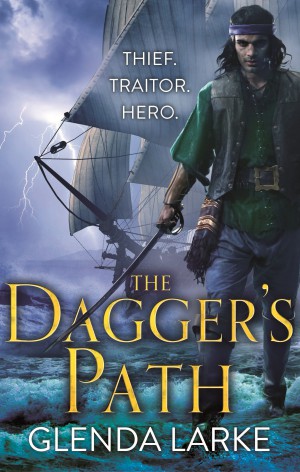
Guest Review: THE DAGGER’S PATH by Glenda Larke (Orbit)

LarkeG-2-DaggersPathThe second novel in the Forsaken Lands series

THEY FOLLOW WHERE THE DAGGER LEADS

Ardhi, Sorrel and the excommunicated cleric, Saker Rampion, stow away on a ship to the Spice Islands. They must return stolen items of great power to Ardhi’s home, but there are ruthless men after this power, men who will kill to possess it.

At home in Ardrone, an army of demonic origin runs amok while Saker’s superiors in the church struggle to quell it. And the young queen Mathilda struggles with the possibility that her newborn child, the heir to the throne, may be linked to the corruption that has erupted throughout the land.

Sorcerers, lascars, pirates and thieves collide…

Reviewed by Ryan Frye

Think of a time when you thoroughly enjoyed the opening installment of a series… It’s probably not too hard a task, and honestly, not all that uncommon. Now, think of a time when you enjoyed the second installment of a series more than you enjoyed the first. For me at least, that’s more difficult. Sure, it happens, but once I’ve mentally checked off Empire Strikes Back, Deadhouse Gates, and… um, The Drawing of the Three, I’m forcing my brain into action, and who needs that? Suffice it to say, the second installment in a series is a tricky thing. That fresh, clean smell is gone, the characters are no longer new and exciting, and often (especially if we’re talking a trilogy) the characters tend to do a lot of moving around so that things are set up for the finale.

Well, The Dagger’s Path just so happens to be a second installment in a trilogy, it also follows a first-in-series, The Lascar’s Dagger, which I thoroughly enjoyed. So how did this second volume fare? Quite well in fact. Continue reading

Guest Post: “Anarchy Sucks” by Gail Z. Martin

0061-eWomenNetworkWar of Shadows is the newest book in my Ascendant Kingdoms Saga, tracing the struggle of disgraced lord Blaine McFadden and his convict friends, as they attempt to restore control over magic and reinstate the rule of law in the devastated kingdom of Donderath. It’s the third book in the series, and with rival warlords and rogue mages competing for control over Donderath’s ruins, there’s action and intrigue aplenty.

Underneath this all is a heartfelt conviction, born out of a lifelong study of history, that anarchy sucks.

The suckishness of anarchy seems up for debate. It’s quite trendy these days to loudly announce “we don’t need no stinkin’ government”. Sometimes, the announcement comes from people well-heeled enough to wall themselves in secure enclaves and protect their interests with private armies of security guards. On the other end of the spectrum are live-off-the-land survivalist types who believe that some canned food, a trout stream and several thousand rounds of ammunition are all that’s needed to live the good life. Continue reading

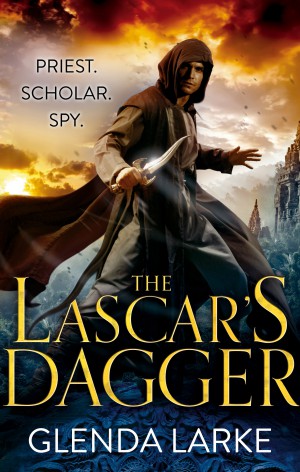
Guest Review: THE LASCAR’S DAGGER by Glenda Larke (Orbit)

LarkeG-1-LascarsDaggerA good start to a new series

Faith will not save him

Saker looks like a simple priest, but in truth he’s a spy for the head of his faith. It’s a dangerous job, and more lives than merely his own depend on his secrecy.

When Saker is wounded by a Lascar sailor’s blade, the weapon seems to follow him home. Unable to discard it, nor the sense of responsibility that comes with it, Saker can only follow its lead.

It will put him on a journey to strange shores, on a path that will reveal terrible secrets about the empire, about the people he saves, and likely lead to his own destruction. The Lascar’s dagger demands a price, and that price will be paid in blood.

Reviewed by Ryan Frye

From the blurb provided above, I honestly had some doubts about reading Glenda Larke’s The Lascar’s Dagger. Buzz words like spies, magical daggers, and empires harboring dark secrets give rise to a few red flags for this reviewer. I’ve never gotten into the whole bad-ass hooded assassin thing. And empires/kingdoms with dark secrets, and sketchy politics have become ubiquitous within the epic fantasy genre. As a result, I try to outright avoid, or at least limit to some degree those genre themes in my fantasy reading. That being said, I’d read some positive reviews of the book from trusted sources, and I had a feeling that I needed to give this book a shot. I’m glad I listened to that feeling. Continue reading

Upcoming: RADIANT STATES by Peter Higgins (Gollancz/Orbit)

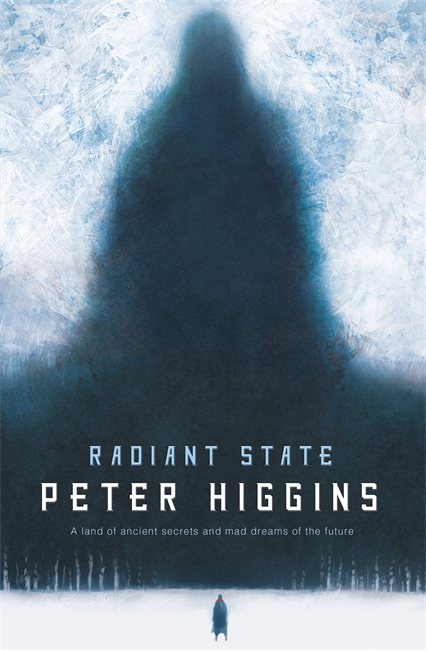
HigginsP-WC3-RadiantStateUK

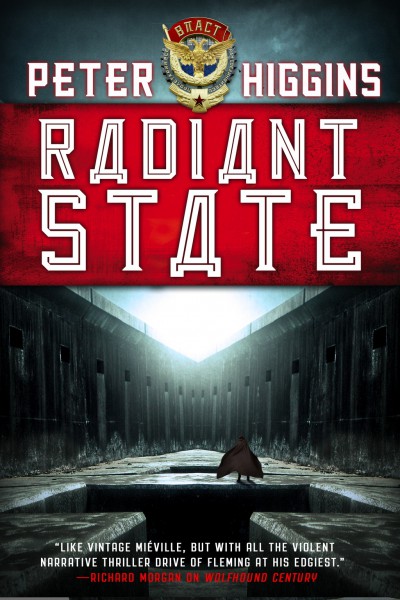
I really enjoyed Peter Higgins‘s first novel, Wolfhound Century. I haven’t got around to reading the sequel, Truth And Fear, but it is inching up my TBR mountain. In the meantime, I spotted this cover on Gollancz’s website, and thought I’d share it. While the publisher’s page didn’t have a lot of information, I did some digging and it turns out that this is the third novel in the Wolfhound series. While digging, I also found the cover for the US edition (below), which will be published by Orbit Books. As for a synopsis…? Well, this is all I was able to come up with:

IN THE WAR BETWEEN THE ANGELS AND THE STATE, THERE CAN ONLY BE ONE VICTOR.

Radiant State will be published May 19th by Orbit in the US, and May 21st by Gollancz in the UK.

Incredibly, someone has already rated it 1* on Goodreads… What a tool.

HigginsP-WC3-RadiantStateUS

Upcoming: A CROWN FOR COLD SILVER by Alex Marshall (Orbit)

MarshallA-CrownForColdSilverI saw this novel mentioned on the Orbit Books website, but with scant information regarding the story. So, naturally, I did a little digging and went straight to the easily-accessible catalogue for Spring 2015.

Action-packed epic fantasy from a bold new voice in the genre – a retired warrior returns to battle to seek revenge for a terrible blow, old friends and old enemies will pay the price.

Cold Cobalt, the Banshee with a Blade, First Among Villains … Queen Zosia.

When there were no more titles to win and no more worlds to conquer, the warrior queen Zosia faked her demise and gave up her legend to history. But when violence finds its way to her door years later, she must round up her adventuring companions — each surprised to see her alive — and set out for revenge.

Time has not been kind to her old comrades, and some have only their own goals in mind. Not only that, but there’s a young, beautiful and skilled general out there, gathering soldiers to her banner for a war against the deadliest of enemies. The girl is using a legend she did not earn, and calling herself by a name that was never hers — that of Zosia herself.

Sounds pretty cool. Alex Marshall‘s A CROWN FOR COLD SILVER is due to be published in April 2015, by Orbit Books in the UK, North America and AUS/NZ.

“Speed of Dark” by Elizabeth Moon (Orbit)

MoonE-SpeedOfDark2002A superb, endearing, and moving modern classic

Lou is different to “normal” people. He interacts with the world in a way they do not understand. He might not see the things they see, however, but he also sees many things they do not. Lou is autistic.

One of his skills is an ability to find patterns in data: extraordinary, complex, beautiful patterns that not even the most powerful computers can comprehend. The company he works for has made considerable sums of money from Lou’s work. But now they want Lou to change – to become “normal” like themselves. And he must face the greatest challenge of his life. To understand the speed of dark.

As I’m sure a lot of other reviewers have found, Speed of Dark is not the easiest of novels to review. Reading Speed of Dark was illuminating, engaging, and moving. Lou is a powerful and endearing voice, and to get a glimpse of how his mind works and how he sees the world was fascinating. I don’t know nearly as much about autism as I should, but I felt Moon has written an intelligent and nuanced tale of an autistic man’s experiences in a world that doesn’t know how to accept him as he is, nor properly understand how he sees the world. This is a great novel, and it is absolutely clear to me why it won a Nebula Award.

To get it out of the way quickly, I think there was only one weakness to the novel, and that was the fact that plot felt somewhat of a secondary concern. This is not strictly speaking a bad thing, as Lou and his colleagues are universally interesting characters to spend time with. The plot centres around the innovative “cure” for autism, and the characters’ decisions of whether or not they want to take it, and therefore become more like the “normals”. The ending felt just a tad rushed and truncated, and I’m still not sure how I actually feel about Lou’s choice (I won’t spoil it, though).

What a cure for autism would mean is something I’ve wondered about quite a bit, recently. It’s not something I’m very good at talking or writing about, but I did like the way Moon handled the issue and hypothetical, and also how her characters saw the choice.

Without doubt, the best thing about the novel is Lou’s voice. I loved reading the story told through his perspective – seeing the different ways he sees people and the world, his shrewd observations about how “normals” treat him so very differently, when they don’t have to (or, indeed, really shouldn’t). The different ways in which certain actions of his are treated as symptoms, while the same actions from a normal are considered, well… normal. Here’s an early example from the novel, when Lou is visiting his therapist, Dr. Fornum:

When she answers the phone I can look around her office and find the twinkly things she doesn’t know she has.  I can move my head back and forth so the light in the corner glints off and on over there, on the shiny cover of a book in the bookcase.  If she notices that I’m moving my head back and forth she makes a note in my record… It is called stereotypy when I do it and relaxing her neck when she does it…

In fact, this early scene with Dr. Fornum is filled with interesting and intelligent commentary on the treatment and impression of those with autism in society today. I’m sure there are many reviews that have used the following passage, but I thought it was superb and perfectly explains Lou’s situation:

If they aren’t going to listen, why should I talk?

I know better than to say that out loud. Everything in my life that I value has been gained at the cost of not saying what I really think and saying what they want me to say.

In this office, where I am evaluated and advised four times a year, the psychiatrist is not less certain of the line between us than all the others have been. Her certainty is painful to see, so I try not to look at her more than I have to. That has its own dangers; like the others, she thinks I should make more eye contact than I do. I glance at her now.

Dr. Fornum, crisp and professional, raises an eyebrow and shakes her head not quite imperceptibly. Autistic persons do not understand these signals; the book says so. I have read the book, so I know what it is I do not understand.

What I haven’t figured out yet is the range of things they don’t understand… I know some of what she doesn’t know. She doesn’t know that I can read. She thinks I’m hyperlexic, just parroting the words… She knows I work on a computer, she knows I went to school, but she has not caught on that this is incompatible with her belief that I am actually nearly illiterate and barely verbal… She does not like it when I use big words (as she calls them) and she tells me to just say what I mean.

MoonE-SpeedOfDark2014

The novel is filled with very-well-written passages, or almost beautifully-worded observations and descriptions. At one point, for example, Lou ponders the nature of his autism, and how or why he has it:

I do not think God makes bad things happen just so that people can grow spiritually. Bad parents do that, my mother said. Bad parents make things hard and painful for their children and then say it was to help them grow. Growing and living are hard enough already; children do not need things to be harder. I think this is true even for normal children. I have watched little children learning to walk; they all struggle and fall down many times. Their faces show that it is not easy. It would be stupid to tie bricks on them to make it harder. If that is true for learning to walk, then I think it is true for other growing and learning as well.

God is suppose to be the good parent, the Father. So I think God would not make things harder than they are. I do not think I am autistic because God thought my parents needed a challenge or I needed a challenge. I think it is like if I were a baby and a rock fell on me and broke my leg. Whatever caused it was an accident. God did not prevent the accident, but He did not cause it, either… I think my autism is an accident, but what I do with it is me.

As I said at the start, and is no doubt apparent at this point, this is a tricky novel to review. Overall, then, I would say that this novel is extremely well-written, delicately and intelligently handled, quite moving and even uplifting. It could be described as “low-SF”, as the cure and something at the end are pretty much the only science fictional part of the story.

Very highly recommended. This is a superb novel.

***

I received this novel as part of the Hodderscape Review Project. It is published in the UK by Orbit Books, and received a new cover this week (the second included in the review, above).
Author-Of-Many-Genres: Jeff Somers

I was spending some time on Goodreads, recently (as you do), and I noticed that Jeff Somers wrote in a number of genres. On the face of things, that is not at all a groundbreaking discovery. But, given the publishing industry’s preference for author branding, I thought it was interesting that Somers wrote under the same pen-name for all of the genres. Again, not exactly an earth-shattering discovery, but it gives me the opportunity to feature his work on the blog, before I get around to reading any of it. So, without further ado…

Author Bio: “Born in Jersey City, N.J., Jeff Somers has managed to migrate just five minutes away to nearby Hoboken, land of overpriced condominiums and a tavern on every corner. Between weekly drunks, Jeff manages to scrawl enough prose onto cocktail napkins and toilet paper to keep up a respectable fiction career.”

Genres: Avery Cates (Cyberpunk), Ustari Cycle (Urban Fantasy), Lifers, and Chum (fiction)

PrintAvery Cates – THE ELECTRIC CHURCH (debut), THE DIGITAL PLAGUE, THE ETERNAL PRISON, THE TERMINAL STATE, THE FINAL EVOLUTION

In the near future, the only thing growing faster than the criminal population is the Electric Church, a new religion founded by a mysterious man named Dennis Squalor. The Church preaches that life is too brief to contemplate the mysteries of the universe: eternity is required. In order to achieve this, the converted become Monks – cyborgs with human brains, enhanced robotic bodies, and virtually unlimited life spans.

Enter Avery Cates, a dangerous criminal known as the best killer-for-hire around. The authorities have a special mission in mind for Cates: assassinate Dennis Squalor. But for Cates, the assignment will be the most dangerous job he’s ever undertaken – and it may well be his last.

*

SomersJ-UC1-TricksterUstari Cycle – TRICKSTER

Magic uses blood — a lot of it. The more that’s used, the more powerful the effect, so mages find “volunteers” to fuel their spells. Lem, however, is different. Long ago he set up a rule that lets him sleep at night: never use anyone’s blood but your own. He’s grifting through life as a Trickster, performing only small Glamours like turning one-dollar bills into twenties. He and his sidekick, Mags, aren’t doing well, but they’re getting by.

That is, until they find young Claire Mannice — bound and gagged, imprisoned in a car’s trunk, and covered with invisible rune tattoos. Lem turns to his estranged mentor for help, but what they’ve uncovered is more terrifying than anybody could have imagined. Mika Renar, the most dangerous Archmage in the world, is preparing to use an ocean of blood to cast her dreams into reality — and Lem just got in her way.

*

SomersJ-ChumCHUM

Mary and Bickerman are the center of their circle of friends – but these friends are strangers as well as family to them. In the course of year, under the influence of a stressful wedding and a whole lot of alcohol, relationships and nerves are twisted and broken as the dynamics of the cozy-seeming group shift. Secrets are kept, emotions withheld, and it doesn’t look like it’s going to end well for anyone.

Told always in first person, but not the same person, and unfolding in double-helix chronology that provides a “Rashomon”-like narration, “Chum” is the story of love, liquor, and death.

*

SomersJ-LifersLIFERS

Three twenty-something guys, who transitioned from collegiate underachieving to corporate bottom feeding sketch out a plan to make a grab for some dignity. They will rob the publishing house that employs their only stable member and results him on a daily basis. Being the bright, perceptive fellows they are, they all quickly realize it’s about the money.

For Phil “Dub” Dublen, it’s a pissed off statement against a dull, meaningless job. For self-styled poet Trim, it’s a chance to actually be outrageous and anarchic as he needs to be. For Trim’s roommate Dan, it seems to be something he does for the same reason he does everything: to vent some anger, having nothing better to do. By the time their master plan is all said and done, nothing has been solved, nothing is better, and nothing, really, has changed. And, in the slightly fractured wisdom of the larcenous trio, this surprises none of them.

Who’s read any of these? I’ve picked up TRICKSTER and LIFERS, and intend to read them ASAP. Any other multi-genre authors you like? Or any you would like me to feature on the blog in either a post like this, or as reviews?

Guest Post: “It’s the End of the World — Bring Charmin” by Gail Z. Martin

MartinGZ-DaysOfTheDead

In the post-apocalyptic TV show “Revolution,” one of the characters, a former Google executive, says, “80 million dollars in the bank and I would trade it all right now for a roll of Charmin.” Of all the things that society has lost, at that moment, he misses commercially-produced toilet paper. It’s the little things that count.

I write the Ascendant Kingdoms Saga, a post-apocalyptic medieval epic fantasy series, for Orbit Books. In Ice Forged, the first book in the series, my characters have to come to terms with what they’ve lost, both big and small. Oddly enough, sometimes it’s the small things that matter the most.

Epic fantasy usually deals with the sweeping repercussions of events and decisions — the wars, assassinations, dynastic conflicts and economic collapses that change the balance of power. Certainly anything worthy of being called an apocalypse affects the superstructure of society: government, commerce, economics, and technology. Add in plague and natural disaster and a nation, continent or kingdom loses a significant portion of its workforce, its intellectual capital, its history and its physical infrastructure. Those losses are guaranteed to change what daily life is like for the survivors, and to make just getting by much more difficult.

Martin,GZ-IceForgedYet for individuals — whether real people or book characters — sometimes the big losses seem distant and abstract and it’s the small losses that drive home just how much life has changed and what is gone. In Ice Forged, characters mention what they miss, little things like memories of how holidays were celebrated and favourite foods that are now difficult or impossible to get. Perhaps it’s the realization that the landmarks — like a castle or the main street of a city—that seemed immutable are now ruined. It’s the dislocation of war and cataclysm that causes long-time neighbours to go missing, and the people you always met in the course of your daily life to vanish. Or it’s discovering that with crops unplanted or unharvested and distilleries and vineyards ruined, there’s not going to be any new good wine, ale or whiskey any time soon.

When the means of production are destroyed, whether those are craftsmen or factories, the goods in existence are all the goods there will be until manufacturing is restored. For the characters in Ice Forged, that means any goods they can’t grow themselves or create from raw materials. Not only will there be no new brocades or silks (and nowhere to wear them), but no new metals or coal mined, no imported goods until trade is restored, and nothing that someone might have purchased rather than making. Things like sugar and salt, maybe even lumber and clay become difficult to find. Looting the ruins and the trash heaps becomes the new form of shopping. And in a million little ways, life becomes strange and hard.

In Ice Forged, the devastation of the Cataclysm goes beyond physical destruction. Mages on both sides made a doomsday strike using magic, and unintentionally destroyed the bonds that allowed men to tame magic and use it to their purposes. For a culture that depended on the little magics for everyday life, that means no healers, no using magic to keep pests out of the crops or strengthen a sea wall, no way to keep milk from spoiling or food from rotting or all the hundreds of small ways that people had come to rely on a flicker of power here and there. And after four centuries of using magic as part of everyday life, few people remember how to do things the old way.

In The Hitchhiker’s Guide to the Galaxy, Douglas Adams advised readers to “Always know where your towel is.” Perhaps he should have included some Charmin, just in case?

***

Martin,GZ-ReignOfAshCome check out all the free excerpts, book giveaways and other goodies that are part of my Days of the Dead blog tour! Trick-or-Treat you way through more than 30 partner sites where you’ll find brand new interviews, freebies and more.

Ice Forged will be a Kindle Daily Deal with a special one-day price of just $1.99 only on October 31!

Reign of Ash, book two in the Ascendant Kingdoms Saga launches in April, 2014 from Orbit Books.

***

About the author: Gail Z. Martin is the author of Ice Forged in The Ascendant Kingdoms Saga and the upcoming Reign of Ash (Orbit Books, 2014), plus The Chronicles of The Necromancer series (The Summoner, The Blood King, Dark Haven & Dark Lady’s Chosen) from Solaris Books, and The Fallen Kings Cycle (The Sworn and The Dread) from Orbit Books. In 2014, Gail launches a new urban fantasy novel, Deadly Curiosities, from Solaris Books. She is also the author of two series of ebook short stories: The Jonmarc Vahanian Adventures and the Deadly Curiosities Adventures. Be sure to check out Gail’s website and follow her on Twitter and Facebook for more up-to-date news. Gail can also be found at the Disquieting Visions blog and on the Ghost In The Machine Podcast.

“Before the Fall” by Francis Knight (Orbit)

KnightF-RD2-BeforeTheFallRojan Dizon’s second outing – good, but unfortunately doesn’t live up to potential of book one

MAHALA IS A CITY OF CONTRASTS: LIGHT AND DARK. HOPE AND DESPAIR.

Rojan Dizon just wants to keep his head down. But his worst nightmare is around the corner.

With the destruction of their power source, his city is in crisis: riots are breaking out, mages are being murdered, and the city is divided. But Rojan’s hunt for the killers will make him responsible for all-out anarchy. Either that, or an all-out war.

And there’s nothing Rojan hates more than being responsible.

Back in January, I developed a bit of a book-crush on Fade to Black, the first book in Knight’s Rojan Dizon series. (I believe “ZOMG!” and “amazeballs” were used in the review…) It was with great anticipation, therefore, that I awaited the arrival of Before the Fall. As it turns out, though, this sophomore novel did not live up to my expectations. It retains the marvellous world (well-realised and atmospheric), fascinating and dark magic system, and generally interesting characters. But… Well, there were a lot of issues that I ordinarily would only have expected in a debut novel. Sad to say, this just didn’t grab me as much as the first.

It’s impossible to write about this series without commenting on the world-building. Knight has created and realised a superb setting for her characters: it is a vertical city, hemmed in by mountains (and other, potentially hostile nations). The rich live at the top, and affluence decreases the further down you go. It is a city of suspicions and paranoia in both the lower and upper levels – the Specials keeping order, and strata envy and snobbery all working to keep everyone in their proper place. It is a wonderfully dark and atmospheric setting, and Knight fills the book with great passages that fill out our mental image of the city. (I do hope there are more than three set in it.)

While the character are all interesting and varied, I felt like Before the Fall didn’t advance them as much as I would have liked. Rojan, who should have been a riveting protagonist (partly because of his actions in Fade to Black, but also because of his magic, situation, and so forth), felt flatter than before. The first one hundred pages were frustratingly repetitive in the minutiae – Knight/Rojan frequently informs us that the Black is so close, calling to Rojan whenever he uses his magic; just as we are too frequently informed that everything has become Rojan’s responsibility. On top of that, we also get rather a lot of why and what he likes about women, then how he’s sworn off women but keeps “falling off the wagon”, how he is supposedly suave (yet surrounded by women who are unattainable). We get that he’s a bit of a philanderer and lover of many women, don’t need to keep telling us. It just felt like we got too much of that sort of thing – if this were a movie, it would be like an over-abundance of establishing shots. There is also more-than-necessary rehashing of what happened in the first novel (but, strangely, without as much detail as would perhaps have been useful?). That’s all a bit vague, for which I apologise – I want to avoid offering spoilers for the first novel as well as this one. All of this makes Rojan a less-than-compelling guide for more of the novel than I expected, this time around. Certainly, there are times when he’s an engaging protagonist, and his connection, affection and objection to his own magic is interesting. Also (and this is perhaps a strange thing to notice), but there was a higher-than-average use of the word “fuck” in the first 100 pages or so.

In addition to my issues with characterisation, the main plot took a little too long to get going, and with the repetitious nature of the character-building, it just didn’t hook me for much time. There were fits and starts, when I would devour larger chunks of the story in short sittings, followed by lulls. Par for the course for most novels, I suppose, but it was a noticeably different reading experience to the one I had for Fade to Black. This is a pity, as the investigation and state of affairs are interesting – the fact that Knight discusses how the destruction of the city’s energy source and supply has effected the city and its population is interesting and well done. In this respect, we really get the feeling that the City itself is a character, and I certainly liked the fact that tangible social and economic upheaval was having realistic repercussions on Knight’s world and characters. Public unrest, simmering suspicions and paranoia, and outbursts of misplaced violence are frequent themes.

Overall, then, I would characterise Before the Fall very much as a bridging installment to the series. Take it as a middle-act, rather than a stand-alone, and I think people will find it much easier to overlook its flaws. I was very disappointed that I didn’t love this as much as the first book. I nevertheless look forward to the final novel, Last to Rise, which is due to be published in November 2013.