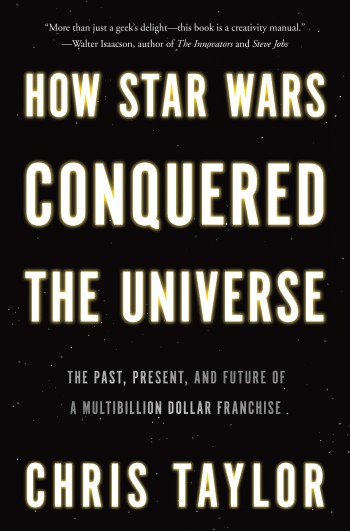
Audio Review: HOW STAR WARS CONQUERED THE UNIVERSE by Chris Taylor (Basic Books/Head of Zeus)

TaylorC-HowStarWarsConqueredUniverseUSThe book every Star Wars fan is looking for…? Yes.

Why do most people know what an Ewok is, even if they haven’t seen Return of the Jedi? How have Star Wars action figures come to outnumber human beings? How did ‘Jedi’ become an officially recognised religion? When did the films’ merchandising revenue manage to rival the GDP of a small country?

Tracing the birth, death and rebirth of the epic universe built by George Lucas and hundreds of writers, artists, producers, and marketers, Chris Taylor jousts with modern-day Jedi, tinkers with droid builders, and gets inside Boba Fett’s helmet, all to find out how STAR WARS has attracted and inspired so many fans for so long.

This book is the first comprehensive history of the Star Wars phenomenon, tracing its origins and examining the incredible impact the films (especially the first three) had on science fiction, film-making and storytelling. Written by Mashable journalist Chris Taylor, this book is a fascinating trove of trivia, insight and observation. Taylor traces almost every kernel of influence — from George Lucas’s fascination and fondness for Flash Gordon to his early days of wanting to be a race-car driver — to paint the most detailed picture of the franchise’s evolution. I alternated between the audiobook edition (provided by Audible UK) and an eARC (provided by Basic Books).

The short version of this review is pretty simple: How Star Wars Conquered the Universe is a must-read for all fans of science fiction. Continue reading

Q&A with CATHERINE BAILEY

BaileyCatherine-AuthorPicCatherine Bailey is the author of The Secret Rooms and Black Diamonds — both histories of the British aristocracy. She read history at Oxford University and is an award-winning television producer and director, making a range of critically acclaimed documentary films inspired by her interest in twentieth century history. Bailey’s US publisher, Penguin, organised this Q&A…

In THE SECRET ROOMS, you explain what drew you to the story of the Rutland family, that you were researching a book on World War I and asked to see the Rutland archives and when there were obvious gaps in the records you decided to devote your attention on uncovering what the family was trying to hide. What brought you to write about Wentworth House and the Fitzwilliam family, and how did you discover that they also had secrets they were trying to keep buried?

I first saw Wentworth House in the late 1990s when I was researching a documentary film in Yorkshire. The size of the house – the largest in Europe – was breathtaking. Here, it seemed, was England’s forgotten palace. Unlike comparable houses, such as Chatsworth or Blenheim, it was closed to the public. Outside its locality, few knew of its existence. Seeing it for the first time, it looked empty and abandoned. The shutters were drawn; its 18th century façade was black with grime and in a poor state of repair. The image was haunting: I wanted to know what had happened there over the centuries, and what had led to its abandonment.

Over the next few years, whenever I could find the time from my work as a television producer, I researched the twentieth century story of Wentworth House. From architectural journals and newspaper articles, I was able to piece together a narrative. In 1900, the house had belonged to William, the 6th Earl Fitzwilliam, the richest man in Britain. His fortune came from coal. Within a 30-mile radius of Wentworth, tens of thousands of men worked in mines in which he had an interest. The Fitzwilliams had powerful connections; in the first decades of the 20th century, the newspapers listed the names of guests at their lavish house parties. They included Kings and Queens, Prime Ministers and politicians, famous musicians, writers and artists. Later, there was a connection to the American Kennedy family. In 1948, Peter, the 8th Earl Fitzwilliam, had been killed in a plane crash with Kathleen Kennedy, the sister of the President. But the details were tantalizingly sketchy; very little appeared to have been written about Wentworth or the Fitzwilliam family. Particularly intriguing, was a photograph, taken in the 1940s, which showed the landscape around the house blighted by open cast mining. Soon after, the Fitzwilliams had moved out. Continue reading

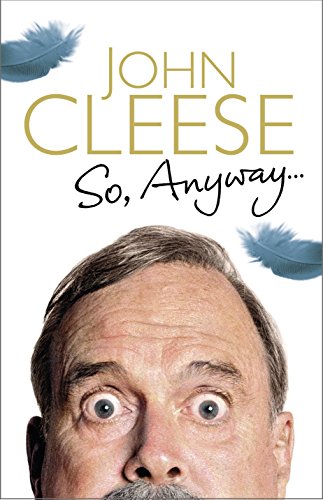
Review: SO, ANYWAY… by John Cleese (Doubleday)

CleeseJ-SoAnywayAn interesting, if surprising biography

Candid and brilliantly funny, this is the story of how a tall, shy youth from Weston-super-Mare went on to become a self-confessed legend. En route, John Cleese describes his nerve-racking first public appearance, at St Peter’s Preparatory School at the age of eight and five-sixths; his endlessly peripatetic home life with parents who seemed incapable of staying in any house for longer than six months; his first experiences in the world of work as a teacher who knew nothing about the subjects he was expected to teach; his hamster-owning days at Cambridge; and his first encounter with the man who would be his writing partner for over two decades, Graham Chapman. And so on to his dizzying ascent via scriptwriting for Peter Sellers, David Frost, Marty Feldman and others to the heights of Monty Python.

Punctuated from time to time with John Cleese’s thoughts on topics as diverse as the nature of comedy, the relative merits of cricket and waterskiing, and the importance of knowing the dates of all the kings and queens of England, this is a masterly performance by a former schoolmaster.

This biography was not at all what I was expecting. For one thing, Monty Python plays a relatively tiny part in the story. Instead of So, Anyway…, this book could easily have been called “The Road to Monty Python”. Despite this, I found it interesting and, after Cleese moved on to his university days, absolutely engaging. Continue reading

Quick Review: THINKING ABOUT IT ONLY MAKES IT WORSE by David Mitchell (Faber)

MitchellD-ThinkingAboutItOnlyMakesItWorseA superb collection of Mitchell’s Observer columns

Why is my jumper depreciating? What’s wrong with calling a burglar brave? Why are people so f***ing hung up about swearing? Why do the asterisks in that sentence make it okay? Why do so many people want to stop other people doing things, and how can they be stopped from stopping them? Why is every film and TV programme a sequel or a remake? Why are we so reliant on perpetual diversion that someone has created chocolate toothpaste? Is there anything to be done about the Internet?

These and many other questions trouble David Mitchell as he delights us with a tour of the absurdities of modern life – from Ryanair to Downton Abbey, sports day to smoking, nuclear weapons to phone etiquette, UKIP to hotdogs made of cats. Funny, provocative and shot through with refreshing amounts of common sense, Thinking About It Only Makes It Worse celebrates and commiserates on the state of things in our not entirely glorious nation.

David Mitchell is a comedian, actor, writer and the polysyllabic member of Mitchell and Webb. He won BAFTAs for Peep Show and That Mitchell and Webb Look, and has also starred in Jam and Jerusalem, The Bleak Old Shop of Stuff and Ambassadors. He writes for the Observer, chairs TheUnbelievable Truth, is a team captain on Would I Lie To You? and has been in two films, neither of which made a profit.

I have long been a fan of David Mitchell’s television work – That Mitchell & Webb Look, Peep Show (which I was actually didn’t love at first), the all-too-short Ambassadors mini-series, and his frequent guest spots on QI and Have I Got News For You being my favourites. After I listened to the audio edition of his superb memoir, Back Story, my respect for him grew even more (it’s among my top ten ‘reads’ of the year, easily). I didn’t know how frequently he had been writing for the Observer, however, so I was pleasantly surprised when I received a review copy of Thinking About It Only Makes It Worse. This is a great read. Continue reading

Upcoming: “The Secret History of Wonder Woman” by Jill Lepore (Knopf)

LeporeJ-SecretHistoryOfWonderWomanI am a huge fan of Jill Lepore’s writing – both long-form and also her journalism and shorter pieces. A professor of American History at Harvard University (and a staff writer at The New Yorker), Lepore has written extensively about history and how we interpret, teach, and read the history of the United States. Last year, I read the paperback edition of The Story of America, which was easily one of the best books I read in 2013. Perhaps of more interest to the readers of Civilian Reader, though, her upcoming work is about the fan-favourite Amazon warrior from the Justice League: Wonder Woman. Due to be published on October 28th, 2014 by Knopf. Here’s the rather long synopsis:

Wonder Woman, created in 1941, is the most popular female superhero of all time. Aside from Superman and Batman, no superhero has lasted as long or commanded so vast and wildly passionate a following. In the more than seven decades since she first appeared, her comic books have never been out of print. In years of interviews and archival research, Harvard historian and New Yorker staff writer Jill Lepore has uncovered an astonishing trove of documents, including the never-before-seen private papers of William Moulton Marston, Wonder Woman’s creator. Lepore has discovered that, from Marston’s days as a Harvard undergraduate, he was influenced by early suffragists and feminists, starting with the British suffragist Emmeline Pankhurst, who was banned from speaking on campus in 1911, when Marston was a freshman. In the 1920s, Marston and his wife brought into their home, as Marston’s mistress, the niece of Margaret Sanger, one of the most influential figures of the twentieth century. The Marston family story – a house of one man, three women, and four children-is a story of drama, intrigue, and irony. In the 1930s, Marston and Sanger’s niece together wrote a regular column for Family Circle celebrating conventional family life, even as they pursued a life of extraordinary nonconformity. No less fascinating is Marston’s role as the inventor of the lie detector. Internationally known as an expert on truth, he lived a life of secrets-only to spill them on the pages of the Wonder Woman comics he began writing in 1941.

The Secret History of Wonder Woman is a tour-de-force of intellectual and cultural history, explaining not only the mysterious origins of the world’s most famous female superhero, but solving some of the most vexing puzzles in the American past. Wonder Woman, Lepore argues, is the missing link in the history of the struggle for women’s rights – a chain of events that begins with the women’s suffrage campaigns of the early 1900s and ends with the troubled place of feminism a century later.

Given how prominent the character has been in not only the comics and SFF communities (specifically the absence of plans for a Wonder Woman big-budget movie), but in pop-culture and gender studies communities, this is a very timely book. I’m really looking forward to this.

Mini-Review: “The Owl Who Liked Sitting on Caesar” by Martin Windrow (Bantam Press)

WindrowM-OwlWhoLikedSittingOnCaesarAn endearing memoir of one man and his owl

When author Martin Windrow met the tawny owlet that he christened Mumble, it was love at first sight. Raising her from a fledgling, through adolescence and into her prime years, Windrow recorded every detail of their time living together (secretly) in a south London tower block, and later in a Sussex village. This is the touching, intriguing and eccentric story of their 15-year relationship, complete with photographs and illustrations of the beautiful Mumble. Along the way, we are given fascinating insight into the ornithology of owls – from their evolution and biology to their breeding habits and hunting tactics. The Owl Who Liked Sitting on Caesar is a witty, quirky and utterly charming account of the companionship between one man and his owl.

This is a book that doesn’t require much of a review. It is an endearing, amusing, and also moving account of an editor’s life and experiences as the owner of an owl. An interesting, short book.

“Perched on the back of a sunlit chair was something about 9 inches tall and shaped rather like a plump toy penguin with a nose-job. It appeared to be wearing a one-piece knitted jumpsuit of pale grey fluff with brown stitching, complete with an attached balaclava helmet. From the face-hole of the fuzzy balaclava, two big, shiny black eyes gazed up at me trustfully. Kweep, it said quietly.”

Windrow recounts his various experiences with Mumble (and the short tenure of his first owl), and there are so many moments that bring a smile or even laugh, as he recounts the rather cat-like affections and mannerisms of his pet owl. (Indeed, Windrow says owls are basically cats with wings). To avoid cute-overload, the author alternates some chapters of his experiences with more informational chapters – for example, one on the biology of owls, one (really interesting) chapter on their place in folklore and mythology, and so forth.

A quick read, that will make you smile and also tug on your heartstrings, The Owl Who Liked Sitting on Caesar is an enjoyable book. It perhaps could have done with being a bit shorter: the anecdotes have a slightly repetitive quality about them, without ever losing the obvious sense of affection Windrow felt for his pet and companion. A different book to what I normally read, it was nevertheless a quick and endearing diversion.

“Floating City” by Sudhir Venkatesh (Allen Lane)

VenkateshS-FloatingCityA thoroughly engaging study of hustlers, strivers, dealers, call girls and other lives in illicit New York

After his insider’s study of Chicago crack gangs electrified the academy, Columbia University sociologist Sudhir Venkatesh spent a decade immersed in New York’s underbelly, observing the call girls, drug dealers, prostitutes and other strivers that make up this booming underground economy.

Amidst the trust-funder cocktail parties, midtown strip clubs, and immigrant-run sex shops, he discovers a surprisingly fluid and dynamic social world – one that can be found in global cities everywhere – as traditional boundaries between class, race and neighbourhood dissolve. In Floating City, Venkatesh explores New York from high to low, tracing the invisible threads that bind a handful of ambitious urban hustlers, from a Harvard-educated socialite running a high-end escort service to a Harlem crack dealer adapting to changing demands by selling cocaine to hedge fund managers and downtown artists. In the process, and as he questions his own reasons for going deeper into this subterranean world, Venkatesh finds something truly unexpected – community.

Floating City is Venkatesh’s journey through the “vast invisible continent” of New York’s underground economy – a thriving yet largely unseen world that exists in parallel to our own, at the heart of every city.

I first came across Sudhir Venkatesh’s name in Freakonomics – as, I’m sure, did many non-sociologists. In Levitt’s book, Venkatesh contributed a small selection of his work with the crack gangs in Chicago. This study would go on to form much of Gang Leader For A Day, the author’s previous book. Venkatesh is a rare academic: he can write in such an engaging, riveting style, that his books read almost like novels. In Floating City, the ethnographer turns his gaze on New York City and its underground economy. This is, while flawed in minor ways, easily one of the best non-fiction works I’ve read in a number of years.

It would be easy to share quotations and detailed descriptions of so much of this book and the people Venkatesh got to know. It is a wonderfully-told narrative – from the first chapter, in which he discovers a long-time acquaintance from Harvard is also a high-class New York madam, to the final chapter in which he effectively bids farewell to his contacts and, in truth, new friends. I read the book in three days, blitzing my way through the chapters.

Venkatesh touches not only upon the criminal activities his contacts take part in, but also the economic and social repercussions of the lives they find themselves living. It is sometimes inspirational, but often it is also heart-wrenching, seeing the damage (personal and collateral) that the lives of call-girls, drug smugglers, illegal immigrants, and so forth can cause. True, one must have been living under a rock (or, perhaps, the rarefied penthouses along Central Park) to not be aware, even superficially, in the plight of the poor, the difficulties that face those who are forced by situation to operate in the black markets. Venkatesh is a sympathetic, eloquent guide to the New York underbelly.

The author writes with an almost cheeky sense of humour, too. Amused at the situations he finds himself in, and also the system in which he is operating – from the academic strictures of Columbia University to the illicit systems he sees at work during his fieldwork – which include strip clubs, porn stores in Hell’s Kitchen, Midtown bars in the company of escorts and ‘managers’, to name but three. He doesn’t glamorize what he is reporting on, but nor does he inflect his words with judgement. In fact, as he admits, he

There are a fair few poignant moments, and events that Venkatesh witnesses which are near-universal experiences for those from broken or unhappy homes. For example, he joins a contact’s family for dinner. Because of their difficult situation, however, a fight breaks out, and Venkatesh says he’ll put their awakened son back to bed. The scene is very affecting:

“Joshi refused my offer to read and got down on the floor and took a plastic soldier in each hand, speaking to them softly while moving them across his raised knees. The sight shot the ache of an old memory through me. So many times I did the exact same thing, hiding in my room while my mother raised her voice against my father… With the raised voices of his parents beating through the door, Joshi put his soldiers on sentry duty and got into bed. Would he | remember this moment for the rest of his life? Would part of him always be ten years old and anchored to the battlefield of his bedroom floor, fighting an imaginary war to distract himself from the source of pain?”

VenkateshS-FloatingCityUSThe author frequently mentions and discusses his struggles against academia’s, and especially Columbia’s disdain for “popular” sociology books and articles, aimed at reaching wider markets. If not targeted solely at fellow academics, a study will be dismissed as “journalistic”, as if that were the height of criticism. As someone who very much does not write in a conventional “academic” style, partly due to journalistic training, and partly my belief that hoarding knowledge is a guaranteed path to academic and professional destruction and irrelevance, I found Venkatesh’s style refreshing and quite brave. (True, the events and research he details in the book are from a decade and more ago, but still.) At one point in the book, the author recounts a conversation with the chair of Columbia University’s sociology department, who cautioned him, “It will never take the place of real, deep sociology… Just don’t be confused about that.” Nevertheless, I am very grateful that Venkatesh chose to aim for a broader audience.

His inviting style and approach does often place him at the centre of certain scenes. That does pose issues of academic and/or scientific detachment (recognised by the author), but also move this book beyond pure, accessible sociology and somewhat into the memoir genre. As he says at the end, the book is intended as a research memoir of sorts. It works, in my opinion, and I welcomed the personal reflection, and the Schrödinger-effect his participation clearly created in certain situations. If not for his research, for example, would his drug dealer contact have ever met up with his secretly-a-madam acquaintance at the art gallery? You get a sense of his professional anxieties, how his desire to really pull back the curtain of New York’s illicit subculture for a wider audience, hamstrung by some of his tenured colleagues’ disdain for letting non-academics getting a look at the goods (if you will).

“… tale[s] of improvisation in a world of shifting values and social roles. And if the upper-end madam and the ghetto thug were both improvising their supposedly fixed social-roles, if their way of relating and even their styles were subject to such rapid revisions – as if they were merely a fiction agreed on between two people – then it was a short step to admitting that succeeding in a life of crime wasn’t so different from making art. The global city, like the canvas, provided the structure, but the rest was in the individual’s hands, making each [person]… a kind of artist whose art and job consisted in crafting the latest, most up-to-date version of themselves and offering it to a city for final judgement. Is this the ‘me’ that will finally make it?”

To observe something is to change it. Through Venkatesh’s observations, and the wealth of detail and data he has compiled, perhaps we will see a genuine and positive change in the way society, city and national governments address and understand criminal activity, the ‘war on poverty’, and also the American Dream in the ever-changing, ever-more-complex 21st Century city.

Very highly recommended.

***

Floating City is out now – published by Allen Lane/Penguin in the UK, and Penguin Press in the US.

Excerpt: “The Tudors” by Peter Ackroyd (Macmillan)

TheTudors

Something a little different, today. As I’m sure I’ve mentioned elsewhere on the blog, I’m a huge fan of history (if you also happen to follow Politics Reader, you will have seen that there, too). I studied medieval history at school, and have maintained a life-long interest in this period. So, I am very happy to share with you a short extract from the second volume of Peter Ackroyd’s exceptional History Of England, The Tudors (Macmillan).

Chapter I

HALLELUJAH

Ackroyd-HoE2-TheTudorsPBThe land was flowing with milk and honey. On 21 April 1509 the old king, having grown ever more harsh and rapacious, died in his palace at Richmond on the south bank of the Thames. The fact was kept secret for two days, so that the realm would not tremble. Yet the new Henry had already been proclaimed king. On 9 May the body of Henry VII was taken in a black chariot from Richmond Palace to St Paul’s Cathedral; the funeral car was attended by 1,400 formal mourners and 700 torch-bearers. But few, if any, grieved; the courtiers and household servants were already awaiting the son and heir. When the body, having been taken to the abbey of Westminster, after the funeral service was over, was lowered into its vault the heralds announced ‘le noble roy, Henri le Septie’me, est mort’. Then at once they cried out with one voice, ‘Vive le noble roy, Henri le Huitie’me ’. His title was undisputed, the first such easy succession in a century. The new king was in his seventeenth year.

Midsummer Day, 24 June, was chosen as the day of coronation. The sun in its splendour would herald the rising of another sun. It was just four days before his eighteenth birthday. The ceremony of the coronation was considered to be the eighth sacrament of the Church, in which Henry was anointed with chrism or holy oil as a token of sacred kingship. His robes were stiff with jewels, diamonds and rubies and emeralds and pearls, so that a glow or light hovered about him. He now radiated the power and the glory. He may have acted and dressed under advice, but he soon came to understand the theatre of magnificence.

Henry had taken the precaution, thirteen days before the coronation, of marrying his intended bride so that a king would be accompanied by a queen; it was thereby to be understood that he was an adult rather than a minor. Katherine of Aragon was the child of Isabella of Castile and Ferdinand of Aragon, in whose reign Spain was united. She had come from that country in order to marry Prince Arthur, Henry’s older brother, but events conspired against her. Arthur died less than six months after their wedding, of consumption or the sweating sickness, and Katherine was left at the English court in the unenviable position of a widow whose usefulness had gone. It was said that the king himself, Henry VII, might wish to marry her. But this was unthinkable. Instead she was betrothed to Prince Henry, and was consigned to some years of relative penury and privation at the hands of a difficult father-in-law who was in any case pursuing a better match for his son and heir. Yet, after seven years of waiting, her moment of apotheosis had come. On the day before the coronation she was taken in a litter from the Tower of London to Westminster, passing through streets draped in rich tapestry and cloth of gold. A contemporary woodcut depicts Henry and Katherine being crowned at the same time, surrounded by rank upon rank of bishops and senior clergy.

Henry’s early years had been spent in the shadow of an anxious and over-protective father, intent before anything else on securing the dynasty. The young prince never spoke in public, except in reply to questions from the king. He could leave the palace at Greenwich or at Eltham only under careful supervision, and then venture into the palace’s park through a private door. Much care was bestowed on his early education, so that he acquired the reputation of being the most learned of princes. Throughout his life he considered himself to be a great debater in matters of theology, fully steeped in the scholarship of Thomas Aquinas. He took an early delight in music, and composed Masses as well as songs and motets; he sang, and played both lute and keyboard. He had his own company of musicians who followed him wherever he walked, and by the time of his death he owned seventy-two flutes. He was the harmonious prince. Thomas More, in a poem celebrating the coronation, described him as the glory of the era. Surely he would inaugurate a new golden age in which all men of goodwill would flourish?

Henry was himself a golden youth, robust and good-looking. He was a little over 6 feet in height and, literally, towered over most of his subjects. It was written that ‘when he moves the ground shakes under him’. He excelled in wrestling and archery, hawking and jousting. Nine months after the coronation, he organized a tournament in which the feats of chivalry could be celebrated. He rode out in disguise, but his identity was soon discovered. He had read Malory as well as Aquinas, and knew well enough that a good king was a brave and aggressive king. You had to strike down your opponent with a lance or sword. You must not hesitate or draw back. It was a question of honour. The joust offered a taste of warfare, also, and the new king surrounded himself with young lords who enjoyed a good fight The noblemen of England were eager to stiffen the sinews and summon up the blood.

When he was not master of the joust, he was leader of the hunt. He spoke of his hunting expeditions for days afterwards, and he would eventually own a stable of 200 horses. Hunting was, and still is, the sport of kings. It was a form of war against an enemy, a battleground upon which speed and accuracy were essential. Henry would call out ‘Holla! Holla! So boy! There boy!’ When the stag was down, he would slit its throat and cut open its belly before thrusting his hands into its entrails; he would then daub his companions with its blood.

Older and more sedate men were also by his side. These were the royal councillors, the majority of whom had served under the previous king. The archbishop of Canterbury, William Warham, remained as chancellor. The bishop of Winchester, Richard Foxe, continued to serve as lord privy seal. The other senior bishops – of Durham, of Rochester and of Norwich – were also in place. The young king had to be advised and guided if the kingdom were to continue on its settled course. Whether he would accept that advice, and follow that guidance, was another matter.

The surviving members of the House of York were restored to favour, after they had endured the indifference and even hostility of the previous king. Henry VII had identified himself as the Lancastrian claimant to the throne. Even though he had married Elizabeth of York after his coronation, he was suspicious and resentful of the rival royal family. The essential unity of the realm was now being proclaimed after the dynastic struggles of the previous century.

The older councillors now took the opportunity of destroying some of the ‘new men’ whom Henry VII had promoted. His two most trusted advisers, or confidential clerks, were arrested and imprisoned. Sir Richard Empson and Sir Edmund Dudley had been associated with the previous king’s financial exactions, but they were in general resented and distrusted by the bishops and older nobility. They were charged with the unlikely crime of ‘constructive treason’ against the young king, and were duly executed. It is not at all clear that Henry played any part in what was essentially judicial murder, but his formal approval was still necessary. He would employ the same methods, for removing his enemies, in another period of his reign.

Henry was in any case of uncertain temper. He had the disposition of a king. He could be generous and magnanimous, but he was also self-willed and capricious. The Spanish ambassador had intimated to his master that ‘speaking frankly, the prince is not considered to be a genial person’. The French ambassador, at a later date, revealed that he could not enter the king’s presence without fear of personal violence.

An early outbreak of royal temper is suggestive. In the summer of 1509 a letter arrived from the French king, Louis XII, in reply to one purportedly sent by Henry in which the new king had requested peace and friendship. But Henry had not written it. It had been sent by the king’s council in his name. The youthful monarch then grew furious. ‘Who wrote this letter?’ he demanded. ‘I ask peace of the king of France, who dare not look me in the face, still less make war on me!’ His pride had been touched. He looked upon France as an ancient enemy. Only Calais remained of the dominion that the English kings had once enjoyed across the Channel. Henry was eager to claim back his ancient rights and, from the time of his coronation, he looked upon France as a prize to be taken. War was not only a pleasure; it was a dynastic duty.

Yet the pleasures of peace were still to be tasted. He had inherited a tranquil kingdom, as well as the store of treasure that his father had amassed. Henry VII bequeathed to him something in excess of £1,250,000, which may plausibly be translated to a contemporary fortune of approximately £380,000,000. It would soon all be dissipated, if not exactly squandered. It was rumoured that the young king was spending too much time on sports and entertainments, and was as a result neglecting the business of the realm. This need not be taken at face value. As the letter to the French king demonstrated, the learned bishops preferred their master to stay away from their serious deliberations.

There were in any case more immediate concerns. Katherine of Aragon had at the end of January 1510 gone into painful labour. The result was a girl, stillborn. Yet Katherine remained evidently pregnant with another child, and the preparations for a royal birth were continued. They were unnecessary. The swelling of her belly subsided, caused by infection rather than fruitfulness. It was announced that the queen had suffered a miscarriage, but it was rumoured that she was perhaps infertile. No greater doom could be delivered upon an English queen. She disproved the rumours when she gave birth to a son on the first day of 1511, but the infant died two months later. Katherine may have been deemed to be unlucky, but the king would eventually suspect something much worse than misfortune.

Henry had already strayed from the marriage bed. While Katherine was enduring the strains of her phantom pregnancy in the early months of 1510, he took comfort from the attentions of Anne Stafford. She was one of the queen’s ladies-in-waiting, and was already married. She was also a sister of the duke of Buckingham, and this great lord was sensitive of his family’s honour. Anne Stafford was sent to a nunnery, and Buckingham removed himself from court after an angry confrontation with the king. Katherine of Aragon was apprised of the affair and, naturally enough, took Buckingham’s part. She had been shamed by her husband’s infidelity with one of her own servants. The household was already full of deception and division. Other royal liaisons may have gone unrecorded. Mistress Amadas, the wife of the court goldsmith, later announced the fact that the king had come secretly to her in a Thames Street house owned by one of his principal courtiers.

***

Peter Ackroyd’s The Tudors is out now.