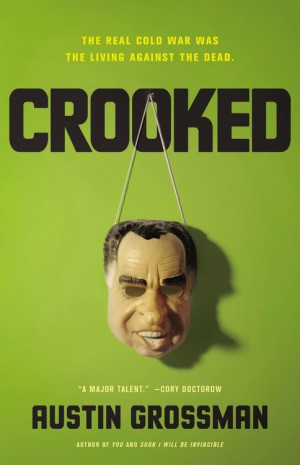
Review: CROOKED by Austin Grossman (Mulholland)

GrossmanA-CrookedAn excellent secret history

Richard Milhous Nixon lived one of the most improbable lives of the twentieth century. Our 37th President’s political career spanned the buttoned-down fifties, the Mad Men sixties and the turbulent seventies. He faced down the Russians, the Chinese, and ultimately his own government. The man went from political mastermind to a national joke, sobbing in the Oval Office, leaving us with one burning question: how could he have lost it all?

Here for the first time is the true story told in his own words: the terrifying supernatural secret he stumbled on as a young man; the truth behind the Cold War; the truth behind the Watergate coverup. What if our nation’s worst president was really a pivotal figure caught in a desperate struggle between ordinary life and horrors from another reality? What if the man we call our worst president was, in truth, our greatest?

In Crooked, Nixon finally reveals the secret history of modern American politics as only Austin Grossman could reimagine it. Combining Lovecraftian suspense, international intrigue, Russian honey traps and a Presidential marriage whose secrets and battles of attrition were their own heroic saga, Grossman’s novel is a master work of alternative history, equal parts mesmerizing character study and nail-biting Faustian thriller.

I was a relative latecomer to Austin Grossman’s novels — I only read You in 2014, and have yet to read Soon I Will Be Invincible (which I do own). When I first read the synopsis for Crooked, though, I knew I wouldn’t wait to read this one: I am a US politics and history nut, with a particular interest in the presidency. So, given that Grossman’s a great author, and that he was mixing two of my favourite things (politics and SFF), Crooked has been one of my most-anticipated novels of the year. I’m very happy to say, I was not disappointed. This is an excellent novel. Continue reading

Guest Post: On Magical Worldbuilding by Peter Orullian

OrullianP-AuthorPicWorldbuilding is a big topic. Especially for epic fantasy. Or it can be, anyways. Writers and novels differ on approach, of course. With my series, The Vault of Heaven, I did spend time thinking through some things before I got deep into the writing. Glad I did.

Before I dive in, though, I should say that I also left lots of room for spontaneous creation. I don’t map my books out in infinite detail. I likes me some surprises along the way.

When it came to the worldbuilding, however, there were a few bits I locked in from the get go. And because worldbuilding is a ginormous topic, I want to focus on magic this time around.

I sat on a panel recently where the topic was basically: heavily rule-based magic vs. the more open approach. The examples thrown out by my co-panelists went something like: Brandon Sanderson on one end and Terry Brooks on the other, maybe Tolkien. You’ve likely heard this before. One side of the continuum has very precise rules for how the magic works — it reminds me, in fact, of Magic: The Gathering. Then, on the other side of that same continuum, you have magic that just works, and may even seems inexhaustible — with nearly no consequence for the wielder.

First off, for me, that last bit is a cardinal sin. If a character can wield something as super-awesome and powerful as magic and do so infinitely, he or she is pretty much a god. And gods don’t tend to lose many battles. To balance that out, the writer would need to give that super-awesome and powerful magic to both sides of the conflict. The escalation is endless. And silly. It might make for fun reading for a while. You know. Lots of cool visuals. Battles of epic proportions. Gods throwing mountains. The sky filled with lightning scorching entire countries. Time reversing itself. Suns exploding. And on. And on. Continue reading

Review: THE MAGICIAN KING by Lev Grossman (Plume/Arrow)

GrossmanL-M2-MagicianKingUSA superb follow-up to The Magicians

Quentin and his friends are now the kings and queens of Fillory, but the days and nights of royal luxury are starting to pall. After a morning hunt takes a sinister turn, Quentin and his old friend Julia charter a magical sailing ship and set out on an errand to the wild outer reaches of their kingdom.

Their pleasure cruise becomes an adventure when the two are unceremoniously dumped back into the last place Quentin ever wants to see: his parent’s house in Chesterton, Massachusetts. And only the black, twisted magic that Julia learned on the streets can save them.

In an effort to catch up for the third volume in Lev Grossman’s Magicians series, here’s my very quick review of The Magician King: it’s an excellent follow-up to a brilliant first installment. If you haven’t read this series yet, I strongly urge you do so. I don’t think you’ll be disappointed. Continue reading

Upcoming: “The Relic Guild” by Edward Cox (Gollancz)

CoxE-RG1-RelicGuild2014I’ve been lucky enough to read a (very) early draft of this, about a year and a half ago, before it was submitted to publishers for consideration. I can’t wait to see the final version. This cover, unveiled earlier this week, is awesome. The Relic Guild is, in my opinion, a must-read of 2014.

Here’s the synopsis:

Magic caused the war. Magic is forbidden. Magic will save us.

It was said the Labyrinth had once been the great meeting place, a sprawling city at the heart of an endless maze where a million humans hosted the Houses of the Aelfir. The Aelfir who had brought trade and riches, and a future full of promise. But when the Thaumaturgists, overlords of human and Aelfir alike, went to war, everything was ruined and the Labyrinth became an abandoned forbidden zone, where humans were trapped behind boundary walls a hundred feet high.

Now the Aelfir are a distant memory and the Thaumaturgists have faded into myth. Young Clara struggles to survive in a dangerous and dysfunctional city, where eyes are keen, nights are long, and the use of magic is punishable by death. She hides in the shadows, fearful that someone will discover she is touched by magic. She knows her days are numbered. But when a strange man named Fabian Moor returns to the Labyrinth, Clara learns that magic serves a higher purpose and that some myths are much more deadly in the flesh.

The only people Clara can trust are the Relic Guild, a secret band of magickers sworn to protect the Labyrinth. But the Relic Guild are now too few. To truly defeat their old nemesis Moor, mightier help will be required. To save the Labyrinth – and the lives of one million humans – Clara and the Relic Guild must find a way to contact the worlds beyond their walls.

Be sure to check out Edward Cox’s Tumblr and Twitter for more on his writing and exuberant personality (directly inverse to just how awesomely dark, atmospheric and Peake-ian his novel is). The Relic Guild is due to be published by Gollancz, on September 18th, 2014. It is also part of the publisher’s £1.99 Debut eBook promotion – which means there is no excuse for you to not check out this great new author. (At the time of writing, there weren’t yet any retail links to pre-order the novel, but I’ll be sure to share it ASAP.)

Excerpt & Giveaway: WORDS OF RADIANCE by Brandon Sanderson (Gollancz)

Sanderson-SA2-WordsOfRadianceUK-Banner

Brandon Sanderson’s Words of Radiance is one of the most hotly-anticipated epic fantasy novels of the year. Published by Gollancz (UK) and Tor Books (US).

Thanks to Gollancz, who also provided this excerpt (Chapter 3), there is a copy of the book up for grabs! All you need to do to be in with the chance of winning it is to re-tweet this excerpt on Twitter, follow @civilianreader, and include the hashtag “#CRWoR”. Simples. If you are not on Twitter, then you can leave a comment at the end, and I’ll include you in the random draw, as well. The winner will be selected at the end of the day (9pm) – unfortunately, the giveaway is for UK only.

(See banner, below, for upcoming stops on the blog tour.)

Sanderson-SA2-WordsOfRadianceCh3

Soldiers reported being watched from afar by an unnerving number of Parshendi scouts. Then we noticed a new pattern of their penetrating close to the camps in the night and then quickly retreating. I can only surmise that our enemies were even then preparing their stratagem to end this war.

— From the personal journal of Navani Kholin, Jeseses 1174

Research into times before the Hierocracy is frustratingly difficult, the book read. During the reign of the Hierocracy, the Vorin Church had near absolute control over eastern Roshar. The fabrications they promoted — and then perpetuated as absolute truth — became ingrained in the consciousness of society. More disturbingly, modified copies of ancient texts were made, aligning history to match Hierocratic dogma.

In her cabin, Shallan read by the glow of a goblet of spheres, wearing her nightgown. Her cramped chamber lacked a true porthole and had just a thin slit of a window running across the top of the outside wall. The only sound she could hear was the water lapping against the hull. Tonight, the ship did not have a port in which to shelter.

The church of this era was suspicious of the Knights Radiant, the book read. Yet it relied upon the authority granted Vorinism by the Heralds. Th is created a dichotomy in which the Recreance, and the betrayal of the knights, was overemphasized. At the same time, the ancient knights — the ones who had lived alongside the Heralds in the shadowdays — were celebrated.

This makes it particularly difficult to study the Radiants and the place named Shadesmar. What is fact? What records did the church, in its misguided attempt to cleanse the past of perceived contradictions, rewrite to suit its preferred narrative? Few documents from the period survive that did not pass through Vorin hands to be copied from the original parchment into modern codices.

Shallan glanced up over the top of her book. The volume was one of Jasnah’s earliest published works as a full scholar. Jasnah had not assigned Shallan to read it. Indeed, she’d been hesitant when Shallan had asked for a copy, and had needed to dig it out of one of the numerous trunks full of books she kept in the ship’s hold.

Why had she been so reluctant, when this volume dealt with the very things that Shallan was studying? Shouldn’t Jasnah have given her this right off ? It—

The pattern returned.

Shallan’s breath caught in her throat as she saw it on the cabin wall beside the bunk, just to her left. She carefully moved her eyes back to the page in front of her. The pattern was the same one that she’d seen before, the shape that had appeared on her sketchpad.

Ever since then, she’d been seeing it from the corner of her eye, appearing in the grain of wood, the cloth on the back of a sailor’s shirt, the shimmering of the water. Each time, when she looked right at it, the pattern vanished. Jasnah would say nothing more, other than to indicate it was likely harmless.

Shallan turned the page and steadied her breathing. She had experienced something like this before with the strange symbol- headed creatures who had appeared unbidden in her drawings. She allowed her eyes to slip up off the page and look at the wall — not right at the pattern, but to the side of it, as if she hadn’t noticed it.

Yes, it was there. Raised, like an embossing, it had a complex pattern with a haunting symmetry. Its tiny lines twisted and turned through its mass, somehow lifting the surface of the wood, like iron scrollwork under a taut tablecloth.

It was one of those things. The symbolheads. This pattern was similar to their strange heads. She looked back at the page, but did not read. The ship swayed, and the glowing white spheres in her goblet clinked as they shifted. She took a deep breath.

Then looked directly at the pattern.

Immediately, it began to fade, the ridges sinking. Before it did, she got a clear look at it, and she took a Memory.

“Not this time,” she muttered as it vanished. “This time I have you.” She threw away her book, scrambling to get out her charcoal pencil and a sheet of sketching paper. She huddled down beside her light, red hair tumbling around her shoulders.

She worked furiously, possessed by a frantic need to have this drawing done. Her fingers moved on their own, her unclothed safehand holding the sketchpad toward the goblet, which sprinkled the paper with shards of light.

She tossed aside the pencil. She needed something crisper, capable of sharper lines. Ink. Pencil was wonderful for drawing the soft shades of life, but this thing she drew was not life. It was something else, something unreal. She dug a pen and inkwell from her supplies, then went back to her drawing, replicating the tiny, intricate lines.

She did not think as she drew. The art consumed her, and creationspren popped into existence all around. Dozens of tiny shapes soon crowded the small table beside her cot and the floor of the cabin near where she knelt. The spren shifted and spun, each no larger than the bowl of a spoon, becoming shapes they’d recently encountered. She mostly ignored them, though she’d never seen so many at once.

Faster and faster they shifted forms as she drew, intent. The pattern seemed impossible to capture. Its complex repetitions twisted down into infinity. No, a pen could never capture this thing perfectly, but she was close. She drew it spiraling out of a center point, then re- created each branch off the center, which had its own swirl of tiny lines. It was like a maze created to drive its captive insane.

When she finished the last line, she found herself breathing hard, as if she’d run a great distance. She blinked, again noticing the creationspren around her — there were hundreds. They lingered before fading away one by one. Shallan set the pen down beside her vial of ink, which she’d stuck to the tabletop with wax to keep it from sliding as the ship swayed. She picked up the page, waiting for the last lines of ink to dry, and felt as if she’d accomplished something significant — though she knew not what.

As the last line dried, the pattern rose before her. She heard a distinct sigh from the paper, as if in relief.

She jumped, dropping the paper and scrambling onto her bed. Unlike the other times, the embossing didn’t vanish, though it left the paper — budding from her matching drawing — and moved onto the floor.

She could describe it in no other way. The pattern somehow moved from paper to floor. It came to the leg of her cot and wrapped around it, climbing upward and onto the blanket. It didn’t look like something moving beneath the blanket; that was simply a crude approximation. The lines were too precise for that, and there was no stretching. Something beneath the blanket would have been just an indistinct lump, but this was exact. It drew closer. It didn’t look dangerous, but she still found herself trembling. This pattern was different from the symbolheads in her drawings, but it was also somehow the same. A flattened-out version, without torso or limbs. It was an abstraction of one of them, just as a circle with a few lines in it could represent a human’s face on the page.

Those things had terrified her, haunted her dreams, made her worry she was going insane. So as this one approached, she scuttled from her bed and went as far from it in the small cabin as she could. Then, heart thumping in her chest, she pulled open the door to go for Jasnah.

She found Jasnah herself just outside, reaching toward the doorknob, her left hand cupped before her. A small figure made of inky blackness — shaped like a man in a smart, fashionable suit with a long coat — stood in her palm. He melted away into shadow as he saw Shallan. Jasnah looked to Shallan, then glanced toward the fl oor of the cabin, where the pattern was crossing the wood.

“Put on some clothing, child,” Jasnah said. “We have matters to discuss.”

*

Sanderson-SA2-WordsOfRadianceUK-Banner“I had originally hoped that we would have the same type of spren,” Jasnah said, sitting on a stool in Shallan’s cabin. The pattern remained on the floor between her and Shallan, who lay prone on the cot, properly clothed with a robe over the nightgown and a thin white glove on her left hand. “But of course, that would be too easy. I have suspected since Kharbranth that we would be of different orders.”

“Orders, Brightness?” Shallan asked, timidly using a pencil to prod at the pattern on the floor. It shied away, like an animal that had been poked. Shallan was fascinated by how it raised the surface of the floor, though a part of her did not want to have anything to do with it and its unnatural, eye- twisting geometries.

“Yes,” Jasnah said. The inklike spren that had accompanied her before had not reappeared. “Each order reportedly had access to two of the Surges, with overlap between them. We call the powers Surgebinding. Soulcasting was one, and is what we share, though our orders are different.”

Shallan nodded. Surgebinding. Soulcasting. These were talents of the Lost Radiants, the abilities — supposedly just legend — that had been their blessing or their curse, depending upon which reports you read. Or so she’d learned from the books Jasnah had given her to read during their trip.

“I’m not one of the Radiants,” Shallan said.

“Of course you aren’t,” Jasnah said, “and neither am I. The orders of knights were a construct, just as all society is a construct, used by men to define and explain. Not every man who wields a spear is a soldier, and not every woman who makes bread is a baker. And yet weapons, or baking, become the hallmarks of certain professions.”

“So you’re saying that what we can do . . .”

Was once the definition of what initiated one into the Knights Radiant,” Jasnah said.

“But we’re women!”

“Yes,” Jasnah said lightly. “Spren don’t suffer from human society’s prejudices. Refreshing, wouldn’t you say?”

Shallan looked up from poking at the pattern spren. “There were women among the Knights Radiant?”

“A statistically appropriate number,” Jasnah said. “But don’t fear that you will soon find yourself swinging a sword, child. The archetype of Radiants on the battlefield is an exaggeration. From what I’ve read — though records are, unfortunately, untrustworthy — for every Radiant dedicated to battle, there were another three who spent their time on diplomacy, scholarship, or other ways to aid society.”

“Oh.” Why was Shallan disappointed by that?

Fool. A memory rose unbidden. A silvery sword. A pattern of light. Truths she could not face. She banished them, squeezing her eyes shut.

Ten heartbeats.

“I have been looking into the spren you told me about,” Jasnah said. “The creatures with the symbol heads.”

Shallan took a deep breath and opened her eyes. “This is one of them,” she said, pointing her pencil at the pattern, which had approached her trunk and was moving up onto it and off it — like a child jumping on a sofa. Instead of threatening, it seemed innocent, even playful — and hardly intelligent at all. She had been frightened of this thing?

“Yes, I suspect that it is,” Jasnah said. “Most spren manifest differently here than they do in Shadesmar. What you drew before was their form there.”

“Th is one is not very impressive.”

“Yes. I will admit that I’m disappointed. I feel that we’re missing something important about this, Shallan, and I find it annoying. The Cryptics have a fearful reputation, and yet this one — the first specimen I’ve ever seen — seems . . .”

It climbed up the wall, then slipped down, then climbed back up, then slipped down again.

“Imbecilic?” Shallan asked.

“Perhaps it simply needs more time,” Jasnah said. “When I first bonded with Ivory—” She stopped abruptly.

“What?” Shallan said.

“I’m sorry. He does not like me to speak of him. It makes him anxious. The knights’ breaking of their oaths was very painful to the spren. Many spren died; I’m certain of it. Though Ivory won’t speak of it, I gather that what he’s done is regarded as a betrayal by the others of his kind.”

“But—”

“No more of that,” Jasnah said. “I’m sorry.”

“Fine. You mentioned the Cryptics?”

“Yes,” Jasnah said, reaching into the sleeve that hid her safehand and slipping out a folded piece of paper — one of Shallan’s drawings of the symbolheads. “That is their own name for themselves, though we would probably name them liespren. They don’t like the term. Regardless, the Cryptics rule one of the greater cities in Shadesmar. Think of them as the lighteyes of the Cognitive Realm.”

“So this thing,” Shallan said, nodding to the pattern, which was spinning in circles in the center of the cabin, “is like . . . a prince, on their side?”

“Something like that. There is a complex sort of conflict between them and the honorspren. Spren politics are not something I’ve been able to devote much time to. This spren will be your companion — and will grant you the ability to Soulcast, among other things.”

“Other things?”

“We will have to see,” Jasnah said. “It comes down to the nature of spren. What has your research revealed?”

With Jasnah, everything seemed to be a test of scholarship. Shallan smothered a sigh. This was why she had come with Jasnah, rather than returning to her home. Still, she did wish that sometimes Jasnah would just tell her answers rather than making her work so hard to find them. “Alai says that the spren are fragments of the powers of creation. A lot of the scholars I read agreed with that.”

“It is one opinion. What does it mean?”

Shallan tried not to let herself be distracted by the spren on the floor. “There are ten fundamental Surges — forces —by which the world works. Gravitation, pressure, transformation. That sort of thing. You told me spren are fragments of the Cognitive Realm that have somehow gained sentience because of human attention. Well, it stands to reason that they were something before. Like . . . like a painting was a canvas before being given life.”

“Life?” Jasnah said, raising her eyebrow.

“Of course,” Shallan said. Paintings lived. Not lived like a person or a spren, but . . . well, it was obvious to her, at least. “So, before the spren were alive, they were something. Power. Energy. Zen-daughter-Vath sketched tiny spren she found sometimes around heavy objects. Gravitationspren — fragments of the power or force that causes us to fall. It stands to reason that every spren was a power before it was a spren. Really, you can divide spren into two general groups. Those that respond to emotions and those that respond to forces like fi re or wind pressure.”

“So you believe Namar’s theory on spren categorization?”

“Yes.”

“Good,” Jasnah said. “As do I. I suspect, personally, that these groupings of spren — emotion spren versus nature spren — are where the ideas of mankind’s primeval ‘gods’ came from. Honor, who became Vorinism’s Almighty, was created by men who wanted a representation of ideal human emotions as they saw in emotion spren. Cultivation, the god worshipped in the West, is a female deity that is an embodiment of nature and nature spren. The various Voidspren, with their unseen lord — whose name changes depending on which culture we’re speaking of — evoke an enemy or antagonist. The Stormfather, of course, is a strange off shoot of this, his theoretical nature changing depending on which era of Vorinism is doing the talking. . . .”

She trailed off . Shallan blushed, realizing she’d looked away and had begun tracing a glyphward on her blanket against the evil in Jasnah’s words.

“That was a tangent,” Jasnah said. “I apologize.”

“You’re so sure he isn’t real,” Shallan said. “The Almighty.”

“I have no more proof of him than I do of the Th aylen Passions, Nu Ralik of the Purelake, or any other religion.”

“And the Heralds? You don’t think they existed?”

“I don’t know,” Jasnah said. “There are many things in this world that I don’t understand. For example, there is some slight proof that both the Stormfather and the Almighty are real creatures — simply powerful spren, such as the Nightwatcher.”

“Th en he would be real.”

“I never claimed he was not,” Jasnah said. “I merely claimed that I do not accept him as God, nor do I feel any inclination to worship him. But this is, again, a tangent.” Jasnah stood. “You are relieved of other duties of study. For the next few days, you have only one focus for your scholarship.” She pointed toward the floor.

“The pattern?” Shallan asked.

“You are the only person in centuries to have the chance to interact with a Cryptic,” Jasnah said. “Study it and record your experiences — in detail. This will likely be your first writing of signifi cance, and could be of utmost importance to our future.”

Shallan regarded the pattern, which had moved over and bumped into her foot — she could feel it only faintly — and was now bumping into it time and time again.

“Great,” Shallan said.

***

The story continues in Words of Radiance…

Sanderson-SA2-WordsOfRadiance

“Breach Zone” by Myke Cole (Headline/Ace Books)

ColeM-SO3-BreachZoneUKThe explosive conclusion to Myke Cole’s first trilogy

The Great Reawakening did not come quietly. Across the country and in every nation, people began “coming up Latent,” developing terrifying powers — summoning storms, raising the dead, and setting everything they touch ablaze. Those who Manifest must choose: become a sheepdog who protects the flock or a wolf who devours it…

In the wake of a bloody battle at Forward Operating Base Frontier and a scandalous presidential impeachment, Lieutenant Colonel Jan Thorsson, call sign “Harlequin,” becomes a national hero and a pariah to the military that is the only family he’s ever known.

In the fight for Latent equality, Oscar Britton is positioned to lead a rebellion in exile, but a powerful rival beats him to the punch: Scylla, a walking weapon who will stop at nothing to end the human-sanctioned apartheid against her kind.

When Scylla’s inhuman forces invade New York City, the Supernatural Operations Corps are the only soldiers equipped to prevent a massacre. In order to redeem himself with the military, Harlequin will be forced to face off with this havoc-wreaking woman from his past, warped by her power into something evil…

In this, the final part of Cole’s first trilogy, we have an excellent conclusion. Not only do we see the events of the last three books come together, but the story digs deeper and offers more than either of its predecessors. The author has really pulled out all the stops for this one, and written a really fantastic novel.

The novel is set predominantly in Manhattan, with a few scenes and events taking place in or around the New York area – for example, Bookbinder is on a ship off the coast, testing a new device just as the action kicks off. Harlequin is at the centre, which I liked, as it turns out he is a far more nuanced character than we might have seen in the previous novels (which were through the eyes of people who often were on the wrong side of him). As he takes command of the incursion on Manhattan, we get to see him in action, struggling to keep the hordes from the Source at bay, while also attempting to marshal allies from the Manhattan Selfer underground and also keep the military and law enforcement forces available in line and manning the barricades.

The action is as well-written and realistic as before, with plenty of intense moments that place the reader right alongside the combatants, in the thick of the fighting. I particularly enjoyed seeing the sorcerers let loose, unleashing their myriad powers in devastating and creative ways – the way Cole has developed and devised the various ‘schools’ of magic is fantastic, and he always surprises with the ways in which the powers can be interpreted, and yet still grounded (somewhat) in reality. It was also great to read about the urban conflict taking place in neighbourhoods I have spent many a day walking. I don’t know why everyone seems so keen on destroying New York City in fiction, TV and movies…

What I found most interesting with this novel was how the action was not the best element. In fact, it faded slightly into the background for me. I thought the flashback chapters, detailing Harlequin’s past with Scylla, were absolutely superb, and showed that Cole is not just an excellent military-sci-fi writer. (True, we knew this from Control Point and Fortress Frontier, but in Breach Zone his talent really shines on all fronts.) With this, his third novel, Cole has well and truly arrived. He has written a novel that is just better in every way. The balance between action, character development and world-building was spot-on. As with the previous two novels, I also really liked the use of chapter epigraphs to add further colour and background to the world/reality he has created.

As I mentioned on Twitter when I was reading it, Breach Zone is like a perfect blend of Marvel’s Avengers and the Battle for Helms Deep. Only, better. To draw another comparison to comics, it’s not difficult to see similarities between Scylla and X-Men antagonist Magneto, as she espouses a similar reorientation of society, with the latents on top. Cole’s use of the flashbacks to detail her evolution from high-powered CEO to prisoner of the SOC was deftly done, fleshing out her character and showing us the dangers of government paranoia, overreach and overreaction. She’s a tragic figure, and her relationship with Harlequin just one of the casualties of a frightened government’s policies to control that which it cannot control, nor understand.

If you haven’t read any of these novels, yet, I strongly urge you to do so. I’ve been saying it ever since I read Control Point, but with each novel it becomes clearer: Myke Cole is a fantastic new talent, and if each of his novels improves on the last, it won’t be long before we see him climbing ever-higher on the bestseller list.

Highly recommended.

***

Also on CR: Interview with Myke Cole, Guest Post (Influences & Inspirations)

Myke Cole’s Shadow Ops trilogy – Control Point, Fortress Frontier and Breach Zone – are published by Headline in the UK and Ace Books in the US.

Upcoming: “No Hero”, “Yesterday’s Hero” and “Anti Hero” by Jonathan Wood (Titan)

Wait, the first two of those books have already been published, right…? Well, yes. Now, though, they are going to be published by a better publisher with better distribution and better artwork. This series made a bit of a splash when No Hero first appeared in 2011. Since then, Wood’s original publisher (Night Shade Books) has experienced a number of… troubles. But fans of the series – existing and prospective – have nothing to fear, for Titan Books has recently acquired publishing rights for the Arthur Wallace series! Here are the details of the three books (thus far):

WoodJ-1-NoHero2NO HERO

“What would Kurt Russell do?”

Oxford police detective Arthur Wallace asks himself that question a lot. Because Arthur is no hero. He’s a good cop, but prefers that action and heroics remain on the screen, safely performed by professionals. But then, secretive government agency MI37 comes calling, hoping to recruit Arthur in their struggle against the tentacled horrors from another dimension known as the Progeny. But Arthur is NO HERO!

Can an everyman stand against sanity-ripping cosmic horrors?

No Hero is due to be published in March 2014.

WoodJ-2-YesterdaysHero2YESTERDAY’S HERO

Another day. Another zombie T-Rex to put down. All part of the routine for Arthur Wallace and MI37 — the British government department devoted to defending Britain from threats magical, supernatural, extraterrestrial, and generally odd.

Except a zombie T-Rex is only the first of the problems about to trample, slavering and roaring, through Arthur’s life. Before he can say, “but didn’t I save the world yesterday?” a new co-director at MI37 is threatening his job, middle-aged Russian cyborg wizards are threatening his life, and his co-workers’ are threatening his sanity.

As Arthur struggles to unravel a plot to re-enact the Chernobyl disaster in England’s capital, he must not only battle foreign wizards but also struggle to keep the trust of his team. Events spiral out of control, friendships fray, and loyalties are tested to their breaking point.

Yesterday’s Hero is due to be published in September 2014.

ANTI HERO

What do you do when your best friend becomes a supervillain?

Agent Arthur Wallace is used to dealing with danger that is extraterrestrial, supernatural, or generally odd. But when a drone-strike interrupts his best friend’s funeral, it becomes clear that his next assignment is going to be stranger than usual. When it turns out that the drone was hijacked by a rogue, digital version of that friend… well then nothing is clear to Arthur any more.

Now the man Arthur counted on most is set on destroying humanity in a grand scheme to save the natural world. And the CIA is set on destroying that man. And Arthur can’t work out who the hero is any more. But he has to work out the all the answers fast, because now he’s staring into the bloody maw of the zombpocalypse itself.

Anti Hero, which has not been available before (to my knowledge), is due to hit shelves in March 2015. I’ll be sure to share the artwork as soon as I spot it.

Also on CR: Interview with Jonathan Wood, Guest Post on Living With Consequences

Q&A with Meg Howrey, one half of MAGNUS FLYTE

FlyteM-2-CityOfLostDreams

Meg Howrey is one half of the writing team that goes by the name “Magnus Flyte” – Christina Lynch forms the other half. Their second novel, City of Lost Dreams, was released in the US yesterday by Penguin (it is also available in the UK). Penguin US organised a Q&A, which is reproduced below, in which Howrey discusses writing as a partnership, cake (such good cake…), and the two novels (of course).

FlyteM-1-CityOfDarkMagicHow did your collaboration under the name Magnus Flyte come about?

We met at a writers’ retreat on an island off Cape Cod and became fans of each other’s work. When we got back to California, we started getting together for mini writers’ retreats at Chris’s house near Sequoia National Park. The plot for our first novel, City of Dark Magic was hatched on a walk with Chris’s dog Max. The name “Magnus Flyte” is a hybrid (much like our novel). “Magnus” was a usurping Roman senator (not so different from City of Dark Magic’s villain, Charlotte Yates) and “Flyte” is for Sebastian Flyte, Evelyn Waugh’s wonderful lush who, like Max in our novel, has a difficult relationship with his highborn family and the house they live in.

There have been a lot of news stories lately about women who use male pen names, especially when writing genre fiction. Do you think it’s helpful?

Possibly helpful to the author, who may have any number of reasons to use a pen name – a desire to escape gender stereotyping, anonymity, sheer whimsy. One can only imagine how delighted J.K. Rowling was to watch her book get wonderful reviews without any references to Voldemort! Since we had heard that men avoid books by women, we decided to choose a male pseudonym to reach both genders. But then our identities were made public from the beginning, so we didn’t get a chance to see if “Magnus Flyte” would fool anyone. No matter, we love him anyway.

In City of Dark Magic, Prague was very much its own character as well as the setting for the novel. Why did you choose Vienna to be the setting of City of Lost Dreams?

Vienna was the adopted home of Beethoven and we had grown so fond of old LVB in the first novel that we were curious about visiting at least one of the 60 apartments he lived in there as, reportedly, the worst tenant ever. Also, neither of us had ever been to Vienna. And finally, we highly recommend all writers setting a novel in a beautiful European city so that one is forced to travel there and do research (eat sachertorte, visit castles) in a manner that is tax deductible. (Note to I.R.S: don’t even think about it, we have all our receipts.)

sachertorte

You did quite a lot of research for City of Dark Magic – visited Prague, had a great deal of notes and researched music as well. How much research did you do for City of Lost Dreams?

Binders! Color-coded binders! In the first novel we had briefly touched upon the life of poet Elizabeth Weston, her stepfather Edward Kelley, and Kelley’s partner in magic, Dr. John Dee. These were all characters we wanted to explore a bit more, particularly Elizabeth, about whom not very much is known. (A fact that we believe she would find completely unacceptable – the woman was more famous than Shakespeare in her time.) Along the way we got interested in Franz Anton Mesmer (who gave us the word “mesmerized” and the phrase “animal magnetism”). Not everything makes it in. Well, everything makes it in on the first draft, because Magnus is a terrible pack rat for obscure history, but then we prune him down a bit.

FlyteM-2-CityOfLostDreams

As a heroine, Sarah Weston is particularly memorable. How did her character evolve in your second novel?

Sarah still isn’t terribly interested in winning prizes for decorum, though perhaps in the second book she is not quite as guided by certain… compulsions. In the sequel she is fighting to save the life of someone she loves, so she’s more focused. The challenges she faces are personal, and she’s questioning herself a lot more: what she believes, what she wants. But as Sarah herself says, she’s no princess. And she’s not one to look a gifted horseman in the mouth.

In City of Dark Magic, the science angle had a lot to do with perception and time travel. You continue those themes in the sequel, and also mix in some ideas about healing and medicine.

We’ve both been interested in the brain’s influence on disease for a while, but in August 2012 when we returned from our research trip to Vienna, Chris’s dog Max was deathly ill. It turned out to be an autoimmune disease with no known cause. With great treatment at U.C. Davis Max went into remission and is now very healthy, but the episode raised a lot of interesting questions about what medicine is and isn’t able to do, and how ultimately mysterious our immune systems are. Why does a healthy body turn on itself? How can that process be reversed? What power does the mind have? And is Chris’s dog Max really – as we suspect – the reincarnation of the 6th Duke of Devonshire?

Your writing is loaded with references from the arts, history and politics. What sort of reader did you envision for this series?

Perhaps we think more of where our potential readers might be when they read rather than what their expectations might be. We think of what we would ourselves enjoy reading on a long plane flight, a weekend with challenging relatives, just after a bout of concentrated study, or feeling mentally frisky. We’re eccentric readers and lovers of long dinner parties where the talk ranges from travel to science to gossip to art, to dreams and dogs and music and philosophy and sex. Our ideal reader takes something away from the books that starts a conversation or a burst of laughter among friends. We’ve loved hearing from readers that were inspired to check out Prague, or listen to Beethoven, or find out more about certain historical characters. And of course we’re deeply indebted to booksellers for knowing whose hands to put the book in. Booksellers are the real celebrities.

Prague-CastleAtNight

Prague Castle at night

What is your process for co-writing? What are some of the challenges and benefits of writing with a partner? How has that process come to change now that you have completed two novels?

Both books were written in the same way, according to the rules laid down by Magnus Flyte. We alternate chapters, relay style, responding to whatever you were just sent. No rewriting until we get to the end. Trying our best to inspire, amuse, and surprise each other.

Some chapters get sent to the other person with the heading: “You might want to kill me for this one.” (Inevitably, this chapter will be received rapturously.) In the revision process there is a lot more discussion but we give each other a free hand, no “this is my chapter and you can’t touch it.” The best sentence wins, the egos are parked outside. By the end we have trouble remembering who wrote what, and in fact a great many paragraphs and even single sentences are a combination of both writers. People always ask us “what happens when you disagree?” and we have only the dull answer that when we disagree we just talk and listen until we come up with something that we both can live with.

You have developed quite a backstory for Magnus Flyte, who “may have ties to one or more intelligence organizations, including a radical group of Antarctic separatists” and “may be the author of a monograph on carnivorous butterflies.” How did Magnus Flyte, the author, become such a colorful character?

Constructing Magnus’s biography (and extensive bibliography) is actually the only time we have ever written together in the same room. It was a bit like improv…or an accelerated version of our writing process.

Author A: I think Magnus wrote a bibliography of a 14th century warrior…

Author B: A warrior priest. A warrior priest named Clement. Clement something…

Author A: Clement the Bald.

Author B: Perfect.

The legend of Magnus continues to grow. He just accidentally became king of an island nation. He’s taken up smelting. He’s writing a treatise on the best way to make love in the outdoors.

These books sit in an unusual space, crossing multiple genres. What are some of your individual and collective literary influences?

We both emerged from the womb with books in our hands and haven’t stopped reading since then, omnivorously and eccentrically. We have a lot of shared enthusiasms – from Nancy Mitford to neuroscience. Chris has always had a twisted passion for Nabokov and S.J. Perelman, Meg loves Evelyn Waugh and Aldous Huxley. We both love mysteries: Simenon, Sayers, Marsh. The list is long and genres be damned.

Can you give us any hints about your next novel or where the series is going?

Only Magnus knows…

***

Magnus Flyte’s City of Dark Magic and City of Lost Dreams are both out now in the US and UK, published by Penguin. Be sure to follow the author(s) on Facebook and Twitter for more news and updates.

“The Crystal Cave” by Mary Stewart (Hodder)

StewartM-M1-CrystalCaveOne of the best-loved interpretations of the Merlin Myth

Fifth century Britain is a country of chaos and division after the Roman withdrawal. This is the world of young Merlin, the illegitimate child of a South Wales princess who will not reveal to her son his father’s true identity. Yet Merlin is an extraordinary child, aware at the earliest age that he possesses a great natural gift – the Sight.

Against a background of invasion and imprisonment, wars and conquest, Merlin emerges into manhood, and accepts his dramatic role in the New Beginning – the coming of King Arthur.

Hm. How to review a book that is well-written, well-conceived, but didn’t fire one’s imagination? In brief, I suppose, is the best answer. I received this as part of the Hodderscape Review Project, which has been a great way to try out some classics of genre fiction. True, only one has truly wormed its way into my mind (Stephen King’s The Shining), but I am very happy that I’ve had the opportunity to read these books (this is the third so far). I’m especially looking forward to the next title in the project (by none other than Ursula le Guin…). The Crystal Cave, however, must also be put on the Shelf of Classics That Disappointed.

Despite this, there is a fair bit to like in this novel. Stewart’s prose is well-crafted and fluid – it reminded me of Robin Hobb’s Assassin’s Apprentice, actually, in style. The characters are interestingly portrayed and well-drawn. Despite these things, the story itself just didn’t grab me enough to make me love it. This is one of the first novels that, after I told friends and family that I was going to read it, was universally met with comments along the line of, “It’s great!” and “It’s fantastic!” Sadly, I just didn’t get swept up by it. The story took too long to get going. I did, however, enjoy how Stewart brought in Merlin’s gift of Sight into the story, and developed it over the course of this first book – he first comes across as incredibly observant, and then we start to see his knowledge of things he couldn’t possible know.

As far as Merlin/Arthur interpretations go, I can certainly see why this has been so popular, and how that popularity endures today. Of the many other versions of this story that I have read (most recently, I think, DC Comics’ Demon Knights and Maurice Broaddus’s Knights of the Breton Court), this is probably the best conceived and in-depth.

It is perhaps the long-game approach that Stewart took that makes the novel not really work for me. It suffers from being too obviously the first part of a series – the characters, ideas and so forth aren’t developed enough, and I didn’t think the plot moved forward enough. Sadly, this means I haven’t got the bug to seek out the rest of the series. At least, I am not in any hurry. As someone who will happily sit through thousands of pages of epic fantasy trilogies (most recently, Joe Abercrombie and Peter V. Brett – both authors for whom I had some catching up to do), it is perhaps strange to say this book didn’t work for me.

That’s quite possibly the most carefully-written, sitting-on-the-fence review I’ve ever written. I’m not proud of it. I just couldn’t rustle up much verve to dig deeper. Which is never a good sign when it comes to a novel. I’m sure, in the future, I’ll give this another try. As it stands, though, it didn’t work for me, and I don’t want to belabour the point.

Witchblade: Rebirth, Vol.1 – “Unbalanced Pieces” (Top Cow/Image)

Witchblade-Rebirth-Vol.01Writer: Tim Seeley | Art: Diego Bernard | Inks: Fred Benes, Alisson Rodrigues | Colors: Arif Prianto of IFS

In the wake of Top Cow’s Rebirth, Sara Pezzini has relocated from New York to Chicago and struggles to adapt to being a private detective. Pezzini quickly discovers that a change of scenery and occupation hasn’t changed one thing… the Witchblade is still a magnet for the supernatural Quickly drawn into a conflict between two mystical gangs, she must once again balance her responsibility as bearer of the Witchblade with her personal life.

Collects: Witchblade #151-155

I haven’t read a great deal of Witchblade comics, or other comics in Top Cow’s universe (Artifacts, The Darkness), but I’m somewhat conversant in the mythology. I read the first book by Ron Marz, which was itself a reboot/jumping-on-point, but then became distracted by the New 52 and a selection of other books (I’m not proud of it, but… Batman, baby!). After it was announced that Tim Seeley was taking over writing duties, my interest was piqued once again, having rather enjoyed his Hack/Slash horror-comedy series. So I dove in… And rather liked what I found.

I’m not sure that this needs a particularly long review. People who know the series already will know pretty much what to expect – it’s dark, gothic, but also slick. The only major difference is the location, as Sara has moved to Chicago (interestingly, that’s also where Dick “Nightwing” Grayson just moved to in the DC New 52). For new readers, this book has a lot of extra material that gives you some background. It’s not essential to read in order to enjoy this, though, as the concepts are pretty tried-and-true, but with some well-conceived and original developments.

Seeley blends a private investigator storyline and feel with just the right amount of weird in the first issue/chapter to get us intrigued. But then things get really weird – Sara tangles with biker witches, age-sucking creatures with a very strange version of their own ‘Witchblade-armour’, and a strange, supernatural beastie with a long history of fighting bearers of the Artifacts…

Things are not going well for Sara in her new environment, and her sense of displacement and ennui is well written. She’s finding her place, and it’s not going particularly well – on the social, financial, and divine purpose fronts. Add to this a policewoman who has it in for Sara, and a rather unsatisfying romantic (un)attachment with a stage magician harbouring an ulterior motive.

The story is well-written, well-paced and well-realised. Despite my aforementioned lack of fore-knowledge of the extended Witchblade mythos, I didn’t have any trouble following this. It’s weird, it’s sometimes amusing, it’s often creepy. The art team does a great job of bringing Seeley’s story to life on the page in crisp, sharp artwork. It’s eye-catching and vivid. I’m very glad I picked up volumes two and three in the ComiXology sale the other day, as I think I’ll be sticking around for a lot more of this series. I may have to try out the Rebirth The Darkness series, too.

If you are a fan of supernatural stories, filled with the occult, magical and gothic weirdness – not to mention a few gribbly beasties – then Seeley’s Witchblade is absolutely for you. Definitely recommended.