Guest Post: “Tower of Babel” by Aidan Harte

AidanHarte-AuthorPicMasons, like writers, learn the hard way to choose their foundation carefully. The strength of that first stone defines the structure, sets the tone. Accordingly, Chapter One of Spira Mirabilis begins with blasphemy. The Last Apprentice of Concord whips up a Children’s Crusade and instead of sending them to fight the approaching coalition led by Contessa Scaligeri, he sets them to construct a new cathedral. This is a recreation of the Tower of Babel, that structure torn down by an outraged God who then “confounded the language of all the Earth,” for good measure.

Finishing The Wave Trilogy, I found myself toiling in Babel’s shadow. This influence can be partly ascribed to the setting – cathedral building was medieval society’s engine, the focus of mathematics, engineering, art and devotion – but what troubled me was what Nimrod’s Tower says about creation. It condemns all creation as a blasphemous encroachment. What more damning indictment of the hubris of storytelling than a tower reaching to heaven, swatted aside by the greatest creator of all? The Middle East’s attitude to idolaters has always swayed between hostility and ambivalence. No accident then that Scheherazade, like Babel, springs from the fertile soil between the Euphrates and the Tigres. The lovely slave girl forever spinning yarns to keep her head from tumbling is, I like to think, the patron saint of storytelling. Her story reveals the secret of all stories: once you get in the habit of it, it’s easier to keep going than to stop.

HarteA-WaveTrilogy2014

There’s always a new twist, a cliff-hanger to escape, a long lost uncle to appear, a reconciliation or – better yet – a quarrel to be had. The deeper one is immersed, the more improbabilities one will accept. Watch the end of any Hitchcock film; it will seem overwrought, even silly, but only because you haven’t earned the heightened emotions the last act demands. Plenty of wonderful stories, like political careers, simply capsize before the finish line. The final season of The Wire is a catastrophe, but it seems churlish to say so. Instead we echo the builders of Babel: ‘Shame how it ended, but wasn’t she splendid?’

It’s a bittersweet thing to leave a place you’ve lived in for years but I’m finally saying addio to Etruria. No matter how much we rehearse farewells, they are almost always anticlimactic. Only a committed Austinian can recall the last lines of Pride and Prejudice:

“With the Gardiners, they were always on the most intimate terms. Darcy, as well as Elizabeth, really loved them; and they were both ever sensible of the warmest gratitude towards the persons who, by bringing her into Derbyshire, had been the means of uniting them.”

I know – yawnsville, right? Dear Jane is simply putting the chairs away and turning out the lights, but we’ve enjoyed the evening’s entertainment so much that we can’t complain if it ends in diminuendo. First impressions matter. Endings? Not so much. That last Parthian shot won’t mar a wonderful story or salvage a dull one. The battle’s won or lost long before then. Famous farewells, then, are necessarily a rare species. There’s Gatsby with his green light and boat going nowhere and Sydney Carton doing that far, far better thing. My favourite comes from Tracy Chevalier’s The Girl with the Pearl Earring. ‘A maid comes free’ is the final bittersweet flourish which makes this poignant tale linger.

Parting pickings are slim because it is a truth universally concealed that most writers are too preoccupied leaving the stage with dignity to craft something beautiful. But endings should be fashioned as carefully as the keystone that completes the arch, and not afterthoughts. Readers are well used to preposterous final acts when the air suddenly escapes. The sound of that rushing air is usually a Calvary horn. When it toots, it’s time to get your coat. The technical term is Deus Ex Machina, or God from the Machine. The phrase, as every eager Lit Grad know, originates in Greek theater when Zeus or one of his progeny would drop down and resolve things with a thunderbolt.

In Spira Mirabilis I throw a spanner in the divine machinery, asking what if God wants to help, but is powerless. I posit that God was not merely offended by Nimrod’s Tower, He was threatened. The Apprentice’s Tower is a knife to sever earth and heaven, and Contessa Scaligeri is the only one who can stop him. High stakes then. Does it come off, or does it come crashing down, leaving me with the poor hod-carriers at Babel, unpaid and gibbering nonsense?

Let’s see when the dust settles.

***

Aidan Harte is the author of The Wave TrilogyIrenicon, The Warring States and Spira Mirabilispublished in the UK by Jo Fletcher Books. Spira Mirabilis will be published on March 27th (eBook) and April 3rd (hardcover).

Also on CR: Interview with Aidan Harte, Guest Post (Yesterday That Never Was), Excerpt of Irenicon

“The Circle” by Dave Eggers (Knopf)

EggersD-TheCircleAn interesting, timely and disturbing novel

When Mae Holland is hired to work for the Circle, the world’s most powerful internet company, she feels she’s been given the opportunity of a lifetime. The Circle, run out of a sprawling California campus, links users’ personal emails, social media, banking, and purchasing with their universal operating system, resulting in one online identity and a new age of civility and transparency. As Mae tours the open-plan office spaces, the towering glass dining facilities, the cozy dorms for those who spend nights at work, she is thrilled with the company’s modernity and activity. There are parties that last through the night, there are famous musicians playing on the lawn, there are athletic activities and clubs and brunches, and even an aquarium of rare fish retrieved from the Marianas Trench by the CEO. Mae can’t believe her luck, her great fortune to work for the most influential company in America — even as life beyond the campus grows distant, even as a strange encounter with a colleague leaves her shaken, even as her role at the Circle becomes increasingly public.

The Circle is the first novel I’ve read by Eggers. It is also one of the creepiest books I’ve ever read. The novel revolves around Mae Holland, a new hire at The Circle – a massive, Google-meets-Facebook-type social media goliath. We follow her story as she navigates the company, its quirks, and also its never-ending evolution. We see her life turned upside down as she strives to rise in the Circle’s ranks, to adopt and embrace its new innovations. Completing the Circle becomes an obsession, and despite clear signs of its negative impact on her life and those of her loved ones, the inexorable pull of the company, the sense of community, and compulsion to be a part of something proves too much for Mae to resist.

What made this novel so unsettling was how Eggers has extrapolated an all-too plausible (albeit slippery-slope) evolution of social media. The author’s not subtle, either, and it sometimes felt like he is trying to bludgeon the reader with his own negative feelings about social media and its ubiquitous place in contemporary life. At the same time, he has a point. As The Circle continues to evolve, and gobble up ever-more resources, technology and, above all else, access to its users’ private lives, we see an unprecedented erosion of privacy. More than that, though, is that this erosion is voluntarily embraced by Circle users.

Despite the anvil-from-the-sky approach to delivering his point, Eggers has written an accessible, engaging and above-all thought-provoking novel. It will make you analyse your own social media use, and probably make you adjust your habits, too…

An important, if unsubtle, novel, The Circle is certainly recommended reading for anyone who embraces a well-connected life.

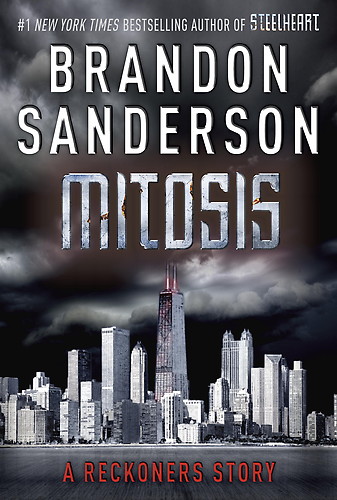
Review: MITOSIS by Brandon Sanderson (Gollancz)

Sanderson-R-MitosisUSA good short story stop-gap between Steelheart and Firefight

Epics still plague Newcago, but David and the Reckoners have vowed to fight back.

Sanderson self-published this short story, set in the same world as his first super-hero novel, Steelheart. I rather enjoyed the novel (which was the first of the author’s that I’ve read), and when I stumbled across this I was very happy to be able to dive back into the world he’s created. I’m not going to include an official synopsis, as that will give away the ending of Steelheart.

Nevertheless, what you need to know (for both the novel and Mitosis) is that in this reality, super-heroes exist – something happened that bestowed upon a small percentage of the global population special powers. Unlike in the super-hero comic books of Marvel, DC, et al, the power has very much gone to most of these powered individuals’ heads, and they started using them for their own ends. In Chicago, Steelheart reigned supreme with a coterie of other powereds. Steelheart the novel was the story of a fight against this tyranny, spear-headed by an insurgent group known as the Reckoners and their new ‘recruit’, who is a bit of a geek, and has been cataloguing the powered dictators and criminals as a means to learn of their weaknesses.

Mitosis deals with a single powered individual: Mitosis. The story moves quickly, and there is a rather nifty homage (perhaps) to Agent Smith from second and third The Matrix movies. That is all I shall say on the specific plot of this story.

If you are familiar with Sanderson’s writing – be it The Way of Kings or his Mistborn series – then you are sure to know what to expect: brisk, engaging and professional storytelling. The man can certainly write, and I intend to get more of his novels read by the end of this year. [Famous last words, perhaps, but I managed to read three of the four authors I promised to last year…]

Short, but well-worth reading to hold you over until the release of Firefight.

***

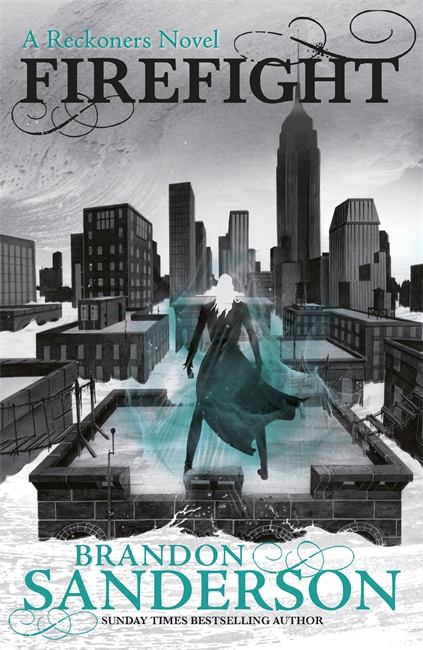
UPDATE: When I first wrote this, Gollancz had yet to announce the UK cover art, which I have now included below. The UK hardcover edition also includes an excerpt from Firefight and also some character sketches. It’s a really great little book. Perfect for any fan of Sanderson’s writing.

Sanderson-R2-FirefightUK

Upcoming: “The Truth About the Harry Quebert Affair” by Joël Dicker (Maclehose Press)

DickerJ-TruthAboutTheHarryQuebertAffairUKI’ve been seeing a lot of buzz surrounding Joël Dicker’s latest novel, The Truth About the Harry Quebert Affair. Last year, I started reading more (literary) fiction, and I’ve become as keen on finding new novels in all genres, and not just SFF, to feature on here. I’ve become particularly interested in American literary fiction – author such as Michael Chabon, Donna Tartt, Richard Russo, and Claire Messud to name but four (all but one of whom have featured on the blog already). It was therefore interesting to me that Dicker’s novel has created such a storm (it has sold over two million copies on the continent) and that it has even been hailed as having “all the elements of the Great American novel” (La Croix), despite Dicker actually being Swiss. Now that Maclehose Press has unveiled the UK artwork for the novel, I thought it a good time to post a quick something about it.

The novel is translated by Sam Taylor, who also translated HHhH. Here’s the synopsis…

Who killed Nola Kellergan?

Marcus Goldman, the toast of the New York literary scene, is at his wit’s end after being struck by writer’s block. Desperate not to lose his new found fame and in search of inspiration he decides to spend a few weeks in New Hampshire at the home of Harry Quebert, world famous author and his mentor from university.

During his stay, Marcus discovers that in 1975, aged 34, Harry had an affair with 15 year old Nola Kellergan. The summer of their affair, Nola disappeared after she was seen running through the woods, covered in blood. No one has seen Nola since and no one knows what happened.

Then the unthinkable happens, 33 years after her disappearance, the body of Nola Kellergan is found in Harry’s garden. Determined to prove Harry’s innocence, Marcus gets embroiled in the murder case of the century, while everywhere in America people are asking: Who Killed Nola Kellergan?

Not just a book about an unsolved murder case, The Truth about the Harry Quebert Affair explores the price of fame and the seduction of success, the ferocity of the publishing industry and the power of the media, love in all its forms and what it means to be a truly great writer.

The Truth About the Harry Quebert Affair is published in the UK by Maclehose Press, in May 2014.

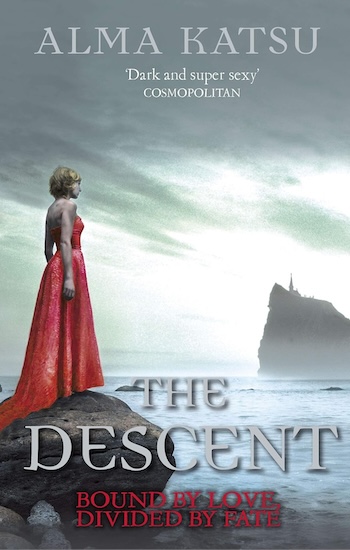
An Interview with ALMA KATSU

KatsuA-I3-DescentUKA few days ago, a copy of Alma Katsu’s third novel, The Descent dropped through the mailbox. It is the third novel in the author’s The Immortal trilogy, but I didn’t (at the time) know too much about the series or the author, so I took the opportunity to send her some questions.

Who is Alma Katsu?

As a girl, I wanted to have a magical, fantastical life but the outlook was kind of narrow and grim, and I think that’s why I turned to creating my own worlds in fiction. Then, funnily enough, I ended up having a life that was the stuff of fantasy: working in intelligence, traveling, doing all this technical, math-y stuff that I never would’ve thought possible for a little storyteller. Lesson: you never know where life will take you. Continue reading

Christmas Fiction Review Catch-Up: Jonathan Dee, A.S.A. Harrison & John Niven

I am falling terribly behind on my reviews. So, in order to get caught up a bit more on the backlog, I’ll be combining some reviews into thematic posts (of sorts). This one takes a look at three non-SFF novels I’ve read recently.

***

DeeJ-AThousandPardonsJonathan Dee, A Thousand Pardons (Corsair)

Ben and Helen Armstead have reached breaking point and it takes one afternoon – and a single act of recklessness – for Ben to deal the final blow to their marriage, spectacularly demolishing everything they built together.

Helen and her teenage daughter Sara leave for Manhattan where Helen takes a job in PR – her first in many years – and discovers she has a gift for spinning crises into second chances. But can she apply her professional talent to her personal life?

I rather enjoyed this. It was a quick read, but not perfect. The novel starts out with the sudden, spectacular dissolution of Helen’s marriage to Ben, who is quite the narcissist experiencing quite the midlife crisis and breakdown. The first part of the novel follows Helen as she makes her way to New York, and stumbles into a PR job. She has a knack for coaxing out appropriate, believable apologies out of her clients. For a short time, she is able to enjoy this success. Then the novel brings Ben back into the narrative, and we get a more even-handed impression of the two characters – while I had enjoyed reading about Helen, and it did take a little while before reorienting myself for Ben’s side of the story, the novel benefited from them both being central. Dee’s prose is fluid, and I rattled through this novel at quite the pace. At times, though, things moved perhaps a little too fast – Helen’s advancement in the PR business jumps ahead slightly, and Dee doesn’t give much time over to Helen and Sara’s new lives in the big city. I think the author could have spent some more time exploring what each of the characters was going through.

Nevertheless, A Thousand Pardons is an enjoyable novel about a marriage in ruins and a family in crisis; about the limits and joys of self-invention; and about the peculiar seduction of self-destruction. It is also the tale of redemption and forgiveness, of sorts, and the enduring connection families can feel with each other, despite some of the most difficult of circumstances. It’s not a bad introduction to Dee’s fiction, and I enjoyed it enough to convince me to pick up The Privileges at some point in the not-too-distant future.

*

HarrisonASA-TheSilentWifeUKPBA.S.A. Harrison, The Silent Wife (Headline)

Todd Gilbert and Jodie Brett are in a bad place in their relationship. They’ve been together for twenty-eight years, and with no children to worry about there has been little to disrupt their affluent Chicago lifestyle. But there has also been little to hold it together, and beneath the surface lie ever-widening cracks. HE is a committed cheater. SHE lives and breathes denial. HE exists in dual worlds. SHE likes to settle scores. HE decides to play for keeps. SHE has nothing left to lose. When it becomes clear that their precarious world could disintegrate at any moment, Jodie knows she stands to lose everything. It’s only now she will discover just how much she’s truly capable of…

Oh, how I wanted to love this book. For months, it seems, I’ve seen so much praise and a constant trickle of links for great and gushing reviews on Twitter. The book itself is covered in eye-catching blurbs from prominent authors, reviewers, and so forth. So how was it? Well… Politely? It wasn’t for me. Bluntly honest? I was bored. Throughout. I didn’t like either of the main characters. He is a douche, a lecherous cheater, who seems to only appreciate what his wife does for him and the fact that she’s attractive. She is fastidious to a fault, ordered and lacking any impulsiveness and rather bland:

“Meticulous planning has its merits. Life at its best proceeds in a stately manner, with events scheduled and engagements in place weeks if not months ahead. Scrambling for a last-minute date is something she rarely has to do, and she finds it demeaning.”

Now, I understand that both of the characters were probably meant to come across as either a complete ass (him) or quietly in denial about everything (her), but damn it doesn’t make for interesting reading. The synopsis above is not the whole synopsis. I cut the following:

“A chilling psychological thriller portraying the disintegration of a relationship down to the deadliest point when murdering your husband suddenly makes perfect sense.”

I found this as chilling as tepid tap water. That being said, in terms of prose and construction, The Silent Wife is very competent. The author’s prose are very well constructed, which is really the only reason I kept reading. That bit about the novel being a “chilling psychological thriller”? I was waiting for that to happen right up until I turned the final page. Maddeningly bland. This was the biggest let down of the year, I was left wondering if what I bought and read was the same book everyone else had been talking about…

*

NivenJ-StraightWhiteMaleJohn Niven, Straight White Male (William Heinemann)

Kennedy Marr is a novelist from the old school. Irish, acerbic, and a borderline alcoholic and sex-addict, his mantra is drink hard, write hard and try to screw every woman you meet.

He’s writing film scripts in LA, fucking, drinking and insulting his way through Californian society, but also suffering from writers block and unpaid taxes. Then a solution presents itself – Marr is to be the unlikely recipient of the W.F. Bingham Prize for Outstanding Contribution to Modern Literature, an award worth half a million pounds. But it does not come without a price: he must spend a year teaching at the English university where his ex-wife and estranged daughter now reside.

As Kennedy acclimatises to the sleepy campus, inspiring revulsion and worship in equal measure, he’s forced to reconsider his precarious lifestyle. Incredible as it may seem, there might actually be a father and a teacher lurking inside this “preening, narcissistic, priapic, sociopath”. Or is there.

This was a very pleasant surprise. There was a bit of a rocky start – the first couple of chapters painted an awful picture of the protagonist, and I worried that I’d always struggle to engage with him. However, Niven very quickly surprised. Straight White Male ended up being one of my favourite reads of the year.

Kennedy, our protagonist, starts off as one ugliest protagonists I’ve read about. He’s kind of awful: spoiled, wasteful, a drunkard, lewd, a sex addict with an unhealthy disrespect for women (sleeping with someone in the cloak room at his wedding, juggling multiple porn platforms at once)… He’s a complete narcissist. He’s not a pleasant guide for a lot of the opening chapters, which did make me wonder if I wanted to continue reading. Everyone else Kennedy interacts with is as well-written as this asshole, which made me stick with it, and eventually we learn why Kennedy is the way he is, and see his character develop. Niven can definitely write, and write very well, which kept me coming back. So, if you aren’t a fan of anti-hero protagonists, I’d recommend still sticking with the book, as it gets very good.

I really liked the way Kennedy gets to say and do all the things I bet many people living and working in or with Hollywood would love to say to all the self-important, pompous “artistes” with inflated senses of their own genius… He doesn’t shy away from opining on their flaws (or shouting  them at prima donna, uneducated actors). His internal and external commentary is often very funny. He’s also honest about why he does certain things. Kennedy is also not sparing on his frustrations with the publishing industry, either.

“Busy jumping from rewrite to polish to dialogue pass because, of course, all this was easier (and much more remunerative) than spreading his intestines across the page for two fucking years writing a novel. Because the only things he wanted to write about he couldn’t. He wasn’t blocked so much as… finished. The novel? That was a man’s business. He was done with it. Not that anyone knew that yet of course.”

What was most interesting, however, is how Niven slowly unveiled the tragic story of Kennedy’s sister, and how that has effected his behaviour. A lot of what he does, in the end, seems like avoidance and alcohol-fuelled coping and distraction. After the story shifts to the UK, things move quite a bit faster, too, which was a little disappointing. I would have liked some more… well, everything, really. Rather than reading that as an indictment of the novel, consider it my way of saying I wish it had been longer, because it was so good. Which it was.

Straight White Male is a very good novel on some of the many neuroses and coping mechanisms to which men can turn. Funny, irreverent, touching, and well-written, this is definitely recommended.

Mini-Review: THE LANGUAGE OF DYING by Sarah Pinborough (Jo Fletcher Books)

Pinborough-LanguageOfDyingAn affecting, slim tale of loss, family and never-forgotten pain

Tonight is a special, terrible night. A woman sits at her father’s bedside watching the clock tick away the last hours of his life. Her brothers and sisters – all traumatised in their own ways, their bonds fragile – have been there for the past week, but now she is alone. And that’s always when it comes. As the clock ticks in the darkness, she can only wait for it to find her…

Clocking in at only about 125 pages, The Language of Dying nevertheless packs an emotional wallop. A daughter watches over her dying father, as her brothers and sister visit their childhood home. Each is dealing with their own issues and difficulties – be it drug abuse, general unhappiness with their lives, and also their difficulty in dealing with the imminent death of their father. The narrator recounts a number of fond memories and also some extremely painful ones (which, if I recall correctly from a blog-post the author wrote not too long ago, may be at least inspired by certain real events). The book is filled with a great many small, intimate details – it’s quite British, too, in that respect. The family is clearly a broken family, in many ways, and their dealings with each other can be difficult and cause friction. But then, at other times, they reminisce together over happier times. There is perhaps, also, a history of mental instability. This gives a certain dreamlike and questionable quality to a possibly-supernatural slant to the story that is alluded to at the start, and appears again at the end (one I really liked – and I enjoyed the ambiguity).

“… I still look. Forty next birthday and I’m looking out of the window for something that may be imaginary, that I haven’t seen in fifteen years, if ever I saw it at all…”

This is, as I say right at the top, is a powerful, elegant tale of loss and family, and some of the different manifestations of grief. The story is incredibly moving, and I will admit to shedding at least a couple of tears (ahem, ok, more than that). A remarkable, short piece of fiction. Very highly recommended.

“The Emperor’s Children” by Claire Messud (Knopf)

Messud-TheEmperorsChildrenAn interesting tale of privilege in New York, in the lead-up to 9/11

A novel about the intersections in the lives of three friends, now on the cusp of their thirties, making their way — and not — in New York City. There is beautiful, sophisticated Marina Thwaite — an “It” girl finishing her first book; the daughter of Murray Thwaite, celebrated intellectual and journalist — and her two closest friends from Brown, Danielle, a quietly appealing television producer, and Julius, a cash-strapped freelance critic.

The delicious complications that arise among them become dangerous when Murray’s nephew, Frederick “Bootie” Tubb, an idealistic college dropout determined to make his mark, comes to town.

As the skies darken, it is Bootie’s unexpected decisions — and their stunning, heartbreaking outcome — that will change each of their lives forever.

This novel came very highly recommended, but for some reason it took me quite a long time to get around to reading it. I have a weak-spot for novels set in New York City. This is the first one I’ve read that takes a look (near the end) at the impact of 9/11 on inhabitants of the city – not in terms of politics or the War on Terror, but rather as an event that would turn the lives of these protagonists upside down, in both large and small ways. I certainly enjoyed reading the novel, but it’s not perfect. It offers some shrewd, pointed commentary on the foibles and anxieties that face or characterise the lives of privileged (and some not-so-privileged) white youth in New York City.

The friends at the core of the story are quite typical, in many respects. This works in their favour, and makes the novel pretty easy to sink in to. They are from a wealthy set, but each hides their own insecurities from the others. Julius, for example, is down on his luck, and has been hiding the fact that he has resorted to temping in order to make ends meet. Danielle is ticking along, but then develops a relationship with someone she never would have thought possible. Marina is a typical, spoiled, highly privileged daughter of an accomplished, beloved-of-the-NY-literary-set journalist. In the meantime, Bootie, Marina’s awkward cousin with delusions of literary/journalistic grandeur, a surprisingly strong sense of his own iconoclasm, moves to New York, and ends up causing quite the unpleasant stir.

It’s tricky to go into too much detail, as is so often the case. Messud weaves a number of twists and turns into the novel, as her protagonists navigate their way through their personal and professional lives – Marina struggling to finish the long-fallow book project she’s been paid to write (years ago), and also having to deal with her new boyfriend’s obvious distaste and derision for her father’s reputation; Danielle trying to get her productions green-lit, while keeping her new romance secret from her friends (who would undoubtedly disapprove); Julius, whose love-life takes a turn for the better, before spiraling catastrophically; and Bootie’s attempts to make a life in New York, balancing his awe, jealousy and eventual disappointment in Marina’s father (for whom he works as an assistant for a short while).

The novel had two particular strengths. First, the characterisation – which I know I haven’t outlined particularly well, above – was excellent. These are people who are by no means perfect or in any way heroes. There is a natural ugliness, almost, to their personalities: the natural jealousies, the petty narcissism, and so forth. But also their privileged ennui, as they attempt to figure out what it is they are meant to be doing with their lives (something I can sometimes relate to). There were a few uncomfortable moments when I would read one of the characters’ inner struggles, perhaps raise a judgmental eyebrow or sneer, and then realise that I myself had harboured similar thoughts, worries, or jealousies on occasion.

Another thing I really liked about the novel, were the moments in which characters would talk about books. Perhaps a strange thing to pick up on, given that they are universally small and fleeting moments in the story, but I really liked it. For example, when Danielle is looking at her bookshelves in her apartment, a form of biblio-memoir:

… a wall of books, both read and unread, all of them dear to her not only in themselves, their tender spines, but in the moments or periods they evoked. She had kept some books since college that she had acquired for courses and never read — Fredric Jameson, for example, and Kant’s Critique of Judgment — but which suggested to her that she was, or might be, a person of seriousness, a thinker in some seeping, ubiquitous way; and she had kept, too, a handful of children’s books taken from her now-dismantled girlhood room, like Charlotte’s Web and the Harriet the Spy novels, that conjured for her an earlier, passionately earnest self, the sober child who read constantly in the back of her parents’ Buick, oblivious to her brother punching her knee, oblivious to her parents’ squabbling, oblivious to the traffic and landscapes pressing upon her from outside the window.

Messud does a great job of giving each character their own voice (although, sometimes only slightly different from others), and she’s doing a great job of deconstructing her protagonists and their neuroses and petty jealousies. But, and this is my only real issue with the novel: it could have been trimmed down, I think. There were times when it felt like the novel veered off into an unnecessary tangent, without adding enough to the story to justify it, or being too mundane to really be worth it. I also think the author has never found an over-long sentence she didn’t like. There were, for my taste, far too many run-on sentences. There were so many instances when a well-placed full-stop would have done wonders for the prose and reading experience; any number of sentences that were begging to be broken up into easier-read sizes. Take, for example, this paragraph (which is by no means the worst offender):

As they each gingerly dismantled and consumed their fanciful dishes — in her case at least, a fancy that, Danielle thought but did not say, was less original and extraordinary than the restaurant’s reputation and price had led her to expect, and therefore disappointing, as she had chosen the venue to impress — Danielle proceeded to explain that she had been taken with his use of the term, that she had, perhaps wrongly, heard in it a certain echo, the suggestion of an ethos that she thought might be found, to greater or lesser degrees, in certain other publications or presentations, and that she, in her producer’s role, had thought to articulate into, well, a movement.

Or this stuttering, shorter example: “and there was, had been, at the very sight of him, at the front of the line at the restaurant, a pull that Danielle felt to be inevitable, personal, even spiritual — a magnetic attraction.” And the use of near-repetition to make or reinforce a point (“having felt, and felt keenly”).

There are, of course, moments of levity that break up what could otherwise become a rather heavy-handed narrative. Mostly, this occurs when theses privileged characters are confronted with simple situations they are entirely ill-equipped to deal with (thing that would, ordinarily, be dealt with by the Help). For example, when Marina’s cat, Pope, dies:

“I’m sorry, Daddy — it’s just the Pope. She’s not — I mean, she’s dead.”

“Oh.” The two of them stood side by side without approaching. “You’re quite sure?” Murray asked, scratching at the back of his head.

“Yep. Sure.” The cat, a black blot on the duvet, didn’t move.

“Is your mother asleep?”

“Hours ago.”

“Hmm. Worse things could happen than leaving her there for the night, don’t you agree?”

The idea seemed somehow sacrilegious to Marina, though whether the offense was against the cat or the bed and its imminent occupant, she couldn’t have said. “Don’t dead things, you know, leak?”

“Not overnight, I wouldn’t think. And it’s pretty cool in here.”

And this, later moment in which they discuss what to do with books from university…

“What did you major in, in college?” she ventured again, after a time.

“Poli Sci.”

“Mm-hmm.”

“You must have been English, right?”

“Does it show that badly? We all were. I was double, English and Philosophy. I don’t remember a thing.”

“Who does?”

“Seriously, though, I look at the books on my shelves and it’s clear that I read them, back then, but I can’t remember ever doing it, and I don’t have the first idea what they might be about.”

“Read them again, then?”

Danielle sighed. “Not now. Maybe someday. I look at them and wonder who I was, you know? It’s a long time ago. I’m thirty.”

“You should throw those books away.”

“Like, in the garbage?”

“Like that.”

“Sacrilege. It would be.”

“Do you hang on to clothes you haven’t worn for ten years? Or bags of pasta, or cans of beans?” Danielle did not need to answer. “What is it about books? Perfectly rational people get crazy about their books. Who has time for that?”

“I measure my life out in books.”

“You should be measuring your life by living. Correction: you shouldn’t be measuring your life. What’s the point?”

Ultimately, The Emperor’s Children is a richly drawn, well-observed story of how these friends and relatives navigate their world. The characters develop naturally over the course of the story, and while they felt rather cookie-cutter at the beginning, they quickly developed their own voices. Despite the sometime-trouble I had with Messud’s drawn-out prose-style, this is a recommended read. I’ll be sure to read her latest novel, The Woman Upstairs, very soon.

“Wonder Boys” by Michael Chabon (Harper Collins / Random House / Open Road)

Chabon-WonderBoysA University Professor’s Crippling Writer’s Block and Drug-Fuelled Self-Destruction

Grady Tripp is a pot-smoking middle aged novelist who has stalled on a 2611-page opus titled Wonder Boys. His student James Leer is a troubled young writer obsessed by Hollywood suicides and at work on his own first novel. Grady’s bizarre editor Terry Crabtree and another student, Hannah Green, come together in his wildly comic, moving, and finally profound search for an ending to his book and a purpose to his life.

This is the second of Michael Chabon’s novels that I’ve read – and in a very short time, too. I still have no idea how to review The Amazing Adventures of Kavalier & Clay, which may rank as one of my all-time favourite novels. (Needless to say, it’s not difficult for me to see why it won the Pulitzer Prize.) Wonder Boys, the novel Chabon wrote before Kavalier & Clay, is a rather different novel. It’s nowhere near as long, for one thing – and yet, strangely, it feels far more rambling and unfocused. I enjoyed it a great deal, and zipped through it in just a couple of days. Chabon has a wonderful way with words that can make even the mundane a pleasure to read about.

The main character is almost archetypical, struggling author with writer’s block. Wonder Boys is basically the story of his long-time spiral of self-destruction coming to a head. Over the course of a single weekend, his wife leaves him, his affair takes a shocking turn, lots of people realise that he’s a nightmare and kind of feckless. He also has to attempt to keep his rather predatory editor away from one of his potentially-suicidal students. Along the way, there is a dead dog, one of Marilyn Monroe’s jackets, a shoot-out in an alley, and also a massive dead snake. And some Korean Jews. And a heavy amount of drug consumption.

Chabon-WonderBoysORI haven’t read much literary fiction (or whatever genre this is meant to be in), but there are some tropes that are popping up. They seem to be predictable in their unpredictability. Strange things happen. People do really weird things (see, for example, the bacchanal in The Secret History). They react in slightly melodramatic ways. And yet… there is a way that Chabon writes these little weirdnesses that feels very natural. Realistic, and not actually forced or jarring.

Without walking through the whole plot, it’s tricky to know what to write for this review. I am not aiming for a review in the style of the New Yorker, The New Republic, or Harper’s, so I’m not going to attempt to deconstruct this in any intellectual or academic manner. That’s not what the blog is for. What I will say, though, is that if you’re after a slightly strange, well-written novel about a writing professor at a small Ohio University going crazy, then this is for you. It’s witty, engaging, rather addictive, and very quirky.

Author-Of-Many-Genres: Jeff Somers

I was spending some time on Goodreads, recently (as you do), and I noticed that Jeff Somers wrote in a number of genres. On the face of things, that is not at all a groundbreaking discovery. But, given the publishing industry’s preference for author branding, I thought it was interesting that Somers wrote under the same pen-name for all of the genres. Again, not exactly an earth-shattering discovery, but it gives me the opportunity to feature his work on the blog, before I get around to reading any of it. So, without further ado…

Author Bio: “Born in Jersey City, N.J., Jeff Somers has managed to migrate just five minutes away to nearby Hoboken, land of overpriced condominiums and a tavern on every corner. Between weekly drunks, Jeff manages to scrawl enough prose onto cocktail napkins and toilet paper to keep up a respectable fiction career.”

Genres: Avery Cates (Cyberpunk), Ustari Cycle (Urban Fantasy), Lifers, and Chum (fiction)

PrintAvery Cates – THE ELECTRIC CHURCH (debut), THE DIGITAL PLAGUE, THE ETERNAL PRISON, THE TERMINAL STATE, THE FINAL EVOLUTION

In the near future, the only thing growing faster than the criminal population is the Electric Church, a new religion founded by a mysterious man named Dennis Squalor. The Church preaches that life is too brief to contemplate the mysteries of the universe: eternity is required. In order to achieve this, the converted become Monks – cyborgs with human brains, enhanced robotic bodies, and virtually unlimited life spans.

Enter Avery Cates, a dangerous criminal known as the best killer-for-hire around. The authorities have a special mission in mind for Cates: assassinate Dennis Squalor. But for Cates, the assignment will be the most dangerous job he’s ever undertaken – and it may well be his last.

*

SomersJ-UC1-TricksterUstari Cycle – TRICKSTER

Magic uses blood — a lot of it. The more that’s used, the more powerful the effect, so mages find “volunteers” to fuel their spells. Lem, however, is different. Long ago he set up a rule that lets him sleep at night: never use anyone’s blood but your own. He’s grifting through life as a Trickster, performing only small Glamours like turning one-dollar bills into twenties. He and his sidekick, Mags, aren’t doing well, but they’re getting by.

That is, until they find young Claire Mannice — bound and gagged, imprisoned in a car’s trunk, and covered with invisible rune tattoos. Lem turns to his estranged mentor for help, but what they’ve uncovered is more terrifying than anybody could have imagined. Mika Renar, the most dangerous Archmage in the world, is preparing to use an ocean of blood to cast her dreams into reality — and Lem just got in her way.

*

SomersJ-ChumCHUM

Mary and Bickerman are the center of their circle of friends – but these friends are strangers as well as family to them. In the course of year, under the influence of a stressful wedding and a whole lot of alcohol, relationships and nerves are twisted and broken as the dynamics of the cozy-seeming group shift. Secrets are kept, emotions withheld, and it doesn’t look like it’s going to end well for anyone.

Told always in first person, but not the same person, and unfolding in double-helix chronology that provides a “Rashomon”-like narration, “Chum” is the story of love, liquor, and death.

*

SomersJ-LifersLIFERS

Three twenty-something guys, who transitioned from collegiate underachieving to corporate bottom feeding sketch out a plan to make a grab for some dignity. They will rob the publishing house that employs their only stable member and results him on a daily basis. Being the bright, perceptive fellows they are, they all quickly realize it’s about the money.

For Phil “Dub” Dublen, it’s a pissed off statement against a dull, meaningless job. For self-styled poet Trim, it’s a chance to actually be outrageous and anarchic as he needs to be. For Trim’s roommate Dan, it seems to be something he does for the same reason he does everything: to vent some anger, having nothing better to do. By the time their master plan is all said and done, nothing has been solved, nothing is better, and nothing, really, has changed. And, in the slightly fractured wisdom of the larcenous trio, this surprises none of them.

Who’s read any of these? I’ve picked up TRICKSTER and LIFERS, and intend to read them ASAP. Any other multi-genre authors you like? Or any you would like me to feature on the blog in either a post like this, or as reviews?