Guest Post: “Don’t Build Worlds on Your Doorstep” by Geoff Gudgion

GudgionG-SaxonsBaneEvery novelist, in every genre, builds worlds. Mine aren’t on a distant galaxy but close to home, perhaps a little too close to home. I like to ground the reader in a world that they’ll recognise, then tilt the board slightly so that as the menace emerges they think, “This could happen to me.” It seems, though, that not everyone is happy with this twisting of rules they hold dear.

In Saxon’s Bane, I started by creating an English village that could trace is foundation to a Saxon warlord, Aegl. Back then, there were deer and boar to hunt in the woods, fresh water in the stream, and the ground would be fertile. It was a place for Aegl to ground his spear and plant his generations. Allingley was founded.

“Where is Allingley?” I’m sometimes asked. Readers seem to finish the book knowing the place, and want to go there. They’re disappointed when I tell them it’s imaginary. World-building comes easier to me, you see, when I take elements that I know and blend them into something fresh. The scent of an otherness, for example, in the depths of an ancient wood. Even the old language is recognisable in the traces of Anglo-Saxon that linger in modern English. Allingley would have been Aegl-ingas-leah in Anglo-Saxon, the clearing of Aegl’s people. I can also borrow from established legend, in this case the warrior Aegl or Egil and his wife Olrun, the Swan Maiden. I brought their story to life in this sleepy village on the banks of the Swanbourne, where, nearly one and a half millennia later, the peat-preserved body of a ritually-slaughtered Saxon warrior is uncovered.

World-building from legend and folklore also allows me to weave threads of reality or literature into the plot, for example the Old Norse epic poem Hávamál, when the God Odin talks of the power of runes:

Ef ek sé a tré uppi váfa virgilná,
Svá ek rist ok i rúnum fák,
At sá gengr gumi ok mælir viđ mik.

If I see a corpse hanging in a tree
I can carve and colour the runes
So that the man can walk and talk with me.

Runes are a rich source material, both as script and faith-laden symbols. I’m not a pagan, but I’ve always been fascinated by the old faiths, when people lived close to their gods, at one with nature rather than being given dominion over nature. I created a character in Saxon’s Bane, a fresh-faced, bright-eyed young pagan woman, who is part of a tradition of healers that has survived in this remote area despite the witch-finding pogroms of King James. I think by the end of the book I was a little in love with her. I researched pagan traditions and crafted a belief system around her that I called the ‘Old Way’. She is a counterbalance to an archaeologist who becomes obsessed with her project, and who doubts her sanity as she struggles to reconcile her academic discipline with her growing, preternatural understanding. Their story unfolds through the eyes of a car crash survivor, a man on his own journey to healing, who does not know whether what he saw at the edge of death was real or a product of his own traumatised mind.

So far, so good. My world-building rang true. I had a location, I had characters, I had the catalyst for a plot. I could start to bring the Dark Ages to life in present-day England, but always keeping to my principle of plausibility; a car that crashes as it swerves to avoid a stag, for example, and the discovery of a stag tattoo on the peat-preserved forehead of the Saxon warrior.

I find there’s a risk in making worlds too plausible. If you write on the principle of letting the reader think ‘that could be me’, it’s a short step to the reader thinking ‘that is me’. There’s a character in the book who finds the ‘Old Way’ too mild, and who experiments with some seriously nasty ideas of his own. As the past begins to echo in the present, he comes to believe in his own power and slides from reprobate to psychopath. All too plausible, apparently, for one practicing Wiccan. There’s an emotional rant on Goodreads from someone who is “nauseated” at the suggestion that any follower of the Horned God could be anything other than sweetness and light.

Oops. It seems I’ve blundered across someone else’s world. Perhaps I’d better start building a little further away. Gallifrey, for example. It might be safer. Meanwhile, I’ll send this off to Civilian Reader before I’m turned into a frog.

*  *  *

Geoff Gudgion is the author of SAXON’S BANE, published by Solaris Books. Here’s the synopsis, to whet your appetite further…

Fergus’ world changes forever the day his car crashes near the remote village of Allingley. Traumatised by his near-death experience, he stays to work at the local stables as he recovers from his injuries. He will discover a gentler pace of life, fall in love – and be targeted for human sacrifice.

Clare Harvey’s life will never be the same either. The young archaeologist’s dream find – the peat-preserved body of a Saxon warrior – is giving her nightmares. She can tell that the warrior was ritually murdered, and that the partial skeleton lying nearby is that of a young woman. and their tragic story is unfolding in her head every time she goes to sleep. Fergus discovers that his crash is linked to the excavation, and that the countryside harbours some dark secrets. as Clare’s investigation reveals the full horror of a Dark age war crime, Fergus and Clare seem destined to share the Saxon couple’s bloody fate.
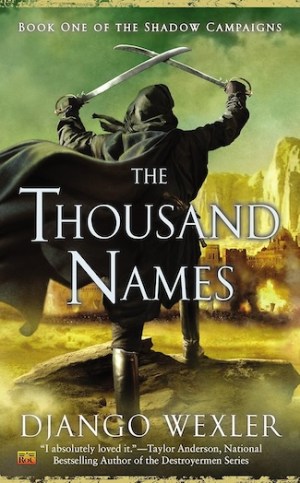
Review: THE THOUSAND NAMES by Django Wexler (Del Rey UK/Roc)

WexlerD-SC1-ThousandNamesUSOne of my most anticipated debuts of the year – flawed, but does not disappoint overall

Captain Marcus d’Ivoire, commander of one of the Vordanai empire’s colonial garrisons, was resigned to serving out his days in a sleepy, remote outpost. But that was before a rebellion upended his life. And once the powder smoke settled, he was left in charge of a demoralized force clinging tenuously to a small fortress at the edge of the desert.

To flee from her past, Winter Ihernglass masqueraded as a man and enlisted as a ranker in the Vordanai Colonials, hoping only to avoid notice. But when chance sees her promoted to command, she must win the hearts of her men and lead them into battle against impossible odds.

The fates of both these soldiers and all the men they lead depend on the newly arrived Colonel Janus bet Vhalnich, who has been sent by the ailing king to restore order. His military genius seems to know no bounds, and under his command, Marcus and Winter can feel the tide turning. But their allegiance will be tested as they begin to suspect that the enigmatic Janus’s ambitions extend beyond the battlefield and into the realm of the supernatural—a realm with the power to ignite a meteoric rise, reshape the known world, and change the lives of everyone in its path.

I first heard about this novel what feels like ages ago. As is usual for me, I was impatient to read it, but then ended up taking my sweet time getting around to it. It was worth the wait, though, and I think Django Wexler is definitely an author to watch. As with many highly-anticipated novels, I struggled to review it (I finished it well over a week ago). There are lots of things I would like to discuss, but they would be spoilers. There are some nitpicks that feel overly nitpicky (easy to spot in the review). So, I’m keeping this relatively short. The Thousand Names has some minor flaws, but it is nevertheless an ambitious, well-written opening act. I can’t wait for book two, and I think most readers will feel likewise after reading this. Continue reading

Upcoming: “The Fifth Season” by N.K. Jemisin (Orbit)

Another cover from Orbit’s recent mass-cover-reveal (I’m sharing a few of them today), and another for which I can’t find much other information. I’m a big fan of N.K. Jemisin’s series – I loved The Hundred Thousand Kingdoms and The Broken Kingdoms, as well as The Killing Moon. For some reason, though, Jemisin’s series are ones I seem incapable of finishing… [This is a weird, apparently pathological problem with me.]

I’ll share more information as and when I stumble across it. In the meantime, here’s the cover (it’s rather teasing, doesn’t give too much away, but I like it nevertheless):

Jemisin-FifthSeason

UPDATE: Spotted this on A Dribble of Ink, who got the info from The Mary Sue – some more information about the book:

“The Fifth Season is set in a world which has suffered frequent, repeated Extinction Level Events for millions of years, and all life (and magic) in this world has adapted to it. Hundreds of years might pass between these events — easy, plentiful years in which great cities rise, and people have the leisure for art and science and rapid advancement — but then, again and again, the cities fall. The world is littered with the detritus of these times of plenty, and this cover hints at them: past ages of decadence, now decaying; stone that endures beneath flaking gilt.”

Upcoming: “The Path to Power” by Karen Miller (Orbit)

Spotted this over on Orbit Books’ recent mass-cover-reveal post, and I really liked the look of it (dead bodies, mysterious silhouetted figure, grand hallways…):

Miller-1-PathToPowerHC

Sadly, I couldn’t find anything about the story itself, except for this comment from Miller’s website: “Have to continue being a bit hush hush about the story, but I promise I’ll reveal more when I can!” Bugger. I’m intrigued.

Upcoming: “Art of Hunting” by Alan Campbell (Tor)

Campbell-GC2-ArtOfHuntingThe first novel in Alan Campbell’s Gravedigger Chronicles, Sea of Ghosts, is one of my favourite novels from 2011. After reading that, though, I haven’t heard much at all from Mr. Campbell. The author, who also wrote the Deepgate Codex trilogy – Scar Night, Iron Angel and God of Clocks – is an fabulously talented fellow, in my opinion, and I’ve been desperately keeping my eyes open for information about his next novel. (Interestingly, or perhaps weirdly, I was reading his blog before I ever started this one. His and Joe Abercrombie’s… Anyway.)

Thanks to a work-requirement to read Locus magazine, I spotted a mention that Alan Campbell’s Art of Hunting is on its way, and it is the sequel to Sea of Ghosts! This has made me ridiculously happy (and impatient). Here’s the synopsis…

The Haurstaf have been decimated. The Unmer have seized the palace at Awl. Ianthe’s father carries her to safety. But she is not interested in a life of treasure hunting with him. She returns to the palace, hoping to find the Unmer prince with whom she shared some of her darkest moments.

Prince Paulus Marquetta discovers a friend and ally in Ianthe, albeit a dangerous one. She has the power to destroy his mind with a single thought, and yet she herself remains at risk from his own innate sorcerous abilities. The handsome young prince could murder her with a simple touch.

Briana Marks, meanwhile, has escaped with her life. Fearful of Marquetta’s rule, she travels to the Dragon Isles to seek out the exiled Unmer lord, Argusto Conquillas and beg him to help her assassinate Ianthe. When Granger learns of this plot to kill his daughter, he must use every scrap of his resourcefulness and cunning to protect her.

Maskelyne returns to Scythe Island to study the crystal he plucked from the wreckage of the Unmer chariot. The artifact leads him to discover exactly why the Drowned continue to deposit thousands upon thousands of keys on the beach beneath his fortress. The Unmer, in their quest to unlock the secrets of the universe, forged a monster. Now Maskelyne knows where this thing is imprisoned…

Art of Hunting is due out in November 2013, published by Tor in the UK.

Interview with JAMES TREADWELL

Treadwell-Advent2

James Treadwell is the author of Advent and Anarchy, two novels that seem to have taken the UK (and perhaps the US?) by storm. In advance of my belated reading of the novels, Hodder were kind enough to hook me up with an interview with James. Read on!

Let’s start with an introduction: Who is James Treadwell?

I think he’s that tall confused-looking bloke in the back row, the one who needs a haircut. He also appears to have bad shoes.

Treadwell-AnarchyAnarchy, the sequel to Advent, was recently published by Hodder. How would you introduce the series and novel to a potential reader?

I’m very bad at these “elevator pitches” … I suppose one way I might do it is by asking someone if they’ve ever wondered what it would be like – what it would really, really be like – if something impossible happened to them.

But if I was trying to give a more general thumbnail description of the books, I’d probably say that they’re about the return of magic to the world. To our world, that is, the real world we live in; the one in which we all know there isn’t actually any magic.

What inspired you to write the novels? And where do you draw your inspiration from in general?

Advent is based on something that’s been in my thoughts for years and years, long before I ever thought there’d be a time when I could try making a book out of it. As far as I can remember it started with an image of a boy walking alone in a wood and meeting something inexplicable on the way. Why that particular image felt like it had a story in it I don’t know, but apparently it did.

Treadwell-AdventIt often seems to start with a small thing like that: a scene, or a particular character, or an event, which somehow feels like it has extra weight. But I don’t really know where stories come from. Philip Pullman once compared it to fishing from a small boat on a big lake. You just sit there, and – if you’re lucky – something eventually grabs the hook, down in that enormous and entirely invisible space beneath you. You can’t make it happen, though. All you can do is concentrate and be patient.

How were you introduced to genre fiction?

Good question. I wish I could remember. One of the very first things I remember reading – some kind of school reading book, I’d have been six or seven years old – must have been a version of the Nibelungenlied, because I remember the name Kriemhild, and a vague but powerful sense of being excited by dragons and heroes and strange quests. I definitely remember being addicted to a lovely paperback retelling of the Norse myths, a few years later, and I loved Narnia as soon as I discovered it. I can’t remember a time when I wouldn’t have chosen those kind of stories over any other. I’ve always wanted to be enchanted, I suppose.

How do you enjoy being a writer and working within the publishing industry? Do you have any specific working, writing, researching practices?

I love being a writer, for all sorts of reasons. The publishing industry is an entirely different matter. Not in a bad way – I have a wonderful agent and editor, and whenever I go into my publishers’ office I’m astonished (and delighted) by how cheerful they all seem to be. But I know nothing at all about the whole business of printing, marketing and selling books. I do writing: anything beyond that is up to someone else.

Everyone has work habits, don’t they? What can I think of that might be a little unusual? I write using pen and paper, which probably counts as a quirk. I always leave the house. I treat first drafts as raw material rather than anything approximating a final product.

When did you realize you wanted to be an author, and what was your first foray into writing? Do you still look back on it fondly?

I suppose I’ve always liked the idea of trying to tell stories, but the prospect of actually being an author never seemed realistic until a quite unexpected combination of circumstances came about when I was in my mid-thirties.

I did write a sort of sprawling second-hand fantasy epic in my teens. It was inexcusably terrible last time I looked, so much so that I haven’t dared look again for a very long time. But I do have happy memories of the process itself: staying up late(-ish) in my bedroom, letting the imagination work and ignoring everything else.

What’s your opinion of the genre today, and where do you see your work fitting into it?

By “the genre” we mean fantasy, yes? That’s a big and interesting question.

I’m intrigued by the prevailing unseriousness of fantasy these days. A lot of the best work has a kind of knowing, sardonic cool in it somewhere, as if it’s written by a generation hugely influenced by Douglas Adams. I’m thinking of someone like Terry Pratchett, whose version of fantasy is openly satirical. But I’m also thinking of someone like Joe Abercrombie, where you have fairly conventional fantasy material, but treated in a highly ironic manner (like with the title of The Heroes). Even with Neil Gaiman – who I think is an authentic genius, one of the best writers alive – there’s a shimmer of witty brilliance over everything, a sort of dark sparkle. You see much less of the gentle earnest solemnity of Tolkien or Le Guin, these days. Another way of putting it: think about the difference between Frodo Baggins and Tyrion Lannister as fantasy protagonists. Or, think of how much more wisecracking and cheeky Dr. Who has become.

Treadwell-FantasyMentions

Part of the reason this intrigues me is that I’m pretty sure my own writing entirely lacks this quality. But I don’t really want to talk about where I fit or don’t fit into a genre: that’s for others to discuss, if they want to. Besides, thinking about my work in relation to Gaiman’s or Le Guin’s is just going to make me sad.

What other projects are you working on, and what do you have currently in the pipeline?

I know what I’m going to do once the Advent trilogy is finished (which will be in a few months). It’s a project that has come about in an utterly extraordinary way, so extraordinary that I really can’t say very much about it. Sorry.

What are you reading at the moment (fiction, non-fiction)?

I’ve just finished Gossip From the Forest, Sara Maitland’s book about fairy tales, which is wonderful. I’m working my way through M John Harrison’s LightNova SwingEmpty Space trilogy, also very remarkable. I particularly like the fact that it features suburbs and streets and train stations from my patch of West London. I’ll never look at the roundabout in Mortlake quite the same way.

Treadwell-Reading

What’s something readers might be surprised to learn about you?

I’m too chicken to read H.P. Lovecraft. It’s true. He gives me nightmares. Quite a few people have told me that my books are rather “dark”, but I’m a total literary coward. I can’t handle any sort of horror.

What are you most looking forward to in the next twelve months?

Probably watching the Winter Olympics on the BBC. Biathlon! Curling! It would be different if it was all the time, but when it’s once every four years you have to grab the opportunity with both fists. Carpe curling, as Horace might have said.

***

James Treadwell’s Advent series is published by Atria in the US (artwork below). Advent and Anarchy are available now. Here’s the synopsis for Advent (from Goodreads):

“A drowning, a magician’s curse, and a centuries-old secret.”

1537. A man hurries through city streets in a gathering snowstorm, clutching a box in one hand. He is Johann Faust, the greatest magician of his age. The box he carries contains a mirror safeguarding a portion of his soul and a small ring containing all the magic in the world. Together, they comprise something unimaginably dangerous.

London, the present day. Fifteen-year-old Gavin Stokes is boarding a train to the countryside to live with his aunt. His school and his parents can’t cope with him and the things he sees, things they tell him don’t really exist. At Pendurra, Gavin finds people who are like him, who see things too. They all make the same strange claim: magic exists, it’s leaking back into our world, and it’s bringing something terrible with it.

First in an astonishingly imaginative fantasy trilogy, Advent describes how magic was lost to humanity, and how a fifteen-year-old boy discovers that its return is his inheritance. It begins in a world recognizably our own, and ends an extraordinarily long way from where it started – somewhere much bigger, stranger, and richer.

Treadwell-AdventAnarchyUS

US Covers

Upcoming: “The Broken Eye” by Brent Weeks (Orbit)

I have been abysmally slow, keeping up-to-date with Brent Weeks’s Lightbringer series. I read and loved The Black Prism, but for some reason I haven’t managed to get around to The Blinded Knife. Earlier this week, Orbit Books (Brent’s publisher in both the UK and US) unveiled the artwork for the third novel in the series, The Broken Eye. And it’s awesome. Here it is…

Weeks-BrokenEyeHC

The overall design is by the incredible Lauren Panepinto; the Illustration is by Silas Manhood; and the Photography (figure) is by Shirley Green.

Unfortunately, I couldn’t find a synopsis. The author announced in May that the first draft was complete.

Also on CR: Reviews of Way of Shadows, Shadow’s Edge & Beyond the Shadows, and Perfect Shadow

Review: THE MAGICIANS by Lev Grossman (Arrow/Plume)

GrossmanL-M1-MagiciansUKAn intriguing first volume in a new series

In a secret world of forbidden knowledge, power comes at a terrible price…

Quentin Coldwater’s life is changed forever by an apparently chance encounter: when he turns up for his entrance interview to Princeton he finds his interviewer dead – but a strange envelope bearing Quentin’s name leads him down a very different path to any he’d ever imagined.

The envelope, and the mysterious manuscript it contains, leads to a secret world of obsession and privilege, a world of freedom and power and, for a while, it’s a world that seems to answer all Quentin’s desires. But the idyll cannot last – and when it’s finally shattered, Quentin is drawn into something darker and far more dangerous than anything he could ever have expected…

I’m rather late getting to this novel. It’s been out for a while, and I actually have multiple copies of it – eBook, UK edition, and also a signed US edition (which I picked up in January 2013 in Boston, when Mr Grossman dropped by the MLA conference). There’s been a lot written about this novel already, but I’ve been studiously avoiding any and all reviews. I really enjoyed reading this. It’s not perfect, but it is both clever and engaging. Obviously the first part of something much larger, I would certainly recommend it. Continue reading

Upcoming: “Master of Dragons” by Chris Wraight & “The Great Betrayal” by Nick Kyme (Black Library)

Wraight-MasterOfDragonsIt seems like Chris Wraight is having a very good, busy year. Alongside his Space Wolves and Horus Heresy work, he has a couple of Warhammer fantasy novels coming out, too. Today, I want to highlight Master of Dragons, part of the Time of Legends series, which is due to be published by Black Library in November 2013. Here’s the synopsis…

The epic war between dwarfs and elves continues.

For millennia, the elves of Ulthuan and the dwarfs of the mountain realm have been friends and allies. Now that time is over and the War of Vengeance has begun. Prince Imladrik, master of dragons and Ulthuan’s finest warrior, is ordered to leave his beloved homeland and lead his host in a war he does not believe in. Facing the fury of the dwarfs, the jealousy of his brother and the ever-present threat of Malekith’s dark elves, Imladrik must balance his love for his wife and home with the thrill of battle.

I’ve read a fair bit of Wraight’s work, now, and I’m really looking forward to this novel. After all: dragons! I really must catch up with his Space Wolf novels, too (Blood of Asaheim and the upcoming Stormcaller – both of which I’ll post about tomorrow)… If you want a taste of his work with the High Elves, be sure to check out his novella, Dragonmage.

Kyme-WoV1-GreatBetrayal2I think the novel is a sequel (of sorts) to Nick Kyme’s The Great Betrayal, which is also getting a re-issue in the same month. Here’s the synopsis for that novel…

The war between dwarfs and elves that shaped the Warhammer world begins.

Thousands of years before the rise of men, the dwarfs and elves are stalwart allies and enjoy an era of unrivalled peace and prosperity. But when dwarf trading caravans are attacked and their merchants slain, the elves are accused of betrayal. Quick to condemn the people of Ulthuan as traitors, the mountain lords nevertheless try to prevent conflict, but the elves’ arrogance undoes any chance of reconciliation and war is inevitable. At the city of Tor Alessi a vast army stands against the dwarfs. Here Snorri Halfhand, son of the High King of the dwarfs, will meet his destiny against the elven King Caledor as the first blow is struck in a conflict that could bring about the fall of two great civilisations.

Upcoming: “Neferata” & “Master of Death” by Josh Reynolds (Black Library)

A couple more Warhammer Undead novels in the pipeline from Josh Reynolds: Neferata and Master of Death.

ReynoldsJ-Neferata2014Ok, so Neferata is actually already available (in paperback and eBook), but Black Library seem to be re-releasing their Warhammer Legends series with new (and, frankly, better) covers. Here’s the synopsis for Neferata:

The vampire queen Neferata plots to create a new empire.

Neferata is a queen without a kingdom. Lahmia has fallen, her vampire children have scattered and she is reduced to draining blood from the beasts of the mountains. After a chance encounter with a party of dwarfs, she sets her sights on a capital for her new empire – the stronghold of Silver Pinnacle. She calls her allies to battle – but can she truly trust Ushoran, Lord of Masks, and his bestial Strigoi vampires?

Neferata is due to be (re-)published in January 2014.

ReynoldsJ-MasterOfDeathNext up is Master of Death, the follow-up novel (which has not been available before)…

An ancient follower of the Great Necromancer seeks power over death itself.

W’soran, one of the first vampires and former pupil of the Great Necromancer Nagash, plots to unravel the secrets of life and death. But his hunt for power is interrupted by a civil war in Mourkain, the mountain nation ruled by his former ally, Ushoran. Now W’soran must battle old friends and new enemies as he weaves a complex web of treachery and deceit in order to anoint himself the Master of Death…

Master of Death is also due to be published in January 2014.

I haven’t had a chance to read Neferata, yet, but after reading Master of Mourkain, a short story by Reynolds, my appetite was certainly whet for more of his Undead fiction.