“The Strain” by Guillermo del Toro & Chuck Hogan (Harper/William Morrow)

DelToroHogan-1-TheStrainThe start of the vampire apocalypse… It’s very well-written, but…

At New York’s JFK Airport an arriving Boeing 777 taxis along a runway and suddenly stops dead. All the blinds have been drawn, all communications channels have mysteriously gone quiet. Dr Ephraim Goodweather – head of a rapid-response team investigating biological threats – boards the darkened plane… and what he finds makes his blood run cold.

Meanwhile, in a pawnshop in Spanish Harlem, aged Holocaust survivor Abraham Setrakian knows that the war he has been dreading his entire life is finally here.

Before the next sundown Eph and Setrakian must undertake the ultimate fight for survival. A terrifying contagion has come to the unsuspecting city – hungry, merciless, lethal… vampiric?

It took me so long to get around to reading this. And it’s taken me a few months to get around to writing the review. I’m not sure why, but there we go. The first in del Toro and Hogan’s trilogy, it chronicles the events that spark the outbreak of a vampiric plague in New York, threatening the country beyond, and the toppling of the status quo. It’s an interesting novel, but one that I struggled with a fair bit, given its pacing. Conceived as a trilogy, this novel is basically the set-up and that’s about it. We learn a little of the background – minor moments from the vampire’s history, and the former-concentration camp inmate who discovered that it was feeding on inmates; and then, decades later, tracking it across to the New World.

The Strain is a novel that, in my mind, doesn’t really require too long a review. It is basically the opening act for the next two novels in the series, and doesn’t stand on its own. Things only really start to happen in the final 20% or so of the book. True, the story follows a more slow-burn, anticipatory-horror approach to unveiling the threat and seeing the vampires spreading across Manhattan and New York’s other boroughs. This slow pace irked me, I have to admit. It felt like a lot of hurry-up-and-wait. True, the authors give us a very good, detailed account of how vampires develop over time, and how the epidemic spreads. Also, how intransigent people are when it comes to being faced with the supernatural and inexplicable. But beyond that, when I finished the book I didn’t feel a need to immediately reach for book two (which I have). I’m sure I will, at some point, but at the moment, I have no burning desire to get on with the series.

As for the craft of the novel? Yes, del Toro and Hogan have done a very good job of covering all their bases, and creating their own vampiric lore that has more in common with zombie apocalypse tales (in the way vampirism is more like a disease than not) and plague outbreak. It is interesting, and it’s well-written. The characters are realistic and well-drawn, and the vampires are sufficiently and particularly horrific – mindless, feeding beasts that have more in common with the aforementioned walking dead than the more popular version of vampires. There’s a creepy and cool hive-mind quality to how they operate and how the primary vampire controls and directs them. I particularly enjoyed the flashback chapters that detailed the historical brushes with the creature. I hope we get a few more of them in the next book.

If you’re interested, or particularly driven, to dedicate yourself to reading all three novels in a row, I’m sure this is a very rewarding story. The pacing of the first threw me, sure, but I can’t fault the authors’ talents on display. It’ll be interesting to see how it translates onto TV…

*

The Strain is published in the UK by Harper, and by William Morrow in the US.

An Interview with SIMON BECKETT

BeckettS-StoneBruises

Simon Beckett’s Stone Bruises is one of my most-anticipated thriller novels of 2014. I was very happy, therefore, to get the chance to interview the author. Read on, fair reader, for Beckett’s thoughts on writing, his latest novel, and more.

Let’s start with an introduction: Who is Simon Beckett?

BeckettS-TheChemistryOfDeathI’m the author of four crime thrillers featuring David Hunter, a British forensic anthropologist. I’ve worked as a freelance journalist for most national newspapers and colour supplements, and the idea for the Hunter series came after I was commissioned to write a piece on the Body Farm in Tennessee, where real human cadavers are used to research decomposition. It was a gruesome but fascinating experience, and provided the basis for the first David Hunter novel, The Chemistry of Death. My aim was to draw on some of the forensic techniques I’d seen used in the US but with a British main character and a British setting. And to make it scary, as well.

I thought we’d start with your fiction: Your latest novel, Stone Bruises, will be published by Transworld in January 2013. How would you introduce the novel to a potential reader? Is it part of a series?

Stone Bruises is a standalone novel rather than part of a series. It’s a psychological thriller that opens with a young British man, Sean, abandoning a bloodstained car in rural France. He’s obviously traumatised and on the run, although we don’t know what he’s trying to escape from. When he’s badly injured in what might be described as “suspicious circumstances”, he regains consciousness to find he’s being cared for by two young women on a dilapidated farm. He’s not sure if he’s a patient or a prisoner, but despite falling foul of the women’s violent father, he begins to regard the farm as a perfect hiding place. Except that he’s not the only one with secrets, and as his own story emerges we come to realise this might not be the idyllic retreat that Sean imagines.

What inspired you to write the novel? And where do you draw your inspiration from in general?

I don’t think I could say anything inspired me, as my ideas tend to come from a variety of different sources. But when I was younger I hitchhiked in France myself, so I know how remote some parts are – and how difficult it can be to hitch a lift. So I came up with what I thought was a strong opening scene, and then built the story and character from there.

BeckettS-StoneBruises

How were you introduced to genre fiction?

I read a lot of horror and science fiction as a kid, and then started reading crime after someone recommended Raymond Chandler. That was quite an eye-opener, as until then I’d thought crime was all fusty, murder-in-the-drawing room-type-stories. It made me realise that what’s loosely categorised as “crime fiction” can cover a huge range of different styles and stories.

How do you enjoy being a writer and working within the publishing industry? Do you have any specific working, writing, researching practices?

I’m lucky being able to make a living doing this, although it isn’t something I take for granted. I always try to make each book better than the last, which can make life difficult sometimes but stops you becoming complacent. I try to work more or less office hours, but that often goes out of the window. The main thing is to be disciplined, and keep going.

SimonBeckett-AuthorPicWhen did you realize you wanted to be an author, and what was your first foray into writing? Do you still look back on it fondly?

I’ve always enjoyed writing, and took an English degree that had a creative writing element. But after I graduated I found I’d nothing to write about and stopped altogether for a few years. I wound up doing various jobs, from playing in bands to property repairs, but at the back of my mind I still had an urge to write. Then I got a job teaching English as a foreign language in Spain, and since I only worked evenings I had a lot of free time. So I started writing again, but even then it still took me several years to actually get anything published. 

What’s your opinion of the genre today, and where do you see your work fitting into it?

I think crime fiction seems very healthy at the moment. It’s hugely popular and I think maybe there’s less literary snobbery towards it now than there used to be. Which is only right: some crime fiction is good and some isn’t, just like anything else. As for where I fit in, I don’t really think of it in those terms: I just write the best stories I can, and try to make them as believable and unpredictable as possible.

What other projects are you working on, and what do you have currently in the pipeline?

At the moment I’m working on the next David Hunter novel.

BoydW-007-SoloWhat are you reading at the moment (fiction, non-fiction)?

I’m reading Solo, the new James Bond thriller by William Boyd. I’m a long-time fan of Ian Fleming’s original Bond novels and Boyd is a very good writer, so I have high hopes.

What’s something readers might be surprised to learn about you?

Hard to say. I play percussion – congas and bongos – though not as much as I used to. I suppose that might surprise a few people.

What are you most looking forward to in the next twelve months?

I try not to think too far ahead. But I’m looking forward to Stone Bruises being published in January.

***

Stone Bruises is published tomorrow in the UK, by Bantam/Transworld Books.

Upcoming: “The Fell Sword” by Miles Cameron. And Who is Miles Cameron, really…?

ChristianCameron-AuthorPic

I’ve always found the practice of using pen names rather interesting. The various reasons people resort to using names other than their own, on creative works they have slaved for months or even years over are myriad. It’s particularly interesting to learn when some of your favourite authors have been secretly writing under different names for ages. Today, Gollancz has unveiled the true identity of “Miles Cameron”, the author of The Red Knight and the upcoming The Fell Sword (January 30th): it is none other than Canadian author Christian Cameron, bestselling author of historical fiction, such as the Tyrant , Long War, and Chivalry series. Rather cheekily, Christian has been claiming that “Miles” was his fantasy loving cousin… The scamp.

Cameron-RK2-TheFellSwordUKHere’s some information on The Fell Sword, Cameron’s next novel…

Loyalty costs money.

Betrayal, on the other hand, is free

When the Emperor is taken hostage, the Red Knight and his men find their services in high demand – and themselves surrounded by enemies. The country is in revolt, the capital city is besieged and any victory will be hard won. But The Red Knight has a plan.

The question is, can he negotiate the political, magical, real and romantic battlefields at the same time – especially when intends to be victorious on them all?

ChristianCameron-RedKnight

Join the Greatcoats! (Competition #1)

Greatcoats-Seal

Due to popular demand, the eBook of Sebastien de Castell’s Traitor’s Blade has been bought forward by his published Jo Fletcher Books to February 10th! The printed edition will be published at the beginning of March. To celebrate, JFB are offering up to 100 eReview copies of the novel via NetGalley!

To enter this competition is really simple. All you have to do is tweet @JoFletcherBooks your Greatcoat name, which is worked out thus:

1. Write down the name of your first school.

2. Writing down the MAIDEN name of your Grandmother on your Mother’s side.

3. Combining the two. Simples.

The winners of this completion will be announced on the 6th of February, and will receive eReview copies via Net Galley.

In case you’re interested, my Greatcoat name is “Kensington Gollarsch” – a debonair, rakish and mischievous swordsman…

deCastellS-GC1-TraitorsBladeI’ve already read the novel, and I thought it was excellent – a real swashbuckling blast of a read, blending the tone and fun of Alexandre Dumas’s Three Musketeers with a more modern fantasy sensibility added to the mix. Great characters, great pacing and prose. Traitor’s Blade deserves to be a hit, and I can’t wait to read the second book in the series. Here’s the synopsis:

Falcio is the first Cantor of the Greatcoats. Trained in the fighting arts and the laws of Tristia, the Greatcoats are travelling Magisters upholding King’s Law. They are heroes. Or at least they were, until they stood aside while the Dukes took the kingdom, and impaled their King’s head on a spike.

Now Tristia is on the verge of collapse and the barbarians are sniffing at the borders. The Dukes bring chaos to the land, while the Greatcoats are scattered far and wide, reviled as traitors, their legendary coats in tatters.

All they have left are the promises they made to King Paelis, to carry out one final mission. But if they have any hope of fulfilling the King’s dream, the divided Greatcoats must reunite, or they will also have to stand aside as they watch their world burn…

An Interview with TAYLOR STEVENS

StevensT-TheInformationist

Taylor Stevens is the author of the new thriller THE INFORMATIONIST. It has an interesting premise and a pretty unique-seeming protagonist. Naturally, I wanted to learn more after the book arrived in the mail, and so Stevens’s UK publicist (Arrow) kindly set up this interview…

Let’s start with an introduction: Who is Taylor Stevens?

I’ve been asked many, many questions but this is the first I’ve been presented with this one, so let’s see: Officially, Taylor Stevens is an award-winning, New York Times bestselling author, whose books have received critical acclaim, are published in over twenty languages, and whose first title, The Informationist, has been optioned for film by James Cameron’s production company. Unofficially, Taylor Stevens is a harried, fulltime working mom, who juggles after-school activities and all the crazy that goes into running a household, with making up stories to pay the bills.

Your latest novel, The Informationist, was published by Arrow in December. How would you introduce the novel to a potential reader? Is it part of a series?

The Informationist is the beginning of tragic, intense, victorious, globe-trotting, rollercoaster-ride of a kick-butt series, though I had no idea that would be the case when I wrote it. As readers, we tend to categorize books because this allows us to explain in quick brushstrokes how they fit into the reading experience. For that reason, these stories are labeled thrillers, although there is more to them than that. They are in the vein of Jason Bourne, or James Bond, or Jack Reacher—albeit with a woman in the lead who could go toe-to-toe with any one of the men.

What inspired you to write the novel? And where do you draw your inspiration from in general?

Well, the impetus and inspiration winds so far back that we would take pages to get to the root of it, but in its most concise version: I had lived in Equatorial Guinea, a tiny island off the coast of Central Africa, for a little over two years. When I made the decision to start writing, it was because I wanted to bring this country to life for readers who might never have the chance to visit. Without a doubt, the first two books are drawn heavily from things I lived and experienced, but we’re heading into the fifth book now and, as I often joke to my readers, “I only have so much life trauma to pull from and I’d really like to keep it that way.” World news and current events work quite well as alternative source material.

StevensT-TheInformationist

The Informationist UK Cover

How were you introduced to thrillers/crime fiction?

Somewhat by accident, I think. When I first began writing fiction, I had no concept of genre. I had been born and raised in a very strict, isolated, and controlled religious environment in which my education stopped completely when I was 12 years old. We weren’t allowed to watch TV, or listen to music from the outside, and were also forbidden from reading fiction. When finally I was free of that and able to make my own choices, not only did I have no reference as to what authors to read, I was too poor to go to bookstores to buy books. Everything I read came to me second hand, and as it was, most of the novels were suspense and thrillers. So I came to fiction with the understanding that stories were meant to be “exciting,” and that was what I emulated when I began to tell stories of my own — which actually worked out quite nicely given that writing suspense is what I’m good at.

How do you enjoy being a writer and working within the publishing industry? Do you have any specific working, writing, researching practices?

I cannot even imagine what life would have been like had this whole “writing thing” not worked out. I’m overwhelmed by the goodness that has come through the publication experience, ever grateful for each day that passes wherein I’m able to pay the bills while still being available for my children. That said, I do not really consider myself a “creative” or even a “writer” so much as a storyteller who happens to use the written word as the medium for communication. My personality is more inclined toward spread-sheets and paperwork, so imagining the stories to life is what’s most difficult about the process. Once the stories are built, the bean-counter in me gets to have fun with the editing and tightening, which is handy I suppose, because revision is where the craft lies. As far as writing and researching practices, these have changed often throughout the years, but the one thing that has been consistent is “butt in chair.” That’s the only way to get a book written.

StevensT-InformationistUS

The Informationist US Cover

When did you realize you wanted to be an author, and what was your first foray into writing? Do you still look back on it fondly?

You see, this is a very difficult question to answer. Growing up, I had no concept that “being an author” was even an option. Thoughts of becoming a doctor or lawyer, bartender or chef were as foreign as those of becoming a handyman within one of the communes — which, in our culture, was strictly a male job. As a girl, the best I could hope for was to become a personal assistant to one of those higher up the cult food-chain, and in my early twenties I did wind up in that unpaid position for a few years. As children we were essentially child labor, and as we had no mental stimulation and we were so bored, I would make up stories for entertainment. When I was fourteen, I started writing them down, but this turned out very badly. When my notebooks were discovered, I was isolated from my peers and the “demons” “exorcised” and my writing was confiscated and burned. I was told never to write fiction again, or else. I was in my thirties, at home with two babies, when I realized that I wanted to give storytelling another try. But I didn’t start writing with the idea of “becoming an author.” I wrote just so I could say I had finished a book, and to give a finger to the people who had controlled me in the past. There was no way I could have possibly predicted or even imagined what would follow from the determination to see that one decision through.

Taylor Stevens (credit must be used Alyssa Skyes)

Taylor Stevens (Credit: Alyssa Sykes)

What’s your opinion of the genre today, and where do you see your work fitting into it?

To be honest, I have no idea. I’m still sorely under-read and rather painfully oblivious to current trends. I know that there is so much available for readers to explore and that my books are just a drop in a vast ocean of goodness. I’m completely honored to be part of that ocean, though, and treasure every one of my fans and readers — they’re the ones who’ve kept me in business and I owe them a huge debt of gratitude.

What other projects are you working on, and what do you have currently in the pipeline?

The next in the series, THE INNOCENT, takes readers inside the cult of my childhood. It is as close to real life as I could get in a genre-specific, word-count based, fictional format. For that reason, it is more psychological and has less blood and violence than the first — but the realism is uncomfortably accurate. The high octane continues with THE DOLL, and in the United States we are now getting ready to publish the fourth in the series, THE CATCH. I’m excited because with each new title I hear from more readers, and I do love to interact with my readers. For those who are interested, I email regularly via my website.

What are you reading at the moment (fiction, non-fiction)?

SmithHW-PowerOfPerceptionI’m a firm believer in the need for continual self-growth. I feel that the more I am able to shed bad habits and wrong ways of thinking, the happier and more balanced my life will be — and there is always room for improvement. I have just finished Power of Perception by Hyrum W. Smith. It’s a tiny book, basically the direct transcript of a speech that he gives, but the principles, simple as they are, are life-changing. Based on how much I appreciated the speech, I purchased two of his older books, 10 Natural Laws of Successful Time and Life Management and What Matters Most: The Power of Living Your Values, and plan to start them shortly.

What’s something readers might be surprised to learn about you?

Considering the characters that I write and the life background I’ve risen from, readers are often surprised—perhaps disappointed—to discover that I’m very sweet, happy, empathetic, content, and polite in real life. I also cry when I see or experience something beautiful, or when something makes me happy (which is often).  And I hate suspense and blood and gore, which I find hilarious, seeing as that’s exactly what I write. I suppose it’s different with my own work because I get to control the story and I know how it ends. I love spoilers. Sometimes that’s the only thing that will get me to watch a particularly suspenseful movie. With suspenseful books, I have to read the last chapter first.

What are you most looking forward to in the next twelve months?

Over the past few years, during quiet spells, or while waiting to receive material back from my publisher, I’ve worked on side project geared more toward a younger audience. Oblivious as I am, I couldn’t say what genre the book is, only that it’s not a thriller. I finally finished the writing just last month and the response from test readers has been quite enthusiastic. The manuscript is in the hands of my agent now, and I’m nervous because it’s unlike anything I’ve done before. If I could have a wish granted over these next twelve months, it would be to see something wonderful happen with that story. I’m also quite excited to begin on the fifth book in the Vanessa Michael Munroe series.

*

Be sure to visit the author’s website, and follow her on Twitter and Facebook, for more information and news. The Informationist by Taylor Stevens is available now (Arrow Books in the UK, Crown in the US).

“Legion of the Damned” Digital Anthology (Black Library)

Various-BL-LegionOfTheDamnedCollection

A collection of short stories all focused on that enigmatic Space Marines legion, the Legion of the Damned, from some of Black Library’s best up-and-comers and a couple of not-quite-old-hands. The Legion are a peculiar addition to the WH40k lore. I remember when they first made models for them (they were a custom job by one of their professional modellers, if I remember correctly). Since then, there’s no doubt that they’ve fleshed out the background and the story of who and what the Legion is. Sadly, I haven’t been keeping up-to-date with more than the fiction set in Games Workshop’s science fiction and fantasy systems for well over a decade. As a result, these six stories contained some interesting new detail. I still don’t have a full picture of how the Legion ‘works’, but by no means does this bother me. These authors have done a great job of writing tales that tap into the horror and menace of the Legion of the Damned, and their mysterious appearances on the battlefields of the 41st millennium. I’ll deal with each of the stories individually, below…

I read the stories as individual short stories on my Kindle, so I have no idea if I read them in the order that the collection is compiled. I’ve listed them in the order I read them.

David Annandale, THE DARK HOLLOWS OF MEMORY

The sinister limbo of winter is falling on the Imperial archive world of Mnemosyne. A great fog rolls in, one that will not dissipate for months. With it comes unimaginable hell for the planet’s citizens as the Chaos Space Marines of the Company of Misery stage a brutal invasion. But as the defenders of Mnemosyne fall before the Traitors, something moves in the mist. There are phantoms abroad, warriors of darkness and flame. The Company of Misery is now confronted by the Legion of the Damned, and the terrified scribes of the Librarium find themselves caught in a war between the armies of horror and terror.

This was a really good story. It’s peculiar, atmospheric, well-paced and very well-written. I also liked the battle in the library-feel to it. Just right for a short story, I think. A tricky story to write about without ruining the ending. Needless to say, the Legion of the Damned and their aesthetic and tactics are perfectly suited to Annandale’s skills and style of writing – he does a great job of evoking the sinister-spookiness of the Legion. The author continues to impress, with each new piece of fiction. I’ll have to bump his latest Space Marine Battles novella, Stormseer, up the TBR (e-)mountain.

*

Josh Reynolds, REMORSELESS

After a gruelling siege, the Iron Warriors scent victory over their eternal enemies the Imperial Fists. Alongside their grand battalions is a host of Traitor Guardsmen – Skaranx is unique amongst their number, a killer of Angels. As he stalks his singular prey, he encounters Space Marines the likes of which he has never seen before. Remorseless, these warriors are beyond life and death. They are damned and so, he realises chillingly, is he…

This story didn’t start as slickly as I’ve come to expect from Reynolds. It certainly improved tremendously and quickly as the story unfolded, though. The antagonist, who is also the narrator, is sufficiently brutal and twisted. The near-claustrophobic urban battlefield setting is well-written and presented, and adds to the frantic combat and atmosphere of chaos. I imagined this could be filmed with close-focus handicam, all shaky and intense (like a baroque, military sci-fi version of the Jason Bourne movies). By the end of the story, this has turned into a very good, engaging cat-and-mouse battle. If the mouse was a genhanced killing machine, and the cat was just a creepier, more efficient killing machine…

*

L.J. Goulding, ANIMUS MALORUM

Fighting against ork invasion, Fourth Captain Erices and his few surviving warriors are prepared to sell their own lives dearly in the name of the Imperium. However, when dark legionnaires led by the mysterious Brother-Sergeant Centurius emerge from the catacombs to aid in the defence of the city, it becomes worryingly unclear what exactly they might expect in return…

This story takes on a very interesting aspect of the Legion of the Damned’s presence in the WH40k universe. Specifically, what happens after the battle? It’s a nice alternative approach to the Legion: after all, they are only usually presented on the field of battle. I had never read any fiction or background text that discussed what happens next. Animus Malorum is a well-written tale, with a superb, sinister twist at the very end. I didn’t see that coming. Very cool indeed.

*

Graeme Lyons, FROM THE FLAMES

Battle-brother Seoc of the Invaders is alone. With his brothers dead around him, killed by the avatar of an alien war god, he prepares to sell his life dearly and join the Emperor in eternity. Until something emerges from the flames… Spectral Space Marines, their black armour adorned with symbols of fire and death, move to engage the enemy, but can Seoc survive the battle between the bloody-handed horror and the terrible revenants?

This was more a micro-story, really, but it is nevertheless a pretty good one. It’s a very quickly-paced battle scene, which offers an interesting and inspired way to deal with a burning enemy (Eldar Avatar) and what that means for burning saviours (the Legion of the Damned squad that does the battlefield equivalent of a drive-by). It was a very good decision to keep this short, as it gave the story more punch.

*

C.Z. Dunn, SHIP OF THE DAMNED

Far from home, Sister Agentha travels aboard an ancient pilgrim vessel, providing a sacred light in the vast darkness of the void. However, on answering a mysterious distress signal, she soon finds herself with far more to contend with than the ignorance of children as plague zombies flood the decks and wreak bloody havoc on the faithful. Trapped in the belly of the ship with death on all sides, Agentha’s only hope is a mysterious black object taken from a group of refugees… but will it send help, and what will be left of them when it does?

I really liked that this story was focused on a female non-combatant: Sister Agentha, who is effectively a teacher (although, one with considerable faculty for violence, seeing as everyone from her order is still trained to battle the foes of the Emperor). She confiscated a shiny metallic ball from one of her students, something he picked up after the shuttle he was originally on was left adrift, dropped by space marines in black armour. The pilgrim vessel the characters inhabit answers a distress signal that proves to contain… plague zombies! It’s been a while since I read anything about those gribbly beasties. The story is atmospheric and tense. Good stuff.

*

Nick Kyme, VOTUM INFERNUS

Fleeing in the aftermath of a terrible defeat, troopers of the Vostroyan Firstborn are being hunted by dark eldar. A pair of wyches, a brother and sister, plan to make brutal sport of the mon’keigh. But as the mists thicken a strange figure appears on the battlefield, one clad in armour of blackest night. Who are “the Damned” and what do they want with this world and the souls upon it…?

What happens when warriors who employ and embody fear are faced with an enemy more terrifying? This is a pretty interesting story. Sometimes, the description went a bit further than necessary, creating tautologies, but it’s still a solid addition to the collection. It’s perhaps not Kyme’s best, but does the trick. In addition, the twist at the end was unexpected and pretty cool.

*

General Thoughts…

There is a slight feeling of repetition, if you read all of these stories together. This is neither the fault of the authors, nor me saying that the stories are all the same (just see what I’ve written, above). Rather, the nature of the Legion of the Damned and how they “work” in the WH40k setting means there are only a limited number of ways to describe (particulars aside) their appearance on a battlefield and also their physical aspect (for example, from Lyons’s piece, “Hulking black shadows wreathed in witchfire, they are of sinister aspect, ebon armour decorated with arcane sigils made of what looks like bone” – this tells you everything you need to know, and is a variation on what’s to be found in all these stories – and probably the Space Marine Battles: Legion of the Damned novel, too…). Overall, though, I enjoyed reading these stories. If you’re looking for short stories set in the WH40k universe, with a slightly more dark, horror-feel to them, then this collection should suit perfectly.

Cemetery Girl, Vol.1 – “The Pretenders” by Charlaine Harris & Christopher Golden (Jo Fletcher Books)

Harris&Golden-CemeteryGirl1-PretendersAn excellent first part in an original graphic novel trilogy by two New York Times bestselling authors

Writers: Charlaine Harris & Christopher Golden | Art: Don Kramer | Colours: Daniele Rudoni | Letters: Jacob Bascle

She calls herself Calexa Rose Dunhill — names taken from the grim surroundings where she awoke, bruised and bloody, with no memory of who she is, how she got there, or who left her for dead.

She has made the cemetery her home, living in a crypt and avoiding human contact. But Calexa can’t hide from the dead — and because she can see spirits, they can’t hide from her.

Then one night, Calexa spies a group of teenagers vandalizing a grave — and watches in horror as they commit murder. As the victim’s spirit rises from her body, it flows into Calexa, overwhelming her mind with visions and memories not her own.

Now Calexa must make a decision: continue to hide to protect herself — or come forward to bring justice to the sad spirit who has reached out to her for help…

This is Charlaine Harris’s first original graphic novel project. Teaming up with fellow New York Times bestselling author Christopher Golden, they have come up with something pretty interesting, too. The Pretenders is the first part of a trilogy, and as a result does not present a tidy ending. In fact, rather the opposite: by the end of the book, Calexa has helped solve one crime, it’s true, but along the way readers will be confronted by a number of intriguing questions and mysterious goings-on – be they Calexa’s memories or her new-found powers.

The artwork throughout is pretty good – it’s nothing particularly unique, but it is clean and clear; and overall the compositions enrich the story and realise it in a vivid, eye-catching manner. The story itself moves at a good clip: despite the relative slimness of the book, the story doesn’t feel rushed, but not does it feel drawn out. In fact much of the story focuses on Calexa getting used to, and making her life in the cemetery (now you know where the series title comes from), and I actually liked this. The Urban Fantasy equivalent of the Origin Story, perhaps? The synopsis states that she avoids people, which is for the most part true, however, despite her sneaking about, there are a couple of people who learn of her existence and extend a helping hand (albeit clandestinely). For me, it was this part of the story – one of unexpected kindness and help – that stood out. No doubt, with parts two and three, the supernatural shenanigans and Calexa’s past will be unveiled. I’m certainly looking forward to finding out the true about what brought our protagonist to the cemetery in the first place, but in the meantime, The Pretenders is a great introduction to this setting.

Recommended for all fans of Harris’s and Golden’s previous prose-fiction, but also Urban Fantasy as a whole and comics that dabble in similar territories (for example, the Buffy graphic novels, which Golden has also worked on).

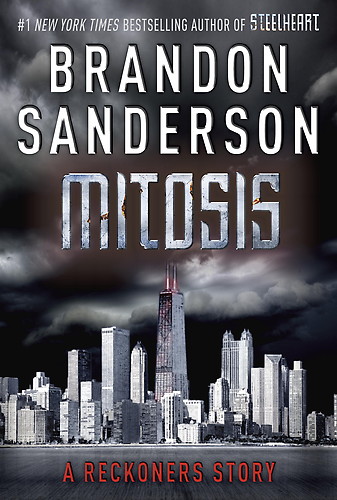
Review: MITOSIS by Brandon Sanderson (Gollancz)

Sanderson-R-MitosisUSA good short story stop-gap between Steelheart and Firefight

Epics still plague Newcago, but David and the Reckoners have vowed to fight back.

Sanderson self-published this short story, set in the same world as his first super-hero novel, Steelheart. I rather enjoyed the novel (which was the first of the author’s that I’ve read), and when I stumbled across this I was very happy to be able to dive back into the world he’s created. I’m not going to include an official synopsis, as that will give away the ending of Steelheart.

Nevertheless, what you need to know (for both the novel and Mitosis) is that in this reality, super-heroes exist – something happened that bestowed upon a small percentage of the global population special powers. Unlike in the super-hero comic books of Marvel, DC, et al, the power has very much gone to most of these powered individuals’ heads, and they started using them for their own ends. In Chicago, Steelheart reigned supreme with a coterie of other powereds. Steelheart the novel was the story of a fight against this tyranny, spear-headed by an insurgent group known as the Reckoners and their new ‘recruit’, who is a bit of a geek, and has been cataloguing the powered dictators and criminals as a means to learn of their weaknesses.

Mitosis deals with a single powered individual: Mitosis. The story moves quickly, and there is a rather nifty homage (perhaps) to Agent Smith from second and third The Matrix movies. That is all I shall say on the specific plot of this story.

If you are familiar with Sanderson’s writing – be it The Way of Kings or his Mistborn series – then you are sure to know what to expect: brisk, engaging and professional storytelling. The man can certainly write, and I intend to get more of his novels read by the end of this year. [Famous last words, perhaps, but I managed to read three of the four authors I promised to last year…]

Short, but well-worth reading to hold you over until the release of Firefight.

***

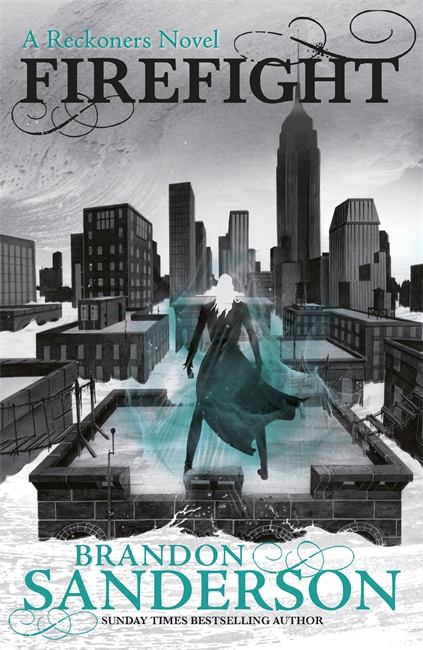
UPDATE: When I first wrote this, Gollancz had yet to announce the UK cover art, which I have now included below. The UK hardcover edition also includes an excerpt from Firefight and also some character sketches. It’s a really great little book. Perfect for any fan of Sanderson’s writing.

Sanderson-R2-FirefightUK

Upcoming: “Vengeful Spirit” by Graham McNeill (Black Library)

McNeill-HH-VengefulSpiritI’ve already posted the full artwork for Graham McNeill’s next Horus Heresy novel, Vengeful Spirit. Now, however, I’ve managed to dig up a synopsis, which gives me another opportunity to feature it – I’m sure everyone who reads CR is fully aware of how much I enjoy the HH series of novels and short stories. So, without further ado…

On the planet of Molech, the Titan Legions go to war against the armies of Horus.

Once the favoured son of the Emperor of Mankind, the name of Horus has become a curse to the loyal defenders of the Imperium, and a rallying call to the traitor forces tearing across the galaxy. While their allies wage war on a thousand different fronts, the XVIth Legion descend upon the Knight World of Molech – home to House Devine and their feudal levies, and a principal seat of Imperial military power. Just what could have drawn Horus to attack such a strongly defended planet, and what might he be willing to sacrifice to fulfill his own dark destiny?

I’m still not 100% sure when this is going to be released – Amazon UK has September 2014 listed as publication, but Black Library often releases things a little earlier through their own store/website. So maybe a couple months earlier? Needless to say, whenever it’s available, I can’t wait to read it.

The Horus Heresy: Horus Rising, False Gods, Galaxy in Flames, Flight of the Eisenstein, Fulgrim, Descent of Angels, Legion, Battle for the Abyss, Mechanicum, Tales of Heresy, Fallen Angels, A Thousand Sons, Nemesis, The First Heretic, Prospero Burns, Age of Darkness, The Outcast Dead, Deliverance Lost, Know No Fear, The Primarchs, Fear to Tread, Shadows of Treachery, Angel Exterminatus, Betrayer, Mark of Calth, Promethean Sun, Scorched Earth, Vulkan Lives, Scars (episodes I-III, IV-IX, X-X11), The Unremembered Empire

Upcoming: “The Truth About the Harry Quebert Affair” by Joël Dicker (Maclehose Press)

DickerJ-TruthAboutTheHarryQuebertAffairUKI’ve been seeing a lot of buzz surrounding Joël Dicker’s latest novel, The Truth About the Harry Quebert Affair. Last year, I started reading more (literary) fiction, and I’ve become as keen on finding new novels in all genres, and not just SFF, to feature on here. I’ve become particularly interested in American literary fiction – author such as Michael Chabon, Donna Tartt, Richard Russo, and Claire Messud to name but four (all but one of whom have featured on the blog already). It was therefore interesting to me that Dicker’s novel has created such a storm (it has sold over two million copies on the continent) and that it has even been hailed as having “all the elements of the Great American novel” (La Croix), despite Dicker actually being Swiss. Now that Maclehose Press has unveiled the UK artwork for the novel, I thought it a good time to post a quick something about it.

The novel is translated by Sam Taylor, who also translated HHhH. Here’s the synopsis…

Who killed Nola Kellergan?

Marcus Goldman, the toast of the New York literary scene, is at his wit’s end after being struck by writer’s block. Desperate not to lose his new found fame and in search of inspiration he decides to spend a few weeks in New Hampshire at the home of Harry Quebert, world famous author and his mentor from university.

During his stay, Marcus discovers that in 1975, aged 34, Harry had an affair with 15 year old Nola Kellergan. The summer of their affair, Nola disappeared after she was seen running through the woods, covered in blood. No one has seen Nola since and no one knows what happened.

Then the unthinkable happens, 33 years after her disappearance, the body of Nola Kellergan is found in Harry’s garden. Determined to prove Harry’s innocence, Marcus gets embroiled in the murder case of the century, while everywhere in America people are asking: Who Killed Nola Kellergan?

Not just a book about an unsolved murder case, The Truth about the Harry Quebert Affair explores the price of fame and the seduction of success, the ferocity of the publishing industry and the power of the media, love in all its forms and what it means to be a truly great writer.

The Truth About the Harry Quebert Affair is published in the UK by Maclehose Press, in May 2014.