Review: DEVIL SAID BANG by Richard Kadrey (Voyager)

Kadrey-4-DevilSaidBangUKHow do you rule the unruly? Sandman Slim in Hell! Again…

While ruling the denizens of darkness does have a few perks, James Stark isn’t exactly thrilled at the course his career (not to mention his soul) has taken. Breaking out of Hell once was a miraculous trick. But twice? If anyone can do it, it’s Sandman Slim. While he’s working out the details of his latest escape plan, Slim has to figure out how to run his new domain and hold off a host of trigger-happy killers mesmerized by that bulls-eye on his back. Everyone in Heaven, Hell, and in between wants to be the fastest gun in the universe, and the best way to prove it is to take down the new Lucifer, aka Sandman Slim aka James Stark.

Then again, LA isn’t quite the paradise it once was since he headed south. A serial killer ghost is running wild and his angelic alter-ago is hiding somewhere in the lost days of time with a secret cabal who can rewrite reality. And starting to care about people and life again is a real bitch for a stone-cold killer

Ah, Sandman Slim… One of the best Urban Fantasy series on the market reaches its fourth volume. If you’re looking for a gritty tale of Heaven, Hell, Nephilim, batshit crazy supernatural people and creatures, weird hoodoo, and weird shenanigans, there’s really no better series or author to turn to. This series is a must-read.

[Disclaimer: There are some minor spoilers for the previous books in the series, but I’ve tried to keep the review short and to-the-point.] Continue reading

“God’s War” by Kameron Hurley (Night Shade/Del Rey UK)

Hurley-GodsWar

The start of a new, unconventional SF trilogy

Nyx had already been to hell. One prayer more or less wouldn’t make any difference…

On a ravaged, contaminated world, a centuries-old holy war rages, fought by a bloody mix of mercenaries, magicians, and conscripted soldiers. Though the origins of the war are shady and complex, there’s one thing everybody agrees on…

There’s not a chance in hell of ending it.

Nyx is a former government assassin who makes a living cutting off heads for cash. But when a dubious deal between her government and an alien gene pirate goes bad, Nyx’s ugly past makes her the top pick for a covert recovery. The head they want her to bring home could end the war – but at what price?

The world is about to find out.

This is an unconventional, highly original and enjoyable debut sci-fi novel. I took my sweet time getting to it, for reasons I cannot fathom, but since its release in 2010 it’s received a lot of positive coverage from around the blogosphere. And now I know why. It’s not going to be to everyone’s taste, but it’s tightly written, well-constructed (for the most part), and… well, bonkers. I enjoyed this.

It also has one of the greatest, make-you-sit-up-and-take-note first sentences: “Nyx sold her womb somewhere between Punjai and Faleen, on the edge of the desert.”

The short Part One is a rapid-fire, near-riotous introduction to Nasheenian society and our main protagonist, Nyx. She is a somewhat troublesome, sometime rogue “bel dame” (a sanctioned bounty hunter and enforcer, I suppose). She’s been doing work on the side, which she really shouldn’t, and her sisters do not take kindly to this. We get a few hints of her past, but not too many until very near the end. She is caught, punished and imprisoned. Then we jump forward about seven years, and Nyx has moved on from her bel dame past and is working as a bounty hunter with a motley crew of violent and eccentric misfits.

The story is pretty grim, overall. The two main nations featured are at war with each other, and have been for quite some time. The two sides are constantly experimenting with new and innovative ways of causing mass-murder, often utilising the novel’s greatest creating: the bug-related bio-tech. (This is why the term “bugpunk” has been coined, and you’ll quickly see how suitable it is.) Nyx can be brutal (emotionally and physically) to those close to her. She’s reckless, cavalier, and self-destructive. Rhys, her pet magician (and the second ‘main’ character), is long-suffering, but they have a really interesting dynamic. They embody everything about each other’s culture that they don’t like, and yet they are drawn to each other nevertheless, and have created a mutually beneficial arrangement that seems to suit them both.

Hurley’s characters are pleasantly diverse, and I liked the imbalance towards more female characters. (Nasheenian society is matriarchal.) I enjoyed the way Hurley wrote them all, and I think she’s created a great society and world with which to keep writing in and for fans to keep reading (there are two more books in the series). Rasheeda, in particular, is creepy as all get out. And bonkers. The inclusion of shape-shifters was interesting, too (all that mucous must be a bit of a bitch, though…). The characters are interesting, three-dimensional and felt distinct from each other. I particularly liked Nyx’s crew, who created a dysfunctional family to follow. Rhys was a great character, and I liked all of his P.O.V. chapters. He’s a good lens through which we learn of the Nasheenian matriarchal society and the differences between that and his own, highly conservative Chenjan culture.

Bugs! Let’s get back to the bugs for a moment. They are everywhere and in almost everything: medicine (needles have eyes, because they seem to be specially engineered creatures), magicians control them for various means (healing, torture, light, espionage, security and surveillance, communications, etc.), and even some weapons have biological components. “Bio-tech”, in other words, on this world, is really “bug-tech”. Maybe my favourite things about this were the “bakkies”, which seem to be semi-organic (at least) buggies or cars. It’s all very weird, but detailed and very well-devised and realised on the page. Hurley never delves too deeply into how it all works – she gives us just enough to know what to picture, and then gets on with the story. Once the book ended, though, I felt like I had a pretty clear picture of how it all worked and fit together. Very cool.

Elements from early on in the novel are tied up quite nicely by the end (there’s a nice circle to the narrative). As a first novel, there is of course a lot of world-building going on, almost all of it very good and often fascinating, intricate. This can sometimes feel like it’s taking over the story, however: relegating the bounty hunt (or “note”, as it’s referred to on this world) to a near-peripheral status. I didn’t mind so much, as I enjoy reading about the world and its various societies. That being said, there were definite times when I had to remind myself that there was a narrative running through this, and it wasn’t just an exercise in imaginative social and cultural creation. This makes the end a little bit busy, in my opinion, although I will accept that I was distracted by the world-building, so I may have missed a couple of salient points from early on.

The writing is very good. I was willingly pulled on through the story, and read it relatively quickly.

Ultimately, I really enjoyed God’s War and, while flawed, I can certainly see how it has grabbed the attention of a number of discerning SFF fans. As I said, it’s unconventional, but it also draws from a lot of SFF traditions and plays around with almost all of them in new and interesting ways. Highly original, it really is about time God’s War was picked up by a UK publisher – which it now has been, by Del Rey UK (who are proving to have a pleasingly eclectic taste in titles).

Definitely recommended. I’ll be reading Infidel quite soon, followed shortly thereafter that by Rapture (both of which I already have from the US).

Wonder Woman, Vol.2 – “Guts” (DC)

WonderWoman-Vol-02Writer: Brian Azzarello | Artist: Cliff Chiang (#7-8, 11), Tony Atkins (#9-10), Kano (#10) | Inks: Dan Green (#9-) | Colors: Matthew Wilson

Wonder Woman goes to hell! After playing Poseidon, Hades, and Hera against each other, Hades strikes back by kidnapping Zola and trapping her in the Underworld. It’s up to Wonder Woman — with a little help from the God of Love and the God of Smiths — to break Zola out. But what is Hades’ real game, and once you get into the land of the dead, how exactly do you get out?

Collects: Wonder Woman #7-12

I rather enjoyed the first collection of Azzarello’s run on Wonder Woman. Chiang’s artwork is great, and Azzarello’s story has some surprises and is a pretty interesting interpretation of Greek Mythology. Where the first collection, “Blood” was strong, “Guts” didn’t live up to my expectations as much as I had hoped – mainly because there’s a bit of a weak middle-section. Otherwise, though, this is still pretty interesting and it does end on a strong note.

One of the first things that jumped out at me in this book is the sinister, predatory, almost evil character Azzarello imbues the Amazons with (it involves the methods they employ to reproduce…). Wonder Woman and her allies have travelled to Mt. Aetna, seeking the help from Hephaestus (the gods’ weapon-maker). Over the course of the first chapter of “Guts”, we learn of the fate of male offspring of the Amazons, which shocks Diana’s impression of the Amazons’ culture to the core.

While in the company of Hephaestus, we also get the Wonder Woman-equivalent of the “Guns, lots of guns” scene in The Matrix. Only, they don’t just pick up guns (Wonder Woman has, initially, a more conventional, traditional approach to weaponry).

WonderWoman-08-InternalArt1

Issue #9 onwards dropped a little in quality, I must say. The story becomes a little more odd, and gets just a tad silly. I still really enjoy the depiction of Greek mythology and so forth, but the story just didn’t feel as strong as past issues. The ending to issue #10 was… A bit meh, too. I’m not sure if it was meant to be a morality tale, or a clunky attempt at a future-redemption tale. Or if it was just a long lead up so they could have that final page, when Wonder Woman employs Eros’s guns in a particular way. I’m just not sure what to make of it. I didn’t hate it by any means, but it was an oddly-written issue.

Ultimately, Wonder Woman has become a tale of squabbling families, deals and bloody betrayals. Which is rather appropriate, I think, given the Greek Mythology that infuses Azzarello’s version of the Wonder Woman story (I have no experience reading any previous Wonder Woman series or storylines, so I can’t comment beyond this). The final chapter ends with a nice twist, before offering quite the tease for the next story arc.

I really love Cliff Chiang’s artwork. Atkins & Kano’s issues/chapters do a very good job of matching Chiang’s style, but we start to see some odd touches coming through (for example, exaggerated facial expressions – particularly Strife’s). Thankfully, Chiang returns for issues #11 and #12. The depiction of Hell is pretty interesting, too.

WonderWoman-08-InternalArt5

Although, I’m not sure why a Greek god would re-create a hellish version of London… (Despite some earlier issues taking part there, Diana and everyone else in this series is either a Greek God/myth or American, so London is an odd choice, no?)

WonderWoman-08-InternalArt4

To be honest, I didn’t like this collection as much as Volume 1. Despite the very strong artwork and aesthetic, Azzarello’s story (particularly the botched wedding/romance with Hel in the middle) just failed to grab my attention. Nevertheless, apart from that mid-point wobble, it is still not a bad read – I just think there have been better issues in the series, and Azzarello has definitely produced some better comics. If you’re a fan of more “modern” approaches to classic comic heroes, then I think you’ll find something in here to enjoy and meet your needs.

WonderWoman-Vol.2-Content

Original Issue Cover Art

***

Further Reading: The Atlantic ran a story on their website about Azzarello’s Wonder Woman, “Wonder Woman’s Violent, Man-Pandering Second Act” by Noah Berlatsky (who also runs Hooded Utilitarian), which I thought others might find interesting. I also had more to say about the article than I did about the book, so if you’ll indulge me…

WonderWoman-MarstonArticleImageBerlantsky believes Azzarello has betrayed the original intent of Wonder Woman’s creator. William Marston, who seems to have been quite the polymath in his day, created the character of Wonder Woman sometime in the mid-1940s, in reaction to the comics available at the time. Me being me, I tracked down the original article, and it’s pretty interesting, so I’ve included a couple of quotations from it, below.

In The American Scholar, Marston wrote that, “from a psychological angle” the comics of that era’s “worst offense was their blood-curdling masculinity.” (In “Why 100,000,000 Americans Read Comics”, Winter 1943/4 issue, pp.35-44, in case you’re interested in tracking it down). Berlantsky offers a nostalgic run-down of the classic ideals Marston brought to his series (space kangaroos!), and then moves on to how Azzarello has broken with it. I should mention from the outset that all I’ve read of the character has been the first two volumes of the New 52 series, and a few Justice League-related books (including Geoff Johns’ New 52 iteration of that series as well).

I won’t deal with everything from The Atlantic article, but there is one thing I’d like to pick up on. Specifically, the guns.

He takes particular objection to Chiang’s cover pieces that depict Wonder Woman wielding Eros’s guns:

“Chiang’s interior cover for issue #8 shows Wonder Woman leaping from the side, shooting two golden pistols while discarded golden shell cases rain down around her — the insufficiently swaggering golden lasso nowhere in sight. Elsewhere in the series, we get to see Wonder Woman shot in the chest; a woman displaying her gashed open and bleeding arms, a giant devouring monster zombie creature, and another interior cover showing Wonder Woman with a death’s head toting those cool golden guns again.”

Berlantsky has a point, in some respects. But, given the ending of issue #10 (which I mentioned above), there is a little bit more to it than the chance to just give Diana big, gold-plated (shiny!) guns. I do agree with him that the ending is “banal”, but perhaps I wouldn’t have used quite as strong a word. When maybe I should have. He goes on:

“The fact that the guns belong to the god Eros, and shoot bullets of violent infatuation just emphasizes that, for Azzarello, even love is a blood-curdling business best expressed through phallic firepower.”

Also possible, but part of me thinks Azzarello’s use of pistols may be more of a nod to Baz Lurman’s Romeo & Juliet (“Take up your .45-Magnum-semi-automatic swords!”) and the inspiration for updating classical weaponry for more modern firepower. I have absolutely no proof of this, though, so it’s entirely possible I’m wrong. It’s just an optional theory.

I think Berlantsky’s right, though, about Azzarello & Co.’s “eagerness to demonstrate the adultness of the adult content” of the New 52 series. But, I think he sadly does not appreciate Azzarello’s take on Greek Mythology:

“each [god/character] is rolled out to demonstrate their cool-as-shit, bad-ass powers and complicated dynastic motivations. Everybody – Hades, Wonder Woman, everyone – bargains and schemes and betrays and manipulates everyone else. It’s a god-eat-god world out there – and one built, in every way, on blood”

This is, actually, a pretty faithful interpretation of Greek mythology. In some ways, then, despite the obvious added masculinity, Azzarello has returned Diana’s story and that of her supporting cast to a point closer to the source material? True, this defeats the intended “purpose” (for want of a better word) of the original series, but it is nevertheless an interesting story. Comics writers are frequently criticized for trying new things with characters (often, it is met with Screaming Denunciation from long-time-fans, and bemused incredulity from newer readers).

Berlantsky’s article has an interesting omission, though, which I think supports his point even better than Diana taking up twinned fire-arms. One could argue that there is even more “blood-curdling masculinity” in the way Azzarello changes Diana’s classic weapon. Berlantsky says the guns are more attractive to the “(much smaller) audience of (mostly) men in their 20s, 30s, and 40s” than Wonder Woman’s Lasso of Truth. (I always thought it was a whip, but that could just say something about me…) In this book, Hephaestus gives Diana a different whip (definitely a whip this time), which can cause some pretty nasty, fiery damage/pain/destruction. Surely it is the bastardisation of her traditional weapon (“tool”? “Accessory”?), the one that set her apart as the hero who settles conflict non-violently, that is more indicative of the shift Berlantsky wants to highlight?

Ultimately, the article finishes on a note I agree with: the justification of (using Berlantsky’s terminology) “blood-curdling masculinity” as a short-hand for “maturity and realism”. Or, in fantasy community terminology, short-hand for “grimdark”!

“But making Wonder Woman more violent doesn’t make her more mature or more real. It just makes her more conventional.”

Not mentioned in Berlatsky’s article is a Marston quotation, also from The American Scholar, his reaction after an attempt to submit Wonder Woman to a comics publisher:

“A male hero, at best, lacks the qualities of maternal love and tenderness which are as essential to a normal child as the breath of life. Suppose your child’s ideal becomes a superman who uses his extraordinary power to help the weak. The most important ingredient in the human happiness recipe still is missing – love. It’s smart to be strong. It’s big to be generous. But it’s sissified, according to exclusively masculine rules, to be tender, loving, affectionate, and alluring.”

WonderWoman-MarstonArticleImage2

A lot of the article is rather dated, but there’s something nice about reading an article by a writer back in the 1940s who was so clearly irritated by male-domination of comic literature. I also rather liked this passage from Marston’s article, with regards to why people read comics:

“Nine humans out of ten react first with their feelings rather than with their minds; the more primitive the emotion stimulated, the stronger the reaction. Comics play a trite but lusty tune on the C natural keys of human nature. They rouse the most primitive, but also the most powerful, reverberations in the noisy cranial sound-box of consciousness, drowning out more subtle symphonies. Comics scorn finesse, thereby incurring the wrath of linguistic adepts. They defy the limits of accepted fact and convention, thus amortizing to apoplexy the ossified arteries of routine thought. But by these very tokens the picture-story fantasy cuts loose the hampering debris of art and artifice and touches the tender spots of universal human desires and aspirations, hidden customarily beneath long accumulated protective coverings of indirection and disguise. Comics speak, without qualm or sophistication, to the innermost ears of the wishful self. The response is like that of a thirsty traveler who suddenly finds water in the desert – he drinks to satiation.”

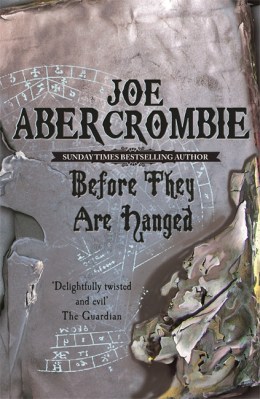
Review: BEFORE THEY ARE HANGED by Joe Abercrombie (Gollancz/Pyr)

AbercrombieJ-FL2-BeforeTheyAreHangedUK1The awesome, second novel in the First Law trilogy

Bitter and merciless war is coming to the frozen north. It’s bloody and dangerous and the Union army, split by politics and hamstrung by incompetence, is utterly unprepared for the slaughter that’s coming. Lacking experience, training, and in some cases even weapons the army is scarcely equipped to repel Bethod’s scouts, let alone the cream of his forces.

In the heat-ravaged south the Gurkish are massing to assault the city of Dagoska, defended by Inquisitor Glokta. The city is braced for the inevitable defeat and massacre to come, preparations are made to make the Gurkish pay for every inch of land… but a plot is festering to hand the city to its beseigers without a fight, and the previous Inquisitor of Dagoska vanished without trace. Threatened from within and without the city, Glokta needs answers, and he needs them soon.

And to the east a small band of malefactors travel to the edge of the world to reclaim a device from history – a Seed, hidden for generations – with tremendous destructive potential. A device which could put a end to war, to the army of Eaters in the South, to the invasion of Shanka from the North – but only if it can be found, and only if its power can be controlled…

I am a relative newcomer to Joe Abercrombie’s First Law series. Despite buying (and subsequently losing) all of his novels. I read the first book, The Blade Itself, and while I enjoyed it a great deal, I didn’t quite see the genius that so many of my friends and fellow reviewers saw. Then I read Before They Are Hanged. NOW I get it. This is a fantastic book, that had me hooked from the first page onwards. Joe Abercrombie is, frankly, a fantasy genius. Continue reading

Gotrek & Felix: “The Reckoning” by Jordan Ellinger (Black Library)

Ellinger-G&F-TheReckoningA Novella from the Upcoming Gotrek & Felix: Lost Tales

Gotrek and Felix: unsung heroes of the Empire, or nothing more than common thieves and murderers? The truth perhaps lies somewhere in between, and depends entirely upon whom you ask… Summoned back to Barak Varr by the outraged King Grundadrakk, the pair discover that a terrible crime has been committed – the dwarfen hold’s Book of Grudges has been stolen, right out of its sealed vault. Given that his own name appears upon its fading pages, Gotrek is honour-bound to join an expedition to recover the ancient tome. How far will the trail lead, and just what manner of individual would seek to rob the dwarfs of their vengeful legacy

I’m not a fan of buying novellas individually if they will be released later in a collected anthology, but when The Reckoning was released, I really fancied a short dip back into the Warhammer setting with my two favourite characters. And luckily, this story is really rather good.

To be honest, The Reckoning didn’t start too well, as the captain of the Dorabella was given a bit of a cliché accent. (The Dorabella is the ship on which our heroes are fleeing a mob intent on capturing them for… something they may or may not have done.) The story is set twenty years since the Window Tax Riots in Altdorf, the event that resulted in Gotrek and Felix’s first encounter – and, as can happen from time-to-time, after much alcohol resulted in Felix pledging to write Gotrek’s epic.

A group of heavily armoured Dwarfs attack the Dorabella, board it and apprehend our much-put-upon heroes. Apparently, Gotrek committed a crime before leaving Barak Varr (which he visited on his way to the Slayer Shrine to make his oath).

The best thing about this novella is the amount of detail it adds to Gotrek’s back-story. We learn a little more of his life pre-slayerdom. For example, I don’t remember knowing before this that he was a master engineer (it’s entirely possible I just forgot – there have been quite a lot of novels, now…).

“Where are we going?”

Gotrek’s single eye glittered. “To Barak Varr. I want to see for myself how these fools let someone into my vault.”

After examining the vault, Gotrek, Felix and their Dwarven captors recognise that there’s something else entirely going on, and so they descend into the tunnels below Barak Varr. As is so often the case with Gotrek and Felix, they are in pursuit of the mischievous and malicious Skaven, who have apparently stolen something very dear to the Dwarfs. We don’t really get to know the new dwarf characters as well as I would have liked, but it is by no means much of a problem – the action comes fast and often, and the story moves along at a good clip. The Skaven they are after are also an interesting, Goulding-Gotrek&Felix-LostTalesunique bunch, and I think Ellinger’s done a great job writing a new spin on the neverending war between the rat-kin and Dwarfs. (I won’t spoil what it is, but it’s well-written and executed.)

The Reckoning reminded me of the early Gotrek & Felix short stories, and particularly those found in Trollslayer. The atmosphere, the tight prose, and the sword-axe-and-sorcery fun. It was, therefore, very enjoyable and a most welcome addition to the series.

Overall, then, this is a really good novella, and I’m now really looking forward to reading the other three in Gotrek & Felix: The Lost Tales, which will be published in August 2013. I really don’t know why I’m still taking so long to read Josh Reynolds’s Gotrek & Felix: Road of Skulls novel… (Soon!)

Guest Review: “What Lies Within” by Tom Vowler (Headline)

Vowler-WhatLiesWithinA tightly spun, atmospheric and powerful psychological suspense.

Reviewed by Milo Milton-Jefferies

Living in a remote Devon farmhouse, Anna and her family have always been close to nature, surrounded by the haunting beauty of the moor. But when a convict escapes from nearby Dartmoor prison, their isolation suddenly begins to feel more claustrophobic than free. Fearing for her children’s safety, Anna’s behaviour becomes increasingly irrational. But why is she so distant from her kind husband Robert, and why does she suspect something sinister of her son Paul? All teenagers have their difficult phases…

Meanwhile, a young idealistic teacher has just started her first job, determined to ‘make a difference’. But when she is brutally attacked by one of her students, her version of events is doubted by even those closest to her. Struggling to deal with the terrible consequences, she does what she can to move on and start afresh.

As the two narratives converge, the tension builds to a devastating denouement, shattering everything you thought you believed about nature, nurture and the true meaning of family.

There are several reasons why I love being a part of the blogging community, but I think one of the more important reasons is that there are literally loads of novels out there that I would never have heard of and discovered were it not for reviewing. When Stefan offered me the chance to guest review What Lies Within by Tom Vowler, I leapt at the chance, and this book turned out to be a very enjoyable reading experience, despite the fact I went into it knowing almost nothing about the book, except for the blurb and the cover.

The first thing that drew me to What Lies Within was that its location, Devon (for all you international readers, a county towards the south-west England), is where I live, and I don’t get the chance to read novels set in the same county as me very often, due to the fact that I’m a big reader of SFF books and very rarely do these take place in the English Countryside. So, I was willing to give Vowler the benefit of the doubt, and gave this book a try…

… And I was pleasantly surprised. This book deals with a touchy subject that not many people may feel comfortable with reading, and I couldn’t help but be compelled to support the teacher when reading this book, especially after all the things she’s subjected to. The theme of What Lies Within is essentially having to remain a good person even while you’re suffering bad events. What I liked about this book was that it really keeps you reading. It is hardly a comfortable read, mainly due to the subject matter, but What Lies Within is nonetheless an enthralling read.

And there’s a slow and gradual build up to this story. This book is very much a character-focused book as opposed to a plot-centric one. When I first read What Lies Within’s blurb, I mistakenly thought it would be a hunt for an escaped convict-type novel. But the book is far more than that, and an interesting read.

The story is told in the “present”, but the use of flashbacks is very interesting and develop over the course of the novel, as we learn more about certain events and discover that all things are not as initially clear-cut as we imagine them to be. Vowler has some strong, positive writing and really captures Anna’s personality. She’s a character with a harsh background and the author paints a sympathetic and empathetic picture of our protagonist.

I don’t want to give away the twist in the book, but it’s a pretty powerful one. What Lies Within is a book that’s full of surprises, and I am struggling to think of anything negative to say about it.

Review: THE DAYLIGHT WAR by Peter V. Brett (Voyager/Del Rey)

BrettPV-DC3-DaylightWarUKThe long-awaited third book in The Demon Cycle

On the night of a new moon all shadows deepen.

Humanity has thirty days to prepare for the next demon attack, but one month is scarcely enough time to train a village to defend themselves, let alone an entire continent caught in the throes of civil war.

Arlen Bales understands the coreling threat better than anyone. Born ordinary, the demon plague has shaped him into a weapon so powerful he has been given the unwanted title of saviour, and attracted the attention of deadly enemies both above and below ground.

Unlike Arlen, Ahmann Jardir embraces the title of Deliverer. His strength resides not only in the legendary relics he carries, but also in the magic wielded by his first wife, Inevera, a cunning and powerful priestess whose allegiance even Jardir cannot be certain of.

Once Arlen and Jardir were like brothers. Now they are the bitterest of rivals. As humanity’s enemies prepare, the only two men capable of defeating them are divided against each other by the most deadly demons of all: those that lurk in the human heart.

After finishing The Desert Spear, it was not long before I had to dive into The Daylight War. I’d come late to the series, so I hadn’t been champing at the bit quite as much as other fans, but after finishing book two, I could certainly see why people were so very eager. The third book in the series continues to build on the excellent foundations of The Painted Man and The Desert Spear, as the story moves ever forward. This is an addictive, immersive and excellent fantasy novel. Continue reading

Amazing Spider-Man: “Died In Your Arms Tonight” (Marvel)

AmazingSpiderMan-600-ArtWriters: Dan Slott, Stan Lee, Mark Waid, Bob Gale | Artists: John Romita, Jr., Marcos Martin, Colleen Doran, Mario Alberti | Inks: Klaus Janson | Colors: Dean White, Jose Villarrubia, Javier Rodriguez

The return of Doctor Octopus, Daredevil, a wedding you never predicted, and the return of one of the most important people in Peter Parker’s life. Doc’s back in town, but it’s only a prelude to darker days ahead as Spidey unknowingly prepares for a gauntlet he can’t predict. Also, several short features showcase some rarely-explored aspects of both Spidey and Peter’s life. And, finally, the second most important wedding day of Peter Parker’s life.

Collects: Amazing Spider-Man #600-601, Amazing Spider-Man Annual #36,
& material from Amazing Spider-Man Family #7

The book is rather uneven. It’s bitty, highly episodic, and the tone veers all over the place, dependent on the writer. The humour works at times, but at others it feels like it is trying so hard, it’s difficult to like it at all (imagine the quippiness of Gilmore Girls, but with a wall-crawling super-hero). It took longer than I expected to read all of this, as I just couldn’t get sucked in. It is not, however, without its moments. Thankfully, the book improved, once we got beyond the first, mammoth issue.

First up, let me just deal with the “Spider-Man Covers You’ll Never See!” features, which are sprinkled throughout the book. They’re crap, and pointless. Moving on…

AmazingSpiderMan-600Issue #600 of Amazing Spider-Man is 101 pages long, including the cover and back-matter/extras (I was reading this via the comiXology app), and man did it drag at times. I’m not wholly new to Spider-Man or the characters that surround him. I’ve read a number of issues from all over the series chronology, as well as other Spidey series. So I wasn’t exactly lost while reading this, but there were times when I just wondered why the hell I should care at all.

“LAST LEGS”

Writer: Dan Slott | Art: John Romita, Jr. | Inks: Klaus Kanson | Colors: Dean White

In this story, Spidey’s incessant quipping was frankly exhausting. Maybe 10% of the comments, retorts and jokes were enough to raise a smile. That is certainly not a success rate that one might expect from such a popular series. Doctor Octopus is a complete cartoon, and his dialogue is just awful and cliché, and had me cringing on almost every page. I was very disappointed. The story dragged, the wedding stuff preparations and Spidey’s ongoing conflict with Mayor Jameson were simply tedious. I’ve read some later Spider-Man stuff written by Slott, and it’s clear to me that he got much better over time, as he became more comfortable with the characters. Given what I know about Superior Spider-Man, and the end of Amazing Spider-Man (issue #700), I can see some foreshadowing.

AmazingSpiderMan-600-Interior3

“IDENTITY CRISIS”

Writer: Stan Lee | Art: Marcos Martin | Colors: Javier Rodriguez

In this first back-up-style story, Spidey has visited a shrink. He reflects on his many, many years of adventures. The writing was a little weak, but the premise was strong: Spider-Man basically goes through all the (very) weird events and experiences that have happened over the course of the 600 issues of the series to this point. There’s a nice, knowing nod and a wink regarding the comics industry’s tendency to upend the lives of their various characters, not to mention ret-conning, poor artistic and narrative decisions, and other things like that. It was amusing, but I do think it could have been better, if written by someone else.

“MY BROTHER’S SON”

Writer: Mark Waid | Art: Colleen Doran | Colors: Jose Villarrubia

This short tale is told from the perspective of Uncle Ben. He’s reflecting on his insecurities about raising Peter, after the death of his father. We see how much he worries about his nephew, how much he misses his brother. It builds nicely, and eventually Ben and Peter confront his concerns. It’s calm, not at all melodramatic. And it is actually a wonderful, moving story. Superb.

“IF I WAS SPIDER-MAN”

Writer: Bob Gale | Artist: Mario Alberti

This story has slightly rougher artwork than the previous stories, but it is a fun story of kids philosophizing (as they are wont to do) about how they would “be” Spider-Man, if they got the chance. They go through all of the things that would be so cool, and the ways in which they’d use their powers for celebrity and other selfish purposes. But then move on to the concerns they have.

“It’s just WRONG — that Spider-Man is cool, but BEING Spider-Man isn’t cool. That’s, like, so totally messed up.”

Tell me about it, thinks Peter Parker, as he wanders past…

“THE BLESSING”

Writer: Marc Guggenheim | Artist: Mitch Breitweiser | Colors: Elizabeth Breitweiser

Aunt May, pre-wedding to Jameson Snr., is visiting Uncle Ben’s grave. She talks to him, going over her various fears, her worry that she might appear to be replacing Ben. It’s a short diversion. Sweet story, interesting art style, but thin and ruined by a silly, schmaltzy ending.

“FIGHT AT THE MUSEUM”

Writer: Zeb Wells | Artist: Derec Donovan | Colors: Antonio Fabella

Wells is also the author of the first few issues of the awesome Avenging Spider-Man. However, this is just another quick jolt of making fun of past bad decisions (the Spider Mobile, in this case). It’s fine, but too short to really do anything beyond make long-time fans chuckle. (In itself, no bad thing, it’s true.)

“VIOLENT VISIONS”

By: Kelly, Fiumara, Chuckry & VC’s Caramagna

This was a very dark and very cool short: it’s clearly a prologue, of sorts, for “The Gauntlet” storyline, which ran from #6??-#6?? (and was collected into five books). I’m quite intrigued by this upcoming story, now, I must say. I had been cool on this whole series (despite picking up the first two collections from #600) at this point, but this short certainly made me sit up and take note.

***

AmazingSpiderMan-601Writer: Mark Waid | Artist: Mario Alberti | Colors: Andres Mossa

Which brings us, after waaay too long, to issue #601. This one features a famous cover – of Mary Jane Watson, sitting suggestively on the couch, breasts pressed together, as Spidey swings off out the window. I have a feeling someone recreated this at some point, perhaps the guy behind Collectors…?

This issue finally picks up the main story from the end of #600. Mary Jane Watson has returned to New York, which has distracted Peter no end. It kicks off the morning after the wedding, with Peter waking up, very hung-over. He turns over, and sees a woman in his bed, who he believes is MJ. Unfortunately for Peter, it’s not his former flame. Michelle (his not-exactly-platonic-anymore roommate) is especially pissed after Peter calls her “MJ”. Naturally: “You’re the reason there’s a waiting period on handguns!” she screams at him.

AmazingSpiderMan-601-Interior3

The issue had a lot of talk about economic downturn and hard economic and employment times (the issue was published in 2010, so that’s not surprising).

“THE BEST VERSION OF MYSELF”

Writer: Brian Michael Bendis | Artist: Joe Quesada | Colors: Morry Hollowell

This was another pretty cool back-up story: Spidey drops in on Luke Cage’s wife, Jessica Jones, and their baby daughter (she used to be a super-hero, apparently). They talk about Jones’s memories of the first time she ever saw Spider-Man, and how much of an impact it had on her own career as a super-powered-person. Spider-Man convinces her that the best way for her to instill the idea of “With great power comes great responsibility” is to show her the best side of herself, rather than to just tell her. (This story continues in New Avengers, apparently.)

***

AmazingSpiderMan-Annual-36And last, but by no means least, we get to Annual #36.

Writer: Marc Guggenheim | Artist: Pat Oliffe | Inks: Pat Oliffe & Andy Lanning | Colors: Antonio Fabela

The whole Parker and Jameson wedding party has schlepped up to Boston for a special dinner. This, sadly, meant that a lot of the issue was written in a “Bahstin” accent. Rookie, bad writer mistake. It was fine for one or two speech bubbles, but after that, it quickly got old and annoying (not to mention inconsistent). Mid-way through the dinner, some crazy dude called “Raptor” interrupts Peter in the bathroom (uncool), and just starts wailing on him. It turns out, Raptor believes Peter is Ben Reilly – Peter’s clone from a long-running Spider-Man story-arc, The Ben Reilly Epic. There’s more to come from this story, later in the series, and I’ll be interested to see how it unfolds.

AmazingSpiderMan-Annual-36-Interior3

I think the annual should have been placed at the start of the book: chronologically, it would’ve made far more sense, being set before the wedding. It’s not a bad way to finish a book, though. Despite the “Bahstin” accents…

***

So, overall, this book is very hit-and-miss. It’s long, but the first issue makes it feel so much longer. There are moments of excellent story-telling; but there are also swathes of dull, drawn-out and boring sections. If you want to start on Amazing Spider-Man, then there may be a better point either earlier or later in the series. I’ll be investigating later collections (I have already read the follow up to this book, Red-Headed Stranger), so I might be able to give new readers a suggestion for a better starting-point.

Mini-Review: Fatale, Vol.1 – “Death Chases Me” (Image)

CRIM008_cvrWriter: Ed Brubaker | Artist: Sean Phillips | Colors: Dave Stewart

In modern times, Nicolas Lash stumbles upon a secret that will lead him down the darkest path imaginable… to a seductive and ageless woman who’s been on the run since the 1930s.

And in 1950s San Francisco, reporter Hank Raines crosses paths with that same woman and gets caught in a vicious triangle between a crooked cop and a man who is more monster than man.

But who is Josephine and what is her secret? And how many men will die and kill for her?

Collects: Fatale #1-5

Brubaker and Philips’s Fatale is an interesting, if flawed blend of noir-ish thriller and horror suspense and weirdness. The series has enjoyed plentiful good and middling coverage in all comic-related corners of the internet. I’m not really sure I can add much to the discussion, to be honest. After finishing it, I found I had very little opinion on it – positive or negative.

The story is fine: there are corrupt cops; a rash of strange, “cult killings” all over San Francisco. This first volume follows a number of slightly-muddled story-threads, which all lead up to an underground confrontation with a cult-leader (who is a lot more than he appears to be). Josephine appears to have a strange, powerful allure for apparently all men she encounters – and, of course, a mysterious past. Despite my interest in such stories, though, Fatale never really managed to excite my interest beyond the cursory.

The artwork is good, and certainly enhances the atmosphere and noir-feel to the story, but it is sadly not a style I would spend much time lingering over.

I think Fatale would have worked much better as a prose-novel. It was too fast-paced near the end, despite an almost agonizingly-slow build up at the start. Despite my qualms and reservations, it will be interesting to see how the series develops in the second volume, but I wouldn’t rush to buy it. (Luckily, I recently got Volume 2 through NetGalley, so I could get to it a lot quicker than I otherwise would have done).

In conclusion, then, and coming from a huge fan of Brubaker’s other work – specifically his initial run on Marvel’s Captain America (and Winter Soldier), Gotham Central (review coming soon), and also Batman: The Man Who Laughs – I’m sad to say that this was a massive disappointment.

I borrowed Fatale Volume 1 from the local library.

Fatale-Vol.01-Content

Green Lantern, Vol.1 – “No Fear” (DC)

GreenLantern-Vol.1-NoFearWriter: Geoff Johns | Artist: Carlos Pacheco (#1-3), Ethan van Sciver (#4-5), Simone Bianchi (#6) | Inks: Jesus Merino (#1-3), Prentis Rollins (#5) | Colors: Moose Baumann (#1-5), Nathan Eyring (#6)

Hal Jordan is back from the dead – now watch as he re-establishes his life as a pilot. Standing in his way, though, is one of the deadly Manhunter androids followed by the Shark.

Collects: Green Lantern #1-6

After reading Blackest Night, its prequel Agent Orange, and Green Lantern: Rebirth, I’ve finally got around to reading the first collection of Geoff Johns’s pre-New 52 run on Green Lantern proper. And I was… well, not exactly bowled over, but nor was I exactly disappointed. It’s a fun book, and I’m sure it would be a good buy if you’re a fan of the character, but haven’t managed to read that much of his back-story or pre-New 52 adventures.

The first four pages of the book are a blitz-through of the story of how Abin Sur selected of Hal Jordan to be his successor. There’s a mention of the yellow impurity, which was properly explained in Green Lantern: Rebirth. The main story begins, as Jordan is trying to get a new job, back in the US Air Force. He’s struggling a bit, given that the guy he clocked to get his initial discharge is now heading up the program and division he would have to join to get re-upped. Awkward, for sure…

GreenLantern-01-Interior1

The next two chapters focus on a rogue “Manhunter 2.0” and Hal’s attempt to put it down. As it turns out, Manhunters are not so keen on humans…

GreenLantern-02-Interior1

The book is a little uneven beyond this, as we’re informed that an entire, new Green Lantern Corps is being called up, after the ravages of Parallax, which at least means they don’t know what Jordan became and what he did when he was possessed. Very strangely, at the start of one chapter (#4), what appears to be an alien, a gray, stepped out for a cigarette and is hit by a military jeep…

GreenLantern-04-Interior3

There’s a lot of cryptic information and nuggets throughout this book, but it didn’t really feel like it was going anywhere. Jordan goes to see Hector Hammond. Who has a huge head… I wasn’t entirely familiar with the character, but he features in the rest of the book.

In Chapter 5, we get… SHARKS!! Big, f**k-off evil ones. In another example of characters evolving “millions of years” in one go by an apparent freak accident… It gets to the point when it feels a bit like a narrative crutch. Thankfully, we do get an explanation for all this rampant evolution. And also a huge fight against a shark-beast that Jordan apparently has clashed with in the past.

Also, while reading this book, I was initially very confused about the creepy little German-speaking gremlins that kept cropping up at seemingly random moments…

GreenLantern-05-Interior1

In the final chapter, everything is finally tied up, and the German-speaking gremlins are explained. This was really weird. Quirky, not necessarily in a bad way, though. They appear to be experiment-obsessed aliens who like to dick around with others species’ genetics, technology, and evolutionary stage.

GreenLantern-06-Interior2

The artwork throughout is strong, as you can see from the samples included here. It’s not particularly stand-out, but it serves its purpose well – Johns’s story is well-realised. It was not, however, anything I felt particularly strongly about.

“No Fear” is not a bad book, overall, nor is it a bad start to a newly re-booted series. It’s a little bit unfocused, but at the same time it is starting to show signs of the quality I’ve seen in later books and the New 52 Green Lantern (which is the reason I decided to pick this up in the first place). At this point, pre-New 52 Green Lantern isn’t nearly as strong as the first two volumes of the New 52 re-boot. I’m not sure it’s as good for new readers, either. That’s a lot of dissembling after I said it was a good book… But, in view of the series at large, “No Fear” just isn’t as strong as other collected editions or story-arcs. It’s rather quirky, though.

Will I read volume two and beyond? Absolutely. I’m just not in as much of a rush to do so as I was after reading Blackest Night and the New 52 Green Lantern.

GreenLantern-Vol.1-NoFear-Content