“Kill Shot” by Vince Flynn (Simon & Schuster)

Flynn-KillShot

A second novel of Mitch Rapp’s early CIA career

For months, Mitch Rapp has been steadily working his way through a list of men, bullet by bullet. With each kill, the tangled network of monsters responsible for the slaughter of 270 civilians becomes increasingly clear. He is given his next target: a plump Libyan diplomat who is prone to drink and is currently in Paris without a single bodyguard.

Rapp finds him completely unprotected and asleep in his bed. With confidence in his well-honed skills and conviction of the man’s guilt, he easily sends a bullet into the man’s skull. But in the split second it takes the bullet to leave the silenced pistol, everything changes. The door to the hotel room is kicked open and gunfire erupts all around Rapp. In an instant the hunter has become the hunted. Rapp is left wounded and must flee for his life.

I am a huge fan of Vince Flynn’s novels – I’ve read them all except the latest, now. Sadly, the author passed away earlier this year, so there is actually only the one other novel (which I will read A.S.A.P.). Flynn’s novels are action-packed, tightly written, and always a great read. If you’ve never read any of the Mitch Rapp novels (or Term Limits, the set-in-the-same-time prequel of sorts), then I highly recommend that you do. Kill Shot was a little bit different, following on from American Assassin, the first novel set during Rapp’s very early career as a CIA assassin. It’s a very good novel.

The novel starts with a scene between Irene Kennedy and the CIA shrink, Lewis. They’re talking about Rapp, his incredible proficiency and fish-to-water acclimation to his new job – he’s only been with the Company for a year at this point, and is proving brutally efficient and competent at killing…

“I’m talking about the fact that he is a one-man wrecking ball. That he has methodically, in a little over a year, accomplished more than we have accomplished in the last decade. And let’s be brutally honest with each other.” Lewis held up a finger. “The ‘what’ that we are talking about is the stone-cold fact that he is exceedingly good at hunting down and killing men.”

There’s some nice foreshadowing for the future novels set after this discussion between the shrink and Irene (it continues off-and-on during the novel). For example, this snippet, which foreshadows Term Limits…

“Justice is blind, and if you train a man to become judge, jury, and executioner . . . well, then you shouldn’t be surprised if he someday fails to see the distinction between a terrorist and a corrupt, self-serving bureaucrat.”

Rapp, in the meantime, is in Paris, executing one of the terrorists involved in the ring that took down the plane that killed his college sweetheart. The operation doesn’t go as planned, as someone was waiting for Rapp. The next morning, the news breaks in Washington that Libya’s Oil Minister has been killed along with three innocent civilians and four unidentified men. The French authorities are certain that the gunman is wounded and on the loose in Paris. Rapp’s handlers have only one choice, of course: deny any responsibility for the incident and pray that their secret asset stays that way, avoiding capture and dying quietly. Naturally, Rapp is unlikely to do so, and decides to get to the bottom of the situation, and hunt down the rat in the chain of command.

Rapp’s paranoia and relative newness in the business sets in motion a series of events dictated by his training and also belief that he’s been set up by someone very close to him – specifically, and for a short while, the potential that Irene was the one that spilled the beans:

“She was by necessity the person who knew the most about him, and the details of this mission. His orders came from her. If anyone were in a position to set him up it would be her.”

With nobody to trust, he resorts to his wits to get to the bottom of things, as the two sides – Rapp’s and the CIA’s – circle each other, attempting to ascertain the other’s motives. Slowly, though, the truth comes out, and Rapp is able to channel his… attentions in the appropriate direction.

The novel is not as fast-paced as Flynn’s previous novels, and felt slightly drawn out at times. Key events and moments helped maintain interest, however, as we see Rapp growing more into his new role, and everyone else coming to terms with just how good he is at his job. Flynn also offers a fair bit of discussion and commentary on the nature of psychosis and psychopathy and their potential connection to those with careers in the military – especially with regards to special forces.

Given the early setting, it was also interesting to see a different, undeveloped side of Stansfield’s, Irene’s and Rapp’s relationships. They trust his skills, but they have not yet developed the intense bond of trust that we saw even in Transfer of Power (a novel that helped light the fire under my thriller addiction).

I ended up not taking too many notes for this novel – this is not exactly a surprise, when it comes to thrillers or novels that I become engrossed in. It is a very good thriller, and I was drawn on throughout, devouring this far quicker than most novels I’ve read recently.

Overall, this is a very good novel. Not the author’s best, but certainly a must-read for fans of the series and also for thriller fans in general.

Vince Flynn’s final novel, The Last Man, is out now.

Series Chronology: American Assassin, Kill Shot, Term Limits, Transfer of Power, The Third Option, Separation of Power, Executive Power, Memorial Day, Consent to Kill, Act of Treason, Protect and Defend, Extreme Measures, Pursuit of Honor, The Last Man

“Armageddon” by Aaron Dembski-Bowden (Black Library)

DembskiBowden-ArmageddonTwo Space Marine Battles stories from one of Black Library’s best young talents.

++ Grimaldus…

They lied to us about the Mannheim Gap. They sent us there to die. You know of whom I speak. We cannot outrun the echoes of Khattar. We pay the price now for our virtue in the past. The Celestial Lions will never leave this world. A handful of us remain, but we know the truth. We died at the Mannheim Gap. We died the day the sun rose over the scrap-iron bodies of alien gods. ++

++ Message for Black Templars Reclusiarch Merek Grimaldus, From Celestial Lions Deathspeaker Julkhara ++

Armageddon collects Aaron Dembski-Bowden’s early Space Marine Battles novel, Helsreach, and a new novella set shortly after the events of that novel, Blood And Fire. Both are quite different, and as a long-time fan of the author’s it is interesting to compare them – in terms of style, confidence, and story construction. (Though, fear not, this review is not a piece of academic literary criticism.) Overall, I think this collection is very strong, and while the novella is much better than the novel, both are highly recommended for fans of the author, the series, and science-fiction in general.

I’m going to address each part of the omnibus separately, before providing a brief summation at the end.

*

DembskiBowden-HelsreachHELSREACH

When the world of Armageddon is attacked by orks, the Black Templars Space Marine Chapter are amongst those sent to liberate it. Chaplain Grimaldus and a band of Black Templars are charged with the defence of Hive Helsreach from the xenos invaders in one of the many battlezones. But as the orks numbers grow and the Space Marines dwindle, Grimaldus faces a desperate last stand in an Imperial temple. Determined to sell their lives dearly, will the Black Templars hold on long enough to be reinforced, or will their sacrifice ultimately be in vain?

Helsreach is a very strong addition to the Space Marine Battles series. It is a novel that is both excellent, yet also slightly disappointing. It is an excellent example of military science-fiction, with intense and fast-paced battle and action scenes, strong characters, and a tightly written plot.

Given the series parameters (which is far more combat-oriented), though, I felt that Helsreach doesn’t really give the author the space or time to do what he’s best at: getting into the heads of his characters, exploring the light and dark of conflict, and the psychological impacts of warfare at any length. This is a pity, as I think he approached these themes brilliantly in the Knight Lords trilogy and also his Horus Heresy novels. Helsreach remains a strong novel, however, and I think he certainly fulfills the brief of the series. There are still some very good observations sprinkled throughout. For example, the PR benefits of certain tactics and well-timed speeches, and also when the strategic council discusses the morale-boosting benefit of having the Black Templars assembling in formation before sallying forth, pict-feeds beaming the imagery around the embattled/besieged planet. (Noam Chomsky and John Pilger would have been proud of these observations…)

Despite the slightly diminished focus on character development, there are shades of Dembski-Bowden’s skills evident throughout. I can pick out quite easily the scenes that some early reviewers didn’t like, as they do break up the action and slow down the novel just a smidge. I welcomed these quieter moments, though. For example, Grimaldus’s face-to-face with the princeps majoris of Invigilata, Zarha. It was an interesting scene, he in his imposing armour, her floating in an amniotic tank, on the bridge of a vast war machine. Though even this scene was too short, truncated by the need to get to the conflict.

It was nice to see some brief cameos from familiar characters (Commissar Yarrick, for example, most recently immortalised by David Annandale in his truly excellent novella, Yarrick: Chains of Golgotha). There were also a higher-than-normal number of strong or highly-ranked female characters for a WH40k novel, which is another nice touch.

Above all, though, there are fierce Space Marines of the Black Templar chapter – one I don’t know a great deal about. I must, say, though, that they do seem a rather dour and ferocious lot. Makes for interesting reading. There are also orks. Lots and lots of orks. As I said earlier, there are plenty of solid action scenes, and the author manages to resist the more florid impulses and tendencies of many of his fellow BL stable-mates, keeping descriptions sparse-yet-evocative. A couple of them were still a shade over-long for my tastes.

Ultimately, this is a very good novel of science fictional warfare on a pretty massive scale (So. Many. Orks.), and if that’s what floats your boat, Helsreach should suit your taste very well. However, having read everything else Aaron Dembski-Bowden has written for Black Library, I must admit to preferring his other, less constrained and more nuanced fiction. He’s still my favourite Black Library author, but this is by no means my favourite of his books.

*

DembskiBowden-Blood&FireBLOOD AND FIRE

In the aftermath of the war for Hive Helsreach, Black Templars Chaplain Grimaldus receives a unexpected distress call from an old ally. The Celestial Lions Space Marines are being targeted by the Inquisition and have been brought to the brink of extinction. Will they regroup and rebuild, or will they choose to go out in a final blaze of glory? That is what Grimaldus must decide…

In contrast to Helsreach, Blood And Fire is far more reminiscent of Dembski-Bowden’s post-Helsreach fiction. It’s less about cramming in as much bolter porn as humanly possible, and more about exploring the characters involved, their temperaments and motivations. We get to know Grimaldus more (always a good thing, as he’s a really interesting character). The story builds to a fantastic, intense battle. There are a couple of elements of the story that I thought weren’t as well rounded-off as I would have liked (the role of the Inquisition, for example), which could suggest that there is either more to come from Grimaldus – or, less charitably, that this should have been longer (which would have been no bad thing). As with Helsreach, this is a very strong addition to the series.

If you have any interest in the Warhammer 40,000 franchise, then I would certainly recommend this book. Both stories give us an excellent glimpse into how the Astartes and their Imperial Guard allies make war together, and also just how deadly a scourge the orks can be, when rallied under the banner of a gifted warboss. Intense, brutal, yet also deftly written, this is very fine military science-fiction.

Also by Aaron Dembski-Bowden: Cadian Blood, Throne of Lies (audio), Shadow Knight, Soul Hunter, Blood Reaver, Void Stalker, The Emperor’s Gift, The First Heretic (Horus Heresy), Butcher’s Nails (Horus Heresy), Betrayer (Horus Heresy), Savage Weapons (Horus Heresy)

Space Marine Battles Series: Rynn’s World, Helsreach & Blood And Fire, The Hunt for Voldorius, The Purging of Kadillus, Fall of Damnos, Battle of the Fang, The Gildar Rift, Legion of the Damned, Architect of Fate (anthology), Bloodspire (audio), Wrath of Iron, Deathwolf (audio), Flesh of Cretacia, The Siege of Castellax, Steel Blood (short), The Death of Antagonis

Comics Round-Up: CAPTAIN AMERICA (Vol.5) Collections (Marvel)

CaptainAmerica-Header

With my new job, I haven’t been spending as much time at my home computer in the past few months. I have not, however, stopped reading. Not by any stretch of the imagination. As a result, though, I have been racking up a lot of sets of notes for books (fiction, non-fiction, and particularly graphic novels) that I haven’t had a chance to feature on the blog, yet. So, over the next couple of weeks, I’m going to try (famous last words) to get a whole bunch mini-reviewed.

Part of the attraction of shorter reviews for many of these graphic novels, along with the lower time commitment, comes from a desire to avoid spoilers. Some of these – as in this review – are volumes that come pretty late in established (or slowly-becoming-established) series. Anyway, let us get on with it. Here are some thoughts on the following Captain America books: The Death of Captain America, Vols.1-3, Man With No Face, and also Man Out Of Time.

*

ComicsRoundUp-CaptainAmerica(Brubaker)

DEATH OF CAPTAIN AMERICA Vols.1-3 & MAN WITH NO FACE

Writer: Ed Brubaker | Artists: Steve Epting, Mike Perkins, Butch Guice (Vol.2), Rob De La Torre (Vol.3), Luke Ross (Vol.3) | Inks: Butch Guice (Vol.2), Mike Perkins (Vols.2,3), Steve Epting (Vol.3), Rick Magyar (Vol.3), Fabio Laguna (Vol.3) | Colours: Frank D’Armata

Collects: Captain America #25-48

Continuing the story begun in Winter Soldier, Red Menace, and Civil War, Ed Brubaker manages to keep this series going very strong. I have no doubt the impact of this storyline would have been much greater, had I not already known about the wealth of series featuring Steve Rogers-as-Captain America that would come afterwards. I can see how it would have been pretty shocking at the time, though.

CaptainAmerica-5.49-Interior1

The story is pretty strong, and in the first volume we see how Steve’s death impacts those who have fought alongside him for years and even decades. Brubaker and the art team do a great job of portraying the pall of gloom that descends on the core members of S.H.I.E.L.D., Iron Man, but especially Bucky (Winter Soldier) Barnes and Natasha (Black Widow). We also learn of Rogers’ wish that Bucky should take on the mantle of Captain America. This is quite a contentious issue, given Bucky’s status as a wanted criminal (the Winter Soldier, you’ll remember, was a Russian assassin). What follows over the course of the three Death of Captain America books is a combination of survivors getting to grips with the new reality, a significant amount of soul-searching (without ever getting too ‘emo’), and Bucky’s growth into the role of Captain America. Understandably, it takes a while before our new star-spangled hero gets even remotely comfortable in his new role, and Red Skull and a small clutch of evil minions certainly don’t make things easy.

CaptainAmerica-5.49-Interior2

Speaking of Red Skull et al… I can’t help but think of some of these classic Captain America villains as being rather more cartoony than can properly survive in modern comics, with modern tastes. Certainly, Brubaker & Co. have done a superb job with the story and the artwork (very atmospheric throughout), but the Red Skull, Armin Zola… Too silly, in my opinion.

Sharon Carter’s storyline was a little too drawn out, I think. It was interesting, certainly (and there are a couple of shocking reveals along the way), but I think this could have been handled better, without resorting to some rather cheesy ‘classic’ plot devices.

This problem is sidestepped in Man With No Face, as Brubaker places Bucky’s past – as Cap’s sidekick and as Winter Soldier – at the centre of the conflict. The story revolves around a couple of mission in China, and a decades-long plot for revenge. I thoroughly enjoyed this one (perhaps more than the Death of… storyline, which did start to feel a little dragged out). This fourth book is an interesting story. The eponymous antagonist (sort-of: the Man Without a Face) is truly creepy, but his boss is even more creepy in his lack of super-powers or weird ‘evil’ deformities (I can’t say more without ruining things). The story is filled with slow burn, noirish touches, and I was hooked throughout.

All of these books, but especially the latter, are great, and continue the story brilliantly. For me, Brubaker’s Captain America will always be the Captain America for me. I love this series, and am very glad I have a few more books to read…

Highly recommended.

*

CaptainAmerica-ManOutOfTime-TPBCAPTAIN AMERICA: MAN OUT OF TIME

Writer: Mark Waid | Artist: Jorge Molina | Inks: Karl Kesel | Colors: Frank D’Armata

When the Avengers pull a mysterious, tattered soldier from the sea, they unwittingly bring back to life the Living Legend of World War Two – a man whose memories of a life sixty years ago are as fresh as yesterday! How will Steve Rogers, frozen in suspended animation for half a century, adapt to the world of the 21st century?

Collects: Captain America – Man Out of Time #1-5 (complete mini-series)

This is a great story. We see Steve Rogers slowly come to grips with the new time, from its history and tech to his place within it. Tony Stark gradually brings Cap up to speed and into the modern age, showing him a number of developments, exhibitions at the Smithsonian, and more. We learn of how he survived: it seems that he fell into the sea and (somehow) became frozen on the day Bucky was blown up on a plane (to later re-emerge as the Winter Soldier).

CaptainAmerica-ManOutOfTime-02-Interior2

Frankly, Waid knocks it out of the park. It is a brilliant story, written with heart and nuance. The author’s trademark subtle and gentle humour is also on display. Waid also uses Captain America’s reintroduction to his own country as a means to offer up some social, political and cultural commentary, too, which I thought he handled very well.

The artwork is often stunning, and certainly enhances the story (though sometimes the faces were a smidge more cartoony than I like), and this is both a moving and striking graphic novel. The many full-page images, for example, are particularly wonderful and evocatively composed (see below for but two examples).

Man Out Of Time is very highly recommended indeed. A must, in fact, for fans of the character.

CaptainAmerica-ManOutOfTime-FullPagePieces

Short Fiction Round-Up: Hillary Jordan, Brian McClellan, Tom Rachman & Frank Cavallo

CivilianReader-Shelves3

I’ve been reading a selection of short stories over the past couple of weeks, but I keep forgetting, or getting distracted from posting the reviews. So, to speed things up, I’ve compiled this selection of four reviews. Each is very different to the others, and offers something different. Not all of them were great, but each has something to offer the reader with a couple of hours to spare – either on a commute, or in between longer reads as palate cleansers. I had a lot more to say about one of them, but it is part of a much larger, decade-spanning series.

Reviewed: Frank Cavallo’s Into the Valley of Death, Hillary Jordan’s Aftermirth, Brian McClellan’s The Girl of Hrusch Avenue, and Tom Rachman’s The Bathtub Spy Continue reading →

“Generation V” by M.L. Brennan (Roc Books)

BrennanML-GV1-GenerationVThe start of a new, fun vampire Urban Fantasy series

Reality Bites

Fortitude Scott’s life is a mess. A degree in film theory has left him with zero marketable skills, his job revolves around pouring coffee, his roommate hasn’t paid rent in four months, and he’s also a vampire. Well, sort of. He’s still mostly human.

But when a new vampire comes into his family’s territory and young girls start going missing, Fort can’t ignore his heritage anymore. His mother and his older, stronger siblings think he’s crazy for wanting to get involved. So it’s up to Fort to take action, with the assistance of Suzume Hollis, a dangerous and sexy shape-shifter. Fort is determined to find a way to outsmart the deadly vamp, even if he isn’t quite sure how.

But without having matured into full vampirehood and with Suzume ready to split if things get too risky, Fort’s rescue mission might just kill him…

Generation V is that rare beast: an Urban Fantasy that managed to both entertain me and surprise me, while also eliciting plenty of chuckles. I’m not as versed in the genre as I perhaps should be, but this was a lot of fun, and I can’t wait for the sequel.

Brennan offers up an interesting spin on vampire urban fantasy (some of which is detailed in yesterday’s interview). For one thing, I liked the Not Born a Vampire, but Born to a Vampire thing – the gradual evolution from human to vampire for those born to a vampire line was pretty intriguing. Naturally, therefore, Fort’s “transition” to vampire, or apparent lack of managing it, forms a good part of the meta-narrative of the novel. The process is kind of random and unknown, and Brennan drops hints about it and the overall process along the way. The vampires in this reality are not the uber-predators we may be used to. Sure, they lack a conscience, and drink blood, etc. But they have extreme difficulty in reproducing more vampires. I liked this.

Brennan offers a lot of detail, but doesn’t get bogged down or over-complex. In many ways, Generation V plays the role of origin story, as the novel has a pretty clear purpose: to introduce us to these characters and this mythology. It does an excellent job, actually. We learn about Fort’s family (see quote below, for his relationship with his siblings), his friends, his manipulative ex-girlfriend, his feckless and douchebag of a roommate.

“My sister, Prudence, fantasized about breaking all of my bones to kindling (as detailed to me last year at Christmas), but Chivalry wouldn’t. He was just giving me a reminder of what I wasn’t. He was a full vampire, and could break a person’s neck before the person even realized he was moving. I was still mostly human, and sucked at sports.”

Fort is an interesting character, and a fun guide to this new world. He is world-weary, but also loves being human, and wants to hang on to it as long as possible. He is also a victim of the economic downturn (sort-of…), languishing in the service industry after graduating from college.

My favourite character, though, is Suzume, who I liked immediately. She’s a lot of fun, and plays a wonderfully mischievous bodyguard with a slight case of ADHD, and a mission to protect Fort. While simultaneously driving him crazy… She’s a “kitsune”, a fox trickster from Japanese mythology, and Brennan does a great job of weaving in this myth into her narrative. (Interestingly, kitsune have featured in more of my reading of late – see Fairest Volume 2, by Lauren Beukes.) Suzume’s clan’s history, however, also presented the only clanger in the novel: while recounting her grandmother’s migration from Japan to the US, the story gets the order of the atomic bombs dropped on Japan wrong, which I thought was a very strange mistake to make (“After the next bomb was dropped on Hiroshima…” – the first was dropped on Hiroshima, the second on Nagasaki…)

The novel is lighthearted in tone (as I mentioned earlier, the story and banter made me chuckled frequently). That being said, Brennan can also conjure up claustrophobic fight scenes and a dash of the sinister, too, and equally skillfully. The author avoids becoming flippant, but does skirt quite close on just a couple of occasions. Generation V is the closest I’ve come across that evokes the style and fun of Kevin Hearne’s Iron Druid series (which is also superb).

Ultimately, this is recommended for anyone who wants their Urban Fantasy with a healthy does of fun, an interesting new twist on vampire and supernatural mythology, and a decent story. True, it is very much part one of a series: it feels like an opening salvo, focusing perhaps too much for some readers on laying the groundwork for something larger and more long-term. But, I had a blast reading this – it’s quickly-paced, tightly-written, and often funny. I really can’t wait for the sequel, Iron Night.

Certainly recommended.

“Lexicon” by Max Barry (Mulholland Books)

BarryM-LexiconA superb new thriller, from the author of Jennifer Government

At an exclusive school somewhere outside of Arlington, Virginia, students aren’t taught history, geography, or mathematics—they are taught to persuade. Students learn to use language to manipulate minds, wielding words as weapons. The very best graduate as “Poets,” and enter a nameless organization of unknown purpose.

Whip-smart runaway Emily Ruff is making a living from three-card Monte on the streets of San Francisco when she attracts the attention of the organization’s recruiters. Drawn in to their strange world, which is populated by people named Brontë and Eliot, she learns their key rule: That every person can be classified by personality type, his mind segmented and ultimately unlocked by the skillful application of words. For this reason, she must never allow another person to truly know her, lest she herself be coerced. Adapting quickly, Emily becomes the school’s most talented prodigy, until she makes a catastrophic mistake: She falls in love.

Meanwhile, a seemingly innocent man named Wil Parke is brutally ambushed by two men in an airport bathroom. They claim he is the key to a secret war he knows nothing about, that he is an “Outlier,” immune to segmentation. Attempting to stay one step ahead of the organization and its mind-bending poets, Wil and his captors seek salvation in the toxically decimated town of Broken Hill, Australia, which, if ancient stories are true, sits above an ancient glyph of frightening power.

I’m going to keep this review very short (for me). Lexicon is filled with twists, revelations, and a superb blending of timelines that makes it rather difficult to review sans spoilers. Needless to say, though, Lexicon is a thoroughly enjoyable, gripping and original thriller.

The novels starts with a kidnapping at an airport that is at once amusing, while also quite excellently, uncomfortably mirroring the drugged-nature and mindset of the victim, Wil. (A brave choice, to be sure, as it was a little weird…) Over the course of the novel, we follow Wil, as he has one brush with death after another – the plan of his kidnapper, Tom, goes to hell in a hand basket fast, so they form a weird kind of partnership (I won’t spoil why).

The narrative switches between Wil’s story and that of Emily. Emily, one of our primary protagonists, is great. She starts off as a huckster on the streets of San Francisco, scraping by on card tricks and scamming tourists and gullible locals alike. She is approached by some strange man in a suit, who seems to have a considerable power of suggestion… After passing a potentially-degrading test, she is taken to the school (mentioned in the synopsis, above), and we see her learn various aspects of what they can teach – advanced persuasion, if you will (or, linguistic manipulation, if we’re being a bit more honest). The school is run by an ancient secret society called the Poets, which uses words as weapons. Emily develops into their most gifted, and also troubled, member. Her story follows her rise within the school, and her education there. In her younger years, I was reminded of Veronica Mars, for some reason. I could totally see Kristen Bell playing her in a movie… I thought Barry handled her story arc, and development very well. There were plenty of endearing moments, and also heartbreaking moments.

As story progresses, these two threads inevitably join (not how I expected, but it happens about a third of the way in). Barry mixes up timelines without much signposting, but it works.

The author writes with a great prose style: it is inviting, engaging, extremely well-paced, and sprinkled with a fair few quips and funny asides, which only made me love the story and characters even more.

Overall, Lexicon is a superb thriller. It touches upon a number of modern questions of privacy, identity, and perhaps most importantly, the rising obsession of data-collection. Barry weaves these topics into a tapestry that also underlines the power of language and coercion. It is utterly engrossing, and brilliantly written.

Very highly recommended. Lexicon is easily one of my favourite reads of the year.

Review: THE SHINING GIRLS by Lauren Beukes (Harper/Mulholland)

BeukesL-ShiningGirlsUKHCA superb, unusual thriller.

The girl who wouldn’t die, hunting a killer who shouldn’t exist…

A terrifying and original serial-killer thriller from award-winning author, Lauren Beukes.

1930’s America: Lee Curtis Harper is a delusional, violent drifter who stumbles on a house that opens onto other times.

Driven by visions, he begins a killing spree over the next 60 years, using an undetectable MO and leaving anachronistic clues on his victims’ bodies.

But when one of his intended ‘shining girls’, Kirby Mazrachi, survives a brutal stabbing, she becomes determined to unravel the mystery behind her would-be killer. While the authorities are trying to discredit her, Kirby is getting closer to the truth, as Harper returns again and again…

This has been one of the most anticipated novels of 2013. There are ads in many publications, and plenty of posters in the London Underground. I’m very happy to report, then, that it absolutely deserves the hype it has enjoyed. The Shining Girls is a superb novel, and one of the most interesting thrillers I’ve read in a long while. Easily one of the best reads of the year so far. Continue reading →

Review: TERMINUS by Adam Baker (Hodder)

Baker-TerminusAn intense tale, that proves there’s (un)life in the zombie genre yet!

The world has been overrun by a lethal infection, ravaged by a pathogen that leaves its victims locked half-way between life and death. New York, bombed to prevent the spread of the disease, has been reduced to radioactive rubble. A rescue squad enters the subway tunnels beneath Manhattan, searching for the one man who can create an antidote. The squad battle floodwaters, lethal radiation and infected, irradiated survivors as they race against the disease that threatens to extinguish the human race.

Adam Baker is an author who has been on my radar for a long time, but for some reason I keep missing his novels. With his third novel, though, I was more proactive. As soon as I got my mitts on Terminus, I dove right in. This is an atmospheric, gripping and suspenseful novel. I loved it. Continue reading →

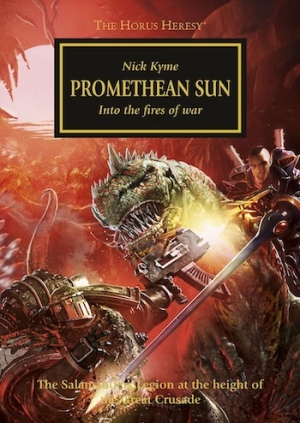
Review: PROMETHEAN SUN by Nick Kyme (Black Library)

KymeN-HH-PrometheanSunFormer Limited Edition Novella gets a wider release
As the Great Crusade sweeps across the galaxy, the forces of the Imperium encounter a world held in thrall by the alien eldar. While the Iron Hands of Ferrus Manus and Mortarion’s Death Guard battle against the hated xenos, it is the Salamanders who brave the deepest and most deadly jungles, encountering monstrous reptilian beasts and foul witchery along the way. Ultimately, it falls to their primarch Vulkan himself to thwart the sinister designs of the eldar, if the Legions are to liberate this world and bring illumination to its inhabitants.

Promethean Sun was Black Library’s first limited edition Horus Heresy novella. As someone who couldn’t afford it back then, naturally I grumbled quietly to myself about missing out on this part of the series – which has, actually, been a superb example of sustained, multi-volume and multi-author storytelling. There have been wobbles, of course, but for the most part this series has been amazingly strong. So, back to this book. After reading it, I realise I shouldn’t have grumbled. Sad to say (and very surprisingly), this was a disappointment, with greater weaknesses than strengths. The story meanders, the writing’s not as strong as I know Kyme can produce, and Vulkan’s characterisation feels off. For completists only, I would say. Continue reading →

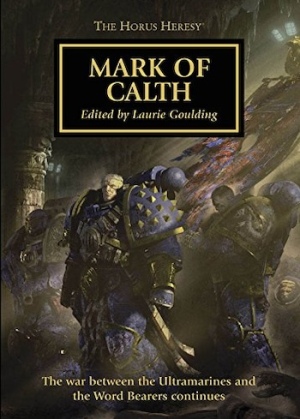
Review: MARK OF CALTH ed. Laurie Goulding (Black Library)

Various-HH25-MarkOfCalthThe latest Horus Heresy Anthology

In this all-new collection of Horus Heresy stories, witness the untold tales of the Underworld War.The Heresy reached Calth without warning. In just a few hours of betrayal and bloodshed, the proud warriors of the XIIIth Legion – Guilliman’s own Ultramarines – were laid low by the treachery of their erstwhile brothers of the XVIIth. Now, as the planet is scoured by solar flares from the wounded Veridian star, the survivors must take the fight to the remaining Word Bearers and their foul allies, or face damnation in the gloomy shelters beneath the planet’s surface.The battle for Calth is far from over

I’ve enjoyed all of the Horus Heresy anthologies that Black Library has produced. So I was very happy when I received this as a gift from a friend. I’ve liked some anthologies more than others, it’s true. But in each one, I think the authors have done a great job of advancing the overall story of the larger Galactic Civil War, as well as fleshing out the mythology of the event that has dictated much of the development of the Warhammer 40,000 universe. Mark of Calth takes a slightly different approach, focussing on the after-effects of the Word Bearers’ assault on Calth (as portrayed in Dan Abnett’s Know No Fear). It’s a good selection of stories, certainly, but I definitely think it’s time to move the HH story beyond Calth… (I have high hopes for Vulkan Lives, the next novel in the series, by Nick Kyme; and the soon-to-be-more-widely-released Promethean Sun novella, also by Kyme). So, one after the other, here are some short thoughts on the stories herein… Continue reading →