Review: A COLDER WAR by Charles Cumming (Harper)

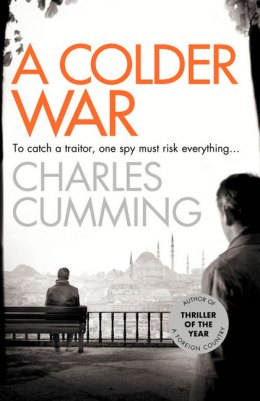
CummingC-TK2-AColderWarUKTom Kell returns…

A top-ranking Iranian military official is blown up while trying to defect to the West. An investigative journalist is arrested and imprisoned for writing an article critical of the Turkish government. An Iranian nuclear scientist is assassinated on the streets of Tehran. These three incidents, seemingly unrelated, have one crucial link. Each of the three had been recently recruited by Western intelligence, before being removed or killed.

Then Paul Wallinger, MI6’s most senior agent in Turkey, dies in a puzzling plane crash. Fearing the worst, MI6 bypasses the usual protocol and brings disgraced agent Tom Kell in from the cold to investigate. Kell soon discovers what Wallinger had already begun to suspect – that there’s a mole somewhere in the Western intelligence, a traitor who has been systematically sabotaging scores of joint intelligence operations in the Middle East.

This is the second novel to star Tom Kell, disgraced SIS agent, and apparently the services new go-to problem fixer. At least, for problems that need to be fixed quietly and delicately – more so than the secret service normally requires. A Colder War improves on A Foreign Country in almost every way (quite the feat, given how good the previous novel was), and hopefully marks the beginning of a long-running series to star Kell. This is another engrossing, expertly crafted espionage thriller. Continue reading

Short Review: A FOREIGN COUNTRY by Charles Cumming (Harper)

CummingC-TK1-AForeignCountryUKAn excellent spy thriller

On the vacation of a lifetime in Egypt, an elderly French couple are brutally murdered. Days later, a meticulously-planned kidnapping takes place on the streets of Paris.

Amelia Levene, the first female Chief of MI6, has disappeared without a trace, six weeks before she is due to take over as the most influential spy in Europe. It is the gravest crisis MI6 has faced in more than a decade. Desperate not only to find her, but to keep her disappearance a secret, Britain’s top intelligence agents turn to one of their own: disgraced MI6 officer Thomas Kell.

Tossed out of the Service only months before, Kell is given one final chance to redeem himself – find Amelia Levene, at any cost. The trail leads Kell to France and Tunisia, where he uncovers a shocking secret and a conspiracy that could have unimaginable repercussions for Britain and its allies. Only Kell stands in the way of personal and political catastrophe.

Charles Cumming is one of my favourite authors – in the thriller genre or otherwise. He writes tightly-plotted, gripping espionage thrillers in the tradition of John le Carré and others of that era. [It is, perhaps somewhat cliché to now compare Cumming to le Carré, but it really is apt.] Cumming’s novels are decidedly British, in that they are devoid of melodrama or the dick-swinging swagger that can characterise American-authored espionage thrillers (see, for example, Vince Flynn and Brad Thor). They are, however, just as gripping. Continue reading

Mini-Review: Sex Criminals, Vol.1 – “One Weird Trick” (Image)

PrintWriter: Matt Fraction | Artist: Chip Zdarsky

Suzie’s just a regular gal with an irregular gift: when she has sex, she stops time. One day she meets Jon and it turns out he has the same ability. And sooner or later they get around to using their gifts to do what we’d ALL do: rob a couple banks. A bawdy and brazen sex comedy for comics begins here!

This is a very unconventional, amusing and even ground-breaking book. It is also one I’m not entirely sure how best to review. Is it funny? Absolutely. And not just because it’s sex-related, and because that can often be very funny – especially when it’s about weird stuff, or people’s anxieties about it. This is a great book, and it’s no wonder that it has been taking critics and comic fans by storm.

Fraction’s story is multi-layered – it looks at sex, and how young people’s experiences can be varied, great, uncomfortable, misunderstood, and complicated. It is not preachy, nor is it flippant. It also has some great moments that are about reading and the imagination. And our protagonists are plotting a bank heist (in order to save a library). There is some pretty weird stuff near the end – which diminished the impact for me just a little, but by no means completely. I will absolutely be back for volume two.

The book is filled with some great background gags, and there were plenty that had be giggling for pages to follow (and also a couple that resurfaced in my mind at odd moments, setting me off giggling again). Sex Criminals is a series that really needs to be read and experienced for yourself – to review it at length would kind of ruin its magic, I think.

Zdarsky’s artwork is great throughout – and I love the way he’s added all the details and background stuff, without clobbering the reader with it. The sex-time graphics are really interesting and well-done, too.

With its great storytelling and superb artwork, not to mention its interesting and welcome message, and colourful well-drawn characters, this is a very highly recommended collection.

Review: MAYHEM by Sarah Pinborough (Jo Fletcher Books)

Pinborough-MayhemDr. Bond, I presume…

A new killer is stalking the streets of London’s East End. Though newspapers have dubbed him ‘the Torso Killer’, this murderer’s work is overshadowed by the hysteria surrounding Jack the Ripper’s Whitechapel crimes.

The victims are women too, but their dismembered bodies, wrapped in rags and tied up with string, are pulled out of the Thames – and the heads are missing. The murderer likes to keep them.

Mayhem is a masterwork of narrative suspense: a supernatural thriller set in a shadowy, gaslit London, where monsters stalk the cobbled streets and hide in plain sight.

This is the first of Pinborough’s novels that I’ve read, and I rather enjoyed it. It has all of the elements that I look for in fiction, in one tightly-written package: crime, investigation, mystery, a dash of the supernatural and horror. It’s an excellent mix, well-executed. And it’s the first in a series. Continue reading

Short Story Review: “A Plague of Saints” by David Annandale (Black Library)

Annandale-APlagueOfSaintsA quick look at an early mission

Heresy in a hive city has brought Commissar Sebastian Yarrick and the 252nd Armageddon Steel Legion to the barren world of Molossus. With the inquisition at his back and a ragged force of rebels before him, Yarrick must discover the cause of the uprising and bring it to an end. Venturing into the hive’s lower levels, Yarrick and the soldiers of the Astra Militarum discover a deadly horror in the shadows.

This release also includes the bonus short story ‘Sacrificial’, in which Yarrick and the Steel Legion face corrupted cultists.

This is a really good short story. Whereas Annandale’s first Yarrick story, the novella Chains of Golgotha, told us of the mission during which the Commissar met his arch nemesis, A Plague of Saints takes us further back. Here, Yarrick is a relatively short-in-the-tooth Commissar, not yet risen to the heights of heroism and respect that long-time WH40k fans will be familiar with. All in all, it’s a great story, and helps flesh out one of the Imperium’s most interesting (human) characters.

Yarrick has been dispatched to a world seemingly in revolt. He’s attached to the Armageddon Steel Legion Guard regiment. An inquisitorial team meets them on arrival, and things almost immediately appear sketchy. What are the inquisitor and his henchmen getting up to? What is causing the lower-level inhabitants of the Hive to revolt?

A Plague of Saints has all the hallmarks that I’ve come to expect from Annandale’s fiction. It is expertly crafted, and populated by interesting and well-rounded characters. The author’s prose is fluid and evocative, without being over-done. And he’s an expert at atmosphere and locating the reader in the story without info-dumping or over-describing. Later in the story, the author manages to paint a picture of tense menace, furious combat, and just a shade of horror. [No spoilers, here!] This is probably one of the best short stories I’ve read from BL in a while. Annandale just keeps getting better.

The micro-story included in this eBook, Sacrificial, was a short, sharp display of how ruthless Yarrick can be in executing his prerogative. A good addition.

Annandale’s done a great job bringing this character to life. I am very eager to get my hands on the full-length novel, Imperial Creed. Absolutely recommended for all fans of WH40k and military science fiction.

Short Story Review: “Hidden Depths” by Sandy Mitchell (Black Library)

MitchellS-HiddenDepthsA Secondary Character steps into the Foreground

Inquisitor Amberley Vail, best known for chronicling the escapades of Commissar Ciaphas Cain, follows the trail of smugglers of alien technology, and finds herself in the middle of something much bigger… An artefact of an ancient race leads Inquisitor Vail and her warband into the depths of an underhive, where more than just mutants and gangers lurk in the darkness. Will Vail survive to tell Commissar Cain about this adventure?

Inquisitor Amberley Vail, chronicler of the Ciaphas Cain adventures, finds herself in deadly peril when an ancient alien artefact leads her into the depths of an underhive.

I’ve enjoyed a number of Mitchell’s Warhammer 40,000 novels – in particular, his Ciaphas Cain series, which takes a more amusing, less-serious (but no less action-packed) approach to the WH40k aesthetic and universe. Hidden Depths takes one of the secondary-characters from the Cain series and brings her to the fore: Amberley Vail – she appears in the Cain novels, but she’s also the ‘narrator’, as the novels are presented as edited narrative histories of Cain’s “heroism”. And the story really works. This was a very good read.

Mitchell takes what is becoming the ‘standard’ template for stories that feature an Inquisitorial warband at its centre: there’s an OCD and pedantic savant, the dreamy psychic, former-Arbitrator enforcer, and usually someone who is some variation of a former underhive ganger (Mitchell checks each box). There’s nothing wrong with this make-up, but it would be interesting to see some more variation.

Nevertheless, Mitchell offers a story with a classic-Black Library feel to it. It reminded me of the stories we used to get in Inferno!, the quarterly fiction magazine, and some of the earlier anthology stories. It also reminded me of the now-old Necromunda game that Games Workshop used to produce (and was always my favourite). The warband descends into the underhive to figure out what’s going on. Naturally, they come face to face with ravenous beasts and an unexpected enemy.

There are some nice, cheeky jokes in here, too – for example:

“We wasn’t expecting the Holy Inquisition…”

“No one ever does.”

Sometimes the sense of fun veers a bit too close to glib and maybe even threatens to become slightly annoying. But, for the main, Mitchell maintains a lighter tone that works, and doesn’t get too silly. In fact, that’s what makes his fiction work so well – the fact that he obviously doesn’t take the source material and aesthetic too seriously, but at the same time he keeps well within the sub-genre’s bounds.

This is a fun, quick read. If you’re a fan of the Ciaphas Cain series, this is a must-read. If you’re a fan of BL fiction in general, too, you should enjoy this. Recommended.

Short Review: “The Humans” by Matt Haig (Canongate)

Haig-TheHumansAn excellent examination of what it means to be human

It’s hardest to belong when you’re closest to home… One wet Friday evening, Professor Andrew Martin of Cambridge University solves the world’s greatest mathematical riddle. Then he disappears. When he is found walking naked along the motorway, Professor Martin seems different. Besides the lack of clothes, he now finds normal life pointless. His loving wife and teenage son seem repulsive to him. In fact, he hates everyone on the planet. Everyone, that is, except Newton. And he’s a dog. Can a bit of Debussy and Emily Dickinson keep him from murder? Can the species which invented cheap white wine and peanut butter sandwiches be all that bad? And what is the warm feeling he gets when he looks into his wife’s eyes?

The standfirst says it all, really: The Humans is an excellent examination of what it means to be human – everything from the horror and ugliness, to the beauty and wonder of life on Earth. It is a novel that is filled with insight, depth, affection, and humour. From the beginning, we are introduced to an imposter on earth – an alien who has taken the place of one of Cambridge University’s most respected mathematicians, who has just solved one of the great mysteries of mathematics. The race from which this being hails believes the solution will bring great upheaval to the universe: it could, after all, allow humans to leave Earth, and venture out into the universe. This would, of course, bring all their baggage with them. After all, from the outside, human can come across as miserable, money-obsessed, violent assholes.

As the new Andrew Martin navigates his new life, quashing all knowledge of the real Martin’s discovery, he finds himself confronted with everything that is good about life as a human. His obliviousness to what the real Andrew did before he was replaced, gives him a childlike innocence and fresh slate – something that has a real impact on his family life, in both positive and negative ways. He starts to go native, despite the frequent warnings of his superiors – the Hosts.

It doesn’t take long to read The Humans – the novel is very focused, the pacing is brisk, and Haig’s prose is pretty sparse. It is also superb – elegant in its focus, nuanced, affectionate yet not uncritical, and often very funny. His characters are well-rounded and expertly brought to life on the page. The book will also make you want to read more Emily Dickinson…

Haig is fast becoming one of my favourite writers, and I’ve only read two of his novels. The Humans is a must read. I thoroughly enjoyed this, and can’t recommend it enough.

“The Truth About the Harry Quebert Affair” by Joel Dicker (MacLehose Press)

DickerJ-TruthAboutTheHarryQuebertAffairUKA gripping and absorbing, slightly flawed thriller

August 30, 1975. The day of the disappearance. The day a small New Hampshire town lost its innocence.

That summer Harry Quebert fell in love with fifteen-year-old Nola Kellergan. Thirty-three years later, her body is dug up from his yard along with a manuscript copy of his career-defining novel. Quebert is the only suspect.

Marcus Goldman – Quebert’s most gifted protégé – throws off his writer’s block to clear his mentor’s name. Solving the case and penning a new bestseller soon blur together. As his book begins to take on a life of its own, the nation is gripped by the mystery of ‘The Girl Who Touched the Heart of America’. But with Nola, in death as in life, nothing is ever as it seems.

This is not an easy book to review. It has been on my radar for a while, and I’ve been eager to read it ever since I saw it mention on (I think) The Bookseller. I would say it mostly lived up to my expectations. It is expansive, brilliant, absorbing, briskly-paced, but also flawed and at times frustrating, even aggravating. A confounding novel to review. Despite the issues I had with certain elements of the novel and story, it was utterly gripping, and I thoroughly enjoyed reading it.

First of all, I very much enjoyed reading it – I was always eager to get back to it, when life forced me to stop reading (sleep, meetings, etc.). Dicker has written an engaging thriller, one that brings a decades-old disappearance back into the spotlight, as a beloved member of a small town community – the titular Harry Quebert – is accused of two shocking, heinous acts: continuing an affair with a fifteen year-old girl, and also her murder. What follows is an investigation by the accused’s protégé (of sorts), in an attempt to clear his name and salvage his reputation. Along the way, things get very messy indeed. Threats and revelations abound, which keeps readers guessing all the way through – the truth is only revealed in the final 10% of the novel (I read it as an eARC). I really liked the way Dicker keeps throwing out red herrings, and also that Marcus’s investigation does one hell of a lot of damage along the way: relationships are shattered, secrets (related and not) are brought into the light, and the competing agendas at work tear the community apart.

Speaking of these competing agendas: there are times when Dicker’s character come across as cartoonish, and not in a good way. For example, Marcus’s editor/publisher is rather unrealistic – as if every commercial consideration that any publisher would need to take into account is exaggerated and overblown. He is an awful person, and there’s no reason to disbelieve the existence of such characters, but he does certain things that seem so stupid. Considering he’s able to offer $2,000,000 dollar advances, he comes across as singularly devoid of the emotional intelligence to be a high-powered, successful publisher in New York. The publishing aspects of the novel were, actually, the most lacking in verisimilitude, which was a real pity.

Dicker’s writing is, for the main, excellent and the translation is superb, too. The pacing is superb, and I was absolutely captivated by the narrative and investigation. At the same time, there were instances when the dialogue – especially that featuring Marcus’s editor, Nola and select other characters – appears melodramatic and just not very good. At the risk of sounding condescending or unfair, I can’t help but wonder if this is an instance of lost-in-translation?

There were times when the investigation – official and Marcus’s amateurish actions – veered off in strange ways. Partly, this was to allow for the frequent upending of their attempts to get to the bottom of things. For the main, it worked very well, but there were certainly times when I became frustrated. Without shedding too much light on particulars, some of the switcheroos felt forced. In addition, some of the characters are morons – especially when it comes to the writing of the book-within-the-book. Marcus and his editors commit some astonishing failures and cock-ups, one that didn’t ring true at all. One in particular, very near the end, is an unforgivable oversight that I just can’t see happening in real life – something that could so easily have been rectified over the course of the investigation. Frustrating moments like this robbed the novel of some of its impact.

This review is, I recognise, rather vague on the details. This is because, despite this flaws – and some might consider them huge – I could not stop reading. In terms of sheer enjoyment, The Truth About the Harry Quebert Affair is one of the most enjoyable books I’ve read in a while. Given how picky I can be, and how easy gaffs and inconsistencies can ruin a novel for me, I think that’s saying something. It is not surprising to me that this has been such a success.

If the goal of any novel should be to entertain, be thought-provoking, and get the reader thinking, this this novel succeeds on every level. That is has some shortcomings is made almost irrelevant by just how good the rest of it is.

Gripping and absorbing, this is well worth reading. Definitely recommended, but be warned that there are some niggles.
Horus Heresy Short Reviews: CENSURE and WOLF OF ASH AND FIRE (Black Library)

Just wanted to flag up two Horus Heresy short stories I’ve read recently, as they were both very good, and well worth an enthusiast’s time.

Kyme-HH-CensureCENSURE by Nick Kyme

In the depths of Calth’s arcology network, the Underworld War has raged for years. Aeonid Thiel, previously an honoured sergeant of the Ultramarines, once again finds himself in trouble – pitted against the daemonic forces of the Word Bearers, he has no choice but to venture back to the ravaged surface and brave the deadly solar flares that have scoured all life from this world. With a lowly Imperial Army trooper as his only companion, it falls to him to drive the maniacal Dark Apostle Kurtha Sedd and his warband from the overrun XIIIth Legion stronghold.

This was originally released as an audio-drama. When it was released as an eBook, however, I picked it up right away. Kyme is really growing as an author – each new story of his that I read, I can see that he’s just getting better and better. This story is set (once again) on Calth, the planet at which the Heresy and the extent of the betrayal truly exploded out into the open. After the battle of Calth, there could be no denying that the galaxy had indeed been set on fire. Censure is set some years after the events of Mark of Calth and Know No Fear, and Aeonid Thiel has returned to the ravaged world to fight against the Word Bearers and support the remnant loyalists. It focuses on a specific mission and conflict, and is fast-paced, nuanced, and expertly paced. Quite excellent, and very highly recommended.

*

McNeill-HH-WolfOfAshAndFireTHE WOLF OF ASH AND FIRE by Graham McNeill

The Wolf of Ash and Fire is a Horus Heresy short story that takes place during the Great Crusade, before the outbreak of the Horus Heresy. The Wolf of Ash and Fire follows Horus Lupercal, fighting alongside the Emperor Himself, as the Luna Wolves fight for control of the Ork-held planetoid of Gorro. The Wolf of Ash and Fire was released as a free e-book with every copy of Macragge’s Honour.

This short story was released free through the Black Library website some time ago. It’s a quick, battle-filled tale of Horus’s strategic expertise, battlefield fury, and pre-Heresy devotion to the Emperor. It is also one of the few stories that features both the Emperor and Horus on the battlefield together – and it is epic. The battle scenes are great, swirling and furious. I’d really like McNeill (or any of the Heresy writers, actually) to revisit this campaign, or just write some more stories like this. As with Censure, this is highly recommended for all fans of the series. I can’t wait for McNeill’s next Heresy novel, Vengeful Spirit (out later this year).

“Midnight Crossroad” by Charlaine Harris (Gollancz)

HarrisC-MT1-MidnightCrossroadUKA great start to a new series

Welcome to Midnight, Texas, a town with many boarded-up windows and few full-time inhabitants, located at the crossing of Witch Light Road and Davy Road. It’s a pretty standard dried-up western town.

There’s a pawnshop (someone lives in the basement and is seen only at night). There’s a diner (people who are just passing through tend not to linger). And there’s new resident Manfred Bernardo, who thinks he’s found the perfect place to work in private (and who has secrets of his own).

Stop at the one traffic light in town, and everything looks normal. Stay awhile, and learn the truth…

This is the first novel of Harris’s that I’ve read, and I must say I rather enjoyed it. A gently-paced mystery, with a supernatural slant, and populated by endearing, varied and well-constructed characters.

The novel started pretty slowly, for me. For the first 50 pages or so, it felt like Harris was intent on painting as complete and full a picture of Midnight, Texas. Everything was described, at length, and I worried that this was a sign of padding. Thankfully, the story then kicked in, and what followed was an engaging small-town mystery.

A disappearance and death from years ago is dragged into the present, stirring up earlier suspicions and far-reaching animosities. It also brings Midnight to the attention of a number of unsavoury elements, all of which are pursuing their own agendas. A new discovery leads Manfred and a select few of his fellow Mightnighters to investigate. In some ways, Midnight Crossroad feels like an established series, as some of the characters’ actions need to be taken with a pinch of salt – they are far more accepting of certain things than one might expect (the vigilantism, for example, not to mention some of the odder characteristics of certain Midnighters).

HarrisC-MT1-MidnightCrossroadUSEach of the town’s inhabitants has their own secrets, and it is considered very bad form to pry. That each and every one of them has secrets, though, is an accepted fact. This has led to the creation a surprisingly close-knit community, despite none of the characters truly knowing the others. One of the things I really liked about the novel is the fact that Harris doesn’t reveal everything. In fact, many of the characters remain somewhat mysterious – while readers will no doubt draw their own conclusions, Harris is rarely explicit about their natures. I’m looking forward to each of the characters developing over the course of the series. There’s a lot of potential for expansion, I think.

This wasn’t what I was expecting. Although, to be fair, I wasn’t really sure what to expect to begin with. The supernatural elements are pretty down-played, but they are definitely there – be it through Fiji’s witchcraft, Manfred’s clairvoyance, and… well, a couple of other things that to discuss would be spoilers.

Harris is in no rush to tell the story, but it won’t take you long to read this – not only is the book very focused (after the first 50 pages), but you’ll likely not want to put it down. It offers a welcome change in pace to the usual thrillers I read, and the added, understated supernatural elements were expertly woven into the story while also not drowning out the plot.

An excellent first experience with Harris’s work, I’ve become a new convert, and have ordered the first couple of Sookie novels to try. If you are already a fan of Harris’s fiction, then you won’t be disappointed by Midnight Crossroad. If, like me, you are new to her work, then this is as good a place to start as any other.

Definitely recommended. I really enjoyed this.

***

Midnight Crossroad is published by Gollancz in the UK and Ace Books in the US – both in May 2014.