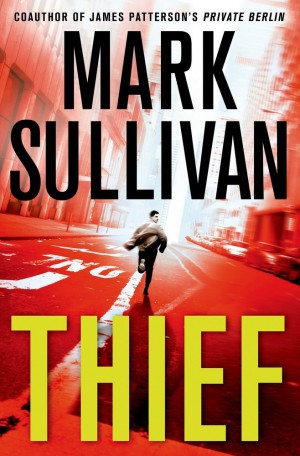
Excerpt: THIEF by Mark Sullivan (Minotaur/Quercus)

SullivanM-RM2-ThiefUSCo-author of Private Berlin and Private L.A. with James Patterson, Mark Sullivan‘s next novel is THIEF. Due to be published on December 16th, 2014 (next week), by Minotaur. It is the third novel featuring Robin Monarch — following Rogue and Outlaw. The series is published in the UK by Quercus Books, and will publish Thief on December 31st in eBook, and January 1st in print. For more details on the series, scroll down to the end of the post.

Here is the synopsis for Thief:

Robin Monarch is a man with a complicated past and dangerous present.  He’s been a soldier, a CIA agent, a freelance operative but first and foremost, Robin Monarch is a thief of the highest order. Orphaned at twelve, Monarch originally stole for survival, then he stole for his friends and cohorts, now he steals to order, and to give back to the to the woman who saved his life many years ago.

With the help of his team, Monarch breaks into the legendary Christmas party of Beau Arsenault, a shady investor and behind-the-scenes player at the very highest levels of power politics. Arsenault is not above bending or breaking the rules if there’s illicit profit to be made. Monarch has decided that those illicit profits will be better used to take care of orphans and street kids. Using the party as cover to break into Arsenault’s secret vaults, Monarch comes away with two unexpected things. One is a bullet — he gets shot when he’s caught trying to escape with tens of millions of negotiable instruments. The second is a lead on what might be his most audacious exploit ever. A previously undiscovered tribe in South America may well have the secret to the most sought after knowledge in history — that of eternal life. And Robin Monarch must use all his skills — as an operative, as a thief — to keep this secret from falling into the worst possible hands.

And now, a (lengthy) excerpt… Continue reading

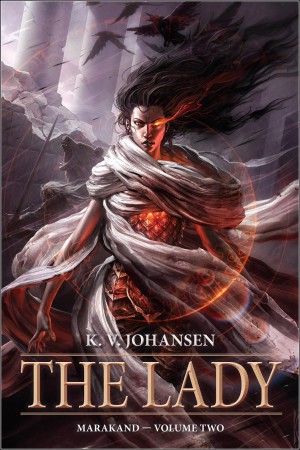
Excerpt: THE LADY by K.V. Johansen (Pyr)

JohansenKV-M2-TheLady

THE LADY, the second novel in K.V. Johansen‘s two-part Marakand series, is published today by Pyr Books. To celebrate the release, and just in case you weren’t aware of the novel (or series), here’s the first chapter to whet your appetite…

THE LADY

Chapter 1

The man had been like an older brother to him ever since his parents had got him hired into the caravan-mistress Gaguush’s gang, but sometimes Zavel could hate the self-righteous bastard of a Westgrasslander. Like now. All he had wanted was the loan of a few coins, but no, he got a tongue-lashing instead. As if Holla-Sayan had never had a drink or two more than sat well the next morning, or gone with an easy woman. And if that wasn’t what he was up to now, skulking down the street with his eyes running anxiously to those two slim figures who’d walked ahead and were now waiting arm in arm, a Grasslander caravaneer with the long braids of the road and another with her Nabbani-black hair cut short as a Marakander boy’s. That one looked around, wondering where her victim had got to.

Zavel had Holla-Sayan by the arm, stopping the man just walking off on him, and now he dug in his fingers. Gaped wordless a moment. Couldn’t be. And Holla had been right with them, a hand under the Nabbani’s elbow, all friendly, when Zavel had spotted the threesome, the Westgrasslander and the two women, one of whom was—Ivah. The past year hadn’t treated her well. She was gaunt and pallid, but cutting her long hair was no disguise at all; he knew the sly narrow eyes, yellow brown as his own, the delicate features and tight little mouth, bruised black as it was. She knew him, too. He saw her eyes widen in shock, and damn if she didn’t look to Holla-Sayan in some appeal.

“Holla!” He let go Holla-Sayan’s arm, pushed away from him. “Ivah! You murdering, bastard whore of the Lake-Lord, you—” His knife was in his hand and he leapt for her, reaching to grab her by the front of her coat, to jerk her close and into the stabbing blade, but he choked, jerked backwards himself by the hood of his coat, Holla, damn him, and he spun around, slashing. Holla-Sayan knocked his arm aside and a fist hit his jaw. He heard the thud of it, felt the jarring clack of his teeth. Then nothing. Continue reading

Excerpt: THE GENOME by Sergei Lukyanenko (Open Road)

LukyanenkoS-TheGenomeThanks to Open Road Media for allowing CR to share this excerpt from Sergei Lukyanenko’s THE GENOME. Here’s the synopsis…

Five months after the horrific accident that left him near death and worried that he’d never fly again, master-pilot Alex Romanov lands a new job: captaining the sleek passenger vesselMirror. Alex is a spesh — a human who has been genetically modified to perform particular tasks. As a captain and pilot, Alex has a genetic imperative to care for passengers and crew — no matter what the cost.

His first mission aboard Mirror is to ferry two representatives of the alien race Zzygou on a tour of human worlds. His task will not be an easy one, for aboard the craft are several speshes who have reason to hate the Others. Dark pasts, deadly secrets, and a stolen gel-crystal worth more than Alex’s entire ship combine to challenge him at every turn. And as the tension escalates, it becomes apparent that greater forces are at work to bring the captain’s world crashing down.

Read on for Chapter Three… Continue reading

Excerpt: THE REVOLUTIONS by Felix Gilman (Corsair)

GilmanD-TheRevolutionsHeader

CHAPTER ONE

It was the evening of what would later be called the Great Storm of ’93, and Arthur Archibald Shaw sat at his usual desk in the Reading Room of the British Museum, yawning and toying with his pen. Soft rain pattered on the dome. Lamps overhead shone through a haze of golden dust. Arthur yawned. There was a snorer at the desk opposite, head back and mouth open. Two women nearby whispered to each other in French. Carts creaked down the aisle, the faint tremors of their passing threatening to topple the tower of books on Arthur’s desk, which concerned explosives, and poisons, and exotic methods of murder.

He was writing a detective story. This was something of an experiment. Not knowing quite how to start, he’d begun at the end, which went:

That night the dome of St. Paul’s Cathedral broke through London’s black clouds as if it were the white head of Leviathan rising from the ocean. The spire and the cross shone in a cold and quite un-Christian moonlight, and diabolical laughter echoed through the night. The detective and his quarry stood atop the dome, beneath the spire, each man ragged from the exertion of their chase.

“Stop there, Vane,” the detective called; but Professor Vane only laughed again, and began to climb the spire. And so Dr Syme pursued.

GilmanF-RevolutionsUKPBWhich was not all bad, in Arthur’s opinion. The important thing was to move quickly. It was only that month that Dr Conan Doyle had sent his famous detective off into the great beyond — chucking him unceremoniously from a waterfall in Switzerland — and the news that there would be no more stories of the Baker Street genius had thrown London’s publishing world into something of a panic. In fact, there were nearly riots, and some disturbed individuals had threatened to torch the offices of the Strand Magazine. The hero’s death left a gap in the firmament. The fellow who was first to fill it might make a fortune. It was probably already too late.

For the past two and a half years Arthur had been employed by The Monthly Mammoth to write on the subject of the Very Latest Scientific Advances. He wasn’t any kind of scientist himself, but nobody seemed to mind. He wrote about dinosaurs, and steam engines, and rubber, and the laying of transatlantic telegraph cables; or how telephones worked; or the new American elevators at the Savoy; or whether there was air on the moon; or where precisely in South America to observe the perturbations of Venus; or whether the crooked lines astronomers saw on the fourth planet might be canals, or railroads, or other signs of civilization — and so on. Not a bad job, in its way — there were certainly worse — but the Mammoth paid little, and late, and there was no prospect of advancement there. Therefore he’d invented Dr Cephias Syme: detective, astronomer, mountain-climber, world-traveller, occasional swordsman, et cetera.

Vane dangled by one hand from the golden cross, laughing, his white hair blowing in the wind. With the other hand he produced a pistol from his coat and pointed it at Syme.

“What brought you here, Syme?”

The Professor appeared to expect an answer. Since Dr Syme saw no place to take shelter, he began to explain the whole story — the process by which, according to his usual method, he had tackled each part of Vane’s wild scheme — how he had ascended that mountain of horrors — from the poisoning at the Café de L’Europe, to the cipher in the newspaper advertisements that led to the uncovering of the anarchists in Deptford, which in turn led to the something or other by some means, and so on, and thus to the discovery of the bomb beneath Her Highness’s coach, and thus inevitably here, to the Cathedral.

Arthur sketched absent-mindedly on his blotting paper: a dome, a cross, inky scudding clouds.

The notion of the struggle on the dome had come to him in a dream, just two nights ago; it had impressed itself upon him with the intensity of a lightning flash. Unfortunately, all else remained dark. How did his detective get there? How precisely had they ascended the dome (was it possible?). And above all: what happened next?

Nothing, perhaps. In his dream, Dr Syme fell, toppling from the dome into black fog, nothing but hard London streets below. Not the best way to start a detective’s adventures. Something would have to be done about that. Perhaps he could have poor Syme solve his subsequent cases from the afterlife, through the aid of a medium.

Dr Syme lunged, knocking the pistol from the Professor’s grip, but his enemy swung away, laughing, and drew from his coat a new weapon: a watch.

“We have time,” the Professor said. “Dr Syme, I confess I have arranged events so that we might have time and solitude to speak. I have always felt that you, as a man of science, might see the urgent need for reform — for certain sacrifices to be made —”

Arthur’s neighbour began to pack his day’s writings into his briefcase. This fellow — name unknown — was stand-offish, thin, spectacled. Judging from the pile of books on his desk, on which words like clairvoyance and Osiris were among the most intelligible, his interests tended to the occult. He closed his briefcase, stood, swayed, then sat back with a thump and lowered his head to his desk. Arthur sympathised. The dread hour and its inexorable approach! Soon the warders would come around, waking up the sleepers, emptying out the room, driving Arthur, and Arthur’s neighbour, and the French women, and all the scholars and idlers alike out to face the night, and the rain, and the wind that rattled the glass overhead.

Midnight! The Professor waited, as if listening for some news to erupt from the befogged city below.

“Well,” Syme said. “I dare say I know your habits after all this time. I know how you like to do things in twos. I knew there would be a second bomb. At the nave, was it, or the altar? I expect Inspector Wright’s boys found it quick enough—”

A terrible change came across the Professor’s face. All trace of civilization vanished, and savagery took its place—or, rather, not savagery, but that pure malignancy that only the refined intellect is capable of.

Howling, the Professor let go of the cross and flung himself onto Dr Syme.

Pens scratching away. Rain drumming on the glass, loudly now. A row of women industriously translating Russian into English, or English into Sanskrit, Italian into French. Arthur’s neighbour appeared to have fallen asleep.

Arm in arm, locked together in deathly struggle, the two men fell — rolling down the side of the dome — toward

Toward what, indeed!

“By God,” said Inspector Wright, hearing the terrible crash. He came running out into the street, to see, side by side, dead, upon the ground —

Arthur put down his pen, and scratched thoughtfully at his beard.

His neighbour moaned slightly, as if something were causing him pain. Concerned, Arthur poked his shoulder.

The man jumped to his feet, staring about in wild-eyed confusion; then he snatched up his briefcase and left in such a hurry that scholars all along the rows of the Reading Room looked up and tut-tutted at him.

***

Rain sluiced noisily down the glass. Lamps swayed in mid-air. Thunder reverberated under the dome as the Reading Room emptied out.

Arthur’d thought he might try to bring out his friend Heath for dinner, or possibly Waugh, but neither was likely to venture out in that weather. Bad timing and bloody awful luck.

He collected his hat, coat, and umbrella. These items were just barely up to the Reading Room’s standards of respectability, and he doubted that they were equal to the challenge of the weather outside. Certainly the manuscript of Dr Syme’s First Case was not — he’d left it folded into the pages of a treatise on poisons.

Outside a small band of scholars, idlers, and policemen sheltered beneath the colonnade. Beyond the colossal white columns, the courtyard was dark and the rain swirled almost sideways. In amongst it were stones, mud, leaves, tiles, newspapers, and flower-pots. Some unfortunate fellow’s sandwich-board toppled end-over-end across the yard, caught flight, and vanished in the thrashing air. Arthur’s hat went after it. It was like nothing he’d ever seen. A tropical monsoon, or whirlwind, or some such thing.

He was suddenly quite unaccountably afraid. It was what one might call an animal instinct, or an intuition. Later — much later — the members of the Company of the Spheres would tell him that he was sensitive, and he’d think back to the night of the Great Storm and wonder if he’d sensed, even then, what was behind it. Perhaps. On the other hand, anyone can be spooked by lightning.

He was out past the gates, into the street, and leaning forward into the wind, homewards down Great Russell Street, before he’d quite noticed that he’d left the safety of the colonnade. When he turned back to get his bearings, the rain was so thick he could hardly see a thing. The Museum was a faint haze of light under a black dome; its columns were distant white giants, lumbering off into the sea. The familiar scene was rendered utterly alien; for all he could tell, he might not have been in London any more, but whisked away to the Moon.

His umbrella tore free of his grip and took flight. He watched it follow his hat away over the rooftops, flapping like some awful black pterodactyl between craggy, suddenly lightning-lit chimneys, then off who-knows-where across London.

*   *   *

The Revolutions by Felix Gilman is published tomorrow in the UK by Corsair.

Excerpt: ASSAIL by Ian C. Esslemont (Transworld)

Esslemont-6-Assail

A Novel of the Malazan Empire

Prologue

North territory of a new land

Of the Jaghut wars:

Seventh century of the 12th Lamatath campaign

33,421 years before Burn’s Sleep

The woman ran at a steady unhurried pace. her breath came as long level inhalations through the mouth and out through her wide nostrils. Sweat darkened the front and back of her buckskin shirt. Her moccasins padded silently over stones and pockets of exposed sandy soil. That she was running up a wide rocky mountain slope, and had been for most of the day, attested to iron strength and endurance. She dodged round slim poles of young pine, white spruce and birch. She jumped rocks and slid and scrambled up steep gravel talus fans. She knew she could outpace her pursuers, but that she would never shake them from her trail. Yet still she ran on.

She knew that once they tired of the chase, they would take her. She judged it ironic that the same desperate urge to continued existence that drove her also lay behind their relentless pursuit – though they had relinquished their claim to it long ago.

Still she scrambled on up the slope, for one hope remained. One slim unlikely chance. Not for her survival; she had given that up the moment she glimpsed the hoary eldritch silhouettes of her pursuers. The one slim chance lay for vengeance.

Knife-edged broken rock cut her fingers as she scrabbled for handholds. It flayed her moccasins. The surrounding steep slopes of tumbled stone and talus heaps were just now emerging from winter; ice clung to shadowed hollows and behind the taller boulders. Snow still lay in curved dirty heaps, almost indistinguishable from the surrounding gravel. She took vigour from the chill bite of the high mountain air, knowing it perfectly natural rather than any invoked glacial freeze. Taking cover in a stand of pine, she paused to risk a glance behind: no movement stirred upon the slope below, other than a smallish herd of elk just now clattering their way downvalley. No doubt disturbed by her passage.

Yet she knew she was not alone. She also knew her pursuers needed not to show themselves to run her down. She’d hoped, though, they would at least grant her this one small gesture.

A lone figure did then step out from the cover of tumbled glacial moraine. It was as if she’d willed its appearance. The tattered remains of leathers flapped about its impossibly lean frame. A dark ravaged visage scanned the slope, rising to her. The white bear hide that rode atop the head and shoulders hung as aged and winddried as its wearer. She and he locked gazes across the league that separated them – and across a far larger unbridgeable gulf as well.

So far behind? she wondered. Then she understood and in that instant threw herself flat.

Something shattered against the rocks next to her. Flint shards thinner than any blade sliced her buckskins and flensed the skin beneath.

She jumped to her feet and returned to scrambling up the slope. She reached a ridge that was a mere shoulder of the far taller slope: a jagged peak that reared far above. Here she paused a second time, exhausted, her lungs working, drawing in the icy air.

Then she screamed as a spear lanced through her thigh, pinning her to the bare stony surface. She fell back against a rock and took hold of the polished dark haft to draw it. A skeletal hand knocked hers aside.

The same fleshless visage that had caught her gaze below now peered down at her. Empty dark sockets regarded her beneath the rotting brow of a white tundra bear. Necklaces of yellowed claws hung about the figure’s neck – presumably the claws of the very beast it wore – while the scraped hide of the beast’s forelimbs rode its arms down to the paws tied with leather bindings to its own hands. Ribs darkened with age peeked through the mummified flesh of its torso. Rags of leather buckskin lay beneath the hide, all belted and tied off by numerous leather thongs. A long blade of knapped flint, creamy brown, its tang wrapped in leather, stood thrust through a belt. ‘Why flee you here, Jaghut?’ the Imass demanded.

‘I flee destruction,’ she answered, her voice tight with suppressed pain.

Others of the Imass warband now walked the ridge. The bones of their feet clattered on the rocks like so many stones. ‘Caves above, Ut’el,’ one of their number announced, pointing a flint blade higher up.

The Imass, Ut’el, returned its attention to her. ‘You would seek to lure us to ambush,’ it announced.

‘If you say so.’

‘I am disappointed. You have brought death to your kin as well.’ It faced one of the band. ‘Take scouts. They are occupied?’

This Imass dipped its hoary skull where the flesh and hair had fallen away in patches. ‘Yes, Bonecaster.’

Bonecaster! the woman marvelled. A mage, shaman, of the breed! If she should bring this one to destruction then all would have been worth the struggle.

The Bonecaster returned its attention to her. She sensed its mood of disappointment. ‘I had thought you a more worthy prize,’ it murmured, displeased.

‘As we had hoped for more worthy successors.’

‘Victory is the only measure of that, Jaghut.’

‘So the victors would soothe themselves.’

The undying creature raised its bony shoulders in an eloquent shrug. ‘It is simply existence. Ours or yours.’

She allowed herself to slump back as if in utter defeat. ‘You mean the elimination of all other than you. That is the flaw of your kind. You can only countenance your family or tribe to live.’

‘So it is with all others.’

‘No, it is not. You are merely unable to see this.’

‘Look about, Jaghut. Raw nature teaches us…’ Ut’el’s whisper faint voice dwindled away as he slowly raised his bone and dried tendon features to the higher slope.

‘How fare your scouts, Bonecaster?’ she asked, unable to keep a savage grin from her face.

‘They are gone,’ he announced. His gaze fell to her. ‘Others are there.’ He now shook his nearly fleshless head in admiration, and, it seemed to her, even horror. ‘My apologies, Jaghut. I would never have believed any entity would dare…’ He drew his flint blade. ‘You are a desperate fool. You have doomed us all – and more.’

‘I am merely returning the favour.’

All about, the remaining Imass warriors flinched as if stung, drawing their blades of razor-thin flint. ‘Purchase us what moments you can,’ he told them flatly. His tannin-brown visage remained fixed upon her.

The warriors dipped their heads. ‘Farewell,’ one answered, and they disappeared into snatches of dust.

Above, figures now came pouring from the cave mouths: stone grey shapes that ran on oddly jointed legs, or all four limbs at a time.

‘I am tempted to leave you to them,’ Ut’el said. ‘But we Imass are not a cruel people.’

‘So you would absolve yourselves over the centuries, yes?’ She took hold of the spear haft. ‘That is fortunate. Because we Jaghut are not a judgemental people.’ And she heaved herself backwards in one motion, yanking the spearhead from the ground to tumble off the ledge, spear in hand.

He swung, but the blade cut just short of her as she slipped from the narrow ridge. Her buckskins snapped in the wind. ‘I leave you to…’ she yelled as she plummeted from sight down the sheer thousand-foot drop.

. . . your doom, Ut’el Anag, Bonecaster to the Kerluhm T’lan Imass, finished for her. He turned to face the high slope. The grey tide of creatures had finished his band and now closed upon him.

In what he considered his last moments, he raised his flint blade to his face. He watched how the knapped facets reflected the clouds overhead, how the reflections rippled like waves on clear lake water.

No. This is not yet done. I so swear.

He stepped into the realm of Tellann as the first of the clawed hands snapped closed upon the space he once occupied.

*   *   *

Hel’eth Jal Im (Pogrom of the White Stag)

51st Jaghut War

6,031 years before Burn’s Sleep

Esslemont-6-AssailHere evergreen forest descended mountain slopes to a rocky shore. Shorebirds hunted for crabs and beetles among tide-pools and stretches of black sand beaches. From their perches on tree limbs and among the taller rocks larger birds of prey watched the shorebirds and the glimmer of fingerlings in the shallows.

A morning mist hung over the bay. The air was still enough for sounds to cross from one curve of the shore to the other. The figure that arose from the seaweed-skirted boulders was not out of keeping with the scene. The tattered remains of leathers hung from its withered, mummified shoulders and hips. A nut-brown flint blade hung thrust through a crude twisted-hair belt tied about its fleshless waist. Over its head of patches of stringy hair and exposed browned skull it wore a cap cut from the cured grey hide of a beast more at home on sundrenched savanna than temperate boreal forest.

Similar figures arose, one by one, here and there about the shore. They gathered around the first arrival, and though gender was almost impossible to tell among their fleshless desiccated bodies, skin little more than paper-thin flesh over bone, this one was female and her name was Shalt Li’gar, and she was of the Ifayle T’lan Imass.

‘What land is this?’ one of the band, J’arl, asked. In answer, she raised her head as if taking the earth’s scent through the exposed twin gaps of her nostrils. ‘I know it not,’ she judged. ‘No account of it has been shared with me, nor with those with whom I have shared.’

‘Others of us must have found it before, certainly,’ another, Guth, commented.

‘And what became of them…?’ Shalt answered, thoughtfully, peering into the mist to the far shore of the sheltered bay.

The other ravaged faces turned as well and all were silent and still for a time. So quiet and motionless were they that an eagle flew overhead to stoop the waters, its talons slicing the surface. It rose with a fish struggling in its claws, and perched in a nearby half-dead fir to tear at its meal.

The faces of all the Imass had turned silently to follow the course of its flight.

‘Favourable, or unfavourable?’ J’arl asked into the continued silence.

‘Are we the eagle?’ answered another. ‘Or the fish?’

Shalt extended a withered arm to the bay. ‘Others are fishing as well,’ she pronounced.

They started picking their way round the curve of the shore.

First to emerge from the mist were the prows of hide boats pulled up on the strand of black gravel that climbed steeply to the forested rocky slope. Smoke trailed through the trees. Shalt glimpsed a stout log structure high on the slope. Figures now came running down a trail. They carried spears armed with stone heads, maces of stones tied to wood handles. They wore stained and beaded leathers and animal hide capes.

‘Humans,’ Guth observed, unimpressed. ‘We should search inland.’

‘Pity they choose not to talk,’ Shalt judged, almost with a sigh. ‘We will scout inland.’

J’arl thrust up a withered hand, all sinew and bone. ‘I ask for a pause. There is something…’

Shalt regarded him. She tilted her age-gnawed head. ‘A presence?’

‘Something,’ he repeated, wary, as if unwilling to say more.

The local people had formed a line inland. They yelled and shook their weapons. Shalt studied them: much taller than she and her stock. Prominent jaws, large teeth. Similar in features – probably the descendants of a small breeding population. Such was not so unusual among her own kind, long ago.

Her band was disappearing one by one, moving on, when one of the locals shouted something Shalt understood: ‘Be gone, demons from the outside!’

The words used made all her remaining band reflexively draw their blades. For they were in the Jaghut tongue. Shalt stepped forward. ‘Whence came you by this language?’ she asked in the same tongue.

‘It is known to us of old, demon,’ an elder answered, sneering.

Known? she repeated, wonderingly. How can this be?

‘And we have been warned of your kind,’ he continued. ‘Be gone! You are not welcome here.’

Shalt raised her chin, the flesh worn away from one side of her mandible, and scented again, deeply. What came on the air staggered her, and were she not of the Imass she would perhaps have fainted into unconsciousness from the challenge it presented to her very core.

‘Abomination…’ J’arl breathed in an exhalation of cold air. He raised his blade.

No! Shalt cried to herself. They are human! We mustn’t slide down this path… it will lead us to annihilation.

J’arl started forward and Shalt acted without thought. Her blade sliced through vertebrae at the juncture of neck and shoulder. J’arl slumped, though she knew he was not finished utterly.

Up and down the shore her band exploded into a whirling mêlée of Imass striking Imass. Flint blades clashed and grated in a burst of clamour that sent all the nearby birds skyward in alarm. A group coalesced round Shalt, who directed them into a line defending the milling locals.

‘Flee the coast!’ she shouted to the people as she blocked a strike from Guth. ‘Flee!’

‘They will be found,’ Guth promised her as he strained. ‘If not us, then others.’

Shalt cut him down as well and wept as she fought, for he had been a companion of uncountable years.

She spared the mêlée a glance and despaired. The aggressors far outnumbered the defenders. Yet she was First of the Band for a reason and she fought even as all her allies fell about her. She was last, giving ground, suffering strikes that shaved dried flesh from her limbs and cut rotted hide from her shoulders. Now her skills overcame the constraints of the attackers, who fell one by one before the two-handed blade, so thin as to be translucent, that she flicked and turned as lightly as a green branch.

A blow took her skull. It severed bone down past her right occipital ridge. Yet even as her skull shattered she dropped this last aggressor and wailed at the necessity, for it was Bruj’el, a bull of a warrior, and cousin to her mate gone these many centuries.

She turned to the people. She could sense her animating spirit fleeing its flawed vessel. Her Tellann-provided vision was darkening, withdrawing. She fell to her bony knees. She dropped her blade to brace herself with one hand and breathed out one last fading sigh to the staring, awed figures.

‘Hide yourselves…’

***

Ian C. Esslemont’s Assail is published in the UK tomorrow, by Transworld Books. Esslemont is the author of four other Malazan novels, also published in the UK by Transworld: Night of Knives, Return of the Crimson Guard, Stonewielder, Orb Sceptre Throne, and Blood and Bone.

Esslemont-Malazan-1to5

Excerpt: OUR LADY OF THE STREETS by Tom Pollock (Jo Fletcher Books)

untitled

I. THE FEVER STREETS

Chapter One

A girl hurried barefoot through the streets of what had once been East London.

She stumbled, clumsy in her haste, and caught herself with the iron railing she carried in her right hand. Her skin was covered in scales of tiny terracotta rooftops. A fringe of rubberised cable fell across her forehead from under the hood of her sweatshirt. The hair-fi ne streets that crisscrossed her back were flooded with oily sweat. As she ran, her shadow loomed and shambled in front of her, stretched by the dawn.

Beth could barely keep her eyes open. Hunger, exhaustion and week after week of pretending to be fi ne had hollowed her out. She licked her dry lips. She could sense the pulse of the street under her, but instead of slapping her soles flat to the pavement and replenishing herself from that tantalising thrum of energy, she ran on tiptoes like she was trying to avoid broken glass. She looked up at where the houses had used to be and swallowed fearfully. Hungry as she was, she didn’t dare feed here.

Brick terraces rose on both sides of her, their façades unbroken but for the zigzag of mortar: no windows, no doors. Gravel paths led through the overgrown front gardens to dead-end against the featureless walls. No one knew exactly when Hackney had fallen to the Blank Streets, or how many people had been trapped in their homes when all the entrances and exits had suddenly vanished. Beth had heard rumours of fat beads of blood rolling down the cracks between bricks like marbles through children’s toy mazes, but she’d never witnessed it. All she knew for certain was what everyone knew: the cries for help had fallen silent quickly – far too quickly for those entombed inside to have starved to death.

Oscar, nestled in her hood, growled and curled tighter into her neck.

I hear you, little buddy, she thought. She reached back into her hood and let the little lizard lick her fingertips. I hear you.

She paused at the end of the street and bent double. Her breath sawed in and out of her lungs, rattling like a troubled engine. Get a grip, she ordered herself. She straightened slowly, feeling the steel hinges in her vertebrae click into place.

She heard a noise and froze.

It was very faint, like a shoe-scuff, but the city was all but silent now and such small sounds carried. She felt a brief impulse to open herself up to the street, to push her consciousness into the asphalt and feel what it felt – but she held back, eyeing the windowless walls. On these streets, she didn’t know what might push back into her. She imagined her eyes, nose, mouth, ears, even her pores, sealing over with the same seamless brick and shuddered.

She inhaled deeply and all the minuscule lights that dotted the city on her skin flared in response to the fresh oxygen.

Thames, she whispered inside her head, please, dear Christ, let me be in time.

She turned the corner – and stared.

If her voice had still belonged to her, she would have laughed, but instead she just stood there in silence, her mouth open, while her chest heaved and her jaw ached.

Garner Street, the road where she’d lived all her life until three months ago, had been spared.

She stumped towards number 18 in a relieved daze. Wilting plants and dead bracken blocked the gate from opening more than a few inches, but she knew that gap well and squeezed through it with ease. Chapped paint surrounded a letterbox with so fierce a spring that when she was a kid she’d imagined it was the snapping jaws of a brass wolf.

She smiled to herself. Back when we had to pretend.

The place looked the same as always, the same as it had the night she’d fled it: the night Mater Viae returned.

*

She relived it between eye-blinks: the blue glare from the blazing Sewermanders reflecting off the walls; the stink of burning methane and wet cement; the terrified faces of London’s Masonry Men pressing out of the brickwork, their mouths silently shaping pleas for help. The walls had rippled as Mater Viae’s clayling soldiers swarmed under them, clamping red hands over those screaming mouths and pulling them back beneath the surface; the Sodiumites had fled their bulbs in bright panic, leaving darkness and silence in their wake when everything passed on.

And the cranes…

A spindly shape caught her eye and she looked up. A crane loomed over the tiled roofs at the far end of the street. It was stock-still.

If you’re looking for something to be grateful for, Beth, she told herself, there’s always that.

When Mater Viae first stepped through the mirror, the cranes had started to move. For three days and three nights they’d torn at the flesh of the city, but then, as suddenly as they’d woken, they’d stopped, fallen silent. Not a single crane had moved since. No one knew why, but it was the smallest of small mercies, and Beth wasn’t complaining.

She fumbled in the pocket of her hoodie, but came up empty.

You’ve got to be kidding me. What kind of Street Goddess locks herself out of her own damn house?

Lizard claws pricked their way down her arm and Oscar appeared on her hand, growling at her questioningly. Beth sighed and nodded; the Sewermander rolled an eye and moved towards the lock. There was a faint hiss from inside the house, from the direction of the kitchen. Beth smelled gas.

Oscar’s tongue flicked out. Blue flame flared in the keyhole and with a snap-sizzle the lock vanished and was replaced by smoke, charred wood and a hole two inches across. Beth stroked the back of Oscar’s head and he let out a self-satisfied purr.

Ah, the Sewer Dragon. What self-respecting burglar would be seen without one?

She pushed inside and let her feet settle flat on the carpet. For a moment she swayed in place, stretching her feet, wiggling her toes and relishing the return of her balance as the tension ran out of her insteps. The place smelled of dust and next door’s interloping cat.

The house felt smaller than it had when she’d left it, like a three-quarter-scale mock-up for a film set. She hurried up the stairs, passing photos of her mum and dad and herself as a kid. She trailed her tile-clad fingertips across them as she passed, but she didn’t look at them.

A cobweb stretched across the doorway to her room and she broke it like a finishing-line tape. A sunbeam shone in through the skylight. Old sketches were strewn all over the floor. She accidentally kicked a mug over, and cold, mouldskinned tea crept over a half-finished flamenco dancer with swirling charcoal galaxies for eyes.

She yanked her wardrobe open, shovelled armfuls of clothes out of the way and pulled out a battered Crayola carry-case. Over the years that yellow plastic box had held her diaries, her love letters (both the ones she’d received and the ones she hadn’t had the guts to send; sadly, they were seldom to the same boys), condoms, a handful of razor blades and her first-ever eighth of ganja, still wrapped in cellophane: everything she’d ever been scared of her dad finding.

She snapped the clasps and tipped out the current contents – a round-bottomed chemical flask and a yellowing paperback novel – onto the bed. She picked up the book and turned it over. The cover had fallen off and the pages had the texture of ash. The Iron Condor Mystery: she’d locked it away in her box the day after Dad gave it to her. She remembered her mum leafing through it when she was alive, and her dad obsessively doing the same after her death. She ran her thumb delicately along the spine, then pulled her hand back like she’d been burned.

Even after the cranes and the trains and the metal wolves, even after the chemicals had changed her skin to concrete and her sweat to oil, Beth feared the traces this book had left on her heart. She stuffed it into her back pocket and turned to the flask. The liquid inside it glimmered like mercury and reflected the green light of Beth’s eyes back at her as it clung to the inside of the glass. A label taped to it read: Childhood outlooks, proclivities and memories: traumatic and unusual. Dilute as required.

She pulled the label off and turned it around. The words were written on the back of a sepia photo of a boy with messy hair and a cocky smile.

So here we are, Petrol-Sweat. Beth looked from the photo to the room and back again. With everything we used to be.

She lifted the bottle and peered into her reflection in the glass. And here’s what I am now. What you made me. She felt a dull ache set into her forearm from the simple act of holding up the flask. A drop of sweat fell from her brow and stained the duvet black.

But did you know any way to save me from it?

‘That him?’

Beth looked up sharply. The skylight was open and a girl in a black headscarf was looking in, her chin resting on folded arms. The scars on her brown skin bracketed her mouth as she smiled, a smile Beth returned with an openmouthed stare.

‘Anyone else, I’d say this was an awkward silence,’ Pen said. ‘But since it’s you, I’ll let it pass.’ She swung her legs in through the window and dropped into the room.

Recovering herself, Beth rummaged in her pocket for her marker pen and grabbed a scrap of paper from the floor.

Told you to wait back at Withersham, she scrawled on the back of it. Her surprise made the words jagged. Blank Streets, fever Streets. Not safe here.

Pen lifted her scarred chin the way she always did when Beth implied she couldn’t take care of herself. ‘Chill, B. I came over the rooftops. The tiles aren’t deadly yet, far as we know, anyway. Besides, you were taking so long – I got worried.’ She frowned, puzzled. ‘What gives? I covered the distance here in forty-five minutes, which means you could have run it less than five. But you’ve been gone more than an hour. What happened?’

Beth swallowed, her rough tongue sticking to the roof of her mouth as she wrote her reply. Being careful. Masonry Men at junction with Shakespeare Ave. Didn’t know whose side they were on.

She passed the note over, watching Pen carefully. One advantage of losing your voice, she thought to herself. Lies go over easier on paper.

Pen’s frown deepened. She sat on the end of Beth’s bed, crossed her legs under her and started drumming her palms against her kneecaps. ‘Weird being back in this room after all the nights we spent sitting up in it,’ she said. ‘You remember the very first time? When we were bitching about Gwen Hardy? I was so worried you’d tell her I could barely get the words out.’ She laughed and showed the scarred back of her hand to Beth. ‘It felt like the riskiest thing I’d ever do.’

Beth smiled carefully, keeping her church-spire teeth hidden behind her lips. She went to sit beside Pen.

‘You miss it?’ Pen asked. ‘Talking like that?’ She paused, but Beth made no move towards her paper. Pen started to pick at the cuticles on her hands, peeling the skin back from around her nails like pencil shavings.

Quickly, Beth put a hand over hers to stop that little self-demolition. She mouthed, What is it?

Pen looked right into her eyes. Beth could see the green glow from her own gaze fill her friend’s eye sockets. ‘Could you use your other voice, B?’ Pen asked quietly. ‘Your new one? I miss hearing you talk back.’

Beth hesitated, but then she opened her hands in front of her. The lines in her palms were streets, dark canyons between miniature rooftops. As she concentrated, tiny lights began to traverse them: the wash of headlights from invisible cars. She heard the growl of their engines and the faint protest of their horns. Water gurgled through turbines on her shoulder. A train rattled over tracks near her heart.

The sounds were faint, but if you knew how to listen, you could hear words in the edges of them where they blended into one another: a precise and literal body language.

‘What’s wrong, Pen?’ Beth asked.

Pen sighed. ‘Glas sent a pigeon,’ she said. ‘She found my parents.’

Beth started forward in concern. ‘Thames! Are they okay? Are they—?’

‘They’re alive,’ Pen said. ‘They’re not hurt. They made it to the evacuation helicopter when Dalston fell – they manage to dodge the Sewermanders and get out. They’re staying in Birmingham right now—’

‘Pen! That’s grea—’

‘—with Aunt Soraya.’

Beth sat back. ‘Oh.’

‘Yes.’

‘Your favourite Aunt Soraya? The one whose house I stayed at?’

‘That’s the one.’

‘The one with pictures of you up all along her hall? The one who named her cat after you?’

‘Yeah. Can’t imagine that was awkward when my folks turned up, what with them not even remembering I exist.’

‘Pen, I—’

‘I did that to them, B,’ Pen cut her off, her voice still quiet but stony, matter-of-fact, brooking no argument. She kept her eye on the shred of skin she was flicking on her thumb. ‘I was the most important thing in their lives and I stole myself from them.’ Her gaze fell on the bottle of Fil’s memories. ‘Just like that. I thought that what they couldn’t remember couldn’t hurt them, but damn, it’s hurting them now.

‘Glas had her bird sit right on the window ledge. It listened in to a whole conversation. You’d be amazed how many words that trash-spirit has to use to say, “You’ve made your parents think they’re crazy.” when she’s trying to be nice about it.’ She sniffed like she’d been crying, though no tears had fallen, and rubbed the sleeve of her jacket across her eyes.

After a moment she continued, ‘Anyway, Glas just told me, and since we were here anyway, it felt kind of appropriate to tell you here, for old time’s sake, you know?’

Beth nodded, but she couldn’t hold her friend’s gaze so she studied the swallow pattern on her duvet cover instead.

‘B?’

Beth didn’t look up.

‘Is there anything you want to talk about?’

Beth stilled her shaking right hand by making a fist.

For old time’s sake, she thought. Her old backpack was tucked under her desk, stuffed with aerosol cans and stencils and markers. The smile she gave Pen was almost shy. ‘You feeling inspired, Pen?’

Pen returned the smile, stood up and stretched. ‘I think I might have some game, sure.’

untitled

***

Tom Pollock’s OUR LADY OF THE STREETS is the third novel in his Skyscraper Throne series, and will be published in the UK by Jo Fletcher Books on August 7th, 2014. The series also includes The City’s Son and The Glass Republic.

PollockT-SkyscraperThroneUK

Excerpt: BLOOD WILL FOLLOW by Snorri Kristjansson (Jo Fletcher Books)

KristjanssonS-2-BloodWillFollow

Prologue

EAST OF STENVIK, WEST NORWAY

October, AD 996

Ulfar walked, and the world changed around him. With every step the colours shifted from green to yellow, from yellow to red, from red to brown. Around him, nature was dying. Every morning he watched the same pale sun rise over greying trees. He was cold when he woke and wet when he slept. He jumped when he heard a twig snap or a bird take flight. Every shadow threatened to conceal a group of King Olav’s men about to burst out of the forest with drawn swords. His ribs still hurt after the fall, but there had been no other way out of Stenvik. They’d hidden themselves among the corpses at the foot of the wall until dark, then made their way in silence to the east, past the bloody remains of Sigmar on the cross and into Stenvik Forest, over the bodies of scores of slaughtered outlaws, after King Olav’s army had charged through the ranks of the forest men, killing everything in its path.

Audun marched beside him, hardly saying a word. The blond blacksmith had regained his strength incredibly quickly after the fight on the wall. The only thing that remained was a hole in his shift, front and back, where Harald’s sword had skewered him.

Audun had died on that wall. They both knew it.

Yet there he was, marching stony-faced beside Ulfar, hammer tied to his belt. Neither of them spoke of the fey woman on the ship – beautiful, evil and serene in her last moments. Neither of them mentioned her words. Were they truly cursed to walk the earth for ever? Would they never know the peace of death? Audun refused to speak of his experience, as if talking would seal their fate and somehow make it real. Just thinking about it sent chills up and down Ulfar’s spine.

On the first night after the wall he’d fallen into an uneasy sleep, only to wake with the breath stuck in his throat and Lilia’s falling body in his mind. Audun, standing first watch, had spoken then. He’d known what was wrong, somehow. He told Ulfar she’d be with him for ever and that no matter what he did, he couldn’t make her leave and he couldn’t make her live, so he should accept it, let her into his head and let her out again. That night Ulfar wondered just how many people visited Audun in his dreams.

The sharp wind tugged at Ulfar’s ragged cloak as his feet moved of their own accord, picking a path over stones, tree branches and dead leaves. When they set out they’d gone east, then north, then further east, with the sole aim of putting the most distance possible between themselves and King Olav, ignoring everything else. They were fleeing, like animals from a fire. Like cowards from a fight. At their back was the smell of Stenvik’s corpses, burning on King Olav’s giant pyre. No doubt Geiri’s body was among them.

Ulfar stopped.

He searched for the sun in the sky. He looked north, then south. He looked back to where they’d come from.

Audun shuffled to a halt and glared at him. ‘What?’

Ulfar swallowed and blinked. ‘I’m going home,’ he said. ‘There’s something I need to do.’ Then he turned to the east. He felt Audun’s eyes on his back as he walked away.

image

STENVIK, WEST NORWAY

October, AD 996

‘Do you accept our Lord Christ as your eternal saviour?’ Finn snarled, forearms taut with tension.

Valgard sighed. ‘He can’t hear you, Finn. Lift his head up.’

The burly warrior snorted, grabbed a handful of hair and pulled the prisoner’s head out of the water trough. The bound man tried to cough and suck in air at the same time, thrashing in panic as his lungs seized up.

‘Hold him,’ Valgard said. Finn strengthened his grip and planted a knee in the small of the prone man’s back. The slim, pale healer knelt down on the floor, leaned into the prisoner’s field of vision and put a firm hand on his chest. ‘You’re not dying,’ he said. ‘You’re getting enough air to survive. Breathe,’ he added, prodding at the man’s sternum with a bony finger. ‘In… out… in… out… Good.’ The man stopped squirming and lay still on the floor. Finn shifted the knee against the prisoner’s back but did not let go of the man’s hair. ‘Now. My friend here asked you a question. Do you believe?’ The man spat, coughed and tried to speak, but all that came out was a hoarse wheeze. Valgard’s smile flickered for an instant. ‘Let me see if I can explain this,’ he said. ‘King Olav has told us that for a man to accept the faith he needs to be… what was it?’

‘Christened,’ Finn said.

‘That’s right. Christened. And this involves pouring water over the head. We thought about this and figured that the more heathen you are, the more water you will need. So we have this’ – Valgard gestured to the trough – ‘and we have you. And we’re going to keep christening you until you believe. Do you believe in our Lord Christ?’ He expected the tough-looking raider to spit and snap like the others had – either that, or accept his circumstances and lie. Some men had a bit of sense in the face of death, but among the captured raiders that hadn’t appeared to be a highly valued trait.

Neither of these things happened. Much to Valgard’s surprise, he noticed that the prisoner’s lips were quivering. The man was crying silently, mouthing something. ‘Put him down. Check the straps.’ Finn lowered the prisoner to the floor and quickly did as he was told. When he’d examined the wrist and ankle straps to his satisfaction, he nodded at Valgard. ‘Good. Would you bring us something to eat? He’s not going anywhere and you could use the rest.’

Finn lurched to his feet, favouring his right leg. ‘You staying with him?’

Valgard rose alongside the big soldier and put a hand on his shoulder. ‘I don’t think we should leave him alone. You go – I’ll be fine. You’ve made sure he’s all tied up.’ Watching the concern in the eyes of King Olav’s captain as he left the house, Valgard had to fight to suppress a smile. It had taken fewer than four days since the fall of Stenvik to bring Finn over to his side. The fact that he’d made the big warrior dependent on the mixture that soothed his aches helped. Mindful of the lessons learned from Harald’s descent into madness, he’d gone easy on the shadowroot this time.

Still, Valgard felt the last days deep in his bones. The aftermath had been hectic – much to everyone’s surprise, the king had refused to put the captured raiders to the sword. He’d extended the same mercy to the men of Stenvik, explaining to Valgard that he wanted to show all of them the way of the White Christ first. Valgard had nodded, smiled and done his best to patch up those most likely to survive – including his current visitor.

The man on the floor looked to be around forty years old, with thinning hair the colour of an autumn field. Callused rower’s hands and a broad chest suggested he’d spent his life sailing; weatherworn and salt-burned skin confirmed it. He’d probably killed a lot of people, Valgard mused. This wolf of the North Sea who now lay trussed up on the floor of Harald’s old house had most likely raped, terrorised and tortured with his group of stinking, bearded brothers, like all raiders. Apparently he’d followed someone called Thrainn, who’d been a brave and noble chieftain. But most of the brave and noble people Valgard had ever heard of shared the same trait – they were dead.

He knelt back down beside the man on the floor and waited, listening to his captive’s ragged breathing.

‘She’ll… kill me,’ the bound man whispered.

Valgard’s scalp tingled and the breath caught in his throat. Was this it? He fought hard to keep his composure. ‘Who?’ he asked.

‘She is… she is the night…’

Working carefully, Valgard eased the bound sailor up into a sitting position. Heart thumping in his chest, he chose his words carefully. ‘She was… with Skargrim, wasn’t she?’ The sailor shuddered and nodded. ‘And she would kill you.’ Again, the sailor nodded and when he tried to look around, Valgard said, ‘There’s no one here. You are safe. Five thousand of the king’s soldiers are camped around Stenvik. No one will attack us.’

This did nothing to ease the sailor’s fears. ‘She could do anything. We are all in her power.’

Fighting to control another surge of excitement, Valgard asked, ‘Who was she? Where did she come from?’

‘She raised the dead,’ the sailor muttered. ‘She was beautiful…’

‘And she came with you?’

‘Not us. Skargrim. Someone told me she murdered Ormar with his own knife. She was the magic of the north. She’ll find me. I can’t. I can’t abandon the gods. She’ll find me.’ The words tumbled out as silent tears streamed down the raider’s cheeks. ‘I can’t,’ he muttered, lapsing into silence.

After a moment’s thought, Valgard stood up and moved to his workbench. He came back with a small leather flask. ‘Here. Drink this. It’s for your throat. To make sure you breathe right.’ The prisoner gestured to his tied hands and Valgard snorted. ‘Forgive me. I’m thoughtless. Here.’ He leaned forward, touched the spout to the bound man’s lips and tilted very carefully. ‘Sip, but be careful.’

The sailor drank from the flask, sighing when Valgard took it away. ‘Thank… you,’ he managed before drifting off.

‘No. Not at all. Thank you,’ Valgard replied. He watched the sleeping man and listened to his breathing slow down. As it became more laboured, the sailor’s eyelids fluttered. The time between breaths increased. Then the man on the floor was still.

Exhaling, Valgard thought back on when he’d first seen someone die. He hadn’t been much more than eleven summers. She was an old woman; her hacking cough had irritated him. Passing in and out of sleep, she woke up in the hut where Sven used to teach him about healing. She shouted her husband’s name, confused and frightened. Then she fell silent. Valgard had watched as she sank back on her pallet and the life just… left. He’d gone out of the hut and vomited. He was easily rattled back then: a sickly, weak boy.

Seventeen years had passed and Valgard had seen more than his share of death since then. Like birth, it tended to involve blood, slime and screaming. Like birth, it was a lot more important to the people it was happening to than the rest of the world. It was a cycle, and it would keep on repeating.

Or so he’d thought.

He replayed the moments again in his head. As much as Valgard had been intent on his own survival when King Olav’s army walked into Stenvik, he had not been able to take his eyes off Harald when the raider captain started screaming on the wall, his wife Lilia kicking and squirming in his arms. He’d watched with growing horror as Harald denounced the leaders of Stenvik, mocked King Olav and ripped through Lilia’s throat with a jagged piece of wood, sacrificing her to the old gods, throwing her to the ground like a sack of grain. Valgard was on the point of turning away when he saw Ulfar rushing the stairs and charging the sea captain, only to be beaten back by Harald’s mad fury. Ulfar stumbled and Audun strode into the fight, throwing himself on Harald’s sword to get at the furious raider.

Valgard had seen Audun die in Ulfar’s arms after Harald crumpled before him. For all the raiders’ jibes, he knew what death looked like. He’d seen the sword come out of the man’s broad back, watched the muscles seize up and felt the life leave the blacksmith’s body, like it had left countless bodies before him.

And then he’d seen the tiniest bit of movement on the wall. Audun had moved. The shock on Ulfar’s face had told the rest of the tale.

Valgard had watched Ulfar jump over the wall, holding Audun – and then the survival instinct kicked in, tore him off the spot and hurtled him along. Blind panic pushed him to his hut just in time to retrieve the cheap cross he’d secretly bought off a travelling merchant when he’d heard the rumours of King Olav’s ascendancy. Valgard threw himself to his knees and started praying in Latin, not two breaths before King Olav’s soldiers burst through the door.

Since then he’d done his best to please his new master, but he couldn’t forget what he’d seen on the wall. Audun had cheated death, and it had to be connected to the attack somehow. That, or something to do with Ulfar.

In his quest for information, Valgard had volunteered to join Finn in christening the captured raiders from the north, but most had either drowned or Finn had snapped their necks when they refused to convert. A handful had come over to King Olav’s side, but Valgard did not trust them. This was the first tangible bit of information he’d received about the mysterious presence on Skargrim’s ship; there had been a bit of talk about a small, knifewielding woman who’d been Skargrim’s boatman, but after living with raiders his entire life and spending a lot of time with Harald, Valgard discounted that as nonsense. He’d heard the stories after Audun killed Egill Jotun, but anything from the battlefield was to be taken with a pinch of salt too. No women’s bodies had been thrown on the pyre.

Well, except for Lilia’s.

Now, however, it looked like things were finally moving his way. He’d felt the truth in the sailor’s words. The man had been terrified. As sceptical as Valgard was of the old ways, the stories from the far north had always appeared to support the idea of magic, or some kind of connection with the gods. Now it fell to him to determine whether this was true or not. This was what he needed. He needed to go north – but how?

‘You must come.’ Finn’s voice shook Valgard out of his thoughts. The big soldier could move quietly when he wanted to. ‘To the longhouse.’

‘Why? What’s going on?’ Valgard said, rising slowly.

‘Hakon Jarl has replied, apparently,’ Finn said. His face did not give anything away.

Valgard raised his eyebrows. ‘Has he? Well then. Let’s go.’

Finn did not ask about the body on the floor.

*

KristjanssonS-2-BloodWillFollowWhen they entered the longhouse, Jorn was already there, sitting to the right of King Olav. It was very faint, but Valgard still heard Finn’s snort of displeasure. The longhouse wasn’t anything like as great as it had been in Sigurd’s time. War trophies had been ripped off the wall, along with weapons and shields. In their place was a big, broad cross that the king had ordered built out of broken weapons, to signify how faith overcame war, apparently. It caught and broke the rays of the sun. Valgard couldn’t help but think that a handful of Harald’s men would have turned the components of that cross back into tools of pain and death in an instant.

The king spotted them and gestured to the dais. They walked past an old farmer, sixty if he was a day, clad in muddy rags and clutching a sack that looked heavy. He was flanked by two watchmen as he shivered in the cold air. King Olav paid him no mind; the rough and discoloured woollen sack had all his attention.

‘Sit, Finn,’ the king commanded, gesturing to his left. Valgard took a seat by the wall. King Olav nodded very briefly to acknowledge his presence. Then he turned to the old man. ‘You bring a message from Hakon,’ he said.

‘Y-yes,’ the farmer stuttered.

‘In parts?’

‘That’s what the riders said,’ the old farmer mumbled. His voice trembled and he did not dare look the king in the eye. Judging by the sound of King Olav’s voice, Valgard thought that was probably a good idea.

‘So riders came from the north and brought you this,’ Jorn said. Sitting on the king’s right, the self-proclaimed Prince of the Dales looked altogether too pleased with himself. A lucky strike against the Viking Thrainn in what was supposed to be the Stenvik raiders’ last stand had given him some notoriety among the men; turning on Sigurd had not worked against him as much as Valgard had thought it would. Always well dressed and groomed, Jorn looked at home as the king’s right-hand man. He pressed the old farmer. ‘Why didn’t you tell them to bring the whole message themselves?’

‘They… they threatened me, my lord,’ the old man muttered. ‘They told me to take it to… the king… or I’d be on a spike.’

‘Very well,’ King Olav interrupted. ‘What’s in the sack?’

The old farmer shuddered, swallowed twice and drew a deep breath. Then he grabbed the bottom corners of the sack and tipped its contents out onto the floor.

Two rag piles landed with a thud.

‘Oh, the—’ Finn muttered before he bit his lip.

Jorn stared dumbly at the rags. ‘Is that… his—?’ The messenger’s left hand had been cut off, as had his right foot. The farmer shook the sack. Another two bundles tumbled out and clattered onto the floor.

‘The men said… they said Hakon Jarl says you can come up to Trondheim and collect the rest any time you want.’

Like Jorn and Finn, Valgard held his breath. The tense silence was broken when King Olav smashed a mailed fist on the armrest of the high chair. ‘Why won’t he listen?’ he growled. ‘I bring peace. I bring prosperity. I bring a better life for him and his stinking herd of miserable sheep!’

‘The northern lords haven never been famous for caring much about their flock, my King,’ Jorn said. ‘Hakon Jarl has always been a hard master. I don’t think he would like to be ruled by anyone else.’ After a brief pause, he added, ‘It is a shame that he doesn’t understand what is best for him and his people. We’ll show him who rules next summer. Or next spring, even. Before he expects it.’

‘I’ll make him understand,’ King Olav snarled. ‘I can’t run the country while I wait for him to assemble an army.’

Valgard’s face felt hot and his heart hammered in his chest. The chance was here, right now. He cleared his throat. ‘Then why wait for spring?’

He barely managed to stand his ground when King Olav turned towards him. ‘What do you mean?’ Fury was burning in the king’s eyes.

‘Hakon is a savage, we all know it. He has been ruling the north for longer than I can remember, and he is by all accounts a strong chieftain.’

Jorn frowned. ‘Why are you telling us this? We know—’

‘But where do you fit into Hakon’s world, your Majesty? What are you to him?’ Valgard continued, addressing the king and ignoring the dirty look from Jorn. ‘An upstart? One of many challengers? Someone to be squashed? Or someone to be feared?’

‘More than five thousand men follow me. And the word of Christ,’ King Olav said.

‘And why do you think he had your messenger killed?’ Valgard said. The longhouse was suddenly very silent. ‘You knew he wouldn’t step aside. He certainly knows it. He also knows that  autumn is here and winter is on its way. So he gambles. He decides to send a statement of his strength, to taunt you and eliminate the one man who could have told you what his forces are really like. While you stew down here, he gathers strength. Word will get around that he defied you; when winter clears, his stinking herd of miserable sheep may have grown significantly.’

King Olav watched Valgard intently. ‘So—?’

‘Take it. Take his challenge – but take it now.’

Jorn nearly jumped out of his seat. ‘That’s foolish! You could never—’

‘Stop.’ King Olav’s calm voice cut Jorn off. ‘Listen. You should listen more.’ The Prince of the Dales slumped back in his seat, and the king sat in silence for a little while. When he spoke again, he sounded almost curious. ‘Go north in autumn, you say.’ His words were directed to Valgard, but he looked to the sky. ‘I will… think about this. Leave us.’

Valgard followed Finn towards the door. The look on Jorn’s face as they left was not lost on him.

*

‘A-a-and then what?’ Runar said.

‘He just sat there. Didn’t say a word. Then he got up and went over to his little prayer table with the Bible, knelt down and started mumbling. He kept looking up at the roof. After a while I just left. I don’t think he noticed,’ Jorn snapped, whittling at a stick.

‘Th-this does not sound good,’ Runar said. He paced in the hut they’d been forced to share. Five thousand men were squeezed together in and around Stenvik, growing more hungry and restless by the day. ‘But we n-need to th-think about this. There may be opportunities.’ Outside, someone saluted as they passed by but got no reply.

‘But when? When do we do something? Anything?’ The knife bit into the stick and sent wood chips flying into a growing pile at Jorn’s feet. ‘I’m sick and tired of playing nice. Poisoning the food didn’t work, and—’

‘W-w-wrong,’ Runar stammered. ‘Poisoning the food worked just f-f-f-fine. Little f-food for them-m, n-n-n—’ Runar took several deep breaths to get the words out. ‘No b-blame for us,’ he added, smiling. ‘A-and we m-move when the moment comes. You’ll know,’ he added. ‘Y-you’ll know.’

‘This doesn’t feel very heroic,’ Jorn grumbled. ‘I’m not doing anything. The men will not think I’m doing—’

‘Th-th-that’s good, th-th-though. Because right now, K-King Olav is making a m-mistake. Or at least he’s thinking about it.’

Jorn sighed and rose. The house they’d been given was wooden, well made but simple, with only a few trophies mounted on the walls. They’d cleared out the dresses and a strange collection of leather bottles and had found a chest under the bed containing an impressive assortment of blades, axes and meanlooking spearheads – killing tools. They had kept these for themselves.

‘You forgot that there’s also less food for us,’ he grumbled.

Runar shrugged. ‘That’s no problem. You were s-s-starting to get fat anyway.’ He grinned. ‘Now all w-we need to do is w-wait until he decides how to m-mess this up.’

There was a knock on the door.

‘Who’s there?’ Jorn asked.

‘The king requests your presence,’ a boy’s voice piped up. ‘Wall. Now. Both of you,’ he added.

Runar smiled again, winked at Jorn and motioned towards the door.

*

They found King Olav standing above the north gate, looking out. In front of him, Stenvik Forest was a wall of red, yellow and brown, with only occasional dabs of green.

‘I have sought guidance on the matter. We will send a delegation to Hakon Jarl.’

‘A delegation, my lord?’ said Jorn. ‘But Hakon will—’

King Olav turned and looked at them. His smile was cold. ‘Jorn, you are a loyal servant and Christ commends you for your work. But you speak too much and too quickly. Like I said: listen more. We are going north to talk to the jarl. Our delegation will number three thousand men.’

Jorn took a few breaths to compose himself and digest the information. ‘As you wish, your Majesty. Who do you want with you, and who are you leaving behind?’

‘I will take you both with me. Finn will stay behind, command in Stenvik and speak with my authority.’ King Olav turned again, and Jorn risked a quick look at Runar. He got a grin and a wink in return.

‘Very good,’ Jorn hazarded. ‘Which men will you take?’

‘I want at least eight hundred archers, eight hundred foot, pike and as much experienced horse as we can carry. The rest is at your discretion. You’ve got a head for this.’

‘Thank you, your Majesty,’ Jorn replied.

‘That is all.’

‘Yes. Yes, thank you,’ Jorn said. Runar was already moving towards the stairs.

When they reached the ground, Runar turned towards him. His eyes positively sparkled. ‘W-we n-n-n-need to talk!’ he stuttered.

Jorn simply gestured towards the hut.

Once they’d closed the door, Runar bounded around the cabin. ‘Perfect. Perfect!’ he exclaimed. ‘You’ve already got the men from the Dales on your side. I’ve t-talked to some of the boys from the southeast – some of them could be swayed. Skeggi, B-b-botolf and his brother Ingimar might all cross over, and I think that would make up a good four hundred at the least. Now all we n-n-need to do is get them on the right boats. Put K-king Olav in a boat with us, thirty of our men, boat gets lost and the king finally gets to meet his precious m-m-maker.’ Runar grinned from ear to ear.

Jorn frowned. ‘Keep your voice down. I don’t like this. I don’t like it at all. It sounds stupid to me, and King Olav isn’t stupid.’

‘Even s-smart people make mistakes,’ Runar said, still grinning. ‘Sometimes they don’t know they’re m-making them until it’s too late.’

*

Valgard shuddered and pressed harder into the chair. It was starting to feel like King Olav’s longhouse would never be warm. They’d been in the middle of converting another raider to the good side when the boy had come to summon them. The man had not been… cooperative. Yet another soul which would not be joining Christ in heaven. He couldn’t help but think that the way this was going, the other side would be having one bastard of a war party.

King Olav gestured for them to approach. ‘I have consulted with higher powers. You were right yesterday, Valgard. We should strike, and strike now. Waiting is the wrong thing to do. So we’ll take three thousand men up north. Finn, you will stay behind and control this town in my stead. Valgard, you will stay with him to negotiate with the men of Stenvik. You’re one of them; they will trust you.’

Valgard had to fight to keep the panic off his face. He hadn’t been able to go back to his hut after yesterday’s meeting. Instead he’d walked the town, treading paths he’d stopped walking since the battle, allowing his mind to wander and listening to the sounds of the town, the voices in the huts. He’d almost been able to taste it; in his mind he had been on his way to the mysterious north to seek the source of the magic. To find the power. And now it was all being taken away. He had to think of something, fast. ‘Erm, your Majesty, I am not sure they’ll trust me too much. They will not forgive me for abandoning the old gods.’

‘Do you fear them?’ The king looked mildly curious.

‘I am not a warrior,’ Valgard said. ‘I have lived in this town all my life, endured their taunts – they hated me because I couldn’t fight, they despised me because I knew things they didn’t, and now they fear me because I believe in the one true God. I do not doubt that if you were to leave me here, some of them might seize the opportunity to do me harm.’

‘Finn will be with you, as my voice. I’ve known and believed among the savages, and with Finn by my side no harm has yet befallen me. You will be his advisor. He will be acting chieftain of Stenvik.’

Finn coughed, swallowed and coughed again. ‘If… if that is your wish, your Majesty—’

‘It is. I can trust you, Finn, and Valgard can make sure the influence of Sigurd and Sven does not confuse the men. Now go – there is much that needs to be done.’

There is indeed, Valgard thought as he walked out. There is indeed.

*

‘What do you want?’ The guard posted outside Sigurd and Sven’s house was big, ugly and determined. Valgard thought he’d probably been put in front of their cabin because he’d be very hard to move out of the way. A large, hand-made crucifix hung on a cord around the big oaf’s neck.

Valgard made the sign of the cross and bowed his head. ‘Glory to God, amen.’ The guard mumbled something indistinct in return. ‘I am here to check on the health of our… guests.’ The guard stared dully at him and did not move a hair’s breadth. ‘Finn said I should look them over.’ Still no movement. ‘If they were to fall ill, King Olav would get very angry.’

The guard inched away from the door.

‘Thank you,’ Valgard said. The guard ignored him and stared straight ahead. The door was reinforced; the bar across it was at least half Valgard’s weight. After struggling with it for a while, Valgard managed to shift the bar just enough to send it crashing to the ground. The guard spared him a contemptuous glance but did not move a finger. Biting back a curse, Valgard sent him a smile instead and opened the door as far as he could.

The inside of the hut was dark and dusty. Sigurd sat with his back against the far wall; Sven was getting to his feet. He had been allowed a pouch of herbs to treat his wounds, but he looked naked without a blade. Valgard stepped towards his foster-father and helped him up. He glanced towards Sigurd; Sven shook his head.

‘I’m trying,’ Valgard muttered under his breath, ‘but there’s no reasoning with the king. He’s out of his mind. Jesus this, Jesus that.’

‘Could you get us some weapons? We’d happily—’

Valgard grabbed the old man’s wrist with strength he didn’t know he had. ‘No,’ he hissed. The look of surprise on Sven’s face was rewarding. ‘You’re not cutting your way out of this. There are five thousand men out there.’

‘We’ve seen worse,’ Sven said.

Valgard released his grip. ‘I know, Father. I’ve heard the stories. But I think patience is the best way forward now. Just… allow things to happen. Give me a couple more days. I’ve talked to the men. They’re behind you. We just need to find the right moment.’ He glanced towards the door and the guard outside it. ‘I’m not supposed to give you this. King Olav wants to control what you eat so he can keep you weak.’ Valgard reached into the folds of his tunic, produced a leather bottle and handed it to Sven. ‘For both of you.’

‘Thank you, son,’ Sven said. His expression was difficult to read.

‘You’re welcome, Father,’ Valgard replied. The breath caught in his throat. ‘I must go – I have things to do. His Majesty doesn’t like to wait.’

Sven glanced towards Sigurd and for the first time since Valgard stepped through the door he saw a twinkle in the old rogue’s eye. ‘Tell me about it,’ he muttered.

Valgard’s smile lasted until he’d turned his back. When he left the hut, the guard was waiting, holding the bar.

*

King Olav sat down in the high chair, then stood up again. Unable to find a comfortable position, he continued walking around the longhouse and touching the silver cross hanging around his neck. ‘How many ships do we have?’

‘Sixty,’ Jorn said. ‘Sixty ready to sail, needing only minimal repairs.’

‘Sixty. How many benches?’

‘Mostly twenty-seaters, up to thirty-six.’

‘And have you decided who we’re taking?’

‘We’ve drawn up a list,’ Jorn said, gesturing to Runar.

‘Very good,’ King Olav said. ‘What of the grain stores?’

Runar consulted a slate of wood with carved notches. ‘W-we have th-thirty sacks of grain left, forty head of s-smoked lamb… Th-they managed to treat what Sigurd had slaughtered and s-save most of it… herbs for soup, sixty sacks of turnip—’

‘Take what you think you’ll need,’ King Olav said. ‘You’ve proved valuable, Runar. I do not doubt that you provide a lot of ideas for Jorn. We start the fitting tomorrow morning. We sail as soon as we can.’

‘Th-thank you, your M-m-mah—’

A dismissive wave of King Olav’s hand stopped Runar in his tracks. ‘That’s enough. Go. Do what you need to. I have things to do.’

Jorn and Runar rose quietly and left the longhouse. When they’d gone, King Olav walked over to the makeshift altar and knelt.

‘Father,’ he muttered, ‘Father, tell me that this is right. I will risk the deaths of hundreds of my men, Norse warriors who have learned to love you and Jesus Christ. Give me some sign that you value your servant.’

A stillness filled the longhouse. Outside, the autumn light faded as afternoon turned to evening. The door to the longhouse opened slowly and Finn entered with Valgard close behind. After a short while, the big warrior cleared his throat.

King Olav rose without a word. He moved to the dais and motioned for them to approach.

‘I’m glad you are here, Finn. We need to talk about your reign as chieftain of Stenvik.’ He smiled. ‘No need to look so worried, my friend. It will all work very well. Valgard will counsel you and make sure you don’t step on any toes.’

Valgard cleared his throat. ‘If I may, your Majesty. There is one thing I must mention to you. It is very important. I think that you should be careful—’

One of King Olav’s guards burst in. ‘My King! My King!’

‘You will salute!’ Finn shouted. ‘What do you want?’

‘It’s… it’s Sven and Sigurd! The guard just told me to come and fetch you!’

‘What?’ the king snapped.

‘They’re not breathing!’

*  *  *

Snorri Kristjansson’s Blood Will Follow will be published by Jo Fletcher Books on May 29th 2014. It is the sequel to Swords of Good Men. Reviews for both coming soon!

Errata: The first version of this post incorrectly identified the novel as “Blood Will Flow” – many apologies to the author for this error!

Also on CR: Interview with Snorri Kristjansson

KristjanssonS-SwordsOfGoodMen

Excerpt & Giveaway: WORDS OF RADIANCE by Brandon Sanderson (Gollancz)

Sanderson-SA2-WordsOfRadianceUK-Banner

Brandon Sanderson’s Words of Radiance is one of the most hotly-anticipated epic fantasy novels of the year. Published by Gollancz (UK) and Tor Books (US).

Thanks to Gollancz, who also provided this excerpt (Chapter 3), there is a copy of the book up for grabs! All you need to do to be in with the chance of winning it is to re-tweet this excerpt on Twitter, follow @civilianreader, and include the hashtag “#CRWoR”. Simples. If you are not on Twitter, then you can leave a comment at the end, and I’ll include you in the random draw, as well. The winner will be selected at the end of the day (9pm) – unfortunately, the giveaway is for UK only.

(See banner, below, for upcoming stops on the blog tour.)

Sanderson-SA2-WordsOfRadianceCh3

Soldiers reported being watched from afar by an unnerving number of Parshendi scouts. Then we noticed a new pattern of their penetrating close to the camps in the night and then quickly retreating. I can only surmise that our enemies were even then preparing their stratagem to end this war.

— From the personal journal of Navani Kholin, Jeseses 1174

Research into times before the Hierocracy is frustratingly difficult, the book read. During the reign of the Hierocracy, the Vorin Church had near absolute control over eastern Roshar. The fabrications they promoted — and then perpetuated as absolute truth — became ingrained in the consciousness of society. More disturbingly, modified copies of ancient texts were made, aligning history to match Hierocratic dogma.

In her cabin, Shallan read by the glow of a goblet of spheres, wearing her nightgown. Her cramped chamber lacked a true porthole and had just a thin slit of a window running across the top of the outside wall. The only sound she could hear was the water lapping against the hull. Tonight, the ship did not have a port in which to shelter.

The church of this era was suspicious of the Knights Radiant, the book read. Yet it relied upon the authority granted Vorinism by the Heralds. Th is created a dichotomy in which the Recreance, and the betrayal of the knights, was overemphasized. At the same time, the ancient knights — the ones who had lived alongside the Heralds in the shadowdays — were celebrated.

This makes it particularly difficult to study the Radiants and the place named Shadesmar. What is fact? What records did the church, in its misguided attempt to cleanse the past of perceived contradictions, rewrite to suit its preferred narrative? Few documents from the period survive that did not pass through Vorin hands to be copied from the original parchment into modern codices.

Shallan glanced up over the top of her book. The volume was one of Jasnah’s earliest published works as a full scholar. Jasnah had not assigned Shallan to read it. Indeed, she’d been hesitant when Shallan had asked for a copy, and had needed to dig it out of one of the numerous trunks full of books she kept in the ship’s hold.

Why had she been so reluctant, when this volume dealt with the very things that Shallan was studying? Shouldn’t Jasnah have given her this right off ? It—

The pattern returned.

Shallan’s breath caught in her throat as she saw it on the cabin wall beside the bunk, just to her left. She carefully moved her eyes back to the page in front of her. The pattern was the same one that she’d seen before, the shape that had appeared on her sketchpad.

Ever since then, she’d been seeing it from the corner of her eye, appearing in the grain of wood, the cloth on the back of a sailor’s shirt, the shimmering of the water. Each time, when she looked right at it, the pattern vanished. Jasnah would say nothing more, other than to indicate it was likely harmless.

Shallan turned the page and steadied her breathing. She had experienced something like this before with the strange symbol- headed creatures who had appeared unbidden in her drawings. She allowed her eyes to slip up off the page and look at the wall — not right at the pattern, but to the side of it, as if she hadn’t noticed it.

Yes, it was there. Raised, like an embossing, it had a complex pattern with a haunting symmetry. Its tiny lines twisted and turned through its mass, somehow lifting the surface of the wood, like iron scrollwork under a taut tablecloth.

It was one of those things. The symbolheads. This pattern was similar to their strange heads. She looked back at the page, but did not read. The ship swayed, and the glowing white spheres in her goblet clinked as they shifted. She took a deep breath.

Then looked directly at the pattern.

Immediately, it began to fade, the ridges sinking. Before it did, she got a clear look at it, and she took a Memory.

“Not this time,” she muttered as it vanished. “This time I have you.” She threw away her book, scrambling to get out her charcoal pencil and a sheet of sketching paper. She huddled down beside her light, red hair tumbling around her shoulders.

She worked furiously, possessed by a frantic need to have this drawing done. Her fingers moved on their own, her unclothed safehand holding the sketchpad toward the goblet, which sprinkled the paper with shards of light.

She tossed aside the pencil. She needed something crisper, capable of sharper lines. Ink. Pencil was wonderful for drawing the soft shades of life, but this thing she drew was not life. It was something else, something unreal. She dug a pen and inkwell from her supplies, then went back to her drawing, replicating the tiny, intricate lines.

She did not think as she drew. The art consumed her, and creationspren popped into existence all around. Dozens of tiny shapes soon crowded the small table beside her cot and the floor of the cabin near where she knelt. The spren shifted and spun, each no larger than the bowl of a spoon, becoming shapes they’d recently encountered. She mostly ignored them, though she’d never seen so many at once.

Faster and faster they shifted forms as she drew, intent. The pattern seemed impossible to capture. Its complex repetitions twisted down into infinity. No, a pen could never capture this thing perfectly, but she was close. She drew it spiraling out of a center point, then re- created each branch off the center, which had its own swirl of tiny lines. It was like a maze created to drive its captive insane.

When she finished the last line, she found herself breathing hard, as if she’d run a great distance. She blinked, again noticing the creationspren around her — there were hundreds. They lingered before fading away one by one. Shallan set the pen down beside her vial of ink, which she’d stuck to the tabletop with wax to keep it from sliding as the ship swayed. She picked up the page, waiting for the last lines of ink to dry, and felt as if she’d accomplished something significant — though she knew not what.

As the last line dried, the pattern rose before her. She heard a distinct sigh from the paper, as if in relief.

She jumped, dropping the paper and scrambling onto her bed. Unlike the other times, the embossing didn’t vanish, though it left the paper — budding from her matching drawing — and moved onto the floor.

She could describe it in no other way. The pattern somehow moved from paper to floor. It came to the leg of her cot and wrapped around it, climbing upward and onto the blanket. It didn’t look like something moving beneath the blanket; that was simply a crude approximation. The lines were too precise for that, and there was no stretching. Something beneath the blanket would have been just an indistinct lump, but this was exact. It drew closer. It didn’t look dangerous, but she still found herself trembling. This pattern was different from the symbolheads in her drawings, but it was also somehow the same. A flattened-out version, without torso or limbs. It was an abstraction of one of them, just as a circle with a few lines in it could represent a human’s face on the page.

Those things had terrified her, haunted her dreams, made her worry she was going insane. So as this one approached, she scuttled from her bed and went as far from it in the small cabin as she could. Then, heart thumping in her chest, she pulled open the door to go for Jasnah.

She found Jasnah herself just outside, reaching toward the doorknob, her left hand cupped before her. A small figure made of inky blackness — shaped like a man in a smart, fashionable suit with a long coat — stood in her palm. He melted away into shadow as he saw Shallan. Jasnah looked to Shallan, then glanced toward the fl oor of the cabin, where the pattern was crossing the wood.

“Put on some clothing, child,” Jasnah said. “We have matters to discuss.”

*

Sanderson-SA2-WordsOfRadianceUK-Banner“I had originally hoped that we would have the same type of spren,” Jasnah said, sitting on a stool in Shallan’s cabin. The pattern remained on the floor between her and Shallan, who lay prone on the cot, properly clothed with a robe over the nightgown and a thin white glove on her left hand. “But of course, that would be too easy. I have suspected since Kharbranth that we would be of different orders.”

“Orders, Brightness?” Shallan asked, timidly using a pencil to prod at the pattern on the floor. It shied away, like an animal that had been poked. Shallan was fascinated by how it raised the surface of the floor, though a part of her did not want to have anything to do with it and its unnatural, eye- twisting geometries.

“Yes,” Jasnah said. The inklike spren that had accompanied her before had not reappeared. “Each order reportedly had access to two of the Surges, with overlap between them. We call the powers Surgebinding. Soulcasting was one, and is what we share, though our orders are different.”

Shallan nodded. Surgebinding. Soulcasting. These were talents of the Lost Radiants, the abilities — supposedly just legend — that had been their blessing or their curse, depending upon which reports you read. Or so she’d learned from the books Jasnah had given her to read during their trip.

“I’m not one of the Radiants,” Shallan said.

“Of course you aren’t,” Jasnah said, “and neither am I. The orders of knights were a construct, just as all society is a construct, used by men to define and explain. Not every man who wields a spear is a soldier, and not every woman who makes bread is a baker. And yet weapons, or baking, become the hallmarks of certain professions.”

“So you’re saying that what we can do . . .”

Was once the definition of what initiated one into the Knights Radiant,” Jasnah said.

“But we’re women!”

“Yes,” Jasnah said lightly. “Spren don’t suffer from human society’s prejudices. Refreshing, wouldn’t you say?”

Shallan looked up from poking at the pattern spren. “There were women among the Knights Radiant?”

“A statistically appropriate number,” Jasnah said. “But don’t fear that you will soon find yourself swinging a sword, child. The archetype of Radiants on the battlefield is an exaggeration. From what I’ve read — though records are, unfortunately, untrustworthy — for every Radiant dedicated to battle, there were another three who spent their time on diplomacy, scholarship, or other ways to aid society.”

“Oh.” Why was Shallan disappointed by that?

Fool. A memory rose unbidden. A silvery sword. A pattern of light. Truths she could not face. She banished them, squeezing her eyes shut.

Ten heartbeats.

“I have been looking into the spren you told me about,” Jasnah said. “The creatures with the symbol heads.”

Shallan took a deep breath and opened her eyes. “This is one of them,” she said, pointing her pencil at the pattern, which had approached her trunk and was moving up onto it and off it — like a child jumping on a sofa. Instead of threatening, it seemed innocent, even playful — and hardly intelligent at all. She had been frightened of this thing?

“Yes, I suspect that it is,” Jasnah said. “Most spren manifest differently here than they do in Shadesmar. What you drew before was their form there.”

“Th is one is not very impressive.”

“Yes. I will admit that I’m disappointed. I feel that we’re missing something important about this, Shallan, and I find it annoying. The Cryptics have a fearful reputation, and yet this one — the first specimen I’ve ever seen — seems . . .”

It climbed up the wall, then slipped down, then climbed back up, then slipped down again.

“Imbecilic?” Shallan asked.

“Perhaps it simply needs more time,” Jasnah said. “When I first bonded with Ivory—” She stopped abruptly.

“What?” Shallan said.

“I’m sorry. He does not like me to speak of him. It makes him anxious. The knights’ breaking of their oaths was very painful to the spren. Many spren died; I’m certain of it. Though Ivory won’t speak of it, I gather that what he’s done is regarded as a betrayal by the others of his kind.”

“But—”

“No more of that,” Jasnah said. “I’m sorry.”

“Fine. You mentioned the Cryptics?”

“Yes,” Jasnah said, reaching into the sleeve that hid her safehand and slipping out a folded piece of paper — one of Shallan’s drawings of the symbolheads. “That is their own name for themselves, though we would probably name them liespren. They don’t like the term. Regardless, the Cryptics rule one of the greater cities in Shadesmar. Think of them as the lighteyes of the Cognitive Realm.”

“So this thing,” Shallan said, nodding to the pattern, which was spinning in circles in the center of the cabin, “is like . . . a prince, on their side?”

“Something like that. There is a complex sort of conflict between them and the honorspren. Spren politics are not something I’ve been able to devote much time to. This spren will be your companion — and will grant you the ability to Soulcast, among other things.”

“Other things?”

“We will have to see,” Jasnah said. “It comes down to the nature of spren. What has your research revealed?”

With Jasnah, everything seemed to be a test of scholarship. Shallan smothered a sigh. This was why she had come with Jasnah, rather than returning to her home. Still, she did wish that sometimes Jasnah would just tell her answers rather than making her work so hard to find them. “Alai says that the spren are fragments of the powers of creation. A lot of the scholars I read agreed with that.”

“It is one opinion. What does it mean?”

Shallan tried not to let herself be distracted by the spren on the floor. “There are ten fundamental Surges — forces —by which the world works. Gravitation, pressure, transformation. That sort of thing. You told me spren are fragments of the Cognitive Realm that have somehow gained sentience because of human attention. Well, it stands to reason that they were something before. Like . . . like a painting was a canvas before being given life.”

“Life?” Jasnah said, raising her eyebrow.

“Of course,” Shallan said. Paintings lived. Not lived like a person or a spren, but . . . well, it was obvious to her, at least. “So, before the spren were alive, they were something. Power. Energy. Zen-daughter-Vath sketched tiny spren she found sometimes around heavy objects. Gravitationspren — fragments of the power or force that causes us to fall. It stands to reason that every spren was a power before it was a spren. Really, you can divide spren into two general groups. Those that respond to emotions and those that respond to forces like fi re or wind pressure.”

“So you believe Namar’s theory on spren categorization?”

“Yes.”

“Good,” Jasnah said. “As do I. I suspect, personally, that these groupings of spren — emotion spren versus nature spren — are where the ideas of mankind’s primeval ‘gods’ came from. Honor, who became Vorinism’s Almighty, was created by men who wanted a representation of ideal human emotions as they saw in emotion spren. Cultivation, the god worshipped in the West, is a female deity that is an embodiment of nature and nature spren. The various Voidspren, with their unseen lord — whose name changes depending on which culture we’re speaking of — evoke an enemy or antagonist. The Stormfather, of course, is a strange off shoot of this, his theoretical nature changing depending on which era of Vorinism is doing the talking. . . .”

She trailed off . Shallan blushed, realizing she’d looked away and had begun tracing a glyphward on her blanket against the evil in Jasnah’s words.

“That was a tangent,” Jasnah said. “I apologize.”

“You’re so sure he isn’t real,” Shallan said. “The Almighty.”

“I have no more proof of him than I do of the Th aylen Passions, Nu Ralik of the Purelake, or any other religion.”

“And the Heralds? You don’t think they existed?”

“I don’t know,” Jasnah said. “There are many things in this world that I don’t understand. For example, there is some slight proof that both the Stormfather and the Almighty are real creatures — simply powerful spren, such as the Nightwatcher.”

“Th en he would be real.”

“I never claimed he was not,” Jasnah said. “I merely claimed that I do not accept him as God, nor do I feel any inclination to worship him. But this is, again, a tangent.” Jasnah stood. “You are relieved of other duties of study. For the next few days, you have only one focus for your scholarship.” She pointed toward the floor.

“The pattern?” Shallan asked.

“You are the only person in centuries to have the chance to interact with a Cryptic,” Jasnah said. “Study it and record your experiences — in detail. This will likely be your first writing of signifi cance, and could be of utmost importance to our future.”

Shallan regarded the pattern, which had moved over and bumped into her foot — she could feel it only faintly — and was now bumping into it time and time again.

“Great,” Shallan said.

***

The story continues in Words of Radiance…

Sanderson-SA2-WordsOfRadiance

Excerpt: “The Unquiet House” by Alison Littlewood (Jo Fletcher Books)

Alison Littlewood’s latest novel, THE UNQUIET HOUSE, is due to be published in the UK by Jo Fletcher Books on April 24, 2014. Here, for your reading pleasure, is an excerpt…

LittlewoodA-UnquietHouseUKChapter Seven

Emma didn’t know when the house had changed. She had been sleeping, but when she awoke she had a sense that she had been listening to it all along, or if not listening, sensing it with her body, finding its rhythm, attuning herself to its ways.

She pushed the covers away, feeling too hot under them, but outside, the air was bitter. There was a sharp barrier between the two and once she’d crossed it, it was too late; the chill delved inside, embracing her skin, furrowing along her body, finding her spine, her legs, her feet. The room was dark, everything grainy and silver. The ceiling looked a long way off and the corners were dark, as if a child had sketched the room in stark black lines. She sat up and realised that the cupboard door was hanging open once more. How ridiculous, she thought. Monsters in the cupboard, like in a story. And then she saw the man standing quietly next to it.

He was half-dressed. He had hunched shoulders and a stocky body and slightly bowed legs, and she opened her mouth but the only sound she could make was a dry gasp. He didn’t move but she knew that he was watching her. She couldn’t see his eyes but she could just make out his rumpled vest and then she knew: the suit was his – he had come looking for it but he wouldn’t find it because she had thrown it away. Now he’d come to see where it was and instead, he had found her.

Her hands flexed. She could feel the tainted material on her skin, that shiny-musty fabric. She could see again the way she’d thrown it down in disgust, just as if it wasn’t wanted, wasn’t needed any longer.

You’re being fanciful, Emma.

She took a deep breath. She was in a strange house and there was nothing there, only an unfamiliar room full of shadows. But he was there. He didn’t move but continued to stand there, and she could feel his gaze on her, though she still couldn’t see his eyes. She could sense the hostility in his look. She became conscious of the cold on her own face, a bone-deep cold. She was alone, and for a moment that was the worst thing of all. She didn’t know why she had come here, but then she remembered Charlie, sleeping at the other end of the house. He would banish this thing. He’d grin at her and laugh, his very presence denying the possibility of its existence.

Panic took her and she pushed herself to her feet and ran, hoping – hoping – that the man wouldn’t stretch out his arm and grasp her shoulder as she passed. Then she was in the corridor and heading for Charlie’s room. The worn carpet was no protection from the hard boards beneath and her steps rang out loudly. She banged on the door, and the moment she did, she felt ridiculous. If she was so scared, why didn’t she just go in? There were no locks on the doors, nothing to stop her. And if she wasn’t, why was she at his door?

He opened it, his face full of concern. She reached for his arm and started to cry. She wanted to be held and yet a part of her didn’t want to touch him, this stranger in a strange house – in her house. Then he opened the door wider and put a hand on her arm and brought her out of the corridor, drawing her inside.

Charlie didn’t switch on the light but a slanting glow lit the room anyway and she realised his room didn’t have any curtains. There was nothing to shut out the moon which shone down, silvering the ancient carpet and the mound of his makeshift bed. She hugged herself. What must he think of her?

But he didn’t touch her. He took a step back and waited. She no longer knew what she was going to say. She was no longer sure she’d seen anything at all.

‘What is it?’ he asked at last. ‘A bad dream?’

‘No. I woke up. I thought – I thought I saw someone in my room.’

He turned towards the door. ‘There’s someone in the house? Now? All right, I’ll go and check. Have you heard him moving about – do you think he’s still in your room? Should we call someone?’

Instinctively she grabbed his arm. She felt cool skin, the roughness of his hair, and she realised he was wearing only T-shirt and shorts. He must be freezing. ‘No, don’t – I don’t think— that wasn’t it, Charlie. No one’s broken in. At least, I don’t think they have. I— it’s hard to explain, but it didn’t feel like that.’

He frowned. ‘What do you mean? Did you dream it, Emma, or should I go looking?’

She paused. ‘No, I didn’t dream it.’ Her voice faltered. ‘He was real. I saw someone. I felt him looking back at me. I had to go straight past him to get out of the room. I was scared he’d touch me when I went past.’

‘And did he? Did he try to grab you?’

She shook her head. It hadn’t been like that, not someone who could grab and hold on. But someone trying to touch her would have been bad enough. She just wasn’t sure if she’d have felt it as a physical thing, a real thing. Now she didn’t know which would be worse, her feeling it or not feeling it. She reached out for him again. This time it felt more intimate, chosen rather than a reflex. She closed her fingers over his arm. ‘I’m sorry,’ she said. ‘It wasn’t a dream – or I don’t think it was – but it wasn’t real either. I knew he wasn’t real even while he was looking straight at me. Don’t ask me how I knew that. I just knew. He wasn’t there, not like we are, but he was still real.’

He looked at her and she replayed her words in her head, realising how stupid it sounded.

But Charlie didn’t tell her she was being fanciful. He didn’t tell her there was nothing there and he didn’t try to reason with her or name her fear. He simply twisted around so that he was standing at her side and he put his arm around her. After a while he squeezed her shoulders and he said, ‘I’ll go and take a look.’

She couldn’t see his expression as he walked out of the room. His footsteps receded, steady and sure, and there came the faint creak of a door opening and then silence. Emma listened to the sound of her own breathing. She tried to remember if she’d heard him breathing, the man in her room; she didn’t think so. She wasn’t sure what it would mean if she had. She still didn’t think he had been a real person.

After a time she heard footsteps again but they didn’t come back to this room. Instead they faded into another, and then came louder on the landing and then rhythmic on the stairs. After a time the same rhythm sounded, getting louder this time, and before the thought had fully formed in her mind that it might not be Charlie, it might be him, the door swung wide and she saw the outline of Charlie’s hair. He walked in and smiled reassuringly. ‘There’s no one there,’ he said. ‘I had a good look around – I even looked under the bed and in the cupboard, and in the other rooms and downstairs. Unless someone kept slipping into a different room while my back was turned, we’re on our own.’

She took a deep breath. ‘No, I— I didn’t think there would be. Sorry, Charlie.’

He frowned as the words sank in, and he tensed. Now he would say it: There’s nothing there, Emma. You’re just being fanciful. She could already hear the note of contempt that would be in his voice when he said it.

But he didn’t say that. Instead, she heard a low chuckle. ‘Well, you know what this means.’

I’m crazy, she thought. That’s what it means.

‘This house is even more interesting than you thought. It looks as if you’ve got a real live ghost.’

She turned the word over in her mind. Ghost. Had she really thought of it that way? She had only known that the person

in her room had come from somewhere else, that it belonged somewhere else. She hadn’t thought of it as a ghost – she hadn’t thought to name it – but now she couldn’t get the word out of her mind. It didn’t fit with the way she thought of herself. She wasn’t the sort of person who saw ghosts, or even believed in them. She pushed the idea away, something to think about later, and she forced herself to nod at Charlie. She really didn’t want to go back to her room, not now, but she couldn’t stay here.

‘Thank you, Charlie,’ she started. She found she wanted to say something else, to explain the whole thing away perhaps, but tiredness had overtaken her. She didn’t want to think about it, not now. Later maybe, when she couldn’t sleep or when she was alone. Charlie showed her out and she stood in the hallway, looking at the door to her room.

*

She knew her room was empty even before she flicked on the light and it flooded across the dingy floor and into the dusty corners. The cupboard door was open, though she couldn’t see inside. The sense of presence which had been so strong when she’d awakened was gone.

She went to the door, reaching out to push it closed once more, and froze. The suit was back again. It was hanging on its yellowing padded hanger, not pulled awry but straight and neat, the trousers sharply creased around the white shine of the bulked-out knees, the jacket hanging squarely over the top. At once she thought of grabbing the thing and taking it downstairs and throwing it out of the door, but she stopped herself even before the movement began. She didn’t want to feel that fabric on her fingers. Would the owner of the thing still be looking for it? Perhaps she’d feel his hand on her shoulder after all.

But maybe he’d already found it – she had thrown it out, hadn’t she? She’d put it in the bin outside or left it in the drawing room, she wasn’t sure which. It hadn’t been something she’d wanted in the house. He must have come looking for it, and he’d found it and placed it in here. If she was to move it again, she might make everything worse. It might even call him back.

Then a thought struck her and she flushed with heat. Charlie had come in here, hadn’t he? He’d been checking the place, being helpful. And he knew about the suit. More Savile Row, the old man.

He’d been downstairs too, while she hid in his room. Had he found the suit down there and brought it back up with him? The whole thing might have been some kind of joke. Heat spread through her. She’d thought he was helping, that he was being kind, and all the time he’d just been pulling some kind of trick. She frowned. Had she really seen a stranger in her room or had that been only another kind of trick? The kind that meant standing and watching her, in the dark – watching her sleep, maybe?

She shook her head. The suit was still there, in front of her eyes. Tomorrow she would take it outside and banish it forever; it would be gone and so would Charlie and she would get on with all the things she’d planned to do. For now, though, she had no intention of touching it. Let it stay there. She backed away and closed the door, making sure it snicked into place. It wouldn’t open on her again; she didn’t even have to think about it until morning.

She turned, still not liking to have her back to that door, just as if she were a child again, afraid of the monster in the wardrobe, and she got back into bed. The sheets had grown cold and she pulled them up to her shoulders, watching the door as she nestled her head into her pillow. Charlie had comforted her. He had been kind to her, had gone to see what was wrong, looking around the house in the dark and the cold. It couldn’t have been him. She had seen a ghost, for God’s sake. If she accepted that, it wasn’t too much of a step to suppose it could have found its suit and put it back. And that was enough to worry about, without inventing trickery of another kind: without souring the kindness of the one person in her life who appeared to be intent on helping her.

***

Excerpt: AGE OF SHIVA by James Lovegrove (Solaris)

LovegroveJ-AgeOfShiva2014

This April, Solaris Books publishes the sixth novel in James Lovegrove’s New York Times-bestselling Pantheon series, Age of Shiva. Below, you will find the first three chapters!

AGE OF SHIVA

This is a confession.

This is an apology.

This is an origin story.

This is the tale of ordinary people who became extraordinary, became heroes, and the price we all paid.

It’s completely true.

I know.

I was there.

LovegroveJ-AgeOfShiva2014

CHAPTER 1

KIDNAP IN CROUCH END

I stepped out of my flat to get my lunchtime sandwich and cappuccino, and never went back.

There was a coffee place round the corner from my house. It styled itself like one of the big chains, calling itself Caffè Buono and boasting baristas and leather armchairs and a Gaggia machine, but it was the only one of its kind in existence and it never to my knowledge opened any other branches. The sandwiches were all right, though. The coffee too.

I didn’t notice the jet black Range Rover with tinted windows prowling after me as I sauntered along the street. It was spring. The sun was out, for a change. I’d been slaving away at my drawing board since breakfast. Daylight on my face felt sweet. To be among people – the usual milling midday Crouch End crowds – was pleasant. My work was a kind of solitary confinement. It was always good to get out.

I was thinking of a plump, tasty BLT and also of the plump, tasty new barista at Caffè Buono. Krystyna, her name badge said. From Poland, to judge by the spelling and her accent. Farm-girl pretty and very friendly. Flirtatious, even. It was never likely that I would ask her out, she being at least fifteen years younger than me, but seeing her brightened my day and I chose to think that seeing me brightened hers. If it didn’t, she did a very creditable job of pretending it did.

I moseyed along, a million miles from where I was, and all the while the jet black Range Rover was stealing ever closer to me, homing in from behind, a shark shadowing its prey.

I was coming to the end of my latest commission – another reason I was so preoccupied. I was on the final straight of eight months’ solid work. Five pages left to go on a four-issue miniseries. Full pencils and inks, from a script by Mark Millar. I liked collaborating with Millar; he gave the bare minimum of art direction. Usually he offered a thumbnail description of the content of each panel, with a caption or two to fit in somewhere, along with an invitation to “knock yourself out” or “make this the best fucking picture you’ve ever drawn.” So few restrictions. Happy to let the artist be the artist and do what an artist was paid to do. I was fine with that.

But it had been a long haul. I was slow. Had a reputation for it. A stickler; meticulous. Notoriously so. Every page, every panel, every single line had to be exactly right. That was Zak Zap’s unique selling point. You only got top-quality, ultra-refined product, and if you had to wait for it, tough titties. I’d been known to tear up a completed page rather than submit it, simply because a couple of brushstrokes weren’t precisely as I’d envisaged they’d be, or the overall composition was a fraction off. Just rip that sheet of Bristol board in half and bin it. Three days’ effort, wasted. And I’d rage and fume and yell at the cat, and then maybe neck down a few beers, and then next morning I’d plonk my backside down in front of my drawing desk and start all over again.

Stupid, but that’s how I was.

It was why Francesca left me.

Not the tantrums or the fits of creative pique. She could handle those. Laugh them off.

It was the pressure I put on myself. The sense of never being good enough which constantly dogged me. The striving for unrealisable goals. The quest to be better than my best.

“It’s not noble to be a perfectionist, Zak,” Francesca told me as she packed her bag. “It’s a kind of self-loathing.”

I was within spitting distance of the coffee place, just passing the Louisiana Chicken Shack, when the Range Rover drew alongside and braked.

The doors were already open before the car came to a complete stop.

Men in suits bundled out.

I glimpsed them out of the corner of my eye. They were Hugo-Boss-clad barrels in motion. My first thought was that they must be bodyguards for some movie star. Someone famous, over in the UK from Hollywood to promote the release of his latest action-fest, had had a sudden hankering for southern fried chicken, and his security detail were forming a cordon so that he could go in and buy a bucketful. Will Smith, maybe. Bruce Willis. The Rock. One of those guys.

And then I thought, In Crouch End? This wasn’t even the fashionable end of Crouch End. This was the crouchy end of Crouch End. And no movie star in his right mind, however hungry, would want to sample the battered scrag ends of battery hen they served at the Louisiana Chicken Shack.

And then the nearest of the men in suits grabbed hold of me. And then another of them did too, clamping a hand around my elbow and whispering in my ear, “Don’t shout. Don’t struggle. Act natural, like this is nothing out of the ordinary. Otherwise you’ll regret it.”

Then, loudly so that passersby would hear, he said, “All right, sweetheart. That’s enough now. You’ve had your fun, but it’s time to go back to the Priory. Your management is paying all that money for your rehab. They don’t want it wasted.”

With that, they dragged me towards the Range Rover – literally dragged, my heels scraping the kerbstones. I was helpless, inert, a flummoxed idiot, no idea what was going on. Even if I hadn’t been warned to act natural, I’d have been too dumbfounded to resist or protest.

It happened so fast. Just a handful of seconds, and suddenly I was in the back seat of the Range Rover, squashed between two of the suited goons, and the car was pulling out into the traffic, and I wasn’t going to have that BLT or that cappuccino today and I wasn’t going to cheer up Krystyna with a smile and she wasn’t going to cheer me up either.

CHAPTER 2

KNUCKLEDUSTER RING, HILLBILLY MOUSTACHE AND FRIENDS

There are moments in your life when you do what you have to, simply because you’re too scared to do anything else.

I was no Jedi knight, no master of kung fu. I hadn’t been in a fight since secondary school, and that was more of a pathetic bitch-slap contest than anything, and besides, I lost. Now I was in a car with four blokes, each of whom weighed twice as much as me, each of whom had a shaven head and no-bullshit mirrored sunglasses and seam-straining muscles and looked as though he could snap my neck just by breathing hard on me.

Compliance was the only logical course of action. I wasn’t going to karate chop my way out of this predicament. I didn’t have super powers like the characters in the comics I drew for a living. No eye beam to blast a hole through the car roof. No webbing to truss up my kidnappers. No frigging Batarang. I was stuck, a victim, panic-stricken, hyperventilating, only human.

They could kill me, these men. Were they going to kill me? Who were they? What did they want with me?

We had driven perhaps half a mile before I finally found some gumption and piped up. “Piped” was the word; my voice sounded like a piccolo.

“You must have the wrong man,” I said. “I haven’t done anything. I’m nobody.”

“You Zachary Bramwell?” said the goon on my immediate left, who wore a gold sovereign ring so large it could easily double as a knuckleduster.

It didn’t really seem to be a question, which was why I said, “Yes.”

“Then we’ve got the right man. By the way, you got a phone on you?”

“No.”

“I’m going to check anyway.” Knuckleduster Ring ransacked my pockets, finding nothing but lint and loose change. “Left it at home, eh?”

I had. I nodded.

“Good. No need to confiscate it, then. Now shut your trap.”

I shut my trap, but after another mile I couldn’t keep it shut any longer. My anxiety wouldn’t let me.

“What was all that stuff about ‘the Priory’ and my ‘management’?”

“What do you think? To make it look like we were staging an intervention.”

“Oh. But you are sure you’ve got the right Zachary Bramwell, not a different one? Same name but, you know, minus the substance addiction issues?”

“Hundred per cent.”

“So where are you taking me? Who do you work for? Are you cops? The government?”

Knuckleduster Ring smiled. The goon on my right, who had the type of drooping moustache favoured by bikers and hillbillies, smirked. The guy driving the car actually laughed, like I’d cracked a joke.

“Nah,” said Knuckleduster Ring. “They pay shit.”

“Private contractors, you could call us,” said Hillbilly Moustache. “Available to the highest bidder.”

“Well, who is that, then?” I said. “Who in God’s name has it in for me so badly that they’ve hired you to snatch me off a London street in broad daylight?”

“Christ, this fucker talks a lot,” said the fourth goon, who was the spitting image of Knuckleduster Ring and could only have been his identical twin brother. “Can’t I give him a crack upside the head? I don’t want to listen to him jabber all the way.”

“Unharmed, intact,” said the driver, who I reckoned was the boss of the outfit. He had a diamond inset into one of his upper incisors. “That’s the brief. But,” he added, “maybe you should think about quietening down, Mr Bramwell. My boys have a pretty low threshold of tolerance for nonsense, if you know what I’m saying. Here, I’ve got an idea. How about some nice soothing music? Help us all chillax.”

Diamond Tooth switched on the radio, tuned it to Classic FM, and there we were, tootling along the North Circular, me and this quartet of brick-shithouse abductors, listening to a sequence of plinky-plonk sonatas[*], with comments from the nerdy posh announcer spliced in between. At one point Knuckleduster Ring’s twin brother raised his hand off his knee and started stroking patterns in the air as though conducting an orchestra. It was ridiculous, and I might have thought it funny if I hadn’t been trying so hard not to soil my pants.

We drove for an hour, leaving London behind. We headed northbound up the M1, turning off somewhere before Milton Keynes and then wiggling around in the Buckinghamshire countryside on A-roads and B-roads until I was thoroughly disorientated and couldn’t have found my way back to civilisation even with a map.

In my head Diamond Tooth’s words – “Unharmed, intact” – rang like a church bell, offering solace and hope. Whoever my kidnappers’ employer was, he didn’t want me hurt. There was at least that.

Or could it be that he didn’t want me hurt until he himself got his hands on me? I was the pair of box-fresh sneakers that no one else could touch and that only his feet could sully.

I racked my brains, thinking of people I’d pissed off during the nearly forty years of my life so far. It wasn’t exactly a short list. I’d aggrieved more than a few editors in the comics biz with my propensity for handing in work at the very last minute, or else blowing the deadline completely. I’d hacked off my previous landlord but one with my complaints about mice droppings in the kitchen and mould on the bathroom walls, but those were legitimate gripes and he had no right to be upset with me for pestering him about things he was duty-bound to fix. I’d left behind a trail of women who to a greater or lesser degree found me lacking in the attentive boyfriend department, up to and including Francesca, who had stuck it out with me the longest but had ultimately come to the same conclusion as the rest: that I wasn’t worth the time, trouble and effort. And then there was that financial advisor at the bank who I’d lost my rag with, just because he told me I wasn’t in a “reliable occupation with regular income” and therefore didn’t deserve to be offered a more preferential mortgage rate. In hindsight, I shouldn’t have swept his pot of ballpoint pens onto the floor of his cubicle and told him to stick his flexible variable rates up his backside. It was petty and childish of me. I should have done the mature, manly thing and thumped the tosser.

All these people and others had cause to dislike Zak Bramwell. They might well wish to curse me under their breath and think ill of me during the long watches of a sleepless night.

But hate me so much as to have me brought to them so that they could inflict prolonged and nefarious revenge upon my person at their leisure? And at great expense, too?

I didn’t think so.

Who, then? Who the hell was I being taken to meet?

I couldn’t for the life of me rustle up an answer.

Finally the Range Rover arrived somewhere. And by “somewhere” I mean the middle of nowhere.

To be precise: a disused, dilapidated aerodrome that had once served as a US airbase during World War 2 and subsequently the Cold War, and was now a collection of grass-covered hangars, mouldering Quonset huts, and sad, sagging outbuildings.

An air traffic control tower with smashed-out windows overlooked a shattered concrete runway criss-crossed by strips of weed.

And on the runway stood the most extraordinary vehicle I had ever seen.

CHAPTER 3

THE GARUDA

Most of you reading this will be familiar with the Garuda. How can you not be? You’d have seen it on TV or the internet, maybe been fortunate enough to watch it in flight, zipping overhead with scarcely a sound. You’d no doubt have been startled the first time you clapped eyes on it, perhaps a little in awe, certainly impressed.

Back then, virtually nobody knew about the Garuda. Maybe no more than a couple of hundred people in total were aware that it existed.

So imagine my feelings as the Range Rover bumped out onto that runway and pulled up in front of this sleek metal angel with its folded-back wings, its downturned nosecone, its jet vents, its high-arched undercarriage, its rugged spherical wheels, its all-round air of lofty magnificence. It didn’t seem to be standing on the ground so much as perching, a forty-ton bird of prey that had briefly alighted to survey the lie of the land.

I was gobsmacked, all the more so in those shabby surroundings. The incongruity was striking. It didn’t belong here in a disused Midlands aerodrome. It belonged somewhere in the future, perhaps docking with a space station in near Earth orbit.

I think I fell a little bit in love with it, there on the spot. And bear in mind, this was before I had any idea what the Garuda was capable of, all the things it could do.

The goons hauled me out of the car and lugged me over to the aircraft, from which steps unfolded like a carpet unrolling. A door opened, so smoothly it seemed to melt inwards, and a woman emerged, extending a hand to me in welcome.

I can’t deny that things were suddenly looking up. She was quite beautiful. She was Asian – Indian, if I didn’t miss my guess – with almond-shaped eyes and soft features. Her hair was pure black gloss and her figure was full, just the way I liked. I wasn’t into the skinny, self-denying type of woman. I preferred someone who ate and drank with an appetite and wasn’t guilt-ridden or ashamed.

Her dress was smart and immaculate, from pale blue silk blouse to hip-hugging skirt. Her makeup was subtle but effective. Her nails were varnished chocolate brown.

I think I fell a little bit in love with her, too. Maybe I was just glad to see a face that was utterly unlike the hard, expressionless faces of the four goons. Maybe it was a relief to meet someone who looked friendly and wasn’t acting as though I needed to have my head stove in.

“Aanandi Sengupta,” she said, introducing herself. “I hope you’ve had a pleasant journey, Zak. Sorry if it’s been a bit… abrupt. Our employers are not patient men. When they want something, they tend to reach out and grab it. Often without asking permission until afterwards.”

“Ahem. Yes, well…” I felt scruffy and uncomfortable in front of the crisply turned-out Aanandi Sengupta. I hadn’t shaved that morning, I was in my oldest, baggiest sweatshirt and jeans, and there were ink blotches on my fingers as I shook her hand. I was a mess, and she was as far from a mess as one could be. “Can’t say they were the finest conversationalists I’ve ever met.”

I glanced over my shoulder as I said this. The goons were keeping their distance from the aircraft, standing at ease, soldiers relieved of a duty. I was passing from their care to Aanandi’s. And don’t think I was unhappy about that, but I also figured I had no choice about getting on the plane. If I turned and made a run for it, Diamond Tooth, Hillbilly Moustache and the twins would be on me in a flash. I could walk aboard willingly or I could be frogmarched aboard with my arm twisted up between my shoulderblades. Either way, I was making the flight.

“Come on in,” Aanandi said. “I promise I’ll answer every query you have, once we’re wheels up and in the air.”

“Every query? Because I have loads.”

“Almost every. Some stuff is off-limits for now. All right?”

“Fair enough.”

The main cabin was spacious and fitted with large, plush seats; about a dozen, all told. Shagpile carpet whispered underfoot. I caught a whiff of a fragrant scent – incense?

“Make yourself at home, Zak. I can call you Zak?”

A woman like her, she could have called me anything she liked.

“How about a drink? Coffee? Tea? Something stronger?”

My body was crying out for alcohol. Something to de-jangle the nerves. But I settled for mineral water. I had a feeling I ought to remain compos mentis for the time being. Whatever wits I had, I needed to keep them about me.

The water came in a cup with a plastic sippy lid, like a takeaway coffee. This should have struck me as odd, but didn’t. So much else here was off-kilter, what was one more thing?

Aanandi hit an intercom button. “Captain? We’re ready for takeoff.”

She sat beside me. She buckled her lap belt and I followed suit and buckled mine. Through the window I saw the Range Rover depart with its full complement of goon, veering out through the broken gateway it had come in by. I gave it a little farewell wave.

The aircraft began to move, those ball-shaped wheels rolling along within armatures that clutched them like talons, and then, before I even realised, we were airborne. The abandoned aerodrome shrank below. England disappeared. Within moments we were soaring among the clouds, our climb so steep it was all but vertical. Other than a plummeting sensation in the pit of my stomach, there was little to tell me we were actually in ascent; our rise was smooth, turbulence-free and eerily quiet.

“What is this thing?” I asked Aanandi. “It’s like something out of a Gerry Anderson show.”

“It’s the Garuda. It’s the only one of its kind; a multi-platform adaptable personnel transporter, equally at home in five different travel environments.”

“It’s ruddy quiet, is what it is. My bicycle’s louder.”

“I don’t know the technicalities, but the engine design incorporates sound reduction technology way in advance of anything else currently on the market. The turbofans have the highest conceivable bypass ratio and feature multilobe hush kit modification baffles. And of course the cabin is comprehensively soundproofed with layers of porous absorbers and Helmholtz resonators.”

“That’s an awful lot of jargon for someone who says she doesn’t know the technicalities.”

Aanandi gave a brief, self-effacing smile. “I listen well. I pay attention. I have a good memory.”

“Your accent,” I said. “American?”

“Born and bred. Second-generation Indian from Boston.”

“And who are these ‘employers’ you mentioned?”

“That I can’t tell you, Zak. Not yet. You’ll find out in due course. What I can tell you is that you’re under no obligation to co-operate with them. You’re under no obligation to do anything. I’m pretty sure you’ll want to be a part of what’s happening, once you learn what it is, but there’s no coercion involved. We’re after willing recruits, not slaves.”

“It did seem like I was being pressganged,” I said.

“Not so. Those four were perhaps a little insensitive and overenthusiastic, I imagine, but they had to get the job done quickly and with minimum fuss. Like I said, we work for people who are not patient and have no time for messing around.”

“Well, where are we going? Is that one of the queries you can answer?”

“Certainly. The Indian Ocean. The Maldives.”

“Seriously?”

“Is that a problem?”

I looked at her. “Normally I’d say no. Who wouldn’t want to visit a tropical paradise? Especially when someone else is paying for the ticket. But… You can see it from my point of view, can’t you? I’m in a super-duper fancypants James Bond aircraft, with someone I’ve never met before, being flown halfway across the world. How long does it even take to get to the Maldives? Twelve hours?”

“Ten by conventional means. In the Garuda, a third of that.”

I shot past that little nugget of information. I was in full spate, mid-rant. All the outrage and disquiet of the past hour was pouring out, and not much was going to stem the flow. “And there I was, not so long ago, just walking down the street, minding my own business. I still can’t help thinking this is a case of mistaken identity. You’ve picked up the wrong Zak Bramwell. What the hell would anyone who can afford a plane like this want with someone like me? I draw comic books for a living, for heaven’s sake. I don’t have any practical skills besides that – and it’s not even that practical.”

“You are Zak Zap, though,” Aanandi said.

I winced a little. The name sounded dumb, coming from her. Even dumber than usual. “That’s me. I know, I know. Pretty lame. I was young when I chose it. Teenager. Seemed cool then. Now I’m stuck with it and there’s not much I can do. Too late to change it.”

“The same Zak Zap who drew the Deathquake strip for 2000 AD, and did brief but well-respected runs on Fantastic Four and Aquaman, and recently illustrated Robert Kirkman’s Sitting Ducks miniseries for Image.”

“Yeah. Don’t tell me you’re a fan.”

“I’m not. But the people I work for are.”

“Oh.” I digested this fact. It sat pleasantly in my belly. “Right. And, er… Am I going to some sort of convention? Is that what this is? Maybe a private one?”

“Not as such.”

“I just thought… I mean, I’ve done Comic Con. Plenty of others, too. Crap hotels, mostly. Teeming hordes of cosplayers and fanboys. Pros all hunkered down at the bar trying to avoid them. I thought this might be the same deal only, you know, classier.”

“Afraid not.”

“Shame.” The professional freelancer instinct kicked in. “But you say there’s work involved? Actual paid work?”

“There could be,” said Aanandi, “if you want it. Very well paid.”

I was beginning to like the sound of this. I was still unnerved and discombobulated. It had not been an ordinary day so far, and the dread evoked by my “kidnap” had yet to subside. But work was work, and I was never one to turn a job offer down. I could hardly afford to: plenty of comics artists made a pretty decent wage, but they were the fast ones, the guys who could churn out a book a month, twenty-odd pages bang on schedule, no sweat. As I’ve already established, that wasn’t me. My financial situation was definitely more hand-to-mouth. I’d never been asked to draw any of the mega-sellers; Fantastic Four had been in the doldrums when I was assigned to it – and then fired six issues later. And as for Aquaman… Who the hell buys Aquaman? I only took the gig because I was short on cash at the time and I liked drawing underwater stuff. [†]

So I didn’t have a steady stream of backlist royalty revenue to rely on, and no editor with any sense was going to hire me to do Superman or Amazing Spider-Man or any of the other DC and Marvel flagship titles. Readers wouldn’t stomach the indefinite delays between issues or the inevitable rushed fill-ins by other artists. They’d desert in droves.

So somebody was interested in employing me? And was flying me to the Maldives for the job interview?

I can handle that, I thought.

I felt a flush of smugness, the kind you get when your talent is recognised, when you’re acknowledged as being skilled at what you do. The pardonable kind. A sort of giddiness overcame me. I undid my lap belt, thinking that a victory stroll up and down the cabin aisle was in order, a moment by myself to clench my fist and go “Yes!” under my breath.

“I wouldn’t do that if I were you,” Aanandi advised.

Too late. I was already on my feet. And then I was off my feet. I was somehow standing without standing. My toes were in contact with the carpet, but only just. The giddiness wasn’t an emotion, it was a genuine physical sensation. I was bobbing in the air, a human balloon.

“What the hot holy…?”

Aanandi took my wrist and pulled me back down into my seat. I refastened the belt, tethering myself.

“I would have warned you,” she said, “but you had so much to say.”

The empty cup floated free from the armrest tray. Tiny sparkling droplets of mineral water poured from its lid aperture like reverse rain.

I glanced out of the window.

We were high up.

Oh, God, so fucking high up. I could see the curvature of the Earth, the horizon line of pale blue sky giving way to the blue-blackness of the void. Continents were small enough that I could blot them out with my hand. Cloud forms were rugged Arctic snowscapes.

“Space,” I breathed. “We’re in fucking space.”

—–

[*] Vivaldi? Haydn? One of those guys.

[†] There’d never been any great fan-love for the King of the Seas with his daft orange and green swimsuit and his power to exert mental control over, er, fish. After my brief tenure on the title, no one liked him much more than they had before.

***

AGE OF SHIVA is published by Solaris Books on April 10th 2014. The rest of the Pantheon series is out now: Age of Ra, Age of Zeus, Age of Odin, Age of Aztec, Age of Voodoo, Age of Godpunk (Anansi, Satan, Gaia)

Lovegrove-PantheonSeries1-5&GP