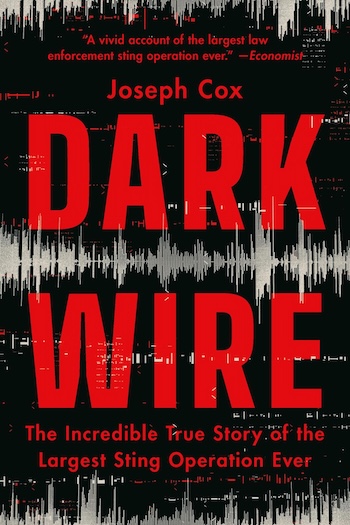
Very Quick Review: DARK WIRE by Joseph Cox (PublicAffairs)

The engaging, fascinating story about the largest sting operation in history

In 2018, a powerful app for secure communications called Anom took root among organized criminals. They believed Anom allowed them to conduct business in the shadows. Except for one thing: It was secretly run by the FBI.

Backdoor access to Anom and a series of related investigations granted American, Australian, and European authorities a front-row seat to the underworld. Tens of thousands of criminals worldwide appeared in full view of the same agents they were trying to evade. International smugglers, money launderers, hitmen: a sprawling illicit global economy as efficient and interconnected as the legal one. Officers watched drug shipments and murder plots unfold, making arrests without blowing their cover.

Featuring a new epilogue with crucial updates to the case, Dark Wire reveals the true scale and stakes of this unprecedented operation through the agents and criminals who were there. This is a fly-on-the-wall thriller for the modern world, where no one can be sure who is watching.

I first learned about this book via the Wicked Words podcast: my partner sent me the link to the episode with “I think you’ll find this really interesting.” She was right, and I went out and bought the book. I’m happy to say that the book definitely lived up to my expectations. This is a must-read for anyone interested in true crime and politics. Continue reading
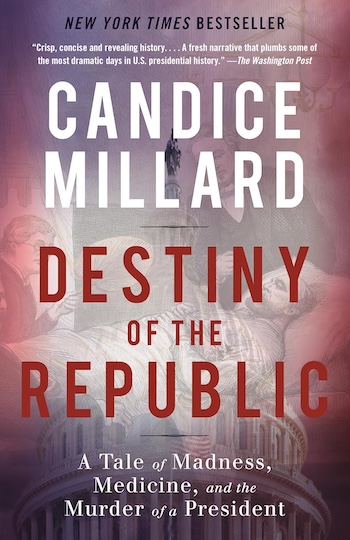
Very Quick Review: DESTINY OF THE REPUBLIC by Candice Millard (Vintage)

An engaging, highly-readable history of Garfield’s rise to the presidency and death.

James Abram Garfield was one of the most extraordinary men ever elected president. Born into abject poverty, he rose to become a wunderkind scholar, a Civil War hero, a renowned congressman, and a reluctant presidential candidate who took on the nation’s corrupt political establishment.

But four months after Garfield’s inauguration in 1881, he was shot in the back by a deranged office-seeker named Charles Guiteau. Garfield survived the attack, but became the object of bitter, behind-the-scenes struggles for power — over his administration, over the nation’s future, and, hauntingly, over his medical care.

Meticulously researched, epic in scope, and pulsating with an intimate human focus and high-velocity narrative drive, The Destiny of the Republic brings alive a forgotten chapter of U.S. history.

Candice Millard’s Destiny of the Republic has been on my radar for a very long time; it was first published in 2011, when I was still in college and reading through as many biographies of the US presidents as I could (for my studies, but also because I was generally interested). I never got around to reading it while at university, but with the recent Netflix adaptation — Death by Lightning — my interest in reading it was revived. So, I popped to Book City in Toronto (highly recommend this local chain), bought the book, and started reading it that same day.

Continue reading

Excerpt: PIRATE COVE by Richard D. Bailey (Bancroft Press)

BaileyRD-PirateCoveUSHCWe have something a little bit different, today: an excerpt from a biography about corporate intrigue and deception, and the dark side of finance: Robert D. Bailey‘s Pirate Cove. Due to be published by Bancroft Press on November 7th, the lovely people at Kaye Publicity have provided us with an excerpt from early on in the book. First, here’s the synopsis:
When Richard Bailey, a successful yet jobless businessman, receives a call from his old friend Jeff, he’s lured back into the high-stakes world of finance. Jeff, a charismatic corporate veteran, is now the number three guy at Southport Lane, a fledgling private equity firm. His boss invites Richard to inspect a pharmaceutical venture that reeks of mismanagement and financial disaster.

Bailey quickly finds himself navigating a sea of corruption as he attempts to rescue a floundering vineyard, Lieb Cellars, while unraveling a complex web of deceit at the heart of the corporate operations at Southport Lane.

Bailey provides an insider’s chronicle of a white-collar crime whose headline-grabbing elements first appeared on the front pages of The Wall Street Journal. It’s the true, unvarnished, previously untold, and fascinating story of how one honest man helped unravel the massive Southport Lane fraud perpetrated by the author’s former employer, 26-year-old, self-proclaimed financial prodigy Alexander Chatfield Burns.

A friend of the author once asked Burns how he got control of four state-regulated insurance companies. With a Cheshire cat grin, Burns cryptically responded, “Jesus with a telescope on Mars couldn’t figure out how I did this.”

But Bailey eventually did.

Now, read on for the excerpt, about the author’s early encounters with Burns…

Continue reading

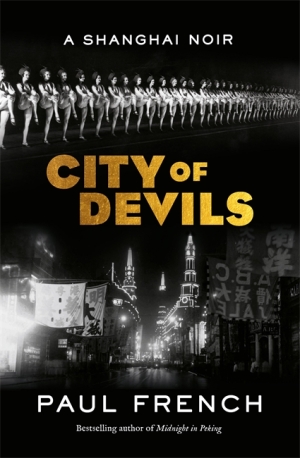
Quick Review: CITY OF DEVILS by Paul French (Riverrun/Picador)

FrenchP-CityOfDevilsUKAn intriguing glimpse into Shanghai’s pre-war underworld

A spellbinding and dramatic account of Shanghai’s lawless 1930s and two of its most notorious criminals…

1930s Shanghai could give Chicago a run for its money. In the years before the Japanese invaded, the city was a haven for outlaws from all over the world: a place where pasts could be forgotten, fascism and communism outrun, names invented, fortunes made – and lost.

‘Lucky’ Jack Riley was the most notorious of those outlaws. An ex-Navy boxing champion, he escaped from prison in the States, spotted a craze for gambling and rose to become the Slot King of Shanghai. Ruler of the clubs in that day was ‘Dapper’ Joe Farren — a Jewish boy who fled Vienna’s ghetto with a dream of dance halls. His chorus lines rivalled Ziegfeld’s and his name was in lights above the city’s biggest casino.

In 1940 they bestrode the Shanghai Badlands like kings, while all around the Solitary Island was poverty, starvation and genocide. They thought they ruled Shanghai; but the city had other ideas. This is the story of their rise to power, their downfall, and the trail of destruction they left in their wake. Shanghai was their playground for a flickering few years, a city where for a fleeting moment even the wildest dreams seemed possible.

In the vein of true crime books whose real brilliance is the recreation of a time and place, this is an impeccably researched narrative non-fiction told with superb energy and brio, as if James Ellroy had stumbled into a Shanghai cathouse.

Until City of Devils, I had only read Paul French’s shorter books on Asia — mainly on early 20th Century China, but also an excellent short book about Kim Jong-un. In City of Devils, French turns his attention to the criminal underworld of Shanghai in the 1930s, and two foreigners who managed to turn certain sectors of the city into their own private kingdoms. It’s a fascinating look at extraterritoriality, Westerners’ fascination with China, and their willingness to take advantage of their hosts. Continue reading