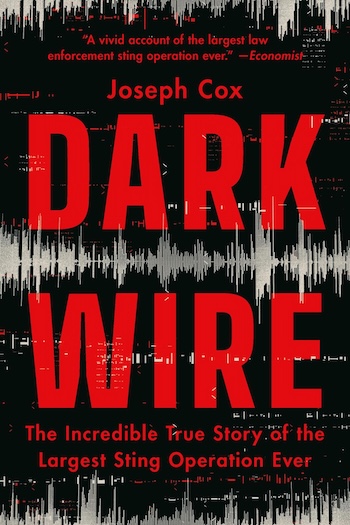
 The engaging, fascinating story about the largest sting operation in history
In 2018, a powerful app for secure communications called Anom took root among organized criminals. They believed Anom allowed them to conduct business in the shadows. Except for one thing: It was secretly run by the FBI.
Backdoor access to Anom and a series of related investigations granted American, Australian, and European authorities a front-row seat to the underworld. Tens of thousands of criminals worldwide appeared in full view of the same agents they were trying to evade. International smugglers, money launderers, hitmen: a sprawling illicit global economy as efficient and interconnected as the legal one. Officers watched drug shipments and murder plots unfold, making arrests without blowing their cover.
Featuring a new epilogue with crucial updates to the case, Dark Wire reveals the true scale and stakes of this unprecedented operation through the agents and criminals who were there. This is a fly-on-the-wall thriller for the modern world, where no one can be sure who is watching.
I first learned about this book via the Wicked Words podcast: my partner sent me the link to the episode with “I think you’ll find this really interesting.” She was right, and I went out and bought the book. I’m happy to say that the book definitely lived up to my expectations. This is a must-read for anyone interested in true crime and politics.
For career criminals, secure communications have long been an essential component of success. Whether it was code-words, euphemisms, or encrypted devices, there has been a decades- (centuries-?) long struggle between organized crime and law enforcement agencies to either maintain secrecy or crack comms open. As organized crime has gone global, and technology has advanced in leaps and bounds, law enforcement has in many ways been at a disadvantage.
In Dark Wire, Joseph Cox tells the story of how American DEA and FBI finally managed to get a look at a criminal secure phone, connected to the Phantom Secure network: the go-to choice for high-level criminals at the time. What follows is a fascinating glimpse into the ways in which organized crime has adopted encrypted networks to communicate with their colleagues and co-conspirators around the globe. Most interesting, though, is the story of how law enforcement, led by the San Diego FBI, took up what must be the most audacious law enforcement plan ever: What if they made their own encrypted network, and somehow got all of the criminals to use it? It’s a complex story of legal wrangling, international cooperation, tech wizardry, and not a little bit of luck. I won’t go into any further details, because this is one you really need to read for yourself, to get a proper sense of how audacious and incredible this story really is.
Well-written, tightly-told, and packed with plenty of excellent quotations and details, Cox’s book is a great read. It kept me reading well into the night on two occasions. It’s almost a cliché, these days, to say a non-fiction book “reads like a thriller”, but Dark Wire is one of the few that actually comes close to this being true. The characters at the centre of the story — law enforcement and criminal — are colourful and well-drawn. The globalization of these criminal organizations was, in some instances, shocking. It’s almost as if they went to business school, and took what they saw as “best practices” and applied them to their dope and weapons smuggling.
Something that stood out for me was how the criminals’ behaviour was so similar to what one might read in a crime, thriller, or mystery novel. Often, in a novel, the hero cop or investigator is able to break the case wide open because the antagonist makes a clumsy, stupid, or arrogant mistake. Based on the events covered in Dark Wire, this is far more realistic than I had originally thought. So many breaks in the cases covered by Cox occur through a criminal’s own actions and mistakes. Hubris, in particular, is a major weakness displayed by most. The immense egos these guys have! Apparently, the mindsets of “titans of industry” and kingpins share a lot of similarities…
Thinking about crime fiction: I wonder how long it’ll be before the strategies covered by Cox’s book start to work their way into crime novels, TV shows, and movies? I’ve seen a hint of it in a recent episode of The Rookie, but nowhere else. It seems to me to offer some particularly interesting possibilities for fiction writers.
Definitely recommended for anyone with an interest in true crime, and the nexus between crime, politics, and tech. I’m very much looking forward to reading Cox’s next book, if there is one.
*
Joseph Cox’s Dark Wire is out now, published by PublicAffairs in North America and in the UK.


Sounds like I’d enjoy it. I read two hacking books, Ghost in the Wires, and This Is How They Tell Me the World Ends, and I’m always interested in this too-true-to-be-fiction-nonfiction. They a really amazing sometimes.
LikeLike