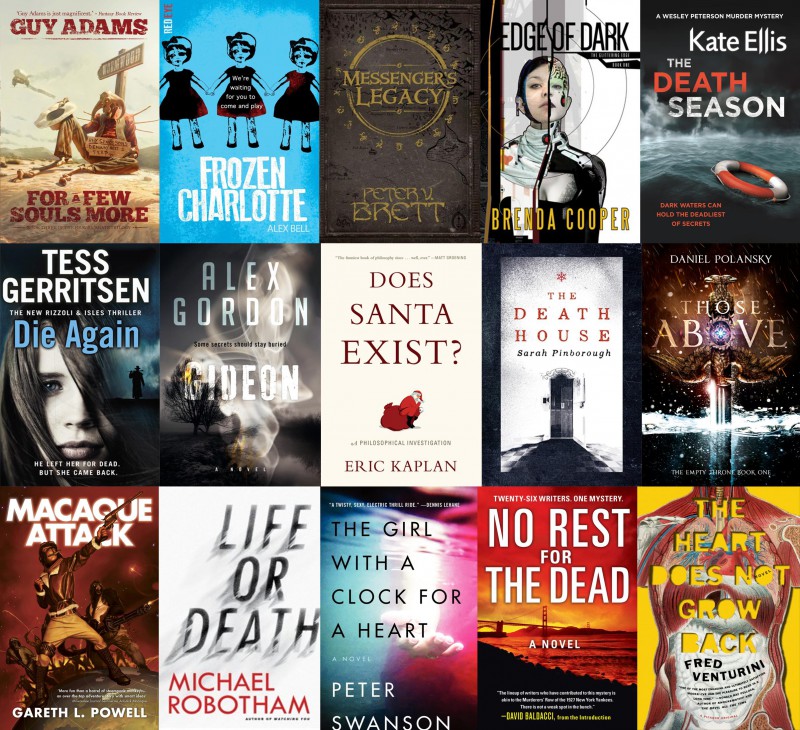
Books Received: December #2 (Or, “It Rained Books Just Before Xmas…”)

BooksReceived-20141220

A nice wave of new titles arrived or were purchased just before Christmas. I’ve just been slow about posting this, which means I’ve already read a couple (and dismissed a couple). Some more have arrived since, too, but I’ll post about those at the beginning of January.

Featuring: Kate Atkinson, Belinda Bauer, Gregory Benford, Douglas Brunt, Chelsea Cain, John Connolly, Christopher Farnsworth, Helen Giltrow, Karl Taro Greenfeld, Lev Grossman, Glenda Larke, Karen Lord, Alex Marhsall, Peyton Marshall, Brian McClellan, D.J. Molles, Syliva Moreno-Garcia, Mark Morris, Larry Niven, Claire North, Chuck Palahniuk, Matthew Pearl, D.B.C. Pierre, Jennifer Ridyard, Jeff Somers, Gabriel Squailia, Mark Sullivan, S.J. Watson, Jaye Wells Continue reading

New Books (November-December)

BooksReceived-201412-02

Featuring: Guy Adams, Alex Bell, Peter V. Brett, Brenda Cooper, Kate Ellis, Tess Gerritsen, Alex Gordon, Eric Kaplan, Sarah Pinborough, Daniel Polansky, Gareth L. Powell, Michael Robotham, Peter Swanson, Peter Terrin, Fred Venturini Continue reading

Guest Post: “Pantheon Inspirations” by James Lovegrove

LovegroveJ-AuthorPicSo far my Pantheon series extends to six novels and three novellas. What is it about these military-SF tales of gods and men that I seem to find so fascinating? Why do I keep coming back time and time again to this well of inspiration?

Partly it’s because the ideas embedded in polytheistic religious mythologies are so wonderfully rich and exploitable, like countless mines yielding up different seams of precious ore. I myself do not believe in deities of any kind, but the stories that others have came up with about them over the centuries are pleasingly intricate and complex, full of incident and nuance. Every Pantheon strikes me as being like a dysfunctional family. Their conflicts and passions echo those of their worshippers. Even though they’re gods, they’re eminently relatable. They banter and squabble, have affairs, plays tricks on one another, lose their temper, just as humans do. The aloof, monotheistic gods whose faiths prevail in the world today aren’t anywhere near as interesting. Those guys are like grumpy father figures you can’t get on with and have to tread carefully around but are still supposed to admire. Where’s the fun in that?

Lovegrove-AgeOfRaI didn’t set out to write a series. When Solaris, my publisher, commissioned Age Of Ra from me, I thought it would be a one-off, a slice of alternate history with a bit of Ancient Egyptian mythology thrown in to add savour. I certainly didn’t anticipate that I’d still be writing in the same subgenre seven years later, or even that that subgenre would have gained its own name, godpunk. But that’s me. I never plan things. Foresight is not my middle name.

The great thing about the Pantheon novels, as far as writing them goes, is that the tone of each is set by the individual tone of the myths which I’m dealing with. Age Of Odin, for instance, could only have taken place in a world caught in the grip of the Fimbulwinter, the three years of constant ice and snow that presage Ragnarok, and the bad guy could only have been Loki, the trickster, pitting himself against the other residents of Asgard as he does in the Sagas and the Skaldic poems. Likewise, Age Of Aztec just had to be about a high-tech, quasi-Aztec culture, full of human sacrifice, ziggurat temples, and flying saucers in the tradition of Chariots Of The Gods. Once I’ve started researching each book, the plot begins to suggest itself, arising organically from the background material. In a way, I have to do only half the work I otherwise might – half the backstory creation, half the worldbuilding. The other half has already been done for me by the people who dreamed up the original stories. You could even call this cheating.

Lovegrove-AgeOfOdin&Aztec

The latest volume in the series, Age Of Shiva, came about largely because I’ve long had a hankering to write a superhero tale, being the massive comics fan than I am. I perceived that the Hindu pantheon is, in many ways, a set of super-powered beings who battle demons, vampires and other monsters. They’re good guys with a clearly delineated set of bad guys ranged against them. That is, of course, a very reductive view of Hinduism, which is a great deal more complicated and beautifully arabesque and nowhere near as trivial as I’m making it sound. On the surface, however, at a purely primal level of storytelling, that is where it’s at. I thought to myself, “I could have some fun extrapolating a superhero story out of this mythology,” and so, as it proved, I did.

LovegroveJ-AgeOfShiva2014The plot focuses on a comic book artist who is employed by a multinational consortium to help on a secret project to create a real-live superhero team. Ten super-powered characters, based on the Ten Avatars of Vishnu, emerge into the glare of the media spotlight, and rapidly make a name for themselves, saving civilians from snake-men, sewer-dwelling vampires and the like. Things, however, get gnarlier and more complicated from there, and it isn’t long before the world’s balance of military power is destabilised and the threat of nuclear Armageddon looms.

That may all sound very serious, but as with the other Pantheon novels, Shiva is all about the action and the fun. The violence is over-the-top, and the protagonist’s narrative voice is, I hope, witty and wry.

I’m not sure what my next Pantheon novel will be, which set of gods it will concentrate on, what shape it will take. I’ve three other books to write first before I seriously have to start thinking about it. The joy of the concept, though, is that whichever pantheon I choose to exploit, I’ll be as surprised by the outcome as any reader.

***

Also on CR: Interview with James Lovegrove, Guest Post on Age of Godpunk, Excerpt (Age of Shiva)

Excerpt: AGE OF SHIVA by James Lovegrove (Solaris)

LovegroveJ-AgeOfShiva2014

This April, Solaris Books publishes the sixth novel in James Lovegrove’s New York Times-bestselling Pantheon series, Age of Shiva. Below, you will find the first three chapters!

AGE OF SHIVA

This is a confession.

This is an apology.

This is an origin story.

This is the tale of ordinary people who became extraordinary, became heroes, and the price we all paid.

It’s completely true.

I know.

I was there.

LovegroveJ-AgeOfShiva2014

CHAPTER 1

KIDNAP IN CROUCH END

I stepped out of my flat to get my lunchtime sandwich and cappuccino, and never went back.

There was a coffee place round the corner from my house. It styled itself like one of the big chains, calling itself Caffè Buono and boasting baristas and leather armchairs and a Gaggia machine, but it was the only one of its kind in existence and it never to my knowledge opened any other branches. The sandwiches were all right, though. The coffee too.

I didn’t notice the jet black Range Rover with tinted windows prowling after me as I sauntered along the street. It was spring. The sun was out, for a change. I’d been slaving away at my drawing board since breakfast. Daylight on my face felt sweet. To be among people – the usual milling midday Crouch End crowds – was pleasant. My work was a kind of solitary confinement. It was always good to get out.

I was thinking of a plump, tasty BLT and also of the plump, tasty new barista at Caffè Buono. Krystyna, her name badge said. From Poland, to judge by the spelling and her accent. Farm-girl pretty and very friendly. Flirtatious, even. It was never likely that I would ask her out, she being at least fifteen years younger than me, but seeing her brightened my day and I chose to think that seeing me brightened hers. If it didn’t, she did a very creditable job of pretending it did.

I moseyed along, a million miles from where I was, and all the while the jet black Range Rover was stealing ever closer to me, homing in from behind, a shark shadowing its prey.

I was coming to the end of my latest commission – another reason I was so preoccupied. I was on the final straight of eight months’ solid work. Five pages left to go on a four-issue miniseries. Full pencils and inks, from a script by Mark Millar. I liked collaborating with Millar; he gave the bare minimum of art direction. Usually he offered a thumbnail description of the content of each panel, with a caption or two to fit in somewhere, along with an invitation to “knock yourself out” or “make this the best fucking picture you’ve ever drawn.” So few restrictions. Happy to let the artist be the artist and do what an artist was paid to do. I was fine with that.

But it had been a long haul. I was slow. Had a reputation for it. A stickler; meticulous. Notoriously so. Every page, every panel, every single line had to be exactly right. That was Zak Zap’s unique selling point. You only got top-quality, ultra-refined product, and if you had to wait for it, tough titties. I’d been known to tear up a completed page rather than submit it, simply because a couple of brushstrokes weren’t precisely as I’d envisaged they’d be, or the overall composition was a fraction off. Just rip that sheet of Bristol board in half and bin it. Three days’ effort, wasted. And I’d rage and fume and yell at the cat, and then maybe neck down a few beers, and then next morning I’d plonk my backside down in front of my drawing desk and start all over again.

Stupid, but that’s how I was.

It was why Francesca left me.

Not the tantrums or the fits of creative pique. She could handle those. Laugh them off.

It was the pressure I put on myself. The sense of never being good enough which constantly dogged me. The striving for unrealisable goals. The quest to be better than my best.

“It’s not noble to be a perfectionist, Zak,” Francesca told me as she packed her bag. “It’s a kind of self-loathing.”

I was within spitting distance of the coffee place, just passing the Louisiana Chicken Shack, when the Range Rover drew alongside and braked.

The doors were already open before the car came to a complete stop.

Men in suits bundled out.

I glimpsed them out of the corner of my eye. They were Hugo-Boss-clad barrels in motion. My first thought was that they must be bodyguards for some movie star. Someone famous, over in the UK from Hollywood to promote the release of his latest action-fest, had had a sudden hankering for southern fried chicken, and his security detail were forming a cordon so that he could go in and buy a bucketful. Will Smith, maybe. Bruce Willis. The Rock. One of those guys.

And then I thought, In Crouch End? This wasn’t even the fashionable end of Crouch End. This was the crouchy end of Crouch End. And no movie star in his right mind, however hungry, would want to sample the battered scrag ends of battery hen they served at the Louisiana Chicken Shack.

And then the nearest of the men in suits grabbed hold of me. And then another of them did too, clamping a hand around my elbow and whispering in my ear, “Don’t shout. Don’t struggle. Act natural, like this is nothing out of the ordinary. Otherwise you’ll regret it.”

Then, loudly so that passersby would hear, he said, “All right, sweetheart. That’s enough now. You’ve had your fun, but it’s time to go back to the Priory. Your management is paying all that money for your rehab. They don’t want it wasted.”

With that, they dragged me towards the Range Rover – literally dragged, my heels scraping the kerbstones. I was helpless, inert, a flummoxed idiot, no idea what was going on. Even if I hadn’t been warned to act natural, I’d have been too dumbfounded to resist or protest.

It happened so fast. Just a handful of seconds, and suddenly I was in the back seat of the Range Rover, squashed between two of the suited goons, and the car was pulling out into the traffic, and I wasn’t going to have that BLT or that cappuccino today and I wasn’t going to cheer up Krystyna with a smile and she wasn’t going to cheer me up either.

CHAPTER 2

KNUCKLEDUSTER RING, HILLBILLY MOUSTACHE AND FRIENDS

There are moments in your life when you do what you have to, simply because you’re too scared to do anything else.

I was no Jedi knight, no master of kung fu. I hadn’t been in a fight since secondary school, and that was more of a pathetic bitch-slap contest than anything, and besides, I lost. Now I was in a car with four blokes, each of whom weighed twice as much as me, each of whom had a shaven head and no-bullshit mirrored sunglasses and seam-straining muscles and looked as though he could snap my neck just by breathing hard on me.

Compliance was the only logical course of action. I wasn’t going to karate chop my way out of this predicament. I didn’t have super powers like the characters in the comics I drew for a living. No eye beam to blast a hole through the car roof. No webbing to truss up my kidnappers. No frigging Batarang. I was stuck, a victim, panic-stricken, hyperventilating, only human.

They could kill me, these men. Were they going to kill me? Who were they? What did they want with me?

We had driven perhaps half a mile before I finally found some gumption and piped up. “Piped” was the word; my voice sounded like a piccolo.

“You must have the wrong man,” I said. “I haven’t done anything. I’m nobody.”

“You Zachary Bramwell?” said the goon on my immediate left, who wore a gold sovereign ring so large it could easily double as a knuckleduster.

It didn’t really seem to be a question, which was why I said, “Yes.”

“Then we’ve got the right man. By the way, you got a phone on you?”

“No.”

“I’m going to check anyway.” Knuckleduster Ring ransacked my pockets, finding nothing but lint and loose change. “Left it at home, eh?”

I had. I nodded.

“Good. No need to confiscate it, then. Now shut your trap.”

I shut my trap, but after another mile I couldn’t keep it shut any longer. My anxiety wouldn’t let me.

“What was all that stuff about ‘the Priory’ and my ‘management’?”

“What do you think? To make it look like we were staging an intervention.”

“Oh. But you are sure you’ve got the right Zachary Bramwell, not a different one? Same name but, you know, minus the substance addiction issues?”

“Hundred per cent.”

“So where are you taking me? Who do you work for? Are you cops? The government?”

Knuckleduster Ring smiled. The goon on my right, who had the type of drooping moustache favoured by bikers and hillbillies, smirked. The guy driving the car actually laughed, like I’d cracked a joke.

“Nah,” said Knuckleduster Ring. “They pay shit.”

“Private contractors, you could call us,” said Hillbilly Moustache. “Available to the highest bidder.”

“Well, who is that, then?” I said. “Who in God’s name has it in for me so badly that they’ve hired you to snatch me off a London street in broad daylight?”

“Christ, this fucker talks a lot,” said the fourth goon, who was the spitting image of Knuckleduster Ring and could only have been his identical twin brother. “Can’t I give him a crack upside the head? I don’t want to listen to him jabber all the way.”

“Unharmed, intact,” said the driver, who I reckoned was the boss of the outfit. He had a diamond inset into one of his upper incisors. “That’s the brief. But,” he added, “maybe you should think about quietening down, Mr Bramwell. My boys have a pretty low threshold of tolerance for nonsense, if you know what I’m saying. Here, I’ve got an idea. How about some nice soothing music? Help us all chillax.”

Diamond Tooth switched on the radio, tuned it to Classic FM, and there we were, tootling along the North Circular, me and this quartet of brick-shithouse abductors, listening to a sequence of plinky-plonk sonatas[*], with comments from the nerdy posh announcer spliced in between. At one point Knuckleduster Ring’s twin brother raised his hand off his knee and started stroking patterns in the air as though conducting an orchestra. It was ridiculous, and I might have thought it funny if I hadn’t been trying so hard not to soil my pants.

We drove for an hour, leaving London behind. We headed northbound up the M1, turning off somewhere before Milton Keynes and then wiggling around in the Buckinghamshire countryside on A-roads and B-roads until I was thoroughly disorientated and couldn’t have found my way back to civilisation even with a map.

In my head Diamond Tooth’s words – “Unharmed, intact” – rang like a church bell, offering solace and hope. Whoever my kidnappers’ employer was, he didn’t want me hurt. There was at least that.

Or could it be that he didn’t want me hurt until he himself got his hands on me? I was the pair of box-fresh sneakers that no one else could touch and that only his feet could sully.

I racked my brains, thinking of people I’d pissed off during the nearly forty years of my life so far. It wasn’t exactly a short list. I’d aggrieved more than a few editors in the comics biz with my propensity for handing in work at the very last minute, or else blowing the deadline completely. I’d hacked off my previous landlord but one with my complaints about mice droppings in the kitchen and mould on the bathroom walls, but those were legitimate gripes and he had no right to be upset with me for pestering him about things he was duty-bound to fix. I’d left behind a trail of women who to a greater or lesser degree found me lacking in the attentive boyfriend department, up to and including Francesca, who had stuck it out with me the longest but had ultimately come to the same conclusion as the rest: that I wasn’t worth the time, trouble and effort. And then there was that financial advisor at the bank who I’d lost my rag with, just because he told me I wasn’t in a “reliable occupation with regular income” and therefore didn’t deserve to be offered a more preferential mortgage rate. In hindsight, I shouldn’t have swept his pot of ballpoint pens onto the floor of his cubicle and told him to stick his flexible variable rates up his backside. It was petty and childish of me. I should have done the mature, manly thing and thumped the tosser.

All these people and others had cause to dislike Zak Bramwell. They might well wish to curse me under their breath and think ill of me during the long watches of a sleepless night.

But hate me so much as to have me brought to them so that they could inflict prolonged and nefarious revenge upon my person at their leisure? And at great expense, too?

I didn’t think so.

Who, then? Who the hell was I being taken to meet?

I couldn’t for the life of me rustle up an answer.

Finally the Range Rover arrived somewhere. And by “somewhere” I mean the middle of nowhere.

To be precise: a disused, dilapidated aerodrome that had once served as a US airbase during World War 2 and subsequently the Cold War, and was now a collection of grass-covered hangars, mouldering Quonset huts, and sad, sagging outbuildings.

An air traffic control tower with smashed-out windows overlooked a shattered concrete runway criss-crossed by strips of weed.

And on the runway stood the most extraordinary vehicle I had ever seen.

CHAPTER 3

THE GARUDA

Most of you reading this will be familiar with the Garuda. How can you not be? You’d have seen it on TV or the internet, maybe been fortunate enough to watch it in flight, zipping overhead with scarcely a sound. You’d no doubt have been startled the first time you clapped eyes on it, perhaps a little in awe, certainly impressed.

Back then, virtually nobody knew about the Garuda. Maybe no more than a couple of hundred people in total were aware that it existed.

So imagine my feelings as the Range Rover bumped out onto that runway and pulled up in front of this sleek metal angel with its folded-back wings, its downturned nosecone, its jet vents, its high-arched undercarriage, its rugged spherical wheels, its all-round air of lofty magnificence. It didn’t seem to be standing on the ground so much as perching, a forty-ton bird of prey that had briefly alighted to survey the lie of the land.

I was gobsmacked, all the more so in those shabby surroundings. The incongruity was striking. It didn’t belong here in a disused Midlands aerodrome. It belonged somewhere in the future, perhaps docking with a space station in near Earth orbit.

I think I fell a little bit in love with it, there on the spot. And bear in mind, this was before I had any idea what the Garuda was capable of, all the things it could do.

The goons hauled me out of the car and lugged me over to the aircraft, from which steps unfolded like a carpet unrolling. A door opened, so smoothly it seemed to melt inwards, and a woman emerged, extending a hand to me in welcome.

I can’t deny that things were suddenly looking up. She was quite beautiful. She was Asian – Indian, if I didn’t miss my guess – with almond-shaped eyes and soft features. Her hair was pure black gloss and her figure was full, just the way I liked. I wasn’t into the skinny, self-denying type of woman. I preferred someone who ate and drank with an appetite and wasn’t guilt-ridden or ashamed.

Her dress was smart and immaculate, from pale blue silk blouse to hip-hugging skirt. Her makeup was subtle but effective. Her nails were varnished chocolate brown.

I think I fell a little bit in love with her, too. Maybe I was just glad to see a face that was utterly unlike the hard, expressionless faces of the four goons. Maybe it was a relief to meet someone who looked friendly and wasn’t acting as though I needed to have my head stove in.

“Aanandi Sengupta,” she said, introducing herself. “I hope you’ve had a pleasant journey, Zak. Sorry if it’s been a bit… abrupt. Our employers are not patient men. When they want something, they tend to reach out and grab it. Often without asking permission until afterwards.”

“Ahem. Yes, well…” I felt scruffy and uncomfortable in front of the crisply turned-out Aanandi Sengupta. I hadn’t shaved that morning, I was in my oldest, baggiest sweatshirt and jeans, and there were ink blotches on my fingers as I shook her hand. I was a mess, and she was as far from a mess as one could be. “Can’t say they were the finest conversationalists I’ve ever met.”

I glanced over my shoulder as I said this. The goons were keeping their distance from the aircraft, standing at ease, soldiers relieved of a duty. I was passing from their care to Aanandi’s. And don’t think I was unhappy about that, but I also figured I had no choice about getting on the plane. If I turned and made a run for it, Diamond Tooth, Hillbilly Moustache and the twins would be on me in a flash. I could walk aboard willingly or I could be frogmarched aboard with my arm twisted up between my shoulderblades. Either way, I was making the flight.

“Come on in,” Aanandi said. “I promise I’ll answer every query you have, once we’re wheels up and in the air.”

“Every query? Because I have loads.”

“Almost every. Some stuff is off-limits for now. All right?”

“Fair enough.”

The main cabin was spacious and fitted with large, plush seats; about a dozen, all told. Shagpile carpet whispered underfoot. I caught a whiff of a fragrant scent – incense?

“Make yourself at home, Zak. I can call you Zak?”

A woman like her, she could have called me anything she liked.

“How about a drink? Coffee? Tea? Something stronger?”

My body was crying out for alcohol. Something to de-jangle the nerves. But I settled for mineral water. I had a feeling I ought to remain compos mentis for the time being. Whatever wits I had, I needed to keep them about me.

The water came in a cup with a plastic sippy lid, like a takeaway coffee. This should have struck me as odd, but didn’t. So much else here was off-kilter, what was one more thing?

Aanandi hit an intercom button. “Captain? We’re ready for takeoff.”

She sat beside me. She buckled her lap belt and I followed suit and buckled mine. Through the window I saw the Range Rover depart with its full complement of goon, veering out through the broken gateway it had come in by. I gave it a little farewell wave.

The aircraft began to move, those ball-shaped wheels rolling along within armatures that clutched them like talons, and then, before I even realised, we were airborne. The abandoned aerodrome shrank below. England disappeared. Within moments we were soaring among the clouds, our climb so steep it was all but vertical. Other than a plummeting sensation in the pit of my stomach, there was little to tell me we were actually in ascent; our rise was smooth, turbulence-free and eerily quiet.

“What is this thing?” I asked Aanandi. “It’s like something out of a Gerry Anderson show.”

“It’s the Garuda. It’s the only one of its kind; a multi-platform adaptable personnel transporter, equally at home in five different travel environments.”

“It’s ruddy quiet, is what it is. My bicycle’s louder.”

“I don’t know the technicalities, but the engine design incorporates sound reduction technology way in advance of anything else currently on the market. The turbofans have the highest conceivable bypass ratio and feature multilobe hush kit modification baffles. And of course the cabin is comprehensively soundproofed with layers of porous absorbers and Helmholtz resonators.”

“That’s an awful lot of jargon for someone who says she doesn’t know the technicalities.”

Aanandi gave a brief, self-effacing smile. “I listen well. I pay attention. I have a good memory.”

“Your accent,” I said. “American?”

“Born and bred. Second-generation Indian from Boston.”

“And who are these ‘employers’ you mentioned?”

“That I can’t tell you, Zak. Not yet. You’ll find out in due course. What I can tell you is that you’re under no obligation to co-operate with them. You’re under no obligation to do anything. I’m pretty sure you’ll want to be a part of what’s happening, once you learn what it is, but there’s no coercion involved. We’re after willing recruits, not slaves.”

“It did seem like I was being pressganged,” I said.

“Not so. Those four were perhaps a little insensitive and overenthusiastic, I imagine, but they had to get the job done quickly and with minimum fuss. Like I said, we work for people who are not patient and have no time for messing around.”

“Well, where are we going? Is that one of the queries you can answer?”

“Certainly. The Indian Ocean. The Maldives.”

“Seriously?”

“Is that a problem?”

I looked at her. “Normally I’d say no. Who wouldn’t want to visit a tropical paradise? Especially when someone else is paying for the ticket. But… You can see it from my point of view, can’t you? I’m in a super-duper fancypants James Bond aircraft, with someone I’ve never met before, being flown halfway across the world. How long does it even take to get to the Maldives? Twelve hours?”

“Ten by conventional means. In the Garuda, a third of that.”

I shot past that little nugget of information. I was in full spate, mid-rant. All the outrage and disquiet of the past hour was pouring out, and not much was going to stem the flow. “And there I was, not so long ago, just walking down the street, minding my own business. I still can’t help thinking this is a case of mistaken identity. You’ve picked up the wrong Zak Bramwell. What the hell would anyone who can afford a plane like this want with someone like me? I draw comic books for a living, for heaven’s sake. I don’t have any practical skills besides that – and it’s not even that practical.”

“You are Zak Zap, though,” Aanandi said.

I winced a little. The name sounded dumb, coming from her. Even dumber than usual. “That’s me. I know, I know. Pretty lame. I was young when I chose it. Teenager. Seemed cool then. Now I’m stuck with it and there’s not much I can do. Too late to change it.”

“The same Zak Zap who drew the Deathquake strip for 2000 AD, and did brief but well-respected runs on Fantastic Four and Aquaman, and recently illustrated Robert Kirkman’s Sitting Ducks miniseries for Image.”

“Yeah. Don’t tell me you’re a fan.”

“I’m not. But the people I work for are.”

“Oh.” I digested this fact. It sat pleasantly in my belly. “Right. And, er… Am I going to some sort of convention? Is that what this is? Maybe a private one?”

“Not as such.”

“I just thought… I mean, I’ve done Comic Con. Plenty of others, too. Crap hotels, mostly. Teeming hordes of cosplayers and fanboys. Pros all hunkered down at the bar trying to avoid them. I thought this might be the same deal only, you know, classier.”

“Afraid not.”

“Shame.” The professional freelancer instinct kicked in. “But you say there’s work involved? Actual paid work?”

“There could be,” said Aanandi, “if you want it. Very well paid.”

I was beginning to like the sound of this. I was still unnerved and discombobulated. It had not been an ordinary day so far, and the dread evoked by my “kidnap” had yet to subside. But work was work, and I was never one to turn a job offer down. I could hardly afford to: plenty of comics artists made a pretty decent wage, but they were the fast ones, the guys who could churn out a book a month, twenty-odd pages bang on schedule, no sweat. As I’ve already established, that wasn’t me. My financial situation was definitely more hand-to-mouth. I’d never been asked to draw any of the mega-sellers; Fantastic Four had been in the doldrums when I was assigned to it – and then fired six issues later. And as for Aquaman… Who the hell buys Aquaman? I only took the gig because I was short on cash at the time and I liked drawing underwater stuff. [†]

So I didn’t have a steady stream of backlist royalty revenue to rely on, and no editor with any sense was going to hire me to do Superman or Amazing Spider-Man or any of the other DC and Marvel flagship titles. Readers wouldn’t stomach the indefinite delays between issues or the inevitable rushed fill-ins by other artists. They’d desert in droves.

So somebody was interested in employing me? And was flying me to the Maldives for the job interview?

I can handle that, I thought.

I felt a flush of smugness, the kind you get when your talent is recognised, when you’re acknowledged as being skilled at what you do. The pardonable kind. A sort of giddiness overcame me. I undid my lap belt, thinking that a victory stroll up and down the cabin aisle was in order, a moment by myself to clench my fist and go “Yes!” under my breath.

“I wouldn’t do that if I were you,” Aanandi advised.

Too late. I was already on my feet. And then I was off my feet. I was somehow standing without standing. My toes were in contact with the carpet, but only just. The giddiness wasn’t an emotion, it was a genuine physical sensation. I was bobbing in the air, a human balloon.

“What the hot holy…?”

Aanandi took my wrist and pulled me back down into my seat. I refastened the belt, tethering myself.

“I would have warned you,” she said, “but you had so much to say.”

The empty cup floated free from the armrest tray. Tiny sparkling droplets of mineral water poured from its lid aperture like reverse rain.

I glanced out of the window.

We were high up.

Oh, God, so fucking high up. I could see the curvature of the Earth, the horizon line of pale blue sky giving way to the blue-blackness of the void. Continents were small enough that I could blot them out with my hand. Cloud forms were rugged Arctic snowscapes.

“Space,” I breathed. “We’re in fucking space.”

—–

[*] Vivaldi? Haydn? One of those guys.

[†] There’d never been any great fan-love for the King of the Seas with his daft orange and green swimsuit and his power to exert mental control over, er, fish. After my brief tenure on the title, no one liked him much more than they had before.

***

AGE OF SHIVA is published by Solaris Books on April 10th 2014. The rest of the Pantheon series is out now: Age of Ra, Age of Zeus, Age of Odin, Age of Aztec, Age of Voodoo, Age of Godpunk (Anansi, Satan, Gaia)

Lovegrove-PantheonSeries1-5&GP

An Interview with DAVE HUTCHINSON

Let’s start with an introduction: Who is Dave Hutchinson?

Dave Hutchinson is a 53-year-old journalist and writer, born in Sheffield and living in London. He likes cats and hates mushrooms. He is obsessed with Twitter to a disturbing degree.

HutchinsonD-EuropeInAutumnYour latest novel, Europe In Autumn, is published by Solaris. How would you introduce the novel to a new reader?

Europe In Autumn is, for want of a better term, a near-future espionage thriller. It’s set in a Europe where the EU has begun to fracture for various reasons, and new nations are springing up all over the place. Rudi, the central character, is a chef who becomes involved with a group of couriers and people smugglers, and finds himself mixed up in what may be a very large conspiracy. It wasn’t originally planned as part of a series, but while I was writing it I had an idea for a companion novel, and since I finished it I’ve started to see a possible sequel. We’ll see how things go.

What inspired you to write the novel? And where do you draw your inspiration from in general?

Inspirations… that’s a tough one. Alan Furst’s novels were a big influence on the feel and structure of the book, and Anthony Bourdain’s Kitchen Confidential inspired me to make Rudi a chef. Further back, Len Deighton’s definitely an influence, as is Keith Roberts. More widely, ideas come from anywhere. You can be reading the paper and a phrase will jump out at you and set off a chain of association that will wind up with you writing a story. Other times a bit of dialogue will pop into your head, or you’ll see something, and a few months later you’ll see something else and sort of subconsciously bolt them together, and that keeps happening until all the bits reach critical mass and you find yourself sitting down and starting to write. It’s just a matter of keeping your eyes open. That’s the easy bit; it’s the writing that’s hard.

How were you introduced to reading and genre fiction?

WellsHG-FirstMenInTheMoonI’ve been a fan of science fiction ever since junior school, when I read First Men In The Moon. It was really the only thing that seemed interesting to me, and I spent years working my way through Asimov, Heinlein, Niven, E.E.  ‘Doc’ Smith and so on. Then I read Funeral In Berlin and really got into spy fiction. Then I read Farewell, My Lovely and really got into crime fiction.

How do you enjoy being a writer and working within the publishing industry? Do you have any specific working, writing, researching practices?

I find writing very, very difficult. I’m an enormously lazy writer – I was picking around at Europe In Autumn for at least ten years, probably longer – but I love doing it. I love the act of imagining something and describing it, and seeing that turn into a book, an object you can actually hold, is a continual delight to me. It’s a very different discipline to journalism, which – at least in the journalism I did – doesn’t allow great scope for creativity. It does, however, knock any prima donna tendencies out of you; I once wrote a double-page feature on the Reagan-Dukakis Presidential election and saw it subbed down to four column inches.

When did you realize you wanted to be an author, and what was your first foray into writing? Do you still look back on it fondly?

I wanted to be a writer very early on – I was scribbling little stories in notebooks when I was about thirteen or fourteen. My first novel was a rip-off of the Lensman books. It was awful beyond belief, and the world is far better off without it. When I was sixteen my mother bought me a typewriter, and that’s really where I date my writing “career” from. And since then it’s just been a long slog of stories, some better than others.

What’s your opinion of the genre today, and where do you see your work fitting into it?

One of the things I like about science fiction is the way it’s constantly examining itself, asking itself questions. I’m not sure other genres do that. Sometimes, I think science fiction puts itself to the question a little too harshly, but it keeps everyone on their toes, keeps things moving forward, and that’s healthy. I think I’ve been seeing articles about how science fiction is dead, or at least stagnant, for the best part of forty years, but it always keeps going, there’s always new blood coming through, new points of view, new questions to face. If my stuff does fit into it at all, it’s in a small, quiet, English kind of way.

What other projects are you working on, and what do you have currently in the pipeline?

At the moment I’m working on the companion to Europe In Autumn, which is a kind of parallel view of some of the events in the first book. I’m also working on a novel called Gunpowder Square, which is a detective story involving gnomes and the nature of Reality. There will also be a book of previously-uncollected short stories at some point either this year or next from NewCon Press.

What are you reading at the moment (fiction, non-fiction)?

Right now I’m re-reading Alexandra Richie’s fabulous biography of Berlin, Faust’s Metropolis, which is an utterly terrific book, I really can’t recommend it highly enough. I’m also reading Dracula for the first time, and I’m finding it a bit of a surprise. Which is always good.

HutchinsonDave-Reading

What’s something readers might be surprised to learn about you?

What would readers be most surprised to learn about me? I’m not sure anything would surprise people who know me. I was once quite athletic – I was Sheffield City discus champion, back in the day. But then I discovered the joys of sloth and I haven’t looked back since.

What are you most looking forward to in the next twelve months?

I have a feeling the next twelve months are going to be a period of great change for me. Some of it for good, some of it maybe not so much. I’m really looking forward to Europe In Autumn coming out, though. It’s amazing to me to think that this thing, which began over a decade ago as a bunch of notes and bits of dialogue, is now a physical object which other people are reading, and whatever happens I’ll always be grateful to Solaris for taking a chance with it. A lot of writers aren’t so lucky.

Guest Post: “Confessions of a TV Series-aholic (Or, What Writers Can Learn From TV Series)” by Rowena Cory Daniells

Rowena Cory-Daniells discusses her addiction to certain TV series, and how they’ve inspired elements of her own fiction…

I’ve discovered I prefer TV series to movies, series like Boardwalk Empire, Deadwood, House of Cards and now from the UK the Peaky Blinders. (So named because according to some sources they sewed razor blades into the peak of their caps to slash across their enemies’ faces).

PeakyBlinders-CillianMurphy

(Cillian Murphy plays gang leader Thomas Shelby)

If a movie is the equivalent of a short story (Minority Report was a story by the same title by Phillip K. Dick), then a TV series is the equivalent of a book in that a series has time to develop complex story arcs and in-depth characterisation.

BreakingBad-S2

(Breaking Bad: Walt and Jessie taking a break in between cooking crystal meth)

As someone who writes big fat fantasy books, I know the craft involved in creating interesting characters and interweaving narratives. When Walter White first found out he had lung cancer and needed money for his pregnant wife and disabled son, I could appreciate the way the audience were positioned to identify with Walt and sympathise even when he broke the law. We go on his journey with him as we see the roll-on effects of his decision to cook crystal meth. Breaking Bad raised the question: Would you break the law to protect your family?

Raising difficult moral questions makes the viewer/reader ask themselves the same question. In the first book of King Rolen’s Kin, Byren instinctively protects his best friend and this gets him in no end of trouble, but we understand why he did it. We can even like him for it.

Deadwood-8-1080

(Deadwood’s Calamity Jane was nothing like Doris Day).

When my husband said he wanted to watch Deadwood, a western series set in a gold rush town, I wasn’t keen because I immediately thought of the kind of westerns that Hollywood produced in the ’50s or Spaghetti Westerns. But I discovered that Deadwood was probably closer to what the Wild West was really like. With no law other than brute force, society degenerated into dog-eat-dog. Suddenly the rules no longer applied and the survival of characters we liked became a whole lot more challenging.

The art to keep the reader turning the page is to give them flawed, but likeable characters, then put those characters in danger. In King Breaker, Byren faces his greatest challenge yet to win back his father’s kingdom, which is ironic because he never wanted to be king.

HouseOfCardsUS

(Kevin Spacey was in his element playing Frank Underwood)

As we watch House of Cards, we see Frank Underwood manipulate and connive to build himself a powerbase while undermining those around him. If we met him, we’d probably find him charming, but we wouldn’t want to get in his way. Clearly, he loves his wife, played by Robin Wright. At the same time he is an utterly ruthless power broker and we find him fascinating from the safe distance of the television screen. When driven by a hunger for power, people can justify many things.

A strong villain is important for the protagonist to test himself against and Byren knows he must defeat his cousin, Cobalt. Byren starts out trying to do the honourable thing, but as set-backs mount, he must make compromises. What will Byren do to win a throne he does not want and will the journey corrupt the man?

Daniells-KingBreaker

The best of TV series deliver interesting characters, caught up in threatening situations which force them to make decisions that test their morality. I hope readers find Byren’s dilemmas as compelling as I did while writing King Breaker.

***

Rowena Cory Daniells’s King Breaker is published by Solaris Books, and is available now. Here’s the synopsis:

THE CONCLUSION TO THE HUGELY POPULAR KING ROLEN’S KIN SERIES!

The story of Byron, Fyn and Piro picks up immediately where the cliff-hanging ending of The Usurper let off!

When Cobalt stole the Rolencian throne, Byren, Fyn and Piro were lucky to escape with their lives; now they’ve rallied, and will set out to avenge their parents’ murder.

Byren is driven to defeat Cobalt and reclaim the crown, but at what cost? Fyn has sworn to serve Byren’s interests but his loyalty is tested when he realises he loves Byren’s betrothed. And Piro never wanted to win a throne, but now she holds the fate of a people in her hands.

An Interview with TONY BALLANTYNE

Ballantyne-DreamLondon

I’ve been aware of Tony Ballantyne’s novels for quite some time, now. I read some of his Penrose novels when they first came out, and have been eagerly awaiting something new. Next month, Solaris will be publishing Dream London, which I will be reading very soon. Graced with a stunning cover by the ever-excellent Joey Hi-Fi, the novel promises to be rather excellent. I had the opportunity to interview Ballantyne, about his work past and present…

Let’s start with an introduction: Who is Tony Ballantyne?

Tony Ballantyne is an SFF writer. His short stories have been published around the world and translated into many languages. The first three were the Recursion Series, the next two part of the robopunk Penrose series. Dream London is his sixth novel.

Your latest novel, Dream London, is published by Solaris in October. How would you introduce the novel to a potential reader? Is it part of a series?

Dream London is a standalone novel, although I do have plans for Dream Paris, a loose sequel. Dream London is rooted in our London, but a London which has been sold to someone or something who is slowly changing the city to suit themselves. Streets change course overnight, buildings grow and shrink and personalities gradually change over time. Captain Jim Wedderburn, the anti hero, is trying to find out who caused these changes.   

Ballantyne-DreamLondon

What inspired you to write the novel? And where do you draw your inspiration from in general?

The novel was inspired by ten years living in London. I had notebooks filled with scenes and ideas, but I had no overall story until a chance conversation provided the spark that pulled the whole thing together. That conversation is basically the opening page of the book – something that happened to my friend whilst on holiday in India. The longer I’ve been writing, the more I’m coming to realise just how much I am inspired by random conversations.

How do you enjoy being a writer and working within the publishing industry?

Being a writer is something that I am: I think most writers would say the same. My wife says that I get naggy when I don’t get to write. I have a very tangential relationship with the publishing industry. I send them stories, they send me rejection slips or cheques. Occasionally we meet in a pub and chat about beer, TV shows and computer games.

When did you realize you wanted to be an author, and what was your first foray into writing? Do you still look back on it fondly?

I think I wanted to be an author about the same time as I started to read. My first foray into writing was writing jokes for Private Eye and romantic fiction for women’s magazines. I still recommend trying romantic fiction to all aspiring writers. It teaches you everything you need to now about the structure of a good story.

BallantyneT-Penrose1to2

Penrose 1 & 2 (Published by Tor)

What’s your opinion of the genre today, and where do you see your work fitting into it?

I am very excited by the genre today. I believe SFF has a wider scope than ever before. I also think that the most exciting and cutting edge work in writing is being produced here. If you look at mainstream literature, it’s about twenty years behind what we’re doing now.

What other projects are you working on, and what do you have currently in the pipeline?

I’m currently working on Cosmopolitan Predators! for Aethernet Magazine. Cosmopolitan Predators! is being written as a piece of serial fiction, as have all the stories in Aethernet. It’s been a fascinating experience, exploring a way of writing that had practically died out. It’s definitely changed me as a writer: you can read more about that here.

After that, it’s back to the long-delayed Penrose 3 novel, some short stories set in the Recursion Universe and, just maybe, Dream Paris.

What are you reading at the moment (fiction, non-fiction)?

Fiction: I’ve just finished the excellent Gone Girl by Gillian Flynn. Non-Fiction: The fascinating Perfect Rigour by Masha Gessen – the story of Grigori Perelman’s contribution to the solution of the Poincaré conjecture.

BallantyneT-Reading

What’s something readers might be surprised to learn about you?

I’m rather good at Ballroom and Latin dancing.

What are you most looking forward to in the next twelve months? 

Worldcon. It’ll be great seeing old friends again.

***

To find out more about Tony Ballantyne’s writing and novels, be sure to visit his website, and be sure to follow him on Twitter. Dream London is published by Solaris Books in the UK and US on October 10th, 2013.

An Interview with GEOFFREY GUDGION

GudgionG-SaxonsBane

Let’s start with an introduction: Geoff Gudgion?

In one paragraph; I was a scholarship boy who was never bright enough to realise I’d have been happier as a writer than a businessman. Until, that is, I had a spectacular row with my boss and stepped off the corporate ladder. Long before that epiphany, I left school at 17 to join the Royal Navy, who later sponsored me to read Geography at Cambridge University. Both experiences were formative in teaching me to string words together.

Your debut novel, Saxon’s Bane, is published by Solaris. How would you introduce the novel to a potential reader? Is it part of a series?

Saxon’s Bane is a thriller with a supernatural twist; past and present collide during the excavation of a Saxon warrior’s grave. The writing challenge, and the fun, was to interweave the present day with a Dark Ages legend, and to bring the two stories together in a plausible climax. Although it’s not part of a series, the main characters will probably reappear in a future book. There’s a fey, fit archaeologist who develops a preternatural understanding of her project. Her character has, ahem, legs.

GudgionG-SaxonsBane

What inspired you to write the novel? And where do you draw your inspiration from in general?

I’ve always been fascinated by the history hidden in the landscape, ever since a crusty old professor at university showed me how to analyse English place names. “Allingley,” he might have said, waving a chalk-dusted arm and breathing a whiff of college port, “Saxon name. Aegl-ingas-leah, the clearing of Aegl’s people.” So I took the Saxon legend of Aegl, the warrior, and his love Olrun, the Swan Maiden, and set the Saxon’s Bane in the village of Allingley, on the banks of the Swanbourne.

Inspiration? It can come from anywhere. That sense of otherness you find in ancient woodland. A mossy ring of standing stones. A church. And just the odd glass of red wine.

Tolkien-LOTR-1-TheFellowshipOfTheRingHow were you introduced to genre fiction?

Tolkien! As a child, I devoured Lord of the Rings. I didn’t end up writing epic fantasy, but Middle Earth was the first believable fantasy world I encountered. I was enchanted!

How do you enjoy being a writer and working within the publishing industry? Do you have any specific working, writing, researching practices?

I love being a writer. I’m living the dream, but I’d say I’m still learning about the publishing industry, and about how to stand out from the crowd. It’s a bit like opening a door, thinking you’re joining a party in a room, only to find yourself in the middle of a football stadium where everyone is shouting.

I tend to write early, and research late in the day. I built an arbour in my garden, which is a wonderfully peaceful and productive place to write, when the weather’s good. It’s also out of reach of the Wi-Fi, so there are fewer distractions! If I have to work indoors, I play a recording of birdsong in my study. I find that helps to tune the brain into a creative space.

When did you realize you wanted to be an author, and what was your first foray into writing? Do you still look back on it fondly?

GudgionG-AuthorPicWhen I found I actually enjoyed English homework at school! I made my first attempts at writing a book during long deployments in warships. Those attempts were dire, and I cringe at their memory. The first piece of writing that made me proud was a short story, “Muse”, which won the Get Writing Conference prize in 2011. It’s on my web site.

What’s your opinion of the genre today, and where do you see your work fitting into it?

I think I’m too new to have an opinion about the genre, particularly when I think genre labels are too confining in any case. They seem to be designed for the publishing machine’s convenience rather than the readers’ benefit.

In terms of where I fit, I’m incredibly honoured when reviewers compare me to Robert Holdstock or Alan Garner. Last week Saxon’s Bane was described as “Good old fashioned mythic stuff; Wicker Man by way of John Fowles,” and I can live with that!

What other projects are you working on, and what do you have currently in the pipeline?

I’m about 80,000 words into a time-slip historical novel, also with a supernatural twist, which is set on a crumbling country estate that has been in the same family for over 600 years. In the 14th Century, the founder of the dynasty swears a terrible oath; in the present day his descendants have forgotten the oath, but perhaps the oath has not forgotten them…

What are you reading at the moment (fiction, non-fiction)?

My last book was Chocolat by Joanne Harris. I love her gentle way of weaving mystery and a little magic into the real world. I’m currently reading Bring Up The Bodies by Hilary Mantel. After that, I’m going to immerse myself into the 14th Century with Chaucer’s Canterbury Tales and Ian Mortimer’s brilliant Time Traveller’s Guide to Medieval England.

Gudgion-Reading

What’s something readers might be surprised to learn about you?

I’m a bit of a lunatic on horseback. A good friend lets me ride a horse that I’ve known and loved for years. I can get stale staring at a screen, and the adrenalin-fuelled madness of a gallop, or the surge and soar over a jump, is the perfect antidote.

What are you most looking forward to in the next twelve months?

Seeing Saxon’s Bane take off, I hope. Then finishing the next book to a standard where it’s accepted by my agent (Ian Drury at Sheil Land). And within twelve months? Who knows, it’s not impossible for that book to be acquired by a publisher. My head is starting to buzz with ideas for the book that will follow, and I’d like those to be thoroughly fleshed out by this time next year, and taking shape on paper. No pressure, then.

An Interview with JAMES MAXEY

Maxey-2-Hush

James Maxey’s Dragon Apocalypse is a series I have been eager to read for a long while. It has been one of many victims of Kindle Invisibility Syndrome (I bought Greatshadow soon after it came out). Now that I have acquired Hush and Witchbreaker, I’ll be sure to blitz through the series, which so many reviewers (many of whom share my tastes in this sub-genre) have enjoyed. So, without further ado, let’s get to the questions…

Let’s start with an introduction: Who is James Maxey?

I’m a guy who daydreams a lot and has enough discipline to write down some of the crazy stuff that crosses my mind.

Your latest trilogy, Dragon Apocalypse, has been published by Solaris. How would you introduce the series to a potential reader?

First, I refrain from calling it a trilogy, and usually only refer to it as a series. The three books out now constitute one arc of a larger story, but there will definitely be future books featuring these characters. It’s a big world with lots of potential, and my eventual story-arc covers decades.

My short pitch for the series is that it’s “X-men meets Tolkien”. The setting and scope of the tale are definitely epic fantasy, but the characters – and to some degree the plot lines – are more superhero inspired. Every major character in the series has some kind of superpower. Instead of battling super villains, they battle dragons, and also each other.

Maxey-DragonApocalypse-Contents

The first book, Greatshadow, is mainly the story of Infidel, a woman with a mysterious past who is super strong and invulnerable. The story is told by Stagger, her best friend, who is secretly in love with her but never confesses his love until the moment of his death in the middle of the first chapter, after he’s accidentally been stabbed with his own knife. His spirit winds up tied to the knife that killed him, so that he winds up haunting Infidel, witnessing her trying to carry on with her life. After Stagger dies, she feels like she’s done with the life of a vagabond mercenary, and wants to make one last big score so she can be insanely wealthy and retire in peace. To do this, she joins up with a hunt to kill Greatshadow, the primal dragon of fire, with the goal of looting his legendary treasure trove. However, the hunt is being organized by the Church of the Book, the dominant religion of the land and the group responsible for her bearing the nick-name “Infidel”. She has to join a party of knights and priests sworn to kill her if they ever learned her true identity. Complicating matters even further, the leader of the dragon hunt is the legendary knight Lord Tower – the man she left standing at the alter near fifteen years before. Hijinks ensue. It’s a love story.

What inspired you to write the novels? And where do you draw your inspiration from in general?

My previous series, the Dragon Age (not related to the video game), was actually science fiction in fantasy drag. Everything in the books has the look of epic fantasy, but underneath it all there’s scientific explanations grounding how our world became the world of Bitterwood. Having written all those epic fantasy books without any recourse to magic, I wanted to go in the opposite direction and create a world where science just doesn’t have any say in the rules. So, instead of the sun being a giant ball of burning gas, the sun is actually a dragon named Glorious who flies across the sky at the same time every day because he’s kind of obsessive compulsive. Also, the Bitterwood novels were fairly gritty, with a few moments of humor, but mostly a very serious tone. The Dragon Apocalypse is much more humorous. It’s not a parody of the fantasy genre, but it does have a lot of fun playing with some of the more absurdist underpinnings inherent to all fantasy.

Maxey-DragonAge-Books

How were you introduced to genre fiction?

Comic books, mostly. Once I discovered superheroes, it was all over for me. My mother worried reading all those “funny books” would warp my mind. Boy, was she right! From comic books, I branched out into reading a lot of science fiction in high school, branching out into more fantasy in college, then, for a long time, settling into reading mostly non-fiction about science, history, geography, etc. I get much more day dream fuel out of reading about the real world than I do reading about made up places.

The Dragon Apocalypse novels are your second series to feature dragons prominently. What draws you in particular to dragons?

As you might suspect from my reading material, I’m something of a nerd. From the time I was in high school until well into my 30s, I played AD&D religiously. Usually, I was DM, so I got to play the roles of all the dragons and other monsters the players would fight. And, dragons really had a lot of questions surrounding them. Just what did they want all that treasure for? If they could talk, did that imply culture? They were pretty smart, genius level in fact, and a lot tougher and stronger than humans. Why weren’t they running the world? Eventually, these musings laid the groundwork for the novels I would go on to write.

How do you enjoy being a writer and working within the publishing industry? Do you have any specific working, writing, researching practices?

One specific writing practice I engage in is that I never look back. Once I start writing a book, I never read any of the first draft until I get to the end. Forward is the only direction. Also, I try to write as swiftly as possible, since I really think momentum matters. The faster I write, the better the story flows. I get into zones where my own thoughts go silent and it’s like I can hear the characters talking to one another. Which, arguable, is a symptom of an undiagnosed mental illness, but let’s not go there.

As to whether I enjoy it… well, yeah. People often ask me what I’m smiling about, when I’m just sitting around looking like I’m doing nothing. What I’m usually smiling at is something funny one of my characters just said in my head. I hope I never reach an age where I outgrow my imaginary friends.

When did you realize you wanted to be an author, and what was your first foray into writing? Do you still look back on it fondly?

I wrote a lot of short stories in high school, then a lot of terrible poetry in college. When I was 25, I put butt in chair and vowed to write a novel. It took me two years to accumulate 60,000 words. It was unrelentingly awful in just about every aspect. The characters were cardboard, the plot was random, the style was pretentious and opaque. The best thing about the book is that it taught me a lot about how not to write a book. Failure can be a great roadmap to success.

What’s your opinion of the genre today, and where do you see your work fitting into it?

I confess, I read almost no current fiction. I used to write a book review column for Intergalactic Medicine Show, and reading nothing but new releases for a couple of years left me yearning to read some older material, stuff I’d always meant to get around to reading, but somehow never had. These days, I’m reading classics almost exclusively. Just this week, I finished A Princess of Mars by Edgar Rice Burroughs, and now I’m reading King Solomon’s Mines by H. Rider Haggard. I’ve got a warm place in my heart for these older pulp novels. There’s something charming about reading books from an era when people were still creating the genres of fantasy and science fiction.

Maxey-Reading1

As to where my work fits in, I’d say the writer I’m most often compared to is Terry Pratchett. I mix humor, action, and philosophy and try not to take my books too seriously, while also taking care not to slip into slap-dash silliness. I never want to let the humor get in the way of you caring for a character or undercutting what’s at stake in the plot. Ultimately, I write books that I want to read. I think that my pulp fiction affinities are pretty evident on the page, with my emphasis on larger than life characters having big adventures against exotic landscapes.

What other projects are you working on, and what do you have currently in the pipeline?

My debut novel was a superhero tale called Nobody Gets the Girl, which came out ten years ago this October. I’ll be celebrating the anniversary with a new print edition of the book this October that will include a new story set in that world. After that, I’m kind of at the mercy of publishers to find out what’s coming out next. I’ve got a steampunk novel under consideration by a couple of publishers, and recently finished the first draft of a new superhero novel called Accidental Gods that I’ll be shopping around soon. While those books are working though the publishing pipeline, I plan to work on a new Dragon Apocalypse novel.

What are you reading at the moment (fiction, non-fiction)?

In addition to the pulp novels, I recently read One Flew Over the Cuckoo’s Nest and reread On the Road. On my daily commute, I’m listening to Jane Eyre as an audiobook. My most recent non-fiction was Gulp by Mary Roach, and I just today bought a book called Wretched Writing, which is about, you know, wretched writing. Lately, I’ve been working on three books at once; an audio book while driving, a bedtime book I read on my Kindle, and some kind of non-fiction paperback on hand for the times when I have little snippets of time to kill.

Maxey-Reading2

What’s something readers might be surprised to learn about you?

This July, I wrote an entire first draft of a novel in just 4 days. (The superhero novel I mentioned, Accidental Gods.) Admittedly, non-consecutive days, Monday, Wednesday, Friday, and the following Monday. Four fifteen hour sessions of just typing as fast as I could to never let the story lose it’s flow. I had a small window of time where my old day job ended and my new day job hadn’t started, and wanted to find out if I could use the intervening days for something productive. Now, I entertain fantasies of locking myself in a cabin with a bottle of tequila and a laptop with no internet connection for one long weekend and seeing what I might emerge with…

What are you most looking forward to in the next twelve months?

In March, I turn 50. I’m going to have a huge party the night before, then, the next day, celebrate by taking a 50 mile bike ride. I’ve been building up to it all summer; so far, the longest distance I’ve done is 30 miles, but I think with another six months of training I’ll be able to do it.

***

Be sure to check out James Maxey’s website for information about his novels. In addition, The Dragon Apocalypse was recently collected into a handy omnibus eBook.

Maxey-DragonApocalypse-Omnibus

Guest Post: “Don’t Build Worlds on Your Doorstep” by Geoff Gudgion

GudgionG-SaxonsBaneEvery novelist, in every genre, builds worlds. Mine aren’t on a distant galaxy but close to home, perhaps a little too close to home. I like to ground the reader in a world that they’ll recognise, then tilt the board slightly so that as the menace emerges they think, “This could happen to me.” It seems, though, that not everyone is happy with this twisting of rules they hold dear.

In Saxon’s Bane, I started by creating an English village that could trace is foundation to a Saxon warlord, Aegl. Back then, there were deer and boar to hunt in the woods, fresh water in the stream, and the ground would be fertile. It was a place for Aegl to ground his spear and plant his generations. Allingley was founded.

“Where is Allingley?” I’m sometimes asked. Readers seem to finish the book knowing the place, and want to go there. They’re disappointed when I tell them it’s imaginary. World-building comes easier to me, you see, when I take elements that I know and blend them into something fresh. The scent of an otherness, for example, in the depths of an ancient wood. Even the old language is recognisable in the traces of Anglo-Saxon that linger in modern English. Allingley would have been Aegl-ingas-leah in Anglo-Saxon, the clearing of Aegl’s people. I can also borrow from established legend, in this case the warrior Aegl or Egil and his wife Olrun, the Swan Maiden. I brought their story to life in this sleepy village on the banks of the Swanbourne, where, nearly one and a half millennia later, the peat-preserved body of a ritually-slaughtered Saxon warrior is uncovered.

World-building from legend and folklore also allows me to weave threads of reality or literature into the plot, for example the Old Norse epic poem Hávamál, when the God Odin talks of the power of runes:

Ef ek sé a tré uppi váfa virgilná,
Svá ek rist ok i rúnum fák,
At sá gengr gumi ok mælir viđ mik.

If I see a corpse hanging in a tree
I can carve and colour the runes
So that the man can walk and talk with me.

Runes are a rich source material, both as script and faith-laden symbols. I’m not a pagan, but I’ve always been fascinated by the old faiths, when people lived close to their gods, at one with nature rather than being given dominion over nature. I created a character in Saxon’s Bane, a fresh-faced, bright-eyed young pagan woman, who is part of a tradition of healers that has survived in this remote area despite the witch-finding pogroms of King James. I think by the end of the book I was a little in love with her. I researched pagan traditions and crafted a belief system around her that I called the ‘Old Way’. She is a counterbalance to an archaeologist who becomes obsessed with her project, and who doubts her sanity as she struggles to reconcile her academic discipline with her growing, preternatural understanding. Their story unfolds through the eyes of a car crash survivor, a man on his own journey to healing, who does not know whether what he saw at the edge of death was real or a product of his own traumatised mind.

So far, so good. My world-building rang true. I had a location, I had characters, I had the catalyst for a plot. I could start to bring the Dark Ages to life in present-day England, but always keeping to my principle of plausibility; a car that crashes as it swerves to avoid a stag, for example, and the discovery of a stag tattoo on the peat-preserved forehead of the Saxon warrior.

I find there’s a risk in making worlds too plausible. If you write on the principle of letting the reader think ‘that could be me’, it’s a short step to the reader thinking ‘that is me’. There’s a character in the book who finds the ‘Old Way’ too mild, and who experiments with some seriously nasty ideas of his own. As the past begins to echo in the present, he comes to believe in his own power and slides from reprobate to psychopath. All too plausible, apparently, for one practicing Wiccan. There’s an emotional rant on Goodreads from someone who is “nauseated” at the suggestion that any follower of the Horned God could be anything other than sweetness and light.

Oops. It seems I’ve blundered across someone else’s world. Perhaps I’d better start building a little further away. Gallifrey, for example. It might be safer. Meanwhile, I’ll send this off to Civilian Reader before I’m turned into a frog.

*  *  *

Geoff Gudgion is the author of SAXON’S BANE, published by Solaris Books. Here’s the synopsis, to whet your appetite further…

Fergus’ world changes forever the day his car crashes near the remote village of Allingley. Traumatised by his near-death experience, he stays to work at the local stables as he recovers from his injuries. He will discover a gentler pace of life, fall in love – and be targeted for human sacrifice.

Clare Harvey’s life will never be the same either. The young archaeologist’s dream find – the peat-preserved body of a Saxon warrior – is giving her nightmares. She can tell that the warrior was ritually murdered, and that the partial skeleton lying nearby is that of a young woman. and their tragic story is unfolding in her head every time she goes to sleep. Fergus discovers that his crash is linked to the excavation, and that the countryside harbours some dark secrets. as Clare’s investigation reveals the full horror of a Dark age war crime, Fergus and Clare seem destined to share the Saxon couple’s bloody fate.