Interview with AL EWING

EwingA-TheFictionalMan

Al Ewing has been writing some interesting British SF and Comics for many years now. With the upcoming release of his latest novel, I thought it would be a good time to ask him about his work, practices and so forth.

Let’s start with an introduction: Who is Al Ewing?

Ewing-Zombo-CanIEatYouPleaseAl Ewing is a writer of comics and novels, predominately SF, and he feels odd talking about himself in the third person so he’ll stop… I’m likely best known for my 2000AD work – I’ve written a few well-received Judge Dredd strips, and I’m the co-creator of Zombo, a dark slapstick satire of whatever’s within reach that’s been running for a few years to critical acclaim. In terms of novels, I’ve up until now mostly done work for hire in other people’s fictional universes – not that I’m complaining; it was a lot of fun. Probably my best-known work in that direction is the El Sombra trilogy for the Pax Britannia line from Abaddon Books.

I thought we’d start with your fiction: Your latest novel, The Fictional Man, was recently published by Solaris. How would you introduce the novel to a potential reader? Is it part of a series?

It’s a stand-alone novel – you don’t have to worry about picking up any others, and I don’t think I’m going to be writing any sequels. I suppose I’d try and sell it to a new reader by saying it’s a conversation on the nature of reality and fiction that’s wrapped up in a bunch of funny business, heartfelt tragedy and, occasionally, hot kinky sex. Ordinarily I wouldn’t mention that last bit but judging by recent blockbuster runaway successes in the prose field there’s a huge audience for it.

EwingA-TheFictionalMan

What inspired you to write the novel? And where do you draw your inspiration from in general?

It spun out of a small-press comic strip I did years ago – literally over a decade ago – and I thought the concept of fictional characters being brought into the real world as Hollywood celebrities was interesting enough for a longer-form piece. It was just a matter of when I’d get the chance to do that. So when Solaris approached me and asked if I had any ideas, that was the first one I went to.

In general… I spend a lot of time on magical thinking, which isn’t much good when it comes to practical issues – in fact it’s actively harmful when you apply it to, say, the economy or whether the rights of your fellow humans should be dictated by imaginary beings – but it is good for writing. I suppose if I had to give advice to a new writer it would be to let your mind wander as much as possible. (Try and spend some time actually writing as well, mind. In fact, if you can do both at once you’ll know you’ve made it.)

How were you introduced to genre fiction?

Ewing-JudgeDreddWhen I was a small boy, my brother introduced me to a comic called 2000AD, which I might have mentioned earlier. It was obviously brilliant – this was during the hot streak of the mid-eighties – and I quickly graduated to the American comics, and I’ve been in love with the comics medium ever since. Much as I enjoy playing with the prose format, you can do a lot more with comics, I find.

How do you enjoy being a writer and working within the publishing industry? Do you have any specific working, writing, researching practices?

I like it! It’s nice work if you can get it. As for specific working practices… I always make sure to write lots of things at the plotting stage that won’t let me get bored at the actual writing stage. With The Fictional Man, I put in a lot of differing formats – nested texts within the central text – so I could change my style up a little. For example, there’s one chapter which breaks into screenplay format for a while, and then another that takes the form of a review similar to what you might find on the Onion AV Club. It’s little things like that that help keep everything fresh.

Ewing-AbbadonBooks

More of Al’s novels from Abaddon Books

When did you realize you wanted to be an author, and what was your first foray into writing? Do you still look back on it fondly?

I used to write a lot as a kid – little columns for school newsletters, short stories, short plays. I used to spend hours writing things just for my own pleasure, without any thought of getting paid or making a living. These days, everything has a deadline attached, and while everything I write is still first and foremost for myself – you can’t write otherwise – I don’t really dive into something purely for its own sake anymore. I’m always writing to a brief, even if that brief is “pitch us something, anything”. Maybe that’s why I end up putting all these formal diversions and side-roads into the professional work I do, to scratch that old itch.

Ewing-Dynamite

For Dynamite Comics, Al also wrote Ninjettes (#1-6) and Jennifer Blood (#7-24)

What’s your opinion of the genre today, and where do you see your work fitting into it?

I have no real opinion of the modern SF genre, to be honest. I don’t really read any – most of my book-reading time is spent either on non-fiction or crime fiction – the solid, tough noirs and procedurals of Richard Stark, Ed McBain and, most recently, Chester Himes. I read a lot of comics too – if you asked me where I fit into the comics world I’d probably say that I was trying to push the boundaries of what could be done, in terms of the form, where I could, and the rest of the time just trying to give the readers some value for money so they didn’t feel disappointed when they put the issue down. I have the same approach to my novel work, except I don’t really keep up on the SF ‘scene’, so I have no idea if I’m pushing against open doors. Buy the book and find out!

What are you reading at the moment (fiction, non-fiction)?

I’m in the middle of All Shot Up by Chester Himes, and then I’ve got The Deportees by Roddy Doyle waiting for me after that. Bossypants by Tina Fey is the current non-fiction book, though I just recently finished Marvel: The Untold Story by Sean Howe and I’d recommend that, with the caveat that it becomes a very different book in its final quarter.

Ewing-Reading

What’s something readers might be surprised to learn about you?

I’ve never taken LSD. Or anything psychoactive. Me and Magic Roundabout.

What are you most looking forward to in the next twelve months?

I just had a very tasty opportunity from a comics company who should probably remain nameless for now. And I’ll likely pitch something else for Solaris, though I tend to leave plenty of time between prose novels to let myself forget how hard they are to write.

Look at all the Pretties Coming from Orbit…!

That’s my rather fanboy-esque way of titling a post featuring a LOT of new artwork. I missed the original post, when it went up in March, but I thought I’d share some of the images on here. Because they’re pretty marvellous:

OrbitReleases-2013

Ones that really stand out for me are Peter HigginsTruth And Fear (I assume this will be published by Gollancz in the UK, as Wolfhound Century was):

Higgins-Truth&Fear

Simon Morden’s Arcanum, which I’ve never heard of (but his Sci-Fi has been very well received)…

Morden-Arcanum

And the third book in Francis Knight’s debut trilogy, Last to Rise:

KnightF-LastToRise

Upcoming: “The Eidolon” by Libby McGugan (Solaris)

McGuganL-EidolonI stumbled across this book completely by accident, but it looked kind of interesting (which makes me wonder why it hasn’t been mentioned more often, elsewhere…). The Eidolon is Libby McGugan’s debut novel, and here is the synopsis:

When physicist Robert Strong loses his job at the Dark Matter research lab and his relationship falls apart, he returns home to Scotland. Then the dead start appearing to him, and Robert begins to question his own sanity.

Vincent Amos, an enigmatic businessman, arrives and recruits Robert to sabotage CERN’S Large Hadron Collider, convincing him the next step in the collider’s research will bring about disaster. Everything Robert once understood about reality, and the boundaries between life and death, is about to change forever. And the biggest change will be to Robert himself…

The Eidolon will be published by Solaris Books in October 2013.

“God’s War” by Kameron Hurley (Night Shade/Del Rey UK)

Hurley-GodsWar

The start of a new, unconventional SF trilogy

Nyx had already been to hell. One prayer more or less wouldn’t make any difference…

On a ravaged, contaminated world, a centuries-old holy war rages, fought by a bloody mix of mercenaries, magicians, and conscripted soldiers. Though the origins of the war are shady and complex, there’s one thing everybody agrees on…

There’s not a chance in hell of ending it.

Nyx is a former government assassin who makes a living cutting off heads for cash. But when a dubious deal between her government and an alien gene pirate goes bad, Nyx’s ugly past makes her the top pick for a covert recovery. The head they want her to bring home could end the war – but at what price?

The world is about to find out.

This is an unconventional, highly original and enjoyable debut sci-fi novel. I took my sweet time getting to it, for reasons I cannot fathom, but since its release in 2010 it’s received a lot of positive coverage from around the blogosphere. And now I know why. It’s not going to be to everyone’s taste, but it’s tightly written, well-constructed (for the most part), and… well, bonkers. I enjoyed this.

It also has one of the greatest, make-you-sit-up-and-take-note first sentences: “Nyx sold her womb somewhere between Punjai and Faleen, on the edge of the desert.”

The short Part One is a rapid-fire, near-riotous introduction to Nasheenian society and our main protagonist, Nyx. She is a somewhat troublesome, sometime rogue “bel dame” (a sanctioned bounty hunter and enforcer, I suppose). She’s been doing work on the side, which she really shouldn’t, and her sisters do not take kindly to this. We get a few hints of her past, but not too many until very near the end. She is caught, punished and imprisoned. Then we jump forward about seven years, and Nyx has moved on from her bel dame past and is working as a bounty hunter with a motley crew of violent and eccentric misfits.

The story is pretty grim, overall. The two main nations featured are at war with each other, and have been for quite some time. The two sides are constantly experimenting with new and innovative ways of causing mass-murder, often utilising the novel’s greatest creating: the bug-related bio-tech. (This is why the term “bugpunk” has been coined, and you’ll quickly see how suitable it is.) Nyx can be brutal (emotionally and physically) to those close to her. She’s reckless, cavalier, and self-destructive. Rhys, her pet magician (and the second ‘main’ character), is long-suffering, but they have a really interesting dynamic. They embody everything about each other’s culture that they don’t like, and yet they are drawn to each other nevertheless, and have created a mutually beneficial arrangement that seems to suit them both.

Hurley’s characters are pleasantly diverse, and I liked the imbalance towards more female characters. (Nasheenian society is matriarchal.) I enjoyed the way Hurley wrote them all, and I think she’s created a great society and world with which to keep writing in and for fans to keep reading (there are two more books in the series). Rasheeda, in particular, is creepy as all get out. And bonkers. The inclusion of shape-shifters was interesting, too (all that mucous must be a bit of a bitch, though…). The characters are interesting, three-dimensional and felt distinct from each other. I particularly liked Nyx’s crew, who created a dysfunctional family to follow. Rhys was a great character, and I liked all of his P.O.V. chapters. He’s a good lens through which we learn of the Nasheenian matriarchal society and the differences between that and his own, highly conservative Chenjan culture.

Bugs! Let’s get back to the bugs for a moment. They are everywhere and in almost everything: medicine (needles have eyes, because they seem to be specially engineered creatures), magicians control them for various means (healing, torture, light, espionage, security and surveillance, communications, etc.), and even some weapons have biological components. “Bio-tech”, in other words, on this world, is really “bug-tech”. Maybe my favourite things about this were the “bakkies”, which seem to be semi-organic (at least) buggies or cars. It’s all very weird, but detailed and very well-devised and realised on the page. Hurley never delves too deeply into how it all works – she gives us just enough to know what to picture, and then gets on with the story. Once the book ended, though, I felt like I had a pretty clear picture of how it all worked and fit together. Very cool.

Elements from early on in the novel are tied up quite nicely by the end (there’s a nice circle to the narrative). As a first novel, there is of course a lot of world-building going on, almost all of it very good and often fascinating, intricate. This can sometimes feel like it’s taking over the story, however: relegating the bounty hunt (or “note”, as it’s referred to on this world) to a near-peripheral status. I didn’t mind so much, as I enjoy reading about the world and its various societies. That being said, there were definite times when I had to remind myself that there was a narrative running through this, and it wasn’t just an exercise in imaginative social and cultural creation. This makes the end a little bit busy, in my opinion, although I will accept that I was distracted by the world-building, so I may have missed a couple of salient points from early on.

The writing is very good. I was willingly pulled on through the story, and read it relatively quickly.

Ultimately, I really enjoyed God’s War and, while flawed, I can certainly see how it has grabbed the attention of a number of discerning SFF fans. As I said, it’s unconventional, but it also draws from a lot of SFF traditions and plays around with almost all of them in new and interesting ways. Highly original, it really is about time God’s War was picked up by a UK publisher – which it now has been, by Del Rey UK (who are proving to have a pleasingly eclectic taste in titles).

Definitely recommended. I’ll be reading Infidel quite soon, followed shortly thereafter that by Rapture (both of which I already have from the US).

Upcoming: “Martian Sands” by Lavie Tidhar (PS Publishing)

Tidhar-MartianSandsLavie Tidhar, award-winning author of Osama and The Bookman Histories, will be releasing a new novella this month: Martian Sands. I must sadly admit that I haven’t read much of Tidhar’s work – something I definitely intend to remedy in the near future, probably starting with this. here’s the synopsis:

1941: an hour before the attack on Pearl Harbour, a man from the future materialises in President Roosevelt’s office. His offer of military aid may cut the War and its pending atrocities short, and alter the course of the future…

The future: welcome to Mars, where the lives of three ordinary people become entwined in one dingy smokesbar the moment an assassin opens fire. The target: the mysterious Bill Glimmung. But is Glimmung even real? The truth might just be found in the remote FDR Mountains, an empty place, apparently of no significance, but where digital intelligences may be about to bring to fruition a long-held dream of the stars…

Mixing mystery and science fiction, the Holocaust and the Mars of both Edgar Rice Burroughs and Philip K. Dick, Martian Sands is a story of both the past and future, of hope, and love, and of finding meaning — no matter where — or when — you are.

Upcoming: “Zenn Scarlett” by Christian Schoon (Strange Chemistry)

Schoon-ZennScarlettThis is a stunning cover, and I have to admit that without it, the book may not have caught my attention. So well done, design team. I’m intrigued to see what this is like. Here’s the synopsis:

Zenn Scarlett is a bright, determined, occasionally a-little-too-smart-for-her-own-good 17-year-old girl training hard to become an exoveterinarian. That means she’s specializing in the treatment of exotic alien life forms, mostly large and generally dangerous. Her novice year of training at the Ciscan Cloister Exovet Clinic on Mars will find her working with alien patients from whalehounds the size of a hay barn to a baby Kiran Sunkiller, a colossal floating creature that will grow up to carry a whole sky-city on its back.

But after a series of inexplicable animal escapes from the school and other near-disasters, the Cloister is in real danger of being shut down by a group of alien-hating officials. If that happens, Zenn knows only too well the grim fate awaiting the creatures she loves.

Now, she must unravel the baffling events plaguing her school, before someone is hurt or killed, before everything she cares about is ripped away from her and her family forever. To solve this mystery – and live to tell about it – Zenn will have to put her new exovet skills to work in ways she never imagined, and in the process learn just how powerful compassion and empathy can be.

Zenn Scarlett will be published by Strange Chemistry in May 7th 2013.

Upcoming: “Ex-Heroes” by Peter Clines (Broadway)

ClinesP-ExHeroesOk, technically, this isn’t actually an “Upcoming” novel (it was published at the very end of February). It was self-published by Clines a while ago, but has recently been picked up by a traditional publisher. It sounds pretty interesting, and I really must get around to reading it (I’ve had a copy on my Kindle for quite a while…).

Stealth. Gorgon. Regenerator. Cerberus. Zzzap. The Mighty Dragon. They were heroes, using their superhuman abilities to make Los Angeles a better place.

Then the plague of living death spread around the globe. Billions died, civilization fell, and the city of angels was left a desolate zombie wasteland.

Now, a year later, the Mighty Dragon and his companions protect a last few thousand survivors in their film-studio-turned-fortress, the Mount. Scarred and traumatized by the horrors they’ve endured, the heroes fight the armies of ravenous ex-humans at their citadel’s gates, lead teams out to scavenge for supplies — and struggle to be the symbols of strength and hope the survivors so desperately need.

But the hungry ex-humans aren’t the only threats the heroes face. Former allies, their powers and psyches hideously twisted, lurk in the city’s ruins. And just a few miles away, another group is slowly amassing power… led by an enemy with the most terrifying ability of all.

“Yarrick: Chains of Golgotha” by David Annandale (Black Library)

Annandale-Yarrick1-ChainsOfGolgothaAn excellent Commissar Yarrick Novella

From the ashes of the Second War of Armageddon a hero of the Imperium emerged. War-torn and bloody, Commissar Yarrick swore vengeance on the beast that escaped his righteous wrath, the despoiler of Armageddon – Ghazghkull Thraka.

Tracking down the ork warlord to the desolate world of Golgotha, Yarrick leads an armoured company to destroy the beast but does not reckon on Thraka’s cunning. Ambushed, his army all-but destroyed, Yarrick is captured and awakes to find himself aboard the beast’s space hulk facing a fate worse than death…

This is a very fine science fiction novella. Annandale has been writing for Black Library a while, now, and with each new release I am even more impressed. Taking on one of the most beloved Imperial characters from the Warhammer 40,000 canon, though, could be a daunting task. Annandale has risen to the task admirably, however, and has managed to capture the essence of Yarrick and his struggle against Ghazghkull excellently. Chains of Golgotha absolutely does his subjects justice.

The story is told from multiple perspectives, but predominantly from Yarrick’s. The others, from Colonel Rogge and Teodor Helm, for example, add extra colour and allow Annandale to step back and show us how those around Yarrick see him. It offers a nice juxtaposition with his own insecurities and recognition of how people view him. His loyal aide de camp, Lanner, is very good at keeping Yarrick grounded, for example.

“For my pains, my reward was a barrage of outrages too studied to be real. They were theatre for my benefit, and it was theatre that I needed, especially since Armageddon. It was one thing to be aware of one’s own legend. Lanner made sure I didn’t believe in it.”

The story takes place two years into this current campaign, and it is not going very well for the Imperial forces. Yarrik has accepted that he has a nemesis, an enemy who is making statements in his attacks and strategies aimed at him, taunting him at the same time as destroying as many Imperial forces as possible. That nemesis is Ghazghkull Mag Uruk Thraka, a hulking beast of an ork warlord, who has been uniting hundreds, if not thousands, of ork warbands and has cut a bloody swathe across space. He is not an opponent to take lightly, but nor is he a typical ork leader.

“As much as it disgusted me to even articulate the thought, there was a monstrous truth that had to be faced: Thraka had the potential to become the ork emperor.”

Late in this campaign, we join Yarrick as he is leading his army to a rendezvous point. It’s been a long, hard-fought campaign, and as well as the continued depravations of the ork forces, support for the war (political and moral) has waned precipitously.

“I had to fight tooth and nail for every tank, every rifle, and every man of my army, every single day since the enthusiasm for the crusade had evaporated in its second year.”

Little does Yarrick know, however, that things are going to get much, much worse for him. As the Imperials are ambushed and their troops either butchered or captured, Chains of Golgotha morphs into a very interesting, unique Warhammer 40,000 tale. We’re taken aboard a vast space hulk, and Yarrick comes face-to-face with Thraka. As I just said, though, this is a highly original story, and nothing plays out as I expected. I will, therefore, not spoil any more of the plot – needless to say, though, this worked for me on every level.

Chains of Golgotha is a great intro to the character. I really liked the tone and voice of the story and of Yarrick. Annandale’s writing is excellent, as well. The author has a gift for giving all of his characters distinct personalities and voices. It hasn’t always worked for me in the past (Mephiston, sadly, was rather odd in Eclipse of Hope), but he nails it in this novella. I’ve also really enjoyed some of his other work (Carrion Anthem, especially). In this story, he once again shows his gift for bringing the maelstrom of warfare to life on the page – it’s an absolute whirlwind at the start, but on the hulk it becomes much closer, more atmospheric and in some ways even more brutal.

Yarrick: Chains of Golgotha is a fantastic novella, and hopefully the first of many Yarrick tales to come. Annandale is definitely one of Black Library’s best up-and-coming authors.

Highly recommended.

[Chains of Golgotha is also available as a special edition hardcover, but I bought the eBook edition.]

Review: BETRAYER by Aaron Dembski-Bowden (Black Library)

DembskiBowdenA-HH24-BetrayerThe Heresy continues, as another brother falls
The Shadow Crusade has begun. While the Ultramarines reel from Kor Phaeron’s surprise attack on Calth, Lorgar and the rest of the Word Bearers strike deep into the realm of Ultramar. Their unlikely allies, Angron and the World Eaters, continue to ravage each new system they come across – upon the garrison planet of Armatura, this relentless savagery may finally prove to be their undoing. Worlds will burn, Legions will clash and a primarch will fall.

Betrayer, the 24th novel in Black Library’s New York Times-bestselling Horus Heresy series, advances the cause of the traitor Legions. One more brother will fall utterly into the grip of Chaos, twisted and manipulated by another. Dembski-Bowden, probably my favourite author working on BL fiction, has written a nuanced novel – one that is thought-provoking, tragic and utterly compelling. Betrayer is another excellent addition to the series. Continue reading

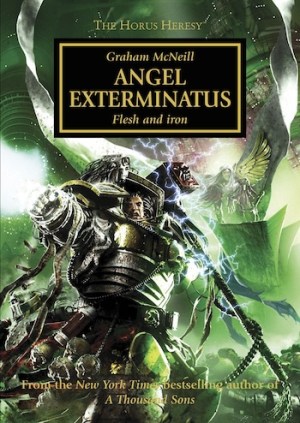
Review: ANGEL EXTERMINATUS by Graham McNeill (Black Library)

McNeillG-HH23-AngelExterminatusThe Iron Warriors, the Emperor’s Children, and secrets between brothers

Perturabo – master of siegecraft, and the executioner of Olympia. Long has he lived in the shadow of his more favoured primarch brothers, frustrated by the mundane and ignominious duties which regularly fall to his Legion. When Fulgrim offers him the chance to lead an expedition in search of ancient and destructive xenos weaponry, the Iron Warriors and the Emperor’s Children unite and venture deep into the heart of the great star maelstrom that haunts Perturabo’s dreams. Pursued by vengeful survivors from Isstvan V and the revenants of a dead eldar world, they must work quickly if they are to unleash the devastating power of the Angel Exterminatus!

In Angel Exterminatus, McNeill gives us a story of a rebellion under strain. The novel follows two traitor legions that could not be more different: the stoic, methodical Iron Warriors; and the wild, arrogant Emperor’s Children, who have given themselves wholesale to the debaucheries of Chaos. The story maintains the high standards of the Horus Heresy series, and certainly justifies the new hardcover editions. This is a solid addition to the series. Continue reading