Guest Post/Excerpt: HOUSE OF SHATTERED WINGS by Aliette de Bodard

deBodard-AuthorPicThe Great Houses war is a central part of the book, though by necessity it’s always seen in flashbacks, as it took place sixty years before the events of the novel. It’s left marks on everyone, and of course it has also devastated Paris and given rise to the city in the book, a dystopic place where people cling to the Great Houses as their only source of safety. This scene is one of the strongest reminiscences from Philippe, who actually fought in it.

It also contains what is possibly my favourite lines in the book: the “magicians turned into soldiers… our best men turned into corpses”, which was one of those gifts from the muse: it came straight into the first draft and hasn’t really moved since.

The war. Philippe thought of the clamor of explosions; of huddling in the doorways of ruined buildings, peering at the sky to judge the best moment to rush out; of his lieutenant in House colors, urging them to lay down their lives for the good of the city; of his squad mates buried in nameless graves, on the edge of Place de la République. Ai Linh, who had had a laughter like a donkey, and always shared her biscuits with everyone else; Hoang, who liked to gamble too much; Phuong, who told hair-raising stories in the barracks after all lights had been turned off. “I don’t know what the war was like, inside the Houses,” he said, and it was almost the truth. Continue reading

Guest Post: “Don’t Hold the Horses” by Arianne “Tex” Thompson

ThompsonAT-AuthorPicYou know how there’s this one genre that we call “swords and horses” fantasy? It’s a heck of a thing. They’re kind of the PB&J of old-school fantasy: tasty, familiar, and they go so well together. But it’s not exactly an even relationship, is it?

I mean, the swords – let’s be real, The Sword – gets all kinds of literary limelight. It’s got a name, a big ol’ backstory, some awesomesweet epic powers, and probably a good chunk of the hero’s destiny riding around in its carbon-steel interior. More often than not, that sucker actually drives the plot.

So why no love for the horses? Size, sex, color, and that’s it. Maybe a name, if it’s going to be a long-term fixture, and not stolen by goblins or eaten by were-possums at the end of the first act. But unless the horse is some kind of magical creature (with a big tip o’ the hat to Misty Lackey’s Heralds of Valdemar series!), you can almost guarantee that it’s just a half-ton inventory item – as if only the fantasy elements of a fantasy story are allowed to be interesting or important.

I vote we change that. And I think a lot of writers would be up for trying – it’s just that we’re not really sure how. After all, most of us don’t live within thirty miles of a horse, nevermind own or ride one. The only time pop culture shows them to us as characters in their own right is either when they’re the focal point of the story (Black Beauty, Seabiscuit, etc.) or else when someone’s following the “basically furry humans with speech impediments” Disney sidekick model. Continue reading

Guest Post: “Anarchy Sucks” by Gail Z. Martin

0061-eWomenNetworkWar of Shadows is the newest book in my Ascendant Kingdoms Saga, tracing the struggle of disgraced lord Blaine McFadden and his convict friends, as they attempt to restore control over magic and reinstate the rule of law in the devastated kingdom of Donderath. It’s the third book in the series, and with rival warlords and rogue mages competing for control over Donderath’s ruins, there’s action and intrigue aplenty.

Underneath this all is a heartfelt conviction, born out of a lifelong study of history, that anarchy sucks.

The suckishness of anarchy seems up for debate. It’s quite trendy these days to loudly announce “we don’t need no stinkin’ government”. Sometimes, the announcement comes from people well-heeled enough to wall themselves in secure enclaves and protect their interests with private armies of security guards. On the other end of the spectrum are live-off-the-land survivalist types who believe that some canned food, a trout stream and several thousand rounds of ammunition are all that’s needed to live the good life. Continue reading

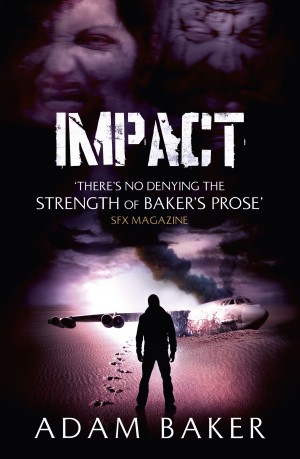
Review: IMPACT by Adam Baker (Hodder)

BakerA-4-ImpactUKSuperb fourth novel in Baker’s horror survival series

The world is overrun by an unimaginable horror. The few surviving humans are scattered in tiny outposts across the world, hoping for reprieve – or death. Waiting on the runway of the abandoned Las Vegas airport sits the B-52 bomber Liberty Bell, revving up for its last, desperate mission. On board – five crew members and one 10-kiloton nuclear payload. The target is a secret compound in the middle of the world’s most inhospitable desert.

All the crew have to do is drop the bomb and head to safety.

But when the Liberty Bell crashes, the surviving crew are stranded in the most remote corner of Death Valley. They’re alone in an alien environment, their only shelter the wreckage of their giant aircraft, with no hope of rescue. And death is creeping towards them from the place they sought to destroy – and may already reside beneath their feet in the burning desert sands.

Impact is the gripping, suspenseful fourth novel set in Baker’s post-apocalyptic reality. Everything I liked about Terminus, the previous novel in the series, is evident here: the tightly-plotted story, the stripped-down prose, realistic characters, sinister atmosphere, and addictive, chilling suspense. From the first page until the last, I was hooked. Continue reading

Short Fiction Review: “The Bloody Deluge” by Adrian Tchaikovsky (Abaddon)

Various-JournalOfThePlagueYearA very good post-apocalyptic story from the author of the Shadows of the Apt series

WHEN THE WORLD ENDED…

The Cull swept the world in the early years of the twenty-first century, killing billions and ending civilisation as we know it. Only a fortunate few, blessed with the right blood, were spared. But in times of need, heroes rise. Leaders, soldiers, rebels – even children – take a stand, to hold back the tide of savagery and set a light in the darkness…

Katy Lewkowitz and her friend and old tutor Dr. Emil Weber, fleeing the depredations of the so-called New Teutonic Order, take refuge among the strangely anachronistic survivors at the monastery of Jasna Góra in Western Poland. A battle of faith ensues, that could decide the future of humankind…

This is the first non-fantasy story of Tchaikovsky’s that I’ve read. It is also the first story I’ve read from Abaddon Books’ Afterblight series. With that in mind, I approached it concerned that I would be lost, missing important backstory and context for this post-apocalyptic world. However, I was very pleased to discover that this works perfectly well without past experience with the series. It’s very well-written, and moves at a pretty brisk pace. This is a good story.

Tchaikovsky’s characters are well-drawn and realistic, not to mention plenty of shades of grey. The role of religion in the story was interesting, and I liked the way the author showed how religious organisations could develop in multiple, conflicting ways when presented with the end of the world. Here, we have an Order that seems to feed of the worst historical characteristics of organised religion, fuelled and worsened by intolerance and bigotry. On the flip side, the group occupying Jasna Góra are far more accepting and focused on good works and charity.

There’s an interesting blend of historical/fantasy and post-apocalypse, here, which can be seen most clearly during the siege – bows and arrows from the walls compete against motorbike-mounted “knights” and a tank. Really enjoyed that about this story, the way the future and advancement of the human race came crashing to a halt in the wake of the Cull.

Speaking of bows, I think the only thing that didn’t work for me was Katy’s rather bizarre confusion, when she realised that the people at Jasna Góra used bows for fighting, and not just hunting. For a British-educated postgraduate, the idea that she would have been unaware of archers’ role in warfare was somewhat baffling.

Overall, then, this is not only a good new direction for Tchaikovsky, but also a good introduction (and, no doubt, continuation) of Abaddon Books’ Afterblight series.

It’s not as assured as Tchaikovsky’s Shadows of the Apt epic fantasy series (one that I am woefully behind on, but which comes to an end this year), and I think I preferred his writing and style in that series. Nevertheless, that should not discount The Bloody Deluge – it’s a solid example of post-apocalyptic fiction. If you’re a fan of the genre, then I think you’ll enjoy this, too.

*

You can read an interview with Adrian about this story, here.

The Bloody Deluge has been collected in the Journal of the Plague Year anthology. Here’s the synopsis for the other two stories therein:

Journal of the Plague Year offers three new tales from across the world of The Afterblight Chronicles, from the International Space Station to the wilds of the Australian Outback and beyond.

In Malcolm Cross’s Orbital Decay, the team in the Space Station watch helplessly as the world is all but wiped out. Exiled from Earth, astronaut Alvin Burrows must solve the mystery of the “Pandora” experiment, even as someone on the station takes to murdering the crew one by one.

In C. B. Harvey’s Dead Kelly, fugitive and convict Kelly McGuire returns to the lawless city of Melbourne to be revenged on his old gangmates, and, ultimately, to reveal his own terrible destiny.
Hinterkind, Vol.1 – “The Waking World” (Vertigo)

Hinterkind-01-ArtWriter: Ian Edginton | Artist: Francesco Trifogli

In a post-apocalyptic world where humans have been pushed to the edge of extinction by the creatures of fantasy and fables, THE HINTERKIND tells the story of one young woman’s quest to fulfill her destiny and put the world right again.

Fifty-seven years after an unspecified biological event has all but wiped out the human race, a green hand has moved over the face of the Earth. Leaf, root and shoot have steadfastly smothered the works of man, remorselessly grinding the concrete, glass and steel back into the minerals from whence they came. Mother Nature is reclaiming what’s rightfully hers but she’s not the only one…

The Hinterkind have returned. They come from hiding places in the lost corners of the world: Centaurs, Satyrs, Elves, Dwarves, Ogres, Trolls, Werewolves, Vampires…

They’re also known as “the Hidden,” “the Twilight People,” the “walkers-in-shadow,” collective names for the menagerie that mankind has hung its tales of myth and magic upon – but these aren’t fairy tale creatures. They are flesh, blood and passion, and they have a long simmering hatred of humanity.

They are a divergent species. Exotic evolutionary try-outs that couldn’t compete with the rapacious ape. Hunted to near extinction through fear and ignorance, they fled to the great forests and deserts, losing themselves in the shrinking wilderness of an ever-expanding world.

Now the wilderness is the world and mankind is in the minority.

Collects: HINTERKIND #1-6

This is a strange, promising, and yet somewhat flawed start to a new series.

The first issue presents a fantastic post-apocalyptic world – one in which human society has been near-destroyed, global populations brought to the brink of extinction. Our protagonists are based in Central Park, New York, and have built a working community: foraging for leftover items in the over-grown city around them, hunting the wildlife. It’s a stunning start, actually, and I was immediately drawn to the setting. The characters and writing were strong, and they were well-realised by the artwork.

Hinterkind-01-Interior6

Then things started to get a bit weird, and this is where (for me) the series stumbled: it became very busy, and the story grew expansive so quickly, that the mash-up of genres started to feel like it was trying too hard. I hesitated for a bit, deciding on how much detail this review should go in to, but I think it’s worth pointing some things out: there are army survivors similar to Buffy’s Initiative (only, weirder), the sidhe and other fairytale creatures have proliferated across the world, and the post-apocalyptic environment can cause mutations. All of this is revealed over this one book. I feel it may have been better to unveil the overall world more gradually, teasing us with possibilities, rather than dumping them all on in very quick succession.

Nevertheless, there’s a lot to enjoy in this book. The artwork is eye-catching; the writing is well-composed; and the characters are pretty interesting. I’m certainly looking forward to reading volume two, when it’s available.

Not the best start to a new Vertigo series, but still better than a lot of other publishers’ new books.

Hinterkind-Vol.1-Contents

Original Issue Covers #1-6, by Greg Tocchini

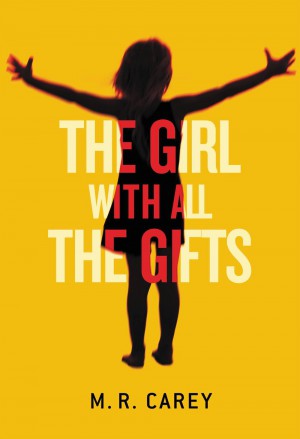
Review: THE GIRL WITH ALL THE GIFTS by M.R. Carey (Orbit)

CareyMR-GirlWithAllTheGiftsA superb novel, one of my favourite so far this year

Melanie is a very special girl. Dr. Caldwell calls her “our little genius”. Every morning, Melanie waits in her cell to be collected for class. When they come for her, Sergeant keeps his gun pointing at her while two of his people strap her into the wheelchair. She thinks they don’t like her. She jokes that she won’t bite, but they don’t laugh. Melanie loves school. She loves learning about spelling and sums and the world outside the classroom and the children’s cells. She tells her favourite teacher all the things she’ll do when she grows up. Melanie doesn’t know why this makes Miss Justineau look sad.

I have long been familiar with Carey’s comics work – mainly the amazing Lucifer and The Unwritten, both of which I am addicted to. It took me a long time to get around to reading this novel, though, for reasons I cannot quite figure out. Long-time readers of the blog will know I’m a fan of certain types of post-apocalyptic-zombie novels. The Girl With All the Gifts is absolutely brilliant, and one of this year’s Must Reads. I loved it. Continue reading