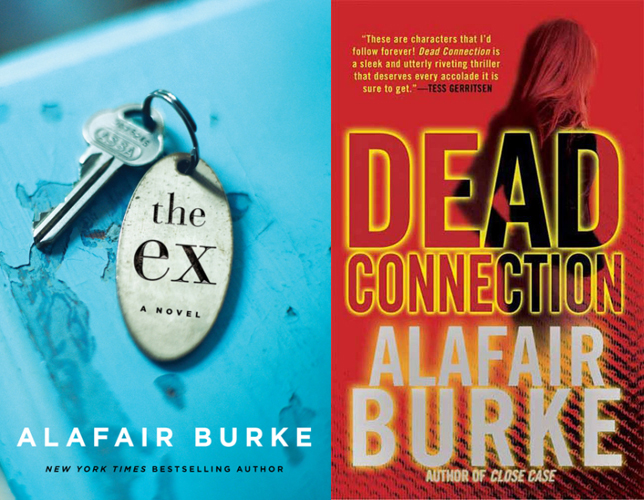
Review: THE EX and DEAD CONNECTION by Alafair Burke

BurkeA-FirstReads-ExDeadConnection

A stand-alone and first in an earlier series

The first novel I read by Alafair Burke, The Ex,  left me feeling a bit dissatisfied. Luckily, my second novel by the author was more engaging. I’m now looking forward to reading the rest of Burke’s backlist.
Continue reading

Upcoming: THE IMMORTALS by Jordanna Max Brodsky (Orbit)

BrodskyJM-TheImmortalsUSI spotted the synopsis for Jordanna Max Brodsky‘s upcoming novel, The Immortals, a little while back in an Orbit catalogue. Today, though, Orbit has unveiled the rather splendid cover for the novel (right), by Kirk Benshoff. I think that’s a pretty great cover.

Here’s the synopsis:

The Restless Ones, the Bearer of the Bow, the Untamed…

… those are only a few of the names Selene DiSilva’s answered to over the years. But these days she’s content to work in secret, defending the women of Manhattan from the evils of men. She’s reclusive, stubborn, and deeply unfriendly to everyone but her dog. But when a woman’s mutilated body washes up in Riverside Park wearing a laurel wreath, Selene finds that she can no longer hide in the shadows.

As more women are threatened, Selene is forced to embrace the one name she’s tried hardest to forget — Artemis. For who better to follow the killer’s tangled trail than the Goddess of the Hunt herself?

The Immortals is due to be published by Orbit in February 2016 (which seems very far away…). I can’t wait to read it. For more, be sure to follow the author on Twitter.

Upcoming Re-Issues: KATHY MALLORY Series by Carol O’Connell (Headline)

OConnellC-KM-Group01UK

I received a press release this morning that really piqued my interest. Over the course of this year (and maybe some of early 2015), Headline will be re-jacketing and re-issuing Carol O’Connell’s Kathy Mallory crime series. I have never read any of the series, I’m sad to say. However, one of the things I love is finding established series on which to binge. I’ve found two ‘new’ series that I was going to start working my way through (Matthew Dunn’s Spycatcher and Daniel Silva’s Gabriel Allon series), but this one has to be added to the list, too. And may even be the first I try. I’m really looking forward to these re-issues.

OConnellC-KM-Group02UK

Here’s the release scheduled:

Mallory’s Oracle – 14th August 2014

The Man Who Lied to Women – 14th August 2014

Killing Critics – 11th September 2014

Flight of the Stone Angel – 11th September 2014

Shell Game – 9th October 2014

Crime School – 9th October 2014

Dead Famous – 6th November 2014

Winter House – 6th November 2014

Shark Music – 4th December 2014

The Chalk Girl – Pub. Date TBC

It Happens in the Dark – Pub. Date TBC

OConnellC-KM-Group03UK

Here’s the synopsis for the first novel, Mallory’s Oracle:

Mallory Book 1: the first NYPD detective Kathy Mallory novel from New York Times bestseller Carol O’Connell, master of knife-edge suspense and intricate plotting.

Detective Kathy Mallory. New York’s darkest. You only underestimate her once.

When NYPD Sergeant Kathy Mallory was an eleven-year-old street kid, she got caught stealing. The detective who found her was Louis Markowitz. He should have arrested her. Instead he adopted her, and raised her as his own, in the best tradition of New York’s finest.

Now Markowitz is dead, and Mallory the first officer on the scene. She knows any criminal who could outsmart her father is no ordinary human. This is a ruthless serial killer, a freak from the night-side of the mind.

And one question troubles her more than any other: why did he go in there alone?

“& Sons” by David Gilbert (Fourth Estate/Random House)

Royal.inddAn intriguing, engaging literary novel

The funeral of Charles Henry Topping on Manhattan’s Upper East Side would have been a minor affair (his two-hundred-word obit in The New York Times notwithstanding) but for the presence of one particular mourner: the notoriously reclusive author A.N. Dyer, whose novel Ampersand stands as a classic of American teenage angst. But as Andrew Newbold Dyer delivers the eulogy for his oldest friend, he suffers a breakdown over the life he’s led and the people he’s hurt and the novel that will forever endure as his legacy. He must gather his three sons for the first time in many years – before it’s too late.

So begins a wild, transformative, heartbreaking week, as witnessed by Philip Topping, who, like his late father, finds himself caught up in the swirl of the Dyer family. First there’s son Richard, a struggling screenwriter and father, returning from self-imposed exile in California. In the middle lingers Jamie, settled in Brooklyn after his twenty-year mission of making documentaries about human suffering. And last is Andy, the half-brother whose mysterious birth tore the Dyers apart seventeen years ago, now in New York on spring break, determined to lose his virginity before returning to the prestigious New England boarding school that inspired Ampersand.

But only when the real purpose of this reunion comes to light do these sons realize just how much is at stake, not only for their father but for themselves and three generations of their family.

& Sons is a very good novel. It’s a bit tricky to review, though. I was quickly drawn into the story, and the lives of the protagonists. It was by no means perfect, and sometimes downright weird, but Gilbert’s prose and characters were engaging throughout.

This is a peculiar novel, in many ways. Gilbert writes extremely well, but that didn’t stop the beginning from being a bit confusing – specifically, the narrative style wasn’t clear. I wasn’t sure who was narrating the tale. It is presented as if Philip Topping has written an account of the events, but bestowed upon himself omnipotence, able to write inside his subjects’ heads without really any way of knowing what was going on. A strange decision, but one that I quickly got used to and accepted.

It is the story of families, fathers and sons. Philip Topping, never particularly close with his father, was always enamoured of the Dyers – revering Andrew, idolising Richard and Jamie, glomming on to the family as an attempt to become a de facto member. For this desire, he has long been mocked and pranked by the elder two Dyer brothers. It was a strange and sometimes-creepy dynamic. Andrew Jr., the half-brother whose existence cratered A.N. Dyer’s marriage, is probably the best character in the novel, and I enjoyed seeing him navigate his world, and the strange dynamic he had with his father and brothers.

GilbertD-AndSonsLiterary fiction seems to require a peculiarity. I’m not sure why this trope has developed, but almost every literary fiction novel I’ve read contains a truly bizarre element or event, and this can often be the stumbling block that takes a great novel and almost ruins it. With & Sons, the peculiarity is the secret Andrew wishes to share with his sons. I’m not going to spoil it, but it kind of came out of nowhere, and we’re never sure if it’s real or a delusion of the fast-declining Andrew Dyer.

I’m not really sure what else to write about the book without spoiling the twists and turns, or delving too deeply or academically into its contents (which is not something CR has been doing in the past). Needless to say, I enjoyed reading & Sons. There’s a great deal of insight and shrewd observation about families – especially fathers and sons – presented in both remorseful and amusing ways. Despite the muddled narrative voice of the first couple of chapters, this grew to become a very strong novel and engaging read.

Recommended for fans of New York-based literary fiction – for example, Claire Messud’s The Emperor’s Children, Donna Tartt’s The Goldfinch – and also authors such as Michael Chabon, Philip Roth and Richard Russo.

*

David Gilbert’s & Sons is published by Fourth Estate in the UK and Random House in the US. It is out now.

“The Strain” by Guillermo del Toro & Chuck Hogan (Harper/William Morrow)

DelToroHogan-1-TheStrainThe start of the vampire apocalypse… It’s very well-written, but…

At New York’s JFK Airport an arriving Boeing 777 taxis along a runway and suddenly stops dead. All the blinds have been drawn, all communications channels have mysteriously gone quiet. Dr Ephraim Goodweather – head of a rapid-response team investigating biological threats – boards the darkened plane… and what he finds makes his blood run cold.

Meanwhile, in a pawnshop in Spanish Harlem, aged Holocaust survivor Abraham Setrakian knows that the war he has been dreading his entire life is finally here.

Before the next sundown Eph and Setrakian must undertake the ultimate fight for survival. A terrifying contagion has come to the unsuspecting city – hungry, merciless, lethal… vampiric?

It took me so long to get around to reading this. And it’s taken me a few months to get around to writing the review. I’m not sure why, but there we go. The first in del Toro and Hogan’s trilogy, it chronicles the events that spark the outbreak of a vampiric plague in New York, threatening the country beyond, and the toppling of the status quo. It’s an interesting novel, but one that I struggled with a fair bit, given its pacing. Conceived as a trilogy, this novel is basically the set-up and that’s about it. We learn a little of the background – minor moments from the vampire’s history, and the former-concentration camp inmate who discovered that it was feeding on inmates; and then, decades later, tracking it across to the New World.

The Strain is a novel that, in my mind, doesn’t really require too long a review. It is basically the opening act for the next two novels in the series, and doesn’t stand on its own. Things only really start to happen in the final 20% or so of the book. True, the story follows a more slow-burn, anticipatory-horror approach to unveiling the threat and seeing the vampires spreading across Manhattan and New York’s other boroughs. This slow pace irked me, I have to admit. It felt like a lot of hurry-up-and-wait. True, the authors give us a very good, detailed account of how vampires develop over time, and how the epidemic spreads. Also, how intransigent people are when it comes to being faced with the supernatural and inexplicable. But beyond that, when I finished the book I didn’t feel a need to immediately reach for book two (which I have). I’m sure I will, at some point, but at the moment, I have no burning desire to get on with the series.

As for the craft of the novel? Yes, del Toro and Hogan have done a very good job of covering all their bases, and creating their own vampiric lore that has more in common with zombie apocalypse tales (in the way vampirism is more like a disease than not) and plague outbreak. It is interesting, and it’s well-written. The characters are realistic and well-drawn, and the vampires are sufficiently and particularly horrific – mindless, feeding beasts that have more in common with the aforementioned walking dead than the more popular version of vampires. There’s a creepy and cool hive-mind quality to how they operate and how the primary vampire controls and directs them. I particularly enjoyed the flashback chapters that detailed the historical brushes with the creature. I hope we get a few more of them in the next book.

If you’re interested, or particularly driven, to dedicate yourself to reading all three novels in a row, I’m sure this is a very rewarding story. The pacing of the first threw me, sure, but I can’t fault the authors’ talents on display. It’ll be interesting to see how it translates onto TV…

*

The Strain is published in the UK by Harper, and by William Morrow in the US.

“Shovel Ready” by Adam Sternbergh (Headline)

SternberghA-ShovelReadyThe start to an interesting new dystopian series…

“I don’t want to know your reasons. I don’t care. Think of me as a bullet. Just point.”

Spademan used to be a garbage man. That was before the dirty bomb hit Times Square, before his wife was killed, before New York became a burnt-out shell. Now the wealthy spend their days tapped into virtual reality; the rest have to fend for themselves in the streets. Now there’s nothing but garbage.

So he became a hit man. He doesn’t ask questions, he works quickly, and he’s handy with a box-cutter.

When he’s hired to kill the daughter of a high-profile evangelist, Spademan’s life is upended. He will have to navigate two worlds – both the slick fantasy and the wasteland reality – to finish the job, clear his conscience, and make sure he’s not the one who winds up in the ground.

In the final few months of 2013, there was quite a bit of buzz around the genre sites related to this book. It has received a slew of great blurbs from respected and excellent authors. It was with great anticipation, therefore, that I dove into it when I received an ARC (quite a while ago, so I’ve been sitting on this review for some time). I enjoyed the novel, and Sternbergh offers up a rather convincing dystopian future, but one that at the same time felt slightly half-baked. The author has written a tightly-plotted novel that is certainly immediate and gripping. It left me wanting more, but not always in a good way.

Right off the bat, I should mention that this is another novel that dispenses with “proper” punctuation – specifically, there are no speech marks to indicate dialogue. This seems to be a style that is becoming popular again – before this, my latest read to take this path was Lavie Tidhar’s excellent The Violent Century. Unlike Tidhar’s latest offering, however, the lack of “normal” dialogue punctuation was confusing more often than I would like: the lack of differentiation between characters speaking would sometimes clash or merge less-than-seamlessly with Spademan’s internal monologue.

The main character, Spademan, is a “different kind of psycho”. He is quietly sociopathic, a product of an uncaring and dehumanizing New York city. Devastated by a dirty bomb, New Yorkers have either fled the city wholesale, barricaded themselves into their homes, or retreated to the outer boroughs. Wealthy and not alike have also retreated to a new, online reality – something akin to a steroidal, higher-tech Second Life – where ‘normal’ life can continue. This is where the bulk of international trade takes place, and the world of financial transactions in particular has retreated from the real world entirely, it seems. Interestingly, and related to the story contained herein, mega-churches have gleefully adopted the new technology as well. [That is all I shall say on that matter…]

The story moves at a breakneck pace, and we’re introduced to a number of interesting and varied, as well as believable, characters from a number of New York neighbourhoods and walks of life. His target and new job turns out to be not at all what he expected.

“Truth is, I have no idea what the next step should be. I’ve had jobs get out of hand, but not like this. I was hired to kill her, not adopt her.”

As someone who was having an extended moment of frustration with what felt like ever-increasingly-long Big Book Fantasies, its slim length was certainly welcome. I enjoyed the pace, but there was a sacrifice: world-building. Not only is the world beyond New York fleshed out at all, really (save the quotation, below), it also meant the world’s logic failed – I ended up not buying that so many people would remain in New York City. Suspending that frustration, though (and there were times when that was difficult), I did rather enjoy the novel.

“As for the rest of it, in in-between part, I hear it’s relatively clean and still open for business, like a plucky dollar store. No longer the land of milk and honey, maybe, but at least you can still get high-grade pharmaceuticals on every street corner on the cheap… Really, it’s just New York that got nuked, cordoned off, shut down, shunned. Capital of the world, cut loose to drift into the sea. The country’s soul, on a funeral pyre.”

The fact that New Yorkers stay in the city, despite the dirty bomb’s destruction and lingering radiation, and also the violence that rose in place of order, reminded me of the New York mentality Brian Wood showed in his masterful DMZ comic series. However, I think it worked much better in the graphic novel series – here, it felt that there wasn’t as much thought put into the world-building as there perhaps should have been. Bits and pieces felt forced, and to then not be fleshed out… Well, Sternbergh’s brevity was not always a boon (though, I repeat, it was refreshing amidst a sea of new, massive doorstoppers).

SternberghA-ShovelReadyUSAs the first book in a series, I’m hoping Sternbergh takes some of the time in his next (and future?) novels to flesh out this dystopian reality. As it stands, this is an engaging thriller, which happens to be set in a dilapidated New York City. Spademan is a good protagonist, and I’d like to read more, but this novel didn’t do enough to establish the world, and given the gaps, why people would remain in the city.

Recommended, therefore, but with the aforementioned caveats. An author to watch, certainly.

*   *   *

Shovel Ready is published by Headline in the UK (Jan.14/Jul.3 eBook/PB) and Crown in the US.

Christmas Fiction Review Catch-Up: Jonathan Dee, A.S.A. Harrison & John Niven

I am falling terribly behind on my reviews. So, in order to get caught up a bit more on the backlog, I’ll be combining some reviews into thematic posts (of sorts). This one takes a look at three non-SFF novels I’ve read recently.

***

DeeJ-AThousandPardonsJonathan Dee, A Thousand Pardons (Corsair)

Ben and Helen Armstead have reached breaking point and it takes one afternoon – and a single act of recklessness – for Ben to deal the final blow to their marriage, spectacularly demolishing everything they built together.

Helen and her teenage daughter Sara leave for Manhattan where Helen takes a job in PR – her first in many years – and discovers she has a gift for spinning crises into second chances. But can she apply her professional talent to her personal life?

I rather enjoyed this. It was a quick read, but not perfect. The novel starts out with the sudden, spectacular dissolution of Helen’s marriage to Ben, who is quite the narcissist experiencing quite the midlife crisis and breakdown. The first part of the novel follows Helen as she makes her way to New York, and stumbles into a PR job. She has a knack for coaxing out appropriate, believable apologies out of her clients. For a short time, she is able to enjoy this success. Then the novel brings Ben back into the narrative, and we get a more even-handed impression of the two characters – while I had enjoyed reading about Helen, and it did take a little while before reorienting myself for Ben’s side of the story, the novel benefited from them both being central. Dee’s prose is fluid, and I rattled through this novel at quite the pace. At times, though, things moved perhaps a little too fast – Helen’s advancement in the PR business jumps ahead slightly, and Dee doesn’t give much time over to Helen and Sara’s new lives in the big city. I think the author could have spent some more time exploring what each of the characters was going through.

Nevertheless, A Thousand Pardons is an enjoyable novel about a marriage in ruins and a family in crisis; about the limits and joys of self-invention; and about the peculiar seduction of self-destruction. It is also the tale of redemption and forgiveness, of sorts, and the enduring connection families can feel with each other, despite some of the most difficult of circumstances. It’s not a bad introduction to Dee’s fiction, and I enjoyed it enough to convince me to pick up The Privileges at some point in the not-too-distant future.

*

HarrisonASA-TheSilentWifeUKPBA.S.A. Harrison, The Silent Wife (Headline)

Todd Gilbert and Jodie Brett are in a bad place in their relationship. They’ve been together for twenty-eight years, and with no children to worry about there has been little to disrupt their affluent Chicago lifestyle. But there has also been little to hold it together, and beneath the surface lie ever-widening cracks. HE is a committed cheater. SHE lives and breathes denial. HE exists in dual worlds. SHE likes to settle scores. HE decides to play for keeps. SHE has nothing left to lose. When it becomes clear that their precarious world could disintegrate at any moment, Jodie knows she stands to lose everything. It’s only now she will discover just how much she’s truly capable of…

Oh, how I wanted to love this book. For months, it seems, I’ve seen so much praise and a constant trickle of links for great and gushing reviews on Twitter. The book itself is covered in eye-catching blurbs from prominent authors, reviewers, and so forth. So how was it? Well… Politely? It wasn’t for me. Bluntly honest? I was bored. Throughout. I didn’t like either of the main characters. He is a douche, a lecherous cheater, who seems to only appreciate what his wife does for him and the fact that she’s attractive. She is fastidious to a fault, ordered and lacking any impulsiveness and rather bland:

“Meticulous planning has its merits. Life at its best proceeds in a stately manner, with events scheduled and engagements in place weeks if not months ahead. Scrambling for a last-minute date is something she rarely has to do, and she finds it demeaning.”

Now, I understand that both of the characters were probably meant to come across as either a complete ass (him) or quietly in denial about everything (her), but damn it doesn’t make for interesting reading. The synopsis above is not the whole synopsis. I cut the following:

“A chilling psychological thriller portraying the disintegration of a relationship down to the deadliest point when murdering your husband suddenly makes perfect sense.”

I found this as chilling as tepid tap water. That being said, in terms of prose and construction, The Silent Wife is very competent. The author’s prose are very well constructed, which is really the only reason I kept reading. That bit about the novel being a “chilling psychological thriller”? I was waiting for that to happen right up until I turned the final page. Maddeningly bland. This was the biggest let down of the year, I was left wondering if what I bought and read was the same book everyone else had been talking about…

*

NivenJ-StraightWhiteMaleJohn Niven, Straight White Male (William Heinemann)

Kennedy Marr is a novelist from the old school. Irish, acerbic, and a borderline alcoholic and sex-addict, his mantra is drink hard, write hard and try to screw every woman you meet.

He’s writing film scripts in LA, fucking, drinking and insulting his way through Californian society, but also suffering from writers block and unpaid taxes. Then a solution presents itself – Marr is to be the unlikely recipient of the W.F. Bingham Prize for Outstanding Contribution to Modern Literature, an award worth half a million pounds. But it does not come without a price: he must spend a year teaching at the English university where his ex-wife and estranged daughter now reside.

As Kennedy acclimatises to the sleepy campus, inspiring revulsion and worship in equal measure, he’s forced to reconsider his precarious lifestyle. Incredible as it may seem, there might actually be a father and a teacher lurking inside this “preening, narcissistic, priapic, sociopath”. Or is there.

This was a very pleasant surprise. There was a bit of a rocky start – the first couple of chapters painted an awful picture of the protagonist, and I worried that I’d always struggle to engage with him. However, Niven very quickly surprised. Straight White Male ended up being one of my favourite reads of the year.

Kennedy, our protagonist, starts off as one ugliest protagonists I’ve read about. He’s kind of awful: spoiled, wasteful, a drunkard, lewd, a sex addict with an unhealthy disrespect for women (sleeping with someone in the cloak room at his wedding, juggling multiple porn platforms at once)… He’s a complete narcissist. He’s not a pleasant guide for a lot of the opening chapters, which did make me wonder if I wanted to continue reading. Everyone else Kennedy interacts with is as well-written as this asshole, which made me stick with it, and eventually we learn why Kennedy is the way he is, and see his character develop. Niven can definitely write, and write very well, which kept me coming back. So, if you aren’t a fan of anti-hero protagonists, I’d recommend still sticking with the book, as it gets very good.

I really liked the way Kennedy gets to say and do all the things I bet many people living and working in or with Hollywood would love to say to all the self-important, pompous “artistes” with inflated senses of their own genius… He doesn’t shy away from opining on their flaws (or shouting  them at prima donna, uneducated actors). His internal and external commentary is often very funny. He’s also honest about why he does certain things. Kennedy is also not sparing on his frustrations with the publishing industry, either.

“Busy jumping from rewrite to polish to dialogue pass because, of course, all this was easier (and much more remunerative) than spreading his intestines across the page for two fucking years writing a novel. Because the only things he wanted to write about he couldn’t. He wasn’t blocked so much as… finished. The novel? That was a man’s business. He was done with it. Not that anyone knew that yet of course.”

What was most interesting, however, is how Niven slowly unveiled the tragic story of Kennedy’s sister, and how that has effected his behaviour. A lot of what he does, in the end, seems like avoidance and alcohol-fuelled coping and distraction. After the story shifts to the UK, things move quite a bit faster, too, which was a little disappointing. I would have liked some more… well, everything, really. Rather than reading that as an indictment of the novel, consider it my way of saying I wish it had been longer, because it was so good. Which it was.

Straight White Male is a very good novel on some of the many neuroses and coping mechanisms to which men can turn. Funny, irreverent, touching, and well-written, this is definitely recommended.

“The Emperor’s Children” by Claire Messud (Knopf)

Messud-TheEmperorsChildrenAn interesting tale of privilege in New York, in the lead-up to 9/11

A novel about the intersections in the lives of three friends, now on the cusp of their thirties, making their way — and not — in New York City. There is beautiful, sophisticated Marina Thwaite — an “It” girl finishing her first book; the daughter of Murray Thwaite, celebrated intellectual and journalist — and her two closest friends from Brown, Danielle, a quietly appealing television producer, and Julius, a cash-strapped freelance critic.

The delicious complications that arise among them become dangerous when Murray’s nephew, Frederick “Bootie” Tubb, an idealistic college dropout determined to make his mark, comes to town.

As the skies darken, it is Bootie’s unexpected decisions — and their stunning, heartbreaking outcome — that will change each of their lives forever.

This novel came very highly recommended, but for some reason it took me quite a long time to get around to reading it. I have a weak-spot for novels set in New York City. This is the first one I’ve read that takes a look (near the end) at the impact of 9/11 on inhabitants of the city – not in terms of politics or the War on Terror, but rather as an event that would turn the lives of these protagonists upside down, in both large and small ways. I certainly enjoyed reading the novel, but it’s not perfect. It offers some shrewd, pointed commentary on the foibles and anxieties that face or characterise the lives of privileged (and some not-so-privileged) white youth in New York City.

The friends at the core of the story are quite typical, in many respects. This works in their favour, and makes the novel pretty easy to sink in to. They are from a wealthy set, but each hides their own insecurities from the others. Julius, for example, is down on his luck, and has been hiding the fact that he has resorted to temping in order to make ends meet. Danielle is ticking along, but then develops a relationship with someone she never would have thought possible. Marina is a typical, spoiled, highly privileged daughter of an accomplished, beloved-of-the-NY-literary-set journalist. In the meantime, Bootie, Marina’s awkward cousin with delusions of literary/journalistic grandeur, a surprisingly strong sense of his own iconoclasm, moves to New York, and ends up causing quite the unpleasant stir.

It’s tricky to go into too much detail, as is so often the case. Messud weaves a number of twists and turns into the novel, as her protagonists navigate their way through their personal and professional lives – Marina struggling to finish the long-fallow book project she’s been paid to write (years ago), and also having to deal with her new boyfriend’s obvious distaste and derision for her father’s reputation; Danielle trying to get her productions green-lit, while keeping her new romance secret from her friends (who would undoubtedly disapprove); Julius, whose love-life takes a turn for the better, before spiraling catastrophically; and Bootie’s attempts to make a life in New York, balancing his awe, jealousy and eventual disappointment in Marina’s father (for whom he works as an assistant for a short while).

The novel had two particular strengths. First, the characterisation – which I know I haven’t outlined particularly well, above – was excellent. These are people who are by no means perfect or in any way heroes. There is a natural ugliness, almost, to their personalities: the natural jealousies, the petty narcissism, and so forth. But also their privileged ennui, as they attempt to figure out what it is they are meant to be doing with their lives (something I can sometimes relate to). There were a few uncomfortable moments when I would read one of the characters’ inner struggles, perhaps raise a judgmental eyebrow or sneer, and then realise that I myself had harboured similar thoughts, worries, or jealousies on occasion.

Another thing I really liked about the novel, were the moments in which characters would talk about books. Perhaps a strange thing to pick up on, given that they are universally small and fleeting moments in the story, but I really liked it. For example, when Danielle is looking at her bookshelves in her apartment, a form of biblio-memoir:

… a wall of books, both read and unread, all of them dear to her not only in themselves, their tender spines, but in the moments or periods they evoked. She had kept some books since college that she had acquired for courses and never read — Fredric Jameson, for example, and Kant’s Critique of Judgment — but which suggested to her that she was, or might be, a person of seriousness, a thinker in some seeping, ubiquitous way; and she had kept, too, a handful of children’s books taken from her now-dismantled girlhood room, like Charlotte’s Web and the Harriet the Spy novels, that conjured for her an earlier, passionately earnest self, the sober child who read constantly in the back of her parents’ Buick, oblivious to her brother punching her knee, oblivious to her parents’ squabbling, oblivious to the traffic and landscapes pressing upon her from outside the window.

Messud does a great job of giving each character their own voice (although, sometimes only slightly different from others), and she’s doing a great job of deconstructing her protagonists and their neuroses and petty jealousies. But, and this is my only real issue with the novel: it could have been trimmed down, I think. There were times when it felt like the novel veered off into an unnecessary tangent, without adding enough to the story to justify it, or being too mundane to really be worth it. I also think the author has never found an over-long sentence she didn’t like. There were, for my taste, far too many run-on sentences. There were so many instances when a well-placed full-stop would have done wonders for the prose and reading experience; any number of sentences that were begging to be broken up into easier-read sizes. Take, for example, this paragraph (which is by no means the worst offender):

As they each gingerly dismantled and consumed their fanciful dishes — in her case at least, a fancy that, Danielle thought but did not say, was less original and extraordinary than the restaurant’s reputation and price had led her to expect, and therefore disappointing, as she had chosen the venue to impress — Danielle proceeded to explain that she had been taken with his use of the term, that she had, perhaps wrongly, heard in it a certain echo, the suggestion of an ethos that she thought might be found, to greater or lesser degrees, in certain other publications or presentations, and that she, in her producer’s role, had thought to articulate into, well, a movement.

Or this stuttering, shorter example: “and there was, had been, at the very sight of him, at the front of the line at the restaurant, a pull that Danielle felt to be inevitable, personal, even spiritual — a magnetic attraction.” And the use of near-repetition to make or reinforce a point (“having felt, and felt keenly”).

There are, of course, moments of levity that break up what could otherwise become a rather heavy-handed narrative. Mostly, this occurs when theses privileged characters are confronted with simple situations they are entirely ill-equipped to deal with (thing that would, ordinarily, be dealt with by the Help). For example, when Marina’s cat, Pope, dies:

“I’m sorry, Daddy — it’s just the Pope. She’s not — I mean, she’s dead.”

“Oh.” The two of them stood side by side without approaching. “You’re quite sure?” Murray asked, scratching at the back of his head.

“Yep. Sure.” The cat, a black blot on the duvet, didn’t move.

“Is your mother asleep?”

“Hours ago.”

“Hmm. Worse things could happen than leaving her there for the night, don’t you agree?”

The idea seemed somehow sacrilegious to Marina, though whether the offense was against the cat or the bed and its imminent occupant, she couldn’t have said. “Don’t dead things, you know, leak?”

“Not overnight, I wouldn’t think. And it’s pretty cool in here.”

And this, later moment in which they discuss what to do with books from university…

“What did you major in, in college?” she ventured again, after a time.

“Poli Sci.”

“Mm-hmm.”

“You must have been English, right?”

“Does it show that badly? We all were. I was double, English and Philosophy. I don’t remember a thing.”

“Who does?”

“Seriously, though, I look at the books on my shelves and it’s clear that I read them, back then, but I can’t remember ever doing it, and I don’t have the first idea what they might be about.”

“Read them again, then?”

Danielle sighed. “Not now. Maybe someday. I look at them and wonder who I was, you know? It’s a long time ago. I’m thirty.”

“You should throw those books away.”

“Like, in the garbage?”

“Like that.”

“Sacrilege. It would be.”

“Do you hang on to clothes you haven’t worn for ten years? Or bags of pasta, or cans of beans?” Danielle did not need to answer. “What is it about books? Perfectly rational people get crazy about their books. Who has time for that?”

“I measure my life out in books.”

“You should be measuring your life by living. Correction: you shouldn’t be measuring your life. What’s the point?”

Ultimately, The Emperor’s Children is a richly drawn, well-observed story of how these friends and relatives navigate their world. The characters develop naturally over the course of the story, and while they felt rather cookie-cutter at the beginning, they quickly developed their own voices. Despite the sometime-trouble I had with Messud’s drawn-out prose-style, this is a recommended read. I’ll be sure to read her latest novel, The Woman Upstairs, very soon.

“Floating City” by Sudhir Venkatesh (Allen Lane)

VenkateshS-FloatingCityA thoroughly engaging study of hustlers, strivers, dealers, call girls and other lives in illicit New York

After his insider’s study of Chicago crack gangs electrified the academy, Columbia University sociologist Sudhir Venkatesh spent a decade immersed in New York’s underbelly, observing the call girls, drug dealers, prostitutes and other strivers that make up this booming underground economy.

Amidst the trust-funder cocktail parties, midtown strip clubs, and immigrant-run sex shops, he discovers a surprisingly fluid and dynamic social world – one that can be found in global cities everywhere – as traditional boundaries between class, race and neighbourhood dissolve. In Floating City, Venkatesh explores New York from high to low, tracing the invisible threads that bind a handful of ambitious urban hustlers, from a Harvard-educated socialite running a high-end escort service to a Harlem crack dealer adapting to changing demands by selling cocaine to hedge fund managers and downtown artists. In the process, and as he questions his own reasons for going deeper into this subterranean world, Venkatesh finds something truly unexpected – community.

Floating City is Venkatesh’s journey through the “vast invisible continent” of New York’s underground economy – a thriving yet largely unseen world that exists in parallel to our own, at the heart of every city.

I first came across Sudhir Venkatesh’s name in Freakonomics – as, I’m sure, did many non-sociologists. In Levitt’s book, Venkatesh contributed a small selection of his work with the crack gangs in Chicago. This study would go on to form much of Gang Leader For A Day, the author’s previous book. Venkatesh is a rare academic: he can write in such an engaging, riveting style, that his books read almost like novels. In Floating City, the ethnographer turns his gaze on New York City and its underground economy. This is, while flawed in minor ways, easily one of the best non-fiction works I’ve read in a number of years.

It would be easy to share quotations and detailed descriptions of so much of this book and the people Venkatesh got to know. It is a wonderfully-told narrative – from the first chapter, in which he discovers a long-time acquaintance from Harvard is also a high-class New York madam, to the final chapter in which he effectively bids farewell to his contacts and, in truth, new friends. I read the book in three days, blitzing my way through the chapters.

Venkatesh touches not only upon the criminal activities his contacts take part in, but also the economic and social repercussions of the lives they find themselves living. It is sometimes inspirational, but often it is also heart-wrenching, seeing the damage (personal and collateral) that the lives of call-girls, drug smugglers, illegal immigrants, and so forth can cause. True, one must have been living under a rock (or, perhaps, the rarefied penthouses along Central Park) to not be aware, even superficially, in the plight of the poor, the difficulties that face those who are forced by situation to operate in the black markets. Venkatesh is a sympathetic, eloquent guide to the New York underbelly.

The author writes with an almost cheeky sense of humour, too. Amused at the situations he finds himself in, and also the system in which he is operating – from the academic strictures of Columbia University to the illicit systems he sees at work during his fieldwork – which include strip clubs, porn stores in Hell’s Kitchen, Midtown bars in the company of escorts and ‘managers’, to name but three. He doesn’t glamorize what he is reporting on, but nor does he inflect his words with judgement. In fact, as he admits, he

There are a fair few poignant moments, and events that Venkatesh witnesses which are near-universal experiences for those from broken or unhappy homes. For example, he joins a contact’s family for dinner. Because of their difficult situation, however, a fight breaks out, and Venkatesh says he’ll put their awakened son back to bed. The scene is very affecting:

“Joshi refused my offer to read and got down on the floor and took a plastic soldier in each hand, speaking to them softly while moving them across his raised knees. The sight shot the ache of an old memory through me. So many times I did the exact same thing, hiding in my room while my mother raised her voice against my father… With the raised voices of his parents beating through the door, Joshi put his soldiers on sentry duty and got into bed. Would he | remember this moment for the rest of his life? Would part of him always be ten years old and anchored to the battlefield of his bedroom floor, fighting an imaginary war to distract himself from the source of pain?”

VenkateshS-FloatingCityUSThe author frequently mentions and discusses his struggles against academia’s, and especially Columbia’s disdain for “popular” sociology books and articles, aimed at reaching wider markets. If not targeted solely at fellow academics, a study will be dismissed as “journalistic”, as if that were the height of criticism. As someone who very much does not write in a conventional “academic” style, partly due to journalistic training, and partly my belief that hoarding knowledge is a guaranteed path to academic and professional destruction and irrelevance, I found Venkatesh’s style refreshing and quite brave. (True, the events and research he details in the book are from a decade and more ago, but still.) At one point in the book, the author recounts a conversation with the chair of Columbia University’s sociology department, who cautioned him, “It will never take the place of real, deep sociology… Just don’t be confused about that.” Nevertheless, I am very grateful that Venkatesh chose to aim for a broader audience.

His inviting style and approach does often place him at the centre of certain scenes. That does pose issues of academic and/or scientific detachment (recognised by the author), but also move this book beyond pure, accessible sociology and somewhat into the memoir genre. As he says at the end, the book is intended as a research memoir of sorts. It works, in my opinion, and I welcomed the personal reflection, and the Schrödinger-effect his participation clearly created in certain situations. If not for his research, for example, would his drug dealer contact have ever met up with his secretly-a-madam acquaintance at the art gallery? You get a sense of his professional anxieties, how his desire to really pull back the curtain of New York’s illicit subculture for a wider audience, hamstrung by some of his tenured colleagues’ disdain for letting non-academics getting a look at the goods (if you will).

“… tale[s] of improvisation in a world of shifting values and social roles. And if the upper-end madam and the ghetto thug were both improvising their supposedly fixed social-roles, if their way of relating and even their styles were subject to such rapid revisions – as if they were merely a fiction agreed on between two people – then it was a short step to admitting that succeeding in a life of crime wasn’t so different from making art. The global city, like the canvas, provided the structure, but the rest was in the individual’s hands, making each [person]… a kind of artist whose art and job consisted in crafting the latest, most up-to-date version of themselves and offering it to a city for final judgement. Is this the ‘me’ that will finally make it?”

To observe something is to change it. Through Venkatesh’s observations, and the wealth of detail and data he has compiled, perhaps we will see a genuine and positive change in the way society, city and national governments address and understand criminal activity, the ‘war on poverty’, and also the American Dream in the ever-changing, ever-more-complex 21st Century city.

Very highly recommended.

***

Floating City is out now – published by Allen Lane/Penguin in the UK, and Penguin Press in the US.

Review: TERMINUS by Adam Baker (Hodder)

Baker-TerminusAn intense tale, that proves there’s (un)life in the zombie genre yet!

The world has been overrun by a lethal infection, ravaged by a pathogen that leaves its victims locked half-way between life and death. New York, bombed to prevent the spread of the disease, has been reduced to radioactive rubble. A rescue squad enters the subway tunnels beneath Manhattan, searching for the one man who can create an antidote. The squad battle floodwaters, lethal radiation and infected, irradiated survivors as they race against the disease that threatens to extinguish the human race.

Adam Baker is an author who has been on my radar for a long time, but for some reason I keep missing his novels. With his third novel, though, I was more proactive. As soon as I got my mitts on Terminus, I dove right in. This is an atmospheric, gripping and suspenseful novel. I loved it. Continue reading