Review: GRAY MOUNTAIN by John Grisham (Doubleday/Hodder)

Grisham-GrayMountainUSAn important and interesting topic, but lacklustre storytelling

The year is 2008 and Samantha Kofer’s career at a huge Wall Street law firm is on the fast track — until the recession hits and she gets downsized, furloughed, escorted out of the building. Samantha, though, is one of the “lucky” associates. She’s offered an opportunity to work at a legal aid clinic for one year without pay, after which there would be a slim chance that she’d get her old job back.

In a matter of days Samantha moves from Manhattan to Brady, Virginia, population 2,200, in the heart of Appalachia, a part of the world she has only read about. Mattie Wyatt, lifelong Brady resident and head of the town’s legal aid clinic, is there to teach her how to “help real people with real problems.” For the first time in her career, Samantha prepares a lawsuit, sees the inside of an actual courtroom, gets scolded by a judge, and receives threats from locals who aren’t so thrilled to have a big-city lawyer in town. And she learns that Brady, like most small towns, harbors some big secrets.

Her new job takes Samantha into the murky and dangerous world of coal mining, where laws are often broken, rules are ignored, regulations are flouted, communities are divided, and the land itself is under attack from Big Coal. Violence is always just around the corner, and within weeks Samantha finds herself engulfed in litigation that turns deadly.

I’m a fan of Grisham’s novels — I’ve spent many a pleasant summer or winter binge-reading his novels, and I’ve always been among the eager readers awaiting his latest novel. That’s not to say I love them all; there have been a couple that failed to engage me. The Street Lawyer, for example, which I’ve started about three times, but never finished. A Time To Kill, which was a perfect example of a debut author over-writing and info-dumping their way through an otherwise good story, ruining it in the process (it does not surprise me that it failed to get much traction when first published) — Grisham provided all the details, swamping the story with his desire to include all the legal minutiae. Gray Mountain walks a line somewhere between these two examples. Continue reading →
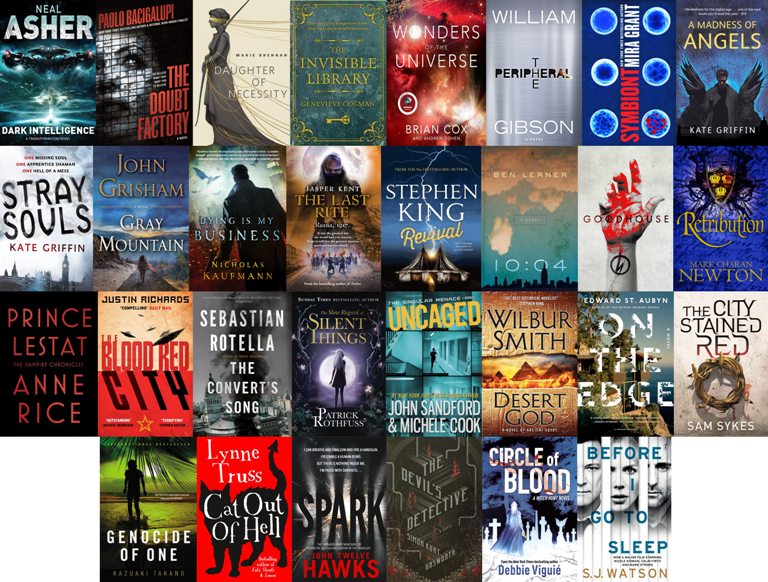
New Books (October)

BooksReceived-20141031

Featuring: Neal Asher, Paolo Bacigalupi, Marie Brennan, Genevieve Cogman, Brian Cox, William Gibson, Mira Grant, Kate Griffin, John Grisham, Nicholas Kaufmann, Jasper Kent, Stephen King, Ben Lerner, Peyton Marshall, Mark Charan Newton, Anne Rice, Justin Richards, Sebastian Rotella, Patrick Rothfuss, John Sandford & Michele Cook, Wilbur Smith, Edward St. Aubyn, Sam Sykes, Kazuaki Takano, Lynne Truss, John Twelve Hawks, Simon Unsworth, Debbie Viguie, SJ Watson

Continue reading →

Upcoming: “Gray Mountain” by John Grisham (Doubleday)

Grisham-GrayMountainUSI’m a big fan of John Grisham’s novels. They don’t all click for me, but many of them have been thoroughly enjoyable and entertaining. Today, details of his next thriller were unveiled! The novel, Gray Mountain, is due to be published in the US in October 2014 (not sure about the UK, yet). Here’s the description from Grisham’s website:

The Great Recession of 2008 left many young professionals out of work. Promising careers were suddenly ended as banks, hedge funds, and law firms engaged in mass lay-offs and brutal belt tightening. Samantha Kofer was a third year associate at Scully & Pershing, New York City’s largest law firm. Two weeks after Lehman Brothers collapsed, she lost her job, her security, and her future. A week later she was working as an unpaid intern in a legal aid clinic deep in small town Appalachia. There, for the first time in her career, she was confronted with real clients with real problems. She also stumbled across secrets that should have remained buried deep in the mountains forever.

Guest Post: “Influences & Inspirations” by Robert Bailey

Robert Bailey is the author of THE PROFESSOR, a legal thriller to be published by Exhibit A Books late January 2014.

BaileyR-TheProfessor-2014I was born from a family of storytellers and teachers. My mother taught English and reading, and my grandmother, a math teacher, was never without a book to read. My father, though a builder by trade, can still hold a room captive with his stories and jokes, and, as a little boy, I was always on the edge of my chair when he would rasp on about Coach Paul “Bear” Bryant and the legends that played football for the Crimson Tide.

As far as writers, John Steinbeck was a major early influence. As a kid, I loved his shorter novels, The Red Pony and The Pearl. As a high school sophomore, we studied The Grapes of Wrath, and Tom Joad remains one of my favorite characters in all of literature. As a southerner and an Alabamian that grew up to be a lawyer, To Kill a Mockingbird holds a special place. I think every lawyer wants to grow up to be Atticus Finch, and the story just had everything. It was thrilling, historical, funny and tragic. Just a remarkable achievement.

Later in high school and early college, I became enraptured with John Grisham, and loved Jack Brigance in A Time to Kill and Mitch McDeere in The Firm. I think it was these Grisham stories that really made me want to give writing a shot. Other writers that have been great influences are Greg Iles (I love the Penn Cage series starting with The Quiet Game), Michael Connelly (It doesn’t get much better than the Harry Bosch series), John Sandford, Lee Child, Winston Groom, Stephen King, Dean Koontz and Mark Childress.

When I decided I wanted to write The Professor, I picked up Stephen King’s memoir, On Writing, and have probably read it at least three times. Not only is it entertaining, but King’s insights on the writing process are insightful and inspiring. I would recommend it for any aspiring writer.

Finally, my time at the University of Alabama School of Law in Tuscaloosa certainly influenced The Professor. In fact, the idea for the story was hatched while day dreaming in class and wondering whether my professors could still try a case after years in the classroom.

Mini-Review: “A Time to Kill” by John Grisham (Arrow)

GrishamJ-ATimeToKillGrisham’s debut novel didn’t really work for me, sadly…

When Carl Lee Hailey guns down the monsters who have raped his ten-year-old child, the people of Clanton see it as a crime of blood and call for his acquittal.

But when extremists outside Clanton hear that a black man has killed two white men, they invade the town, determined to destroy anything and anyone that opposes their sense of justice.

Jake Brigance has been hired to defend Hailey. It’s the kind of case that can make or break a young lawyer. But in the maelstrom of Clanton, it is also the kind of case that could get a young lawyer killed.

The story of Grisham giving away millions of dollars’ worth of A Time to Kill first editions is pretty well-known, now. After his first publisher went bankrupt, Grisham had to buy 1,000 copies of the 5,000 print run. Here’s what he told Newsweek:

“I took all the books down to the local library and we had a big book party. When the party was over, I still owned 882 copies… so I started giving books away. We took them back to my office and packed them in the reception area. The boxes were everywhere, and I would just give them away. If one of my clients wanted a book, I’d try to sell it. If not, I’d give it away. I’d sell them for 10 bucks, five bucks. I used them for doorstops. I couldn’t get rid of these books… These 5,000 books were the only first editions of A Time to Kill. That book today is worth about $4,000. I had 1,500 of them in my law office at one time. So that’s my big mistake — that’s about $6 million, the way I do the math.”

When I re-read A Time To Kill recently, I found it rather tricky. I’m a huge fan of Grisham’s novels, and have read them all – only two haven’t hit the mark for me (The Street Lawyer and, sadly, this one). But this one just didn’t have the skill and addictive quality of his later work. Mainly, that boils down to the way in which it was written, rather than the story itself, which is pretty great.

Put simply: it’s not as polished as the novels that came afterwards. Sure, it’s a great story and premise, and it is – for the most part – well structured. However. The novel is nevertheless over-written and the content shows a distinct lack of authorial and editorial restraint. Grisham, and his characters, describe and explain everything. One sees only the early signs of the master storyteller he would become. There are plenty of tangents that aren’t quite as well incorporated to the main narrative as it perhaps could have been. They also often felt longer than was necessary. Despite this niggle, though, I kept reading.

One thing I do want to point out, and a major plus, is that Grisham doesn’t pull any punches. His characters are well-developed, diverse, and each of them is a mix of good and bad traits. I can’t really comment on how True To Its Times it is, as I only six when this was first published. But the community and society are presented in a pretty open-eyed manner. The racism, divisions, mores are laid bare for the reader. The characters are what make the novel, though. The story, if the writing had been a little more polished and restrained, would have been superb – perhaps why it worked so well as a movie?

I’m certainly interested to see how Sycamore Row turned out (I have it on my Kindle already, just need to read it): the same main character, combined with his years of experience and authorial improvement? It could be a stunning thriller. I think I’ll have to move it up the TBR mountain. Grisham fans will enjoy it, but I’m not sure they’ll like this as much as his later novels (or, really, immediately following novels…).