An Interview with TOBY VENABLES

Venables-HOS1-KnightOfShadows

Today, an interview with horror author Toby Venables, whose latest novel Knight of Shadows was recently published by Abaddon Books. We chatted about the changing nature of genre fiction, writing, undead vikings, and a 12th Century James Bond…

Let’s start with an introduction: Who is Toby Venables?

He’s a fictional construct I’ve been working on for several decades, with mixed success. I just couldn’t nail who or what this character was. He worked as an artist (badly), busked a bit, then worked at a press agency, then got a job in the library of a Cambridge College (alongside Simon Blackwell, who went on to create Armstrong and Miller’s street-talking airmen, and writer of The Thick Of It – it was basically a waiting room for aspiring writers). Finally he got involved in magazine journalism and became an editor, and things seemed to be getting somewhere. He launched magazines in Cambridge, Oxford and Bristol, doing interviews with all manner of celebs. He chatted with Bill Bailey and Eddie Izzard. He met one of his childhood heroes, Ray Harryhausen. He even turned down dinner with Cate Blanchett. It was all starting to come together, in a rather name-droppy kind of a way. Then it all changed again. He went freelance, working as a copywriter, started teaching film stuff at Anglia Ruskin University, and began writing film scripts – one of which went through a long period of development and is even now awaiting the green light. Then suddenly novels happened when he pitched an apparently daft idea – Vikings and zombies – to Abaddon, and they said “yes”. Because it was four fifths historical novel, that led to Knight of Shadows. But also a kind of semi-career in academia as “the zombie guy”. (Are you still following this? Not that these things aren’t interesting, but it’s all a bit chaotic, story-wise.)

I think I’m finally getting somewhere with him, but it’s been a long haul – I wouldn’t blame someone for having got fed up with it around 1992.

Venables-HOS1-KnightOfShadows

Your latest novel, Hunter of Sherwood: Knight of Shadows, was published by Abaddon in October. How would you introduce the novel to a potential reader? Is it part of a series?

It’s set during the Third Crusade, when Richard the Lionheart is off fighting – possibly never to return – and Robin Hood is having his merry way with England. But it’s not primarily about Hood. Our hero is Guy of Gisburne – the man traditionally cast as the villain in the Hood legends. And it is not merely the same old tale told from Gisburne’s perspective. He is an agent for Prince John and a true hero, and Hood is far from the great saviour we have come to know. In fact, he is a psychopath. The trouble is, half of England seems to think he’s wonderful… Originally, it was to be a series, much like Abaddon’s Pax Britannia (steampunk), or Malory’s Knights of Albion (Arthurian, obvs), but after discussions we decided to make it a trilogy – which was fine by me, as it meant I got to write them all, and also had the opportunity to develop a more distinct story arc that would unfold through the three books. There are gaps in the timeline, though, so there is potential to go back and see what Gisburne got up to in the summer of 1192, for example. I think some short stories about his lesser missions would be great. But first things first…

What inspired you to write the novel? And where do you draw your inspiration from in general?

VenablesT-VikingDeadThe “inspiration” was, initially, very journalistic. It was a brief, in effect, brought to me by Abaddon’s Commissioning Editor David Moore, who had the idea to do a series which featured Guy of Gisburne as a kind of 12th century James Bond. Who could resist that..? Because I’d written The Viking Dead for Abaddon, which had a historical setting, he thought I might be a good candidate to take this on, then I fleshed it out and built the story, the characters and the motivations that made the cogs mesh. So, it was kind of a gauntlet thrown down – the sort of challenge that I absolutely love – and I’m immensely grateful to David and Abaddon for the opportunity to do it. Such challenges don’t suit every writer, but they are a spur for me.

In general, though, what inspires me most is cinema. Although I’m working primarily in prose, overall I’m more influenced by films than by other prose fiction, and I think anyone reading the books will spot that. I try to write in a cinematic way, but also I do make direct – or, sometimes, rather obtuse – references to films I love. In Knight of Shadows there’s a Fistful of Dollars bit, a Raiders of the Lost Ark bit, a First Blood bit… I even crowbarred a reference to The Italian Job. And there are some obvious thematic connections with The Dark Knight. But all those things have a place in the story that is completely logical (let’s face it, many of those films already owe a huge debt to classic stories, legends and folklore). It’s important that it’s not just gratuitous – but also I want to relate the action to things that people will know. That’s partly to give it a relevance and immediacy, but also to bring home the fact that those people were, in many ways, just as bold, resourceful, fallible or funny as we are now. Often I find I want to emphasise the familiar, rather than the exotic, which is perhaps an unusual approach for what is loosely termed “fantasy”. It’s easy to see the past as some kind of foreign land. Maybe it is that, to some extent – but it’s a foreign land from which we all came. For me, part of the excitement of history is seeing its direct relevance to today, and finding those points of connection. Maybe that’s why “a 12th century James Bond” struck such a chord.

Venables-MovieInfluences

How were you introduced to genre fiction?

Crikey. When was it ever not there..? There’s an example I often cite, which is the Beowulf and Grendel story. It was read out to us at school, and the whole bit with the wrenching off of the arm left a strong impression. I think it was the first time I was conscious of something being “horror” – of being simultaneously repelled and excited. I still love that story, and intend to write a version of it some day. A big, dark, monstrous novel. Then as I grew up I started to read a lot of science fiction. I kind of worked backwards, starting with 2000AD, then Ray Bradbury and classic hard SF writers like Asimov, Clarke and A.E. Van Vogt, then H.G. Wells, then Frankenstein. Kind of an archaeological excavation of SF. I also had a very nerdy Tolkien period when I was about 14. I made up totally impractical alphabets and watched the whole of Wagner’s Ring Cycle on TV. I still love that. It’s like proto-cinema.

How do you enjoy being a writer and working within the publishing industry? Do you have any specific working, writing, researching practices?

My background is in journalism, and much of what I’ve learned, and my approach to writing, is coloured by that. I was a very undisciplined writer before that, hardly ever finishing anything. Working in journalism taught me about deadlines, and that sometimes getting something done is better than getting it perfect. We’d all love more time to hone what we do, I think, but striving for perfection can become a bottomless pit from which the finished work never emerges. It’s good for the ego to make occasional mistakes and to learn to live with them. The books for Abaddon were written very quickly, with little opportunity to fuss over them. I still did, but at least there was an editor telling me to stop. Otherwise I’d still be faffing about with the twentieth draft of The Viking Dead, and have nothing in print.

Research is something I adore, but if you’re not careful it can become all-consuming – a pleasant diversion from the actual work of writing. It is important to me that things are feasible within their period. I have also woven a lot of actual history (and quite a few historical characters) into the mix, and have tried to ensure that it all fits. But there comes a point where you have to put the research aside – having, hopefully, absorbed enough of it – and just let the characters do their thing. I do sometimes obsess over small details – I’d rather include something real than make it up, if there is indeed something real to be drawn upon – but overall I try not to be pedantic. Some hard-line historical reenacters will not do a thing unless they can find a specific precedent for it in the historical record. I’m not like that. As long as it is possible – and logical, and interesting – I’m happy. People then were not so different from us – just as intelligent, creative and eccentric – and so would have used their ingenuity just as much as we do. Probably more so, through sheer necessity. That’s my fundamental approach. Basically, if a thing was possible, someone probably did it, which opens up some interesting possibilities – such as dreaming up 12th century gadgets for this 12th century James Bond.

When did you realize you wanted to be an author, and what was your first foray into writing? Do you still look back on it fondly?

Venables-AuthorPicHa ha – kind of… I’ve always been a writer. I just didn’t realise it. At university I studied English Literature and Art History, but also did studio work (painting, sculpting, etc.). At one point it looked like I might be an artist – and, in fact, I worked as a printmaker for a year after uni (making angst-ridden, Munch-style views of Cambridge that no one actually wanted to buy) – but nearly all of the artwork I did during the three years of my degree involved words. I should have caught the clue, really.

The first writing I remember doing was a ghost story in primary school. Our English teacher read it out, and said nice things about the description. Grown-up kind of things really. He was a wonderful teacher – not at all patronising, which was a rare thing. Looking back, the fact that he treated it as a piece of writing and not something by a kid made a huge difference. It was incredibly encouraging. Naturally, given this early success, I wrote several sequels, and even developed a recurring character. Later, when I was a teenager, I wrote a totally unpublishable “novel” – part SF, part comedy, part psychedelic concept album. If that sounds bad, it was, it really was… It was actually written in a series of episodes, Dickens-style, and several school friends became devoted readers. But Dickens it ain’t. Some bits of it were quite good, but mostly it was just a bit embarrassing, pandering to my captive audience. And I blatantly nicked elements from everywhere: The Hitchhikers’ Guide, TV programmes, films and anything else that we were into. It was full of in-jokes. I just made it up as I went along, which was how I thought novels were written at the time. Consequently, it had a really crappy, cobbled together soap-style ending. I still have it somewhere. Hopefully it’ll never see the light of day, though it probably taught me more than I realise.

What’s your opinion of the genre today, and where do you see your work fitting into it?

It’s incredibly rich and diverse at the moment, with lots of crossovers from one genre to another, and also one medium to another. Harry Potter, swiftly followed by Peter Jackson’s Tolkien adaptations, have changed the entire landscape – so much so, it’s hard to remember what it was like before. My wife is also a writer, and when we were first touting TV scripts around about ten years ago, the big frustration was that no one here wanted genre. They thought it wasn’t viable on British TV and repeatedly said “We’d love to make this, but we just can’t…” Then Dr. Who came back, and it all went bananas – genre everywhere. The massive growth of the internet has meant that fan fiction has kind of gone crazy, too. That’s inspired and revealed a lot of new talent. There’s a down side to all this, though – and I don’t just mean 50 Shades of Grey. Spurred by this appetite for genre, publishers and writers have started tapping completely new markets – essentially the people who were never really into genre before, but who seem like they might respond a “lite” version. So, we now have some very undemanding, rather wishy-washy stuff out there. I’ve nothing against Twilight and others in themselves – there’s room for it all – but they’re just not my thing. Some of these are the literary equivalent of alcopops – hard stuff made into brightly coloured, fizzy drinks so they’re palatable for teenagers who don’t want their tastes challenged. Mostly I feel it’s a lost opportunity, because cinema shows us that it’s possible to do user-friendly stuff and still say something worthwhile, as with all those great films of the ’80s – ET, Back to the Future, Gremlins, and so on. The key difference is that those were made by people who were really into it, and who knew their genre inside-out. Now we have examples of genre by people who apparently aren’t really into genre, for an audience that isn’t really into genre. That’s never gonna set the world on fire – though some people will hate me for saying so.

Where I fit into all this, I have no idea! I think the direction I would like to go is historical fiction, with the occasional horror/SF mash-up. I like unexpected combinations. I just want it to surprise me, and I think most readers want that too. The wizards/dwarves/dragons variety of fantasy isn’t really my thing – at least in terms of what I want to write. The Beowulf novel, when I get around to it, will feature a big dragon, however. It’s old skool – not a noble creature that someone with a funny name has to bond with so he/she can ride it like a big scaly horse, but a ravening monster. Something that has to be destroyed.

What other projects are you working on, and what do you have currently in the pipeline?

The current thing is the second book of the Gisburne series, whose working title is The Red Hand. It’s about a crazed killer who Gisburne is tasked with stopping and the action takes place mostly in and around medieval London. Think Silence of the Lambs meets Sherlock Holmes – with swords. I’m also planning something rather different, albeit using similar geography – a steampunkish zombie extravaganza set in Victorian London. It’s called Zombie & Son, and is kind of all my favourite 19th century novels put into a blender. With zombies. It begins in a very real, gritty world – no fantasy elements at all – but gradually spirals out of control until London has become a kind of surreal hell on earth (insert joke poking fun at the state of modern London here…). There’s also a screenplay which is waiting to get made. It’s completely different – a contemporary heist/action movie with kind of a western feel to it.

What are you reading at the moment (fiction, non-fiction)?

Fiction: Kim Newman’s Anno Dracula. I’ve been meaning to read it for years, but also Zombie & Son (see above) is also set in late Victorian London with some steampunkish elements. Best to make sure I’m not just rewriting what Kim wrote 20 years ago. That would be silly. I don’t think it’s likely – they’re actually very different worlds – but it’s nice to have an excuse to call this “research”. Also, I just got Dan Simmons’ Song of Kali, which I am very much looking forward to. I absolutely loved The Terror – nine parts amazing historical novel, and one part mind-bending horror. Fabulous book. Song of Kali has been described as one of the most terrifying novels ever written. Who can resist that?

Venables-Reading

Non-fiction: lots of books about things medieval – especially 12th century London (for book two). It’s a tricky period in some respects; the next century is when things really take off and the city undergoes massive expansion, so most of the studies of medieval London tend to focus on the 13th-14th centuries (unlike Paris, for which there’s masses of detailed information about the year 1200). But that in itself makes the earlier period of the place interesting to me. Lots of things just beginning, lots of unrealised potential.

What’s something readers might be surprised to learn about you?

I won the Keats-Shelley Memorial Prize in 2001, for an essay on Shelley’s “Ozymandias”. The (rather modest) prize was £1,000 and I spent it on a cherry red Fender Telecaster. Very rock ‘n’ roll – or it would be if I was actually any good on it.

What are you most looking forward to in the next twelve months?

52 weekends! I might even get away with idling on some of them… But also, the second Guy of Gisburne book will be finished (I hope) and out. Then I’ll be on to book three, and embarking on Zombie & Son in between. That takes me back to my zombie roots, but steampunk style – and I get to destroy Victorian London along the way. Can’t wait.

***

Both Knight of Shadows and Viking Dead are out now in paperback and eBook!

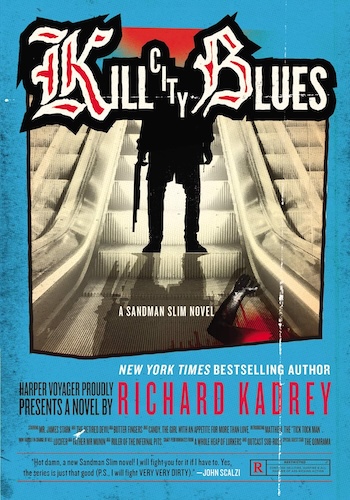
Review: KILL CITY BLUES by Richard Kadrey (Voyager)

Adobe Photoshop PDFSandman Slim is back on Earth, Averting Apocalypse & causing mischief…

James Stark, aka Sandman Slim, has managed to get out of Hell, renounce his title as the new Lucifer, and settle back into life in LA. But he’s not out of trouble yet. Somewhere along the way he misplaced the Qomrama Om Ya, a weapon from the banished older gods who are also searching for their lost power.

The hunt leads Stark to an abandoned shopping mall – a multi-story copy of LA – infested with Lurkers and wretched bottom-feeding Sub Rosa families, squatters who have formed tight tribes to guard their tiny patches of this fake LA. Somewhere in the kill zone of the former mall is a dead man with the answers Stark needs. All Stark has to do is find the dead man, get back out alive, and outrun some angry old gods-and a few killers-on his tail.

In the fifth Sandman Slim novel, we get more of the same. In both a good and less-good way. Kadrey serves up another dose of gritty, sometimes gnarly, often amusing supernatural urban fantasy. All the hallmarks of the Sandman Slim series are on display – the interesting and inspired twists on classic urban fantasy and horror denizens and creatures. His characters are quippy and interesting, not to mention developing rather nicely. The action is well-written, and doesn’t take over from the plot (of the novel or series’ meta-plot). I still love Kadrey’s version of Hell, God, Lucifer and Samael (former Lucifer). All the characters feel very real, now, even if they are outlandish (Kasabian, for example). Continue reading

Witchblade: Rebirth, Vol.1 – “Unbalanced Pieces” (Top Cow/Image)

Witchblade-Rebirth-Vol.01Writer: Tim Seeley | Art: Diego Bernard | Inks: Fred Benes, Alisson Rodrigues | Colors: Arif Prianto of IFS

In the wake of Top Cow’s Rebirth, Sara Pezzini has relocated from New York to Chicago and struggles to adapt to being a private detective. Pezzini quickly discovers that a change of scenery and occupation hasn’t changed one thing… the Witchblade is still a magnet for the supernatural Quickly drawn into a conflict between two mystical gangs, she must once again balance her responsibility as bearer of the Witchblade with her personal life.

Collects: Witchblade #151-155

I haven’t read a great deal of Witchblade comics, or other comics in Top Cow’s universe (Artifacts, The Darkness), but I’m somewhat conversant in the mythology. I read the first book by Ron Marz, which was itself a reboot/jumping-on-point, but then became distracted by the New 52 and a selection of other books (I’m not proud of it, but… Batman, baby!). After it was announced that Tim Seeley was taking over writing duties, my interest was piqued once again, having rather enjoyed his Hack/Slash horror-comedy series. So I dove in… And rather liked what I found.

I’m not sure that this needs a particularly long review. People who know the series already will know pretty much what to expect – it’s dark, gothic, but also slick. The only major difference is the location, as Sara has moved to Chicago (interestingly, that’s also where Dick “Nightwing” Grayson just moved to in the DC New 52). For new readers, this book has a lot of extra material that gives you some background. It’s not essential to read in order to enjoy this, though, as the concepts are pretty tried-and-true, but with some well-conceived and original developments.

Seeley blends a private investigator storyline and feel with just the right amount of weird in the first issue/chapter to get us intrigued. But then things get really weird – Sara tangles with biker witches, age-sucking creatures with a very strange version of their own ‘Witchblade-armour’, and a strange, supernatural beastie with a long history of fighting bearers of the Artifacts…

Things are not going well for Sara in her new environment, and her sense of displacement and ennui is well written. She’s finding her place, and it’s not going particularly well – on the social, financial, and divine purpose fronts. Add to this a policewoman who has it in for Sara, and a rather unsatisfying romantic (un)attachment with a stage magician harbouring an ulterior motive.

The story is well-written, well-paced and well-realised. Despite my aforementioned lack of fore-knowledge of the extended Witchblade mythos, I didn’t have any trouble following this. It’s weird, it’s sometimes amusing, it’s often creepy. The art team does a great job of bringing Seeley’s story to life on the page in crisp, sharp artwork. It’s eye-catching and vivid. I’m very glad I picked up volumes two and three in the ComiXology sale the other day, as I think I’ll be sticking around for a lot more of this series. I may have to try out the Rebirth The Darkness series, too.

If you are a fan of supernatural stories, filled with the occult, magical and gothic weirdness – not to mention a few gribbly beasties – then Seeley’s Witchblade is absolutely for you. Definitely recommended.

Upcoming: “Innocence” & “Wilderness” by Dean Koontz (Harper Collins/Bantam)

KoontzD-Innocence

Dean Koontz is an author who I have been familiar with for years (it’s hard to miss his novels in the SFF and Crime sections of any bookstore in – at least – the English-speaking world). And yet, I have never read anything by him. I think this novel, though, could change that. It sounds great. And, I’ll admit, the UK cover caught my eye – well played, Harper Collins Design Team. Well played. Then I saw the US cover (on the right), and I was even more smitten. Here’s the synopsis:

Addison Goodheart is not like other people…

Addison Goodheart lives in solitude beneath the city, an exile from a society which will destroy him if he is ever seen.

Books are his refuge and his escape: he embraces the riches they have to offer. By night he leaves his hidden chambers and, through a network of storm drains and service tunnels, makes his way into the central library.

And that is where he meets Gwyneth, who, like Addison, also hides her true appearance and struggles to trust anyone.

But the bond between them runs deeper than the tragedies that have scarred their lives. Something more than chance − and nothing less than destiny − has brought them together in a world whose hour of reckoning is fast approaching.

Innocence is due to be published in the UK December 10th 2013 (eBook), and on January 2nd 2014 (Hardcover) – according to Amazon UK. The novel is due to be published in the US by Bantam, also on December 10th 2013.

KoontzD-WildernessIn the meantime – and, if like me, you’ve never read anything by Koontz – the author has written a prequel novella! It’s called The Wilderness, and is published on October 29th 2013 in both the UK and US. Here’s the synopsis for the novella:

Addison Goodheart is a mystery even to himself. He was born in an isolated home surrounded by a deep forest, never known to his father, kept secret from everyone but his mother, who barely accepts him. She is haunted by private demons and keeps many secrets—none of which she dreads more than the young son who adores her.

Only in the woods, among the wildlife, is Addison truly welcome. Only there can he be at peace. Until the day he first knows terror, the day when his life changes radically and forever…

Guest Post: “The Magnificent Liar” by Tim Powers

Continuing Tim Powers’s blog tour, I present to you a guest post about the colourful ‘hero’ Edward John Trelawny.

The Magnificent Liar

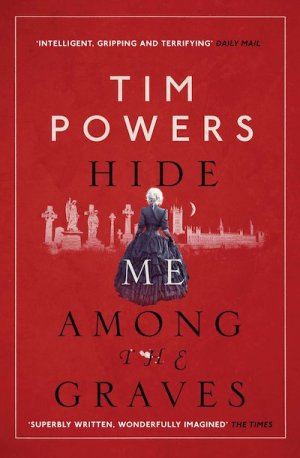
PowersT-HideMeAmongTheGravesUKPBHide Me Among the Graves had a number of colorful characters in it — I can say that with all due modesty, since I cheated and took real people who really lived for characters: Dante Gabriel Rossetti, a genius painter who lost his health and his mind to chloral hydrate addiction; Christina Rossetti, a devout celibate recluse who nevertheless worked face-to-face with London’s prostitutes to reform them and wrote reams of poetry about guilt and reproachful ghosts; and Algernon Swinburne, possibly the best English-language poet since Shelley, who furiously dissipated his gifts with alcohol and sado-masochistic obsessions – but the most fascinating of this circle was a man whose greatest accomplishment was telling lies about his own life.

Edward John Trelawny managed — largely by living a long time – to be a central character in the Italian circle that included Lord Byron and Percy Shelley in the 1820s, and also a prominent figure in the London of the 1860s, a close friend of many of the Pre-Raphaelite painters and poets. The only other figure I can think of right now who did the same kind of era-straddling is Neal Cassady, who was the friend and inspiration of Jack Kerouac and Allan Ginsberg in the 1950s and then, after the Beat phenomenon had petered out, went on to be the same for Ken Kesey and his Merry Pranksters in the late ’60s. Continue reading

“The Shining” by Stephen King (Hodder)

KingS-TheShining2011Perhaps King’s most famous novel. Review by a first-time reader.

Danny Torrance is only five years old, but in the words of old Mr. Hallorann, he “shines” with an exceptional psychic talent. For most of Danny’s life, his clairvoyant abilities have helped him to puzzle out his parents’ troubled relationship, but when his father accepts a position as the winter caretaker for the Overlook Hotel high in the Rocky Mountains, the little boy’s visions spiral into the realm of nightmare.

As blizzards isolate the Torrances, the hotel seems to develop a sinister life of its own. At night, unseen revelers ride the elevators and even the animal-shaped hedges of the topiary prowl the hotel’s grounds like threatening predators. But when Danny meets the woman in room 217, he discovers that the hotel’s phantom guests are more than shadows. Like Danny, the Overlook shines, but the energy it emanates is deadly.

The Shining is one of those novels pretty much everyone knows about. And I wouldn’t be surprised if, like me, they know many references from it without having ever read the book. True, some will know about it from the Kubrick movie (which Stephen King is not too fond of) – although, I haven’t seen that, either. When I got my hands on the novel, I was certainly eager to see what all the fuss was about, and fill in this important gap in my reading history. It is, of course, brilliantly written. But. While it is a fascinating read, there were a couple of things that didn’t quite click for me. I would, however, agree that this is essential reading.

I’m not really sure what to write in this review. It’s a novel that certainly made me think. It’s far more psychological than supernatural (in my opinion). It didn’t “terrify” me, but it was emotionally affecting. Danny, the child, is sympatico, and so many scenes made my heart ache for him. He has “the shine”, a hyper-, supernatural awareness of other people’s emotions, and also telepathic gifts. As he’s only five, he struggles to understand a lot of what he ‘hears’ and taps in to. Jack, his father, is an emotional wreck, fighting against his genetic disposition towards alcoholism and violence. Wendy, Danny’s mother, is the product of a verbally- and emotionally-abusive family (in this case, her mother basically thinks she’s incompetent, a waste of space, and so forth). The majority of the novel is presented through these three filters: Danny’s confusion, his frustration and outright fears; Jack’s suppression of his impulses; Wendy’s self-consciousness and lack of belief in herself. Exacerbating all of their neuroses and hang-ups, is their solitary life at the Overlook Hotel, effectively trapped their during the harsh, inhospitable Coloradan winter. It’s a fascinating, chilling glimpse into the minds of two emotionally damaged parents, and their psychic, confused child.

My ‘issues’ with the novel (for want of a better word) are not with the story, or the majority of King’s approach. It’s a fascinating story of the psychological impact of lifetimes of abuse – both physical and emotional – exacerbated by extreme cabin fever. And some actually supernatural goings on. Maybe. What niggled for me was the relentlessness of King’s characterisation. It was excellently written, and I was engrossed for the majority of the novel, but there were certainly times when I felt that King got into a repetitive cycle – after three or four times of making a point about Jack’s or Wendy’s shortcomings, the fifth and sixth (and sometimes seventh) times around felt like overkill, and the momentum did drop a couple of times. Part One, in particular, was very heavy-handed in its approach to situating the reader in this family’s life and minds. It is a testament to King’s writing skills, though, that he nevertheless brought me back to the story each and every time I started to think things were getting too bogged down.

KingS-TheShining1977Why “maybe”, above, when I mentioned the supernatural? Well, the introduction to the edition I read (Hodder, 2011) could be seen as rather leading. It includes King’s opinion of what actually causes most the weirdness and psychosis in the novel. While I nevertheless came to my own conclusion, and there are certainly some weird and creepy-as-hell goings-on, I think it did prime my impression, or influence how I read the novel. [Maybe it should be an afterword, in future editions?] A really minor complaint, though.

Overall? I’m very glad I finally read this, and I wish I hadn’t taken so long to do so. It’s by no means perfect, but it is frequently engrossing, gripping, and chilling reading. King’s attention to detail throughout is both excellent and also natural. I was reminded of Robert Jackson Bennett’s writing, actually (only, less contemporary than RJB’s), who I read before this. It certainly deserves its place as a literary classic, and an essential read for anyone with an interest in horror, thrillers, psychological tales, and also writing in general. As someone who has read a fair bit of King’s non-fiction (his Kindle Single, Guns, is superb), but never got through the only other novel of his that I’ve tried (Dreamcatcher, which was Messed Up), I’m glad I finally popped my King Fiction Cherry (there has got to be a better way to phrase that…).

I can’t wait to get my hands on Doctor Sleep, the highly-anticipated sequel [oh, I wish I could afford the limited edition of that book…]. Definitely recommended.

***

The Shining was first published by Doubleday in 1977 (cover above). It is now published by Hodder in the UK, and by Anchor in the US.

Comics Round-Up – Constantine & Lucifer (DC, Vertigo)

Still haven’t been reviewing as many comics as I had been earlier in the year, but I recently started reading two very good series – one brand new and on-going (Constantine), one already completed (Lucifer). I enjoyed them both very much, so I thought I’d show them some brief love on the blog.

CONSTANTINE #1-4

Constantine-1to4

Writer: Jeff Lemire & Ray Fawkes | Artist: Renato Guedes (#1-3), Fabiano Neves (#4) | Colors: Marcelo Maiolo

Liar, cheater, manipulator… John Constantine is all of these, and yet he uses these skills and more to protect the world from the darkest corners of the DC Universe.

Spinning out of both Hellblazer (which spanned 300 issues, and was Vertigo’s longest-running series) and also Justice League Dark, this series gives John Constantine its entire attention. I’ve only dipped in to Hellblazer, and certainly haven’t read nearly enough to consider myself overly familiar with the character or conversant with his part, but I enjoyed what I had read. The dark focus on the occult and supernatural were like catnip to me, and they were also what made me try Justice League Dark (which I have been enjoying quite a bit, too).

Constantine-01-Interior2

This series is written by Jeff Lemire, who also recently took over JL Dark. It’s a really good opening to the new series, I think, and we get a good introduction to Constantine’s character. It’s dark, deliciously so, and Constantine is his charming-anti-hero-self throughout. He’s not afraid of sacrificing others for the “greater good”, either – making him not a whole lot better than his antagonists. The end of #1 was particularly gruesome and startling, but these four issues are filled with visually and narratively stunning work. The main villains in this particular story (still incomplete at this stage) is the Cult of the Cold Flame, who have cropped up in JL Dark, too. I’ll certainly be reading more of this series. Recommended.

(Issue #5 is part of the Trinity War story-line, so I’ll be reviewing that as part of an Event review, in a few weeks’ time.)

*

Lucifer-Vol.01LUCIFER, Vol.1 – “Devil at the Gates”

Writer: Mike Carey | Artist: Scott Hampton (Sandman Presents…) & Chris Weston | Inks: James Hodgkins | Colors: Daniel Vozzo

From the pages of THE SANDMAN, Lucifer Morningstar, the former Lord of Hell, is unexpectedly called back into action when he receives a mission from Heaven. Given free reign to use any means necessary, Lucifer is promised a prize of his own choosing if he fulfills this holy request. But once he completes his mission, the Prince of Darkness’ demand shakes the foundation of Heaven and Hell. Now as his enemies unite to stop his reemergence, Lucifer gathers his forces as he prepares to launch his new revolution.

Collects: Sandman Presents Lucifer #1-3, Lucifer #1-4

This is an excellent, independently intelligible spin-off from Neil Gaiman’s Sandman (of which I have only read the first book).

In the first of these two story-arcs, we join Lucifer at his Los Angeles club, Lux. I’m not really sure how to review this book. It’s excellent, certainly, and wonderfully dark. It reminded me of Richard Kadrey’s Sandman Slim series (which is excellent and highly recommended). Lucifer is called up to help out Heaven one last time, in return for a particularly generous reward. The former Lord of Hell sets off on a very strange, dream-like journey. People’s wishes are coming true, and the consequences are starting to become devastating. Teaming up with a “victim” of this plague of wish-granting, Lucifer needs to get to the bottom of the mystery, before the world wishes itself into chaos.

In the second story, the first of Lucifer proper, we begin in Hamburg, where a set of mystical Tarot cards tries to influence the world around it. We get some neo-Nazis, hate crimes, and all of the seven deadly sins exaggerated and enhanced by the influence of the Tarot cards. Lucifer intervenes, in order to bring balance back to the world.

I really liked the alternative location – for once, we weren’t in the USA or UK, which I certainly welcomed. It’s still early days, but we start to see how the series will shape up in the future. I don’t want to spoil things (from either of the two stories), so this is perhaps a rather thin, unsatisfactory review. Nevertheless, I think this is an essential read for anyone with a taste for the darker sides of fiction and comics. Heaven and Hell are popular tropes in speculative fiction, but Lucifer Vol.1 offers a genuinely original spin, and is both written and visualised brilliantly.

I liked this so much, I bought volume two before I had even finished it. I’ll be starting that very soon indeed, so will hopefully have a review up in the next week or two. Deliciously dark, this is a must-read.

Lucifer-01-Interior1

Upcoming: “The Dark Blood of Poppies” by Freda Warrington (Titan)

Warrington-BW3-DarkBloodOfPoppiesI’m intrigued by Freda Warrington’s Blood Wine series. It was first released near the height of the vampire vogue – authors such as Anne Rice had established the genre as far more varied and ambitious that mere heaving bosoms and strained bodices. This year, Titan Books began re-issuing the series, which started with A Taste of Blood Wine (A Dance in Blood Velvet is due to hit shelves in October 2013). Last week, this cover for the third novel in the series was unveiled. And it’s another stunning, attention-grabbing one, too.

Here’s the original synopsis, from the 1996 edition (which I nabbed from the author’s website) – I don’t know if Titan will be changing it for their 2014 edition, but I assume it won’t be too different:

The ballerina Violette Lenoir has fallen victim to the bite of the vampire Charlotte. Her fire and energy have fuelled a terrifying change and a dreadful realisation; that Violette has become Lilith, the demon mother of all vampires.

Haunted both by what she has done and by Violette’s dark sensuality, Charlotte and her immortal lover Karl are drawn towards the dancer and the terrible destiny that has fallen on her shoulders.

But other, far more dangerous shadows are gathering around Violette. To the vampire Sebastian and to the dark heirs of Kristian, she threatens to wreak havoc with their plans to bring all of mankind under their dark wings.

Innocently embroiled in the endgame, courtesan extraordinaire Robyn Stafford finally meets her match as she is torn between the two ultimate lovers: Sebastian, and Violette …

As someone pointed out on Twitter, that is a very Black Metal cover – everything from the title to the model’s make-up does remind me of band photos from Terrorizer and Metal Hammer… It also has a smidgeon of Black Swan in there (ok, a fair bit…). I’m intrigued to read this series, and luckily I have the first book on my tottering TBR Mountain. I’ll hopefully get to it at some point in the not-too-distant future.

The Dark Blood of Poppies is due to be published by Titan Books in April 2014. A new, fourth novel in the series – The Dark Arts of Blood – is also meant to be coming out next year (October).

An Interview with CHRISTOPHER GOLDEN

GoldenC-Author

Very few fans of genre fiction and comics will be unaware of Christopher Golden. He has been writing for a couple of decades, now, mainly horror (or horror-inflected) work. Many will know him for his novels, his anthology work, and also his comics work – including the Baltimore books with Hellboy creator, Mike Mignola. He has a new short story collection coming out next month, through ChiZine, and has an impressive number of other projects he’s currently working on. I caught up with him (via email), and grilled him about writing, horror, and what he’s working on now…

Let’s start with an introduction: Who is Christopher Golden?

At 46, you’d think I would have an answer to that, but I’m still working it out. I’ve been writing full time since 1992, with the sale of my first novel, OF SAINTS AND SHADOWS. Since then, I’ve written or co-written or edited about a hundred books, mostly fiction in the horror, fantasy, mystery, and thriller genres. I’ve written comics and short stories, video games and an animated web series, radio plays and screenplays.

Your short story collection, Tell My Sorrows to the Stones, was published by ChiZine last month. How would you introduce the book to a potential reader? Is there a unifying theme for the stories within?

GoldenC-TellMySorrowsToTheStonesI’ve written short stories for as long as I’ve been writing novels. My previous short story collection, The Secret Backs of Things, collected everything I had done up until that point. But it felt to me as if somewhere along the way I reached a point where I felt as if I’d actually sort of figured it out – this whole short story thing. I’m not saying I don’t like any of my older stories. I like them just fine, most of them. But I do feel as if I grew up a little bit somewhere in there, passed a kind of threshold where I understand the form better than I had before. I often say that my novel Strangewood was when I grew up as a novelist. I think the stories in Tell My Sorrows to the Stones represent a similar maturing, only this time in short story form. There’s more thought in them, for me. More reason for them to exist than the other ones had. A lot of them are about folklore and imagination and belief in general – not religious faith, but faith in ourselves and how dangerous it can be to misplace that sort of faith.

What inspired you to write the short stories? And where do you draw your inspiration from in general?

KingS-NightShiftI grew up loving short stories, both in the works of Jack London and–much more commonly – in anthologies and collections of horror stories. The combination of Stephen King’s Night Shift and the various anthologies edited by Charles L. Grant (I think I started with Terrors before going on to the Shadows series) had a huge influence on me. Then I went backwards, reading things like Alfred Hitchcock’s More Stories for Late at Night and collections of HP Lovecraft stories and Edgar Allan Poe.

As for inspiration… it comes from everywhere. Sometimes it’s a dream or a nightmare, and sometimes it’s just that eureka moment that is the writer’s most invaluable and most indefinable tool. I have a lot of my ideas while traveling, and I often make sense of them while I’m in the shower or taking a walk.

How were you introduced to genre fiction?

I don’t remember how it began for me. It was just there. Twilight Zone and Kolchak the Night Stalker and movies on Creature Double Feature were all on my TV. My favorite comics included Tomb of Dracula and Werewolf by Night. When I started reading, I gravitated immediately toward Stephen King and creepy stories. I remember picking up The Stand in an an airport bookstore… same with various novels by Graham Masterton. From that point, I accumulated horror novels at absurd speed.

How do you enjoy being a writer and working within the publishing industry? Do you have any specific working, writing, researching practices?

I’m incredibly fortunate. I took the big leap right after selling my first novel twenty-one years ago and never looked back. That said, it’s not for the faint-hearted, this full-time writer thing. It’s always a financial roller coaster, but it’s never boring. I write five or six days a week (sometimes seven). Most mornings are taken up by emails and paperwork and phone calls and I do most of my writing just before lunch and then throughout the afternoon. Often I work a few hours on Saturday morning – unless I’m really under the gun, and then I’ll work the whole day or whole weekend… And feel horribly guilty about neglecting my family. I usually have music on while I’m writing. I’m not one of those Starbucks writers, who can sit in a cafe and concentrate… Although I’d like to be. I may have to try it out.

When did you realize you wanted to be an author, and what was your first foray into writing? Do you still look back on it fondly?

I started writing short stories in high school. I kept it up all through college, but it wasn’t until I started my first novel during senior year that I realized it was really the only thing I wanted to do. The first thing I was ever paid to write was an interview with Craig Shaw Gardner that was published in Starlog Magazine. My first short story was “One”, in Deathrealm Magazine. My first novel, Of Saints and Shadows, came out in 1994, but my first book was actually a non-fiction anthology I put together called CUT!: Horror Writers on Horror Film. I look back fondly on all of them.

GoldenC-FirstBooks

What’s your opinion of the genre today, and where do you see your work fitting into it?

I feel like the genre these days is sort of like the Republican Party – splintered and scattered. There are fine writers working in the small press, but the small press has shrunk quite a bit over the past five years or so. A lot of the publishing dedicated to horror at mainstream houses has vanished, making it harder for casual readers to walk into bookstores and discover new horror writers. On the other hand, there are still publishers who do original horror, including St. Martin’s Press, who are publishing my new novel SNOWBLIND in January. On the other hand, horror as a genre has bled into other genres – urban fantasy, thriller, mystery, literary fiction. Examples are everywhere. It’s a guerrilla genre, now. As far as where my work fits…? It fits wherever readers want it to fit. That’s not a cop-out. I write in a variety of genres, different shades, and they all have horror in them, including TIN MEN, the near-future SF military thriller I’m finishing now.

GoldenC-Snowblind

What other projects are you working on?

SNOWBLIND comes out in January, as I mentioned, as does DARK DUETS, the new anthology of collaborative stories I’ve edited. Also in January is CEMETERY GIRL: THE PRETENDERS, the first book in a graphic novel trilogy I’m doing with Charlaine Harris. I’m finishing up TIN MEN, working on a SONS OF ANARCHY comic book miniseries and the continuing series of BALTIMORE comics with Mike Mignola. In a few days I’ll be starting work on a new ALIEN novel.

GoldenC-Upcoming

What are you reading at the moment (fiction, non-fiction)?

Lebbon-ColdbrookI’m reading Tim Lebbon’s fantastic novel COLDBROOK, which is a monstrously cool pan-dimensional SF zombie thriller.

What’s something readers might be surprised to learn about you?

I’m a TV addict who loves music, musical theatre, movies and ice cream. I teach a writing workshop to 7th and 8th graders from my daughter’s school, and I spent a few years directing junior high musical theatre, which I miss terribly and wish I had time for.

What are you most looking forward to in the next twelve months?

World Fantasy Convention in Brighton, UK… And as much free time with my family as I can manage.

Covers, US vs. UK Edition: “The Six-Gun Tarot” by R.S. Belcher (Tor & Titan)

Spotted the UK cover in Forbidden Planet in London today, and was moved to share it on here. I’ve been aware of R.S. Belcher’s The Six-Gun Tarot since it came out in the US (published by Tor), but it seems to have also been quietly released in the UK, recently, by Titan Books. Here are the two covers…

Belcher-SixGunTarot

Out of the two, I definitely prefer the UK cover (on the right). Really cool. If that doesn’t grab your attention, here’s the synopsis:

Nevada, 1869: Beyond the pitiless 40-Mile Desert lies Golgotha, a cattle town that hides more than its share of unnatural secrets. The sheriff bears the mark of the noose around his neck; some say he is a dead man whose time has not yet come. His half-human deputy is kin to coyotes. The mayor guards a hoard of mythical treasures. A banker’s wife belongs to a secret order of assassins. And a shady saloon owner, whose fingers are in everyone’s business, may know more about the town’s true origins than he’s letting on.

A haven for the blessed and the damned, Golgotha has known many strange events, but nothing like the primordial darkness stirring in the abandoned silver mine overlooking the town. Bleeding midnight, an ancient evil is spilling into the world, and unless the sheriff and his posse can saddle up in time, Golgotha will have seen its last dawn…and so will all of Creation.

I’ll be sure to review it as soon as possible (I already have it).