“Wonder Boys” by Michael Chabon (Harper Collins / Random House / Open Road)

Chabon-WonderBoysA University Professor’s Crippling Writer’s Block and Drug-Fuelled Self-Destruction

Grady Tripp is a pot-smoking middle aged novelist who has stalled on a 2611-page opus titled Wonder Boys. His student James Leer is a troubled young writer obsessed by Hollywood suicides and at work on his own first novel. Grady’s bizarre editor Terry Crabtree and another student, Hannah Green, come together in his wildly comic, moving, and finally profound search for an ending to his book and a purpose to his life.

This is the second of Michael Chabon’s novels that I’ve read – and in a very short time, too. I still have no idea how to review The Amazing Adventures of Kavalier & Clay, which may rank as one of my all-time favourite novels. (Needless to say, it’s not difficult for me to see why it won the Pulitzer Prize.) Wonder Boys, the novel Chabon wrote before Kavalier & Clay, is a rather different novel. It’s nowhere near as long, for one thing – and yet, strangely, it feels far more rambling and unfocused. I enjoyed it a great deal, and zipped through it in just a couple of days. Chabon has a wonderful way with words that can make even the mundane a pleasure to read about.

The main character is almost archetypical, struggling author with writer’s block. Wonder Boys is basically the story of his long-time spiral of self-destruction coming to a head. Over the course of a single weekend, his wife leaves him, his affair takes a shocking turn, lots of people realise that he’s a nightmare and kind of feckless. He also has to attempt to keep his rather predatory editor away from one of his potentially-suicidal students. Along the way, there is a dead dog, one of Marilyn Monroe’s jackets, a shoot-out in an alley, and also a massive dead snake. And some Korean Jews. And a heavy amount of drug consumption.

Chabon-WonderBoysORI haven’t read much literary fiction (or whatever genre this is meant to be in), but there are some tropes that are popping up. They seem to be predictable in their unpredictability. Strange things happen. People do really weird things (see, for example, the bacchanal in The Secret History). They react in slightly melodramatic ways. And yet… there is a way that Chabon writes these little weirdnesses that feels very natural. Realistic, and not actually forced or jarring.

Without walking through the whole plot, it’s tricky to know what to write for this review. I am not aiming for a review in the style of the New Yorker, The New Republic, or Harper’s, so I’m not going to attempt to deconstruct this in any intellectual or academic manner. That’s not what the blog is for. What I will say, though, is that if you’re after a slightly strange, well-written novel about a writing professor at a small Ohio University going crazy, then this is for you. It’s witty, engaging, rather addictive, and very quirky.

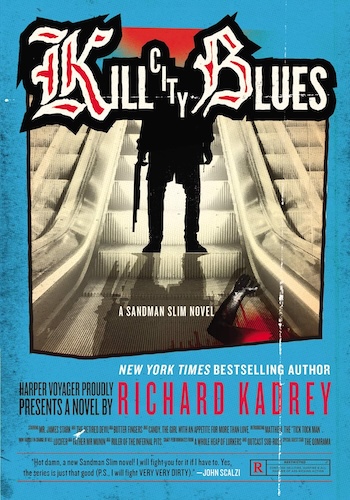
Review: KILL CITY BLUES by Richard Kadrey (Voyager)

Sandman Slim is back on Earth, Averting Apocalypse & causing mischief…

James Stark, aka Sandman Slim, has managed to get out of Hell, renounce his title as the new Lucifer, and settle back into life in LA. But he’s not out of trouble yet. Somewhere along the way he misplaced the Qomrama Om Ya, a weapon from the banished older gods who are also searching for their lost power.

The hunt leads Stark to an abandoned shopping mall – a multi-story copy of LA – infested with Lurkers and wretched bottom-feeding Sub Rosa families, squatters who have formed tight tribes to guard their tiny patches of this fake LA. Somewhere in the kill zone of the former mall is a dead man with the answers Stark needs. All Stark has to do is find the dead man, get back out alive, and outrun some angry old gods-and a few killers-on his tail.

In the fifth Sandman Slim novel, we get more of the same. In both a good and less-good way. Kadrey serves up another dose of gritty, sometimes gnarly, often amusing supernatural urban fantasy. All the hallmarks of the Sandman Slim series are on display – the interesting and inspired twists on classic urban fantasy and horror denizens and creatures. His characters are quippy and interesting, not to mention developing rather nicely. The action is well-written, and doesn’t take over from the plot (of the novel or series’ meta-plot). I still love Kadrey’s version of Hell, God, Lucifer and Samael (former Lucifer). All the characters feel very real, now, even if they are outlandish (Kasabian, for example). Continue reading

Author-Of-Many-Genres: Jeff Somers

I was spending some time on Goodreads, recently (as you do), and I noticed that Jeff Somers wrote in a number of genres. On the face of things, that is not at all a groundbreaking discovery. But, given the publishing industry’s preference for author branding, I thought it was interesting that Somers wrote under the same pen-name for all of the genres. Again, not exactly an earth-shattering discovery, but it gives me the opportunity to feature his work on the blog, before I get around to reading any of it. So, without further ado…

Author Bio: “Born in Jersey City, N.J., Jeff Somers has managed to migrate just five minutes away to nearby Hoboken, land of overpriced condominiums and a tavern on every corner. Between weekly drunks, Jeff manages to scrawl enough prose onto cocktail napkins and toilet paper to keep up a respectable fiction career.”

Genres: Avery Cates (Cyberpunk), Ustari Cycle (Urban Fantasy), Lifers, and Chum (fiction)

PrintAvery Cates – THE ELECTRIC CHURCH (debut), THE DIGITAL PLAGUE, THE ETERNAL PRISON, THE TERMINAL STATE, THE FINAL EVOLUTION

In the near future, the only thing growing faster than the criminal population is the Electric Church, a new religion founded by a mysterious man named Dennis Squalor. The Church preaches that life is too brief to contemplate the mysteries of the universe: eternity is required. In order to achieve this, the converted become Monks – cyborgs with human brains, enhanced robotic bodies, and virtually unlimited life spans.

Enter Avery Cates, a dangerous criminal known as the best killer-for-hire around. The authorities have a special mission in mind for Cates: assassinate Dennis Squalor. But for Cates, the assignment will be the most dangerous job he’s ever undertaken – and it may well be his last.

*

SomersJ-UC1-TricksterUstari Cycle – TRICKSTER

Magic uses blood — a lot of it. The more that’s used, the more powerful the effect, so mages find “volunteers” to fuel their spells. Lem, however, is different. Long ago he set up a rule that lets him sleep at night: never use anyone’s blood but your own. He’s grifting through life as a Trickster, performing only small Glamours like turning one-dollar bills into twenties. He and his sidekick, Mags, aren’t doing well, but they’re getting by.

That is, until they find young Claire Mannice — bound and gagged, imprisoned in a car’s trunk, and covered with invisible rune tattoos. Lem turns to his estranged mentor for help, but what they’ve uncovered is more terrifying than anybody could have imagined. Mika Renar, the most dangerous Archmage in the world, is preparing to use an ocean of blood to cast her dreams into reality — and Lem just got in her way.

*

SomersJ-ChumCHUM

Mary and Bickerman are the center of their circle of friends – but these friends are strangers as well as family to them. In the course of year, under the influence of a stressful wedding and a whole lot of alcohol, relationships and nerves are twisted and broken as the dynamics of the cozy-seeming group shift. Secrets are kept, emotions withheld, and it doesn’t look like it’s going to end well for anyone.

Told always in first person, but not the same person, and unfolding in double-helix chronology that provides a “Rashomon”-like narration, “Chum” is the story of love, liquor, and death.

*

SomersJ-LifersLIFERS

Three twenty-something guys, who transitioned from collegiate underachieving to corporate bottom feeding sketch out a plan to make a grab for some dignity. They will rob the publishing house that employs their only stable member and results him on a daily basis. Being the bright, perceptive fellows they are, they all quickly realize it’s about the money.

For Phil “Dub” Dublen, it’s a pissed off statement against a dull, meaningless job. For self-styled poet Trim, it’s a chance to actually be outrageous and anarchic as he needs to be. For Trim’s roommate Dan, it seems to be something he does for the same reason he does everything: to vent some anger, having nothing better to do. By the time their master plan is all said and done, nothing has been solved, nothing is better, and nothing, really, has changed. And, in the slightly fractured wisdom of the larcenous trio, this surprises none of them.

Who’s read any of these? I’ve picked up TRICKSTER and LIFERS, and intend to read them ASAP. Any other multi-genre authors you like? Or any you would like me to feature on the blog in either a post like this, or as reviews?

Graphic Novels Catch-Up: Hulk, Wonder Woman, Captain America, Superman

GraphicNovelsRead-201310-1

Four mini-reviews of graphic novels I have read over the last couple of weeks: Captain America: Road to Reborn and Reborn, Indestructible Hulk, Superman: Secret Identity, Wonder Woman (New 52).

INDESTRUCTIBLE HULK, Vol.1 – “Agent of S.H.I.E.L.D.” (Marvel NOW)

IndestructibleHulk-Vol.01Writer: Mark Waid | Artist: Leinel Yu

Hulk: Indestructible force more weapon than man. Banner: Smartest man alive. Combined, they are the strongest, smartest weapon on the planet! And NOW!, the Indestructible Hulk is an Agent of S.H.I.E.L.D.! Hulk’s first official missions include taking down the all-new Quintronic Man and battling Attuma on the ocean floor! But not everything is as it seems: What is Banner’s secret hold over S.H.I.E.L.D. Director Maria Hill? What and where is Bannertown, USA? And which one of Banner’s lab assistants holds a deadly secret? Plus: Bruce Banner and Tony Stark are friends but Hulk and Iron Man are anything but!

Collects: Indestructible Hulk #1-5

I read the first issue of this collection when it was first released, and rather liked the approach Waid took to the character. Bruce Banner is hired on by S.H.I.E.L.D., who continue to be wary of… the Other Guy. He’s given his own research team and lab – located at “Bannertown”. The story is pretty good, to start with, as we get reacquainted with Banner and his constant struggle with the Hulk inside him. He goes on a mission with Tony Stark (Hulk doesn’t like Iron Man very much). Then things get rather weird… The story moves into Exaggerated Comic Story, which was a little annoying, after the rather good, nuanced beginning. I would have preferred a little more investigation of Banner’s state of mind, etc. It’s strange that Waid didn’t offer this, actually, given his stellar work on series such as Irredeemable (still one of my favourite stories of all time – comic or otherwise).

There’s an underwater adventure that seemed to come out of nowhere, a big battle, and then we get sent back to Bannertown, where S.H.I.E.L.D. have hired a young, varied and eccentric staff to help Bruce with his research.

Yu’s artwork is, of course, as excellent and distinctive as always. I love his style, and have done ever since I read Superman: Birthright (which was also written by Waid).

It’ll be interesting to see how this series develops. I’ll be back for at least volume 2.

*

WONDER WOMAN, Vol.4 – “War” (DC New 52)

WonderWoman-Vol.4Writer: Ed Brubaker | Artist: Cliff Chiang

Wonder Woman’s world is shocked to its core when her eldest brother, the First Born, is freed from his slumber. Now, with her family in ruins and her friends scattered, she must turn to Orion and the New Gods of New Genesis to save herself and Zola’s newborn from the First Born’s wrath!

Collects: Wonder Woman #19-23

I think I may be losing interest in this series. It seems to be spinning its wheels, while also occasionally veering into excessive (but abrupt) action. I still think Brubaker and Chiang have developed a fascinating and unique take on Greek Mythology and its leading deities, creatures, and so forth. There are moments of sheer brilliance, but then also moments that just didn’t appeal. Orion, for example. What a pointless addition to the series. (Although, his presence did give rise to one of the best couple of pages, when Diana puts him in his place, tired of his provocative lechery and chauvinism – below.)

WonderWoman-19-Interior6

Chiang’s artwork is great, as I’ve mentioned in reviews of previous volumes – there’s actually nothing I would fault on the visual side of things. I just didn’t love the story as much as I have in the past. Going forward, I may not follow this series as closely or quickly as I have been up to this point.

*

CAPTAIN AMERICA: ROAD TO REBORN and REBORN (Marvel)

CaptainAmerica-RoadToRebornWriter: Ed Brubaker | Artist: Dale Eaglesham, Jackson Guice, Luke Ross, Gene Colan, Dave Gutierrez, Rick Magyar, Bryan Hitch

Road to Reborn: Sharon Carter’s dreams are forcing her to relive the death of Steve Rogers – and her time under the control of Dr. Faustus. But will these dreams also reveal hidden secrets about what she saw and did on the day Steve died.

Reborn: Captain America – Steve Rogers – is reborn, but is he the hero we know and love? Or is the new Captain merely a pawn of the Red Skull, or perhaps something worse? And what is Norman Osborn doing lurking on the fringes?

Collects: Captain America #49-50; #600-601
Captain America: Reborn #1-6

Yup, I’m still working my way through the fifth series of Captain America (Marvel refers to it as “Vol.5”, but given that each collection is a “Volume” as well, it gets confusing – hence the use of “series”). I’m still really enjoying it, and I think Brubaker’s characterisation of Steve Rogers, Bucky, and their myriad companions is brilliant. The antagonists remain delightfully cartoon-y – perhaps the only thing that hasn’t aged quite as well as the concept as a whole. Both of these books were very heavy on the nostalgia – even featuring a story about Captain America memorabilia collectors.

CaptainAmerica-RebornReborn ends with a massive battle on the steps of the Lincoln Memorial, as Steve Rogers must wrest control of his body from the Red Skull, whose consciousness has been implanted into the original Captain America’s body. Confused? Yeah, well, it turns out that the “assassination” was not, in fact, an assassination. Apparently, the Red Skull and Arnim Zola had planned to take Cap out of time (or something)… Why? Why didn’t the decades-old nemeses want to actually kill their enemy? Because the Red Skull apparently wanted to become him. Paging Doktor Freud…

Overall, though, not bad. Not the best in the series, but still enjoyable. It’ll be nice to see how the story goes forward, with Bucky still operating as Captain America. I actually rather like Bucky in the role, too – he adds some extra dimensions and insecurities, not to mention methodology. Next in the series is Captain America: Two Americas, which I’ll be reading pretty soon. [I will catch up!]

*

SUPERMAN: SECRET IDENTITY (DC)

Superman-SecretIdentityWriter: Kurt Busiek | Artist: Stuart Immonen

What’s in a name? Everything, if you share it with the Man of Steel!

Set in the real world, SECRET IDENTITY examines the life of a young Kansas man with the unfortunate name of Clark Kent. All Clark wants is to be a writer, but his daily life is filled with the taunts and jibes of his peers, comparing him to that other Clark Kent — the one with super-powers. Until one day when Clark awakens to discover that he can fly… that he does in fact have super-strength! But where did these powers come from? And what’s he going to do about it?

This was a wonderful surprise. Also, a bargain at only $4 (during one of ComiXology’s Superman-related sales, each of the four extra-length issues was only $1). It’s a wonderfully-told story, too. It’s picaresque, following a “real-life” Clark Kent without powers, who has long been plagued by amused relatives and friends gifting him any number of Superman-related memorabilia, toys, and so forth. Then, one day during his teens, he actually develops Superman’s powers. What happens next? Well, that’s the story of this collection, which takes us from Clark’s youth through to old age. We see his life unfold, as he takes a job at a New York journal, gets a book deal, marries someone called Lois (though not “- Lane”, and of Indian descent), and has two daughters. Along the way, he must constantly protect his family and himself from the attentions of the government. He forms a working-relationship with one agent, though, and they strike a deal for moving forward and not getting in each other’s way or on each other’s nerves.

The artwork is pretty good. It’s slightly different from what I’ve seen of Immonen’s other artwork (if I recall correctly), but it does suit the nostalgic and emotional nuance of the story. It’s brilliant, really. Very highly recommended for any lover of Superman stories, looking for something a little different.

*

Some upcoming comic reviews: Sixth Gun, Vol.5; Avengers, Vol.1 (Marvel NOW), American Vampire, Vol.2; Walking Dead, Vol.1 (just in time for Halloween, hopefully); Locke & Key, Vol.2; Atomic Robo, Vol.1; Saga, Vol.2; Thief of Thieves, Vol.1… And no doubt a few others, as I’ve been reading a fair few.

Guest Post: “It’s the End of the World — Bring Charmin” by Gail Z. Martin

MartinGZ-DaysOfTheDead

In the post-apocalyptic TV show “Revolution,” one of the characters, a former Google executive, says, “80 million dollars in the bank and I would trade it all right now for a roll of Charmin.” Of all the things that society has lost, at that moment, he misses commercially-produced toilet paper. It’s the little things that count.

I write the Ascendant Kingdoms Saga, a post-apocalyptic medieval epic fantasy series, for Orbit Books. In Ice Forged, the first book in the series, my characters have to come to terms with what they’ve lost, both big and small. Oddly enough, sometimes it’s the small things that matter the most.

Epic fantasy usually deals with the sweeping repercussions of events and decisions — the wars, assassinations, dynastic conflicts and economic collapses that change the balance of power. Certainly anything worthy of being called an apocalypse affects the superstructure of society: government, commerce, economics, and technology. Add in plague and natural disaster and a nation, continent or kingdom loses a significant portion of its workforce, its intellectual capital, its history and its physical infrastructure. Those losses are guaranteed to change what daily life is like for the survivors, and to make just getting by much more difficult.

Martin,GZ-IceForgedYet for individuals — whether real people or book characters — sometimes the big losses seem distant and abstract and it’s the small losses that drive home just how much life has changed and what is gone. In Ice Forged, characters mention what they miss, little things like memories of how holidays were celebrated and favourite foods that are now difficult or impossible to get. Perhaps it’s the realization that the landmarks — like a castle or the main street of a city—that seemed immutable are now ruined. It’s the dislocation of war and cataclysm that causes long-time neighbours to go missing, and the people you always met in the course of your daily life to vanish. Or it’s discovering that with crops unplanted or unharvested and distilleries and vineyards ruined, there’s not going to be any new good wine, ale or whiskey any time soon.

When the means of production are destroyed, whether those are craftsmen or factories, the goods in existence are all the goods there will be until manufacturing is restored. For the characters in Ice Forged, that means any goods they can’t grow themselves or create from raw materials. Not only will there be no new brocades or silks (and nowhere to wear them), but no new metals or coal mined, no imported goods until trade is restored, and nothing that someone might have purchased rather than making. Things like sugar and salt, maybe even lumber and clay become difficult to find. Looting the ruins and the trash heaps becomes the new form of shopping. And in a million little ways, life becomes strange and hard.

In Ice Forged, the devastation of the Cataclysm goes beyond physical destruction. Mages on both sides made a doomsday strike using magic, and unintentionally destroyed the bonds that allowed men to tame magic and use it to their purposes. For a culture that depended on the little magics for everyday life, that means no healers, no using magic to keep pests out of the crops or strengthen a sea wall, no way to keep milk from spoiling or food from rotting or all the hundreds of small ways that people had come to rely on a flicker of power here and there. And after four centuries of using magic as part of everyday life, few people remember how to do things the old way.

In The Hitchhiker’s Guide to the Galaxy, Douglas Adams advised readers to “Always know where your towel is.” Perhaps he should have included some Charmin, just in case?

***

Martin,GZ-ReignOfAshCome check out all the free excerpts, book giveaways and other goodies that are part of my Days of the Dead blog tour! Trick-or-Treat you way through more than 30 partner sites where you’ll find brand new interviews, freebies and more.

Ice Forged will be a Kindle Daily Deal with a special one-day price of just $1.99 only on October 31!

Reign of Ash, book two in the Ascendant Kingdoms Saga launches in April, 2014 from Orbit Books.

***

About the author: Gail Z. Martin is the author of Ice Forged in The Ascendant Kingdoms Saga and the upcoming Reign of Ash (Orbit Books, 2014), plus The Chronicles of The Necromancer series (The Summoner, The Blood King, Dark Haven & Dark Lady’s Chosen) from Solaris Books, and The Fallen Kings Cycle (The Sworn and The Dread) from Orbit Books. In 2014, Gail launches a new urban fantasy novel, Deadly Curiosities, from Solaris Books. She is also the author of two series of ebook short stories: The Jonmarc Vahanian Adventures and the Deadly Curiosities Adventures. Be sure to check out Gail’s website and follow her on Twitter and Facebook for more up-to-date news. Gail can also be found at the Disquieting Visions blog and on the Ghost In The Machine Podcast.

Books on Film: “Warm Bodies” by Isaac Marion (Vintage)

MarionI-WarmBodiesMovieA brilliant zombie love-story…

Movie Synopsis: Life for Julie (Teresa Palmer) and R (Nicholas Hoult) couldn’t be more different. R is a zombie; with a great record collection; limited vocab and an overpowering love of brain food. Julie is a human; beautiful; strong; open minded and all heart. When R makes an unexpected decision and rescues Julie from a zombie attack, his lifeless existence begins to have a purpose. As the unlikely relationship develops, R’s choice to protect her sets in motion a sequence of events that might just change both of their worlds forever. Directed by Jonathan Levine (50/50) and based on the debut novel by Isaac Marion, the heart-warming Warm Bodies is 2013’s zom-rom-com with a twist.

Director: Jonathan Levine | Starring: Nicholas Hoult, Teresa Palmer, Rob Corddry, John Malkovitch

I stumbled across Isaac Marion’s novel when I was in New York. I read the synopsis in the Union Square Barnes & Noble (one of my favourite places in the world…). Despite being intrigued, I wasn’t in a zombie-mood at the time, so I passed over it – rather unfairly, as it turned out. After the movie was released on DVD, though, I decided to watch the movie first – not something I usually do, but given the vast array of books I have to read, I wanted to squeeze this in. And I’m very glad I did.

All of the actors do a great job, and Nicholas Hoult does a wonderful job of making “R” an engaging and even sympathetic character. He’s funny, he’s awkward, and his internal monologue is wonderfully relatable to anyone who has ever felt stuck, awkward, or like their lives need a change. It’s brilliantly done, all-round, and as we see R’s evolution (“re-evolution”?) we realise just how brilliant Hoult is as an actor. It’s a peculiarly sweet love story, and I loved how it was both true to zombie lore and also unexpected and original, as well as paying tribute to some of the greatest love-stories (Romeo & Juliet, for example). It also has a superb soundtrack…

Very highly recommended. I will have to move the novel up the tottering TBR mountain.

Book Synopsis: “R” is a zombie. He has no name, no memories, and no pulse, but he has dreams. He is a little different from his fellow Dead.

Amongst the ruins of an abandoned city, R meets a girl. Her name is Julie and she is the opposite of everything he knows – warm and bright and very much alive, she is a blast of colour in a dreary grey landscape. For reasons he can’t understand, R chooses to save Julie instead of eating her, and a tense yet strangely tender relationship begins.

This has never happened before. It breaks the rules and defies logic, but R is no longer content with life in the grave. He wants to breathe again, he wants to live, and Julie wants to help him. But their grim, rotting world won’t be changed without a fight…

MarionI-WarmBodies

“The Secret History” by Donna Tartt (Vintage/Penguin)

TarttD-SecretHistoryI finally get around to reading the mega-hit novel of a mysterious group of college friends

Richard Papen arrived at Hampden College in New England and was quickly seduced by an elite group of five students, all Greek scholars, all worldly, self-assured, and, at first glance, all highly unapproachable. As Richard is drawn into their inner circle, he learns a terrifying secret that binds them to one another…a secret about an incident in the woods in the dead of night where an ancient rite was brought to brutal life…and led to a gruesome death. And that was just the beginning….

Another quick review, this (I’m still trying to figure out how best to review literary fiction). The Secret History has been an international mega-hit, and is frequently listed on Must Read books of the decade, your life, and so forth. As a result, it has been on my radar for years. But, because I am never lacking in reading material, I just never got around to buying it. After a particularly acute bout of book-restlessness, I decided it was time for a change from the SFF genres, and picked this up. I read it over a few very satisfying days, evenings and one night (I ended up finishing it at around 3am). It’s not perfect, but it is certainly engrossing and well-written.

The Secret History is a great novel, in many ways. It’s excellently written, and engagingly told. The characters are varied, quirky, and fun to read about (or, as is the case a coupleof times, uncomfortable to spend time with). This characterisation of college students is rather cliché, but I suppose it suits the story – I refer to the peripheral characters, here (drunks, drug-taking, not particularly bright or upstanding). The wild debauchery of Hampden College is merely a backdrop to the main attraction, despite them partaking in it as well. The focus of the novel are the five students in the exclusive Greek classes, and also our narrator, Richard.

There was something that didn’t ring true for me with this group, though: that everybody liked Bunny. Throughout the novel, he is an obnoxious, irritating presence, and I could never quite put my finger on why any of these characters professed to like him. Not a thing he did or said was redeeming or remotely attractive. It does, however, make it easier to believe how quickly our protagonists could turn on him (as we’re informed in the prologue). There were some affectations that didn’t ring true at all – although, because it was difficult to place the novel in a specific time/decade, I may have misunderstood the occasional thing.

The novel is pretty long, but it rarely felt like it was rambling or bloated. I appreciated Tartt’s attention to detail, and the way she realised the world and characters on the page. It is sometimes self-consciously intelligent and pretentious, but that can be forgiven, as it’s perhaps meant as a reflection of her characters (they are a group of young people who are oh-so-prone to affectations and pretentions). The narrative is sometimes disconnected, but always gripping. The final half of the novel, in particular, was riveting, and I stayed up well into the night to finish it off – thinking “one more chapter” at the end of each and every one.

This is a story of betrayal, loyalty and ultimate sacrifice. The way the characters must hide and tip-toe around what they have done, to hide it from their peers, the police and their mentor is plotted very well. Their tension and anxieties felt realistic and palpable. The ending was a tad melodramatic, and I’m pretty sure it didn’t have to end so. I can’t fault Tartt’s ‘world-building’, though.

I’m extremely glad I read this. It’s not the best novel I’ve ever read, but it has certainly added another author to my must-read list. As soon as I finished this, I bought the eBook of The Goldfinch, Tartt’s latest novel. I’m not sure exactly when I’ll have the time to read it, but I hope it is very soon.

Recommended.

“Scars”, Ep.X-XII by Chris Wraight (Black Library)

Wraight-Scars(HH)The final serial episodes of this Horus Heresy novel

Of all the Legiones Astartes, the White Scars of Jaghatai Khan remain the most enigmatic and elusive. Born of a civilisation that prizes honour, speed and fearsome loyalty, their allegiance has yet remained unclear even as the galaxy is torn apart by Horus’s treachery, and both sides have apparently counted them among their potential allies in the war to come. But when the Alpha Legion launch an unexplained and simultaneous attack against the White Scars and Space Wolves, the Khan must decide once and for all whether he will stand with the Emperor or the Warmaster… or neither.

I’m going to keep this very brief, as this review covers the final quarter of a novel. Why ruin it for everyone? The synopsis above is that for the novel as a whole. I must say it is possibly Wraight’s best so far. Everything I’ve reported on from the first nine episodes is just as evident and well-written as in the chapters that have come before. We learn more about the White Scars, and their strange place alongside the other Legiones Astartes, and the Imperium at large. Wraight sets up a lasting conflict and antagonism that (I assume) continues into the “present” Warhammer 40,000 timeline. Two Primarchs face off against each other, and the result of that exchange dictates the fate of the White Scars going forward. These three episodes pack in a lot of action, and the battle-scenes are very well-written (better, even, than Wraight’s Battle of the Fang). I particularly liked the attention paid to the Scars’ as a Legion split in two – mainly because it’s not been particularly well-addressed in other novels. Wraight’s writing is excellent throughout – clear, crisply composed, and briskly paced.

To be honest, a good amount of the story’s impact was lost as a result of the serialisation – hitting cliffhanger moments works for TV series, but not so much for a Horus Heresy novel. Even though I read them in chunks or multiple episodes, I’m used to read a novel in no more than five days (when they’re really long) and as little as one or two days. Stretching one out over a couple of months just didn’t work for me. An interesting experiment, though.

Nevertheless, with the whole novel now available, I would certainly recommend this as a must-read for all fans of the Heresy series. Wraight’s first full-length foray into the era is a triumph of military sci-fi. I certainly look forward to his next offering.

The Horus Heresy: Horus Rising, False Gods, Galaxy in Flames, Flight of the Eisenstein, Fulgrim, Descent of Angels, Legion, Battle for the Abyss, Mechanicum, Tales of Heresy, Fallen Angels, A Thousand Sons, Nemesis, The First Heretic, Prospero Burns, Age of Darkness, The Outcast Dead, Deliverance Lost, Know No Fear, The Primarchs, Fear to Tread, Shadows of Treachery, Angel Exterminatus, Betrayer, Mark of Calth, Promethean Sun, Scorched Earth, Vulkan Lives, Scars (I-III, IV-IX), The Unremembered Empire

[I’m going to work at filling in those review-blanks – some I’ve already read, but there are a couple of oversights that need addressing. As I am always thirsty for more Heresy fiction, I think I may have to catch up pretty soon. Starting with Graham McNeill’s Mechanicum. Fallen Angels is the only other I’ve never read.]

Upcoming: “A Love Like Blood” by Marcus Sedgwick (Hodder)

Sedgwick-ALoveLikeBloodAn ARC of this novel dropped through my mailbox a little while ago, and I had no idea what it was about. Nor could I find much information about it. Naturally, this made me ever-more intrigued (love me a good mystery book…). Publisher Hodder has now unveiled the artwork and synopsis, so here it is…

I’ve chased him for over twenty years, and across countless miles, and though often I was running, there have been many times when I could do nothing but sit and wait. Now I am only desperate for it to be finished.

In 1944, just days after the liberation of Paris, Charles Jackson sees something horrific: a man, apparently drinking the blood of a murdered woman. Terrified, he does nothing, telling himself afterwards that worse things happen in wars.

Seven years later he returns to the city – and sees the same man dining in the company of a fascinating young woman. When they leave the restaurant, Charles decides to follow…

A LOVE LIKE BLOOD is a dark, compelling thriller about how a man’s life can change in a moment; about where the desire for truth – and for revenge – can lead; about love and fear and hatred. And it is also about the question of blood.

When I read this, it will be the first of Sedgwick’s novel I read. Rather looking forward to it.

Guest Post: “The Delphi Room – Through the Looking-Glass” by Melia McClure

McClureM-DelphiRoomIn my novel, The Delphi Room, two people watch the past of the other unfold in a mirror. Trapped next door to one another in rooms they believe to be Hell, Velvet and Brinkley are captive audience to the disturbing “home movies” that play in a mirror that hangs in each of their prisons.

Mirrors are compelling symbols and have appeared in various art forms and spiritual texts throughout the ages. The Oracle of Apollo at Delphi, referenced in my book’s title, demanded of ancient Greeks “know thyself” – no small demand, and one which my characters grapple with mightily, in mightily eccentric fashion. Among other things, mirrors have historically symbolized self-knowledge and wisdom, and like the ancients who returned to Delphi again and again in search of answers to the riddles of life, countless numbers of people currently revisit a mirror as a daily reference point in the evolving construction of identity. The Delphic oracle answered seekers’ questions with riddles, and for mirror-gazers the riddles of the mind have a drastic impact on the perception of the confounding entity known as “self” that is reflected in the glass.

In the world of my novel, mirrors are also a means of two totally isolated people coming to understand the forces that have buffeted and shaped the other, and thus – as understanding creates connection – they give rise to Velvet and Brinkley’s growing bond. Mirrors can symbolize parallel universes or alternate realities, and both of my main characters are trapped in a hellish alternate reality while at the same time experiencing the universe of the other. And when, late in the book, Velvet and Brinkley jump into the past of the other through the mirror, rendering the past present, diverse realities are brought together, which alludes to the symbolism of an all-surfaced mirror: that all realities are one and seen and understood from all sides in the context of eternity.

But beyond the literal mirror-as-object, many of the characters themselves play some sort of mirroring role. Velvet’s psychosis, the Shadowman, reflects back to her multiple aspects of her selfhood: self-loathing, fear, creativity, ingenuity and rage. Brinkley’s psychosis, ’20s film starlet Clara Bow, references her tragic personal history – a history shared by the real-life Clara Bow – and in many ways it mirrors Brinkley’s crushingly sad upbringing: both had mentally ill mothers and, among other common experiences, Brinkley’s mother tried to kill him and as a teenager Clara awoke to find her mother holding a butcher knife to her throat. One could argue that Brinkley’s fractured mind chose to conjure that particular illusory movie star as an object of love because he found solace in the kinship of shared tragedy. Again, mirroring fosters connection: people seek their own humanity reflected back at them in the humanity of another – because, after all, humanity is about oneness.

The lives of Velvet and Brinkley mirror each other in many ways: their unstable mothers and absent fathers, along with their mutual obsession with cinema, furnish them with certain overlapping experiences and tendencies, though both characters are fiercely unique and individualistic. But clarity about the self can be harder to achieve than clarity about another, and the need for familial love can have an obfuscating effect, and thus it is through the mirror’s revelation of the past of the other that Velvet and Brinkley come to greater peace within themselves. As much as one’s reflection in a mirror begs the question “Who am I?”, we are all mirrors for each other, asking “Who are you?” and “Who am I to you?” The concept of identity is, of course, central to any conversation about mirrors, and the characters in The Delphi Room are fighting against crippling antagonism to define themselves on their own terms. What they see in the mirror is very different from how the world sees them, and it is in the chasm between those contrasting perceptions that the truth lies. When Brinkley gazes in a mirror, Clara Bow is there to alternately love and torment him; when Velvet gazes in a mirror, the Shadowman is often reflected as a sinister, albeit colourful, presence.

When we stand before a looking-glass, do we ever really know who is looking back at us?

***

Melia McClure’s The Delphi Room was published by ChiZine in September 2013. Be sure to follow the author on Twitter for more updates about her work, etc. You can read a sample of the novel on Tor.com. Here’s the synopsis:

Is it possible to find love after you’ve died and gone to Hell? For oddball misfits Velvet and Brinkley, the answer just might be yes. After Velvet hangs herself and winds up trapped in a bedroom she believes is Hell, she comes in contact with Brinkley, the man trapped next door.

Through mirrors that hang in each of their rooms, these disturbed cinemaphiles watch the past of the other unfold—the dark past that has led to their present circumstances. As their bond grows and they struggle to figure out the tragic puzzles of their lives and deaths, Velvet and Brinkley are in for more surprises. By turns quirky, harrowing, funny and surreal, The Delphi Room explores the nature of reality and the possibilities of love.