TV: “Downton Abbey” Season 1

DowntonAbbey-Season1UKFinally watched it…

Set in England in the years leading up to the First World War, Downton Abbey tells the story of a complicated community. The house has been home to the Crawley family for many generations, but it is also where their servants live, and plan, and dream, and they are as fiercely jealous of their rank as anyone. Some of them are loyal to the family and committed to Downton as a way of life, others are moving through, on the look out for betterment or love or just adventure. The difference is that they know so many of the secrets of the family, while the family know so few of theirs. But for all the passions that rage beneath the surface, this is a secure world, serene and ordered, and, at first glance, it seems it will last forever. Little do they know, family or staff, that the clouds of the conflict that will change everything are already gathering over their heads.

So, I haven’t owned a TV for many years. Instead, I’ve relied on DVDs, iTunes, and friends. Coupled with my peripatetic existence, I managed to miss Downton Abbey entirely. When I was in Los Angeles in September 2011, though, the show cleaned up at seemingly every awards show. Despite being somewhat intrigued, it took me until now to actually get around to watching it. And, I must say, I really enjoyed it. I had no idea really what to expect – I have never been particularly smitten with British period dramas (while still watching plenty), and expected More Of The Same. Instead, I got one of the best acted, best-written TV shows I’ve seen in a good long while.

I’m not really sure the series needs a full review, but I just wanted to give it a little shout-out on the blog. This is really good. And Maggie Smith really is That. Awesome throughout. So many hilarious, inappropriate lines from the grand dame of the family. All of the actors in the show were superb, from the Crawley family members on down to the new scullery maid. Even the peripheral and bit-parts are written and acted superbly.

Despite all of this, I still can’t tell quite why it’s taken the United States by storm – or, at least, as much as it has. It is very British. Which is probably why I love it, and I’m sure a fair few Americans love it for the same reason, but the universal acclaim seems unusual. If it keeps the show going, however, I am all for it. I will have to order the next two seasons, to be ready for season four…

Guest Review: PROMETHEAN SUN by Nick Kyme (Black Library)

Kyme-HH-PrometheanSunReviewed by Abhinav

The Horus Heresy series has proven to be rather spectacular, right from the very beginning with Dan Abnett’s game-changing opener, Horus Rising. As an exploration of the entire origin-mythos that defines the Warhammer 40,000 setting, the series has done well in exposing how this galactic civil war happened, and how all the players reacted to it, each in their own way. Being a multi-author series (projected to go on to roughly 50 full novels and anthologies, plus additional novellas, short stories and audio dramas), the quality hasn’t been entirely consistent, and there have been some let-downs, or books that don’t seem to fit into an ongoing arc.

Two years ago, Black Library changed the game once more, by offering direct exclusive limited-edition novellas set as interstitials within the larger narrative at work. Being limited to a select few thousand copies, these hardback stories with extra content (such as special faux-skin and illustrations) gave way to a lot of controversy with regards to pricing for the series. This was compounded last year by the publisher’s inexplicable decision to change formats mid-series and offer books in hardback and hardback-sized trade paperbacks before the regular and familiar mass market copies were made available.

As such, novellas like Promethean Sun and Brotherhood of the Storm among others have had to field quite a bit of negative criticism completely unrelated to the actual fictional content within. And that’s what I wanted to focus on in this review. Promethean Sun was re-released a few weeks ago as a non-limited hardback with an accompanying eBook, which is what I got. The two-year wait in between definitely didn’t hurt my enthusiasm.

So, on to the review itself. Here’s the synopsis…

As the Great Crusade sweeps across the galaxy, the forces of the Imperium encounter a world held in thrall by the alien eldar. While the Iron Hands of Ferrus Manus and Mortarion’s Death Guard battle against the hated xenos, it is the Salamanders who brave the deepest and most deadly jungles, encountering monstrous reptilian beasts and foul witchery along the way. Ultimately, it falls to their primarch Vulkan himself to thwart the sinister designs of the eldar, if the Legions are to liberate this world and bring illumination to its inhabitants.

Promethean Sun does one thing really, really well: it delves deeply into Vulkan’s psyche and explores his character through the present and the past alike. That’s what the entire story is about. The Primarch of the Salamanders Legion has been a fairly unknown quantity so far, outside of extremely brief cameos in other stories, most notably Graham McNeill’s Fulgrim, if I recall correctly, and so it was great to finally see more of him. Continue reading

Quick Review: BATMAN #20-21, Annual #2 (DC Comics)

Batman-21A-Art

Writer: Scott Snyder | Artist: Greg Capullo | Inks: Danny Miki | Colors: FCO Plascencia

Witness The New 52 origin of The Dark Knight in BATMAN: ZERO YEAR! Twists and turns are around every corner as Bruce Wayne takes the final steps toward his destiny! And in the backup story, learn more about how different Gotham City was at this dangerous point in time.

The second chapter of “Zero Year” delves into Bruce Wayne’s past with the Red Hood Gang and his run-ins with aspiring District Attorney Harvey Dent! And in the backup story, a secret moment from Bruce’s training abroad is revealed for the first time!

Batman-21&22

Covers & Best Variants for #21-22

These three issues comprise the beginning of a new, larger Batman story-arc. I thought I’d pick up with my comics reviewing, again, and this seemed like a perfect place to start. This storyline, “Zero Year”, focuses on Bruce Wayne’s evolution into the Batman. “Wait, hasn’t this been done before?” you may ask. Well, yes, it has. But Scott Snyder seems to have decided to go even further back, and take a little more time investigating Bruce’s change and development of the idea of the Batman.

Scott Snyder did a great job with “Death of the Family” (despite that going on just a teensy bit too long), so I was looking forward to seeing how he would approach the origin and evolution period of Batman. So far, on the strength of these two issues, he’s doing a great job, and I look forward to seeing how the story unfolds.

Batman-21-Interior6

The first of these issues starts off with what appears to be a dystopian Gotham City, not dissimilar to a post-apocalyptic New York (think of NYC in the I Am Legend movie), overrun by thugs. I hadn’t expected that. (See images, above.) The story then jumps to a different time, leaving all of my questions unanswered. We learn that Bruce has only been back in Gotham for a few weeks, and Alfred is struggling to understand and accept his ward’s approach to cleaning up the city. Bruce’s Uncle Philip Kane has tracked him down, though, and wants his nephew to take over Wayne Enterprises. Which, of course, Bruce doesn’t want to do. He’s waging his battle against the Red Hood Gang (doing some pretty crazy stunts), which I last read about in Alan Moore’s The Killing Joke.

Batman-22-Interior2

In issues #21-22, the story is really only being developed. Bruce is outed by his uncle, Alfred is pushing him to come out of the shadows, to revive the Wayne name and status, and to honour his parents’ legacy and memory. Bruce meets Edward Nygma. And that’s about it, really. A bit tricky to really say much more, as we’re still only seeing the opening moves in a much larger storyline. There will be some cross-over into the other Bat-Family titles, too.

These two issues are pretty good, it’s true, but I think we’re still way too early to be able to write much more than that. As can be expected, the artwork is also top-notch, and I had no complaints in that department at all.

Batman-Annual-02Annual #2:

Story: Scott Snyder & Marguerite Bennett | Writer: Marguerite Bennett | Art: Wes Craig | Inks: Craig Yeung, Drew Geraci, Wes Craig, Jack Purcell, Sandu Florea, Marc Deering | Colours: Ian Hannin

A special “ZERO YEAR” tie-in! Bruce Wayne’s first year as the Dark Knight has just barely begun…and already dangerous elements are coalescing, leading Bruce toward his final destiny.

Despite broadcasting on the cover that this is connected to “Zero Year”, it isn’t, really. There is some mention of Bruce’s early days as a vigilante, as he broke into Arkham Asylum and bumped into the Anchoress. That being said, this is a really good issue – at just six pages longer than a normal issue, I’m not sure it justified its higher price-tag, but I think Bennett (a protégé of sorts of Synder’s) does a great job with the characters and story. Batman has been invited to test the security of an all-new, super-high-tech wing of the Asylum, which is intended to hold the worst of the worst. Unfortunately for Bats, the Anchoress blames him for Arkham’s change in purpose (it really did used to be focused on curing and treating the inmates, rather than merely incarcerating them).

Batman-Annual-02-Interior2

A solid issue, and certainly well-worth reading, but don’t be fooled by the mentions of “Zero Year”. It is tangentially connected, and not in a way that will be essential to the overall storyline. (Unless something weird happens later, I suppose…)  I certainly look forward to reading more by Bennett.

“The Eyre Affair” by Jasper Fforde (Hodder)

FfordeJ-TN1-EyreAffairThe first Thursday Next novel

There is another 1985, where London’s criminal gangs have moved into the lucrative literary market, and Thursday Next is on the trail of the new crime wave’s Mr. Big.

Acheron Hades has been kidnapping characters from works of fiction and holding them to ransom. Jane Eyre is gone. Missing.

Thursday sets out to find a way into the book to repair the damage. But solving crimes against literature isn’t easy when you also have to find time to halt the Crimean War, persuade the man you love to marry you, and figure out who really wrote Shakespeare’s plays.

Perhaps today just isn’t going to be Thursday’s day. Join her on a truly breathtaking adventure, and find out for yourself. Fiction will never be the same again…

It has certainly taken me a long time to get around to this series. I’ve always hesitated as a result of my general ignorance when it comes to many of the “essential” classics, fearing that many of the jokes in the series will just be over my head. However, as part of the Hodderscape review project, I finally got my hands on a copy of this novel. It’s pretty good, but also suffers from some debut issues.

I’m going to keep this review relatively short. First of all, because this is an old novel that has been written about at great length elsewhere. But also because I’m not sure if I was the best audience for it…

There is plenty in here that is whimsical, fun, and very clever. Fforde clearly has a love for reading and the classics, and especially the idiosyncrasies of his subjects. His writing style is brisk and uncluttered, making this an enjoyable and easy read. Thursday is a great protagonist, with a varied and interesting past, and an engaging and endearing voice. Her supporting cast is, likewise, fun to spend time with. The villain is genuinely sinister and creepy (indeed, maybe one of the best villains I’ve read in some time). The myriad special departments of investigation are amusingly delineated, also with a Harry Potter-esque variety for the more supernatural investigations and crimes.

FfordeJ-TN1-EyreAffairUSDespite all these positives, for me The Eyre Affair is also filled with literary references that, sadly, went over my head. I always seemed to be in the “experimental” year at school, when it came to picking set texts for English Literature classes. This has resulted in a complete ignorance of some of the greatest works of literature, including Jane Eyre. (Unless there was a film, in which case I come perilously close to being like Cher in Clueless…) Naturally, this has also given me a considerable inferiority complex…

Thankfully, though, Alyssa was on hand to fill me in on the particulars. I imagine, therefore, that the more literature you have read, the more you will get out of this novel and, one supposes, the series as a whole. That being said, don’t let this put you off if you haven’t read Jane Eyre or other literature that is mentioned herein. There is plenty on offer that is in a similar humorous vein as Terry Pratchett’s novels, so you won’t be adrift in a sea of allusion and references. The story is strong and stands on its own, I think.

As I mentioned at the start, the novel suffers a little bit from debut-itis, in that Fforde comes across as rather self-consciously clever, not to mention stuffing the early pages with a lot of new and whimsical information and nuggets of altered history and literature. At first, I was worried I wouldn’t like this much at all, or at least as much as I had hoped.

However, I persevered, and ultimately rather enjoyed the caper and characters. Will I pick up the next in the series? Probably, as I have it on good authority that they get better and better.

This is a fun, clever, slightly silly novel that will appeal to lovers of literature and reading. For those people, I would say this is a must read.

The Series: The Eyre Affair, Lost in a Good Book, The Well of Lost Plots, Something Rotten, First Among Sequels, One of Our Thursdays is Missing, The Woman Who Died A Lot, Dark Reading Matter (forthcoming)

Two Years (ish) of DC Comics’ New 52

DCHeader

Someone asked me on Twitter if I was still reading comics (they pointed out I hadn’t posted many reviews of them lately). I have been, but because I’ve been reading them in big chunks, interspersed with work reading, as well as both fiction and (future-work-related) non-fiction books, I’ve been letting the comics reviews slide a fair bit. There is another reason, of course: not all of the comics have been single storylines, or complete storylines, which makes reviewing them really tricky. Once you get to around issue #10, anything you write about the story is likely to throw out spoilers. This, I think, is maybe a weakness of reading and reviewing comics on a weekly basis – and is really why I stopped doing that almost a year ago (that and financial considerations). Regardless, my insatiable need to read All The Things With Words means I have been reading a good number of comics via ComiXology’s app on my iPad. With the exception of the frankly phenomenal Hawkeye, I do not buy any issues full-price. I just can’t afford to. So, as and when things go on sale or are discounted (either one or two months after release), I’ve been collecting issues to read in bursts.

That being said, the number of series I’ve been reading has also been steadily culled. I usually give each series a single “volume” – that is, what would appear in a collected, printed trade hardcover or paperback. It’s been a useful way of separating storylines, as well as providing a “book’s worth” to review. (Ahem, if I bothered to review them, that is…)

So which of DC’s New 52 have I kept reading? Which ones will stay? And which will have to go, and why? Below is a brief run-down (by no means exhaustive) of the titles I’ve been reading, collected by theme/larger series…

[I may add to this, over time, as I remember other titles I’ve tried, or just think of something else I’d like to add.]

GREEN LANTERN SERIES

I’m starting with this one, because I recently completed the vast “Rise of the Third Army” and “Wrath of the First Lantern” cross-title events. It was an epic undertaking, and sadly it sometimes felt like it. Not to mention being rather more expensive than I would have wished (or should have given in to). The two events, really one mega-event, had its interesting and gripping moments, but ultimately outstayed its welcome. By the time it ended, expectations were so high, that it fell a bit flat. This, I’m noticing, is a common feeling at the end of comics Events…

Overall, though, the extended family of Green Lantern titles remain interesting. Not all of them are as consistent or gripping as I would like. Green Lantern is still very good. Red Lanterns is possibly the weakest, now, after what had been a promisingly dark beginning. New Guardians is starting to fizzle a bit, too, despite my continuing interest in the wider spectrum of Lantern corps. Green Lantern Corps has some very good moments, too.

GreenLantern-20

With Geoff Johns’s run on the flagship title now over (an epic, redefining era for the character and mythos, filled with many exceptional moments), and with each title now having hit their 20th issues, I think I’m going to retire the series from my ‘pull-list’. Mostly, this is a financial decision, but it is also because the story has hit a point when I feel like I’m overdosing, and just simply want a break. The expanded 20th issue of Green Lantern was a nice wander down memory lane, and offered some intriguing hints for what is to come, but I’m just not prepared to dive back in for a little while longer. When I do return, I think only Green Lantern and Green Lantern Corps will be priorities.

*

BAT-FAMILY TITLES

The Batman family of titles remain my favourites, and (in my opinion) also the best-written. The flagship title, Batman, still written by the excellent Scott Snyder, continues strongly. In the wake of “Death of the Family”, we got some shorter, stand-alone issues and stories, which offered a nice breather. The latest Bat-event has now begun, though (“Year Zero”), so it’ll be interesting to see how that develops. I’ll be keeping this title on the list, and will actually be writing a review of the first three parts of “Year Zero” in the near future (#21-22 and Annual #2).

I’ve been following Detective Comics, too, but it hasn’t been firing on all cylinders for a little while. I’ll probably stick with it a little while longer, but it may have to go at some point. [As a somewhat related aside, I’m considering delving into the pre-New 52 Detective Comics stories, as some of them sound pretty great.]

BatmanDarkKnight-11-ArtGregg Hurwitz’s Scarecrow story for Batman: The Dark Knight was one of the best Batman storylines I’ve ever read. No joke. Yesterday I picked up the final part of his Mad Hatter story-arc (it’s been discounted on ComiXology), and will be reading it all in one go. I will certainly write a review for it, too. Hurwitz has done a truly fantastic job with this title. Very highly recommended indeed. It’s staying on my to-read list.

Batgirl is still going strong, with some potential closure on the question of Barbara’s serial-killer brother. Gail Simone’s keeping the quality high, and the story engaging and fresh. The artwork, too, remains strong throughout. A keeper, and I’m looking forward to picking up some of the creepier-looking recent issues in the near future.

I’m still enjoying Nightwing, as the story and character remain interesting. Post-“Death of the Family”, Dick Grayson moves to Chicago, which I think will be really great for the character – not only is it a change of pace from Gotham, but it will hopefully open up the possibility for plenty of original stories and enemies. I have every intention of continuing with the series, but I may wait longer chunks of time and binge on a complete story-arc each time I do.

Batwoman-09-ArtI haven’t been keeping up-to-date with Batwoman, despite every intention to do so. I had been waiting for printed collections before I left NYC, but chose to de-prioritize it after “Death of the Family” started, because it wasn’t connected. I enjoyed the more horror-leaning aesthetic and storylines, though, so I do hope to get caught up again. (I’ve read up to issue #9, so there is a fair bit of reading to do before I’m up-to-speed… Won’t be too soon, sadly.) It is probably the most eye-catching, artistically of all the New 52 titles. Really superb, original compositions.

Batwing is in the same position as Batwoman. It’s a series I certainly want to read more of, I just can’t afford to right now. Writing duties have changed hands (#19), and it looks like the new team (Jimmy Palmiotti and Justin Gray) have taken the series in an interesting direction. Hopefully it won’t be too long before I get back to it.

One of my favourite series remains Red Hood & The Outlaws. If I had to say why it remains such a good read for me, I think I’d struggle to say. I like the characters – especially Jason “Red Hood” Todd – and they dynamic between them is really good. It’s a bit different, with a more sci-fi feel to it than other Batman-related titles, but perhaps it’s this difference that gives it a fresher feel? It also tied in really nicely with “Death of the Family”. I imagine this will be a keeper for some time.

I’ve also managed to read the first volume’s-worth of new title Talon. James Tynion III is doing something really interesting with this character, and I hope he becomes a permanent member of the DC stable. The first storyline was a slow-burn narrative, but with plenty of action sequences, as we follow Calvin Rose make a sort-of life for himself, with a couple of allies. And also a rogues’ gallery of his very own. It’s quite different to Batman, and I liked a lot about the series. It took me longer than it perhaps should have to adjust my expectations of story-type (I’d not been sleeping and was exhausted when I read it). Nevertheless, it is a pretty great story. The first book also has one hell of a cliff-hanger ending…

Batman&Robin-18-Interior8

My favourite series in the Batman family, though, has got to be Batman & Robin. Each issue is superb, but the silent issue #18 (image above), is one of the most powerful comics I’ve read. Absolutely superb, and I’ll be writing reviews of Volumes 2 and 3 in the near future. A must-read series (along with Hurwitz’s Dark Knight).

Teen Titans, led by Tim “Red Robin” Drake, has had a lot of ups and downs. Scott Lobdell’s humour can work pretty well, but overall I just don’t think I care enough about the characters to stick around any longer than I already have. The future storylines, which seem to feature six-eyed demons, also don’t appeal much.

*

SUPERMAN FAMILY

Personally, I think there has been too much crossover and needed catch-up to fully follow all the storylines, which is also too much to justify financially.

Superman-11-ArtI actually like the Superman series. I seem to be one of the only people who liked the first story arc, which offered some interesting modern-era-media concerns into the story (I studied the role of the media in politics as part of my PhD, so maybe that’s why I liked it more than some others). I did get bored when the DC Powers That Be tied this series in with the daemonites storyline (which was just dull – sorry, there’s really no other way to describe it other than “just dull”, in the end). I bought the issues for Volume 3 (#13-19), not realising that they were all “H’el on Earth” issues. I have no idea if I have to read the other two Super-titles to ‘get’ the story, but it has made me hesitate (perhaps stupidly, seeing as I do own them)…

What of Superboy? Meh. I lost interest, despite enjoying Volume 1. I just never got around to reading any more of the series. Will I in the future? Perhaps. But probably not in the near future.

I finally read the first volume of Supergirl, and while there was some good stuff therein, it was mainly all-action-all-the-time, which left minimal time and space for actual story. Distracting readers with endless set-piece-battles does not a good story make. I don’t think I’ll be reading any more of the series, sadly.

Which brings us to Action Comics. I remain on the fence: Grant Morrison has finally left the series, but I’m not sure if it’s ok to just dive in with the new writers’ work. And my OCD shudders at the incompletion prospect…

*

JUSTICE LEAGUE TITLES

I just finished Justice League #17-19 the other day, aiming to catch up for the latest cross-over event, “Trinity War”. (See? Told you there were a lot of them…) I must say, though, that I was thoroughly underwhelmed with these issues. The story was just weak. The artwork wasn’t great (not to mention schizophrenic, as multiple art-teams were involved). The series has not been without its strong moments, though – for example, when Batman discusses his contingency plans with Superman, and the “Throne of Atlantis” cross-over story.

JusticeLeague-19

Aquaman has been a good title throughout, but due to financial constraints, I haven’t been able to keep up with it as much as I would have liked. It remains a keeper, but not an urgent one. I’ll pick up issues in chunks.

Brain Azzarello’s run on Wonder Woman has been interesting. I have a weakness for anything linked with Mythology (especially Roman, Egyptian, Norse, and as in this case Greek – all of them formed a large part of my youthful and formative reading). The story sometimes veers into the WTF-territory, which I’m not a fan of. But, at the same time, I think the interpretations of the Gods and mythical creatures and characters is really interesting. The first two volumes (“Blood” and “Guts”) were strong, despite a bit of a dip in quality in Volume 2. I’ll keep reading this for at least one more story-arc. And I really do like Cliff Chiang’s artwork.

WonderWoman-12-Art

For some reason, I haven’t been keeping up-to-date with The Flash. I enjoyed the first volume a good deal. Perhaps it’s my innate caution when a storyline suddenly features Gorillas…? It is becoming clearer to me that I really like my comics a little less ‘out there’, unless they’re obviously meant to be totally out there – Hellboy and Justice League Dark (below), for example. I’d like to catch up with this at some point, though, as I do find the Flash to be an interesting character. Speaking of, though, I picked up a few more of the Flashpoint comics recently (again, a ComiXology sale), so I hope to get those read and reviewed at some point soon.

*

THE DARK & EDGE

I really like a lot of Justice League Dark – the artwork is often pretty great, and the story has some great moments. It feels like it’s weakening a bit, but this might be because the creative team had to tread water until the “Trinity War” event could start. I hope it picks up again. I thought Lemire was going to revive it nicely, and on the strength of his first handful of issues, I bought a fair bit of his other work (including Sweet Tooth, which enjoyed an excellent 99c sale on ComiXology not so long ago). We’ll have to wait and see, I guess. I’m sticking around for “Trinity War”, but I will re-assess afterwards.

JLDark-18-Interior2

The only other series I’ve maintained from these ‘sections’ of the New 52 is Demon Knights. I have the issues for Volume 2, but because I’ve been reading a lot of fantasy fiction, I haven’t felt an urgent need to read these. I will, though, as I like the option of reading some fantasy in my comics. Watch this space, I guess.

*

Constantine-01Overall, it looks like I’m losing steam with DC’s wider New 52 line. Some series remain strong, true, but I’m not sure if reading them on an issue-by-issue basis is enough for me. Too often, the story feels incomplete, insufficient, rushed, or what have you. Maybe I just need a bit of a break from them? Who knows. I have picked up some issues from two of the newer series – Constantine and Justice League America – primarily because they are connected to the “Trinity War” event. For some reason, I didn’t feel the need to get The Phantom Stranger or Pandora

Instead of spending my few funds on more super-hero comics, I’ve been picking up some other comics. The aforementioned Sweet Tooth, as well as American Vampire, Locke & Key, and a handful of others. I’m also going to try to get back into the G.I.Joe titles, and maybe dip in to some more Dark Horse (Star Wars and The Massive), Image (Chew, Thief of Thieves) and Zenescope titles. I will also, actually, be delving into the back-catalogues of both DC and Marvel, too – I have a number of older Superman stories, for example, as well as a wealth of X-Men stuff to catch up on.

Does anyone else have any suggestions? Or opinions on the New 52 this far in? Feel free to share in the comments, below, or on Twitter or Facebook.

TrinityWar

“Trinity War” Artwork

“Scars” Episodes I-III, by Chris Wraight (Black Library)

Wraight-Scars(HH)A Horus Heresy Serialised Novel

This is a review of the first quarter(-ish) of the 27th Horus Heresy novel, which is being serialised through Black Library’s website. Reading these, one is left with a bit of a conundrum: how do you review the first three-of-twelve parts of a novel? What constitutes a spoiler, for example?

I’ve decided to approach the installments as if they were the first quarter of a novel, which means all the content is fair game for discussion and mention (although, I have addressed each episode individually, which has made this a rather long review).

I wonder if it might have been better to organise some kind of forum, in which fans of the series could discuss the episodes and novel? There’s so much in these three parts, and given the week-long gaps between each new episode, I think it lends itself quite well to forum-style engagement and discussion.

Anyway, back to the review. First up, here is the synopsis for the full novel:

Jaghatai Khan and his White Scars Legion must choose – the Emperor or Horus? Fresh from their conquest of Chondax and the discovery of Horus’s rebellion, Jaghatai Khan’s warriors stand divided. Long considered one of the less trustworthy Legions, many of the White Scars claim to owe their loyalty exclusively to Terra, and others still to the Warmaster and his warrior lodges. But when a distress call from Leman Russ of the Space Wolves brings the wrath of the Alpha Legion to Chondax, the Khan’s hand is forced and the decision must be made – in the great war for the Imperium, will he side with the Emperor or Horus?

The first Episode was not the strongest start to a novel. It didn’t fully grab me, like most other Heresy novels have – this is, perhaps, a real danger when serialising a novel that has not been specifically written for this format. (Although, it should be stated from the outset that the first three episodes have been chopped up rather well.) It’s also tricky, though, to address: taken as an individual read, it wouldn’t have left me 100% convinced that I wanted to read on. Because I had the next two episodes, though, I can say that Scars could shape up into one of the strongest Heresy novels.

The story opens with two Astartes aspirants, Tamu and Haren. The two characters are going through trials for what I had assumed were the White Scars. It took a few pages to realise they weren’t both trying out for the same Legion, though, which at least explained the different types of name (Haren Svensellen didn’t sound particularly Asian-influenced, as most White Scars’ names are). Haren, it turns out, had been marked for selection by the Luna Wolves, but is reassigned to the White Scars at the last minute. It’s a little bit muddled, if you haven’t memorised the Legion numbers (as opposed to names), but it quickly sorted itself out.

Through Haren’s ordeal, we learn that this is happening after Horus has made a name for himself: “I will become one of you,” he thinks after confronting a Luna Wolf. “For Horus. For Horus and the Emperor, I will become one of you.”

The mix of ‘Asian’-style terminology (“an owlish Khitan from Choq-tan named Jeldjin” – a bit of a clunky example) seemed at times to be rather heavy-handed or excessive. Wraight throws out a lot of new jargon without the best integration. Less, or a more gradual introduction, would have been better. Interestingly, we learn through Haren’s experiences, the White Scars prefer recruits from the Asiatic hive cities, and he finds their “archaic customs, their introversion, their exceptionalism” irritating. The first episode, then, offers an interesting, if truncated, alternative induction story. I liked this a lot, as it suggests that inductions are not always as harmonious or clear-cut as we may have been led to believe.

To make things a bit more confusing, at the end of Episode I, Tamu changes his name as he is inducted, to Shiban. Haren becomes Torghun.

There’s some foreshadowing, as Tamu asks if Terrans are as tough as Chogorians:

“I am glad you are a poet. Only poets can be true warriors.”

“Do the Terrans think the same way?”

Yesugei laughed. “I do not know,” he said. “One day you will meet one. When you do, ask him.”

Not difficult, therefore, to spot that Tamu/Shiban and Haren/Torghun are fated to meet.

Wraight-Scars(HH)-pt1In Episode 2, the story’s scope widens, and we are introduced to a number of other key characters. Ilya Ravallion, a General in the Departmento Munitorum, for example, who is charged with handling the White Scars’ logistics. Through Ilya’s eyes, we get some good commentary on the White Scars’ style – both martial and temperamental.

“They were the elusive ones, the Legion who roamed too far, the ones who had almost broken away entirely, rampaging outwards from the thrust of the Crusade and angling off into the deep void. Prodigal, her superior had called them.”

Assigned to the White Scars, Ilya feels she’s been given a surprising final assignment: “organising the unorganisable, imposing some sense of discipline upon a Legion that treated warfare like a kind of carefree, joy-filled art form.” In the third episode, discussed below, this theme is revisited, and we learn that Ilya “had come to find the White Scars’ amiable indifference to Imperial edicts more endearing than exasperating.”

And finally, we get some examination on Jhagatai Khan, in relation to his brother Primarchs:

“They said Horus Lupercal was the finest commander in the galaxy. They said that the Angel Sanguinius was the mightiest in combat, or maybe Russ of Fenris, or maybe poor tortured Angron. They said Guilliman was the greatest tactician, the Lion the most imaginative, Alpharius the subtlest. None of them gave the Khan a second thought. But then, they hadn’t seen him [in combat].”

We learn a bit more about Shiban and Torghun, and also start to get a glimpse of a rift between Terran-born White Scars and Chogorian-born Astartes. Torghun, for example, is a member of a Lodge (which haven’t featured much in recent HH fiction), which is made up exclusively of Terran-born Astartes. I have a feeling that the rift within the Legion is going to be borne of these hostilities. It’ll be an interest addition to the canon, too – despite their obviously aggressive, homicidal approach to non-humans, none of the Heresy (or WH40k) fiction has dealt with human racial tension. If handled well, this could be very interesting indeed.

The second episode also gives us more idea of the time-period for the novel – the Space Wolves have already burned Prospero (the events of McNeill’s excellent A Thousand Sons and Abnett’s Prospero Burns), and also after the Isstvan Dropsite Massacre. The final portion of this part focuses on the Space Wolves, who are chaffing at having been sent away to discipline Magnus’s Legion – thereby ensuring their absence from Isstvan, which in turn likely helped sway the conflict in favour of the traitors. Their task also prevented them from coming to the aid of their now-fallen brother Legions. Then, while preparations are underway for the Legion return to Terra, an Alpha Legion fleet appears out of the warp…

One of the most interesting scenes is at the start of Episode III. It is set in the Observatory of the Imperial Palace on Terra. Malcador the Sigillite, Primarch Rogal Dorn and Commander Valdor of the Legio Custodes are discussing the state of the galaxy and the newly-erupted Civil War. Through their discussion, we learn just how thin information is.

“I never asked you how it felt, Constantin, to see Prospero burn. Did even your callous soul blanch at that?”

Valdor didn’t miss a beat. “No. It was necessary.”

“Was it?” sighed Malcador. “I did not give the order. I wanted Magnus censured, not destroyed. What was it that made Russ do it? You never could give me an answer.”

Dorn exhaled impatiently. “You know all of this, Malcador. You know all that happened there, just as we do.” He was coldly furious. “Does this need repeating? The Warmaster is at the heart of it, poisoning everything we do, and now he has the blood of three more Legions on his hands.”

This chapter expands once again our understanding of the rivalries and loyalties between the Primarchs. It also re-iterates the strange, almost lonely position of the Khan. The Khan was only really close to two of his brothers: Horus and Magnus. Naturally, this produces some concern among the leaders of the Imperium. As Valdor states, “So there it is. The Khan’s known allies, Horus and Magnus, traitors both.”

As with the aforementioned novels by McNeill and Abnett, Wraight ties in the treason to the events at Nikaea, when the Emperor decreed that all Legions must disband their psychic corps (the Librarians, etc.). As Malcador laments,

“As I said at the time, Nikaea was the root of this. We should have explained things better, though there were reasons, some of which we could never disclose, not there… We were too caught up in what needed to be done. That may be the tragedy of it all – we did not explain.”

Thankfully, we finally meet the Primarch Jaghatai Khan. He had felt rather absent up to this point… As it turns out, Khan has no idea what occurred on Nikaea, hoping instead that Yesugei (who appears to be his second-in-command?) was successful in helping keep the Librarius alive in the Legions.

The Space Wolves and Alpha Legion also face off in the void.

“I wondered if it would become easier,” Bjorn mused.

“If what would?” asked Godsmote.

“Killing another Legion. Killing kinsmen.”

“We’re not there yet.”

“Yes, we are.”

To return to the pending rift within the Legion, we see a little bit more of the Terran-born Astartes’ frustrations.

“As was typical, the White Scars straggling Legion structure made coordination difficult… The Chogorians seemed happy enough with that. They were used to their inscrutable primarch and his impulsive decision-making. The Terrans took it harder, at least those who hadn’t long resigned themselves to the Legion’s haphazard methods of command and control.”

Given that we’re told the process can take well over a decade, I find this a little strange. It’s an interesting development, certainly, and one I haven’t seen in other Heresy fiction. Therefore it is welcome, not to mention also providing the motivation behind the Legion split easier to swallow, but at the same time… They were made into Astartes, elevated to become super-humans. So they didn’t become Luna Wolves – we’ve been led to believe that all humans see all Space Marines as the pinnacle of supra-human evolution, and are in complete awe of them. It seems almost petty that the friction effectively arises because some of them weren’t pick for the right ‘team’.

All in all, despite the weaker first Episode, Scars is shaping up to be a pretty interesting addition to the Horus Heresy series. Wraight’s writing is well-crafted, and the story moves at a brisk, smooth pace. I hope we get some more White Scars background, though, and perhaps some of their Primarch’s history. I haven’t read much about the Legion before (and have read neither Wraight’s previous novel Savage Scars, nor the limited edition novella, Brotherhood of the Storm).

I do, however, think I would have preferred to read this as part of the complete novel, so I’m not sure if I’m going to continue reviewing the episodes in collected chunks, or just wait for the novel to be complete. Part of this is just down to my own personal impatience with reading in small chunks – I much prefer to devour a novel in a relatively quick period, rather than in slow, weekly drips. It’s an interesting experiment, at least.

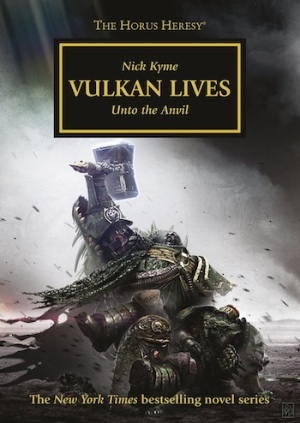
Review: VULKAN LIVES by Nick Kyme (Black Library)

KymeN-HH26-VulkanLivesA superb, different Horus Heresy novel

In the wake of the Dropsite Massacre at Isstvan V, the survivors of the Salamanders Legion searched long and hard for their fallen primarch, but to no avail. Little did they know that while Vulkan might have wished himself dead, he lives still… languishing in a hidden cell for the entertainment of a cruel gaoler, his brother Konrad Curze. Enduring a series of hellish tortures designed to break his body and spirit, Vulkan witnesses the depths of the Night Haunter’s depravity, but also discovers something else – a revelation that could change the course of the entire war.

How does one review a novel that packs in so very many revelations? With great difficulty, as it happens… Vulkan Lives is a great novel. It is a superb addition to Black Library’s New York Times-bestselling sci-fi series. It is a superb example of intelligent, thoughtful science fiction. It’s not flawless, true, but I loved it. I have a feeling it won’t be met with universal acclaim from the more action-oriented sections of the WH40k fan-base, but I think it does a great job of fleshing out some hitherto overlooked events and questions of the era. Continue reading

“Ex-Heroes” by Peter Clines (Del Rey UK/Broadway)

ClinesP-1-ExHeroesUKSuperheroes-vs.-Zombies Novel Fails to Impress

Stealth. Gorgon. Regenerator. Cerberus. Zzzap. The Mighty Dragon. They were heroes, using their superhuman abilities to make Los Angeles a better place.

Then the plague of living death spread around the globe. Billions died, civilization fell, and the city of angels was left a desolate zombie wasteland.

Now, a year later, the Mighty Dragon and his companions protect a last few thousand survivors in their film-studio-turned-fortress, the Mount. Scarred and traumatized by the horrors they’ve endured, the heroes fight the armies of ravenous ex-humans at their citadel’s gates, lead teams out to scavenge for supplies—and struggle to be the symbols of strength and hope the survivors so desperately need.

But the hungry ex-humans aren’t the only threats the heroes face. Former allies, their powers and psyches hideously twisted, lurk in the city’s ruins. And just a few miles away, another group is slowly amassing power… led by an enemy with the most terrifying ability of all.

I had high hopes for this novel – mixing superheroes and zombies seems like such an awesome, perhaps even common-sense mélange, yet it had not been done before. So, when the three books arrived on my doorstep, I was eager to get stuck in. While Ex-Heroes had some good bits – the action-scenes, in particular, are well-written – ultimately, I do not think this book was ready for publication. This was a big disappointment.

Ex-Heroes is very much rooted in the super-hero and zombie apocalypse genres. Clines does a fine job of painting the post-apocalyptic Los Angeles, and it was never difficult to get a sense of the place and atmosphere when he was writing about the city, it’s few surviving residents, and its shambling hordes.

The novel is also, disappointingly in my opinion, equally rooted in comic book aesthetic of, at a guess, 1990s Marvel – all of the women are super-hot, sexually available, adolescent fantasies. There’s even a “dominatrix-ninja” who doesn’t wear very much at all. This character is Stealth, and Clines overdid her introduction: it is filled with such cliché ideas of what makes someone a genius, for example, and also explanations of how much being stunningly beautiful was something that never mattered to her, and that she was endlessly frustrated that people will only ever see her worth in her looks. Fine, nothing wrong with the latter. But then why on Earth would she design an outfit that accentuates her underwear-super-model figure? And yes, she was an underwear-super-model. I think I get what the author was trying to comment on, but he didn’t do it too well at all. And I may be being charitable…

The novel is meant as pure entertainment, and I can certainly see what the author was trying to do. In many ways, he succeeds, but the end result remains not brilliant. It’s a good, even inspired blend of two popular genres – I’d say more rooted in superhero than zombie sub-genre, though, as it lacks the slow-build, sinister tension of the best zombie tales. It does a good job of tapping in to many wish fulfillment needs of super-hero fans everywhere.

Another major weakness, in my opinion, was the writing. I think it could have been much better written. The story lacked depth, but I can’t deny that I zipped through what I read pretty quickly. Sadly, the characters were unsurprising, some of the “psychology” seemed mixed up or garbled. The “relationships” were bland, relying on gorgeous, sexually aggressive women fawning over the menfolk. It lacked tension. Ultimately, I was rather bored. Which is why I stopped reading.

ClinesP-1-ExHeroesUSWhich is a pity, as I thought there were elements of the narrative and apocalypse-building that were innovative and interesting. For example, the nature of zombism idea is intriguing: the virus/pathogen is actually non-fatal, it just turns people/victims into walking petri dishes, as if they have been “injected with the CDC’s wish list” of the myriad diseases percolating in Los Angeles.

And the action scenes aren’t bad. But the overall momentum, and the level of my interest dwindled quickly, the more I read. Each time I picked it up, I’d easily get through a handful of chapters. But each time it took a bit more effort to pick it back up. I wonder, really, if the novel had been properly formulated before it was written – most of the ideas are there, but I would describe this as an early draft at best. It’s missing development. It lacks chops.

As I mentioned at the start, I was sent the first three novels in the series, which makes me feel a little awkward about disliking it as much as I have, truth be told. Will I read the others? Probably, yes. But I’m in no rush to get to them, so don’t hold your breath for reviews in the near future.

With Ex-Heroes, while Clines has managed to come up with an interesting, original spin (as far as I’m aware) on two very popular genres, the actual story, characters and quality of writing aren’t there. I really wanted to like this, but ultimately, after about 40% of the novel, I just couldn’t read any more. This, in my opinion, was not ready to go to market. A real shame.

***

Update: The original version of this review included an error. I stated that Ex-Heroes was previously self-published, when in fact it was published through a small-press: Permuted Press. Apologies for the error.

*

Ex-Heroes – and the sequels Ex-Patriots and Ex-Communication – are out now in the UK (Del Rey) and the US (Broadway).

ClinesP-2-ExPatriots

Book 2 – UK, US

ClinesP-3-ExCommunication

Book 3 – UK, US

The fourth book in the series, Ex-Purgatory, will be published in January 2014. Here are the covers (UK, US):

ClinesP-4-ExPurgatory

“Apocalypse Now Now” by Charlie Human (Century)

Human-ApocalypseNowNow-UKA bonkers, fascinating, twisted debut urban fantasy

I love the smell of parallel dimensions in the morning.

Baxter Zevcenko’s life is pretty sweet. As the 16-year-old kingpin of the Spider, his smut-peddling schoolyard syndicate, he’s making a name for himself as an up-and-coming entrepreneur. Profits are on the rise, the other gangs are staying out of his business, and he’s going out with Esme, the girl of his dreams.

But when Esme gets kidnapped, and all the clues point towards strange forces at work, things start to get seriously weird. The only man drunk enough to help is a bearded, booze-soaked, supernatural bounty hunter that goes by the name of Jackson ‘Jackie’ Ronin.

Plunged into the increasingly bizarre landscape of Cape Town’s supernatural underworld, Baxter and Ronin team up to save Esme. On a journey that takes them through the realms of impossibility, they must face every conceivable nightmare to get her back, including the odd brush with the Apocalypse.

This is an extremely strong debut novel, from an author who exhibits a great deal of talent and potential. Apocalypse Now Now is bonkers, twisted, very funny, and utterly engaging. I read this a little while ago, but Human’s characters and writing have stayed with me. The author channels the best of Urban Fantasy, makes it his own, and blends it with a Hunter S. Thompson-esque flair for language. This was a lot of fun.

[Full disclosure: I now work for Charlie Human’s agent. So I probably shouldn’t be reviewing this, but I loved it and wanted to at least write something.]

Baxter is an interesting and fun guide to the Cape Town supernatural underground. He is not your typical teenager. He’s possibly crazy, Machiavellian, a little paranoid, and definitely sociopathic. He picks on his brother, who is slightly mentally handicapped. He’s unpleasant to a lot of people. He runs a porn-ring. He goes to a fancy-ish school in Cape Town:

Like all prominent high schools in the leafy Southern Suburbs we have lush school grounds, sophisticated computer labs that were out of date as soon as they were installed, a debating team, a competitive rugby team, and gangs, drugs, bulimia, depression and bullying.

It’s an ecosystem; a microcosm of the political, economic and military forces that shape the world. Some high-school kids worry about being popular or about getting good marks. I worry about maintaining a fragile gang treaty that holds Westridge together. Horses for courses, as my dad says.

The first two-thirds of the novel make up what has to be the strongest start to a debut series I’ve read in a very long time. We get a superb, guided tour of Cape Town’s underground, and also plenty of interesting asides about South African folklore and mysticism. The story builds to a rather strange ‘Big Boss Fight’, which I didn’t find quite as compelling as the world-building and character-development in the first two-thirds of the book. True, there’s a lot of world-building and attention to establishing the characters, but I was never bored. In fact, I would have happily read even more of his creations. I haven’t come across a more-immediately-gripping UF series than this.

I felt I really got to know Baxter, the members of the Spider (especially Kyle, Baxter’s closest friend), Ronin and everyone else. They interact realistically, they bitch and gripe at each other. Baxter makes the adults he interacts with extremely uncomfortable. Maybe the only character who wasn’t expertly incorporated into the story was Esme, which is strange, given that her kidnapping forms much of Baxter’s motivation in the story… A minor weakness, though, in an otherwise superb novel.

Human’s writing is immediate, addictive, funny, and expertly crafted. The humour is natural, understated, often rather dark, and I often chuckled and laughed-out-loud on the train and Tube. Baxter’s internal monologues (and dialogues, as it turns out… just read it) are cynical, fresh, and often very funny. It’s like he sees the world with one eyebrow permanently raised.

Encouraging a sweet and fragile teacher – distraught at the thought that we don’t care about her class, and driven to hysteria by consistent and vicious undermining of her authority – to throw herself from the second storey is wrong. But it’s also fun.

Human-ApocalypseNowNow-SAThis is a pretty short (somewhat disjointed) review, I know. But this is a novel that has to be read to be properly appreciated. I could provide near-endless quotations and descriptions of his original and brilliant creations. But that would rob the novel of its impact, when you pick it up yourself (which you must!). I’d love to sit down and chat with people who have read this, going through various plot points, jokes, etc., in more detail. I took a greater-than-normal amount of notes, mainly favourite quotations and jokes. Let’s hope plenty of other people read it, so I have others to chat to about it.

Needless to say, Charlie Human has proven that Urban Fantasy is still a very vibrant and diverse genre, with considerable scope for originality and invention. He’s also messed around with a lot of the genre’s tropes, twisting things into new shapes, while remaining true to some classic themes and aesthetics. I really can’t wait for the second novel in the series. (It’s on its way.) Cape Town is a refreshing location for the story, and adds so much to how the author has created his supernatural community and mythology. It’s really great.

I recommend this very highly to anyone with even a slight interest in Urban Fantasy. Also, to just anyone who’s looking for something original, very well-written, funny, dark, and genre-blending. Charlie is definitely an author to watch, and I think we’re still only scratching the surface of what he can, and will do.

Apocalypse Now Now is out, uh, now in the UK.

Short Story Review: “Know Thyself” by Andy Smillie (Black Library)

Smillie-KnowThyselfMore superb Flesh Tearers from Smillie

Sent to meet with Flesh Tearers Chapter Master Gabriel Seth to discuss a recent incident in which the Flesh Tearers and Space Wolves came to blows, Inquisitor Corvin Herrold boards the flagship of the Chapter, the mighty Victus. But when he discovers a shocking secret, Herrold finds himself a prisoner of Sanguinius’s most dangerous sons, and his audience with the Master of the Flesh Tearers proves more perilous than he could have ever imagined.

Andy Smillie has done it again: he has managed to portray characters that should be mindless, ferocious psychopaths in a nuanced, relatable, and not-unsympathetic manner. What Aaron Dembski-Bowden does in long-form, Smillie has mastered in this shorter-format.

It was really interesting to see how the Flesh Tearers’ command deal with the Inquisition, and their extreme means of conveying unto those who deem them heretics and corrupt what lies at the heart of their character. It’s not pretty, nor is it supposed to be. The Tearers are the way they are, a distillation of the more brutal aspect of their originator Primarch, Sanguinius.

This is a superb short story, and I can’t wait to read more by Smillie. I really must get caught up with Flesh of Cretacia

More Flesh Tearers by Andy Smillie: Beneath The Flesh, Torturer’s Thirst

[This story was originally published in the Black Library Weekender Anthology 2012: Saturday.]