
Director: Antoine Fuqua | Writers: Creighton Rothenberger, Katrin Benedikt | Cast: Gerard Butler, Aaron Eckhart, Morgan Freeman, Dylan McDermott, Rick Yune, Angela Bassett
I finally Watched OLYMPUS HAS FALLEN, tonight. I thought it was really good, too. A political Die Hard for the modern age, perhaps? The movie is action-packed, very well-paced (I never got bored, and never felt like the screenplay or movie as a whole was padded with anything that was unnecessary). It is quite brutal, though – but in a “realistic way”, if that makes sense? Gerard Butler (the hero, and a member of the Secret Service) offers a very good portrayal of a hyper-efficient, highly-trained killer (former special ops, etc.). There’s no “flash” to the fight scenes, he doesn’t suddenly break into any wire-work or seamless, stylised martial arts. It’s quite chilling, in its brutal directness. Here’s the extended trailer…
So. Why is there a picture of Vince Flynn’s TRANSFER OF POWER? Well, because there are some startling similarities. Transfer was the first Flynn novel I read, and introduces readers to Mitch Rapp, the CIA’s best operative (translation: assassin). Here’s the synopsis:
What if America’s most powerful leader was also its prime target?
On a busy Washington morning, the stately calm of the White House is shattered as terrorists gain control of the executive mansion, slaughtering dozens of people. The president is evacuated to an underground bunker, but not before nearly one hundred hostages are taken. One man is sent in to take control of the crisis. Mitch Rapp, the CIA’s top counterterrorism operative, determines that the president is not as safe as Washington’s power elite had thought. Moving among the corridors of the White House, Rapp makes a chilling discovery that could rock Washington to its core: someone within his own government wants his rescue attempt to fail.
As I subscribed to the author’s newsletter, I received the email with Flynn’s comment about Olympus Has Fallen (which was, actually, also the first time I heard about the movie). Dated on March 25th, 2013, here is part of “Vince’s Statement On Olympus Has Fallen”, in which he addresses the similarities, mentions White House Down, and also offers some information about the forthcoming American Assassin movie adaptation:
Many of you have emailed me, messaged me on Facebook, posted on my Facebook page and tweeted about the similarities between the new movie Olympus Has Fallen and my book Transfer of Power. My team and I have noticed the similarities as well and know of a second movie coming out this summer also about an attack on the White House. Neither of these movies are Mitch Rapp movies nor do I have any involvement in either project. It is very difficult to prove where a producer, director or screenwriter gets an idea, or to prove how their ideas may have been inspired.
It is exceptionally difficult to prove in court, costs lots of time and money and usually amounts to a great deal of frustration. My team and I have decided to stay focused on the Rapp Franchise – writing one great Rapp novel a year and getting American Assassin made into a movie.
With Bruce Willis signed and on board to play the surly Stan Hurley, a character that I created with him in mind, things are looking good for a fall shoot. Things will start to move quickly in the coming months as Rapp, Kennedy, Stansfield and others are cast. It will be a very exciting time.
I appreciate you looking out for me, and your concern for my intellectual material. In many ways your comments have allowed me to stay calm and focus on what I love most, which is writing a kick ass Rapp novel. For that I offer you my sincere thanks.
I loved Transfer of Power, and blitzed through it in record time. I read it when I hadn’t quite fallen down the Reading Rabbit Hole I obviously inhabit today, but it certainly marked a shift in my reading tastes – after this, I caught up with Flynn’s other books (at the time, only three others had been released), and have read all of Flynn’s novels since, always picking them up on release. That being said, I let things slip for his last two novels, and have been really slow about getting around to The Last Man. Sadly, earlier this year (June 19th) the author lost his three-year battle against cancer. He was only 47. And so The Last Man is also his final novel. There had been plans to publish his work-in-progress, but those plans seem to be on indefinite hiatus. I suppose the publisher and his estate will find someone to finish it off, at some point.
Each of Flynn’s novels has been a tightly-plotted action thriller, firmly rooted in what became the post-9/11 tradition (so yes, the villains are often Middle Eastern terrorists, but a couple of times they are American). Transfer of Power was actually published in 1999, though, which showed a creepy prescience. He was certainly, in my opinion, the best writer among his genre-peers. He was a conservative, politically, but unlike some of his contemporaries, he was always fair in his portrayal of politicians in his novels who held opposing positions to his own or his protagonists’. He was always able to present both sides in an even way. [Some liberal authors could learn something from him on this score – *cough* Eric van Lustbader in The President’s Daughter *cough*]
I will miss having new Rapp novels to read, but I am grateful to have so many to re-read over and over again.
Vince Flynn’s Novels (chronological): American Assassin, Kill Shot, Term Limits, Transfer of Power, The Third Option, Separation of Power, Executive Power, Memorial Day, Consent to Kill, Act of Treason, Protect and Defend, Extreme Measures, Pursuit of Honor, The Last Man
If you like Flynn’s novels already, but want more authors who write in the same (sub-)genre and are worth your time, be sure to check out: Kyle Mills, Andrew Britton (R.I.P.), Alex Berenson (these three are my favourites), Brett Battles, Olen Steinhauer, John Gilstrap (who I’ll be trying out very soon), Daniel Taylor, Brad Thor, Marc Cameron, Tom Cain, Dick Wolf. There are, of course, many others, but these seem to be the best. [Hm. Anyone know any female authors who write in this genre…?]
In case you are interested, here is the trailer for White House Down – which stars Channing Tatum and Jamie Foxx:
Graphic Novel Round-Up (September)

I’ve not been keeping on top of graphic novels and comics as I had been – just been too busy and distracted. Nevertheless, this weekend I was able to catch up on some, so I decided to write very quick reviews of those that stood out.
Reviewed: East of West, Vol.1; Wolverine & the X-Men, Vol.3; Astro City, Vol.1, Archer & Armstrong, Vol.1
*
 East of West, Vol.1 – “The Promise” (Image)
Writer: Jonathan Hickman | Artist: Nick Dragotta
This is the world. It is not the one we wanted, but it is the one we deserved. The Four Horsemen of the Apocalypse roam the Earth, signaling the End Times for humanity, and our best hope for life, lies in DEATH.
Collects: East of West #1-5
This is a pretty interesting series. It was much-hyped when it was first published, but I nevertheless waited for the first story-arc/volume to be available. It is a dystopian future, where much of life seems to have been consolidated onto the American continent. There is an apocalyptic storyline that keeps you guessing, as three of the four horsemen ride out (after being reborn) to track down their missing fourth. Death, as it happens, is the MIA horseman, and he is pursuing his own agenda and mission. Specifically, to find his missing love.

There’s a fair mount going on in the first issues that make up this opening story-arc. It’s well-written and very well-rendered. The artwork is superb, with not a few arresting pages and panels (see, for example, above and below). The story has a lot of influences that one might be able to spot (I couldn’t say for definite if they are genuine influences, or just things I spotted and have associated with my own science fictional/dystopian favourites).

It’ll certainly be interesting to see how this series shapes up in both the short and long-run. Count me in for the long-haul. This is a must-read for anyone who likes dystopian futures, apocalyptic stories, with a healthy dose of futuristic politics, technology, weirdness, and an expertly written story. The artwork complements Hickman’s narrative excellently. Plenty of surprises, but pleasantly familiar at the same time. Recommended.
*
 Wolverine & the X-Men, Vol.3 (Marvel)
Writer: Jason Aaron | Artists: Chris Bachalo & Nick Bradshaw | Colors:
AvX tie-in! Wolverine is torn between two teams! Cyclops comes to the Jean Grey School to extend an olive branch, but will Wolverine’s X-Men join their estranged ex-teammates against the Avengers? And even if they do, will the students follow their lead? After seeing the events of AvX, the kids have a choice to make – but it may not be what you expect!
Plus: Iceman vs. Red Hulk! Kid Gladiator goes after the Avengers single-handedly! The Shi’ar Death Commandos take on the Phoenix! And the secret history of Warbird!
Collects: Wolverine & the X-Men #9-13
I enjoy this series a lot, actually. At first, I had been left a bit wary by the sense of humour, but it has leveled out very well – it’s quirky, funny, and well written. This volume, however, while still enjoyable, also highlights all of my issues with Marvel’s near-endless cross-title Events. In this case, the too-long-running Avengers vs. X-Men. Now, I was lucky that I had read the AvX twelve-issue mini-series, which meant I did have an overall idea of what was happening. However, without that, this book would have come across bitty and confusing: the characters jump about too much, not to mention suddenly, and it feels very much like only a small part of a larger story. There were also a few moments of fast-forward in order to prepare the characters for the massive Event. This grates, because it means Marvel consciously forced writers to refer everything back to the larger event. Therefore, this is not so much a “tie-in” but a “companion”. A pity. For those who have read the main mini-series, though, this book will give you more context and added depth to the conflicts of the central characters – particularly Wolverine. I also really liked the final chapter/issue collected here, and the background we got for Warbird, Kid Gladiator’s bodyguard. Really good issue – the art, story, everything. Excellent.

The whole book is brilliantly rendered, actually. The contrast between Bachalo’s and Bradshaw’s artwork, while stark, does not jar when we do shift. Instead, they somehow manage to complement each other rather well. It’s vibrant, eye-catching, amusing, filled with detail and sometimes subtle. Superb support for Aaron’s writing and story, which they both really manage to bring to life.
Volume 4 is also connected to AvX, but I’ll be reading it anyway, given my fondness for the characters involved. The first two volumes focused more on the school and the new students (and the runaway bamfs, who are always amusing, as is Broo), which I hope we’ll return to in the very near future.
Wolverine & the X-Men is one of the few series that continued post-AvX basically unchanged, for which I am glad. I’ll probably read volume 4 this coming week(end).
*
 Astro City, Vol.1 – “Life in the Big City” (DC Comics)
Writer: Kurt Busiek | Artist: Brent Anderson
Welcome to Astro City, a shining city on a hill where super heroes patrol the skies. Each chapter in this collection is a standalone story, highlighting different aspects or characters in the Astro City world. The city’s leading super hero tries to be everywhere at once, and berates himself for every wasted second as he longs for just a moment of his own. A smalltime hood learns a hero’s secret identity, and tries to figure out how to profit from the knowledge. A beat reporter gets some advice from his editor on his first day on the job. A young woman tries to balance the demands of her family with her own hopes and desires. Despite the fantastic settings, the characters in these slice-of-life stories feel like real people, and that gives the stories real power.
I’m not really sure what to write about this book. It is certainly interesting and worth reading – especially if you are a fan of comic-book heroes in general. The first chapter focuses on a very busy super-hero: he’s super-focused on saving as many people as possible, while also keeping down his job as a fact-checker at a publication. Unfortunately, he never seems to have the time to enjoy his super-powers. Like flying. It’s a very nice story, and the character is re-visited later in the book, when he goes on a date with a heroine of the city. This was an interesting chapter, which looked at the motivations of super-powered vigilantes, and also touched upon some of the classic clichés and patronizing tone leveled at female characters (which is, of course, the point).
The book is filled with nostalgic touches, from the use of a newspaper office as a location (a nod to Superman), but also the “$” signs on the swag bags from the robbery. It’s really quite fantastic. True, I think much of the attraction comes from nostalgia and a wish to peal back the curtain on the lives of super-heroes and those their actions impact.
If you are familiar with classic super-hero tropes, and are looking for both a nod to nostalgia and a development of the lives of these heroes, then Astro City is a must read. This is a really interesting introduction to the series, and I look forward to reading more of it. Certainly recommended.
*
 Archer & Armstrong, Vol.1 – “The Michelangelo Code” (Valiant)
Writer: Fred Van Lente | Artist: Clayton Henry, Pere Peréz (#3-4) | Colors: Matt Milla
It’s history in the breaking! After years of meditation and training, 18-year-old Obadiah Archer has been dispatched to New York City to carry out the sacred mission of his family’s sect – locate and kill the fun-loving, hard-drinking immortal known as Armstrong! But as this naive teenage assassin stalks his prey, he’ll soon find that both hunter and hunted are just pawns in a centuries-old conspiracy that stretches from the catacombs beneath Wall Street to the heights of the Himalayas. And Archer & Armstrong will have to work together if the future is to stand any chance of surviving the past’s greatest threat!
Collects: Archer & Armstrong #1-4
This is my second Valiant collection, after the somewhat disappointing Bloodshot (sorry, it just didn’t click with me, despite my past fondness for the author’s work). After reading this collection, I must say I remain on the fence. The two protagonists had a lot of potential. Archer is the brain-washed son of a crazy, right-wing, creationist power-couple – the opening pages of the book leave little doubt as to how we’re supposed to think about them (if any member of the GOP needs ‘proof’ that publishing were an anti-conservative brand of the liberal media…). Armstrong is the immortal, and shares not a few characteristics with Obelix. This does not make Archer an Asterix analogue, but their relationship does have shade of the Gaulish favourites. Archer is tasked with killing He Who Must Not Be Names (Armstong), and to that end is shipped off to New York City, that hive of villainy and sin. But, our young crusader quickly comes across evidence that his parents are actually the crazy, evil bastards that he has been brought up to abhor. Naturally, this comes as something of a shock to our highly-gifted, rather deadly young hero. Together with Armstong, he sets off on a mission to save the world from the evil machinations of the Sect, who know nothing of the forces with which they are meddling.

I’m not sure if this was meant to be taken at all seriously. I get the feeling that Van Lente and Co. are aiming for truth-through-farce, which is something they have certainly managed to achieve. The tone is light throughout – sometimes too light. True, I do like a bit of darkness in my comics, but this title seemed to not quite get the appropriate balance – when a supposedly ‘serious’ scene came along, it was overshadowed by something silly that happened either just before or immediately after. The “commentary” was at times rather forced, blunt, and simplistic, which weakened the impact. The humour ranged from smile-worthy to meh. (That really should be a technical term… Sadly, it just just an onomatopoeic way of indicating my lack of enthusiasm.)

The story was a bit run-of-the-mill, focusing on one-percenters led mega-conspiracy to keep the masses poor and downtrodden. And yet, despite the unevenness, the lack of preparedness for the tone… I kept reading.

I really couldn’t say for sure if I thought this was actually good or just so bad it went out the other side and became readable. There are certainly things I didn’t like, and yet it seems to be knowingly poking fun at all of the things I like to poke fun at, too. It’s left me rather unsure what I think. I hate that…

Will I be reading the next story-arc? Well… maybe. I’m not in any hurry to do so, but given the frequency with which Valiant Comics offers sales on ComiXology, I will probably be tempted in the not-to-distant future.
“Floating City” by Sudhir Venkatesh (Allen Lane)
 A thoroughly engaging study of hustlers, strivers, dealers, call girls and other lives in illicit New York
After his insider’s study of Chicago crack gangs electrified the academy, Columbia University sociologist Sudhir Venkatesh spent a decade immersed in New York’s underbelly, observing the call girls, drug dealers, prostitutes and other strivers that make up this booming underground economy.
Amidst the trust-funder cocktail parties, midtown strip clubs, and immigrant-run sex shops, he discovers a surprisingly fluid and dynamic social world – one that can be found in global cities everywhere – as traditional boundaries between class, race and neighbourhood dissolve. In Floating City, Venkatesh explores New York from high to low, tracing the invisible threads that bind a handful of ambitious urban hustlers, from a Harvard-educated socialite running a high-end escort service to a Harlem crack dealer adapting to changing demands by selling cocaine to hedge fund managers and downtown artists. In the process, and as he questions his own reasons for going deeper into this subterranean world, Venkatesh finds something truly unexpected – community.
Floating City is Venkatesh’s journey through the “vast invisible continent” of New York’s underground economy – a thriving yet largely unseen world that exists in parallel to our own, at the heart of every city.
I first came across Sudhir Venkatesh’s name in Freakonomics – as, I’m sure, did many non-sociologists. In Levitt’s book, Venkatesh contributed a small selection of his work with the crack gangs in Chicago. This study would go on to form much of Gang Leader For A Day, the author’s previous book. Venkatesh is a rare academic: he can write in such an engaging, riveting style, that his books read almost like novels. In Floating City, the ethnographer turns his gaze on New York City and its underground economy. This is, while flawed in minor ways, easily one of the best non-fiction works I’ve read in a number of years.
It would be easy to share quotations and detailed descriptions of so much of this book and the people Venkatesh got to know. It is a wonderfully-told narrative – from the first chapter, in which he discovers a long-time acquaintance from Harvard is also a high-class New York madam, to the final chapter in which he effectively bids farewell to his contacts and, in truth, new friends. I read the book in three days, blitzing my way through the chapters.
Venkatesh touches not only upon the criminal activities his contacts take part in, but also the economic and social repercussions of the lives they find themselves living. It is sometimes inspirational, but often it is also heart-wrenching, seeing the damage (personal and collateral) that the lives of call-girls, drug smugglers, illegal immigrants, and so forth can cause. True, one must have been living under a rock (or, perhaps, the rarefied penthouses along Central Park) to not be aware, even superficially, in the plight of the poor, the difficulties that face those who are forced by situation to operate in the black markets. Venkatesh is a sympathetic, eloquent guide to the New York underbelly.
The author writes with an almost cheeky sense of humour, too. Amused at the situations he finds himself in, and also the system in which he is operating – from the academic strictures of Columbia University to the illicit systems he sees at work during his fieldwork – which include strip clubs, porn stores in Hell’s Kitchen, Midtown bars in the company of escorts and ‘managers’, to name but three. He doesn’t glamorize what he is reporting on, but nor does he inflect his words with judgement. In fact, as he admits, he
There are a fair few poignant moments, and events that Venkatesh witnesses which are near-universal experiences for those from broken or unhappy homes. For example, he joins a contact’s family for dinner. Because of their difficult situation, however, a fight breaks out, and Venkatesh says he’ll put their awakened son back to bed. The scene is very affecting:
“Joshi refused my offer to read and got down on the floor and took a plastic soldier in each hand, speaking to them softly while moving them across his raised knees. The sight shot the ache of an old memory through me. So many times I did the exact same thing, hiding in my room while my mother raised her voice against my father… With the raised voices of his parents beating through the door, Joshi put his soldiers on sentry duty and got into bed. Would he | remember this moment for the rest of his life? Would part of him always be ten years old and anchored to the battlefield of his bedroom floor, fighting an imaginary war to distract himself from the source of pain?”
 The author frequently mentions and discusses his struggles against academia’s, and especially Columbia’s disdain for “popular” sociology books and articles, aimed at reaching wider markets. If not targeted solely at fellow academics, a study will be dismissed as “journalistic”, as if that were the height of criticism. As someone who very much does not write in a conventional “academic” style, partly due to journalistic training, and partly my belief that hoarding knowledge is a guaranteed path to academic and professional destruction and irrelevance, I found Venkatesh’s style refreshing and quite brave. (True, the events and research he details in the book are from a decade and more ago, but still.) At one point in the book, the author recounts a conversation with the chair of Columbia University’s sociology department, who cautioned him, “It will never take the place of real, deep sociology… Just don’t be confused about that.” Nevertheless, I am very grateful that Venkatesh chose to aim for a broader audience.
His inviting style and approach does often place him at the centre of certain scenes. That does pose issues of academic and/or scientific detachment (recognised by the author), but also move this book beyond pure, accessible sociology and somewhat into the memoir genre. As he says at the end, the book is intended as a research memoir of sorts. It works, in my opinion, and I welcomed the personal reflection, and the Schrödinger-effect his participation clearly created in certain situations. If not for his research, for example, would his drug dealer contact have ever met up with his secretly-a-madam acquaintance at the art gallery? You get a sense of his professional anxieties, how his desire to really pull back the curtain of New York’s illicit subculture for a wider audience, hamstrung by some of his tenured colleagues’ disdain for letting non-academics getting a look at the goods (if you will).
“… tale[s] of improvisation in a world of shifting values and social roles. And if the upper-end madam and the ghetto thug were both improvising their supposedly fixed social-roles, if their way of relating and even their styles were subject to such rapid revisions – as if they were merely a fiction agreed on between two people – then it was a short step to admitting that succeeding in a life of crime wasn’t so different from making art. The global city, like the canvas, provided the structure, but the rest was in the individual’s hands, making each [person]… a kind of artist whose art and job consisted in crafting the latest, most up-to-date version of themselves and offering it to a city for final judgement. Is this the ‘me’ that will finally make it?”
To observe something is to change it. Through Venkatesh’s observations, and the wealth of detail and data he has compiled, perhaps we will see a genuine and positive change in the way society, city and national governments address and understand criminal activity, the ‘war on poverty’, and also the American Dream in the ever-changing, ever-more-complex 21st Century city.
Very highly recommended.
***
Floating City is out now – published by Allen Lane/Penguin in the UK, and Penguin Press in the US.
Review: THE VIOLENT CENTURY by Lavie Tidhar (Hodder)
 A strange-yet-brilliant blend of Watchmen-style Super-Heroes and John le Carré Spy Fiction
They’d never meant to be heroes.
For seventy years they’d guarded the British Empire. Oblivion and Fogg, inseparable at first, bound together by a shared fate. Until a night in Berlin, in the aftermath of the Second World War, and a secret that tore them apart.
But there must always be an account… and the past has a habit of catching up to the present.
Recalled to the Retirement Bureau from which no one can retire, Fogg and Oblivion must face up to a past of terrible war and unacknowledged heroism, a life of dusty corridors and secret rooms; of furtive meetings and blood-stained fields, to answer one last, impossible question: What makes a hero?
The Violent Century is, much to my shame, the first novel of Tidhar’s that I’ve read. And it’s quite the impressive accomplishment. Tidhar is not a stranger to pushing the envelope – see, for example, his World Fantasy Award-winning Osama – and in The Violent Century, he has created an original, engrossing fusion of noir-ish super-heroes and gritty espionage thriller. The publicity material that came with the ARC managed to capture it very well – “Watchmen meets John le Carre”. This is a very good novel. Continue reading
“Before the Fall” by Francis Knight (Orbit)
 Rojan Dizon’s second outing – good, but unfortunately doesn’t live up to potential of book one
MAHALA IS A CITY OF CONTRASTS: LIGHT AND DARK. HOPE AND DESPAIR.
Rojan Dizon just wants to keep his head down. But his worst nightmare is around the corner.
With the destruction of their power source, his city is in crisis: riots are breaking out, mages are being murdered, and the city is divided. But Rojan’s hunt for the killers will make him responsible for all-out anarchy. Either that, or an all-out war.
And there’s nothing Rojan hates more than being responsible.
Back in January, I developed a bit of a book-crush on Fade to Black, the first book in Knight’s Rojan Dizon series. (I believe “ZOMG!” and “amazeballs” were used in the review…) It was with great anticipation, therefore, that I awaited the arrival of Before the Fall. As it turns out, though, this sophomore novel did not live up to my expectations. It retains the marvellous world (well-realised and atmospheric), fascinating and dark magic system, and generally interesting characters. But… Well, there were a lot of issues that I ordinarily would only have expected in a debut novel. Sad to say, this just didn’t grab me as much as the first.
It’s impossible to write about this series without commenting on the world-building. Knight has created and realised a superb setting for her characters: it is a vertical city, hemmed in by mountains (and other, potentially hostile nations). The rich live at the top, and affluence decreases the further down you go. It is a city of suspicions and paranoia in both the lower and upper levels – the Specials keeping order, and strata envy and snobbery all working to keep everyone in their proper place. It is a wonderfully dark and atmospheric setting, and Knight fills the book with great passages that fill out our mental image of the city. (I do hope there are more than three set in it.)
While the character are all interesting and varied, I felt like Before the Fall didn’t advance them as much as I would have liked. Rojan, who should have been a riveting protagonist (partly because of his actions in Fade to Black, but also because of his magic, situation, and so forth), felt flatter than before. The first one hundred pages were frustratingly repetitive in the minutiae – Knight/Rojan frequently informs us that the Black is so close, calling to Rojan whenever he uses his magic; just as we are too frequently informed that everything has become Rojan’s responsibility. On top of that, we also get rather a lot of why and what he likes about women, then how he’s sworn off women but keeps “falling off the wagon”, how he is supposedly suave (yet surrounded by women who are unattainable). We get that he’s a bit of a philanderer and lover of many women, don’t need to keep telling us. It just felt like we got too much of that sort of thing – if this were a movie, it would be like an over-abundance of establishing shots. There is also more-than-necessary rehashing of what happened in the first novel (but, strangely, without as much detail as would perhaps have been useful?). That’s all a bit vague, for which I apologise – I want to avoid offering spoilers for the first novel as well as this one. All of this makes Rojan a less-than-compelling guide for more of the novel than I expected, this time around. Certainly, there are times when he’s an engaging protagonist, and his connection, affection and objection to his own magic is interesting. Also (and this is perhaps a strange thing to notice), but there was a higher-than-average use of the word “fuck” in the first 100 pages or so.
In addition to my issues with characterisation, the main plot took a little too long to get going, and with the repetitious nature of the character-building, it just didn’t hook me for much time. There were fits and starts, when I would devour larger chunks of the story in short sittings, followed by lulls. Par for the course for most novels, I suppose, but it was a noticeably different reading experience to the one I had for Fade to Black. This is a pity, as the investigation and state of affairs are interesting – the fact that Knight discusses how the destruction of the city’s energy source and supply has effected the city and its population is interesting and well done. In this respect, we really get the feeling that the City itself is a character, and I certainly liked the fact that tangible social and economic upheaval was having realistic repercussions on Knight’s world and characters. Public unrest, simmering suspicions and paranoia, and outbursts of misplaced violence are frequent themes.
Overall, then, I would characterise Before the Fall very much as a bridging installment to the series. Take it as a middle-act, rather than a stand-alone, and I think people will find it much easier to overlook its flaws. I was very disappointed that I didn’t love this as much as the first book. I nevertheless look forward to the final novel, Last to Rise, which is due to be published in November 2013.
“Steelheart” by Brandon Sanderson (Gollancz/Delacorte)
 When Superheroes Go Bad…
Ten years ago, Calamity came. It was a burst in the sky that gave ordinary men and women extraordinary powers. The awed public started calling them Epics.
But Epics are no friend of man. With incredible gifts came the desire to rule. And to rule man you must crush his wills.
Nobody fights the Epics… nobody but the Reckoners. A shadowy group of ordinary humans, they spend their lives studying Epics, finding their weaknesses, and then assassinating them.
And David wants in. He wants Steelheart — the Epic who is said to be invincible. The Epic who killed David’s father. For years, like the Reckoners, David’s been studying, and planning — and he has something they need. Not an object, but an experience.
He’s seen Steelheart bleed. And he wants revenge.
I’m going to keep this review pretty short. As a big fan of comic books and super-heroes, I was very intrigued to see what Brandon Sanderson – best known for his magic-heavy, epic high fantasy tomes – would come up with. As it turns out, Steelheart is a fun, quick-paced super-hero novel. It’s a good novel, with an interesting hook, but it is by no means perfect. While I had a couple of niggles, they were easily overlooked based on the strength of the pacing and streamlined prose.
Superhero villains! This has become a popular idea (for my money, the best example is Mark Waid’s Irredeemable comic series). Sanderson manages to pull this off with aplomb. The plot moves at a quick pace, and Sanderson’s direct prose grabbed me from the opening scene. The story opens in a bank, and we learn that the superheroes – or, “Epics”, as they’re known in this reality – are not all about truth, justice and equality for all. Instead, they are pretty much just about getting what they want, when they want. And everyone else is just an inconvenience, a pawn to used and discarded, or an obstacle to be destroyed. In many ways, there’s something about this cynical approach to super-powers that rings more true than the utopian portrayals often found in comic books: human nature is far more likely to make those with super-powers work on behalf of their own selfish desires than for the good of others. [But then, I am eternally cynical…]
There’s a pecking order to the Epics, based on their broad range of abilities, as well as how many they have. It seemed to me like Sanderson put plenty of effort into devising the “system” of super-powers of this world – not as much as he might for a magic system in his fantasy novels, but he appears to have thought of everything and put more thought into the ‘rules’ than many writers do. The detail he offers in the story – of how the powers work, how some Epics have complementary powers, and also their weaknesses – is very well-woven into the narrative, and I never felt like I was being fed an info-dump (although, there were a couple of instances when things came close…).
 I liked the idea of our (non-super-)hero, David, being there when Steelheart bled. The momentous, covered-up event that has fuelled his quest for retribution against the Epics, and Steelheart in particular. It has dictated almost everything he has done, including collecting perhaps the largest ‘repository’ of information on these oppressing Epics. The novel follows his quest for vengeance, and along the way we meet plenty of interesting and colourful characters. Some of them are a bit thin, but they are never dull. David himself is an interesting guide, although his apparent fetishisation of guns left me feeling somewhat uncomfortable. He hooks up with the Reckoners, a group of insurgents who are acting against the Epics in any way they can – attempting to take them out where possible, but equally content to just upset their various plans. Steelheart is the ultimate target, and with the help of David, they think they may have come up with a way to take him and his inner circle of uber-Epics down. There’s action, a bit of suspense, much plotting, some sneaking about, and a huge climax. There’s also a rather under-developed ‘romantic’ possibility, but that seemed like an afterthought, and was therefore a little predictable.
Sanderson’s prose, as anyone familiar with his work would expect, is very well-crafted. It’s focused, fluid and not at all over-done. I’m still very behind on my Sanderson reading (which I’ve mentioned a number of times here on CR), but after reading this, I am even more eager to get to Mistborn and even the Stormlight Archive (ten epic-length fantasy novels…? Usually, that would be a very scary proposition, especially when only the second novel is coming out this year), not to mention Brandon’s stand-alone novels, Warbreaker and Elantris.
If you like super-hero fiction and comic books, or are a fan of Brandon Sanderson, or even if you’re just a fan of science-fiction and speculative fiction, then Steelheart should certainly entertain. It’s a quick read, but an enjoyable one. The pacing does mean Sanderson doesn’t give himself much time to really get into the characters’ heads, which was unfortunate. I would have liked to have learned more about David’s comrades and their pasts. Maybe in the next book? Steelheart could also function as a good introduction to Sanderson’s work and writing. It’s certainly worth picking up. I hope we get to more novels set in this reality in the not-too-distant-future.
Recommended.
Review: THE THOUSAND NAMES by Django Wexler (Del Rey UK/Roc)
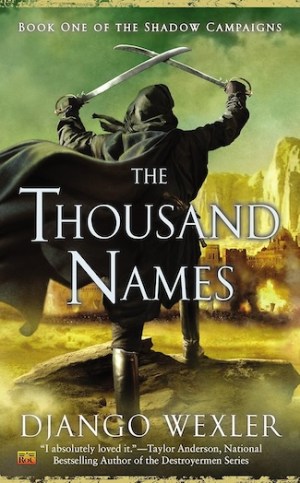 One of my most anticipated debuts of the year – flawed, but does not disappoint overall
Captain Marcus d’Ivoire, commander of one of the Vordanai empire’s colonial garrisons, was resigned to serving out his days in a sleepy, remote outpost. But that was before a rebellion upended his life. And once the powder smoke settled, he was left in charge of a demoralized force clinging tenuously to a small fortress at the edge of the desert.
To flee from her past, Winter Ihernglass masqueraded as a man and enlisted as a ranker in the Vordanai Colonials, hoping only to avoid notice. But when chance sees her promoted to command, she must win the hearts of her men and lead them into battle against impossible odds.
The fates of both these soldiers and all the men they lead depend on the newly arrived Colonel Janus bet Vhalnich, who has been sent by the ailing king to restore order. His military genius seems to know no bounds, and under his command, Marcus and Winter can feel the tide turning. But their allegiance will be tested as they begin to suspect that the enigmatic Janus’s ambitions extend beyond the battlefield and into the realm of the supernatural—a realm with the power to ignite a meteoric rise, reshape the known world, and change the lives of everyone in its path.
I first heard about this novel what feels like ages ago. As is usual for me, I was impatient to read it, but then ended up taking my sweet time getting around to it. It was worth the wait, though, and I think Django Wexler is definitely an author to watch. As with many highly-anticipated novels, I struggled to review it (I finished it well over a week ago). There are lots of things I would like to discuss, but they would be spoilers. There are some nitpicks that feel overly nitpicky (easy to spot in the review). So, I’m keeping this relatively short. The Thousand Names has some minor flaws, but it is nevertheless an ambitious, well-written opening act. I can’t wait for book two, and I think most readers will feel likewise after reading this. Continue reading
TV: “Downton Abbey” Season 1
 Finally watched it…
Set in England in the years leading up to the First World War, Downton Abbey tells the story of a complicated community. The house has been home to the Crawley family for many generations, but it is also where their servants live, and plan, and dream, and they are as fiercely jealous of their rank as anyone. Some of them are loyal to the family and committed to Downton as a way of life, others are moving through, on the look out for betterment or love or just adventure. The difference is that they know so many of the secrets of the family, while the family know so few of theirs. But for all the passions that rage beneath the surface, this is a secure world, serene and ordered, and, at first glance, it seems it will last forever. Little do they know, family or staff, that the clouds of the conflict that will change everything are already gathering over their heads.
So, I haven’t owned a TV for many years. Instead, I’ve relied on DVDs, iTunes, and friends. Coupled with my peripatetic existence, I managed to miss Downton Abbey entirely. When I was in Los Angeles in September 2011, though, the show cleaned up at seemingly every awards show. Despite being somewhat intrigued, it took me until now to actually get around to watching it. And, I must say, I really enjoyed it. I had no idea really what to expect – I have never been particularly smitten with British period dramas (while still watching plenty), and expected More Of The Same. Instead, I got one of the best acted, best-written TV shows I’ve seen in a good long while.
I’m not really sure the series needs a full review, but I just wanted to give it a little shout-out on the blog. This is really good. And Maggie Smith really is That. Awesome throughout. So many hilarious, inappropriate lines from the grand dame of the family. All of the actors in the show were superb, from the Crawley family members on down to the new scullery maid. Even the peripheral and bit-parts are written and acted superbly.
Despite all of this, I still can’t tell quite why it’s taken the United States by storm – or, at least, as much as it has. It is very British. Which is probably why I love it, and I’m sure a fair few Americans love it for the same reason, but the universal acclaim seems unusual. If it keeps the show going, however, I am all for it. I will have to order the next two seasons, to be ready for season four…
Guest Review: PROMETHEAN SUN by Nick Kyme (Black Library)
 Reviewed by Abhinav
The Horus Heresy series has proven to be rather spectacular, right from the very beginning with Dan Abnett’s game-changing opener, Horus Rising. As an exploration of the entire origin-mythos that defines the Warhammer 40,000 setting, the series has done well in exposing how this galactic civil war happened, and how all the players reacted to it, each in their own way. Being a multi-author series (projected to go on to roughly 50 full novels and anthologies, plus additional novellas, short stories and audio dramas), the quality hasn’t been entirely consistent, and there have been some let-downs, or books that don’t seem to fit into an ongoing arc.
Two years ago, Black Library changed the game once more, by offering direct exclusive limited-edition novellas set as interstitials within the larger narrative at work. Being limited to a select few thousand copies, these hardback stories with extra content (such as special faux-skin and illustrations) gave way to a lot of controversy with regards to pricing for the series. This was compounded last year by the publisher’s inexplicable decision to change formats mid-series and offer books in hardback and hardback-sized trade paperbacks before the regular and familiar mass market copies were made available.
As such, novellas like Promethean Sun and Brotherhood of the Storm among others have had to field quite a bit of negative criticism completely unrelated to the actual fictional content within. And that’s what I wanted to focus on in this review. Promethean Sun was re-released a few weeks ago as a non-limited hardback with an accompanying eBook, which is what I got. The two-year wait in between definitely didn’t hurt my enthusiasm.
So, on to the review itself. Here’s the synopsis…
As the Great Crusade sweeps across the galaxy, the forces of the Imperium encounter a world held in thrall by the alien eldar. While the Iron Hands of Ferrus Manus and Mortarion’s Death Guard battle against the hated xenos, it is the Salamanders who brave the deepest and most deadly jungles, encountering monstrous reptilian beasts and foul witchery along the way. Ultimately, it falls to their primarch Vulkan himself to thwart the sinister designs of the eldar, if the Legions are to liberate this world and bring illumination to its inhabitants.
Promethean Sun does one thing really, really well: it delves deeply into Vulkan’s psyche and explores his character through the present and the past alike. That’s what the entire story is about. The Primarch of the Salamanders Legion has been a fairly unknown quantity so far, outside of extremely brief cameos in other stories, most notably Graham McNeill’s Fulgrim, if I recall correctly, and so it was great to finally see more of him. Continue reading
Quick Review: BATMAN #20-21, Annual #2 (DC Comics)

Writer: Scott Snyder | Artist: Greg Capullo | Inks: Danny Miki | Colors: FCO Plascencia
Witness The New 52 origin of The Dark Knight in BATMAN: ZERO YEAR! Twists and turns are around every corner as Bruce Wayne takes the final steps toward his destiny! And in the backup story, learn more about how different Gotham City was at this dangerous point in time.
The second chapter of “Zero Year” delves into Bruce Wayne’s past with the Red Hood Gang and his run-ins with aspiring District Attorney Harvey Dent! And in the backup story, a secret moment from Bruce’s training abroad is revealed for the first time!

Covers & Best Variants for #21-22
These three issues comprise the beginning of a new, larger Batman story-arc. I thought I’d pick up with my comics reviewing, again, and this seemed like a perfect place to start. This storyline, “Zero Year”, focuses on Bruce Wayne’s evolution into the Batman. “Wait, hasn’t this been done before?” you may ask. Well, yes, it has. But Scott Snyder seems to have decided to go even further back, and take a little more time investigating Bruce’s change and development of the idea of the Batman.
Scott Snyder did a great job with “Death of the Family” (despite that going on just a teensy bit too long), so I was looking forward to seeing how he would approach the origin and evolution period of Batman. So far, on the strength of these two issues, he’s doing a great job, and I look forward to seeing how the story unfolds.

The first of these issues starts off with what appears to be a dystopian Gotham City, not dissimilar to a post-apocalyptic New York (think of NYC in the I Am Legend movie), overrun by thugs. I hadn’t expected that. (See images, above.) The story then jumps to a different time, leaving all of my questions unanswered. We learn that Bruce has only been back in Gotham for a few weeks, and Alfred is struggling to understand and accept his ward’s approach to cleaning up the city. Bruce’s Uncle Philip Kane has tracked him down, though, and wants his nephew to take over Wayne Enterprises. Which, of course, Bruce doesn’t want to do. He’s waging his battle against the Red Hood Gang (doing some pretty crazy stunts), which I last read about in Alan Moore’s The Killing Joke.

In issues #21-22, the story is really only being developed. Bruce is outed by his uncle, Alfred is pushing him to come out of the shadows, to revive the Wayne name and status, and to honour his parents’ legacy and memory. Bruce meets Edward Nygma. And that’s about it, really. A bit tricky to really say much more, as we’re still only seeing the opening moves in a much larger storyline. There will be some cross-over into the other Bat-Family titles, too.
These two issues are pretty good, it’s true, but I think we’re still way too early to be able to write much more than that. As can be expected, the artwork is also top-notch, and I had no complaints in that department at all.
 Annual #2:
Story: Scott Snyder & Marguerite Bennett | Writer: Marguerite Bennett | Art: Wes Craig | Inks: Craig Yeung, Drew Geraci, Wes Craig, Jack Purcell, Sandu Florea, Marc Deering | Colours: Ian Hannin
A special “ZERO YEAR” tie-in! Bruce Wayne’s first year as the Dark Knight has just barely begun…and already dangerous elements are coalescing, leading Bruce toward his final destiny.
Despite broadcasting on the cover that this is connected to “Zero Year”, it isn’t, really. There is some mention of Bruce’s early days as a vigilante, as he broke into Arkham Asylum and bumped into the Anchoress. That being said, this is a really good issue – at just six pages longer than a normal issue, I’m not sure it justified its higher price-tag, but I think Bennett (a protégé of sorts of Synder’s) does a great job with the characters and story. Batman has been invited to test the security of an all-new, super-high-tech wing of the Asylum, which is intended to hold the worst of the worst. Unfortunately for Bats, the Anchoress blames him for Arkham’s change in purpose (it really did used to be focused on curing and treating the inmates, rather than merely incarcerating them).

A solid issue, and certainly well-worth reading, but don’t be fooled by the mentions of “Zero Year”. It is tangentially connected, and not in a way that will be essential to the overall storyline. (Unless something weird happens later, I suppose…) I certainly look forward to reading more by Bennett.

