Guest Post: “How Did I Come To Write ‘What Makes This Book So Great?’” by Jo Walton

WaltonJ-WhatMakesThisBookSoGreatJo Walton is a prolific writer and reviewer of speculative fiction and more. One of her newest titles is a collection of essays, adapted from her work for Tor.com, What Makes This Book So Great? Here, Walton addresses how the book came about.

*

The answer to the question “How did I come to write this book?” is that I didn’t. I never wrote it. I wrote a series of blog posts for Tor.com – hundreds and hundreds of them. In all of them I was burbling about books and the way people read. My brief on the blog is to say interesting things about books nobody else has thought about for ages. I read very fast, and I do re-read a lot. I read new things too, but I also enjoy re-reading – and the first thing I ever wrote for Tor.com was the first essay in the book about why I like to re-read. So I re-read old favourites and shared my enthusiasm about them, and along the way I examined some questions about what happens when you re-read a book and don’t enjoy it any more, and the question of why people love reading series. It was exciting to be able to draw people’s attention to books I love that seem neglected or under-rated, like Karl Schroeder’s Lady of Mazes and Terri Windling’s The Wood Wife. I had a lot of fun writing the posts and starting conversations.

WaltonJ-Schroeder&Windling

But all this was blogging, not writing a book. I didn’t think of the posts as the kind of thing that could be published in book form until Patrick Nielsen Hayden suggested that they could be. He and Teresa Nielsen Hayden came up to Montreal for a weekend and the three of us sat down together with a huge pile of printout of all my posts to select a representative and interesting sample to make into a book. We made a lot of selection decisions and also decided to keep the posts chronological, instead of organizing them by some other principle. Doing that selection was hard work but also a lot of fun. So I feel as if I wrote the posts and then assembled the book, but not that I really wrote the book, certainly not in the way I write fiction.

This isn’t a book of reviews – reviews are immediate reactions to new books, and by the nature of things a reviewer is going to feel negative about some of what they’re given to review. These are not first thoughts on books but second thoughts, thoughts after reflection. But I’ve also been a little disconcerted at people referring to it as a book of criticism. I don’t feel as if it’s that at all. Criticism is the kind of thing Gary Wolfe and Farah Mendlesohn and John Clute do – you have to be trained to do criticism. There are people writing wonderful SF criticism these days. It’s part of an academic conversation. This book is much more part of a fannish conversation. My qualification for writing these posts isn’t that I write fiction, it’s that I love reading. I’m not considering things objectively. I haven’t read secondary literature. This is a book of my thoughts about books. It’s  saying “This thing, this thing is interesting and important and this is why I love it – and you might love it too!”

Most of the books discussed are SF and fantasy, because I love SF and fantasy, and because that’s the main focus of Tor.com. But I read widely, and so though there are occasional pieces about other things, George Eliot and Dorothy Sayers and so on, but always with a genre sensibility. And despite what it says on the cover, they’re not all classics by any means. This isn’t an attempt at a history of genre fiction or a survey of the highlights or anything of that kind. It is what it says in the title – me explaining what, in my opinion, makes them so great.

***

What Makes This Books So Great is published today by Corsair Books in the UK. Here’s what Patrick Neilsen Hayden, a senior editor at Tor Books, had to say about the volume’s content, in the announcement on Tor.com:

Included are discussions of books by authors ranging from Vernor Vinge, Robert A. Heinlein, and Jerry Pournelle, to Ursula K. Le Guin, Connie Willis, and Susanna Clarke. Several long series get examined in strings of essays; in particular, Jo re-reads and discusses all of Lois McMaster Bujold’s “Miles Vorkosigan” novels, and all of Steven Brust’s “Vlad Taltos” books, in long multi-part considerations. There are examinations of books you’ve never heard of; there’s at least one essay about a book I’d never heard of. There are insightful and (sometimes) irreverent looks at established classics… and several sharp looks at why and how certain works of the sort that George Orwell called “first-rate second-rate books”… are sometimes exactly what we want to re-read. Taken together, the 130 essays in What Makes This Book So Great are a wonderful immersion in the mind of Jo Walton and a fantastic set of insights into what makes SF and fantasy tick.

*

In related news, Jo Walton’s Small Change trilogy – FARTHING, HA’PENNY, and HALF A CROWN – are to be re-issued in paperback by Corsair in February 2014. Expect reviews of them in the not-too-distant future here on Civilian Reader. In the meantime, here are the synopsis for book one and three new covers…

Eight years after they overthrew Churchill and led Britain into a separate peace with Hitler, the upper-crust families of the “Farthing set” are gathered for a weekend retreat. Among them is estranged Farthing scion Lucy Kahn, who can’t understand why her and her husband David’s presence was so forcefully requested. Then the country-house idyll is interrupted when the eminent Sir James Thirkie is found murdered – with a yellow Star of David pinned to his chest.

Lucy begins to realize that her Jewish husband is about to be framed for the crime – an outcome that would be convenient for altogether too many of the various political machinations underway in Parliament in the coming week. But whoever’s behind the murder, and the frame-up, didn’t reckon on the principal investigator from Scotland Yard being a man with very private reasons for sympathizing with outcasts and underdogs – and prone to look beyond the obvious as a result.

As the trap slowly shuts on Lucy and David, they begin to see a way out – a way fraught with peril in a darkening world.

All three novels are already available as eBooks (and Farthing is at a real bargain-price on Amazon, at the time of writing).

WaltonJ-SmallChangeTrilogy2014

Guest Post: “Influences & Inspirations” by Robert Bailey

Robert Bailey is the author of THE PROFESSOR, a legal thriller to be published by Exhibit A Books late January 2014.

BaileyR-TheProfessor-2014I was born from a family of storytellers and teachers. My mother taught English and reading, and my grandmother, a math teacher, was never without a book to read. My father, though a builder by trade, can still hold a room captive with his stories and jokes, and, as a little boy, I was always on the edge of my chair when he would rasp on about Coach Paul “Bear” Bryant and the legends that played football for the Crimson Tide.

As far as writers, John Steinbeck was a major early influence. As a kid, I loved his shorter novels, The Red Pony and The Pearl. As a high school sophomore, we studied The Grapes of Wrath, and Tom Joad remains one of my favorite characters in all of literature. As a southerner and an Alabamian that grew up to be a lawyer, To Kill a Mockingbird holds a special place. I think every lawyer wants to grow up to be Atticus Finch, and the story just had everything. It was thrilling, historical, funny and tragic. Just a remarkable achievement.

Later in high school and early college, I became enraptured with John Grisham, and loved Jack Brigance in A Time to Kill and Mitch McDeere in The Firm. I think it was these Grisham stories that really made me want to give writing a shot. Other writers that have been great influences are Greg Iles (I love the Penn Cage series starting with The Quiet Game), Michael Connelly (It doesn’t get much better than the Harry Bosch series), John Sandford, Lee Child, Winston Groom, Stephen King, Dean Koontz and Mark Childress.

When I decided I wanted to write The Professor, I picked up Stephen King’s memoir, On Writing, and have probably read it at least three times. Not only is it entertaining, but King’s insights on the writing process are insightful and inspiring. I would recommend it for any aspiring writer.

Finally, my time at the University of Alabama School of Law in Tuscaloosa certainly influenced The Professor. In fact, the idea for the story was hatched while day dreaming in class and wondering whether my professors could still try a case after years in the classroom.

Guest Post: “Confessions of a Four-Color, Benday-Dot, Super-Deformed, Ultra-Compressed Science Fiction Writer” by Paul di Filippo

DiFilippo-WikiWorld

Paul Di Filippo is the author of Wikiworld, a great science fiction short story collection, which was recently published by (now award-winning) ChiZine. To celebrate the release of his new book, he has written the following piece about comics and their relationship with literature, and his own experiences as a reader and writer…

***

My first reading, beyond the typical picture books of my era, such as Harry the Dirty Dog and Hop on Pop, consisted of comic books. Lots and lots of comics. I recall the very first comic I ever read, in 1961, in the summer between first and second grades. It was Mighty Mouse in Outer Space, and it blew my primitive juvenile brain to flinders. (I recently tracked down a copy on eBay, and had lots of fun revisiting it.) I’ve never been the same since. You might very well say that this comic was my first introduction to the literature of fantastika, and set me on the course to becoming a writer of same.

DiFilippo-EarlyComics

After this soon came the hard stuff. Batman, Superman, and the strange new antiheroes from Marvel. Alas, though I read them fresh off the drugstore stands, I retain no issues of Fantastic Four #1 or Amazing Fantasy #15, or similar lucrative titles. I concentrated on buying DC, while my pal Stephen covered the Marvel stuff, and we shared issues for mutual reading pleasure. Stephen, wherever he may be these days, got rich, and I got Lois Lane #53.

This phase of my readerly life lasted until about 1965, when I discovered hardcore adult science fiction, in the form of Raymond Jones’s The Year When Stardust Fell. To my retrospective amazement, I dropped comics almost entirely then, like a fickle lover, in favor of this new, more complex, more satisfying medium. Part of it had to do with my limited allowance. A dollar per week bought seven or eight comics, or two paperbacks. I couldn’t do both.

Well, I’m not going to recap my entire life as a reader from that point on. (To dispel one mystery: I returned to reading comics about thirty years later, with a vengeance.) But I tell the tale only to illustrate a very common path for my generation and the next couple after it. Right up into, oh, the late 1980s, this route — comics first, then books — was totally archetypical. Young fanboys and fangirls imprinted first on comics, then matured into readers of “chapter books.”

But we all know what happened next: the greying of the comics audience, the vanishing of comics from drugstores and supermarkets, the lack of innocent entry-level comics titles, the peer popularity of YA books, etc., etc. — all these factors and more have caused comics no longer to be really a gateway drug. And in fact, comics fandom and book fandom, while overlapping to some small Venn-diagram degree, often are utterly ignorant of each other. (This of course was not always the case, as modern comics fandom arose almost entirely from within SF fandom.)

One important thing which I think this change in reading patterns has caused to go missing from modern SF/F/H writing is a certain comic book sensibility: in plotting, character development, scene-setting, theme presentation, and all the other typical aspects of fiction construction. Because, you see, comics have their own tools of storytelling, and a writer does not fully internalize them unless he or she encounters them at a young, receptive age.

Let me clarify that I’m not talking about a dearth of novels about superheroes. Those are actually kind of trendy right now.

I’m talking about bringing the unique toolkit of comic book storytelling to any kind of writing at all. It could be a mainstream humorous novel, or a historical novel, or, in my case, an SF novel. Not many people are doing that these days.

Maybe you’re old enough to recall when writers such as Thomas Pynchon or Robert Sheckley or Kurt Vonnegut got labeled as “too comic-booky.” It was a fair cop! They were, I am certain, all readers of comics in their youth, and were incorporating the methods they had internalized into their adult prose.

I can’t conduct a seminar in this limited space about all the techniques I discern as originating among comic book writers and artists. I can only give a couple of examples.

Take the matter of switching scenery. Everyone knows how quickly and radically a comic book story can jump from one panel to another. We’ll call this the “then… Korea!” trick, from a recent blog post by the comics savant Mike Sterling. I don’t see this enough in novels. Oh, yeah, we’ll have a jump, an ellipsis of time and space, but usually to a different character, or as a predictable linear progression of the protagonist’s actions. “The next day dawned…” Nothing wild-eyed or unexpected, like catapulting the hero instantly from one venue to another in the blink of an eye.

Or take the matter of shifting the focus of the story in unexpected ways. The Simpsons TV show is the master of this. (Animated cartoons of course being the sibling to comics.) Three minutes into an episode, you think you knew where it’s headed, then, whammo, a total one-eighty. How often have you seen that maneuver in a book?

Or consider serial plotting within a single book. We start with one crisis which is resolved partway through the book, but contains the seeds of the next crisis, and so on as long as desired, until by novel’s end you’re utterly removed from the concerns at the beginning. I can’t even summon up a prose example of this common comics scenario.

If I had to adduce other writers than those named above who follow a comic book esthetic, I’d nominate A.E. van Vogt, Philip K. Dick, and Ron Goulart. Maybe you can start to get a feel now for the type of fiction I’m advocating. Jonathan Lethem, famously a comic book kid, in his early novels manifested some of these chops and riffs. Perhaps the purest and most satisfying writer of such stuff today is my pal Rudy Rucker. His novels are comic books without the artwork. And that certainly doesn’t preclude him tackling serious and important subjects in sophisticated ways.

In my own fiction, I can point to several stories deliberately constructed along these lines. “Fractal Paisleys”; “The Double Felix”; “Flying the Flannel.” And so forth.

DiFilippo-WikiWorld

My newest collection, Wikiworld, holds a few. My all-robot story “Providence” is a homage to the great SF comics from EC. You can picture Wally Wood or Al Williamson art to go with it. “Return to the 20th Century” is more out of DC’s goofy Silver Age Mystery in Space or Strange Adventures line. But even other stories of mine that are not so heavily influenced have benefitted, I believe, by little salient comic book touches.

I said I returned to reading comics with high intensity about twenty years ago. The superhero stuff I enjoy these days is entertaining, but can’t really teach me anything new. But knockout creators like Richard Sala, Dan Clowes, Chris Ware, Jaime and Gilbert Hernandez, Ben Katchor, Cathy Malkasian and Bill Griffith continue to stimulate me to try to incorporate their specialist pencil-and-ink and word-balloon techniques into my prose fiction.

If you’re exclusively a prose writer, you should delve into the comics scene. Once you go lowbrow, you never go back!

Guest Post: “It’s the End of the World — Bring Charmin” by Gail Z. Martin

MartinGZ-DaysOfTheDead

In the post-apocalyptic TV show “Revolution,” one of the characters, a former Google executive, says, “80 million dollars in the bank and I would trade it all right now for a roll of Charmin.” Of all the things that society has lost, at that moment, he misses commercially-produced toilet paper. It’s the little things that count.

I write the Ascendant Kingdoms Saga, a post-apocalyptic medieval epic fantasy series, for Orbit Books. In Ice Forged, the first book in the series, my characters have to come to terms with what they’ve lost, both big and small. Oddly enough, sometimes it’s the small things that matter the most.

Epic fantasy usually deals with the sweeping repercussions of events and decisions — the wars, assassinations, dynastic conflicts and economic collapses that change the balance of power. Certainly anything worthy of being called an apocalypse affects the superstructure of society: government, commerce, economics, and technology. Add in plague and natural disaster and a nation, continent or kingdom loses a significant portion of its workforce, its intellectual capital, its history and its physical infrastructure. Those losses are guaranteed to change what daily life is like for the survivors, and to make just getting by much more difficult.

Martin,GZ-IceForgedYet for individuals — whether real people or book characters — sometimes the big losses seem distant and abstract and it’s the small losses that drive home just how much life has changed and what is gone. In Ice Forged, characters mention what they miss, little things like memories of how holidays were celebrated and favourite foods that are now difficult or impossible to get. Perhaps it’s the realization that the landmarks — like a castle or the main street of a city—that seemed immutable are now ruined. It’s the dislocation of war and cataclysm that causes long-time neighbours to go missing, and the people you always met in the course of your daily life to vanish. Or it’s discovering that with crops unplanted or unharvested and distilleries and vineyards ruined, there’s not going to be any new good wine, ale or whiskey any time soon.

When the means of production are destroyed, whether those are craftsmen or factories, the goods in existence are all the goods there will be until manufacturing is restored. For the characters in Ice Forged, that means any goods they can’t grow themselves or create from raw materials. Not only will there be no new brocades or silks (and nowhere to wear them), but no new metals or coal mined, no imported goods until trade is restored, and nothing that someone might have purchased rather than making. Things like sugar and salt, maybe even lumber and clay become difficult to find. Looting the ruins and the trash heaps becomes the new form of shopping. And in a million little ways, life becomes strange and hard.

In Ice Forged, the devastation of the Cataclysm goes beyond physical destruction. Mages on both sides made a doomsday strike using magic, and unintentionally destroyed the bonds that allowed men to tame magic and use it to their purposes. For a culture that depended on the little magics for everyday life, that means no healers, no using magic to keep pests out of the crops or strengthen a sea wall, no way to keep milk from spoiling or food from rotting or all the hundreds of small ways that people had come to rely on a flicker of power here and there. And after four centuries of using magic as part of everyday life, few people remember how to do things the old way.

In The Hitchhiker’s Guide to the Galaxy, Douglas Adams advised readers to “Always know where your towel is.” Perhaps he should have included some Charmin, just in case?

***

Martin,GZ-ReignOfAshCome check out all the free excerpts, book giveaways and other goodies that are part of my Days of the Dead blog tour! Trick-or-Treat you way through more than 30 partner sites where you’ll find brand new interviews, freebies and more.

Ice Forged will be a Kindle Daily Deal with a special one-day price of just $1.99 only on October 31!

Reign of Ash, book two in the Ascendant Kingdoms Saga launches in April, 2014 from Orbit Books.

***

About the author: Gail Z. Martin is the author of Ice Forged in The Ascendant Kingdoms Saga and the upcoming Reign of Ash (Orbit Books, 2014), plus The Chronicles of The Necromancer series (The Summoner, The Blood King, Dark Haven & Dark Lady’s Chosen) from Solaris Books, and The Fallen Kings Cycle (The Sworn and The Dread) from Orbit Books. In 2014, Gail launches a new urban fantasy novel, Deadly Curiosities, from Solaris Books. She is also the author of two series of ebook short stories: The Jonmarc Vahanian Adventures and the Deadly Curiosities Adventures. Be sure to check out Gail’s website and follow her on Twitter and Facebook for more up-to-date news. Gail can also be found at the Disquieting Visions blog and on the Ghost In The Machine Podcast.

Guest Post: “The Delphi Room – Through the Looking-Glass” by Melia McClure

McClureM-DelphiRoomIn my novel, The Delphi Room, two people watch the past of the other unfold in a mirror. Trapped next door to one another in rooms they believe to be Hell, Velvet and Brinkley are captive audience to the disturbing “home movies” that play in a mirror that hangs in each of their prisons.

Mirrors are compelling symbols and have appeared in various art forms and spiritual texts throughout the ages. The Oracle of Apollo at Delphi, referenced in my book’s title, demanded of ancient Greeks “know thyself” – no small demand, and one which my characters grapple with mightily, in mightily eccentric fashion. Among other things, mirrors have historically symbolized self-knowledge and wisdom, and like the ancients who returned to Delphi again and again in search of answers to the riddles of life, countless numbers of people currently revisit a mirror as a daily reference point in the evolving construction of identity. The Delphic oracle answered seekers’ questions with riddles, and for mirror-gazers the riddles of the mind have a drastic impact on the perception of the confounding entity known as “self” that is reflected in the glass.

In the world of my novel, mirrors are also a means of two totally isolated people coming to understand the forces that have buffeted and shaped the other, and thus – as understanding creates connection – they give rise to Velvet and Brinkley’s growing bond. Mirrors can symbolize parallel universes or alternate realities, and both of my main characters are trapped in a hellish alternate reality while at the same time experiencing the universe of the other. And when, late in the book, Velvet and Brinkley jump into the past of the other through the mirror, rendering the past present, diverse realities are brought together, which alludes to the symbolism of an all-surfaced mirror: that all realities are one and seen and understood from all sides in the context of eternity.

But beyond the literal mirror-as-object, many of the characters themselves play some sort of mirroring role. Velvet’s psychosis, the Shadowman, reflects back to her multiple aspects of her selfhood: self-loathing, fear, creativity, ingenuity and rage. Brinkley’s psychosis, ’20s film starlet Clara Bow, references her tragic personal history – a history shared by the real-life Clara Bow – and in many ways it mirrors Brinkley’s crushingly sad upbringing: both had mentally ill mothers and, among other common experiences, Brinkley’s mother tried to kill him and as a teenager Clara awoke to find her mother holding a butcher knife to her throat. One could argue that Brinkley’s fractured mind chose to conjure that particular illusory movie star as an object of love because he found solace in the kinship of shared tragedy. Again, mirroring fosters connection: people seek their own humanity reflected back at them in the humanity of another – because, after all, humanity is about oneness.

The lives of Velvet and Brinkley mirror each other in many ways: their unstable mothers and absent fathers, along with their mutual obsession with cinema, furnish them with certain overlapping experiences and tendencies, though both characters are fiercely unique and individualistic. But clarity about the self can be harder to achieve than clarity about another, and the need for familial love can have an obfuscating effect, and thus it is through the mirror’s revelation of the past of the other that Velvet and Brinkley come to greater peace within themselves. As much as one’s reflection in a mirror begs the question “Who am I?”, we are all mirrors for each other, asking “Who are you?” and “Who am I to you?” The concept of identity is, of course, central to any conversation about mirrors, and the characters in The Delphi Room are fighting against crippling antagonism to define themselves on their own terms. What they see in the mirror is very different from how the world sees them, and it is in the chasm between those contrasting perceptions that the truth lies. When Brinkley gazes in a mirror, Clara Bow is there to alternately love and torment him; when Velvet gazes in a mirror, the Shadowman is often reflected as a sinister, albeit colourful, presence.

When we stand before a looking-glass, do we ever really know who is looking back at us?

***

Melia McClure’s The Delphi Room was published by ChiZine in September 2013. Be sure to follow the author on Twitter for more updates about her work, etc. You can read a sample of the novel on Tor.com. Here’s the synopsis:

Is it possible to find love after you’ve died and gone to Hell? For oddball misfits Velvet and Brinkley, the answer just might be yes. After Velvet hangs herself and winds up trapped in a bedroom she believes is Hell, she comes in contact with Brinkley, the man trapped next door.

Through mirrors that hang in each of their rooms, these disturbed cinemaphiles watch the past of the other unfold—the dark past that has led to their present circumstances. As their bond grows and they struggle to figure out the tragic puzzles of their lives and deaths, Velvet and Brinkley are in for more surprises. By turns quirky, harrowing, funny and surreal, The Delphi Room explores the nature of reality and the possibilities of love.

Guest Post: “The Magnificent Liar” by Tim Powers

Continuing Tim Powers’s blog tour, I present to you a guest post about the colourful ‘hero’ Edward John Trelawny.

The Magnificent Liar

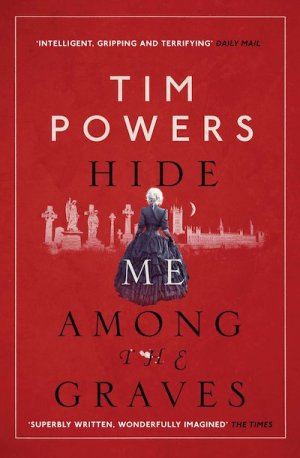
PowersT-HideMeAmongTheGravesUKPBHide Me Among the Graves had a number of colorful characters in it — I can say that with all due modesty, since I cheated and took real people who really lived for characters: Dante Gabriel Rossetti, a genius painter who lost his health and his mind to chloral hydrate addiction; Christina Rossetti, a devout celibate recluse who nevertheless worked face-to-face with London’s prostitutes to reform them and wrote reams of poetry about guilt and reproachful ghosts; and Algernon Swinburne, possibly the best English-language poet since Shelley, who furiously dissipated his gifts with alcohol and sado-masochistic obsessions – but the most fascinating of this circle was a man whose greatest accomplishment was telling lies about his own life.

Edward John Trelawny managed — largely by living a long time – to be a central character in the Italian circle that included Lord Byron and Percy Shelley in the 1820s, and also a prominent figure in the London of the 1860s, a close friend of many of the Pre-Raphaelite painters and poets. The only other figure I can think of right now who did the same kind of era-straddling is Neal Cassady, who was the friend and inspiration of Jack Kerouac and Allan Ginsberg in the 1950s and then, after the Beat phenomenon had petered out, went on to be the same for Ken Kesey and his Merry Pranksters in the late ’60s. Continue reading

Guest Post: “Confessions of a TV Series-aholic (Or, What Writers Can Learn From TV Series)” by Rowena Cory Daniells

Rowena Cory-Daniells discusses her addiction to certain TV series, and how they’ve inspired elements of her own fiction…

I’ve discovered I prefer TV series to movies, series like Boardwalk Empire, Deadwood, House of Cards and now from the UK the Peaky Blinders. (So named because according to some sources they sewed razor blades into the peak of their caps to slash across their enemies’ faces).

PeakyBlinders-CillianMurphy

(Cillian Murphy plays gang leader Thomas Shelby)

If a movie is the equivalent of a short story (Minority Report was a story by the same title by Phillip K. Dick), then a TV series is the equivalent of a book in that a series has time to develop complex story arcs and in-depth characterisation.

BreakingBad-S2

(Breaking Bad: Walt and Jessie taking a break in between cooking crystal meth)

As someone who writes big fat fantasy books, I know the craft involved in creating interesting characters and interweaving narratives. When Walter White first found out he had lung cancer and needed money for his pregnant wife and disabled son, I could appreciate the way the audience were positioned to identify with Walt and sympathise even when he broke the law. We go on his journey with him as we see the roll-on effects of his decision to cook crystal meth. Breaking Bad raised the question: Would you break the law to protect your family?

Raising difficult moral questions makes the viewer/reader ask themselves the same question. In the first book of King Rolen’s Kin, Byren instinctively protects his best friend and this gets him in no end of trouble, but we understand why he did it. We can even like him for it.

Deadwood-8-1080

(Deadwood’s Calamity Jane was nothing like Doris Day).

When my husband said he wanted to watch Deadwood, a western series set in a gold rush town, I wasn’t keen because I immediately thought of the kind of westerns that Hollywood produced in the ’50s or Spaghetti Westerns. But I discovered that Deadwood was probably closer to what the Wild West was really like. With no law other than brute force, society degenerated into dog-eat-dog. Suddenly the rules no longer applied and the survival of characters we liked became a whole lot more challenging.

The art to keep the reader turning the page is to give them flawed, but likeable characters, then put those characters in danger. In King Breaker, Byren faces his greatest challenge yet to win back his father’s kingdom, which is ironic because he never wanted to be king.

HouseOfCardsUS

(Kevin Spacey was in his element playing Frank Underwood)

As we watch House of Cards, we see Frank Underwood manipulate and connive to build himself a powerbase while undermining those around him. If we met him, we’d probably find him charming, but we wouldn’t want to get in his way. Clearly, he loves his wife, played by Robin Wright. At the same time he is an utterly ruthless power broker and we find him fascinating from the safe distance of the television screen. When driven by a hunger for power, people can justify many things.

A strong villain is important for the protagonist to test himself against and Byren knows he must defeat his cousin, Cobalt. Byren starts out trying to do the honourable thing, but as set-backs mount, he must make compromises. What will Byren do to win a throne he does not want and will the journey corrupt the man?

Daniells-KingBreaker

The best of TV series deliver interesting characters, caught up in threatening situations which force them to make decisions that test their morality. I hope readers find Byren’s dilemmas as compelling as I did while writing King Breaker.

***

Rowena Cory Daniells’s King Breaker is published by Solaris Books, and is available now. Here’s the synopsis:

THE CONCLUSION TO THE HUGELY POPULAR KING ROLEN’S KIN SERIES!

The story of Byron, Fyn and Piro picks up immediately where the cliff-hanging ending of The Usurper let off!

When Cobalt stole the Rolencian throne, Byren, Fyn and Piro were lucky to escape with their lives; now they’ve rallied, and will set out to avenge their parents’ murder.

Byren is driven to defeat Cobalt and reclaim the crown, but at what cost? Fyn has sworn to serve Byren’s interests but his loyalty is tested when he realises he loves Byren’s betrothed. And Piro never wanted to win a throne, but now she holds the fate of a people in her hands.

Guest Post: “Don’t Build Worlds on Your Doorstep” by Geoff Gudgion

GudgionG-SaxonsBaneEvery novelist, in every genre, builds worlds. Mine aren’t on a distant galaxy but close to home, perhaps a little too close to home. I like to ground the reader in a world that they’ll recognise, then tilt the board slightly so that as the menace emerges they think, “This could happen to me.” It seems, though, that not everyone is happy with this twisting of rules they hold dear.

In Saxon’s Bane, I started by creating an English village that could trace is foundation to a Saxon warlord, Aegl. Back then, there were deer and boar to hunt in the woods, fresh water in the stream, and the ground would be fertile. It was a place for Aegl to ground his spear and plant his generations. Allingley was founded.

“Where is Allingley?” I’m sometimes asked. Readers seem to finish the book knowing the place, and want to go there. They’re disappointed when I tell them it’s imaginary. World-building comes easier to me, you see, when I take elements that I know and blend them into something fresh. The scent of an otherness, for example, in the depths of an ancient wood. Even the old language is recognisable in the traces of Anglo-Saxon that linger in modern English. Allingley would have been Aegl-ingas-leah in Anglo-Saxon, the clearing of Aegl’s people. I can also borrow from established legend, in this case the warrior Aegl or Egil and his wife Olrun, the Swan Maiden. I brought their story to life in this sleepy village on the banks of the Swanbourne, where, nearly one and a half millennia later, the peat-preserved body of a ritually-slaughtered Saxon warrior is uncovered.

World-building from legend and folklore also allows me to weave threads of reality or literature into the plot, for example the Old Norse epic poem Hávamál, when the God Odin talks of the power of runes:

Ef ek sé a tré uppi váfa virgilná,
Svá ek rist ok i rúnum fák,
At sá gengr gumi ok mælir viđ mik.

If I see a corpse hanging in a tree
I can carve and colour the runes
So that the man can walk and talk with me.

Runes are a rich source material, both as script and faith-laden symbols. I’m not a pagan, but I’ve always been fascinated by the old faiths, when people lived close to their gods, at one with nature rather than being given dominion over nature. I created a character in Saxon’s Bane, a fresh-faced, bright-eyed young pagan woman, who is part of a tradition of healers that has survived in this remote area despite the witch-finding pogroms of King James. I think by the end of the book I was a little in love with her. I researched pagan traditions and crafted a belief system around her that I called the ‘Old Way’. She is a counterbalance to an archaeologist who becomes obsessed with her project, and who doubts her sanity as she struggles to reconcile her academic discipline with her growing, preternatural understanding. Their story unfolds through the eyes of a car crash survivor, a man on his own journey to healing, who does not know whether what he saw at the edge of death was real or a product of his own traumatised mind.

So far, so good. My world-building rang true. I had a location, I had characters, I had the catalyst for a plot. I could start to bring the Dark Ages to life in present-day England, but always keeping to my principle of plausibility; a car that crashes as it swerves to avoid a stag, for example, and the discovery of a stag tattoo on the peat-preserved forehead of the Saxon warrior.

I find there’s a risk in making worlds too plausible. If you write on the principle of letting the reader think ‘that could be me’, it’s a short step to the reader thinking ‘that is me’. There’s a character in the book who finds the ‘Old Way’ too mild, and who experiments with some seriously nasty ideas of his own. As the past begins to echo in the present, he comes to believe in his own power and slides from reprobate to psychopath. All too plausible, apparently, for one practicing Wiccan. There’s an emotional rant on Goodreads from someone who is “nauseated” at the suggestion that any follower of the Horned God could be anything other than sweetness and light.

Oops. It seems I’ve blundered across someone else’s world. Perhaps I’d better start building a little further away. Gallifrey, for example. It might be safer. Meanwhile, I’ll send this off to Civilian Reader before I’m turned into a frog.

*  *  *

Geoff Gudgion is the author of SAXON’S BANE, published by Solaris Books. Here’s the synopsis, to whet your appetite further…

Fergus’ world changes forever the day his car crashes near the remote village of Allingley. Traumatised by his near-death experience, he stays to work at the local stables as he recovers from his injuries. He will discover a gentler pace of life, fall in love – and be targeted for human sacrifice.

Clare Harvey’s life will never be the same either. The young archaeologist’s dream find – the peat-preserved body of a Saxon warrior – is giving her nightmares. She can tell that the warrior was ritually murdered, and that the partial skeleton lying nearby is that of a young woman. and their tragic story is unfolding in her head every time she goes to sleep. Fergus discovers that his crash is linked to the excavation, and that the countryside harbours some dark secrets. as Clare’s investigation reveals the full horror of a Dark age war crime, Fergus and Clare seem destined to share the Saxon couple’s bloody fate.

Guest Post: “The Shy Hero” by Steve Tem

TemSR-CelestialInventoriesI read my first critical work on short stories back in high school, around 1965 or ’66. It was The Lonely Voice by Frank O’Connor. To say it had a profound influence on me is an understatement. Starting with a discussion of Gogol’s “The Overcoat,” the story of a friendless nonentity, an absurd take on a little man, O’Connor develops his theory concerning the difference between short stories and novels. According to O’Connor, one of the key aspects of the novel form is that there is always a character the reader can identify with, and a context that includes the concept of a normal society. Short stories, on the other hand, involve characters who are outcasts, members of submerged populations, characters who readers cannot identify with.

Even that early in my thinking about writing I thought the idea had its limitations, but it still fascinated me, and I thought there were some strong hints in O’Connor’s theory that might help me understand the relative levels and kinds of reader participation that differentiated the novel experience from the short story experience. I eventually wrote my own horrific nod to “The Overcoat” — it appeared in my first collection, City Fishing.

As the years have passed I’ve come to understand that there are almost as many models of what a short story is as there are writers writing them. The short story form truly is a kind of fiction laboratory, allowing you to create brief narratives sometimes from the most arbitrary and unpromising sorts of materials, narratives which really wouldn’t work at any other length. And that concept of the hard-to-identify-with, outcast “hero” is still a recognizable and powerful approach in the short story genre (along with a great many others).

But I view that outcast a little differently these days. For me, a more useful way to look at the outcast is to use words like invisible, forgotten, secretive, under-appreciated, marginalized, even “shy.” These are the people who don’t always speak up, who hide their feelings, who have secret longings, who sometimes have rich imaginations, who sometimes surprise us with their uniqueness. And far from being impossible to identify with. In fact I believe they may be the most universal characters possible. I think most of us feel like these characters at some point or other in our lives, or perhaps they embody a distinctive part of our own personality which seems to have its own voice and narrative arc, and which we find we have to reason with from time to time (or maybe that’s just me). For me, these shy heroes are the direct descendants of the copy clerk in Gogol’s “The Overcoat.”

This does not mean that they are always everyone’s favorite characters. Some readers want characters who take definitive actions, who transform the world, who embody values most of us would want to emulate — in other words, classic heroes. In fact, for some time now the classic hero has been the model for normalcy in fiction. I’ve read articles and watched many panels on characterization in which writers and editors have stated that A) readers want characters they can identify with and B) your main characters should be dynamic, admirable types who take action and speak their minds and make things happen and change the world.

For me there is a discrepancy in these statements. In my experience, most of the people I’ve met haven’t been dynamic and world-changing. For the most part they’ve been quiet people with good intentions who often feel at the mercy of the more powerful forces around and above them — their relatives, their bosses, the government etc. Some of them appear to have secret, complicated inner lives consisting of dreams and great yearnings. Often they don’t get what they yearn for, but they still make a life, they do the best they can. For me these are shy heroes, and they are everywhere around us. Some people find them boring, but I say it’s only because they haven’t looked at them closely enough (and sometimes it requires a writer or other artist to encourage us to look closely enough). Their triumphs may be small, and somewhat compromised, but at least they are triumphs we can believe.

In my experience shy heroes tend to predominate in slipstream, hard-to-classify fiction. And they tend to predominate in my new collection from ChiZine, Celestial Inventories, as well. Two of the stories (“The World Recalled” and the title story) feature main characters obsessed with creating a detailed inventory count of their lives, often with bizarre and moving results. The Bram Stoker Award-winning “In These Final Days of Sales” chronicles the adventures of the world’s worst salesman. Several of the stories deal with strange and elaborate obsessions: in “Origami Bird” it’s constantly folding pages of data into intricate bird-shapes, in “The Disease Artist” it’s a succession of increasingly serious diseases, and in “The Bereavement Photographer” it’s the final images of dead children. Dreams unfulfilled figure into “The High Chair” and “The Secret Flesh.” In “Invisible” an office worker and his wife fade into a literal invisibility. And in “The Company You Keep” a man without friends discovers a secret, tragic bond with an army of strangers. All are private glimpses into the worlds of the shy heroes we pass every day but do not recognize.

Guest Post: “A Commix of Noir & Sequential Art” by Andrez Bergen

Author Andrez Bergen introduces us to his third novel, Who is Killing the Great Capes of Heropa?, and talks about his influences and inspirations.

***

BigSleep-PosterThe first time I saw the 1946 film version of The Big Sleep, I would’ve been about six or seven years of age. My parents were fans – Mum loved Lauren Bacall and my dad aspired to be Humphrey Bogart. With these familial pressures in the mix, at such an impressionable size, of course I was sucked in. Not long later I copped a viewing of the 1941 John Huston vision of The Maltese Falcon, and found myself enamoured with cinematic film-noir years before I even knew what it was.

This affection has been an ongoing affair.

I’ve seen both flicks at least a hundred times apiece, and it translated into the original novels by Raymond Chandler and Dashiell Hammett. That led to poring over still more by these fellows, things like The Long Goodbye, The Thin Man and the Continental Op. I love these yarns, consistently won over – no matter how old I am – by the scathing dialogue, the sarcasm and the oddball characters as much as I am by the “detective mystery” plots involved.

Star-Wars-IV-PosterOn another level there’s always been science fiction, everything from kindergarten days terrified of the Daleks in Doctor Who, through to reruns of classic Star Trek and This Island Earth (1955) in primary school, Blade Runner (1982) in my teens, and Terry Gilliam’s Brazil three years after that. I was smitten with Episode IV when it was just plain Star Wars (1977).

Third cab off the rank is a life-long obsession involving comic books.

I’d say this started when I was learning how to read and my dad subscribed me to British comedy weekly Cor!!, while scouring the pictures gracing Hergé’s Tintin in the local library. Then, again around the age of seven, I was spending summer holidays at my grandparents place in the Melbourne suburb of Richmond. Since my Nan spent so much time cooking and my grandpa was in the living room multitasking with Aussie rules footy on the TV and horseracing on the radio, we were left to our own devices.

In a small shed out the back, covered in old cement sheeting, I uncovered a treasure-trove: silver age Marvel Comics from the 1960s, inside boxes half-eaten by snails and earwigs. These refugees had belonged to my older half-brother Peter, and included Marvel originals of The Fantastic Four, The X-Men and The Avengers – many without covers – along with black-and-white reprints published in British weekly Fantastic.

2000AD-02-FirstDreddAppearanceBy the time I was ten, Melbourne had a mini-renaissance of Marvel reprints via the short-lived Newton Comics imprint, and in 1976-77 I subscribed first to British weekly comic Action (which had sensational, somewhat violent tales like “Hook Jaw” and “Death Race 1999”) and then a title called 2000 AD – the second issue of which introduced Judge Dredd.

And so it goes from there.

This over all mishmash of hardboiled noir, comic books, sci-fi, barely repressed violence, humour and eccentric characters always was going to affect (or should we say infect?) the imagination of an impressionable loner of a kid who wanted nothing more than to grow up to be (a) an astronaut (unlikely since I hated maths), (b) an author, (c) a comic artist, or (d) a film maker.

Funnily enough, despite haphazard attempts to the contrary, I didn’t end up being any of these.

After uni I slipped instead into journalism, I started up a record label, and began producing techno and experimental electronic music under a silly alias named Little Nobody (I still use it occasionally). One of the reasons I moved to Tokyo in 2001 was to pursue this muzak and hack journalism. Oh, and the food too.

But the love of writing fiction, of losing myself in other worlds – and an affection for other people’s noir, sci-fi and comic books, regardless of nationality – has continued to hold steady sway.

No surprise, then, that my first published novel Tobacco-Stained Mountain Goat (2011) was an amalgam of detective noir, dystopian sci-fi, and homage to the cinema of both genres and others as well.

Which brings us (more or less) up to speed, and the publication in September of novel number three: Who is Killing the Great Capes of Heropa? It is a beast of a book that I hope brings the influences full circle. It’s my love-letter not just to noir, pulp and sci-fi, but also to American comic books of the golden and silver ages – basically, 1940-70.

Bergen-WhoIsKillingTheGreatCapesOfHeropa

We are taken into dystopian, near future Melbourne, Australia – the last city on Earth. But we visit this city only fleetingly; most of our time is spent hooked up to an IV drip and electrodes, with our consciousness in a virtual world called Heropa.

As the name of the book implies, this is a murder-mystery of the Sam Spade kind.

Someone is bumping off the Capes (heroes and villains both) for real. There’re leads and red herrings aplenty, undercut by the relationship between members of superhero team the Equalizers – a group that’s seen far better times, has lost its leader, the members squabble a lot, and they rarely trust one another.

Into this fray steps idealistic Jack, a.k.a. Jacob, a.k.a. Southern Cross, forced to come to grips with his oddball, egocentric teammates while tracking down their killer(s).

Within the context of the story lie nods and winks to the great creators.

Not only Chandler and Hammett or Arthur Conan Doyle and Truman Capote, but bigwigs of sequential art and its spiffy yarns, people at Marvel like Jack Kirby, Stan Lee, Roy Thomas, John Buscema, Jim Steranko, Steve Ditko and Barry Windsor-Smith. Other comic book geniuses such as Will Eisner, Jean-Claude Forest, Joe Kubert, Tarpé Mills, Joe Simon, Katsuhiro Otomo and Hergé. Anime gets a shoo-in, even Walt Disney.

And Little Nobody makes a cameo – as a corpse the same size as Ant-Man.

There’re dozens of other references, but I don’t want to give too much of the game away – in spite of the train-spotter’s refs, or perhaps because of them, the novel is my personal salute to these styles I continue to cherish.

And if it succeeds (on a deceptive sliding scale) of achieving a fraction of the nourishment these genres have imparted to me, then I’ll do a self-satisfied George W. Bush aircraft carrier jig wearing a home-made cape cut from a tablecloth, and sign off with “mission accomplished”.

Shhh.