Spotted this on Project: Rooftop, and thought I’d share it on here, too. The piece is by Rahzzah, who also does the art for Moon Girl:

Spotted this on Project: Rooftop, and thought I’d share it on here, too. The piece is by Rahzzah, who also does the art for Moon Girl:
With a number of exciting releases on both sides of the Pond, it looks like 2013 is going to be a very good year for British author Sarah Pinborough.
 First up, and already out in the UK for ages (published by Gollancz in 2010), we have the author’s critically-acclaimed A Matter of Blood will now be hitting shelves in the US.
In a world steeped in darkness, a new breed of evil has fallen…
London’s ruined economy has pushed everyone to the breaking point, and even the police rely on bribes and deals with criminals to survive. Detective Inspector Cass Jones struggles to keep integrity in the police force, but now, two gory cases will test his mettle. A gang hit goes wrong, leaving two schoolboys dead, and a serial killer calling himself the Man of Flies leaves a message on his victims saying “nothing is sacred.”
Then Cass’ brother murders his own family before committing suicide. Cass doesn’t believe his gentle brother did it. Yet when evidence emerges suggesting someone killed all three of them, a prime suspect is found – Cass himself.
Common links emerge in all three cases, but while Cass is finding more questions than answers, the Man of Flies continues to kill…
This is the first novel in Pinborough’s Forgotten Gods series (which I shamefully have not yet read). In the UK, the series title was The Dog-Faced Gods. A Matter of Blood is followed by The Shadow of the Soul (August 2013) and The Chosen Seed (December 2013). As a bonus, here are the three UK covers for the series:

*
 While North Americans will be able to finally get their hands on this trilogy in 2013, Brits will also be treated to Sarah’s latest novel, Mayhem (April 25th, published by Jo Fletcher Books)
When a rotting torso is discovered in the vault of New Scotland Yard, it doesn’t take Dr. Thomas Bond, Police Surgeon, long to realise that there is a second killer at work in the city where, only a few days before, Jack the Ripper brutally murdered two women in one night.
Though just as gruesome, this is the hand of a colder killer, one who lacks Jack’s emotion.
And, as more headless and limbless torsos find their way into the Thames, Dr. Bond becomes obsessed with finding the killer. As his investigations lead him into an unholy alliance, he starts to wonder: is it a man who has brought mayhem to the streets of London, or a monster?
This sounds really cool, so I’m going to try to get a review done A.S.A.P.
And finally, Pinborough also has three novellas – Poison (April 18th), Charm (July 18th) and Beauty (October 17th) – coming out this year in the UK, to be published by Gollancz. Here are the complete covers for the three, which have been described as “absolutely superb, fun, mischievous novellas”:

 Writer: Tim Seeley | Artist: Daniel Leister | Colors: Mark Englert
Exploring Cassie Hack’s first case: 16-year-old Cassie has just been forced to kill her mother, the undead murderer known as the Lunch Lady! Now faced with overwhelming guilt, she must decide if she can make a life with her foster parents and at her new school, or if she should use her new-found slasher-killing skills to save other screaming teenagers! But does the apple fall far from the tree?
Collects: Hack/Slash – My First Maniac #1-4 (complete)
I don’t think I’ve read much else by Tim Seeley – maybe a taster for his new run on Witchblade. But, the other day I saw that Hack/Slash has finally come to an end, and decided to give it a try. Image Comics only published the final 25 issues of the series, plus a couple of mini-series spin-offs. Unable to hunt down the pre-Image comics on ComiXology, I decided to pick up this spin-off, dealing with Cassie’s first case. And I rather enjoyed it, in all its bloody, slasher-movie bonkers glory.
I’ve been trying to figure out how to characterise the overall feel I get from this book. A grimdark Buffy? Someone on argued that Buffy was already rather grimdark. So a grimdarker Buffy? Perhaps. I guess the series’ strength is that it can’t so easily be defined. It draws from many strong traditions of slasher-/horror-movies, adds a dollop of dark, dark humour, and spits out something rather original and engaging. It doesn’t shy away from the uglier side of human nature (of any age or social grouping), and Cassie goes through a lot of hell to grow into the monster-hunting/-slaying bad-ass she is at the end.
The series packs a lot into the first issue. But, this doesn’t slow things down at all. Instead, it makes for a substantial, intriguing and gripping introduction to this world. Cassie’s in foster care, and the issue tells of how she came to strike out on her own. The story of the rest of the mini-series develops as she moves around to Buffalo Center, chasing after rumours of a lurker. It’s brutal. It’s visceral. It’s very good.

In Buffalo Center, Cassie connects with a couple of the local in-crowd, one of which helps her develop her goth-chick look. There’s a rumor surrounding an old farm on the edge of town. And kids are going missing… I didn’t predict how the story was going to develop, and there were a couple of interesting surprises sprinkled into the story.

Seeley has injected a good, dark sense of humour into the book. It’s sometimes very dark, but always amusing. It’s not riotous, but I smirked and chuckled a couple times. It’s not exactly deep, but I can certainly see the beginnings of something complex and addictive. Seeley & Co. have created something pretty special and unique, here.
Overall, I enjoyed this quite a bit. The art style is reminiscent of some of Zenescope’s covers and internal art, but the story is much stronger (in some ways, this is more mature – like Buffy meets Eli Roth in a dark alley, before they stumble into a Stephen King novel…). It’s definitely not for kids, or the too-easily scandalised or shocked. But, if you like horror fiction, movies, or comics, especially ones with a self-conscious, knowing sense of humour, then Hack/Slash could be the perfect comic for you.
I’ll definitely be reading more of this – and, in fact, by the time this review goes live, I will have read the first Image collection, “Vol.9 – Torture Prone”.

Original Mini-Series Covers
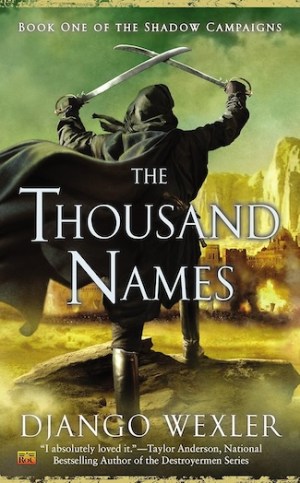 I’ve been trying to remember how I first came across the name Django Wexler. It was probably via Twitter or a publisher’s catalogue. Since finding out about his next novel, The Thousand Names, I’ve had the chance to chat with Mr Wexler a good deal about fiction and more on the Twitters. With just a couple of months to go before the novel hits shelves (one of my most-anticipated novels of 2013), I thought it would be a perfect time to shoot him some questions. He agreed, so here are his responses…
Let’s start with an introduction: Who is Django Wexler?
That sounds kind of existential. Is the correct answer “I am!”?
Excellent, well done. You’ve passed the first test…
So: I’m Django Wexler, fantasy author. Until fairly recently I was Django Wexler, programmer/writer for Microsoft. I grew up in Westchester, NY and went to school at Carnegie Mellon, in Pittsburgh, where I managed to get degrees in Computer Science and Creative Writing. I moved out to Seattle about five years ago to be where the tech jobs are, which is starting to seem a little ironic now that I no longer work in tech. Continue reading
 A Texas Political/Action Thriller
Have you ever wondered how one split-second decision could change your life for ever?
The Bonners are the most powerful couple in Texas. Bode Bonner is the Republican Governor and his wife, Lindsay, is always by his side. From the outside everything looks rosy.
But the Bonners are not happy. Bode is bored – he longs for more excitement in his life. Lindsay is at the end of her tether. She’s had enough of Bode’s womanising and of playing the dutiful wife. She is desperate to break free of her bland, wealthy lifestyle.
Then Lindsay makes an impulsive decision that helps save the life of a poor Hispanic boy. From that moment on, nothing will be the same for the Bonners. Everything is about to change…
I’m a fan of Gimenez’s thrillers. I’ve read a couple of his previous novels, and they struck me as well-paced and addictive thrillers. The Governor’s Wife is no different (I read it in three sittings), and has the quick plotting I remember from his past work. This latest book is a little unusual, though, in that around the half-way mark it seems to change its mind about what sub-genre of thriller it wants to be in… Nevertheless, this is an enjoyable read.
The first half of the novel is a steeped-in-politics, character-driven story. The Governor of Texas, Bode Bonner, is a Rick Perry-type, but with an added dash of Bill Clinton-esque proclivities. In fact, Perry is the only G.O.P. primary candidate not mentioned in the novel, along with T-Paw (Tim Pawlenty to his mum). And there is a lot of mention of the 2012 Republican field of presidential candidates. In fact, this may be the novel with the most politics written into it that I’ve read in a good number of years – more so even than novels I’ve read about murders in Washington, D.C. Politics, and specifically Texas politics are clearly very dear to Gimenez’s heart, and perhaps also a passion of his, as he writes a good number of passages that lay into America’s political polarization and frequent dysfunction. He also takes square aim at the role of money in US politics.
“Bode… You used to be a Democrat when Democrats controlled Texas. Then you switched to Republican when Republicans took over Texas. Now you’re a tea partier because they’re sweeping across Texas. That’s what politicians do, at least the ones who win elections: they ride the wave…. Politics isn’t about what you believe; it’s about winning elections. The tea party is a political opportunity. It’s the wave. Today. But that wave always dies out, and the tea party will, too. And all those middle-class folks will go back to work and church and the PTA and get on with their dull lives out in suburbia and leave politics to the professionals.”
“Which means?”
“Which means the tea party can’t put you or anyone else in the White House. Only the Establishment Republicans have the money for that. The Democrats are going to spend a billion dollars to keep Obama in the White House. Where’s that money coming from? The unemployed middle class? No. It’s coming from Wall Street. Same place Republicans get their campaign money.”
“Money’s the only politics Wall Street knows.”
We’re quickly introduced to Bonner’s character: he sleeps around with his young female aides half his age, and also is entirely self-involved. He’s governor, but not sure why. He’s in it for the thrill of winning, only that’s started to lose its lustre.
He fingered the massive UT college football ring that rode his big right hand like a hood ornament; the memories of football flooded his mind. Sitting in the Governor’s Office and recalling those glorious moments now, Bode couldn’t believe how life had let him down. He leaned back and kicked his size 14-EE hand-made elk skin cowboy boots up onto the desk. He had big feet because he stood six feet four inches tall and carried two hundred and ten pounds, his playing weight. He had blue eyes and good hair. He worked out at the YMCA and ran five miles around the lake every day. He had a working prostate and a valid Viagra prescription. Bode Bonner possessed the strength and stamina and sexual drive to keep up with men half his age. And women. He was still young enough and strong enough and willing enough to live life. He just needed something to do with his life.
“What am I gonna do the next four years?”
“Same thing you did the last four years … Nothing.”
This self-pitying only gets worse:
“Sam Houston thought power should reside in the legislature, so the state constitution provides for a weak executive.”
“Doesn’t provide for much excitement.” Bode shook his head. “I love the guy, but old Sam screwed the pooch on that one. I mean, what the hell is the governor supposed to do for four years? I can’t play golf every day—some days it rains.”
When not discussing Texas and Republican politics, the novel features a lot of information about the “colonias”, those no-man’s-land areas between the Mexican and US border, where poverty and violence are sky-high. After the guided tour of Texan Politics, we are given a tour of this locale, as the Governor’s wife is shown around. Lindsay has decided to do something worthwhile for the state, and has selected this area as her pet project (but not in as shallow a manner as that would sound, nor as shallow as her husband’s decision-making can be). While Bode sits and pouts back in the Governor’s Mansion in Austin, his wife is going to get out there and do something. She effectively disappears from Austin, settles down in the local doctor’s guest house, and grows rather fond of the saintly colonias doctor. Things could get tricky for her and Bode’s political aspirations.
There is an air of desperation to Gimenez’s writing about the state of Texas society, politics and education. There are a number of scenes in which Bode or one of his political colleagues has to consider the state of Texas schools, drop-out rates, incarcerations, executions, poverty, crime, and of course the fact that the great state of Texas is flat broke. (“The only way to save our state is to educate our kids. If we don’t educate them, we’re going to incarcerate them.”) He is even-handed in laying the blame, but given the GOP’s stranglehold on the Lone Star State’s political institutions, much of the fault has to lie with that party. Where the Democrats get dinged is from the national level, and there are a fair few comments about national Democrats, and also President Obama, treating Texas as a Republican opponent, rather than part of the whole United States.
The second half of the novel shakes things up quite a bit. Without delving into the plot details or offering spoilers (of which there could be a great deal), the story morphs into much more of an action movie. A powerful drug-lord in Mexico is roped into the story, after Bode makes a decision to save some kids (yes, that’s vague). Bode has a rather strange religious awakening, late in the novel, which I thought was a bit odd. Perhaps an attempt to have him tick off all of the shallow career-driven politician boxes?
There’s a strain of dark, gallows humour running through the novel – and Gimenez uses it best to highlight how out-of-touch politicians (of both parties) can be.
Things take a turn almost for the excessive as we near the end of the novel (there are surprising deaths, a shoot-out at a popular breakfast spot, a blood feud, and much more). I was expecting something a little less of an action-oriented plot, as a result of the early politics-heavy chapters. That’s not necessarily a bad thing, as I think Gimenez did a good job of handling the shift in pace, and I quickly readjusted my expectations for the escalation in events. I think I just would have preferred more of a political- than action-thriller.
Nevertheless, I read the first 75% in one sitting (I had to eventually go to sleep, though), and quickly polished off the remainder the next day. It’s a very well-paced and tightly written novel. It taps into pretty much everything one could want from a thriller, ticking off a few classic tropes and implementing them into the narrative rather well. The drug lord should have been a cliché, but he didn’t feel like one. The story between Lindsay and the doctor was predictable, but I didn’t mind. Bode’s development as a character was interesting, and overall done rather well.
The Governor’s Wife certainly matches the quality of the author’s previous work, and some may consider it his best. Recommended for thriller fans, and especially those who like a lot of political commentary in their fiction. Which I do. So that worked out very well.
I am sooo looking forward to this movie. Love the character, love the way Hugh Jackman portrays him, and I’ve thoroughly enjoyed all the movies. Roll on July!
 Writer: Joshua Williamson | Artist: Sami Basri | Colors: Jessica Kholinne
Black Razor Agent Fallon has finally tracked down Voodoo and has her cornered! Now it’s time for revenge. But Voodoo knows the truth of her own origins and will decide if she’s going to be a hero – or a villain! Then, Pris is forced to confront exactly what she has become after being experimented on by the Daemonites. She’s offered a deal by the Black Razors… but wherever way she turns, it’s guaranteed more blood will be on her hands.
Collects: Voodoo #7-12 & #0
This book brings the Voodoo series to a close. Given the critical reaction at its start, I’m surprised it lasted as long as it did. I liked the ideas the series included, and it’s a pity it had to end. That being said, some of the chapters in this book felt like the series had been written off.
As the story begins, Pris has escaped from captivity, accompanied by Black Jack and Fallon. Voodoo is on the daemonite ship, facing their Council. She’s told the truth about herself, and the daemonite lord says she has to be captured and reprogrammed. She… disagrees with his assessment of the situation…

The two groups are on a collision course, and by the second chapter, the shit really starts to hit the fan. The chapter (issue #8) was basically one long face-off between Voodoo, Pris and Fallon. All does not go well… Strangely, Pris is offered a job by a dude from the Blackhawks (a series I’ve only read one issue of, but also another that has been axed).
 The rest of the story follows all the various threads of the series being tied up – some in not particularly satisfying manner (there’s some interstellar flight, too). As Pris and Voodoo are trained, almost in parallel, by different forces – Pris by the Blackhawks, Voodoo by Helspont. Pris also discovers that Voodoo worked as a stripper in order to remain below the radar. She is not happy.
In the final chapter, the Zero Issue, we see Priscilla Kitaen’s “birth” on the daemonite ship, before freaking out and fighting her way out. It ends with her being taken into custody by the Black Razors. Then we get Voodoo’s birth as well, as a loyal hybrid. And finally, we join Grifter as his life is saved by Voodoo. I’m not sure it works at all as a “#0”, because it ends on “Continued in Grifter”… Really it’s a series epilogue. It did make me want to catch up on Grifter, though (I’ve read up to #7).

This series crosses over with so many: Superman, Stormwatch, and Grifter. Sometimes these crossovers can be fun or interesting, but when it happens too often, which certainly feels like the case recently (there have been a number of larger, cross-title story-arcs recently). Well, it gets both irritating and expensive… I’m not sure this needed to cross over quite so much. Cameos probably would have sufficed for many scenes and snippets of exposition.
Towards the end of the book, the writing felt a little rushed, but at least it never took itself too seriously. It has a ’80s/’90s action-SF-movie feel to it: it doesn’t all make sense, there are some narrative jumps, etc. The dialogue never quite manages Expendables-levels of cheesy awesome, but that was the vibe I got, sometimes. Not bad, overall, but it’s not too difficult to see why it was sent out to pasture. For the story to really work, it would have required more time and space to properly grow. I think most people will see this was on the outs from early on in this book.
I do like the artwork a lot, though. There are so many nice little details in each issue. I really hope the team are hired on for more of another series.

Original Voodoo Cover Art #7-12 & #0
 Writer: David Finch | Artist: David Finch (#1-4), Jason Fabock (#4-5) | Inks: Scott Williams (#1-3), Richard Friend (#3), Ryan Winn (#4), Batt (#4-5), Sal Regla (#5), Jaime Mendoza (#5), Ray McCarthy (#5), Greg Adams (#5) | Colors: Alex Sinclair (#1-3), Peter Steigerwald (#4-5), Tony Aviña (#5)
Delving into the more supernatural and esoteric areas of Gotham City, the five-part storyline explores the horrific murder of one of Bruce Wayne’s childhood friends… and the terrible ramifications the brutal crime has on Batman’s life.
Collects: Batman: Dark Knight – Golden Dawn #1-5
Just a very quick review. I’d been going back and forth about reading this book for a while, but I eventually bit the bullet and dove in. It was pretty good, but not without its flaws. Overall, if you’re a fan of the darker, weirder and more-supernatural elements of the DCU, then this should suit your tastes.
The synopsis isn’t quite as accurate as it could have been. Batman is on the trail of a missing society girl, Dawn Golden, who he knew as a child. Naturally, Batman gets close to crossing the line (he does a real number on the Penguin). Judging by the first couple of issues/chapters of this mini-series, I can certainly see why DC offered Finch his own Bat-title for the New 52.

At the same time, it has all of the same hallmarks, and some of same weaknesses – for example, the story’s pretty short, and as a result doesn’t delve too deeply into the events, and certainly doesn’t spend much time with set up. It felt a little like an early Darkness story, actually, weird as that may sound (a series published by Image/Top Cow). For example, it was odd to see the demon Etrigan involved. And some other, more demonic characters.

I think I would recommend this if you like your Batman stories a little more supernaturally-flavoured (which I usually do not). I think this could and should have been longer. There’s just not enough character development, and Etrigan’s involvement doesn’t feel particularly well incorporated. The relationship between Bruce and Dawn could have been expanded a great deal, I think, and would have allowed for more of a psychological, backward-looking story.
Sadly, this felt a little thin in the end. That being said, the visuals are excellent. Sadly, that aforementioned lack of build up also robs the ends of its tragic impact (it’s sad, sure, but I think we were meant to find it more affecting).


A strange combination of having had a ton of spare time to read and a new job means I probably won’t be able to write my usual-type of review for many of the books and graphic novels I’ve read over the past couple of months. For some books, I will still write longer reviews, but for many (if not most) I’ll include them in occasional round-/catch-up posts with mini-reviews. Today, I take a look at recently-read Marvel titles.

Reviewed: Amazing Spider-Man “Red-Headed Stranger”, “Return of the Black Cat” & “The Gauntlet Vol.1”; Rick Remender’s Venom Vols.1-3, Ultimate Comics – X-Men Vol.1, Ultimate Comics – Hawkeye, Daredevil Yellow
Amazing Spider-Man: Red-Headed Stranger
 Writer: Fred van Lente, Brian Reed | Artist: Barry Kitson, Robert Atkins, Javier Pudilo, Luke Ross, Rick Magyar, Yanick Paquette, Mark Farmer | Inks: Rick Ketcham, Barry Kitson, Victor Olazaba, Joe Rubenstein | Colors: Jeromy Cox, Antonio Fabela, Javier Rodriguez, Rob Schwager, Nathan Fairbairn
The Chameleon returns with a terrifying new mission that has Mayor J. Jonah Jameson squarely in his sights!
Meanwhile, the Anti-Spidey Squad narrows its dragnet around the Web-Crawler, and Peter Parker gets a brand new job – will it bring him closer to the newly-returned Mary Jane, or push her further away?
Collects: Amazing Spider-Man #602-5
Ok, so the villain Chameleon is pretty creepy. This isn’t a bad story, over all. It doesn’t delve too deeply into the relationships between Peter’s crowd (which I would have liked), and the Mayor is cartoonish in his irrational hatred of Spider-Man (Zeb Wells writes him better, though no less Spidey-hating, in the first issues of Avenging Spider-Man).

The issues included in the book don’t feel as focused as other series I’ve read, but then, these are beyond the 600th issue, so there’s been a ton of story- and world-building beforehand. It has a more round-about way of telling the story. In some ways, Amazing Spider-Man feels a little like a sitcom that’s been on the air for years and we’re comfortable just randomly dropping in to the story. It’s good for that reason, actually. But, also, not as satisfying as it could have been.
*
Amazing Spider-Man: Return of the Black Cat
 Writer: Joe Kelly (606-7), Marc Guggenheim (608-10), Joe Kelly (611) | Artist: Mike McKone, Adriana Melo, Marco Checchetto, Luke Ross, Rick Magyar, Eric Canete | Inks: Andy Lanning, Mike McKone, Justice, Smith, Benes | Colors: Chris Chuckry, Jeromy Cox, Fabio D’Auria, Andre Mossa
“WHO WAS BEN REILLY?”
Raptor is back for revenge against the man he claims killed his family – Ben Reilly, the clone of Spider-Man. Unfortunately, the only person alive that fits Ben’s description is Peter Parker. As this super-powered psycho with a thirst for vengeance targets Peter, his family, and his friends, even Spider-Man might not be able to save the day this time.
Collects: Amazing Spider-Man #606-611
This is another not-particularly-focused book, to be honest. The Black Cat story was short, but good, as she and Spidey tackle a strange case involving Diablo and some cut-price “steel”.
Then there’s a continuation of the Ben Reilly fallout from Amazing Spider-Man Annual #36 (which was included in Died In Your Arms Tonight). It’s a pretty good story, actually, but throwing in Kaine as well near the end meant I got a case of clone-overdose… (I read this before I tried Scarlet Spider, so I wasn’t familiar really with who Kaine actually was).

Finally, there’s a Spidey-Deadpool story, which was… well, just nuts. It also foreshadows the long (perhaps drawn-out) storyline, “The Gauntlet”. (See below.)
*
Amazing Spider-Man: The Gauntlet, Vol.1
 Writer: Mark Waid (#612-14), Fred van Lente (#615-616) | Artist: Paul Azaceta (#612-614), Javier Pulido (#615-616) | Colors: Dave Stewart (#612-614), Javier Rodriguez (#615-616)
The wife and daughter of Kraven the Hunter want Spider-Man dead and they’re sending his oldest enemies to do the job… First up, Electro and Sandman! Plus: Norman Osborn seeks to check off the number one item on The List: Kill Spider-Man!
Collects: Amazing Spider-Man #612-616
This is the first of five volumes covering “The Gauntlet”, featuring confrontations with Electro and Sandman. One thing to say from the start: I didn’t get that these two villains were “sent” by Mrs. Kraven and her evil offspring… Rather, it seemed to just be Their Turn to go up against Spider-Man, in their never-ending roundabout of fight, defeat, incarcerate, fight, defeat, incarcerate…
We start off learning about Electro’s fall, how he got to the sorry point he’s at now (yes, involved Spider-Man royally kicking his ass and foiling his various Nefarious Plans). On page 17, Electro offers a rousing “rooftop rant” for the 99%, following news of a bailout for Dexter Bennett, a billionaire and owner of “The DB” (formerly known as the Daily Bugle). Then all hell breaks loose for Spidey, as Electro rides the wave of Wall Street frustration and popular unrest. The Thinker (awful name for a villain) helps Electro power up, before he takes off to fulfill a vendetta against Bennett. It doesn’t go well for all concerned, and things will change for Peter and everyone else at The DB.
The tale featuring Sandman involves a kidnapped a girl who started calling the bad guy “daddy”, after he dated her mother for a little while. Spider-Man goes to Governor’s Island to rescue her. They fight. It’s a pretty straight-forward story, but not bad. It ends on a tragic note, though.
The book finishes up with “Dark Reign: The List – #8 Kill Spider-Man” (writen by Dan Slott, art by Adam Kubert and Mark Morales, colors by Dean White). I really love the artwork here. I couldn’t quite figure out how it fit in with the series continuity, though. Nevertheless, it’s a decent story, as Peter/Spidey steals some key information – video-logs of Norman Osborne’s heinous crimes and human experiments – and tries to get the information out into the world. It’s a very strong story, actually, I just wish it had fit a bit better.
*
Daredevil – Yellow
 Writers: Jeph Loeb & Tim Sale | Artists: Richard Starkings & Wes Abbott | Colors: Matt Hollingsworth
In this retelling of the early career of The Man Without Fear, the Eisner Award-winning team of Jeph Loeb and Tim Sale have taken an inspiring action adventure story and blended it with a romantic comedy. The result is the heartwarming and heartbreaking story of two young people in love: Matthew Murdock and Karen Page.
Collects: Daredevil – Yellow #1-6
The first thing that jumped out at me in this book is the great artwork. It’s moody, subtle, with really nice use of greys and black in the start, the only color being Daredevil’s red outfit:

In the story, Matt Murdock is writing a letter to “Karen”, and decides to look back at the start, to how it all began for him as Daredevil. Later on, it became clear, for the uninitiated (including myself), that “Karen” is Karen Page, Murdock & Nelson’s secretary – someone both Matt and Foggy had crushes on. Naturally, Karen only had eyes for Daredevil… So Lois Lane-Clark Kent/Superman…
Matt reminisces about his father’s boxing career. Issue one takes us up to the catalyzing event of his father’s murder (very like the movie, actually). In issue two, Daredevil is born, and goes after those who killed his dad (a little time has past by this point).
The story takes a little time to get going, but I found myself reading throughout. Matt’s new in town, still making a name for himself as both a lawyer and also Daredevil (he goes after Electro), that sort of thing. Usual origin-story stuff.
I really love the New York details in the artwork – lots of noticeable city landmarks, well realised on the page.

The story skips towards the end to post-Karen, tying up the whole book. But without telling us what actually happened to Karen. All we get is:
“The rest of the story you know too well. It’s been told a lot of ways, with many other people in my life, but this is the way I choose to remember it when I think of you. Foggy never found love. You found out that Daredevil and Matt Murdock were one and the same. And now… And now you are dead.”
Daredevil’s an interesting character, still. In some ways, he’s not only physically blind, but also emotionally. His father was crooked, but redeemed himself (almost selfishly) at the end, and this act has left its permanent fingerprints on Matt’s own approach to justice.
Summing up, this isn’t a bad book. It’s a slow-burn comic, more about Murdock & Nelson, rather than Daredevil. Quite good, also a bit sad and emotional. I think I prefer Mark Waid’s run on Daredevil, though. (I’m not sure if that’s still being published, though… I know he’s started the rather excellent Indestructible Hulk as part of the Marvel NOW re-boot.)
*
Ultimate Comics: Hawkeye
 Writer: Jonathan Hickman | Artist: Rafa Sandoval | Inks: Jordi Tarragona | Colors: Brad Anderson
Hawkeye’s back in a bad way. Armed and dangerous, Clint Barton is tasked with his most perilous mission yet. And what he discovers will reverberate across the entire Ultimate Universe. Tasked on a covert and dangerous mission, Hawkeye finds himself in the middle of an international arms race – but on the brink of obtaining a serum that will change the course of mutant history, has the eagle-eyed hero aimed too high to succeed?
Collects: Ultimate Comics Hawkeye #1-4 (Complete Series)
Ok, a really short review: ultimately, it boils down to “I really enjoyed this.” There’s a lot of action, as everything in the Southeast Asian Republic (SEAR) goes nuts. You see, the SEAR leaders have developed a new breed of super-humans. Why does this matter? Well, in the Ultimate Comics universe, not only have mutants been hunted to near extinction, but many of them were wiped out in Ultimatum. So yeah, a bit of a game-changer. Hawkeye’s sent to SEAR to see what’s going on, and to steal a sample of the serum against the new virus that the SEAR government also unleashed on the world. The four issues tie in with certain events in Ultimate Comics: X-Men, and leads into the second issue and beyond of Ultimate Comics: Ultimates (which I still have to read).
Sidebar, I really like the cover for the fourth part of the series:

*
Ultimate Comics: X-Men Vol.1
 Writer: Nick Spencer | Artist: Paco Medina | Inks: Juan Vlasco | Colors: Marte Gracia
The biggest mutant cover-up has gone public as the true history of the X-Gene is revealed. the United States government has been outed as the X-Gene’s creator and mutants have been branded terrorists. as an identity crisis rocks the mutant world, the mistrust between man and x-man gets deeper… and it is in this insanity that the X-Men emerge. Who are the X-Men? and how will they fare in a world where they are criminals? Will these outlaw mutants be willing to defend mankind, when all of humanity cries out for their imprisonment?
Collects: Ultimate Comics X-Men #1-6
There’s a really shocking opening scene in this book, as Karen Grant (formerly known as Jean Grey) visits a family whose daughter has recently manifested mutant abilities. Then we’re re-introduced to the mutants from Ultimate X: Origins, and also Kitty Pryde:
“I’m sixteen years old – And this is the story of how I became the most feared and hated terrorist in the history of the United States.”
Jimmy Hudson, Wolverine’s son (who also has the same powers), has left the group and gone on a solo-journey to find out what happened to his father. Meanwhile, the rest of the group of young mutants face off against various aggressive and hostile forces, and eventually a particularly zealous anti-mutant crusader. Shit goes down, I can tell you.
The artwork can be a little off, sometimes (for example, the president’s press secretary’s fingers at the announcement near the beginning; Quicksilver’s eye when he’s with Fury and the US President; and a couple others). But, for the main it’s excellent: bright and vivid, clear and eye-catching. There are also plenty of instances of great nuance in the characters’ facial expressions. It’s not often that I come across comic art that can do so much with small twitches and changes to characters’ expressions. Really impressed.
Overall, this is a pretty cool start to the series, with the group forming, some world-building going on, and the usual beginning-of-series inclusions. It’s not particularly deep, but the story taps into a Government-as-Bad-Medical-Experimenter conspiracies pretty well, and sets things up nicely for the future. I think they were playing this a bit safe, perhaps unsure if people would take to the new direction.
*
Venom, Vol.1, Circle of Four & other issues
 Writer: Rick Remender | Artist: Tony Moore | Inks: Crimelab Studios, Sandu Florea, Karl Kesel (#1-2) | Colors: John Rauch
America… meet your newest Hero! The lethal alien symbiote known as Venom is in the custody of the U.S. military… and with a familiar face from Spider-Man’s world inside the suit, the government’s own personal Spidey is going into action as one of the nation’s top covert agents in hostile territory!
Collects: Venom #1-5
Eugene “Flash” Thompson wears the symbiote suit. But he can apparently only do so for 48-hours, otherwise it will bond permanently with him, and start exerting more control over Flash’s psyche and body. I thought this was a pretty interesting development. I first ‘met’ Flash in an issue of Amazing Spider-Man, in which Chameleon has taken on Peter Parker’s identity. Pseudo-Peter attends a photo-op with the Mayor, to which Flash has been invited – he’s a double-amputee war hero – and Chameleon makes some time to take the piss out of Flash (they went to high school together, and Flash was the jock who took out his insecurities on Peter, despite idolizing Spider-Man).
The book drops us right into a war zone. Shit’s goin’ down, and we’re not given much time to figure out what or take much of a breath. It’s fast-paced, furious, and there’s some trouble with Jack O’Lantern (presented in a truly horrific, evil version of the character). O’Lantern crops up throughout the issues I’ve read (all the way up to #14), and he just gets madder and more brutal as the story goes on. I bought him as a genuinely dangerous, psychotic villain.

The rest of the book develops into a great character piece as well as an action tale. Flash is not only Venom, but also a recovering alcoholic, depressed, suffering from some PTSD, trying to make things work with his girlfriend Betty Brant, and attempting to avoid his father (who is ill and possibly dying).
Some lines of dialogue are used a little too often (for example, inserting the idea of pulling off a Hail Mary, and specific things related to rage and how that effects the symbiote). They’re not terrible, but it’s noticeable that they are either a vocal/authorial tic or a crutch.
This is a great book, though. I’m really glad i picked it up – and have, in fact already read #6-12 (which, for some reason, have not been collected together). The story continues to grow and deepen, as Flash deals with some more changes and tragedy. The fact that a criminal overlord knows his true identity is also putting strain on him, as a marker is finally called in.
I really enjoyed the first book if Venom. The next bunch of issues were also good, but kind of went off the deep end in some ways, and the quality and my interest dipped the more I read. Perhaps I overdosed, I’m not sure.
 Specifically, the trip to Hell in “Circle of Four”, which teams Venom up with Red Hulk, X-23 and Ghost Rider (a new, female one, which was interesting). The misfits are in Las Vegas, but get sucked into Hell, as a demon prince decides to bring Hell to earth – through a casino. Naturally. The story’s ok, but it didn’t grab me as much as the earlier issues.
Overall, I think this series is worth a look, especially if you’re looking for a slightly edgier-Spidey series. I prefer Scarlet Spider, but this will do in a pinch, also. I’ll read more, but I’ll probably wait until it’s on sale again on ComiXology.
One thing I do really like? When the symbiote takes over, and Venom goes mental:

Spotted this on Amazon UK, while looking up info for any new Brandon Sanderson releases, and thought I’d share it on here:

Ten years ago, Calamity came. It was a burst in the sky that gave ordinary men and women extraordinary powers. The awed public started calling them Epics.
But Epics are no friend of man. With incredible gifts came the desire to rule. And to rule man you must crush his wills.
Nobody fights the Epics… nobody but the Reckoners. A shadowy group of ordinary humans, they spend their lives studying Epics, finding their weaknesses, and then assassinating them.
And David wants in. He wants Steelheart — the Epic who is said to be invincible. The Epic who killed David’s father. For years, like the Reckoners, David’s been studying, and planning — and he has something they need. Not an object, but an experience.
He’s seen Steelheart bleed. And he wants revenge.
Disclaimer: I work for Brandon’s UK Agent
Steelheart will be published in the UK by Gollancz in September 2013. I was lucky to get my mitts on a copy, though, and I blitzed through the first quarter of the novel last night – it’s a lot of fun. I’ll do a quick sort-of-review on here when I’ve finished it. If you’re a fan of super-heroes, but always wondered what humans would do if the super-powered persons all used their abilities for evil… Well, this could be the novel for you.
I also hope it’ll open up the sub-genre of super-hero fiction, as I’d like to read more of it. (And I’m writing one myself, actually…)
Here’s the US artwork for the novel (to be published by Delacorte in September as well):

'just a nobody with a blog'
library lovin', backlist browsin', SFF reader...
Another Book Off The To Be Read Pile
Mostly book reviews, and sometimes other stuff
Book Reviews, News, and Other Stuff
My Irrational Life
The writings, reviews and ramblings of Paul Starkey...
by Marianne de Pierres
News, data and insight about the powerful forces that shape the world.
Books! Where are the great books?
that doesn't fall apart two days later
A topnotch WordPress.com site
Random musings from an extreme bibliophile.
And for summer days
On the Writing of Epic Fantasy - The Archives
Welcome to Gav Thorpe's Weblog
Speculative fiction
Don't worry. None of this blood is mine.
 Civilian Reader
