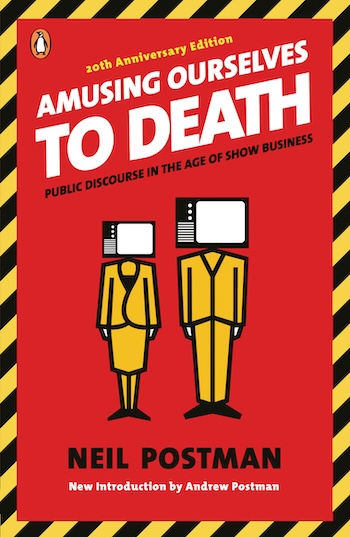
 40 years later, still highly relevant
What happens when media and politics become forms of entertainment? As our world begins to look more and more like Orwell’s 1984, Neil’s Postman’s essential guide to the modern media is more relevant than ever.
Originally published in 1985, Neil Postman’s groundbreaking polemic about the corrosive effects of television on our politics and public discourse has been hailed as a twenty-first-century book published in the twentieth century. Now, with television joined by more sophisticated electronic media—from the Internet to cell phones to DVDs—it has taken on even greater significance. Amusing Ourselves to Death is a prophetic look at what happens when politics, journalism, education, and even religion become subject to the demands of entertainment. It is also a blueprint for regaining control of our media, so that they can serve our highest goals.
Neil Postman’s classic book of media criticism has been on my to-read list for a very long time. It’s an excellent, accessible examination of the US media landscape in the 1980s, but one that also predicted (and warned against) some of what we see today. It’s been getting a little more attention, of late, which is entirely justified.
Postman’s sees the changes in America’s media and news landscape in the 1980s as the first stages in societal and cultural decline, to the point that he invokes the spectre of an impending dystopia. It’s interesting that the official synopsis of the book notes that our world is beginning to “look more and more like Orwell’s 1984,” because the author actually doesn’t see America morphing into an Orwellian, Nineteen Eighty-Four-style dystopia. Rather, as he explicitly states in his Foreword, “This book is about the possibility that Huxley, not Orwell, was right.” For Postman, Brave New World is a more apt prediction of where American culture is headed. From his introduction (emphasis mine):
“What Orwell feared were those who would ban books. What Huxley feared was that there would be no reason to ban a book, for there would be no one who wanted to read one. Orwell feared those who would deprive us of information. Huxley feared those who would give us so much that we would be reduced to passivity and egoism. Orwell feared that the truth would be concealed from us. Huxley feared the truth would be drowned in a sea of irrelevance. Orwell feared we would become a captive culture. Huxley feared we would become a trivial culture… In short, Orwell feared that what we hate will ruin us. Huxley feared that what we loved will ruin us.” (xxii)
Over the course of the book, the author presents a very interesting, well-reasoned, and effective argument and framework for examining the impact of television on society. Ultimately, he believes that any dystopian change will be one that we bring upon ourselves:
“Orwell warns that we will be overcome by an externally imposed oppression. But in Huxley’s vision, no Big Brother is required to deprive people of their autonomy, maturity and history. As he saw it, people will come to love their oppression, to adore the technologies that undo their capacity to think.” (xxi)
Postman had no way of knowing about today’s AI tools, but that final sentence in the quotation seems perfectly crafted to apply to chatbots. People are dazzled and delighted by the obsequious outputs from the various chatbots and “writing” tools they have access to today: its ability to generate for us what we want to “write”, to answer our questions with confident and detailed (albeit often wrong or wayward) answers. Students adopted them almost immediately, without consideration of their accuracy or quality. As the models have ‘improved’, students and others have utilized them ever-more frequently and ever-more broadly, outsourcing ever-more thought to an application that will tell them they are a genius.
It’s easy to see, based on what follows in Amusing Ourselves to Death, why Brave New World resonates much more with Postman than does Nineteen Eighty-Four. Although, I did find it surprising that there was no discussion of Fahrenheit 451 in the book, given how much of it also aligns with Postman’s concerns. (Am I the only one who thinks Chief Beatty’s monologue about how the system developed is the most relevant part of that novel?)
Postman also didn’t live to see social media develop to acquire the incredible power over culture and society it has today (he passed away in 2003), but I imagine he would feel both exasperated and also sadly unsurprised. Much of what he writes about in relation to trivialization and short attention spans has only become more relevant and obvious in the Social Media Age. I imagine TikTok would have become a particular frustration for him.
Postman is sometimes dismissed by his detractors as a “scold”, but I think “curmudgeon” would be a more fair descriptor; there is a puckishness to his criticism of entertainment television and shows. He makes it very clear in the book that he does not believe that the existence of entertainment television is in itself a sign of cultural or intellectual decline; nor is it something he dislikes, nor something he thinks should be ended. It is when “entertainment” subordinates all else that cultural decay can set in. Societies “do not measure a culture by its output of undisguised trivialities but by what it claims as significant” (16). Most people would consider the news, political shows, and educational shows to be significant, so when these productions shift their focus from information to entertainment, “culture may be shriveled” as it becomes a “burlesque” (155): “The problem is not that television presents us with entertaining subject matter but that all subject matter is presented as entertaining.” (87)
There’s no doubt that American politics and the media’s coverage of it has become a trivial burlesque. Since the 2000 election (when I properly started paying attention), the transformation has been quite clear. It’s not just the news programmes, but also the politicians: far too many of them appear more focused on developing zingers and one-liners that play well on television than they are developing solutions and progress; more interested in going viral than being informative to their constituents. (This, of course, also has a lot to do with the perpetual campaign and single-minded interest in getting re-elected, which isn’t the remit of the book.)
At the same time, I do not believe one can deny that some late-night shows — such as The Daily Show, Last Week Tonight, and also Seth Meyers’s news and Closer Look segments — have done a spectacular job of presenting serious issues in an entertaining manner, which can also inform their audiences. Academics have conducted studies about the impact of these shows (especially The Daily Show) on young people’s level of political knowledge and engagement. But this is a case of an entertainment show providing information. The problem arises when, for example, when CNN and other news programmes trivialize their product. Interestingly, Jon Stewart’s famous evisceration of Tucker Carlson on CNN’s Crossfire was on much the same lines.
I do disagree with Postman’s views on the use and value of entertainment to educate. There is value in making education/learning at least somewhat entertaining, whether in schools or the news media. It has been proven to help people who struggle with certain subjects to remember what they are reading and/or being told. Perhaps it is a case that they remember that their teacher was amusing, but they may also remember what they covered. I would add the caveat that it’s essential to find the appropriate balance, and adjust depending on the audience. Perhaps one could argue that this is actually a case of making news/learning engaging, as opposed to entertaining; a distinction that often gets obscured today. Certainly, politics should be engaging, and not treated like a game show.
Postman also has an apparent rose-tinted impression of the world pre-television. He assumes that news literacy and consumption was much higher prior to the TV Age is folly apparently based mostly on the fact that more people had newspaper subscriptions. They were certainly more common, but not universal, before many were replaced by television. But even then that doesn’t mean every issue was read and internalized, or that all subscribers were buying their papers in order to educate themselves deeply or broadly. Plenty of people were ambivalent, had no/limited access to or interest in news (certainly international news), or were too tired from work to come homes and study up on the day’s politics and current affairs. (The same is true today.) Who’s to say that the news and politics sections were as carefully read as the sports and entertainment sections? The same can be true for newspaper subscribers today: how many spend more time on the New York Times puzzles than they do the World News section?
Postman thinks too many people consider ‘credibility’ as aesthetic, rather than rigour, track record, and so forth. (102) Certainly, Fox News and other right-wing outlets have believed that people are more likely to believe what they are told if a beautiful blonde woman tells them. (This seems, sadly to be true in far too many cases). However, it’s interesting that, despite the ‘beautification’ of news, it has gradually been losing credibility for years. In part this is because people see it as nonsense, or obfuscating, or corporate PR. In some ways, then, the news industry’s flirting with entertainment has been a self-inflicted wound. With dwindling “reputable” news, too many people are left to get their information from social media or, now, AI chatbots.
The author holds Huxley in much higher esteem than I do (see my review of “the worst book to make me think”). But his use of Brave New World as a lens through which we can examine our world — for him in the 1980s, and also for us today — is highly effective, and also convincing. Indeed, it has become ever-more useful since Amusing Ourselves to Death was first published. The author clearly agrees with Huxley’s observation, from Brave New World Revisited (266), that many have “failed to take into account man’s almost limitless appetite for distractions”:
“[W]e are a race between education and disaster… [Huxley] was trying to tell us that what afflicted the people in Brave New World was not that they were laughing instead of thinking, but that they did not know what they were laughing about and why they had stopped thinking.” (163)
Today, we live in a world of truly limitless distractions, catered to our own interests, whims, and attention spans; each of us carrying our own choose-your-own-adventure devices in our pockets (to borrow a construction from Cooper Lund). Amusing Ourselves to Death, therefore, is an essential read for anyone who wants to understand the world we live in today.
*
Neil Postman’s Amusing Ourselves to Death 20th Anniversary Edition is out now, published by Penguin.
Follow the Author: Goodreads
I’ll write a review of another of Postman’s books, Technopoly, which has also become more relevant in recent years. The Orwell-vs-Huxley question has also inspired a longer, more-in-depth look at four major dystopian novels and their relevance today; I’m working on that article at the moment, but I don’t have a clear timeframe for when that will be finished, nor where it will appear.

