 So much more than just a book about book-burning
Guy Montag is a fireman. His job is to destroy the most illegal of commodities, the printed book, along with the houses in which they are hidden. Montag never questions the destruction and ruin his actions produce, returning each day to his bland life and wife, Mildred, who spends all day with her television “family.” But when he meets an eccentric young neighbor, Clarisse, who introduces him to a past where people didn’t live in fear and to a present where one sees the world through the ideas in books instead of the mindless chatter of television, Montag begins to question everything he has ever known.
Bradbury’s classic 1953 novel is another that I somehow managed to miss for most of my life. It wasn’t required reading at school, and growing up in the UK and around the world, it never really registered in the way that George Orwell and other (mostly British) classic authors did. Sure, I knew about the firemen-who-burn-books and the ways the novel is invoked whenever a Republican starts banning books; but not much more than the broad strokes. It’s an interesting, mostly very well-written short novel, but one that is also about a lot more than just book burning; it’s also clear why it has had such a long life.
Bradbury was very much writing in the shadow of the Cold War, but in many ways it is separate from that context. As with most dystopian fiction, it’s important to remember that they are allegories and satires; exaggerated warnings about contemporary concerns. Most people focus on the book-burning, and reasonably connect it to various, too-frequent campaigns by those on the right to ban certain books for various reasons.
The Firemen and their work is certainly evocative and attention-grabbing, the way Montag and others describe their work, and the depictions of mounds of books and papers curling up and turning to ash in bonfires. Readers are taken on Montag’s journey, as he goes from diligent fireman, to doubter, to apostate. His dissatisfaction with the vapidity of his home life, his quiet, increasingly-more-desperate desire for something more in life that will evoke an emotion other than simple distraction and banal contentment. He’s the classic odd-man-out of the dystopian form. His quiet, surreptitious acts of dissent and rebellion eventually spiral out of control, and he connects with some like-minded others who further open up his world. Ultimately, though, he discovers that his country is maybe too far gone, and his life is upended.
Focusing just on the firemen’s purpose, however, can ignore what I think is the best, most resonant part of the book. It’s a speech that Chief Beatty gives to Montag, after he notices that his fireman is clearly starting to have doubts and question his profession. Beatty notes that society’s anti-book pivot was not a top-down policy or law: “It didn’t come from the Government down. There was no dictum, no declaration, no censorship, to start with, no! Technology, mass exploitation, and minority pressure carried the trick…” (55) In other words, the government just took advantage of a population that was increasingly less-interested in acquiring and valuing knowledge and art, and turbo-charged that devolution to create a more-easily pliable, checked-out citizenry. We often “head” in the background of scenes snippets radio broadcasts about an ongoing war, typically ignored or tuned-out by the characters.
 It’s interesting that Neil Postman didn’t discuss Fahrenheit 451 in Amusing Ourselves to Death (which I also highly recommend): given that it appears to be a book that is on many, if not most, high school reading lists, I imagine he would have had a lot to say about the Beatty speech. For me, Beatty’s explanation of the gradual devolution of literary and educational attention spans is one of the most interesting elements of the novel. As attention spans continue to contract today, how can the following not resonate:
The sneering comparison to the “slow motion” 19th Century recalled for me various arguments one hears coming out of Silicon Valley and their boosters about AI and digital and technological means for optimizing every aspect of our lives: quicker, faster, shorter; summarize your documents with AI, turn your books into audio samples, and more. It was sometimes moving to read about Montag’s journey into the world of books and reading, the gradual and effortful acquisition of knowledge and appreciation of art.
There are some interesting other (perhaps less bleak) ways in which Bradbury was ahead of his time. As in Huxley’s Brave New World, people in this dystopia take pills (or lozenges) to numb their ennui and other negative feelings, disassociating from the world; reminiscent of increases in pharmaceutical consumption today, but also alcohol and other substance uses to — at least temporarily — disconnect from the bleak news and corporate worlds. We see most of this through Montag’s interactions with his wife, who too often is checked out of the world, leaving Montag isolated and lonely in his own home. In terms of technology, too, he was prophetic; for example, predicting our addiction to using earbuds, therefore protecting us from a life of silence:
“in her ears the little Seashells, the thimble radios tamped tight, and an electronic ocean of sound, of music and talk and music and talk coming in, coming in on the shore of her unsleeping mind.” (10)
“Late in the night he looked over at Mildred. She was awake. There was a tiny dance of melody in the air, her Seashell was tamped in her ear again and she was listening to far people in far places, her eyes wide and staring at the fathoms of blackness above her in the ceiling.” (39)
Also worth acknowledging Bradbury’s excellent fourth wall joke, when he’s describing the TV parlour and the immersive, audience-participation entertainments.
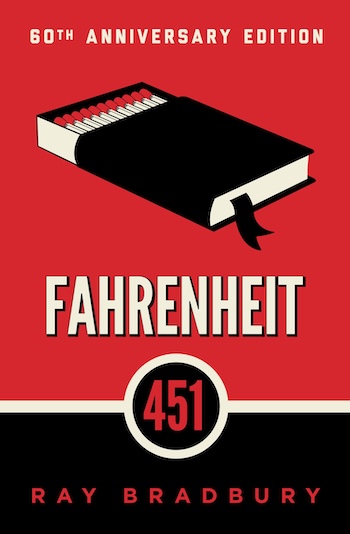
There are times when the book soars, and others when it was a bit clunky; but, for the main this is definitely worth a read. I would particularly recommend the 60th anniversary edition — the additional materials after the novel are fantastic: interesting, informative, and further thought-provoking. It also gave me a book recommendation: Arthur Koestler’s Darkness at Noon, which was also apparently an inspiration for Orwell’s Nineteen Eighty-Four (of course, I have bought it and will read it soon).
*
Ray Bradbury’s Fahrenheit 451 is published by Simon & Schuster in North America and Harper Voyager in the UK.
Also on CR: Review of Zen in the Art of Writing

