 A classic dystopia; and the worst book to make me think
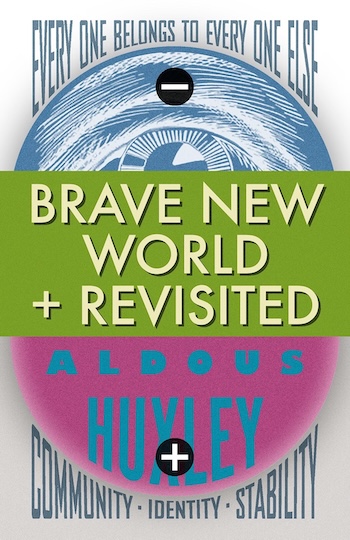
EVERYONE BELONGS TO EVERYONE ELSE
Welcome to New London. Everybody is happy here. Our perfect society achieved peace and stability through the prohibition of monogamy, privacy, money, family and history itself. Now everyone belongs.
You can be happy too. All you need to do is take your Soma pills.
Nearly thirty years after the publication of Brave New World, Huxley checked the progress of his prophecies against reality in Brave New World Revisited and argued that many of his fictional fantasies had grown uncomfortably close to the truth. Sharing his views on issues such as overpopulation, propaganda, the art of selling and brainwashing, Huxley gives a vigorous, astute analysis of the nature of power and authority in modern society. Brave New World Revisited is an urgent and powerful appeal for the defence of individualism still alarmingly relevant today.
Huxley’s Brave New World (1932) is probably one of the most famous British/Western dystopian novels, after George Orwell’s Nineteen Eighty-Four. Deemed a prophetic classic by many, it remains in print (in many, many different editions) on both sides of the Atlantic. The Wall Street Journal called it a “masterpiece… one of the most prophetic dystopian works of the 20th century”. While Huxley has managed to stumble into some astute cultural/social commentary that is ahead of its time, I do not think this a good book.
Right away, readers are given a very clear picture of the Brave New World of the novel: humanity is genetically engineered to fulfill certain roles (with no chance for advancement), and throughout childhood (and beyond) indoctrinated to unquestioningly follow orders and accept their lot in life. There is a twisted form of communism at the centre of this new society; it’s not just that all property is communal property, but so are people — monogamy is not encouraged, and polygamy/free love is actively encouraged and part of indoctrination.
What many (perhaps most) know about Brave New World is soma: the government-controlled drug plentifully distributed to all. It is a drug that provides a state of euphoria and disconnection, depending on the size of dose, and allows users to take a “holiday” from anything in life that causes them grief or stress. Characters seem to take it at the drop of a hat. At one point, it is observed that a “second dose of soma had raised a quite impenetrable wall between the actual universe and their minds” (96-7).
 Bernard Marx, the sort-of hero of the novel, is an odd duck, but also a decent guide to this reality. He has old fashioned tastes, and is more likely to want to stay home reading a book than go out to one of the raves/celebrations/orgies that most people go to. He is smitten with Lenina, another of the main characters of the novel, but is alternately aroused and repulsed by her. She is entirely a creature of this world: when confronted by a reality that she doesn’t like, or one that does not comport with the brainwashed beliefs she has had, she drops soma, “determined to preserve her incomprehension intact.” (91) Similarly, she finds Bernard’s introversion and fondness for reading at home alone to be strange, endearing to begin with but eventually tiresome: “That mania… for doing things in private. Which meant, in practice, not doing anything at all.” Meanwhile, Bernard’s critique of Lenina’s apparently belief that only observed acts are worthy of doing: “In a crowd… as usual.” (88) This exchange made me think of today’s “pics or it didn’t happen” approach to life-via-social media.
In addition to soma and other entertainments put on by the government and managers, Huxley’s Brave New World is one that features a lot of sex — it’s not explicit, but it is terribly written. To me, this felt like the author was thumbing his nose at the cultural mores of his time, which could have provided interesting commentary. Instead, however, the author’s approach to the subject is just downright weird, sophomoric, and in many instances quite gross — the amount of child “sex-play”, for example, lead me to wonder how this novel has survived this long. In this society, “everyone belongs to everyone else”; nobody remains partnered for long, happy to jump into bed with anybody who shows an interest. If someone spends too much time sleeping with just one persons, their friends think they’re boring and weird. Bernard, in another example of being an odd one out, seems to be one of the only monogamists in the novel, and is disappointed by Lenina’s acceptance of this culture norm: “She thinks of herself that way. She doesn’t mind being meat.” (92)
Huxley’s world is unquestionably authoritarian. Unlike Orwell’s, though, it is an ultra-capitalist authoritanism maintained not through violence, but via distraction and drugs. In this world, “Every man, woman and child [is] compelled to consume so much a year. In the interest of industry.” (54) Those who break with orthodoxy are viewed with suspicion and, depending on their caste, punished.
I don’t think it’s much of a spoiler to note that Bernard Marx comes under scrutiny for his different beliefs. At one point, he is told by the Director, one of the government leaders, that “no offence is so heinous as unorthodoxy of behaviour… Unorthodoxy threatens more than the life of a mere individual; it strikes at Society itself.” (137) Conformity must be maintained, in order for the system to perpetuate. Variety and individuality is frowned upon, and ultimately punished. Later in the novel, we’re introduced to John the Savage, who has grown up on a “reserve” for people who have either been exiled from society or been allowed to live outside of it.
It’s easy to see how some of the ideas in this novel have continued to resonate, in addition to what has already been mentioned. As our own world becomes ever more filled and seemingly dictated by diversions — be they pharmaceutical or (social) media in origin, there is much in here that will resonate with anyone who is paying attention to politics and culture. Huxley was correct, in Brave New World Revisited, that many have “failed to take into account man’s almost limitless appetite for distraction.” (267)
There are moments of clarity and writerly skill. For example, the structure in Chapter 3, which alternates between Bernard’s, Lenina’s, and an “official” perspective is extremely effective, and even cinematic; and one of the most interesting uses of alternating POVs that I’ve read. At another moment, Helmholtz, an acquaintance of Bernard Marx, who is also a lover of language and literature, tells Marx that, “Words can be like X-rays, if you use them properly—they’ll go through anything. You read and you’re pierced.” This was one of the few moments when Huxley’s writing comes remotely close to matching Orwell’s skill. (Interesting fact: Huxley taught Orwell French at Eton, and they frequently corresponded — in my reading, neither thought the other’s dystopian novel was particularly good…). The final scenes featuring John are also, ultimately, tragically moving and affecting.
Generally speaking, Brave New World is one of the worst books I’ve read; so I am at least glad that Huxley writes with some brevity. It is, however, a bad book that has made me think; so I guess it also has that going for it. It has the rare distinction, in my experience, of being one of those books that is far less interesting than almost everything written about it. This includes Brave New World Revisited (1958), which is often now included in print editions. It is an interesting read, if for no other reason than it is an author revisiting their work, which doesn’t happen that often. Here, Huxley can come across as thoughtful, honest, but also very strange and (again) quite wrong. His fascinations are sometimes bizarre, problematic (eugenics), and sometimes way off the mark. But, as noted in the previous paragraph, it’s more interesting than the novel itself. Huxley is genuinely concerned about the growing influence and power of Big Business, and the ways in which Big Government is encroaching on people’s lives; with the two often working in cahoots. Similarly, he is worried about what advances in technology may do to society, perhaps making it more likely that his Brave New World becomes a reality. (In some ways, he was right, here.) In a chapter about mass communications, he parodies/paraphrases Churchill, noting that “never have so many been manipulated so much by so few” (252) — something that certainly resonates today, and not just because of the recent creation of Skydance.
While I am glad to have finally read Brave New World (and Brave New World Revisited), I can confidently say that I will never read it again.
*
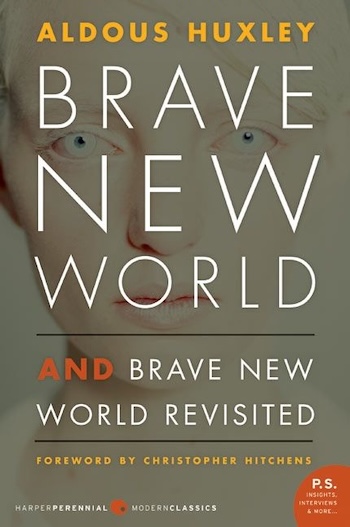
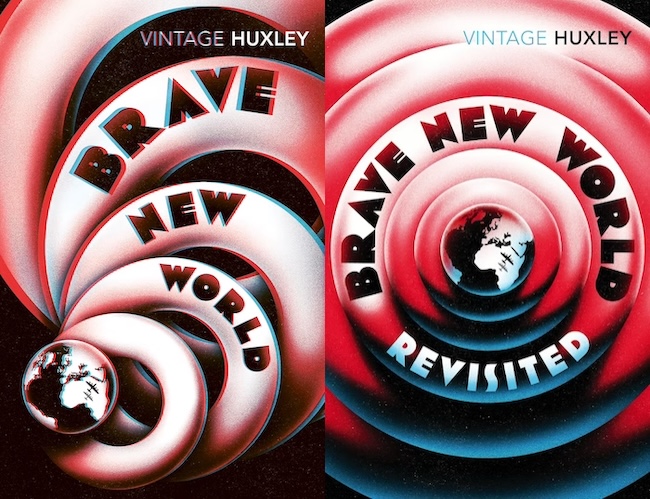
Aldous Huxley’s Brave New World and Brave New World Revisited is published by Vintage in Canada (with a very good introduction by Margaret Atwood), Harper Perennial in the US (with a pretty good introduction by Christopher Hitchens), and Vintage in the UK (in two volumes). There are countless other editions, of course, but these are the ones I read.
Follow the Author: Goodreads

